Now in Flesh Appearing

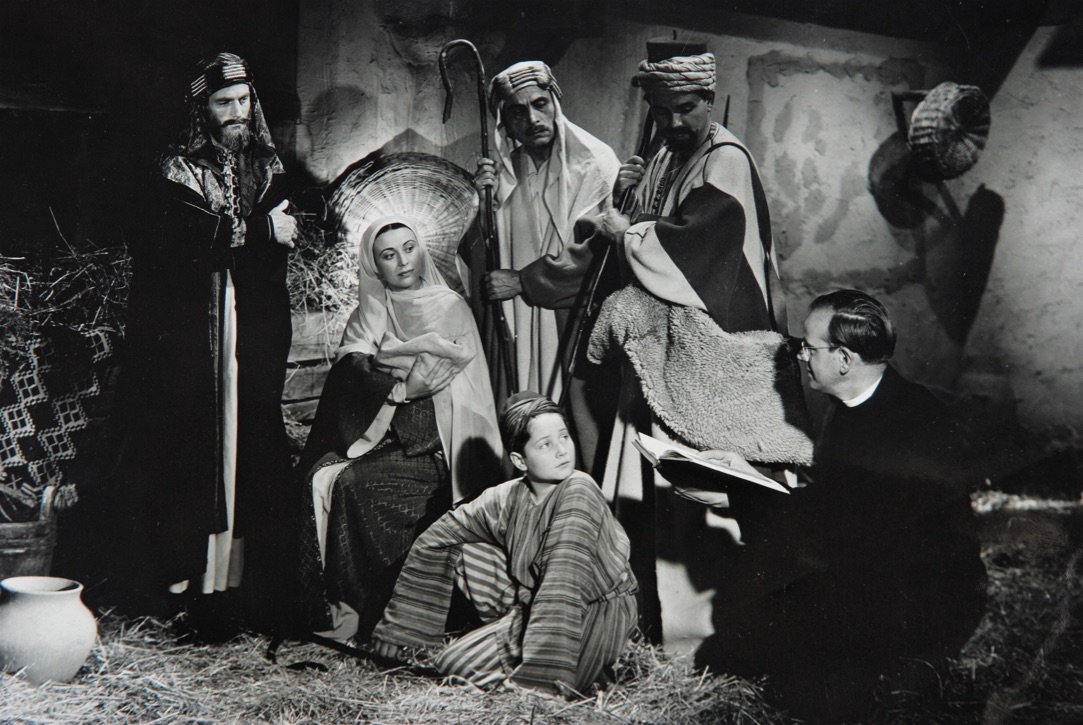
The Rev. James K. Friedrich (right) on the set of Child of Bethlehem (1940).

For he is our childhood’s pattern;
Day by day, like us He grew;
He was little, weak and helpless,
Tears and smiles like us He knew;
And He feeleth for our sadness,
And He shareth in our gladness.

— Cecil Frances Alexander, “Once in Royal David’s City”

My sisters and I each had an unusual childhood connection with the Nativity story. Our father, the Rev. James K. Friedrich, was the pioneer of Christian movie-making in America, and one of his first biblical films was Child of Bethlehem, produced in 1941. My sister Martha was a newborn child then, so she got to play the baby Jesus. Nine years later, my father made Holy Night, the first of a twelve-part series on the life of Christ. I was four years old at the time—much too old to get the leading role—so I was cast as a shepherd boy, entering the stable with several adult shepherds.

In the film, I have a dazed look on my face. I was literally blinded by the light on the Hollywood soundstage where the interiors were shot. Film stock in those days was not as light-sensitive as our camera phones. It required intense illumination to register a proper image. A big row of Klieg lights set up behind the manger threw such a blaze into my eyes that I could barely see the Holy Family. When I hear Luke’s gospel report that “the glory of the Lord shone all around” the shepherds, the indelible memory of those lights at Goldwyn Studios comes to mind.

James L. Friedrich (next to the donkey) at the manger in Holy Night (1949).

My oldest sister, Marilyn, never played in a Nativity film. Hers was a more literal reenactment. In 1936, my parents had stopped in Jerusalem during their honeymoon. In those days, as today, there was violence in the land, and they were warned not to go down the hill to Bethlehem in a car, because cars were easy targets for snipers. It was safer to ride a donkey to the place of Jesus’ birth. My dad recorded their pilgrimage with his 16mm movie camera, and now, every Christmas, I can watch the footage of my mother riding a donkey to Bethlehem, pregnant with her firstborn child.

To Marilyn’s credit, she has never made any personal claims about her origins, but there is, I believe, gospel truth in our childhood memories. Each and every one of us is called to play our part in the Nativity story, but not merely as witnesses like the shepherds or pilgrims like the Magi. God was made flesh so that our own flesh, our own story, may birth the divine intention and the divine life.

You see, the Incarnation isn’t only a matter of God wanting to share our humanity, to make our humanness part of the divine experience. It also reveals God’s desire that we in turn become partakers of the divine nature.

St. John put it this way in his gospel:

To all who received the Incarnate Word, who believed in his name, the Word gave power to become children of God, who were born, not of blood or of the will of the flesh or the will of human beings, but of God (John 1:12-13).

In the centuries that followed, this theme of theosis, or deification––becoming God-like––has pushed the envelope of anthropology by setting a very high bar for the definition of human potential.

In the early church, Irenaeus said that “God became what we are, in order to make us what he is.” Athanasius was even more explicit about the consequences of Incarnation, saying that “God became human so that humans might become God-like.” God-like! Can we even imagine this in our own day, when we are assaulted incessantly by news of human depravity.

Martin Luther, perhaps surprisingly for someone so focused on the burden of human sin, said we were all called to be “little Christs,” and in a Christmas sermon he described the Incarnation as a two-way street: “Just as the word of God became flesh,” he said, “so it is certainly also necessary that the flesh may become word. . . [God] takes what is ours to himself in order to impart what is his to us.”

In the 18th century, some of Charles Wesley’s great hymns were almost shockingly explicit about our capacity to contain divinity.

He deigns in flesh to appear,
Widest extremes to join,
To bring our vileness near,
And make us all divine.

Heavenly Adam, life divine,
Change my nature into Thine;
Move and spread throughout my soul,
Actuate and fill the whole;
Be it I no longer now
Living in the flesh, but Thou.

In the 20th-century, whose atrocities left our confidence in human potential badly shaken, the Catholic contemplative Thomas Merton could still claim that we “exist solely for this, to be the place God has chosen for the divine Presence. The real value of our own self is the sign of God in our being, the signature of God upon our being.” 

And after his famous epiphany at the corner of Fourth and Walnut in Louisville, Merton said, “It is a glorious destiny to be a member of the human race, though it is a race dedicated to many absurdities and one which makes many mistakes: yet, with all that, [God’s own self] glorified in becoming a member of the human race.

“I have the immense joy of being [a human person],” he continued, “a member of a race in which [God’s own self] became incarnate. As if the sorrows and stupidities of the human condition could overwhelm me, now that I realize what we all are. And if only everybody could realize this! But it cannot be explained. There is no way of telling people that they are all walking around shining like the sun.” 

Is this all this talk about divinization going too far? Could we really be walking around shining like the sun? Or at least have the potential for such glory, even if we’re not there yet? If the Nativity in Bethlehem means what I think it does, then the answer has to be yes.

On that wondrous night in Bethlehem, our nature was lifted up as the place where God chooses to dwell. We may still be works in progress, but we are bound for glory. St. Paul believed this when he said that “all of us, with our unveiled faces like mirrors reflecting the glory of the Lord, are being transformed into the image that we reflect in brighter and brighter glory” (II Cor. 3:18).

Another ancient theologian said, “As they who behold the light are within the light and partake of its brightness, so they who behold God are within God, partaking of God’s brightness.”

What happens in Bethlehem doesn’t stay in Bethlehem.

Adoration of the Christ Child, Flemish follower of Jan Joest of Kalkar (c. 1515)

On the Winter Solstice over 40 years ago, I was flying across the San Fernando Valley into L.A.’s Burbank airport on a brilliant December day. The noonday sun was low enough in the southern sky to be reflecting its rays off the surface of swimming pools running along a line parallel to our flight path. There are so many pools in the Valley, and each one, as it was struck by the sun, exploded with an intense dazzle of white light. In rapid succession, tranquil blue surfaces were transformed into momentary images of the sun’s bright fire. For me, it was a vision pregnant with the Christmas promise.

“They who behold the light are within the light and partake of its brightness.” Our pale mirrors are made to contain the most impossible brilliance. And though we have turned away from the Light, the Light seeks us out. No matter how shadowy the path we have taken, the Light will find us, and fill us with divine radiance. That is our destiny, says the Child in the manger.
We may not feel capable or worthy or prepared to receive the Word into the flesh of our own lives, but it is what we were made for. Paradoxical as it may sound, partaking of divinity is the only path to becoming fully human.

A month before he died, Edward Pusey, a 19th-century English priest, wrote to a spiritual friend about our God-bearing capacity:

“God ripen you more and more,” he said. “Each day is a day of growth. God says to you, ‘Open thy mouth and I will fill it.’ Only long. . . The parched soil, by its cracks, opens itself for the rain from heaven and invites it. The parched soil cries out to the living God. O then long and long and long, and God will find thee. More love, more love, more love.”

Participating in divinity doesn’t mean having superpowers or being invulnerable. We won’t be throwing any lightning bolts. Just look at Jesus. His life tells you what “God-like” means. He was born in poverty and weakness, in a stable not a palace, and he lived a life of utter self-emptying and self-offering, giving himself away for the life of the world.

In a novel by the Anglican writer Charles Williams, a young woman goes to church with her aunt on Christmas morning. She is a seeker, not quite a believer, but as they sing a carol about the mystery of the Incarnation, she leans over and whispers to her aunt, “Is it true?” Her aunt, one of those quiet saints who has spent her life submitting to Love divine, turns to her niece with a smile and says simply, “Try it, darling.”

So if you want to try it, if you want to complete your humanity by partaking of divinity, there are many ways to do that. Weep with those who weep and dance with those who dance, the Bible says. Love God with all your heart, and your neighbor as yourself. Welcome the stranger, feed the hungry, free the captive. There are plenty of to-do lists out there. Here’s an excellent one from the Dalai Lama:

May I become at all times,
both now and forever:
A protector for all who are helpless.
A guide for all who have lost their way.
A ship for all who sail the oceans.
A bridge for all who cross over rivers.
A sanctuary for all who are in danger.
A lamp for all who are in darkness.
A place of refuge for all who lack shelter.
And a servant for all those who are in need.
May I find hope in the darkest of days,
and focus in the brightest.

My friends, Bethlehem is not a dream fading away into the past.
It is the human future.
And this is not the morning after.
It is the first day of the rest of our journey into God.


A sermon for Christmas Day at Saint Barnabas Episcopal Church, Bainbridge Island, Washington.

“Strangely light of heart”—Remembering Frederick Buechner

Writing as a holy task (St. Matthew writing his gospel, Ebbo Gospels, 9th century).

Praise, praise! I croak. Praise God for all that’s holy, cold, and dark. Praise him for all we lose, for all the river of the years bears off. Praise him for the stillness in the wake of pain. Praise him for emptiness … Praise him for dying and the peace of death. 

— Frederick Buechner, Godric [i]

Frederick Buechner, one of the greatest of contemporary Christian writers, has departed this life. Born July 11, 1926, he died on August 15, 2022. Buechner pursued a life of faith in an age of doubt, and his wrestling with the language and content of belief in books, sermons and lectures has inspired, instructed, and delighted countless believers and seekers.

My first encounter with his striking words and novel images was during my senior year in college. On the last Sunday of Advent, 1965, my father, James K. Friedrich, a priest and film producer, staged a dramatic reading of Buechner’s imaginative rendering of the Nativity story at All Saints Episcopal Church in Beverly Hills. Before a packed congregation, three distinguished Hollywood actors, two of whom were members of that parish, played the roles of Shepherd, Innkeeper, and Wise Man, each recalling his own experience on that strange night in Bethlehem.

Edward G. Robinson—whose original given name was Emmanuel—registered the Shepherd’s amazement with his familiar dusky growl: 

“The air wasn’t just emptiness any more. It was alive. Brightness everywhere, dipping and wheeling like a flock of birds. And what you always thought was silence stopped being silent and turned into the beating of wings, thousands and thousands of them. Only not wings, as you came to more, but voices—high, wild, like trumpets. The words I could never remember later, but something like what I’d yelled with my mouth full of bread, ‘By God, it’s good, brothers! The crust. The mud. Everything. Everything.’”

Frederic Worlock, a veteran character actor in dozens of films from How Green Was My Valley to 101 Dalmations, sounded the Innkeeper’s lament with his distinctive British voice:

“All your life long, you wait for your own true love to come – we all of us do – our destiny, our joy, our heart’s desire. So how am I to say it, gentlemen? When he came, I missed him.”

And the formidable Raymond Massey lent a patrician aura to the Wise Man’s melancholy reflection on his brief encounter with the Real.

“I will tell you two terrible things. What we saw on the face of the new-born child was his death. A fool could have seen it as well. It sat on his head like a crown or a bat, this death that he would die. And we saw, as sure as the earth beneath our feet, that to stay with him would be to share that death, and that is why we left—giving only our gifts, withholding the rest.”

Only in retrospect would the Magus realize that “to live without him is the real death … to die with him is the only life.” [ii]

You can hear a 23-minute recording of the 1965 performance, “A Christmas Triptych,” here:

Searching for the Holy One in our midst is a core theme of Buechner’s work. His vivid description of a papal mass on Christmas Eve, when the writer was in his early thirties, is one of my favorite moments in all his writings. When Pius XII, carried on a golden throne by Swiss guards, passed among the throng in St. Peter’s that night, his glasses “glittering in the candlelight,” he was “peering into the crowd with extraordinary intensity,” as though he were “looking for someone in particular.”

It was Christ he was looking for, thought Buechner, and a theologian might insist that the holy face was already “visible, however dimly, in the faces of all of us who had come there that night.” For the old pope that wasn’t enough. There was intense longing in his face, but Buechner also detected a “madness”—as if the pope were straining to exceed any settled account of reality. 

And it is the madness that has haunted me through the years.
Madness because I suspect he hoped 
that Christ himself had come back that night 
as more than just the deepest humanity of everyone’s humanity, 
that Impossibility itself stood there resplendent in that impossible place. [iii]

All of Buechner’s work is an attempt to put that Impossibility into words, that we might see and grasp its invitation to new life. His nine years as chaplain to Phillips Exeter Academy in New Hampshire were formative for him. The student body was a diverse and youthfully cynical lot, and Buechner’s challenge as a preacher was how to connect with the unwilling and the unbelieving. I attended an Episcopal school with compulsory chapel in the same years Buechner was at Exeter, and much later I would preach a sermon at Groton, Franklin Roosevelt’s Episcopal prep school. I know how daunting a roomful of resistant and dubious faces can be. For Buechner, the experience was a refiner’s fire. He learned how to make the case for faith in a fresh and accessible tongue. He did it with a remarkable gift for narrative and phrasing. “It’s on the house,” for example, was his translation of “divine grace.” But he also gained credibility by taking doubt seriously.

In our culture of disbelief, where the awareness of divine presence does not come naturally, even believers must live with persistent doubts. There is no way to prove there’s anything beyond the visible world, that our choices have an ultimate dimension, or that our heart’s desire has an abiding home. 

Buechner never denied the validity of doubt. The only thing certain about faith is that it may not be true. “How could God reveal himself in a way that would leave no room for doubt?” he said. “If there were no room for doubt, there would be no room for me. [iv] But it’s always “a fifty-fifty chance” between faith and doubt.[v] You have to choose—not between specific linguistic formulations, which even at their best cannot encompass the Real—but between saying Yes or No when Love invites you to dance. 

“To be a saint,” Buechner wrote, “is to work and weep for the broken and suffering of the world, but it is also to be strangely light of heart in the knowledge that there is something greater than the world that mends and renews. Maybe more than anything else, to be a saint is to know joy.” [vi]

In Buechner’s Nativity dialogues cited above, the Divine Mystery has appeared in the world. The Shepherd embraces it. The Innkeeper fails to notice. The Wise Man, reckoning the cost to himself, refuses the offer. Those remain our options as well. And in a lifetime of extraordinary writings, Frederick Buechner explored the urgency of the choices set before us. We can choose life; we can choose death. We can say Yes; we can say No. Or we can simply ignore the big questions and opt for the unexamined life.

One of Buechner’s great influences was the Scottish writer George MacDonald, who, like himself, was an ordained minister. In 1990, I heard Buechner conclude a lecture with lines from MacDonald’s novel, Thomas Wingfold, Curate. Published in 1876, it posited faith as a brave rejection of the depressing sway of Victorian doubt. The way of faith may not be provable, argues MacDonald’s fictional curate, but it will always be more beautiful—and more “true”—than the alternative. No wonder Buechner loved this passage:

Even if there be no hereafter, I would live my time believing in a grand thing that ought to be true if it is not. No facts can take the place of truths, and if these be not truths, then is the loftiest part of our nature a waste. Let me hold by the better than the actual, and fall into nothingness off the same precipice with Jesus and John and Paul and a thousand more, who were lovely in their lives, and with their death make even the nothingness into which they have passed like the garden of the Lord. I will go further … and say, I would rather die for evermore believing as Jesus believed, than live for evermore believing as those that deny him.

Buechner died at 96. When my mother died at the same age in 2010, I happened to find a quote from his novel Godric among her papers. I put those words on the cover of her requiem bulletin, below a Byzantine image of Christ rescuing the dead from their tombs: 

I see a star, said Godric, at the age of 100 and more. Sometimes this star is still, sometimes she dances. Within that little pool of Wear she winks at me. I wink at her. The secret that we share I cannot tell in full. But this much I will tell. What’s lost is nothing to what’s found and all the death that ever was, set next to life, would scarcely fill a cup. [vii]


[i] Frederick Buechner, Godric (San Francisco: Harper San Francisco, 1980/1983), 96.

[ii] The performance of the text as “A Christmas Triptych” was in December, 1965.Buechner’s text would be published the next year in The Magnificent Defeat (Seabury Press, 1966)..

[iii] Buechner, The Hungering Dark (San Francisco: Harper San Francisco, 1969/1985).

[iv] Ibid., The Alphabet of Grace (San Francisco: Harper San Francisco, 1970/1989), 47.

[v] Ibid., The Book of Bebb (San Francisco: Harper San Francisco, 2001), 143. In the novel, Bebb is asked what he believes. “I believe in everything.” “You make it sound easy,” the other says, and Bebb replies, “It’s hard as hell.” 

[vi] The Magnificent Defeat, 119.

[vii] Godric, 96.

Palm Sunday: The Triumphal Entry

Giotto di Bondone, Entry into Jerusalem (Scrovegni Chapel, Padua, c. 1305)

Still louder ever rose the crowd’s
Hosanna in the highest!
‘O King,’ thought I, ‘I know not why
In all this joy thou sighest.’

The Merchants’ Carol

Where thy victorious feet, Great God, should tread,
In honor this green tapestry is spread;
And as all future things are past to thee,
The triumph here precedes the victory.

— Giambattista Marino, “Palm Sunday”

An anthem for Palm Sunday, “Ride on! ride on in majesty,” sung by the choir of St. Barnabas Episcopal Church, Bainbridge Island, WA, under the direction of Paul Roy, with the late Darden Burns on piano. Lyrics by Henry Hart Milman, music by Mark Shepperd. Jesus’ entry into Jerusalem is from “Day of Triumph” (1954) a feature film produced by my father, James K. Friedrich. The palm branches are from Taryn Elliott via Pexels. My footage of the Seattle viaduct, shot the day before its demolition began, imagines Jesus’ entry into our own cities, while the empty road in Montana recalls the spiritual, “Jesus walked that lonesome valley.” The one who rode among the cheering crowds must go alone to the cross. The sun directs its deathly gaze through the smoke of a forest fire in the Bitterroot Mountains. The irony of Palm Sunday’s “triumph” is seen in the video’s final image of Christ, now carrying the cross through a different kind of crowd (Lippo Memmi, Santa Maria Assunta, San Gimignano, Tuscany, c. 1340).

How can this be?

Cathedral Films producer James K. Friedrich on the set of Child of Bethlehem (1940)

Cathedral Films producer James K. Friedrich on the set of Child of Bethlehem (1940)

My mother Elaine, pregnant with her firstborn child Marilyn, rode to Bethlehem on a donkey (in 1936 around Jerusalem, cars weren’t safe – they attracted gunfire). My father, the Rev. James K. Friedrich, made biblical films, including several on the birth of Jesus. In Holy Night (1949), I was a shepherd boy at the manger, with a stupefied look on my face from the blinding lights behind the camera. But no one could top my sister Martha, who played the baby Jesus in Child of Bethlehem (1940). You could say the Nativity story runs in our family. Even the Episcopal parish church of my childhood was a converted stable.

The thing about Christmas, though, is that everyone gets to be in it. By virtue of the Incarnation, our human nature, our human stories, have become the place where God chooses to dwell. Meister Eckhart put this claim most vividly in the fourteenth century:

“There is only one birth – and this birth takes place in the being and in the ground and core of the soul…Not only is the Son of the heavenly Creator born in this darkness – but you too are born there as a child of the same heavenly Creator. and the Creator extends this same power to you out of the divine maternity bed located in the Godhead to eternally give birth.”

Of course I have been reminded by women friends that only a male could find the sublime in a labor lasting for eternity. But Eckhart’s image makes us uneasy in other ways, for in these disturbing times it may be hard to imagine ourselves as worthy vessels for divinity. Everywhere we turn, we see human life devalued and held in contempt. The poor, the weak, the wounded are marginalized and forgotten. Abuse, violence, cruelty and self-loathing are rampant. Overt racism is making a comeback. Even torture has its shameless defenders.

But Christmas tells a counter-story, about a God who remembers the glory for which we were made, who yearns to speak the word of Love in the vocabulary of human flesh. The seventeenth-century metaphysical poet Henry Vaughan expressed his astonishment at this fact in a memorable line:

Brave worms, and Earth! that thus could have
A God enclosed within your Cell…

Oh, we are brave worms indeed, to believe our frail flesh made for the Incarnation, for the union of time and eternity, finite and infinite, flesh and Word. “God became human,” said St. Athanasius, “in order that humans might become godlike.” And St. Paul told the Corinthians that “all of us, with our unveiled faces like mirrors reflecting the glory of the Lord, are being transformed into the image we reflect in brighter and brighter glory.” (II Cor. 3:18)

In the face of such a wonder, we find ourselves repeating Mary’s old question: “How can this be?” And the best answer I know was given by the medieval mystic, Mechthild of Magdeburg: “Insofar as we love compassion and practice it steadfastly, to that extent do we resemble the heavenly Creator who practices these things ceaselessly in us.”

As we kneel before the Mystery this night, may we know how beloved of God we mortals are, and how very much the Glory wants to be born in us.

To you, dear readers, I wish the merriest and holiest of Christmastides.
God bless us every one!