William Blake, Oberon, Titania, Puck & Fairies Dancing (1786)
“The tables outside the cantina were full of beautiful laughing men and women. I didn’t like the cantina at night: it was hard to book a table, and everyone who sat there looked on display, the women in their lovely summer dresses, the men with their hair oiled back on their heads, their tanned bare feet resting proprietorially on top of their Gucci loafers. One wanted to applaud them for presenting such a successful vision of life: you could almost believe they had lived their whole lives, had been reared and groomed from birth, for this one particular night: that this was the pinnacle, this golden summer evening they had all reached simultaneously.
“Yet it made me a little sad to see them there, laughing and drinking champagne, for you knew it was all downhill from here.”
The beautiful laughing men and women in Cameron’s cantina do not arouse our envy. Their self-display seems shallow, narcissistic and unreal. They appear ignorant of time. Golden summer evenings do not last forever. Having achieved the pinnacle, what Wallace Stevens called “the barrenness of the fertile thing that can attain no more,”[ii] they have nowhere to go but down.
The traditional lore of Midsummer Eve shares this suspicion. To mark the year’s longest day, bonfires were lit on British hilltops to assist and encourage the sun at the outset of its long inevitable decline into the winter dark. And “Midsummer Night”—blessedly short—was said to be a time of both mischief and danger, when chaotic pressures cracked open the stability of the world and wild spirits were abroad.
In A Midsummer Night’s Dream, Shakespeare explores these themes with a complicated plot in which the normal order of the world is unraveled for a night, and confusion rules until the dawn. Rulers find their commands thwarted. Lovers aim their desire at mistaken targets. The beautiful queen of the fairies falls madly in love with a low-born mortal who, by magic spell, has the monstrous head of an ass. Puck, the fairy trickster, multiplies the mischief by both design and error. And even words of dialogue take on altered and contradictory meanings.
All this takes place in an enchanted forest, a wild, liminal state outside the civilized order, where societal assumptions and rules are suspended or reversed, hierarchies are overturned, and identities become fluid and changeable. As Bottom says to Titania, “reason and love keep little company together these days.”
In Shakespeare, such liminal spaces serve a critical purpose. Their disorder offers a freedom to reshuffle and reconsider accepted realities, inviting transformation at both a personal and social level. Removed for a time from the customary rules and roles, characters discover new possibilities for themselves and society before returning to “reality.”
However, once you leave your given world for a time, you can never again accept its reality as absolute. You realize that there is more than one way to do both the self and the world. Any single version of reality is but an alternative. In this sense, life itself is but a dream. This refusal to absolutize the given world is the foundation of social justice: we can live better lives and make a better world. It also, however, can open the door to irrationality and madness, exemplified by the millions who live, happily and hatefully, in the fact-free world of American fascism..
At the end of Shakespeare’s play, Puck delivers an epilogue to the audience, those “who have slumbered here, / While these visions did appear.” It’s all been a dream, he assures us, as if we had never really crossed the boundary into the transformative space of a visionary world.
But can we be so sure? Have we not ourselves been touched, perhaps even transformed? Within A Midsummer Night’s Dream, there is a play-within-a-play (the comically performed tragedy of Pyramus and Thisbe). The actors in Midsummer watch the actors playing actors in Pyramus, just as we the audience watch all these permutations from our safe position outside the “fourth wall” which separates the stage from reality. But are we so different from the players on the stage? As Shakespeare scholar Marjorie Garber writes,
“A play is a fiction, art is an illusion, ‘no more yielding but a dream.’ Can we be blamed if we wonder—now that we have been told that we are reality—when someone will wake and recognize that we are only a dream? Can we be blamed for looking over our shoulders, and wondering who is watching the play in which we are acting, while we watch, onstage, actors watching actors who play actors performing a play?” [iii]
Two weeks after Midsummer Eve, I saw a magical outdoor production of A Midsummer Night’s Dream at the Bloedel Reserve, an Arcadian refuge of woods and meadows on my island. Beginning before sunset, it utilized the fading of the day to intensify our immersion into the dreamworld. By play’s end, it was almost night. The narrow path across a rolling meadow to the exit prevented an immediate return to reality. For a few precious minutes more we lingered in the dream, making our ghostly procession of shadows in the twilight.
Every play comes to an end. Every actor must make an exit. I have no plans to do so any time soon (God willing). There are more lines to deliver! However, since I begin my ninth decade tomorrow, time may not be on my side—but it’s on my mind.
Medieval thinkers divided a human lifetime into “ages.” Some had just four: Childhood, Youth, Maturity, and Old Age. Isadore of Seville (c. 560-636) expanded that to six: infancy (up to 7), childhood (7-14), adolescence (14-28), youth (28-50), gravitas (50-70), and, for anything beyond 70, senectum (the same root as senior and senility).
[Of course, senectum is a hot topic in this election year. Is the President too old to govern? Perhaps a better question would be: Why can’t the other guy act his age? As the Bible says, “Woe to you, land, if your king is a child!” (Ecclesiastes 10:16). But I digress.]
Bartholomaeus Anglicus, The Four Ages (1467-1475)
In this fifteenth-century illumination by Bartholomaeus Anglicus, the four ages of the human life-cycle stand in the same room, as if each of us is all the ages we have ever been. Childhood is clothed in red, the color of sanguinity (eager hopefulness). Youth is into fashion and sports, while Maturity dresses for battle. Old Age, warmly attired for the wintry years, glances back at all his past selves, hopefully with gratitude rather than regret.
Bartholomaeus Anglicus, The Seven Ages (1482)
A later image by the same artist depicts seven ages standing in two groups. On the right, Childhood plays with a stick and ball, Adolescence clasps his schoolbooks, and Youth carries a spear, perhaps dreaming of competitive glory. The first three stages of Maturity are not radically distinct from one another, but Old Age, shorter and bearded, is starting to separate his body from the group. Yet he still keeps an eye on the Child he once was.
Idleness, Dunois Book of Hours (c. 1439-50)
Time is a gift, and I am truly grateful for my years so far—the dreams as well as the realities. Je ne regrette rien. As for the road ahead (even if it’s all downhill), I wish not to be the man on the donkey, idly dozing along the pilgrim way. Like the figure gazing at the view from the bridge, I want to keep taking it all in. As an old man advised a younger friend in Henry James’ The Ambassadors:
“Live all you can; it’s a mistake not to.”
[i] Peter Cameron, Andorra (New York: Farrar Strauss Giroux, 1997), 149-150.
Lorenzo Quinn, Building Bridges (Venice Biennale 2019)
Sermon for Trinity Sunday 2024 at St. Barnabas Episcopal Church, Bainbridge Island, Washington
From late autumn to late spring, Christian liturgy takes us on a ritual journey through the gospel narrative, from the Incarnation and Epiphany of Christ to the dramatic finale of Passion, Resurrection, Ascension and Pentecost.This great sequence concludes with Trinity Sunday, which serves as a kind of epilogue.
The abrupt shift from the engaging world of story to the tangled thicket of doctrine can be a bit of a shock. It’s like going directly from a seminar in English literature to a class in advanced calculus. Our hearts sink and our heads explode. But fear not. The Trinity is no dreary abstraction. Nor is it a matter, as Lewis Carroll might say, of believing three impossible things before breakfast. We are not here to solve once and for all the puzzle of Three-in-One and One-in-Three. We are here to adore the mystery.
The first Christians were not inventive theorists speculating about the divine nature of a generic God. They were the friends of Jesus trying to make sense of the concrete, experiential data of salvation, beginning with the dramatic biblical events they had lived through and continuing to unfold in the common life of their believing communities. Their profound experiences of Jesus and the Holy Spirit had shaken the foundations of their monotheistic faith, and they were trying to sort out the implications.
Jesus and the Spirit had done for them what only God can do: heal, save, sanctify—even vanquish the power of death. Did that make Jesus and Spirit divine? And if so, what did that multiplication of divine persons do to their belief that God was one? Jesus had told them, “I and the Father are one.” But it would take centuries to agree on what he meant.
Without losing the unity of God, how could the early Christian community account for the divine diversity revealed in the saving activities of Christ and the Spirit?
Once they began to call Jesus Kyrios (Lord), which happened very early in their worship and their storytelling, traditional monotheism was radically destabilized. The growing perception of the Holy Spirit as a guiding and empowering presence of deity in their communities only compounded the problem.
There were various attempts to solve the issue by downgrading Jesus and Spirit to subordinate, derivative, or semi-divine realities, by no means equal to the eternal and uncreated God. Such “heresies” were popular with those who wanted to keep God simple. But “orthodoxy” was unwilling to deny the fullness of divinity to either Christ or the Spirit. For them the bottom line was this:
Only God can save us. Christ and Spirit, in the biblical revelation and Christian experience, are integral and essential to salvation. Therefore, they must be “of one substance with the Father.” That is to say, the Persons are all equally integral to the divine reality: God above us, the source and ground of all being; God with us and among us, the companion who is our way, our truth, and our life; and God within us, the energy and vitality of our deepest self. As the theologians put it:
“The Trinity is an account of God that says these are [each] irreducible and indispensable dimensions of the same reality, not different ones, and yet each has its own irreducible integrity.” [i]
And so, a trinitarian faith became foundational for the Christian understanding of divinity: God in three persons, blessed Trinity. But the inherent tension between the one and the three remains to this day. Human thought and human language can’t quite manage to think both things at the same time. It’s like waves and particles. Gregory of Nazianzus, one of most influential shapers of the fourth-century trinitarian consensus, admitted the futility of trying to corral the mystery with concepts. He suggested that we just go with the divine flow:
“I cannot think of the One without immediately being surrounded by the radiance of the Three; nor can I discern the Three without at once being carried back into the One.” [ii]
In an amusing caricature of crudely literal images of the Three-in-One, British theologian Keith Ward imagines three omniscient individuals trying to have a conversation:
“I think I’ll create a universe,” says one. “I knew you were going to say that,” says the second. “I think I’ll create one as well,” says the third. “Well, it had better be the same as mine,” says number one. “You already know that it is,” says number two. “I knew you were going to say that,” says number three.[iii]
If we have difficulty with “God in three Persons,” it is because we think of a person as defined by his or her separateness. I’m me and you’re you! We may interact and even form deep connections, but my identity does not depend upon you. I am a self-contained unit. You can’t live in my skin and I can’t live in yours. That’s the cultural assumption, which goes back at least as far as Descartes in the seventeenth century and continues today in such debased forms as rampant consumerism and economic selfishness, where my needs and my desires take precedence over any wider sense of interdependence, community, or ecology.
But what we say about the Persons of the Trinity is quite different. Each Person is not an individual, separate subject who perceives the other Persons as objects. The Trinitarian persons experience one another not from the outside, but from the inside. They indwell each other in a mutual interiority.
But if the divine Persons are all inside each other, commingled, “of one being,” as the Creed says, what makes each Person distinct? To put it succinctly: the Persons are distinct because they are in relation with one another. No Father unless there is a Son. No Son without a Father. No Holy Spirit without Father and Son.
As Martin Buber observed, we are persons because we can say “Thou” to someone else. To be a person is to experience the difference – and the connection – that forms the space between two separate subjects. My consciousness is not alone in the universe. There are other centers of consciousness: Thou, I… Thou, I… The fact that you are not I is what creates self-consciousness, the awareness of my own difference from what is outside myself.
If we apply this to the Trinity, we say that there are Three Persons because there is relation within God, relation between the Source who begets, the Word who is begotten, and the Spirit who binds the two together and moves them outward in ever widening circles.
These relations are not occasional or accidental. They are eternal. There is an eternal sending within God, an eternal self-giving within God, an eternal exchange by which God is both Giver and Receiver simultaneously. God is Love giving itself away – self-emptying, self-diffusing, self-surrendering – and in so doing finds itself, receives itself, becomes itself. A French mystic put it this way: “it’s a case of un ‘je’ sansmoi” (an “I” without a me).
Wallace Stevens wrote a poem about the process of giving ourselves over to a larger whole. He called it “the intensest rendezvous,” where we find ourselves drawn out of isolation “into one thing.” He wasn’t writing about the Trinity, but his words come as close as any to describing the essential dynamic of the divine Persons:
Here, now, we forget each other and ourselves. We feel the obscurity of an order, a whole, A knowledge, that which arranged the rendezvous.[iv]
As Orthodox theologian John D. Zizioulas says in his influential text, Being as Communion, “To be and to be in relation are the same thing for the divine life … Therefore if Trinity is our guide, the most fundamental definition of being we can give is person-in-communion … The being of the one divine nature is the communion of the irreducibly different persons; the being of the individual persons is constituted by their relations with each other.” [v]
God is not a simple, static substance but an event of relationships. That’s why we say that God is love. “To be” has no ontological reality apart from “to be in relationship.” In the words of Anglican priest John Mbiti of Kenya, expressing the strongly communal mindset of African theology, “I am because we are, and since we are, therefore I am.” [vi]
Each Person contains the others and is contained by them in a shared communion of self-offering and self-surrender. But that continuous self-offering is never a one-way transaction, either one of self-emptying or one of being filled. It is always both at once – giving and receiving – as we ourselves know from our own mutual experience of love at its best.
Trinitarian faith describes a God who is not solitary and alone, a God who is not an object which we can stand apart from and observe. The Trinity is an event of relationships: not three separate entities in isolation and independence from one another, but a union of subjects who are eternally interweaving and interpenetrating
This divine relationality is not something which an originally solitary God decided to take up at some point. God is eternally relational. Before there was an external creation to relate to, God’s own essential self was and is an event of perpetual relation. There was never simply being, but always being-with, being-for, being-in. To be and to be in relation are eternally identical.
When the Bible says, “God is love” (I John 4:16), it means that love is not just something God has or something God does; love is what God is.
As John Zizioulas puts it, “Love as God’s mode of existence … constitutes [divine] being.”[vii] Feminist theologian Elizabeth Johnson echoes this when she says, “being in communion constitutes God’s very essence.” [viii] In other words, God is Love giving itself away—self-emptying, self-diffusing, self-surrendering—and in so doing finds itself, receives itself, becomes itself. The theologians of late antiquity borrowed a word from the arts to describe this process: perichoresis, which means to “dance around.”
Trinity is a dance, with Creator, Christ and Spirit in a continuous movement of giving and receiving, initiating and responding, weaving and mingling, going out and coming in. And while our attention may focus at times on a particular dancer, we must never lose sight of the larger choreography to which each dancer belongs: the eternal perichoresis of Three in One, One in Three.
As Jesus said, “losing” yourself and “finding” yourself are equivalent and simultaneous. In giving ourselves away, we receive ourselves back. This may be counterintuitive to the modernist mindset of autonomous individual self-possession, but it is the essence of communion: “a giving of oneself that can only come from the ongoing and endless reception of the other.” [ix]
If we had the space, I would invite you now to dance the divine perichoresis with your own bodies. We would join hands, circle round, spiral inward, weave in and out of the arches and tunnels of upraised arms, and manifest with our bodies the divine fullness of the Holy Trinity, which has been described as an “interdependence of equally present but diverse energies … in a state of circumvolving multiplicity.” [x] And thus we would, both symbolically and in fact, participate in the divine reality of “reciprocal delight” [xi] which transpires not only in heaven, but “on earth as it is in heaven.”
There are no spectators in the Trinitarian dance, which is always extending outward to draw us and all creation into its motions. As Jürgen Moltmann said, “to know God means to participate in the fullness of the divine life.” [xii]
It’s not a matter of our trying to imitate the relational being of the loving, dancing God, as if we were inferior knock-offs of the real thing. God wants us to become ourselves the real thing. God wants to gather us into the divine perechoresis as full participants in the endless offering and receiving, pouring out and being filled, which is the dance of God and the life of heaven.
And while our dance with God has its mystical, mysterious, transcendent dimensions, it is also very concrete and specific to our historical life on this earth. The divine life of communion and self-diffusive love is the only antidote for the poisonous hatreds of this fearful age.
We know the yoke of sin and death, Our necks have worn it smooth; Go tell the world of weight and woe That we are free to move. [xiii]
Because we ourselves are made in God’s image, who God is matters deeply, both for our own self-understanding and for our engagement with the world. The Trinity isn’t only God’s life. It is ours as well. It’s the shape of every story, the deep structure of the church, and the foundational pattern of reality.
Because God is communion, the eternal exchange of mutual giving and receiving, then God’s Church must live a life of communion as well. When Love’s perechoresis becomes our way of being in the world—as believers, as church—the Trinity is no longer just doctrine or idea. It is a practice, begetting justice, peace, joy, kindness, compassion, reconciliation, holiness, humility, wisdom, healing and countless other gifts. As theologian Miroslav Volf has said, “The Trinity is our social program.” [xiv]
The dance of Trinity is meant For human flesh and bone; When fear confines the dance in death, God rolls away the stone. [xv]
The Church exists to participate in the liberating life of God, and to enable others to do the same. We exist to make divine communion not just an inner experience but a public truth. We don’t just feel God’s perichoresis. We don’t just feel Love’s eternal dance. We embody it. We live it. We show it. We share it.
As the great Anglican preacher Austen Farrer put it so clearly a century ago:
“It is not required of us to think the Trinity. We can do better; we can live the Trinity.” [xvi]
Photographs by the author.
[i] S. Mark Helm, The Depth of the Riches: A Trinitarian Theology of Religious Ends (Grand Rapids, MI: Eerdmans, 2003), 132.
[ii] Gregory of Nazianzus, q. in Karen Armstrong, The Case for God (New York: Knopf, 2009). 116-117.
[iii] Keith Ward, God:A Guide for the Perplexed (Oxford: Oneworld Publications, 2003), 235.
[iv] Wallace Stevens, “Final Soliloquy of the Interior Paramour,” Collected Poetry and Prose (NY: Library of America, 1997), 444.
[v] John D. Zizioulas, Being as Communion: Studies in Personhood and the Church (Crestwood, NY: St. Vladimir’s Seminary Press, 1993), 46.
[vi] quoted in Veli-Matti Kärkkäinen, The Trinity: Global Perspectives (Louisville: Westminster John Knox Press, 2007), 352.
[viii] Elizabeth Johnson, She Who Is: The Mystery of God in Feminist Theological Discourse (NY: Crossroad, 1993), 227.
[ix] Graham Ward, “The Schizoid Christ,” in The Radical Orthodoxy Reader, ed. John Milbank and Simon Oliver (NY: Routledge, 2009), 241.
[x] David Bentley Hart, The Beauty of the Infinite: The Aesthetics of Christian Truth (Grand Rapids: Eerdmans 2003), 114.
[xi] St. Athanasius (c. 296-373), a bishop in Roman Egypt, was a key defender of Trinitarianism.
[xii] Jürgen Moltmann, The Trinity and the Kingdom: The Doctrine of God, trans. Margaret Kohl (San Francisco: Harper & Row, 1981), 152.
[xiii] Richard Leach, “Come Join the Dance of Trinity.”
[xiv] Miroslav Volf, “‘The Trinity is Our Social Program’: The Doctrine of the Trinity and the Shape of Social Engagement,” Modern Theology 14, no. 3 (July 1998).
What is your most precious possession? This was the question posed by two British artists in their random encounters with strangers at the Venice Biennale. For three days in April, Neil Musson and Jono Retallick wandered about the art festival venues literally clothed in the question, printed in various languages on their white smocks. Whenever a curious glance at their outfits prompted conversational engagement, the artists recorded whatever answers people chose to give. From more than fifty responses, the artists will edit the results to post on their website, M+R, in the near future.
Jono Retallick and Neil Musso wearing The Question in Venice. (Photo by Neil Lambert)
It’s a great question! In my monthly Zoom converation with longtime clergy friends, Jono made a guest appearance from the Venice apartment of one of our members.[i] When he invited each of us to name our most precious possession, no one selected a material object. David, a gifted writer and preacher, chose the stories he’s lived—and lived by—over a lifetime. Richard cited his sense of humor, which has never deserted him even when laughter was scarce. Mark, who in his eighties finds himself, as he put it, “in the process of disappearing” as time grows ever shorter, said that what he values most is “now”—the savored fullness of the present moment.
I’m still working on my own answer. The first thing I told Jono was that since everything we are and everything we have is a gift—from the Creator of all as well as the secondary causes of heredity, culture, and the labor of others—it could be said that we in fact possess nothing. But that seems a bit of a cheat, a way to avoid the work of values clarification. The question wants me to think: Where does my greatest treasure lie? What would be the hardest thing to lose?
I’ve known people who had only a few minutes to flee their homes in the path of racing wildfires. And I’ve wondered: If I were in that situation, what irreplaceable items would I grab before running out the door? The box with 50 years of journals? An album of family photographs? The Theotokos icon painted for us on a Greek island? The wooden moon carved by a First Nation artist in Canada? A guitar once played by the legendary Ramblin’ Jack Elliott? It’s only stuff of course, but the things we love best are saturated with stories. They are outward and visible signs of inward and beloved memories. I would feel the poverty of their loss. But I would not call them “most precious.”[ii]
Moon mask (1991) carved on Vancouver Island from alder wood by Richard Menard duing a lunar eclipse. Theotokos icon (2015) by Dimitris Koliousis, Santorini, Greece.
All of us, of course, would reserve “most precious” for our deepest relationships—with God, lovers and friends. But it would violate the integrity of their otherness to deem any of these to be possessions. So I must look elsewhere for my answer to the question.
Good health comes to mind, or even life itself. These are certainly very highly treasured—but as gifts to enjoy, impossible to possess. As the Psalmist reminds us, we are “but flesh, a breath that goes forth and does not return” (Psalm 78:39). We all must learn to loosen our grip in this transitory life.
He who binds to himself a joy Does the winged life destroy He who kisses the joy as it flies Lives in eternity’s sunrise
— William Blake. “Eternity”
I could call faith my most precious possession, for without it I would be hopelessly adrift in a sea of unmeaning. But faith is a communal possession. It is not distinctively mine. Faith is plural, shared and nourished within the collectivity of God’s friends. If I am to speak in the singular, to name what is uniquely mine, I would say that my most precious possession is my imagination—the particular way I see the givenness of the world, processing it within my own heart and intellect, then reflecting my perception back into the world in some fresh way, whether that be in the form of conversation, writing, art, or simply as praise and thanks for a world of beauty and blessing (or lament and protest in the case of suffering and evil).
Calligraphy of Robert Bresson text by Br. Roy Parker OHC.
“Make visible what, without you, might never be seen,” said Robert Bresson, who made films unlike any other. As one critic put it, “Bresson’s films are not merely the most lucid; they are, in essence, lucidity itself.”[iii] Perhaps only the saints attain “lucidity itself,” but each of us has our own unique way of seeing and being. And I imagine that God finds equal delight in what each of us has to report from our respective locations in a universe of infinite possibility.
Dante and Beatrice each adore the heavenly light from their own location Venetian woodcut by Francesco Marcolini (1544).
Light the first light of evening, as in a room In which we rest and, for small reason, think The world imagined is the ultimate good.
This is, therefore, the intensest rendezvous. It is in that thought that we collect ourselves, Out of all the indifferences, into one thing:
Within a single thing, a single shawl Wrapped tightly round us, since we are poor, a warmth, A light, a power, the miraculous influence.
Here, now, we forget each other and ourselves. We feel the obscurity of an order, a whole, A knowledge, that which arranged the rendezvous.
Within its vital boundary, in the mind. We say God and the imagination are one… How high that highest candle lights the dark.
Out of this same light, out of the central mind, We make a dwelling in the evening air, In which being there together is enough.
— Wallace Stevens, “Final Soliloquy of the Interior Paramour”
[i] The Rev. Neil Lambert, an Anglican artist/priest at St. Mary’s, Ash Vale, UK, has collaborated on some previous projects with Musson and Retallick. For more on Lambert and Venice, see Dreaming the Church That Wants to Be.
[ii] In a time when the people of Gaza, Ukraine and many other places are being dispossessed of nearly everything, I am not entirely comfortable talking about the things I have due to my privilege. Situations where the most precious possession might be a loaf of bread, a bottle of water, or a bomb shelter shatter all complacency.
M+R, the webstie of artists Neil Musso and Jono Retallick, is well worth a visit. They are exploring creative ways to transform the way we experience public spaces and social interaction.
Windows, south nave of León Cathedral on the Camino de Santiago.
I was walking instead of writing in May, on pilgrimage along St. Cuthbert’s Way from the Scottish Borders to Holy Island in Northumbria. More on that soon. Meanwhile, I’m preaching the following for Trinity Sunday at my home parish, St. Barnabas Episcopal Church on Bainbridge Island, Washington. Some of it has appeared before on this blog, but the ending is entirely new.
Part of the fun of Trinity Sunday is getting to watch the preacher attempt to explain the most formidable mystery of Christian faith in less than 20 minutes. It can’t be done! We all know that—the preacher knows it too—and the fun part is seeing how he or she is going to fail this time.
Of course, we could just say that a mystery is not meant to be explained, and leave it at that. Let’s just adore the mystery, not investigate it.
But if, as the theologians insist, “the nature of the church should manifest the nature of God,”[i] then we need to know enough about the nature of God to understand how to be a church whose own way of being reflects and manifests that divine nature.
And if investigating the nature of God seems like a daunting task best left to the professionals, those who have the aptitude and training to navigate levels of complexity and nuance which would make our own heads explode, we must remember that the doctrine of the Trinity is not a math problem (How can one be three and three be one?), nor is it an abstract, highly technical construction of the metaphysical elite who spent centuries sorting out differences between Arians, Monophysites, Monothelites, Monarchians, Modalists, Ebionites and Sabellians.
Trinitarian thought isn’t made of thin air or abstract speculation. It is produced and nourished by the concrete, tangible history of Christian experience. Whatever we can actually say about the Trinity is first of all grounded in experience, both the experience of our spiritual ancestors, encoded in Scripture and tradition, and the contemporary, ongoing revelations of our own communal and personal life.
Ever since the first Easter and the first Pentecost, Christians have been trying to make sense of the concrete, experiential data of salvation. Based on our collective and personal experience of being “saved” (or, if you prefer: healed, forgiven, reborn, renewed, resurrected, empowered), what can we say about the God who has done this?
Trinitarian reflection began within an ancient community deeply grounded in the monotheism of Judaism, which had, over the centuries, found ultimate reality to be not a plurality of disconnected or contradictory energies—what the ancients called “the gods”—but a coherent unity, understood to be the “one God.” However, once the early Christians began to attribute divinity to both Jesus and the Holy Spirit, a simple self-contained oneness was no longer sufficient to describe the Reality.
Without losing the unity of God, how could they account for the divine diversity revealed in the saving activities of Christ and the Spirit? Once they began to call Jesus Kyrios (Lord), which happened very early in their worship and their storytelling, traditional monotheism was radically destabilized. The growing perception of the Holy Spirit as a guiding and empowering presence of deity in their communities only compounded the problem.
There were various attempts to solve the problem by downgrading Jesus and Spirit to subordinate, derivative, or semi-divine realities, by no means equal to the eternal and uncreated God. Such “heresies” were popular with those who wanted to keep God simple. But “orthodoxy” was unwilling to deny the fullness of divinity to either Christ or the Spirit. For them the bottom line was this:
Only God can save us. Christ and Spirit, in the biblical revelation and Christian experience, are integral and essential to salvation. Therefore, they must be equally integral to the Holy One who is the Creator and Redeemer of all things
As a consequence, the doctrine of God became trinitarian: Three in one and one in three. In other words, God is relational. God is social. God is a communion of Persons.
If we have difficulty with “God in three Persons,” it is because we think of a person as defined by his or her separateness. I’m me and you’re you! We may interact and even form deep connections, but my identity does not depend upon you. I am a self-contained unit. You can’t live in my skin and I can’t live in yours. That’s the cultural assumption, which goes back at least as far as Descartes in the seventeenth century, and continues today in such debased forms as rampant consumerism and economic selfishness, where my needs and my desires take precedence over any wider sense of interdependence, community, or ecology.
But what we say about the Persons of the Trinity is quite different. Each Person is not an individual, separate subject who perceives the other Persons as objects. The Trinitarian persons experience one another not from the outside, but from the inside. They indwell each other in a mutual interiority.
Is this image of trinitarian indwelling difficult to conceive? Or is it something like the old John Lennon lyric?: “I am he as you are she as you are me and we are all together.” A French mystic put it this way: “it’s a case of un ‘je’ sansmoi” (an “I” without a me). Subjectivity, yes, a distinct consciousness within my own body, particular and unique, yes; but a consciousness deeply permeated by the otherness of interdependent reality.
But if the divine Persons are all inside each other, commingled, “of one being,” as the Creed says, what makes each Person distinct? To put it succinctly: the Persons are distinct because they are in relation with one another.
As Jewish theologian Martin Buber observed, we are persons because we can say “Thou” to someone else. To be a person is to experience the difference – and the connection – that forms the space between two separate subjects. My consciousness is not alone in the universe. There are other centers of consciousness: Thou, I… Thou, I… The fact that you are not I is what creates self-consciousness, the awareness of my own difference from what is outside myself.
If we apply this to the Trinity, we say that there are Three Persons because there is relation within God, relation between the Source who begets, the Word who is begotten, and the Spirit who binds the two together and carries them—and the love between them—outward in ever widening circles.
These relations are not occasional or accidental. They are primordial. They are eternal. There is an eternal sending within God, an eternal self-giving within God, an eternal exchange by which God is both Giver and Receiver simultaneously.
Trinitarian faith describes a God who is not solitary and alone, a God who is not an object which we can stand apart from and observe. The Trinity is an event of relationships: not three separate entities in isolation and independence from one another, but a union of subjects who are eternally interweaving and interpenetrating.
The early Church had a word for this: perechoresis. It means that each Person penetrates the others, each contains the other, and is contained by them. Each fills the space of the other, each is the subject, not the object of each other. As Jesus says in the Fourth Gospel: I am in the Father and the Father is in me.
The word perechoresis literally means “to dance around,” and the ancient theologians quickly seized on that image as an accessibly concrete description of a complex process. The Trinity is a dance, with Creator, Christ and Spirit in a continuous movement of giving and receiving, initiating and responding, weaving and mingling, going out and coming in. And while our attention may focus at times on a particular dancer, we must never lose sight of the larger choreography to which each dancer belongs: the eternal perichoresis of Three in One, One in Three.
Wallace Stevens made a poem about the process of giving ourselves over to a larger whole. He calls it “the intensest rendezvous,” where we find ourselves drawn out of isolation “into one thing.” He wasn’t writing about the Trinity, but his words come as close as any to describing the essential dynamic of the divine Persons:
Here, now, we forget each other and ourselves. We feel the obscurity of an order, a whole, A knowledge, that which arranged the rendezvous.[ii]
This divine relationality is not something which an originally solitary God decided to take up at some point. God is eternally relational. Before there was an external creation to relate to, God’s own essential self was and is an event of perpetual relation. There was never simply being, but always being-with, being-for, being-in. To be and to be in relation are eternally identical.
When the Bible says, “God is love” (I John 4:16), it means that love is not just something God has or something God does; love is what God is. As Orthodox theologian John D. Zizoulas says in his influential text, Being as Communion, “Love as God’s mode of existence … constitutes [divine] being.”[iii] Feminist theologian Elizabeth Johnson echoes this when she says, “being in communion constitutes God’s very essence.”[iv]
In other words, God is Love giving itself away—self-emptying, self-diffusing, self-surrendering—and in so doing finds itself, receives itself, becomes itself.
For those of us made in God’s image, who God is matters deeply, both for our own self-understanding and for our engagement with the world. The Trinity isn’t just a doctrine or an idea. It’s a practice, a way of life, the shape of every story, the deep structure of the church, and indeed of all reality.
The mystics can help us out here. Early in the twelfth century, a German monk named Rupert of Deutz went into a church where mass was being said by a white-haired bishop. At the offertory procession he experienced a vision of the Holy Trinity:
“On the right at the edge of the altar stood three persons of such revered bearing and dignity that no tongue could describe them. Two were quite old, that is, with very white hair; the third was a beautiful youth of royal dignity …”[v]
A century later, Hadewijch of Antwerp, one of those remarkable women mystics who flourished in the late Middle Ages, also had a vision of the Trinity. But instead of three white males, what she saw was a dark whirlpool, which she described as “divine fruition in its hidden storms.” Hovering over this whirlpool was a spinning disc, on which sat a figure wearing the countenance of God – the face of God – on whose breast were written the words, “The Most Loved of All Beloveds.”
We may find Hadewijch’s vision more congenial: it is genderless, and less crudely specific than Rupert’s. And the tempestuous whirlpool, a flood of energy ceaselessly flowing through the universe, conveys a dynamic image of divinity that resembles the postmodern cosmologies of process theology and quantum physics. It’s probably easier for most of us to believe in a divine whirlpool than in three white guys.
But the crucial difference between Rupert and Hadewijch is not in the relative resonance of their imagery, but rather in what happens next. Rupert remains an observer, one who stands apart and sees God as an object. But Hadewijch does not remain separate from what she sees:
“Then I saw myself received in union by the One who sat there in the whirlpool upon the circling disc, and there I became one with him in the certainty of union… In that depth I saw myself swallowed up. Then I received the certainty of being received, in this form, in my Beloved, and my Beloved also in me.”
Rupert’s knowledge of God remained conceptual. Hadewijch’s knowledge of God became experiential. She was gathered into the circulating current of divinity. She became part of its flow, and that divine flow became part of her.
The language she uses for this experience is not mathematical or philosophical. Her language is the language of the heart. She describes being “swallowed up… in my Beloved, and my Beloved also in me.” Love, she discovered, is the way the soul knows. Love is the way the soul sees.[vi]
And what Love knows, what Love sees, is this: God is not a simple, static substance but an event of relationships. That’s why we say that God is love. “To be” has no ontological reality apart from “to be in relationship.” In the words of Anglican priest John Mbiti of Kenya, expressing the strongly communal mindset of African theology, “I am because we are, and since we are, therefore I am.”[vii]
Each Person contains the others and is contained by them in a shared communion of self-offering and self-surrender. But that continuous self-offering is never a one-way transaction, either one of self-emptying or one of being filled. It is always both at once – giving and receiving – as we ourselves know from our own mutual experience of love at its best.
As Jesus said, “losing” yourself and “finding” yourself are equivalent and simultaneous. In giving ourselves away, we receive ourselves back. This may be counterintuitive to the modernist mindset of autonomous individual self-possession, but it is the essence of communion: “a giving of oneself that can only come from the ongoing and endless reception of the other.”[viii]
As God’s friends, we are not merely observers of this divine life of self-offering and self-surrender. We are participants.
If God is communion, the eternal exchange of mutual giving and receiving, then the Church must live a life of communion as well. When Love’s perechoresis becomes our way of being in the world—as believers, as church—the Trinity is no longer just doctrine or idea. It is a practice, begetting justice, peace, joy, kindness, compassion, reconciliation, holiness, humility, wisdom, healing and countless other gifts. As theologian Miroslav Volf has said, “The Trinity is our social program.”[ix]
The Church exists to participate in the life of God, and to enable others to do the same. We exist to make divine communion not just an inner experience but a public truth. We don’t just feel God’s perichoresis. We don’t just feel Love’s eternal dance. We embody it. We live it. We show it. We share it.
Church isn’t something we decide to do—or not do—on a Sunday, when we’re not otherwise occupied. It’s not a consumer item, just one of many options competing for our individual time and attention. Nor is it like a fire hose safely stored in a glass case, for emergency use only. And it is certainly not an antiquarian society preserving quaint rituals, or a museum to display our nostalgia for a lost past.
No! The Church is the society of God’s friends—resurrection people, animated by divine breath—striving to imitate the triune communion of divine life in our human life together. By showing up, by committing to the shared vocation of worshipping, witnessing and serving together, by tending the holy flame of faith in a heedless world, we offer ourselves, our souls and bodies, as vessels of that communion—not only in our sacramental life, but wherever we happen to live and move and have our being.
Is that too hard for us? Are we up to it? My friend Bob Franke once wrote a song about the various ways he showed love for his daughter when she was a little girl. He didn’t do it perfectly, of course. No one does. But he gave it everything he had. And a line from that song, I think, speaks to our own calling as a community of faith to imitate the divine communion of the Trinity in our common life, to practice trinitarian love on earth as it is in heaven:
It may not be the thing we do best, but it’s the best thing that we do.[x]
May the grace of our Lord Jesus Christ, the love of God, and the communion of the Holy Spirit, be with us all, now and forever. Amen.
[i] Catherine LaCugna, God for Us: The Trinity and the Christian Life (San Francisco: Harper San Francisco, 1991), 403.
[ii] Wallace Stevens, “Final Soliloquy of the Interior Paramour,” Collected Poetry and Prose (New York: Library of America, 1997), 444.
[iii] John D. Zizoulas, Being as Communion: Studies in Personhood and the Church (Crestwood, NY: St. Vladimir’s Seminary Press, 1993), 46.
[iv] Elizabeth Johnson, She Who Is: The Mystery of God in Feminist Theological Discourse (NY: Crossroad, 1993), 227.
[v] Bernard McGinn, The Growth of Mysticism: Gregory the Great Through the 12thCentury (New York: The Crossroad Publishing Company, 1994), 330.
[vi] ibid., The Flowering of Mysticism (New York: The Crossroad Publishing Company, 1998), 212-16.
[vii] q. in Veli-Matti Kärkkäinen, The Trinity: Global Perspectives (Louisville: Westminster John Knox Press, 2007), 352.
[viii]Graham Ward, “The Schizoid Christ,” in The Radical Orthodoxy Reader, ed. John Milbank and Simon Oliver (NY: Routledge, 2009), 241.
[ix] Miroslav Volf, “‘The Trinity is Our Social Program’: The Doctrine of the Trinity and the Shape of Social Engagement,” Modern Theology 14, no. 3 (July 1998).
[x] Adapted from Bob Franke, “Boomerang Pancakes,” on For Real (1986). The original line is in the first person singular.
This is the fifth in a series on the canonical hours, the ancient Christian practice for living a mindful day. The first, “Reclaiming My Time,” gives a general introduction, with a list of helpful resources for your own practice of prayer and meditation. This reflection considers Sext and None, the hours of midday and mid-afternoon.
Midday sun near the Summer Solstice (Eugene, Oregon: June 25, 2011)
Bumper to bumper, the days stream past the day-old baked goods store though sometimes a Sunday morning pulls in, driven by some old man who stops in the present for a moment to buy a little bag of yesterdays. But mostly the days, by the dozens, dry out and get thrown to the birds, sparrows and starlings to whom each hour is as tasty as the last.
— Ted Kooser, The Wheeling Year
What are days for? Days are where we live. They come, they wake us Time and time over. They are to be happy in: Where can we live but days?
— Philip Larkin, “The Whitsun Weddings”
Sext
The “sixth hour” after Prime is the midpoint of the solar day. At the highest point of its arc, the sun concludes its ascent by crossing the meridian, passing over from the sky’s eastern half (ante meridian) into its western half (post meridian). From there until sunset, it’s all downhill.
As the summit of the solar journey, when all shadows shrink toward nothingness, noon shares the refulgence of the summer solstice: the sky’s luminosity is at the full, and time pauses to linger. “Here the sun, / Sleepless, inhales his proper air, and rests,” said Wallace Stevens, celebrating the annual moment of “arrested peace, / Joy of such permanence, right ignorance / Of change still possible.”[i] An earlier American poet, Emily Dickinson, celebrated noon as a daily symbol of fullness and ripeness. It was a momentary taste of eternity, a glorious timeout from the temporal flow.
The soul has moments of Escape— When bursting all the doors— She dances like a Bomb, abroad, And swings upon the Hours,
As do the Bee—delirious borne— Long Dungeoned from his Rose— Touch Liberty—then know no more, But Noon, and Paradise— [ii]
The whimsical Douglas Adams (The Hitchhiker’s Guide to the Galaxy) recommends proper enjoyment of the midday pause. “Just as lunch was at the center of man’s temporal day, and man’s temporal day could be seen as an analogy for his spiritual life, so lunch should (a) be seen as the center of man’s spiritual life, and (b) be held in jolly nice restaurants.”[iii]
But midday can be more than a pleasant break in the action. However busy the day, monastic communities take time out to give thanks for the morning, reflect on its challenges and its gifts, and invite grace and wisdom for the afternoon. And so too may we uncloistered believers, immersed in the secular world, profitably recollect, reorient, and recommit in the middle of the day’s story. What is time for? What is this day for? What is it trying to tell me? What is it asking of me? “We harvest what the morning sowed,” says a noonday hymn. “Now grant us undiminished strength / to stand and do what still remains.”[iv]
For the mystic, the noonday surplus of earthly light both images and ignites an inner fire. “Be ablaze with enthusiasm,” said Hildegard of Bingen. “Let us be an alive burning offering before the altar of God.”[v] And it was beneath the midday sun that St. Paul was brought to his knees by “a bright light from heaven” (Acts 22:6). To borrow another line from Emily Dickinson, I imagine Paul’s transformative glimpse of divinity to have been “As much of Noon as I could take / Between my finite eyes.”[vi]
But even in the brightest noon, there lurks the shadow of crisis, “the barrenness / Of the fertile thing that can attain no more.”[vii] Just as the sun’s zenith is the beginning of its descent into night, the soul at noon must reckon with its own temporality. Our escape into the “arrested peace” of Paradise is but a moment. Like the sun, we too must decline toward the Night. And the sense of an ending, the pressure of time running out, afflicts the present moment with doubt. Have I done my best with this day so far? Will I have time to complete the work I have been given to do? Does it matter?
In their meditations on the Canonical Hours, David Steindl-Rast and Sharon Lebell point out the spiritual duality of the noonday hour:
“Sext comes right in the middle of the day, in the middle of everything. It is the middle of our life each day, the time of opportunity and the time of crisis … At this turning point in time we decide the fate of our day, and cumulatively the fate of our lives. Do we renew our fervor and commitment, or do we let the forces of entropy drain our resolve?”[viii]
The Latin word for noon (meridiem) and its European derivatives (mezzogiorno, mediodia, le midi) are simply descriptive: “the middle of the day.” But the English term, confusingly derived from None, the canonical hour for mid-afternoon (3 p.m.), holds negativity in its heart. As a palindrome, it reads “no” from either direction. This double no evokes refusal, but is it the refusal of time—noon as a taste of timeless eternity—or something more dire: refusal of the temporal flow of life itself?
Fritz Lang’s Metropolis (1927).
In her poem, “A Clock stopped,” Dickinson sees a death image in the cessation of a ticking clock at exactly 12 p.m.—called “Degreeless noon” by the poet because the overlapping of hour and second hands, both pointing to XII, leaves no intervening angle between them. Their stilled hands no longer circle the hours. Their “dial life” is at an end. Does that signify eternity or oblivion? This question haunts many of Dickinson’s writings. The word “no” permeates this poem, not only in “noon” but also in “not,” “snow,” “nods,” and, most chillingly, “concernless No”—conveying the indifference of death and nothingness to human fate.[ix]
A Clock stopped – Not the Mantel’s – Geneva’s farthest skill Can’t put the puppet bowing – That just now dangled still –
An awe came on the Trinket! The Figures hunched, with pain – Then quivered out of Decimals – Into Degreeless Noon –
It will not stir for Doctors – This Pendulum of snow – This Shopman importunes it – While cool – concernless No –
Nods from the Gilded pointers – Nods from the Seconds slim – Decades of Arrogance between The Dial life – And Him –
The word for midday occupies the exact middle of the poem: noon is the 38th word out of 75. And the poet makes it rhyme with pain. That’s a slant rhyme: the vowels disagree but the hard sound of the final consonants match. The pairing of noon and pain is unsettling, expressing the ambivalent nature of the hour—the solar zenith where the day begins its decline. Significantly, it was at this very moment that the Lord of life was nailed to the cross, as every noonday liturgy recalls.
Blessed Savior, at this hour you hung upon the cross, stretching out your loving arms: Grant that all the peoples of the earth may look to you and be saved; for your tender mercies’ sake. Amen. (Book of Common Prayer: Service for Noonday).[x]
Mortality is not noon’s only shadow. The Psalmist warns of “the sickness that lays waste at noonday” (Psalm 91:6). The Greek term for this malady is acēdia, variously translated as listlessness, restless boredom, discouragement, despondency. At its extreme is the suicidal ennui of Herman Melville’s “Bartleby the Scrivener,” who descends into total inaction with his perpetual refrain of refusal: “I prefer not to.” John Cassian (c. 350-435), whose 5th-century writings on desert spirituality would be a wellspring for later monastics, rendered acēdia in Latin as taedium cordis (“tedium of the heart”). The desert saints, who struggled with acēdia beneath the enervating Egyptian sun, gave it a more personal title: “the noonday demon.”
Desert Sext (Baja California, 12:05 p.m., October 1, 2005).
Cassian’s desert mentor, Evagrius Ponticus (c. 360-399), described acēdia as a chronic inability to be present:
“The eyes of the listless monk gaze out the window again and again, and his mind imagines visitors. A sound at the door, and he jumps up .… When he reads, the listless monk yawns plenty and easily falls asleep. He rubs his eyes and stretches his arms. His eyes wander from the book. He stares at the wall and then goes back to his reading for a little. He then wastes his time hanging on to the end of words, counts the pages, ascertains how the book is made, finds fault with the writing and the design. Finally he just shuts it and uses it as a pillow. Then he falls into a sleep not too deep, because hunger wakes his soul up and he begins to concern himself with that.”[xi]
I’ve met that noonday demon, and I suspect you have too. All the more needful, then, to transit the daily meridian with a prayer on our lips, and trust in our heart. “Today I place before you death and life,” says the Holy One. “Choose life!”[xii]
None
You sweep us away like a dream; we fade away suddenly like the grass. (Psalm 90:5)
By mid-afternoon, lengthening shadows measure the lateness. With each day’s passing, we think about endings and rehearse our own finality. The daily theater of impermanence may provoke in us wistfulness or melancholy. But it can also teach the art of letting go. This day has bestowed its gifts and it blessings. We have received them as best we could. We are grateful. But we don’t hold on. We don’t worry about the morrow. We entrust ourselves to the Giver, without clinging to the gift.
At None, the day’s labors are winding down. We might wish for more time, or more energy, to complete them gracefully, and we may not have the option to set them down unfinished. But if one has any choice in the matter, would it be better to honor the hour rather than the task? Late afternoon, the hour of None, calls us to work of a more inward kind. How can we make space for the questions, and the prayers which they prompt in us?
What has this day taught me? What could I do differently tomorrow? What requires mending before the sun sets? What burdens can I lay down? Who needs my forgiveness? What must I forgive in myself? What am I grateful for? What precious moments did I forget to sanctify with my deepest attention? Where did I remember God?
Shadows deepen at None (York Minster, UK: October 21, 2015).
The light of a waning afternoon is the sweetest kind. It is warmer and softer, purged of glare and harshness, suffused with fondness. It invites stillness, contemplation, tranquility, rest. It makes the world glow for weary eyes. It is honey for the soul. In these latter days, most of us lack tower bells to announce a pause for mindfulness, or muezzins in minarets calling us to prayer. But afternoon light remains omnipresent, inviting us all to sink into the mystery of the moment, wherever we may be.
W. H. Auden wrote a cycle of poems on the canonical hours: Horae Canonicae. As the poems take us through the diurnal passage from Prime to Compline, we soon realize the poet is talking about Good Friday. The poem for None—the hour when Christ died—imagines the waning of that most singular day.
It is barely three, Mid-afternoon, yet the blood Of our sacrifice is already Dry on the grass; we are not prepared For silence so sudden and so soon; The day is too hot, too bright, too still, Too ever, the dead remains too nothing. What shall we do until nightfall?
These lines register something of my own feelings over a lifetime of Good Fridays, when I exit the church at None into “silence so sudden and so soon.” How does one move on from the death of God? What shall we do until nightfall?
Soon cool tramontana will stir the leaves, The shops will re-open at four, The empty blue bus in the empty pink square Fill up and depart: we have time To misrepresent, excuse, deny, Mythify, use this event, While, under a hotel bed, in prison, Down wrong turnings, its meaning Waits for our lives …[xiii]
I think every disappearing afternoon shares something of this mood. Most days, the doings will be far less dramatic or significant, but there still remains a sense of aftermath, of carrying on under the influence of events now past, trying to make sense of them—or not—while somewhere up ahead, a fuller accounting “waits for our lives.” In any case, every day changes us, and discerning how is part of our prayer life.
But if the weight of Auden’s subject seems too much to carry with you into the average evening, let me leave you with a poem by William Stafford, a gem of self-compassion for the late afternoon:
Nobody cares if you stop here. You can look for hours, gaze out over the forest. And the sounds are yours too—take away how the wind either whispers or begins to get ambitious. If you let the silence of afternoon pool around you, that serenity may last a long time, and you can take it along. A slant sun, mornings or evenings, will deepen the canyons, and you can carry away that purple, how it gathers and fades for hours. This whole world is yours, you know. You can breathe it and think about it and dream it after this wherever you go. It’s all right. Nobody cares.[xiv]
[i] Wallace Stevens, “Credences of Summer,” Collected Poetry and Prose (New York: The Library of America, 1997), 323.
[ii] Emily Dickinson, “The Soul has Bandaged moments”— F360 (1862) 512.
[iii] Douglas Adams, Life, the Universe, and Everything (1980), cited in Mark Barrett, OSB, Crossing: Reclaiming the Landscape of Our Lives (Harrisburg, PA: Morehouse Publishing, 2008), 9.
[iv] Charles P. Price, “The fleeting day is nearly gone,” Episcopal Hymnal 1982, # 23.
[v] Hildegard of Bingen (1098-1179), cited in Macrina Wiederkehr, Seven Sacred Pauses: Living Mindfully Through the Hours of the Day (Notre Dame, IN: Sorin Books, 2008), 111.
[vi] Emily Dickinson, “Before I got my eye put out”— F 336 (1862) 327.
[viii] Brother David Steindl-Rast & Sharon Lebell, Music of Silence: A Sacred Journey Through the Hours of the Day (Brooklyn, NY: Ulysses Press, 2001).
[x] Episcopal Book of Common Prayer (New York: Oxford University Press, 1979), 107.
[xi] Evagrius Ponticus, On the Eight Spirits of Evil, cited in William Harmless, S.J., Desert Christians: An Introduction to the Literature of Early Monasticism (Oxford/New York: Oxford University Press, 204), 326.
The author at Midsummer on the Mississippi River’s Lake Pepin, Wacouta, Minnesota.
A something in a summer’s day, As slow her flambeaux burn away Which solemnizes me.
A something in a summer’s noon – A depth – an Azure – a perfume – Transcending ecstasy.
–– Emily Dickinson
Then summer came, announced by June, With beauty, miracle and mirth. She hung aloft the rounding moon, She poured her sunshine on the earth, She drove the sap and broke the bud, She set the crimson rose afire.
Summer arrived this morning in Puget Sound at 8:54 a.m., Pacific Daylight Time. The sun rose hours ago (5:12) and won’t set until 9:12 tonight––16 hours of sunshine! But with only 103 minutes of complete celestial darkness separating dusk and dawn, the June Solstice feels almost like the Bible’s eternal Day: Your sun shall no more go down (Isaiah 60:30).
Charles E. Burchfield, Summer Solstice (In Memory of the American Chestnut Tree), 1961-66
In Charles Burchfield’s painting, Summer Solstice (1961-66), we see such a world, impossibly radiant. Of the daisies and buttercups in the foreground, the painter said “they could not have even the slightest dark accent, but must be swimming in a glare of sunlight from the zenith sun, and therefore all but obliterated.”[ii]
With such amplitude of light, time seems almost at a standstill. We enjoy the absence of hurry, and bask in the “Credences of Summer” celebrated by Wallace Stevens: “arrested peace, / Joy of such permanence, right ignorance / Of change still possible.”[iii] If Spring is analogous to resurrection, summer is a type of heaven: plenitude of being, perpetual noon, luminous serenity, joyful play, cessation of care.
In high summer there is time for everything––swimming, hiking, reading, talking, tasting, singing, wandering, discovering, escaping, appreciating, savoring, loving, renewing. Time to follow a stream to its source, listen to the whisper of an aspen grove, count the falling stars, dive into a crashing wave, dance to the rising moon. Time for hammocks and porch swings as well. As my Minnesota relatives remind me, “Doing nothing is always an option!”
“Oh sacrament of summer days,” wrote Emily Dickinson. “Thy sacred emblems to partake – / Thy consecrated bread to take / And thine immortal wine!” [iv]
This image of summer as sacrament seems perfectly true when the season is at the full. But any hope for perpetual communion is illusory, the poet insisted. Change is inescapable. The fraudulent “sophistries of June” will too soon begin to fade, “Till Summer folds her miracle – / As Women do – their Gown – / Or Priests – adjust the Symbols – / When Sacrament – is done.” [v]
In some of her poetry, Dickinson’s contemplation of the natural cycle of growth and decay––“that pathetic pendulum”–– produced a mournful catalog of loss. Flowers are “beheaded” by frost. Night’s shadow sweeps over “the startled grass.” The green world and azure sky are swept away in time’s “departing tide.” For most religious minds of the nineteenth century, the year’s fall into wintry death was prelude to spring’s rebirth and summer’s eternity. But Dickinson reversed the order, judging winter’s lifeless silence to be the culminating metaphor of human fate. As Cynthia Griffin Wolff has summarized this poetic trajectory of decay and dissolution, “Sunset’s unvarying bloodbath is the model: all life leads but to death.”[vi]
Dickinson was just being an honest observer. She watched her garden fade, the leaves fall, the birds fly south, the summer depart. She saw friends and family die. Gazing “perplexedly” on so much change and loss, with the old vocabularies of Christian hope worn thin in a century of doubt, she nevertheless yearned for a transcendence which might harmonize the paradoxical pattern of creation and destruction. She kept trying to get to heaven before they close the door. But the riddles of time and destiny could not be solved by mortal mind.
She was tempted to give up the search. “How good to be safe in tombs, / Where nature’s temper cannot reach / Nor vengeance ever comes.”[vii] But late in her life (she died at 55), she came to terms with the unknowability of the larger pattern, allowing herself a degree of trust in a larger Providence, bewildering though it may be. In a letter to a friend a few years before her death, she echoed Job’s leap of faith: “Though he slay me, yet will I trust him” (Job 13:15).[viii]
A century later, another American poet, Thomas Merton, would tell himself, “Dance in the sun, you tepid idiot. Wake up and dance in the clarity of perfect contradiction.” [ix] Dickinson knew that same dance when she wrote:
The Opening and the Close
Of Being, are alike
Or differ, if they do,
As Bloom upon a Stalk ––
That from an equal Seed
Unto an equal Bud
Go parallel, perfected
In that they have decayed ––
But Summer’s first morning is no time to ponder the riddles of temporality, or fret the far-off winter night. “Quick, now, here, now, always,”[x] open your door and lean into the freshness of the world. Run barefoot across the lawns of summer. Thank the generous sun. Breathe the golden air. Find the hidden treasure. Don’t come home till dark.
[i] From “Summer Magic” by Leslie Pinckney Hill (1880-1960), an African-American educator and writer. Q. in Gary Schmidt & Susan M. Felch, Summer: A Spiritual Biography of the Season (Woodstock, VT: Skylight Paths Publishing, 2005), 229.
[ii] Charles Burchfield, Journal for July 10, 1964, in Guy Davenport, Charles Burchfield’s Seasons (San Francisco, CA: Pomegranate Communications, 2004), Plate 35.
[iii] Wallace Stevens, “Credences of Summer,” Stevens: Collected Poetry and Prose (New York: Library of America, 1997), 323.
[iv] “These are the days when birds come back” is really about “Indian summer,” but the sacramental image refers to the authentic, if fleeting, heart of summer, or at least the act of remembering it.
[v] “Sophistries of June” is from “These are the days,” while “Till Summer folds her miracle” is from “It will be Summer––eventually.”
[vi] Cynthia Griffin Wolff, Emily Dickinson (New York: Alfred A. Knopf, 1987), 297.
Following this blog’s inaugural series of dispatches from the Camino de Santiago last spring, readers of The Religious Imagineer may have noticed a curious diversity of topics: saints, seasons, nature, culture, theology, Scripture, liturgy, art, theater, circus, classic cars and cinema. And perhaps they wonder, what ties all this stuff together?
The fox knows many things, but the hedgehog knows one big thing. When Isaiah Berlin explored the implications of this ancient Greek saying in his celebrated 1953 essay, he argued that Tolstoy was by nature a fox but by conviction a hedgehog. His interests were wide and his eye for the particular was acute, but he sought to contain the world’s multiplicity within a single defining idea.
I can relate. And the one big thing for this blog is found in a line from Wallace Stevens:
We say God and the imagination are one …
How high that highest candle lights the dark.
This might be taken as a secular celebration of the human mind, reducing God to one of its creative fictions. But if I read Stevens with the hermeneutic of a believer, “God and the imagination are one” is not necessarily a matter of either-or. It might also mean both-and. God dwells both in the mind and outside it. Imagination is both a way we reach beyond ourselves, and a means by which the transcendent finds a home in us, enabling us to see with the eyes of God and the mind of Christ, and to act accordingly. To say that God and the imagination are does not mean for me that they are identical, but that they participate deeply in one another.
The Creator’s “Let there be light!” and Jesus’ refusal of the tomb’s finality are the supreme biblical examples of divine imagination. But there have been countless imagineers engaged in the work (or is it play?) of bringing the new heaven and new earth into being. The activist imagining peace, the oppressed imagining justice, the forgiver imagining reconcilation, the mourner imagining joy, the saint imagining a new way of being, the theologian and the artist imagining the beauty of the infinite in the particular, are all practitioners of the holy and transformative task of conforming the world more closely to God’s image.
When Jesus quoted Isaiah 61 in his hometown sermon, he embraced such prophetic imagination as his own vocation.
The Imagination of God is upon me,
for she has sent me to bring good news to the poor.
She has sent me to proclaim release to the captives
and recovery of sight to the blind;
to let the oppressed go free,
to proclaim the year of divine favor.
So to return the original question about The Religious Imagineer’s diversity of topics, I would say that imagination is the unifying subject of this blog. How do we say the unsayable, see the invisible, dance the impossible in our images, rituals and stories? How do we attend to the traces of God amid the chronic unknowing of secular modernity? How do we imagine the really Real and the not-yet?
Video artist Bill Viola, the subject of an earlier post, has observed that “in the Middle Ages they painted the sky gold in the paintings … It was realism they were after – reality of the divine effused through everything in the physical world.” That is my theme as well.
I am losing precious days… I am learning nothing in this trivial world. I must break away and get out into the mountains to learn the news. – John Muir
Every year I observe two holy weeks. One is the Christian Holy Week, the densely liturgical mimesis of Jesus’ last days of mortal life. The other is an annual solo backpack in the mountains of the American West. Both are total immersions into the sacred without which my year would be incomplete.
The sacredness of the American landscape has long been a powerful theme in American thought and feeling. To see the sacred in a Massachusetts pond, a Southwest canyon, or an old growth forest is not a denial of the physical in favor of a spiritual “elsewhere,” but a penetration to creation’s inherent depth. The material is not the opposite of spiritual, but its mediation, its container.
In the mid-nineteenth century, the American landscape painters known as “Luminists” made their canvases glow with a divine transparency, while the literary circle of Transcendentalists translated nature’s otherness into language. Emerson insisted that “the noblest ministry of nature is to stand as an apparition of God … A leaf, a drop, a crystal, a moment of time is related to the whole, and partakes of the perfection of the whole.” And when Thoreau withdrew from contemporary society to his Walden refuge, he found “something true and sublime,” where “the morning wind forever blows, the poem of creation is uninterrupted.” Is not everyone who ventures “outside” seeking a similar epiphany?
I keep my walking stick by the front entrance of our home, a daily reminder that the path to God-knows-where is always just on the other side of the door. Two weeks ago I tossed the stick in my car, along with my backpack, and headed for Montana. After a couple of days hiking into the Beartooth mountains north of Yellowstone, I reached a large alpine lake, set in a rocky bowl above treeline, with splendid views of several 12,000’ peaks. From there I made a joyous ramble into the high country beyond the lake, where cumulus shadows glided slowly across immense sunlit walls. Three bald eagles circled over a stream-watered basin. Lush gardens of paintbrush, bluebells, asters and buttercups occupied the hollows vacated by melting snowfields. I dangled my legs over a precipice for a better view of the world below. I lay back in the fragrant grass to consider the radiant sky. I knew again the plenitude of summer, that timeless contentment where one feels, as Wallace Stevens felt, “complete in an unexplained completion.”
That night around 1 a.m., I got out of my tent to see the stars, but clouds had gathered since sunset, so I secured the rain fly over my tent and crawled back inside. I had just drifted off when a couple of large animals entered my campsite, their heavy footsteps awakening me to full alert. The rain fly only allowed a narrow view directly forward from the tent, so I could not identify my visitors, who were off to the side. I could only listen as they explored the camp. I heard breathing just beyond the tent’s nylon wall, a snorting sound that put an image of a bear in my mind. Was it a black bear or the more dangerous grizzly?
Then one of the creatures jumped past the front of the tent. The moon had not yet risen, so I saw only a shadowy blur. It was the size of a large dog, probably a juvenile. And its coat seemed to reflect light, even in the gloom. Could it be the white of a mountain goat, or the light gray fur of a grizzly cub? I just wasn’t sure, and I decided to remain still and silent within my tent rather than provoke an encounter by sticking my head out for a look, especially since I was now situated between parent and child, never a good thing with wild animals.
Imagination and solitude are a potent combination in the middle of the night. I breathed. I prayed. I tried to remember what I had read years ago in Bear Attacks: Their Causes and Avoidance. I thought about St. Francis making peace with the wolf. I had enjoyed the wildness of the place as a spectator in the light of day. But now the wild had come to call on me directly. In the dark of night. What did it want to tell me: You don’t belong here? Your precious subjectivity is meaningless to the appetite of carnivores? What did you expect to find, so far from your human world?
Or: Be not afraid.
After a long hour and a half, the creatures departed. Just before they did so, I saw the silhouetted head of the juvenile, backlit by the rising quarter moon, pop up from behind a rock. It bleated, then vanished. No ursine growl, only a rather playful goodbye. When dawn finally came, I found tufts of fine white wool snagged on the branches of shrubs around my camp. Mountain goats indeed.
I drove out of the mountains through Yellowstone National Park, where wild animals are often visible along the paved roads – bison, bears, deer and elk. At every sighting, people abandon their cars, running toward a vantage point with their cameras and phones to collect a digital simulation of wilderness – something to keep and take back home. This commodification of the wild as consumable experience is a fascinating spectacle that only underlines our everyday alienation from nature. I can’t criticize. I did it too. I got a nice shot of a bull elk when the skittish tourists fled out of frame while I stood my ground.
But wildness can’t be adequately encountered a few feet from your car, or in short stops at viewpoints along an asphalt road. You need to go deeper, further, dwell in its otherness for a time, risk its strangeness, wait patiently until it is ready to deliver the news.
Toward the end of her life, Emily Dickinson made her short list of the things that truly matter: “First – Poets – then the Sun – / Then Summer – Then the Heaven of God. / And then – the List is done – ”
Although death threw its shadow across many of her poems, Dickinson could be a sublime singer of summer – timeless land of perpetual noons, the practical heaven of the perfect moment. And when I rose early this morning to welcome the season on our sunny island in Puget Sound, I too embraced the necessary fiction of capacious days, green and golden, time enough for everything – the swim in the lake, the unexplored trail, the dulcimer in the corner, the hammock under the willow, campfire nights, a pile of expectant books, slow meals with friends.
The poets have long dreamt of a refuge beyond the reach of decay and sorrow. A medieval Spanish lyric finds healing in a summer meadow:
On occasion, whenever
I wake among flowers,
I scarcely remember
my numberless sorrows,
soon wholly forgotten
as I peacefully doze,
and life is restored
by the murmuring leaves:
in their shade, to the sound of
their rustling, I sleep.
Mary Oliver, recalling her American childhood, locates the gate of Paradise at the classroom door when the final bell rings.
I went out of the schoolhouse fast
and through the gardens and to the woods,
and spent all summer forgetting what I’d been taught
And Wallace Stevens, in his “Credences of Summer,” which I peruse like Scripture every Summer Solstice, captures perfectly the radiant calm of the longest day:
This is the last day of a certain year
Beyond which there is nothing left of time…
Postpone the anatomy of summer…
And fill the foliage with arrested peace,
Joy of such permanence, right ignorance
of change still possible…
Exquisite ripeness. The end of longing. Be. Here. Now. Or to quote the flag that flies over the old family cottage on Minnesota’s Lake Pepin, “Doing nothing is always an option.” It is a fiction, of course, a paradise more imagined than lived. Leisure, and the means to enjoy it, are not equally shared. The very notion of hiatus is endangered in a world where information never sleeps. And now climate change has injected a note of dread into our once happy anticipation of warmer days.
Yet summer remains a necessary fiction, which we abandon at our peril. Without its Sabbath rest, without an unhurried interval of play, adventure, refreshment and renewal, our lives would be poor indeed.
Sometimes, on the longest day, I gather a group of friends to await the sunset. Seated in a circle, we each share a story, memory or sensory image that evokes something of summer for us. Though each recollection is personal and particular, it always brings nods of recognition from the group. We all have our own variations on swimming holes and sandy beaches, road trips and mountain cabins, blackberry pies and corn on the cob, a cold drink from a garden hose, the scent of barbecue and suntan oil, street games at dusk, bare feet on the lawn, kisses beneath the stars. No one forgets that summer feeling.
What are the sacraments and memories of summer for you?
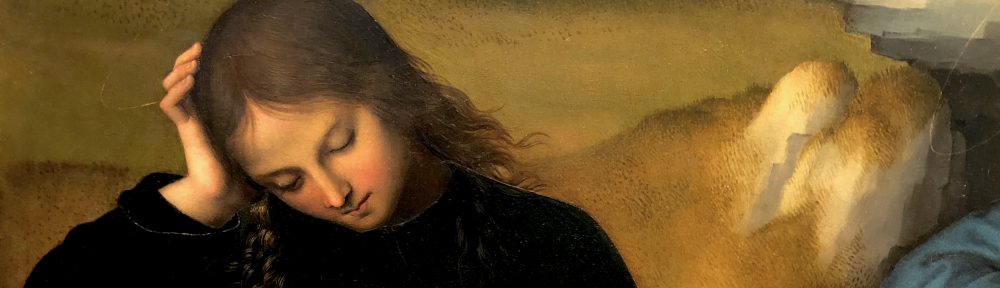

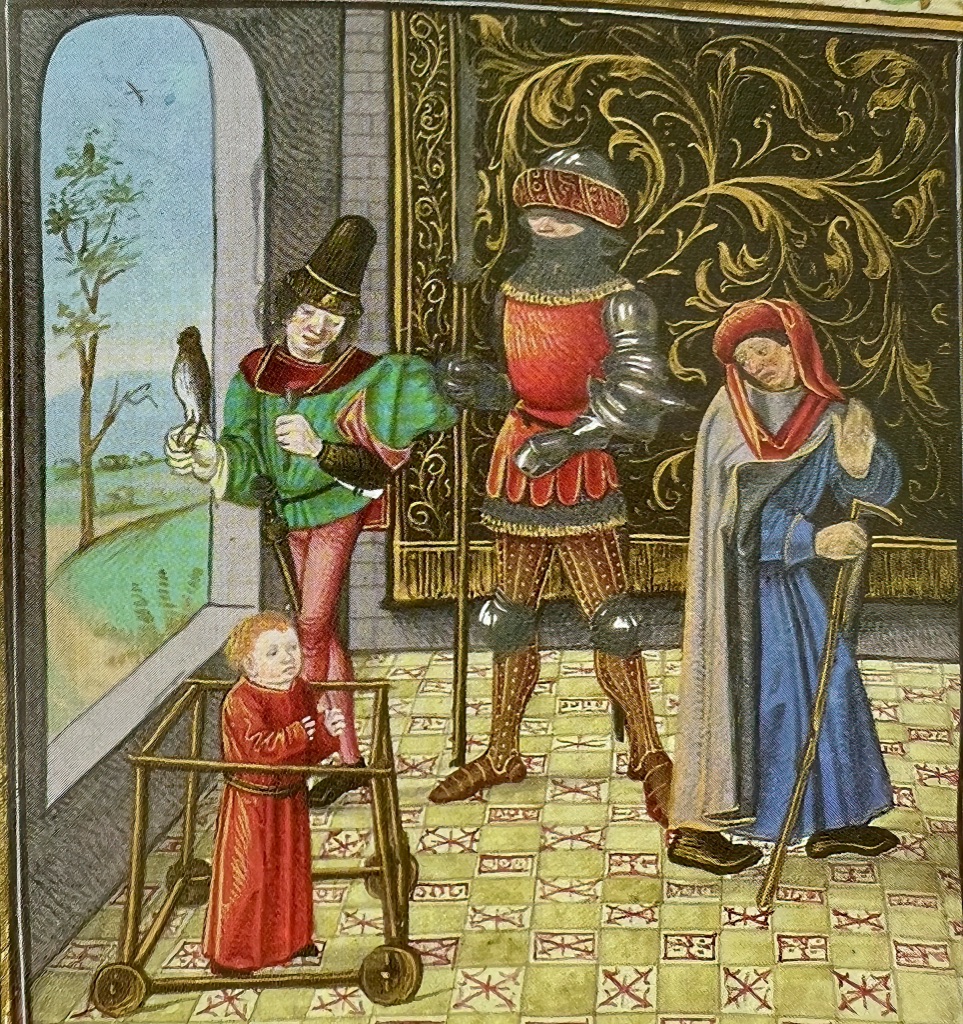


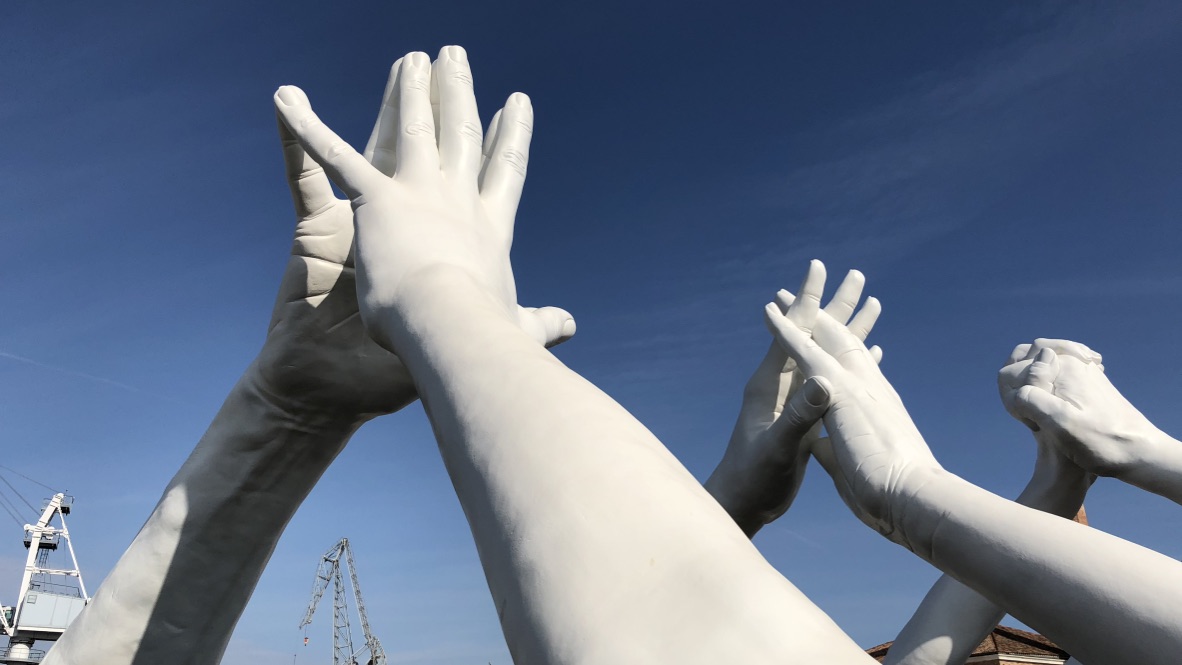


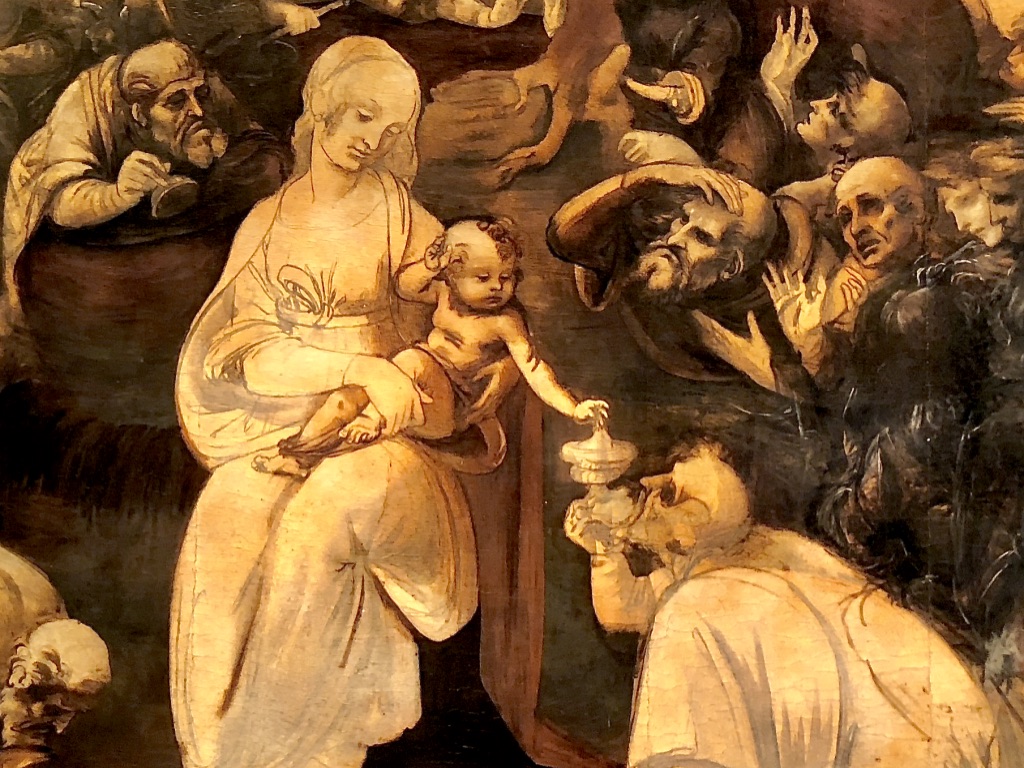

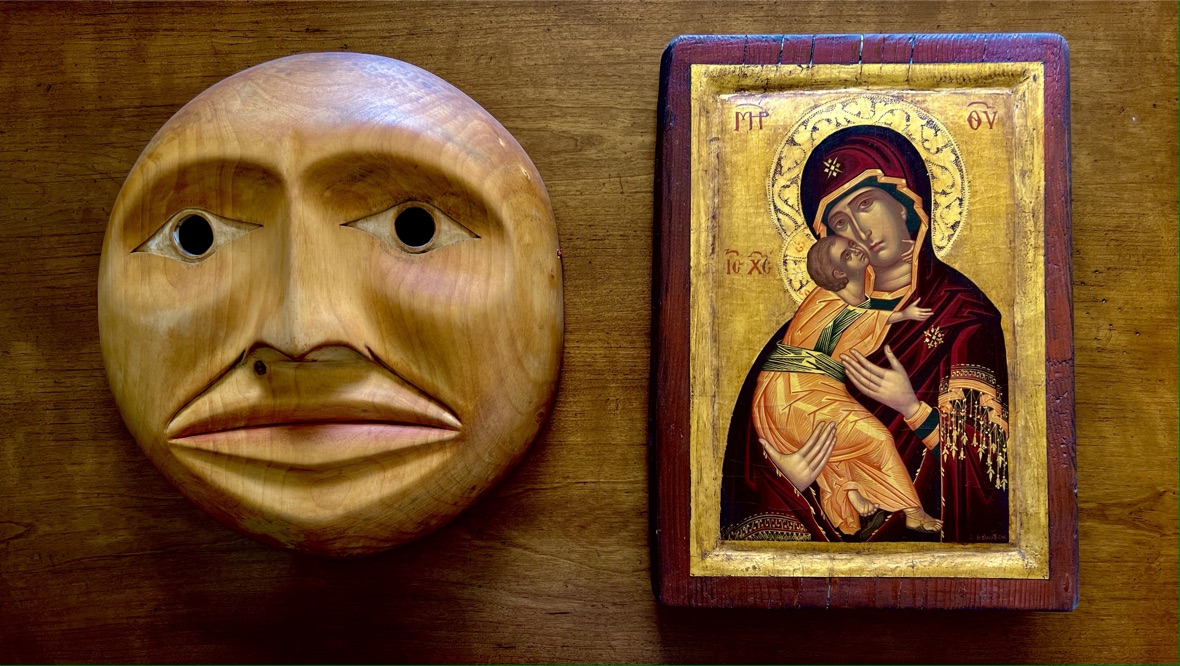


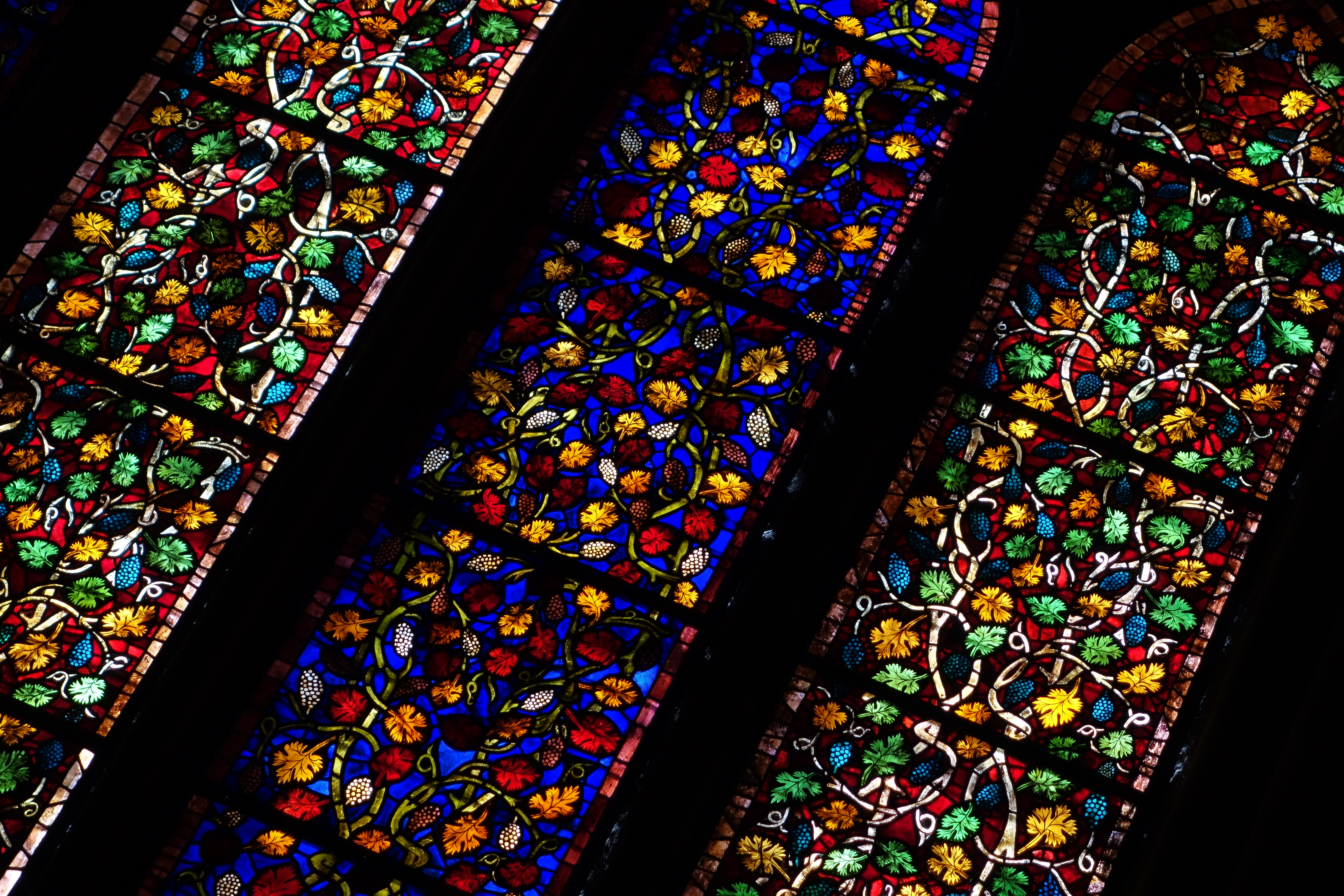


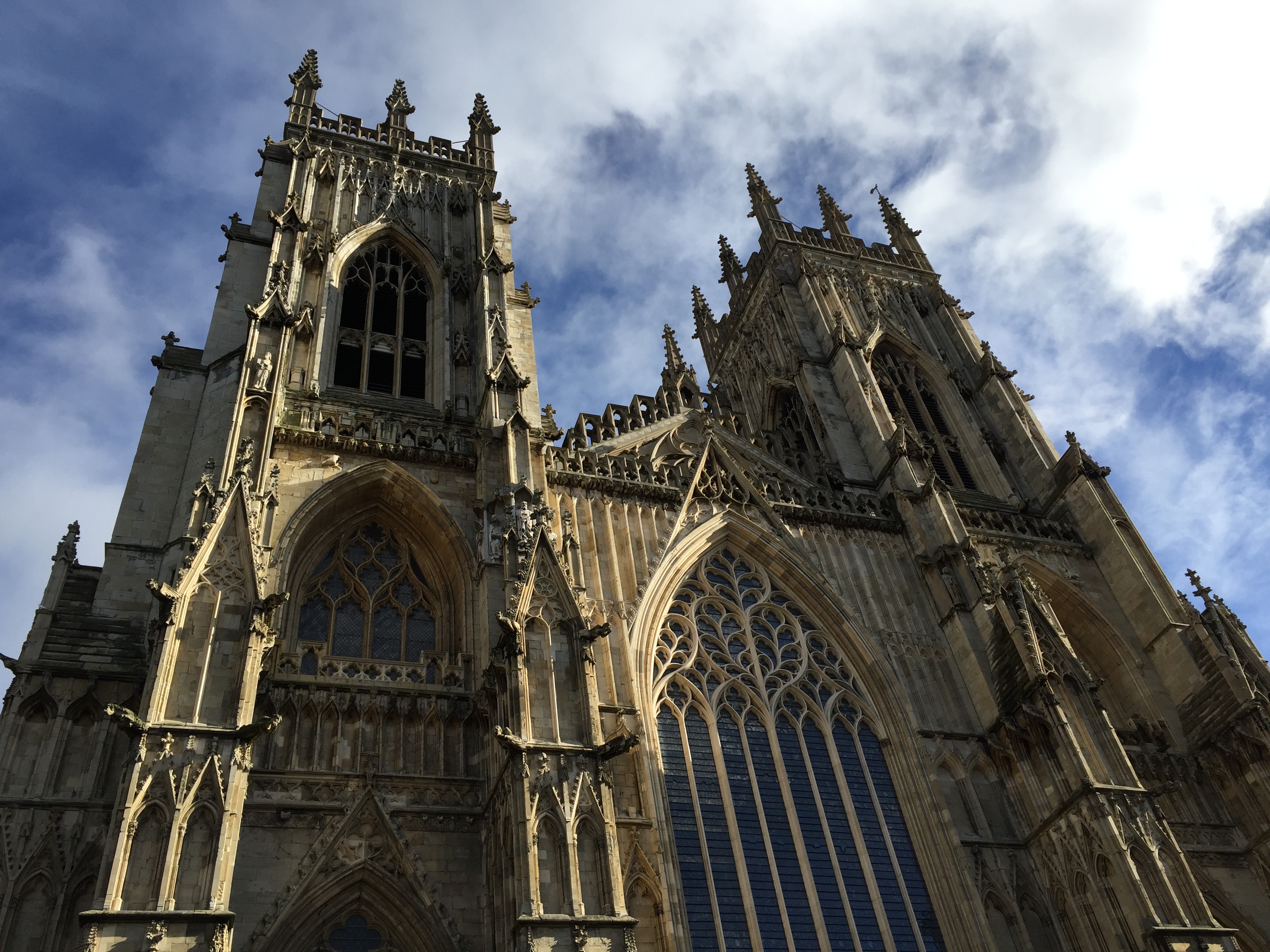


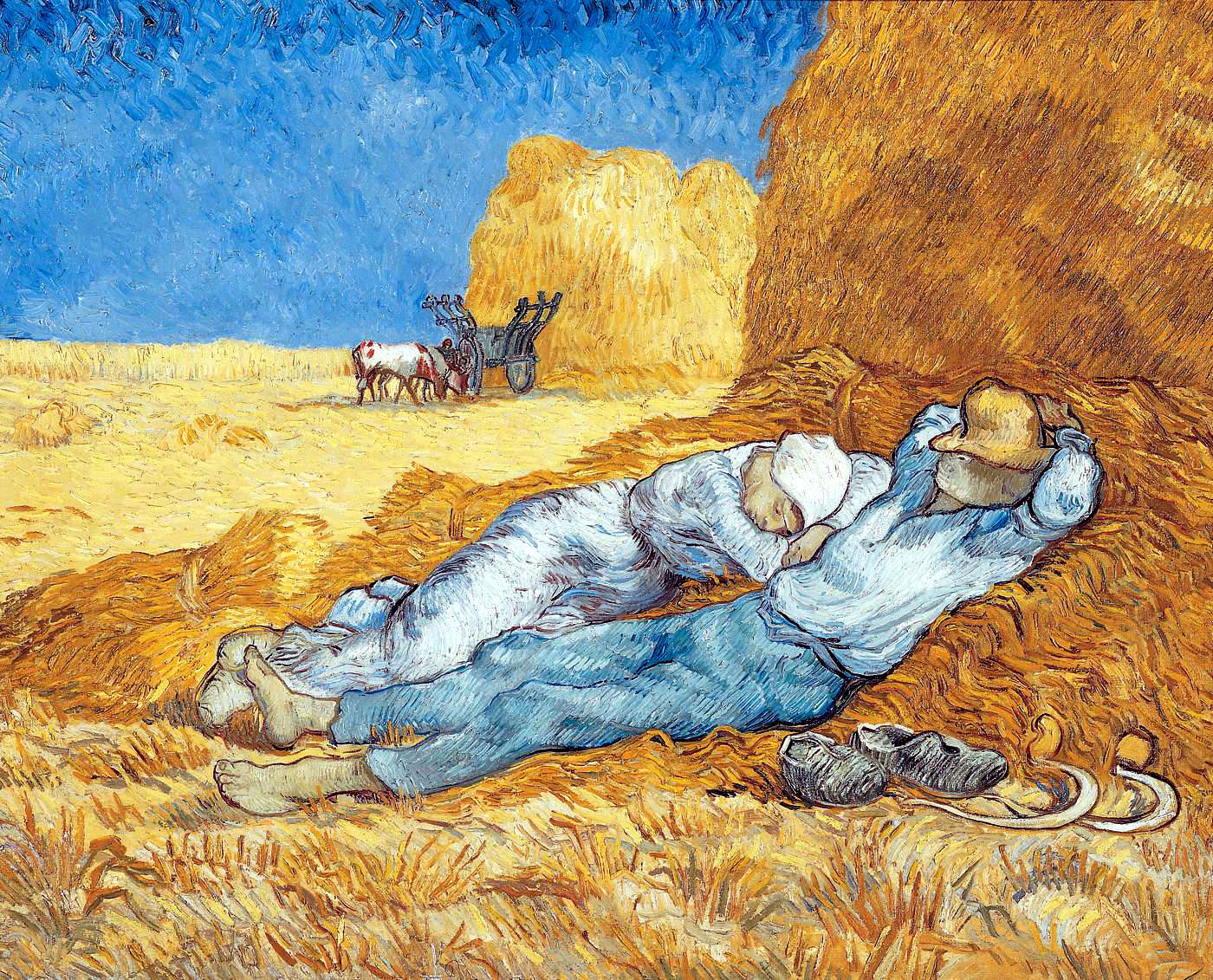
 The religious imagineer