Unknown's avatar

About jimfriedrich

I am an Episcopal priest, liturgical creative, filmmaker, writer, musician, teacher and retreat leader. My itinerant ministry is devoted to religious imagination and holy wonder. My blog is a space where diverse ideas and perspectives - theology and culture, liturgy and spirituality, arts and religion - can meet and converse with one another.

The Spirituality of Running: A Meditation for the Olympiad

Jim Friedrich and Mike Riebs, Santa Monica Mountains, 1961

Jim Friedrich and Mike Riebs, Santa Monica Mountains, 1961

Therefore, since we are surrounded by so great a cloud of witnesses, let us also lay aside every weight and the sin that clings so closely, and let us run with perseverance the race that is set before us, looking to Jesus the pioneer and perfecter of our faith… who endured…so that you may not grow weary or lose heart. (Hebrews 12:1-3)

Even the youthful may faint and grow weary, 
even the fittest may stumble and fall,
but those who wait for the Lord shall renew their strength,
they shall mount up with wings like eagles,
they shall run and not be weary,
they shall walk and never faint. (Isaiah 40:30-31)

The perpetual contest between weariness and perseverance is familiar to every athlete, and every saint. You’re going to get tired. You’re going to get discouraged. You may faint and fall. But keep your eyes on the prize, hold on. On both good days and bad, you’ve got to put in the work, “lay aside every weight,” surrender to a power beyond your solitary will, and stay in the flow.

Over the coming weeks, we will see Olympic athletes do extraordinary things with their bodies, minds and hearts. Some of us will be inspired by their example to get in shape and pursue a goal, to test the limits of our own embodied existence. Others will remain passive spectators, admiring the exceptional gifts of the Olympians with no illusions of doing likewise.

Is it not the same with the saints? Their exceptional feats of faith, hope and love seem so far beyond us that we dismiss our own capacities for discipleship and transformation. But the saints want to inspire, not intimidate us. They are a cloud of witnesses cheering us on to become our truest selves. When poet William Stafford says, “Ask me if what I have done is my life,”[i] we hope the answer will be yes.

In the Divine Comedy, Virgil invites Dante to make the immense and arduous journey into God. The younger poet demurs. “I am not Aeneas,” he says. “I am not Paul.” But he sets out anyway, and in the end discovers he needs to be no one but himself. “Per ch’io te sovra te corono e mitrio,” Virgil says when they part. I crown and mitre you lord over yourself.[ii]

When I was a teenager, I wanted to be a great pole vaulter. I loved the sudden ascent from the runway, feet swinging into the sky, the joyful clearance over the bar, the happy fall back to earth. I aspired to emulate world record holder Bob Gutowski, and for two years in college competed under his coach, Payton Jordan. But I lacked the necessary speed and strength to master the event, and gave it up before my 20th birthday.

I had thought I was a pole vaulter, but would come to discover that I was actually a distance runner. I had run cross-country and the mile in high school, thinking it would be good conditioning for my “real” event. But it wasn’t until my thirties that I finally embraced running as my athletic vocation.

I love the details of training, measuring daily progress as I increase the load and intensity of my runs. I love the mental challenge of racing, the ceaseless negotiation between desire and pain. I love the sense of aliveness that can follow the most exhausting workouts. But most of all I love the poetry of bodily motion, the primal elation of loping unhindered through space, dancing with earth and sky.

Sometimes you get into “the zone” and feel you could run forever. But that feeling is the fruit of weeks and months of training. As the Bible says,

Endure trials for the sake of discipline. Sure, discipline always seems painful rather than pleasant at the time, but later it yields the peaceful fruit of righteousness to those who have been trained by it. Therefore lift your drooping hands and strengthen your weak knees, and make straight paths for your feet. (Heb. 12:7, 11-12)

St. Paul, clearly a track and field fan, knew the amount of work required to get into shape and win the race. “Every athlete concentrates completely on training,” he wrote. “I punish my body and bring it under control.” (I Cor. 9:25, 27). In other words, no pain, no gain.

That doesn’t mean not to back off and be gentle when your body needs to rest and recover. My first two marathon attempts ended with training injuries from increasing my mileage too quickly, before my body was ready. Don’t forget to keep your Sabbath days!

With a more gradual buildup (and better shoes) I stayed healthy for my next two attempts. Here are a couple of excerpts from my Los Angeles training log in 1985, when I was doing 50-60 mile weeks:

9 miles fartlek [alternating fast/slow in a continuous run] in Griffith Park. Tired, no strength, but hung in there with endurance. Instead of power on speed bursts, went for quick rhythm. On hard reps up “Merry-Go-Round hill,” faced oxygen debt pain and tried to “love” it, absorb it as my own. Is it better to go hard only when fresh and sharp, or to push through the flat periods without a full recovery? (3/22/85)

That was a tough day.

 Intense speed work on the track. Fast times. Finally have reached new strength and speed level. Recovery jogs were at higher speed. I kept wanting more work! (4/02/85)

 That was an exhilarating day.

On the tough days, the questions multiply. Why am I putting myself through this? Am I delusional about my potential for improvement? Can my body take it? What’s the point?

When the questions pounce, you need the will to embrace and accept the pain. Hello, brother pain, how nice to see you again. Shall we take a run together? You also need a capacity for self-denial. Lay aside every weight. Great runners learn to let go, to trust that the pain is bearable, to hold nothing back, to surrender to that elusive, transcendent thing that takes over when we reach our limit.

Roger Bannister, who collapsed after he broke the 4-minute mile barrier in 1954, said that “the man who can drive himself further once the effort gets painful is the man who will win.”

Another great miler, 1960 Olympic 1500 meter champion Herb Elliott, received the same lesson from his coach, Percy Cerutty, who thought that running uphill on sand dunes until you couldn’t take another step was an ideal form of training. Cerutty told Elliott, who never lost a race, that “great runners must learn to die.”

Seen in this way, athletics is not just a metaphor for spirituality, but a plunge into the deepest sources of the self. “Learning to die” is the operation of a mysticism where subjectivity is transcended and absorbed into a greater whole. This kind of ecstasy has always been hard to describe since, as Maurice Blanchot suggests, “its decisive trait is that the one who experiences is no longer there when he experiences it.”[iii] The athletes who “disappear” into the Zone or the Flow for a few fleeting moments may struggle to put language to it, but they know something extraordinary has happened that was not of their own making.

What we do with our bodies manifests and expresses inner states, the sacred ground of our being. But bodily practices can also induce inner states. How we move, how we sit, how we breathe, can all make a difference in our spiritual life. Inner and outer are intertwined and interactive. We pray in, with, through our bodies.

“Each bodily act, when purposefully carried out under the control of the Spirit, is prayer. Such bodily acts include eating, sleeping, working, recreating, and posture.”[iv]

Running is a purposive prayer practice for me. I was never an elite runner (nor will I ever be a saint!). But the body I run with is my body, inscribed with the history of my own heart, and “when I run, I can feel God’s pleasure.”[v]

While training for the Boston Marathon at age forty, I took a run down the grassy median of San Vicente Boulevard in Santa Monica, a popular running spot. I saw Johnny Gray, American record holder for 800 meters and four-time-Olympian, stepping onto the path just ahead of me, and for the next two miles I tried to keep pace with him, just to see what it felt like. He appeared to be jogging, with an effortless, graceful stride. I, on the other hand, was working hard to keep up. But for that little while, following in Gray’s footsteps, I felt my own best runner wanting to emerge.

Finishing the California Marathon, December 1984

Finishing the California Marathon, December 1984

An old Anglican prayer asks God to “give us grace…to follow daily in the blessed steps of [Jesus’] most holy life.” What more can we ask of our stories, but to follow daily the blessed steps as best we can, bringing the flawed and glorious dispositions of our embodied selves into the living of our days?

Rainer Maria Rilke puts this perfectly in his poem, “I believe in all that has never yet been spoken.”[vi] It could be the runner’s prayer.

I want to free what waits within me
so that what no one has dared to wish for
may for once spring clear
without my contriving.
If this is arrogant, God, forgive me,
but this is what I need to say.
May what I do flow from me like a river,
no forcing and no holding back …


[i] William Stafford, “Ask Me,” The Way It Is: New and Selected Poems (St. Paul, MN: Graywolf Press, 1998), 56

[ii] Inferno ii, 32; Purgatorio xxvii, 142

[iii] q. in Kevin Hart, “The Experience of Nonexperience,” in Mystics: Presence and Aporia, ed. Michael Kessler & Christian Sheppard (Chicago: University of Chicago Press, 2003), 197

[iv] Herbert Slade, Exploration into Contemplative Prayer (Mahwah, NJ: Paulist Press, 1975), 21. Slade’s groundbreaking book had a great influence on both my praying and my running.

[v] 1924 Olympic 400 meter champion Eric Liddell narrates this line during his race in the film Chariots of Fire (1981)

[vi] trans. Anita Barrows & Joanna Macy: http://www.poetry-chaikhana.com/blog/2011/01/14/rainer-maria-rilke-i-believe-in-all-that-has-never-yet-been-spoken/

Can this be happening? – Donald Trump and the Rise of Authoritarianism

image

If I had a bell,
I’d ring out danger,
I’d ring out a warning …
all over this land.

– Peter Seeger & Lee Hays

I want to write about something other than politics or violence—theology, art, music, film, nature—but it is impossible to ignore the unsettling spectacle of hate and fear in Cleveland this week. Thankfully, it has already set off a multitude of alarms in the mainstream media, which has for too long been complicit in the normalization of the Trump phenomenon as just another option.

The editorial board of the Washington Post has taken the unprecedented step of declaring, at the very outset of the general election season, that Donald Trump is not only “uniquely unqualified to serve as president, in experience and temperament,” he poses “a threat to the Constitution … a unique and present danger.” His presidency “would be dangerous for the nation and the world.”

Has a major American newspaper ever issued such stark condemnation of a presidential candidate?

Many others are joining in the chorus. The Bloomberg editorial board says that Trump’s dystopian rhetoric in Cleveland was “the most disturbing, demagogic and deluded acceptance speech by any major party nominee in the modern era.” Ezra Klein, declares that “Trump is the most dangerous major candidate for president in memory. He pairs terrible ideas with an alarming temperament; he’s a racist, a sexist, and a demagogue, but he’s also a narcissist, a bully, and a dilettante. He lies so constantly and so fluently that it’s hard to know if he even realizes he’s lying. He delights in schoolyard taunts and luxuriates in backlash.” The headline for Klein’s indictment reads: “Donald Trump’s nomination is the first time American politics has left me truly afraid.”

We are familiar with the customary partisan hyperbole of an election year, but the current cries of alarm seem radically different. We have seen American leaders exploit the politics of resentment before. But such calculated manipulation of fear and xenophobia by an unprincipled practitioner of arbitrary will seems more suggestive of Germany in the 1930’s than anything in our own history.

Although Trump’s acceptance speech attempted to paint a patently false picture of a America in extreme chaos and distress, the United States in 2016 is not the Weimar Republic. And Trump is not Hitler. But there are some parallels worth thinking about. Let me offer a few citations from Richard J. Evans’ The Coming of the Third Reich.

Describing the growing electoral success of Hitler’s roughneck party in the 1930 election, “the Nazi gains reflected deep-seated anxieties in many parts of the electorate … more and more people who had not previously voted began to flock to the polls. Roughly a quarter of those who voted for the Nazis in 1930 had not voted before.”[i]

The cult of the strong man who would fix everything quickly and easily made other leaders seem ineffective and weak by comparison. A desperate and aggrieved population was swept away by a vague and undefined promise of a better future.

“Voters were not really looking for anything very concrete from the Nazi Party in 1930. They were, instead, protesting against the failure of the Weimar Republic… The vagueness of the Nazi program, its symbolic mixture of old and new, its eclectic, often inconsistent character, to a large extent allowed people to read into it what they wanted to and edit out anything they might have found disturbing.”[ii]

The German political and economic establishment had significant reservations about Hitler and his movement, but they believed that he could be controlled and guided once he was in power. Eric D. Weitz, in his excellent piece, “Weimar Germany and Donald Trump,” sees the same cynical capitulation going on today: “Today’s Republicans and similarly-minded figures in Europe are like the conservatives who put Adolf Hitler in power: delusional about their influence, playing dangerously with the structures of our democracy.”

In exchange for returning right-wing ideology to the White House, more traditional conservatives are willing to endow Trump with an aura of legitimacy. He’s not so bad. It’s all an act. He can be controlled. But as Hitler said in 1930, “once we possess the constitutional power, we will mould the state into the shape we hold to be suitable.”[iii] Or as Trump would put it: “It will be tremendous. Believe me.”

One final thought. As a person of faith, I found the frequent linkage of God, guns and hate in Cleveland to be sickening and blasphemous. It’s not the Christianity I know, and as Holden Caulfield would say, “Jesus would puke” if he had been forced to watch (I imagine he just went fishing this week). But it troubles me to consider how easily piety can be seduced into something demonic.

As Richard Steigman-Gall has pointed out in his study of Nazi conceptions of Christianity, it became a postwar trope to dismiss Nazism as anti-Christian. We venerate the costly resistance of Bonhoeffer, the Scholls, and the Confessing Church. But there were also many German churchgoers who knelt willingly at the altar of power, hate and fear. ”Whereas millions of Catholics and Protestants in Germany did not think Nazism represented their interests or aims, there were many others who regarded Nazism as the correct Christian response to what they saw as harsh new realities.”[iv]

Lord have mercy.


Related Post

How far can we sink? – Donald Trump and the vortex of rage


[i] The Coming of the Third Reich (London/New York: Penguin Books, 2003), 261

[ii] ibid., 265

[iii] ibid., 455

[iv] The Holy Reich: Nazi Conceptions of Christianity, 1919-1945 (Cambridge/New York: Cambridge University Press, 2003), 262


American violence: Where do we go from here?

Contemplating Kehinde Wiley's "Morpheus" at the Seattle Museum of Art

Contemplating Kehinde Wiley’s “Morpheus” at the Seattle Museum of Art

O Lord, mercifully receive the prayers of your people who call upon you, and grant that they may know and understand what things they ought to do, and also may have grace and power faithfully to fulfill the same … (Book of Common Prayer)

Every Sunday in the liturgical year has a Prayer for the Day, and this is the one recited in Episcopal churches annually on the Eighth Sunday after Pentecost, which in 2016 happened to be July 10. After a week filled with so much troubling violence in America, it was a prayer we badly needed. How in such times can we know and understand what we ought to do? Who will supply the grace and power to find a constructive way forward?

So many words have been written and spoken in recent days as thoughtful people try to grasp where we are, how we got here, and where we must go. It’s an important and necessary conversation, and I feel the imperative, as all responsible citizens must, to add my own voice to the dialogue. I should say something, but I don’t know exactly what. I can hear T. S. Eliot whispering in my ear: “Wait without thought, for you are not ready for thought.”[i]

I have been on vacation, enjoying the Olympic Track & Field Trials in Oregon, staying in a house without television. I’ve heard and read some news, but have not been steeped in constant reportage. And I’ve not seen a single image of the violence. Although columnist Leonard Pitts interrupted his own vacation in Greece to write that “America has gone mad and there’s no place to hide,” I have maintained a certain religious distance from the immersive angst of endless news, since it is only at our peril that we compromise personal Sabbaths. So I am less informed than most about the events of recent days.

But I have read some commentary, and I was particularly struck by Andrew O’Hehir’s Salon article, “Death in Dallas and America’s existential crisis: Our new ‘civil war’ over the nature of reality.”[ii] He describes an America “divided not just by race, culture and ideology, but between competing versions of reality.” While political conflict, culture wars and violent acts have always been with us, today’s “mutual incomprehension” and a “near-total inability to communicate” have not. Competing sides live in alternative universes where mutually acknowledged facts are hard to come by.

At a recent confrontation between demonstrators and counter-demonstrators, a reporter stood in the street between them, taking notes on the slogans and epithets being shouted from opposite sidewalks. A policeman told her she couldn’t stay in the middle of the street. “You have to stand on one side or the other,” he said.

But is there really no place to stand between irreconcilable polarities, no place where we can honor one another with the gift of listening? O’Hehir puts the question in vivid terms:

“Which would be more useful: For me to confront the fact that large numbers of my fellow citizens really believe that black radicals are waging a race war against white America and the police, and that Obama and Hillary Clinton hope to flood the country with Muslims and Mexicans while building socialism? And then try to figure out what the hell happened, and whether I can do anything to bridge the gap between that reality and mine? Or for me to carry on ridiculing others for their paranoid and superstitious beliefs, and congratulating myself for being a product of my class and educational background?”

Can we explore ways to listen to one another? To learn each other’s names, to hear each other’s stories, to understand one another’s language? To risk being stretched and challenged by alternate perspectives?

Such conversation ought to be be curated in churches, schools, homes and civic spaces. But what about the overheated environment of a protest situation? Even there? What would happen if there were a designated “argument-free” listening space at every demonstration, where people could speak without being judged, and the real pain and anxiety beneath the reactive and polarizing rhetorics could be received and acknowledged with respect and compassion?

Impossible? Then let the artists and saints show us how. Dostoevsky, for example, envisioned an improbable example of compassionate listening in The Brothers Karamazov. The brothers and their father are meeting with the saintly Father Zossima at his monastery in the hope of resolving a bitter family dispute. It doesn’t take long for the elder Karamazov and his son Dimitri to disgrace themselves before the holy monk as they bicker and shout and wish each other dead. But instead of intervening with words, Zossima suddenly kneels before Dimitri to kiss his feet. No one knows what to make of this unseemly action, but the monk later explains that when he realized the depth of Dimitri’s inner pain, and foresaw how much suffering it would bring him, he was impelled to make an extreme gesture of compassion. Instead of being sucked into the specific content of the argument, Father Zossima had perceived the pain and suffering behind it, and responded with unconditional love.

And so must we all. As Bobby Kennedy told a shocked and grieving black audience the night Martin Luther King was shot:

“What we need in the United States is not violence and lawlessness, but love and wisdom and compassion toward one another, and a feeling of justice toward those who still suffer in our country, whether they be white or whether they be black.”[iii]

Related posts

Beyond Punch and Judy: The Art of Nonviolent Resistance

After Paris and Beirut, What Kind of Story Shall We Tell?

[i] “East Coker” in Four Quartets

[ii] http://www.salon.com/2016/07/09/death_in_dallas_and_americas_existential_crisis_our_new_civil_war_over_the_nature_of_reality/

[iii] Speech in Indianapolis, Indiana, April 4, 1968: http://www.jfklibrary.org/Research/Research-Aids/Ready-Reference/RFK-Speeches/Statement-on-the-Assassination-of-Martin-Luther-King.aspx

Requiems and rainbows

An era was over and a new Europe was being born. This much was obvious. But with the passing of the old order many longstanding assumptions would be called into question. What had once seemed permanent and somehow inevitable would take on a more transient air. . . Europe’s future would look very different—and so would its past. . . Whatever shape Europe was to take in the years to come, the familiar, tidy story of what had gone before had changed forever.

— Tony Judt[i]

In the introduction to his magisterial Postwar: A History of Europe Since 1945, Judt was writing of Europe’s rise from the ashes of World War II as a continent of some 46 countries sought to overcome a long legacy of division and conflict. His book was published in 2005, and Judt himself died in 2010, but his words could have been written after the Brexit vote. Europe remains a very untidy story, unsettled and full of questions.

When the European Union was hammering out its constitution a dozen years ago, there was considerable discussion about the status of Europe’s Christian heritage in a secular and pluralistic age. Of course, a return to a “Christendom” was neither possible nor desirable, but Scottish theologian David Jasper suggests that the noblest aims of the European Union could trace their roots to the (often neglected) Christian understanding of self-giving love rather than authoritarian power as the divine principle at the heart of reality.

A political life governed by love rather than naked power, he argues, would be “voluntary, willed, and deliberate, a working through of our diversities in totally conscious acts of friendship pursued in love and charity with our neighbors.”[ii] It would build bridges instead of walls.

It remains to be seen which kind of story will prevail, not only in Europe and the UK, but in the United States as well, where many “longstanding assumptions” about social harmony and progress have been cast into doubt by the disturbing resurgence of nativism, bigotry and racism.

image

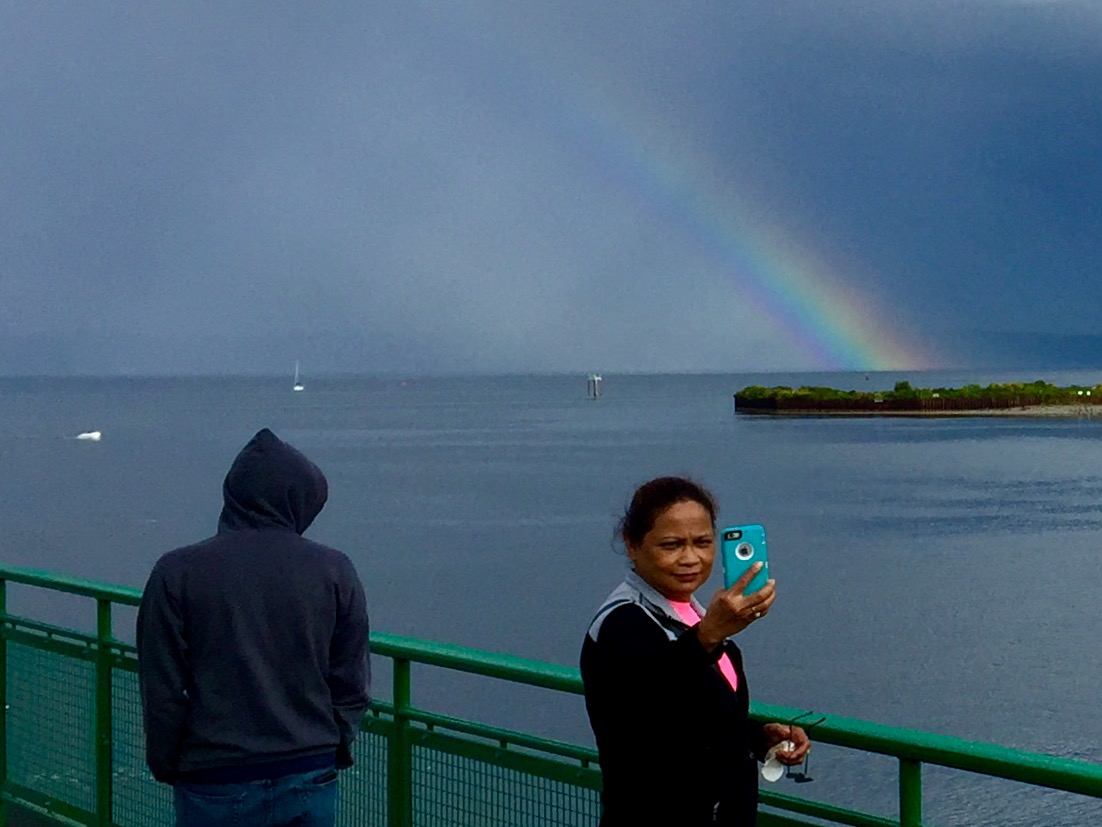
I took this photo on the Seattle-Bainbridge ferry on June 24. The Brexit vote had been announced the night before, on “Midsummer Night,” when, in olden times, mischievous spirits were said to be abroad, and bonfires were lit on British hilltops to aid the sun in its long decline toward winter.

I am not qualified to judge how much mischief and decline can be attributed to the Brexit vote, but the uncertainties of which Judt had written were much on my mind when I happened to see this rainbow, a biblical sign of promise. I snapped the photo on the fly without really composing it, but then I began to see things in it..

The woman seems representative of America as a land of immigrants. She contemplates her own image, like Venus with her mirror. Who am I? How did I get here? She is framing herself against the rainbow. She herself is part of the American rainbow. Is she surprised by what her screen is showing her? Does she register delight at existing in a world of rainbows? Will she turn to see the rainbow itself and not its image only?

We can’t see the face of the young man in the hoodie. He is a mysterious blank, the stranger from God knows where, a veiled presence destabilizing the scene with some unspoken question. His head is turned toward the rainbow, but his hands remain in his pockets. They are not extended in wonder or blessing. His thoughts and feelings are opaque to us. He is shut within the monastery of his dark clothing. Does he see promise in the sky? Is he sad, lonely, aloof, indifferent? Is he experiencing prayerful or poetic rapture?

We could compose a multitude of narratives about these two voyagers, but the only thing we know for sure is that they sail together on the same ark, and though the horizon seems dark, the shadows are illumined with the biblical sign of promise. This boat’s bound for glory, even if rough seas lie ahead.

Last night, at the Oregon Bach Festival, I heard the world premiere of A European Requiem, by Scottish composer James MacMillan. It is an astonishing work of complex sonorities, dramatic colors, and exquisite textures. Although it was composed before Brexit, its title and theme feel particularly resonant now. Do we live in a time of requiem or rebirth?

I was particularly struck by the work’s sublimity, that unnerving blend of fear and wonder generated in the presence of transcendent, overpowering mysteries. MacMillan seemed to suggest that the passage into whatever lies beyond our old familiar life is not altogether smooth and blissful. Hammering percussion and dissonant brass were anything but “rest eternal.” First the soul must be buffeted and broken open as the abyss of nonbeing widening before it. Only then can it hear the consoling chorus welcoming it into paradise.

But while MacMillan’s music allowed us to hear rapturous echoes from the “other side,” it did not take us across the divide. Instead, it concluded with the solemn sounds of the death bed. High, raspy strings whispered the last few breaths of mortal life. And after that, only the slow heartbeat of a bass drum, fading into silence.

Had the Requiem’s heavenly elements been merely a beautiful illusion, destined to vanish with every mortal thing? Or can we put our trust in something beyond the processes of dissolution and ending? Whether we are considering the fate of the world or the fate of the soul, it’s the question on which all else depends.


+


On a lighter note, you can find my new photo essay on the spirituality of summer here.


[i] Postwar: A History of Europe Since 1945 (New York: The Penguin Press, 2005), 1-2

[ii] David Jasper, The Sacred Community: Art, Sacrament, and the People of God (Waco, Texas: Baylor University Press, 2012), 127

Sacraments of Summer

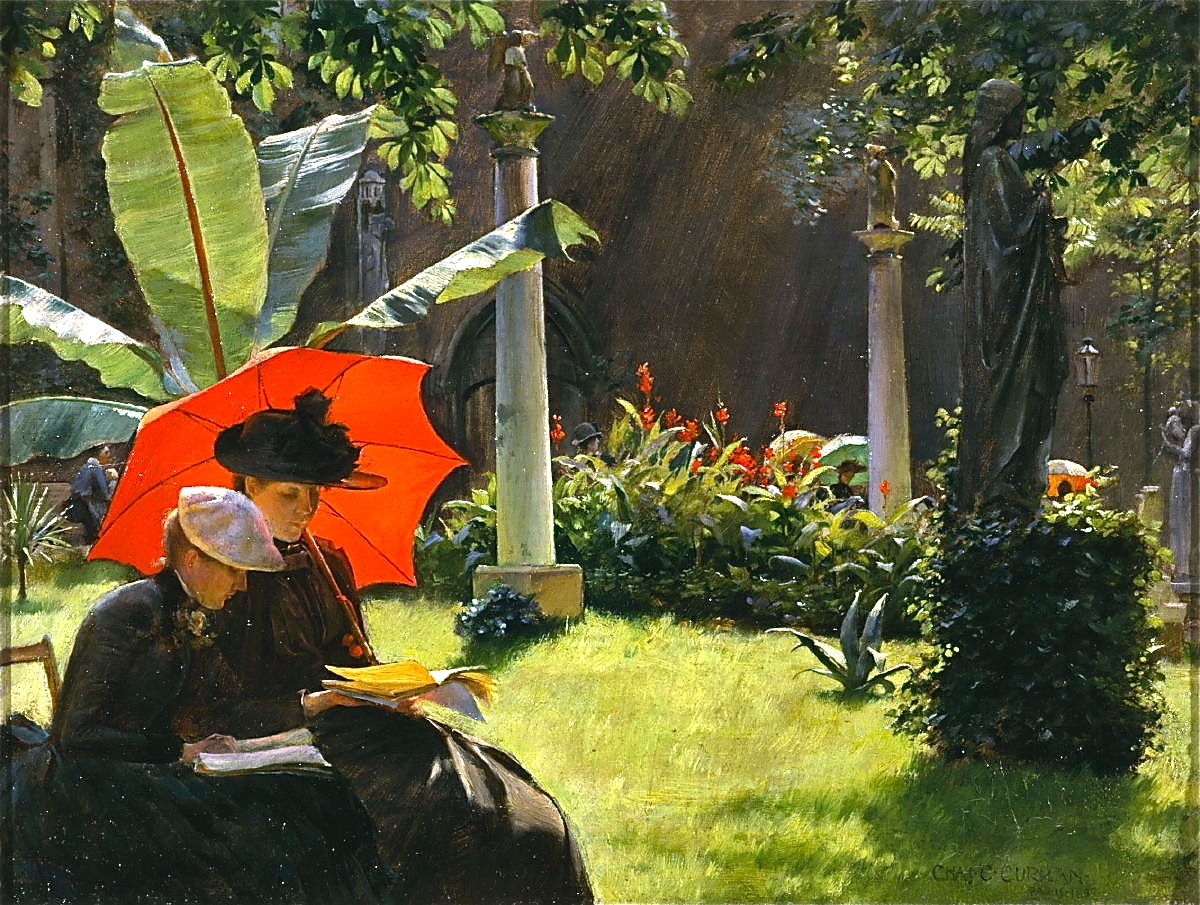
Charles Courtney Curran, Afternoon in the Cluny Garden, Paris (1889)

Charles Courtney Curran, Afternoon in the Cluny Garden, Paris (1889)

Now in midsummer come and all fools slaughtered
And spring’s infuriations over and a long way
To the first autumnal inhalations, young broods
Are in the grass, the roses are heavy with a weight
Of fragrance and the mind lays by its trouble.

– Wallace Stevens, “Credences of Summer”

In a short while, at 3:34 p.m. Pacific Daylight Time, the sun will reach its apogee of 23 degrees 27 minutes above the equator. When that moment comes, I will go outside to give Summer a proper welcome.

Every June Solstice I open Summer like a fresh novel, anticipating adventurous plots, alluring characters, and a world of fascinations presenting itself to my senses without hurry, as if both reader and text had all the time in the world. Summer is one of our sweetest fictions, suffused with a youthful happiness in a shadowless earthly paradise.

Of course, the livin’ isn’t always easy. Agonies and heartbreak may yet interrupt our revels, along with the heat waves, mosquitoes, sunburn, and poison oak. Summer is when my father died, and a dear friend committed suicide. Et in arcadia ego. In timeless Arcadia, death is still around

Even so, when summer smiles, I remember happiness once more:

Firefly nights and swimming hole days,
cold lemonade on a screened porch,
bare feet on warm ground, grass between my toes,
air-conditioned movies on a hot afternoon,
stack of summer reading by the hammock,
the holy calm of nothing to do,
cottonwoods whispering leafy poems to a quiet river,
the pleasurable sublime of high country thunderstorms,
campfire sparks rising to meet the Milky Way,
Springsteen singing us down some lost highway,
windows rolled down in the warm night air,
stars falling into a hayfield after midnight,
moonlight croquet (a candle at each wicket),
swapping songs around red Sonoma wine,
dancing till dawn on Gatsby’s lawn,
those kisses beneath the stars . . .

Do such moments only defer the inevitable erosion of temporal existence, or are they sacramental foretastes of eternal blessedness? Either way, as Michael Cunningham makes clear in The Hours, the Perfect Moment, like Summer itself, is not a gift to be wasted:

It had seemed like the beginning of happiness, and Clarissa is still somewhat shocked, more than thirty years later, to realize that it was happiness…What lives undimmed in Clarissa’s mind more than three decades later is a kiss at dusk on a patch of dead grass, and a walk around a pond as mosquitoes droned in the darkening air. There is still that singular perfection, and it’s perfect in part because it seemed, at the time, so clearly to promise more. Now she knows: That was the moment, right then. There has been no other.


Related posts

That Summer Feeling

Now Welcome Summer


Summoning the Sanity to Scream

Painting by Richard Stott (June 13, 2016). Used by permission of the artist.

Painting by Richard Stott (June 13, 2016). Used by permission of the artist.

Investigators at the scene were overwhelmed by the sounds of endlessly ringing phones coming from the bodies, as people continued to call, hoping for their loved ones to answer.

— CNN

We rise and fall and light from dying embers
remembrances that hope and love last longer,
And love is love is love is love is love is love is love is love
cannot be killed or swept aside.

— Lin-Manuel Miranda[i]


The Orlando massacre is the 179th mass shooting so far this year in the United States of America.[ii] It will not be the last. There’s too much madness, too many guns, too much hate to hope otherwise. We are angry and we are sad, but then what? Gun worship seems the most powerful religion in America. From presidents to schoolchildren, the blood of countless victims stains its altars. And however much we rage and moan we feel powerless to stay the hand of sacrifice.

Each time it happens, causes are discussed, solutions proposed, and we cry, ‘Never again!’ The pundits wring their hands, the NRA and gun-makers pause briefly to reload, Congress turns a blind eye, and then rat-a-tat-tat! More bodies strewn across our public spaces. The cycle repeats itself endlessly.

Why? Mental illness, social pathologies, alienation, racism, resentment, homophobia, hate, terrorism, profiteering by gun-makers, violence as entertainment, social media copycats, an American predilection for the quick fix and the fast draw—probable causes multiply exponentially.

Songwriter Dan Bern summarized the search for answers in his powerful “Kids’ Prayer,” written after the Springfield, Oregon school shooting in 1996:

And all the world descends to offer up their condolences
And offer up their theories what went wrong
And who and why and when and how:

It’s all the killing day and night on television
It’s all the movies where violence is as natural as breathing
It’s guns and bullets as easily obtainable as candy
It’s video games where you kill and begin to think it’s real
It’s people not having God in their lives anymore
Or it’s all of it, or none of it, or some of it, in various combinations …

As a hate crime directed against the LGBT community, Orlando adds a disturbing new dimension to the plague of gun violence. Whatever blend of madness and calculation drove the killer, he didn’t invent homophobia. He just fed off of it. It is still, sadly, in plentiful supply.

Decades ago, James Baldwin, who was both gay and black, wrote about the American capacity for self-delusion as to the extent of its own sickness. Facing up to our social pathologies, whether racism, bigotry, nativism or gun violence, would endanger the national myth of innocence. Better to remain silent and pretend everything is fine.

“But if we say we have no sin, we deceive ourselves” (I John 1:8). A sin unconfessed only makes us sicker. In a 1961 conversation with Malcolm X, Baldwin said:

If I know that any one of you has murdered your brother, your mother, and the corpse is in this room and under the table, and I know it, and you know it, and you know I know it, and we cannot talk about it, it takes no time at all before we cannot talk about anything. Before absolute silence descends. And that kind of silence has descended on this country.[iii]

In a gesture of protest, a Connecticut Congressman has vowed to abstain from the “moment of silence” which seems to be the only Congressional response to mass shootings. “Our silence does not honor the victims; it mocks them,” said Rep. Jim Himes.[iv]

Or in the words of Dan Bern, how many Orlandos will it take before we “summon up the sanity to scream?”[v]

+

Note: The Pieta image is by British painter and Methodist minister Richard Stott, a member of last October’s Venice Colloquium. He painted it in response to Orlando. Thanks to Ric for letting me use it here. Check out his website, “I ask for wonder.”

Related Posts

Is the American Dream a Con Game?

How Far Can We Sink?

We are the singers of life, not of death


[i] Miranda delivered his “sonnet” during the Tony Awards, the night after the Orlando shooting.

[ii] Mass Shooting Tracker

[iii] “Notes for a Hypothetical Novel,” in Nobody Knows My Name, quoted in Nathaniel Rich, “James Baldwin and the Fear of a Nation,” The New York Review of Books, May 12, 2016, p. 42.

[iv] @jahimes, 5:45 pm, June 12, 2016

[v] Dan Bern, “Kids’ Prayer”

A Voice to Raise the Dead

Lucas Cranach the Younger, Raising of the Son of the Widow of Nain (detail, 1569)

Lucas Cranach the Younger, Raising of the Son of the Widow of Nain (detail, 1569)

I’m writing from Hattiesburg, Mississippi, where I’ve been among some amazing people to reflect together on the deep connections between art and spirituality. The fruit of those conversations will find their way into future posts, but meanwhile here is what I’m preaching this morning from the pulpit of Hattiesburg’s Trinity Episcopal Church, based on the gospel text from Luke 7:11-17. 

Watch out! There’s going to be a collision.

Here comes a funeral parade, with a dead young man, his grieving mother, and a whole crowd of mourners, weeping and wailing and gnashing their teeth.

And from the opposite direction, pretty as you please, here comes the Jesus parade: the holy man everybody’s talking about, along with his passel of disciples and a whole bunch of folks who’ve just seen Jesus cure the centurion’s slave in the blink of an eye and who want to see what in heaven’s name he’s going to do next.

The Jesus people are all laughing and talking and telling stories, but suddenly Jesus raises his hand and they all stop, because he’s seen the widow, he’s heard her crying—they can all hear her crying—and Jesus is so moved by her tears, his heart just fills up and overflows with compassion. and whatever he was on his way to do no longer seems all that important.

He knows that moments like this are why he came into the world. So he heads straight across the town square to meet that funeral procession, with all his folks trailing after him, wondering what’s going to happen.

What is going to happen, in the middle of that dusty little country town, is a great cosmic showdown: the parade of death running smack into the parade of life. And here’s how it goes.

Jesus reaches out to touch the coffin, and the pallbearers come to a dead stop. Everybody gets real quiet. Maybe the widow recognizes Jesus. Maybe she’s heard stories about his miracles. But she’s not asking for any help. Her son is dead. She knows his story is over. Nothing Jesus can do about that, she thinks. She’s long since resigned to her grief.

And the only thing Jesus has to say to her is, “Do not weep,” because it’s her son that he wants to talk to. Then Jesus speaks the words he has been given the power to say:

Young man, arise!

And the dead man sits up, opens his mouth, takes a breath, and words start to spill out, words of wonder and joy, and he is alive again. Then Jesus gives him back to his mother. And all the people standing round don’t know whether to be scared or whether to start shouting “Glory to God! Glory to God!”

And as for all of us who listen to this story today,what do we do with the strangeness of it in a world where too many young men and women die and parents weep and there is no resurrection parade that shows up to make everything all right again?

Can we still take hope from this story, or is being snatched from the jaws of death only for the lucky few, like winning the lottery, while the rest of us can only dream of such a happy fate?

This would be a cruel story if it were about a blessing which most of us will never know. But what Jesus did that day in the village of Nain wasn’t a promise that we all now get a free pass to escape the human condition. Jesus didn’t really go around raising up everybody who died. It only happens three times in the gospels. Jesus didn’t come to give everyone a few extra decades of earthly existence. That’s not why he was here.

He was here to show us God, and to show us how humanity is made to become like God—not by grasping power and glory, but by embodying compassion, which is one of the dearest of God’s names.

It wasn’t God’s plan that Jesus spend all his time putting funeral directors out of business. But on that particular day in Nain, Jesus couldn’t help himself. He felt compassion for the widow, and as the incarnate Author of Life, he returned the widow’s son to the sensory world of dust and sunshine just so death wouldn’t get too uppity. Sometimes death needs to be reminded that it never gets the last word.

But Jesus didn’t mean for us to place our own hope in such temporary reprieves. The resurrection of the dead is a mystery more ultimate and profound than what happened to the widow’s son. Dying and rising are inseparable partners in the same transformative dance. It’s the way the story goes, and we just have to live with it. That is why, even at the grave, we make our song: Alleluia, alleluia, alleluia.

So what does this gospel story want to tell us today, wherever you and I happen to find ourselves on life’s journey in the year of grace 2016? I’ll tell you what I hear.

The first thing is, our God is compassionate. Our God is moved by our tears. And in the end, as poet Jane Kenyon said before her own untimely death, God will prove to be “mercy clothed in light.”

Secondly, I am struck by the power of the voice of the Divine Beloved, the voice of Jesus, speaking to us the word of life: Arise. And I don’t think we have to wait for the Last Day to hear it, either.

We are being called back to life every day, every moment, if we only have ears to hear. On her wonderful website, The Painted Bird, Jan Richardson has posted her poem inspired by this gospel. “Blessing for the Raising of the Dead.” tells us that ‘while this blessing / does not have the power / to raise you, /  it knows how to reach you. / It will come to you, / sit down / beside you, / look you / in the eye / and ask / if you want / to live.’ You can read the whole poem here.

Finally, I hear this gospel telling me one more thing. It is not enough simply to hear the voice that blesses and revives. I believe, now that the tongues of Pentecostal fire have settled on our own heads, that you and I are called to speak that voice as well, to be ourselves the voice that blesses, the voice that calls the dead back to life—dead hopes, dead neighborhoods, dead dreams, dead souls.

The word of life is not something we ourselves possess, but God has empowered us to speak it nonetheless: to be Christ’s voice for those in need, to be Christ’s voice to a broken and longing world—

the voice which speaks the word
uttered for all eternity
in the heart of God:

Arise, it says. Arise.


The Faithful Centurion: A Homily for the 2nd Sunday of Pentecost

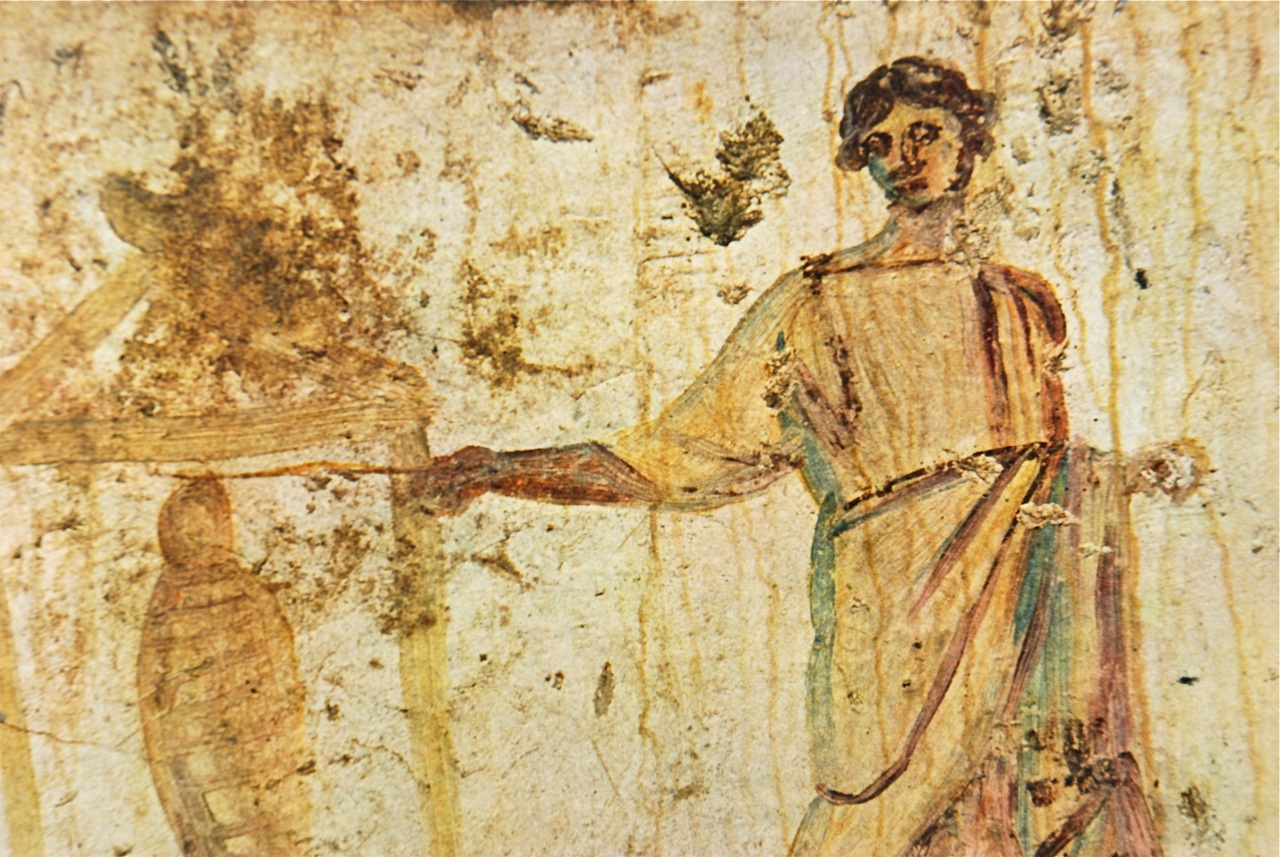
Jesus raises the dead with a wand (Roman catacomb, 3rd century)

Jesus raises the dead with a wand (Roman catacomb, 3rd century)

The gospel story for the Second Sunday of Pentecost[i] describes a world in which things don’t happen the way they’re supposed to.

A Roman centurion treats his slave more like a friend than a piece of property. When the slave gets sick and is close to death, the centurion implores the Jewish community to help him find a healer.

Normally, Jews and Romans were not on the best of terms. Occupying armies just don’t get much love, and besides, doesn’t everybody know that foreigners are just “not our kind?” If only we could build a wall high enough to keep them out!

But this Roman centurion has somehow made friends with the local Jewish elders. He has even built a synagogue for them. So they are happy to help.

The Roman has heard some stories about Jesus and his healing gifts, so he asks the elders to go beg Jesus, that he might come and heal his slave.

Now we’ve heard a lot of stories about Jesus getting the local clergy mad at him, so we may be surprised to learn that there were also some of them who admired Jesus, and maintained good relations with him. That is clearly the case here. And what the elders say to Jesus is this: “The centurion is worthy of having you do this for him, for he loves our people.”

So far, not much is going the way we would expect. A centurion treats his slave like a friend. A Roman loves the Jews, and the Jews love him back. And as for Jesus and the local clergy, they are getting along swimmingly.

But there are more surprises to come.

Jesus goes with the elders to find the centurion’s house, but just before they arrive, the centurion sends some friends out to say, “Lord, do not trouble yourself, for I am not worthy that you should come under my roof; that is why I did not presume to come to you myself. But only speak the word, and my servant shall be healed. For I know something about authority, since I have soldiers serving under me. I say to one, `Go,’ and he goes, and to another, `Come,’ and he comes, and I say to my slave, `Do this,’ and the slave does it.”

How strange to see a Roman officer humbling himself before a wandering Jewish rabbi. “I am not worthy that you should come under my roof,” he says.

And Jesus is “amazed.” That word in the gospel is usually applied to people who are amazed at Jesus. But here it is Jesus’ turn to be amazed. And why? Because the centurion has total faith in the power of Jesus to heal his slave, even at a distance.

“Just as I command my slaves to come and go as I wish, I believe that you have the power to command sickness and death to depart from my house. Only say the word.”

It may seem a little odd that this exchange doesn’t take place directly between Jesus and the centurion. The centurion communicates through intermediaries. This is, he says, because he is not worthy to have Jesus even enter his house. It’s a pretty extraordinary bit of deference on behalf of the powerful Roman.

In any case, Jesus turns to the crowd which has been tagging along because this was clearly the most interesting thing happening in Capernaum that day, and says, “You know what? I haven’t found this kind of faith among any of you folks who go to church. You all could learn something from this centurion fellow. You may call him an unbeliever, but he’s just given you some of the best spiritual teaching you’re ever going to get.”

And then, because this wants to be an odd story from beginning to end, the servant is suddenly well without Jesus ever saying a prayer or speaking a healing word. This miracle happens offstage, and we only hear about it later.

Notice that Jesus never actually meets the centurion or the slave. Everything happens at a distance, through intermediaries, rather the way that prayer works. We may not meet Jesus directly, in the flesh, but his effect on us is still palpable and powerful. And as the centurion believed, it is faith that makes that connection happen.

This strange little story is about a world which is repeatedly and radically disrupted: social and cultural barriers are crossed, enemies act like friends, the master/slave hierarchy is upended, earthly power humbles itself, the religious experts are schooled by a pagan outsider and oh, by the way, a healing miracle happens without any fanfare or even the slightest tangible demonstration of cause and effect. Just another day in the life of the God of surprises.

We could take a number of things from this story, but today my question is this: Who outside our own faith communities has something essential to teach us? And are we capable of appreciative amazement? Are we capable of receiving that teaching with gratitude and humility?

Where are the ones, beyond our institutional and theological boundaries, who are practicing social imagination and nurturing a better future? Where are the ones who are already doing holy work without even knowing God’s name?

Who are the ones
living a practical faith
serving a need
working for change
refusing injustice
breaking boundaries
loving enemies
making peace
showing mercy
finding the lost
tending the sick
visiting the prisoner
binding wounds
soothing the suffering
comforting the afflicted
nourishing wonder
fostering delight
shielding the joyous
organizing the powerless
repairing the world
welcoming the Kingdom . . .

Who are they and how can we learn from them?
How can we support them?
How can we join them?


[i] Luke 7:1-10 (Revised Common Lectionary, Year C)

Is the American Dream a Con Game?

L.A. Times TV Guide cover, June 2, 1968, two days before Robert Kennedy's assassination in Los Angeles (Jim Friedrich personal archive)

L.A. Times TV Guide cover, June 2, 1968, two days before Robert Kennedy’s assassination in Los Angeles (Jim Friedrich personal archive)

Oftener it falls, that this winged man, who will carry me into the heaven, whirls me into the clouds, then leaps and frisks about with me from cloud to cloud, still affirming that he is bound heavenward and I, being myself a novice, am slow in perceiving that he does not know the way into the heavens, and is merely bent that I should admire his skill to rise …

— Herman Melville, The Confidence Man

In Melville’s final novel, a ‘mysterious stranger’ boards a Mississippi riverboat on April Fools Day, initiating a series of scams upon the gullible passengers. Appearing in various guises, the stranger collects money for distant charities, solicits investments in get-rich-quick schemes, and sells miracle cures, all the while encouraging his marks to have confidence in the dream of better lives and a better world. He is the “winged man” who promises to carry them “heavenward.”

However, the marks soon learn that the hopes and dreams on offer are a total fraud. Melville describes the inevitable disillusion: “I tumble down again soon into my old nooks, and lead the life of exaggerations as before, and have lost the faith in the possibility of any guide who can lead me thither where I would be.”[i]

That riverboat still haunts the American imagination. We fall in love with dreams and schemes of better futures, better selves, a “life of exaggerations,” and invest our confidence in those who promise to deliver. This may work out for some, but more often there is the sting of disappointment, a sense of betrayal. As Greil Marcus has written, “America is a trap: its promises and dreams … are too much to live up to and too much to escape.”[ii]

Unattainable promises. Impossible dreams. The lonely crowd grows sullen, resentful, angry, like Nathanael West’s California dreamers in Day of the Locust (1939). Lured by the prospect of a New Eden out West, over the rainbow, they slave and save until they can afford to move to “the land of sunshine and oranges.”

Once there, they discover that sunshine isn’t enough. They get tired of oranges . . . Nothing happens. They don’t know what to do with their time . . . They realize that they’ve been tricked and burn with resentment . . . They have been cheated and betrayed. They have slaved and saved for nothing.[iii]

W. H. Auden described West’s novel as a parable “about a Kingdom of Hell whose ruler is not so much a Father of Lies as a Father of Wishes.”[iv] Either way, it’s a figure we all recognize: the Confidence Man, duping the suckers with his promise to make America great again. “Believe me. Believe me. It’s going to be terrific.”

And what happens when the dreamers tumble back to earth? Most of us muddle on as best we can, but in Stephen Sondheim’s darkly comic musical, Assassins[v], nine embittered and unbalanced Americans find a single target for their anger: the President of the United States. In a carnival of lost souls, a smirking barker (the Confidence Man in disguise!) doles out handguns like cotton candy to a new crop of eager marks. If you keep your goal in sight,” he sings, “you can climb to any height. Everybody’s got the right to their dreams.”

No job? Cupboard bare?
one room, no one there?
Hey, pal, don’t despair-
You wanna shoot a president?
c’mon and shoot a president…

John Wilkes Booth, Leon Czolgosz, Charles Guiteau, Squeaky Fromme, Sara Jane Moore, John Hinckley and a couple more broken dreamers line up to claim a gun as their means of grace and hope of glory.

And all you have to do
Is move your little finger,
Move your little finger and
You can change the world.

The climax takes us to Dallas, where the gang of murderous misfits pressures Lee Harvey Oswald to join their ranks and assuage their shared malady: “a desperate desire to reconcile intolerable feelings of impotence with an inflamed and malignant sense of entitlement.”[vi]

In the finale, all nine assassins come to the front of the stage, singing out with all the confident uplift we expect from our musicals:

Everybody’s got the right to some sunshine!
Not the sun, but maybe one of its beams.
Rich man, poor man, black or white,
Everybody gets a bite,
Everybody’s got the right
to their dreams……

The smiling cast stretches out the last word, “dreams,” for a full twelve seconds as they raise their guns high. The moment the music ends, they all fire at once, a deafening volley, and the stage goes black.

When Assassins premiered in 1990, it was not well received. It seemed too dark and crazy at the time. But when I saw a rare revival this month at Seattle’s ACT Theater, it somehow made perfect sense, so dark and crazy has America become in these latter days.

We all clapped and cheered, of course. It was a fabulous production. The cast was great. It wasn’t all grim. There was plenty of humor. And Sondheim’s songs! But I had tears in my eyes as well. As Jefferson said, “I tremble for my country…”

As the applause went on, I thought of Kierkegaard’s story of a theater which had caught fire backstage as the show was about to begin. The manager grabbed the first actor he found to step through the curtain and warn the audience to evacuate. That actor, alas, was dressed as a clown. “The theater is burning!” he cried. “You must leave immediately!” The audience roared with laughter at the clown’s performance. Such pathos! Such irony! The more he shouted and pleaded, the more they laughed, until they were all consumed by the flames.


[i] Herman Melville, The Confidence Man: His Masquerade in Pierre, Israel Potter, The Piazza Tales, The Confidence-Man, Uncollected Prose, Billy Budd, Sailor (New York: Library of America, 1984), 452

[ii] Greil Marcus, Mystery Train: Images of America in Rock ‘N’ Roll Music (New York: E.P. Dutton, 1975), 22

[iii] Nathanael West, Day of the Locust (from my personal transcription in a 1968 commonplace journal, original page unknown)

[iv] Wikipedia reference: Barnard, Rita. “‘When You Wish Upon a Star’: Fantasy, Experience, and Mass Culture in Nathanael West” American Literature, Vol. 66, No. 2 (June 1994), pgs. 325-51

[v] 1990, music & lyrics by Stephen Sondheim, book by John Weidman

[vi] John Weidman interview, quoted in Misha Berson’s Seattle Times review, March 9, 2016

The roads where we once traveled

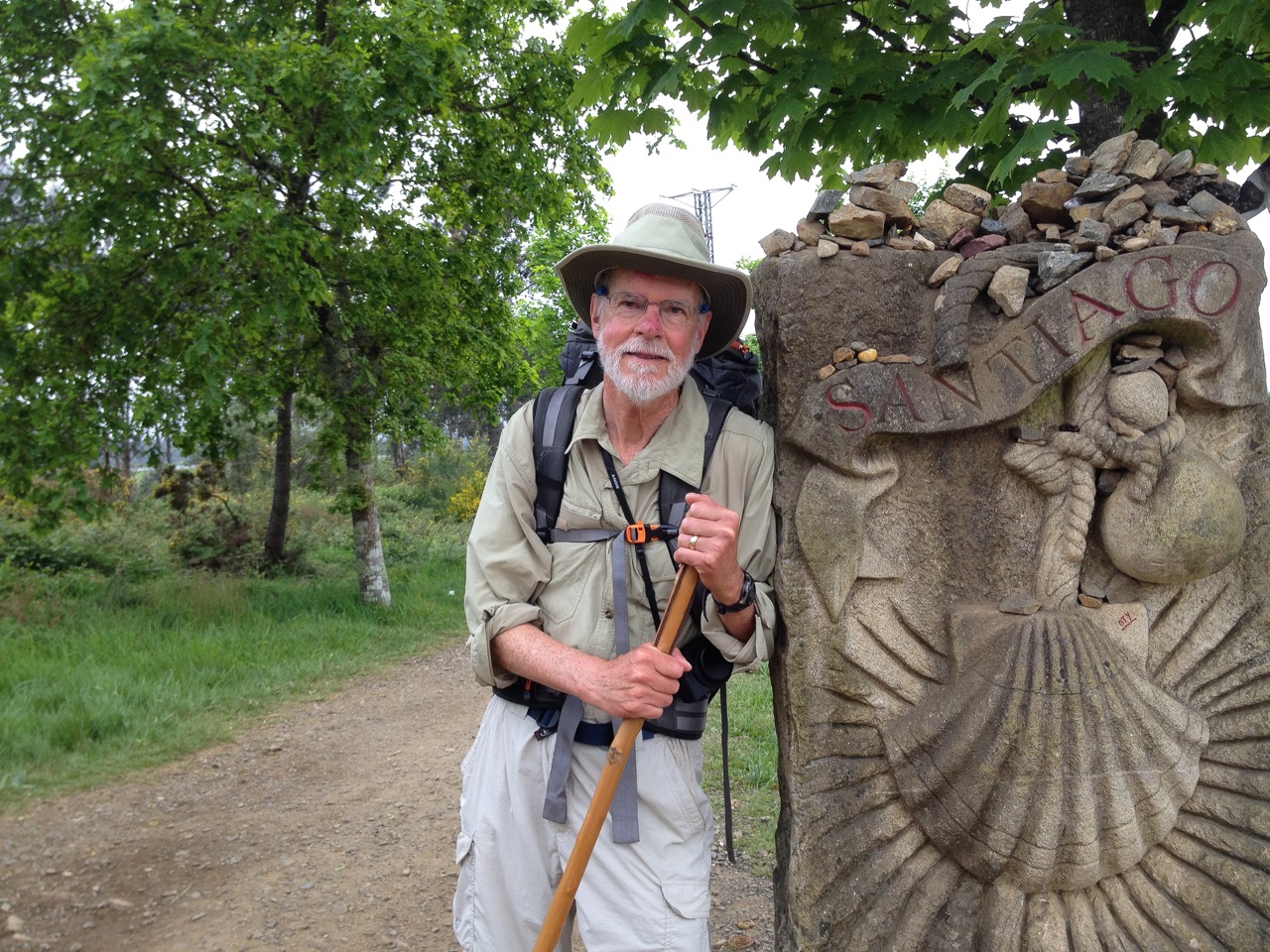
Near the end of my Camino: weary but happy.

Near the end of my Camino: weary but happy.

If I forget my past, Facebook will remind me, popping up a past post for any given date. Today’s memory is a photo and blog link from May 10, 2014, the day before I completed my 500-mile pilgrimage on the Camino de Santiago. I began writing this blog on that journey, and while I try not to repeat myself, I will mark this anniversary by re-posting my blog from that day.  If you are curious to read about my next day’s arrival in Santiago, you can find that here. And all my Camino posts may be found in the April and May archives for 2014. If any of you are inspired to walk the Camino yourselves, I say yes, do not hesitate. You will be blessed.

Songs to Sing and Tales to Tell (May 10, 2014)

And when my journey’s finally over,
when rest and peace upon me lie,
high o’er the roads
where we once traveled,
silently there my mind will fly.

– “Parting Friends”

This is one of the many shape note songs I sang along the Camino. I also sang hymns for Holy Week and Easter, made every tunnel and underpass echo with Kyries and Alleluias, and on a few evenings when a guitar got passed around in a hostel, taught choruses from Steve Earle’s “Pilgrim” (“we’ll meet again on some bright highway, songs to sing and tales to tell”) and Tom Russell’s “Guadalupe” (“I am the least of all your pilgrims here, but I am most in need of hope”). And several times a day I would break out with “Dum pater familias,” the medieval Latin song for St. James that rallied the spirits of the pilgrims who sang it as they walked. Prior to headphones, singing was an important part of the pilgrimage experience – shared voices imprinting the path with songlines.

On my penultimate day, the words of “Parting Friends” are especially apt. My mind indeed flies back over the roads I’ve traveled and the people I’ve met. Previous posts have mentioned some of these, but let me record three more who have embodied for me the spirit of the Camino.

The first is Janine, the hospitalera who welcomed me and six other pilgrims to a humble albergue in Calzadilla de los Hermanillos, a village lost in the vast Meseta like a small boat adrift at sea. In a place forgotten by time and history, this grandmotherly woman provided the most exquisite hospitality, as if we were her own family. The next morning, she saw me off with a blessing. Pointing to her “corazon” and mine, she indicated that we were connected. Then she made a walking motion with her fingers and said, “Buen Camino.” She repeated this touching ritual with each of us. Like saints of old doing good in lonely outposts for no earthly reward, she simply existed to love the stranger.

Then there is Tomas, who has occupied a tiny abandoned village in the mountains near the Camino’s highest point and created, in an eclectic assemblage of flags, signs, sculptures and makeshift structures akin to outsider art, a haven for pilgrims seeking a tranquil respite by day, one of his 35 mattresses by night, or shelter from the storm anytime it’s needed. Whenever he sees a pilgrim approaching, he rings a temple bell to greet and bless them. If a cloud covers the mountain with fog and darkness, he rings the bell to guide lost pilgrims to his safe haven. This is his life: to live as a hermit in order to serve the pilgrim.

Finally, on a shady trail through a eucalyptus grove yesterday, I saw a young man kneeling in the dust to pray before a wayside cross. I don’t know his name or his story, but the evident depth of his devotion reminded me how serious a matter the Camino can be.

And now I am at the outer edge of Santiago, in a quiet albergue with very few occupants. Most pilgrims who get this far simply continue on to the great cathedral less than an hour’s walk from here. But I didn’t want to drag myself to the finish late in the day, wearied and worn by ten miles of walking. I want to arrive fresh and renewed, to finish my Camino in the light of the rising sun on the day of Resurrection. So like Jacob of old, who camped just short of his destination in order to collect himself for the morrow’s big encounter, I shall rest and reflect and – who knows? – maybe wrestle with angels till daybreak.


Related Posts

Hospital for the Soul

The Movement of Hearts and Souls

Surrender