Members of the Same Body? A Post-Election Homily

Thomas Cole, Expulsion from the Garden of Eden (1828)

Thomas Cole, Expulsion from the Garden of Eden (1828)

What just happened? Has half the country endorsed hate, fear, ignorance, racism, white nationalism, misogyny, sexual assault, xenophobia, environmental suicide, nuclear instability, and a war against the poor, the immigrant and the “other?” It has certainly given us the sickening prospect of unprecedented vulgarity, cheesiness, immaturity, dishonesty and self-dealing in the White House for the indefinite future.

Is this a case of “they know not what they do?” Those who proudly wear swastikas or Klan hoods, or wallow in the swamp of alt-right delusion, knew exactly what they were doing, but they are relatively small in number. A far larger faction has argued that while Trump might be a “scumbag” (to quote a Facebook friend who voted for him), his opponent, seen through the lens of misogynist fears and Republican fictions, was far worse.

Then there are the pragmatists and cynics who accept the Trumpian nightmare as unavoidable collateral damage in the war for political victory, ideological supremacy, “moral” and “religious” agendas, control of the Supreme Court, and economic privilege. They might cry a few tears for the victims, but somewhere deep down they “love the smell of napalm in the morning” because “it smells like victory.”[i]

And for the many who have swallowed Trump’s vague promises at face value, he is the strong man who will cure what ails them and make America great again. But the authoritarian dream is a con game, “a Kingdom of Hell whose ruler is not so much a Father of Lies as a Father of Wishes.”[ii]

Trump has great appeal for the dispossessed who burn with resentment and pain, the ones so long ignored, laughed at, or forgotten by a world which has left them behind. Trump’s very awfulness makes him the perfect weapon for striking back. “To those ignored, suffering people, Donald Trump is a brick chucked through the window of the elites.”[iii]

Of course, my own sense of bewilderment and shock at the outcome brands me as one of the arrogant and clueless elite. For the crime of writing my last post, Top Ten Reasons to Stop Trump Now, I have had to sweep up my share of broken glass. But where do we go from here? Are truth and reconciliation viable options in such a divided America? Can’t we all get along?

I addressed this very question in a homily following the presidential election in 2004. It was preached at the Episcopal cathedral in Philadelphia, where I had spent a week getting out the vote. The same lectionary readings will be read in the churches this coming Sunday. Portions of what I preached then remain relevant today, and I publish them here:

At the end of the eighteenth century, the President of the United States, supported by the religious right and a wealthy elite, began to round up dissidents and throw journalists in jail. And he garnered support for this assault upon civil liberties by stirring up fears about war and foreign enemies while dividing the country along the fault lines of self-interest and resentment.

The Vice President, deeply disturbed by this mockery of America’s founding ideals of liberty and the common good, tried to summon hope.

“A little patience,” he wrote, “and we shall see the reign of witches pass over, their spells dissolved, and the people recovering their true sight, restoring their government to its true principles. It is true, that in the meantime, we are suffering deeply in spirit, and incurring the horrors of a war, and long oppressions of enormous public debt. … If the game runs sometimes against us at home, we must have patience till luck turns, and then we shall have an opportunity of winning back the principles we have lost. For this is a game where principles are the stake.”

So wrote Thomas Jefferson in 1798.

Eighteen centuries earlier, Jesus surveyed the prospect of imminent public disaster, and how the game would run against his own followers:

Nation will rise against nation, and kingdom against kingdom.
There will be earthquakes, famines and plague.
And you will be hunted down, arrested, thrown in jail.
Some of you will be killed.
But don’t give in to fear.
Endure. Endure. Keep the faith and you will be saved.[iv]

Jesus’ prophetic vision mingled the political with the cosmic. Jefferson’s concerns were more specifically political, but he also sensed that larger issues were involved. “Principles were at stake.”

But if principles are at stake, is any common ground possible between opposing views? Compromise is the enemy of conviction. As the prophet Malachi wrote:

See, the day is coming, burning like an oven, when all the arrogant and all evildoers will be stubble. The day that comes shall burn them up, says the Lord of hosts…[v]

In the end, Malachi suggests an alternate possibility: The sun of righteousness shall rise, with healing in its wings.[vi] But is that only possible once the demonized “other” has been eliminated?

The dream of forging a new order with blood and fire has mesmerized much of human history, and the Bible sometimes veers in that direction, the direction of “sacred violence”—violence that intends a better world.

Sacred violence has its allure: the dream of remaking the world with force. It’s the dream of terrorists, it’s the dream of the Christian right, and if we ourselves are honest, it’s a dream each of us can understand. Who among us could not suggest a few “arrogant evildoers” as appropriate stubble for God’s cleansing fire? I’ve got my list.

But the Bible, unlike the terrorist, tends to take the point of view of the victim of violence, a perspective which destabilizes all notions of violence as sacred or good. The Son of God hanging on the cross makes all violence suspect.

When the last of the prophets, John the Baptist, considered the tree that fails to produce good fruit, he said, “Chop it down and burn it.” But if we did that, if we really did that, what would be left but a world of stumps and ashes?

When Jesus began his ministry, he renounced the Baptist’s axe, and let himself be nailed upon that barren tree. And by his act of powerless love, he awakened us from the mesmerizing dream of violence and vengeance and victory over our enemies, and made the earth fruitful at last with the feast of forgiveness, the banquet of reconciliation, the food and drink of new and unending life in God.

But how far we now seem from such reconciliation in our civil war between red and blue, rich and poor, rural and urban! If right-wing extremists hate the idea of being in communion with progressives in America, the feeling is certainly mutual. How do we live with these people? How do we dance with these people? Are we not in fact “two nations under God?”[vii]

O Jesus! O Jefferson! Where lies our hope in such a time? Can we endure, as Jesus counsels? Keep on keeping on. This too shall pass.

An imperial, bellicose, gluttonous America is unsustainable in the long run. Reality is simply against it. Whether it’s environmental disaster, economic collapse, civil strife, a Middle East quagmire, or the spiritual costs of building our politics on selfishness and lies, the bill will come due. Must it be the cleansing fire of apocalypse?

Or is there a way of national transformation not so costly to the earth and its people? Is it possible to forge together a political and economic life guided by the better angels of our nature?

In 1630 a little ship called the Arabella brought a group of immigrants to the shores of this country. Their leader, John Winthrop, preached to them before they disembarked: We shall be a city upon a hill. The eyes of all people are upon us.

His words would be taken out of context in the 1980s to celebrate a selfish and greedy America of unbridled private interest, where it was believed that the opposite of “wrong” was “poor.” But in fact, the heart of Winthrop’s sermon proposed a vision of the common good that remains unsurpassed in its description of public life as the space where we act out our essential connectedness:

…we must be knit together in this work as one… We must entertain each other in brotherly affection. We must be willing to abridge ourselves of our superfluities for the supply of others’ necessities. We must uphold a familiar commerce together in all meekness, gentleness, patience and liberality. We must delight in each other, make others’ conditions our own, rejoice together, labor and suffer together, always having before our eyes our commission and community in the work, our community as members of the same body.

Is this really possible? Can we truly delight in each other, make others’ conditions our own, rejoice together, labor and suffer together? In one of the darkest moments in American history, this is the work we have been given to do.

Jesus says, “Endure. Keep the faith and you will be saved.” [viii]
Paul says, “Never tire of doing good,”[ix]

Is anybody listening?

Related Posts

We Are the Singers of Life, Not of Death

Is the American Dream a Con Game?

[i] Robert Duvall utters this famous line during a battle in Francis Ford Coppola’s Apocalypse Now (1979)

[ii] Wikipedia reference: Barnard, Rita. “‘When You Wish Upon a Star’: Fantasy, Experience, and Mass Culture in Nathanael West,” American Literature, Vol. 66, No. 2 (June 1994), pgs. 325-51

[iii] David Wong, “How Half of America Lost Its F**king Mind”, Cracked, Oct. 12, 2016: http://www.cracked.com/blog/6-reasons-trumps-rise-that-no-one-talks-about/  Wong’s analysis is a must-read.

[iv] Luke 21:10-11, 16-18

[v] Malachi 4:1

[vi] Malachi 4:2a

[vii] Thomas Friedman, New York Times, Nov. 2004

[viii] Luke 21:19

[ix] II Thessalonians 3:13

Top Ten Reasons to Stop Trump Now

bosch-hell-cub

Whatever happens on Election Day, the fact that close to half of American voters are willing to embrace the most dangerous and disgusting presidential candidate in American history makes me tremble for my country. With just three days until we choose our fate, here’s my top ten of the catastrophic nightmares currently slouching toward Washington.

1) Climate change       Environmental policies rooted in denial, ignorance, and greed would do irreparable damage to this planet. Time is literally running out. Four years of suicidal idiocy could be irreversible. For this alone, a vote for Trump is both senseless and unforgivable.

2) Nuclear threat      Giving control of the world’s most powerful military, not to mention the nuclear codes, to an emotional toddler is clearly insane.

3) Fascism       Believe me. I alone can make America great. Everyone else is stupid. Trump is part of a worldwide erosion of democracy by a resurgent authoritarianism. Fear and hate have made many sell their souls to naked power. When fascism spread in 1930’s Europe, Americans were confident that “it can’t happen here.” Now we aren’t so sure.

4) Hatred     Racism, bigotry, misogyny, bullying, scapegoating and political violence have been making a shocking comeback, with Trump as their enthusiastic cheerleader. He has endorsed and normalized the most vile sins of the American shadow. God help us should he and his alt-right thugs and cronies ever come to power.

5) Supreme Court    Imagine a Trump majority for the next 25 years.

6) From Russia with love     Trump’s crush on Putin, combined with his own stupendous ignorance, would make him Russia’s perfect fool. Throw in Trump’s extensive financial ties to Russia, and the downside risk to global stability is considerable.

7) Republicans strike back      If the right gets its way, millions will lose their health care, the rich will get richer, the earth will be plundered, minorities will be oppressed, the debt will explode, and the lucky few will escape to Canada.

8) Cultural debasement      Under Trump, the Puritans’ shining city on a hill would become a putrid swamp of vulgarity, sleaze, bigotry and selfishness. I don’t really understand why so many Christians love this guy. To quote Holden Caulfield, “Jesus would puke” at the shameless vanity of Trumpworld.

9) Corruption     Trump’s businesses, already suspect for their history of exploited workers, unpaid contractors, cheated investors, and shady international ties, would not go into a blind trust, but be carried on by his children. That should go well.

10) Stupidity     When I was laughing off the Trump candidacy in a London pub a year ago, a British woman gave me a sobering warning. “Watch out,” she said. “When Boris Johnson ran for mayor of London, he made the whole political process dumber. Trump could do the same thing to you.” And as we have witnessed, the bar has been lowered beyond belief. We are in danger of electing a man of unfathomable ignorance and stupifying shallowness, who has neither capacity nor desire to learn or grow.

That’s my list and I’m sticking to it. God save our country from such a fate. I have recently read about conservative pastors warning their congregations that voting Democratic would condemn them to hell. I myself would never presume to foretell the afterlife of any voter. But I am pretty sure of one thing. No one need go to hell if Trump is elected. Hell will already have come to us.


Related posts

Can This Be Happening? Donald Trump and the Rise of Authoritarianism

How Far Can We Sink? – Donald Trump and the Vortex of Rage

It Ain’t Me, Babe: Dylan Wins the Nobel Prize

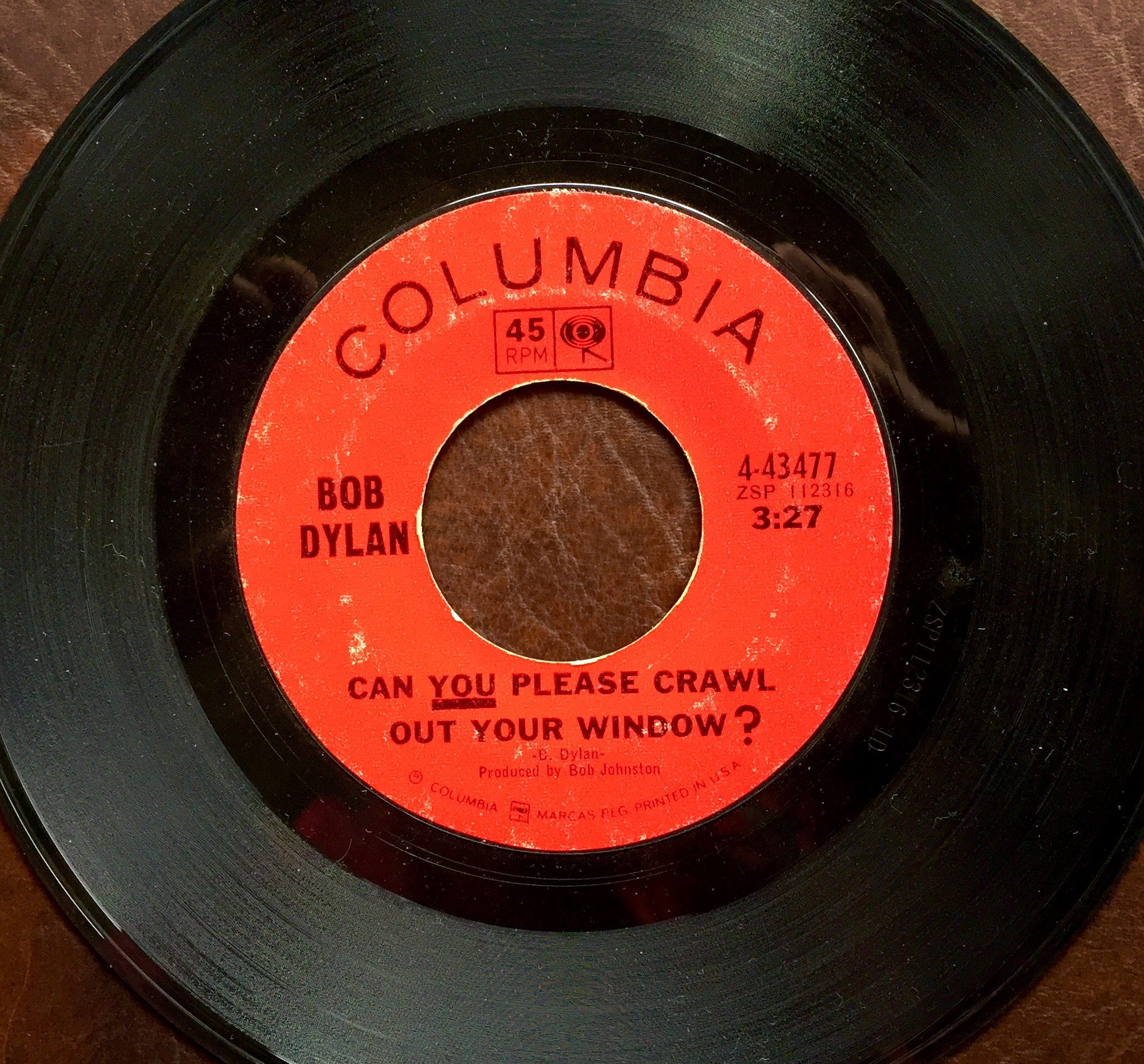
One of my prized 45s is this obscure single, released Dec. 21, 1965.

One of my prized 45s is this obscure single, released Dec. 21, 1965.

Well, I try my best
To be just like I am
But everybody wants you
To be just like them
They say sing while you slave and I just get bored
I ain’t gonna work on Maggie’s farm no more.[i]

All these people that you mention, yes, I know them, they’re quite lame
I had to rearrange their faces and give them all another name
Right now, I can’t read too good, don’t send me no more letters no
Not unless you mail them from Desolation Row [ii]

Little red wagon, little red bike
I ain’t no monkey but I know what I like [iii]

Whenever the Nobel Prize for literature is announced, the American response is often “Who?” In our cultural insularity, few of us know their work or even their names. Not this year. Everybody’s heard of Dylan, and many can recite his lyrics.

The surprise in 2016 stems from the bursting of old academic wineskins. What constitutes literature, anyway? Some of the literary establishment are unhappy that a songwriter tainted with lower-brow genres of popular culture (and currently performing in Las Vegas!) should steal the laurels from more “serious” candidates such as Syrian poet Adonis or Kenyan novelist Ngugi Wa Thiong’o. It’s “a joke,” fumed one French writer. A Scottish novelist dismissed the Nobel committee as “gibbering hippies.” [iv]

But if the linguistic arts trace their origins to the sung poetry of shared rituals, and Homer, the father of western literature, was a blind singer-songwriter who never put pen to paper, then Dylan can justly claim an ancient lineage, and stretching the definition of literature to include his work seems more restoration than innovation.

While Dylan’s jumping the queue ahead of American writers like Philip Roth, Joyce Carol Oates, and Don DeLillo might seem inappropriate to some, it is at least defensible. Oates herself calls the award “an inspired and original choice. His haunting music and lyrics have always seemed, in the best sense, ‘literary.’” [v]

Dylan has certainly had his down periods of uneven albums and terrible concerts. I myself have endured one too many evenings of mumbled words, mangled melodies, and an almost contemptuous stage presence. But to sustain such an influential and ever-evolving body of work over half a century, bridging the cultural divide between high and low, making the play of language a lever to move the world, is an astonishing achievement. His poetic and musical gifts have so often given voice to the collective longing of our “subterranean homesick blues.” They have also taken us inward, to the places of the heart where “we sit here stranded, though we’re all doing our best to deny it.” [vi]

As Bruce Springsteen has written, “Bob pointed true north and served as a beacon to assist you in making your way through the new wilderness America had become. He planted a flag, wrote the songs, sang the words that were essential to the times, to the emotional and spiritual survival of so many young Americans . . .” [vii]

Dylan was the soundtrack for my own coming of age. During my first year of college in 1963, a classmate thrust Dylan’s first album into my hands. “You’ve got to hear this,” he said. As soon as that growling, barbaric yawp started blasting out of the speakers, I was spellbound. Like so many others, I took up the guitar just so I could play his songs. “Blowin’ in the Wind” (from his second album), was my first attempt (key of D with its easy chords). By my senior year, dozens of Dylan songs were in my repertoire. I even learned the ten-minute “Desolation Row” by heart, once performing it on Rome’s Spanish Steps, by the house where Keats died, during a post-graduate summer of hitchhiking Europe with my guitar.

In Berkeley on March 28, 1965, I caught one of Dylan’s final all-acoustic concerts, just before the release of Bringing It All Back Home, the first album in his unmatched trilogy (Highway 61 Revisited and Blonde on Blonde would follow). Ken Kesey and Allen Ginsberg were sitting up front. Hippies and Hell’s Angels mixed with students and professors. The hall was charged with anticipation. From “Gates of Eden” to “It’s All Over Now, Baby Blue,” it was an amazing night.

It was the first time I ever heard “Mr. Tambourine Man.” Top 40 radio, or even Dylan’s previous work, had not really prepared me for the trippy ride “upon that magic swirling ship.” Behind its dazzling succession of vivid images, I recognized something primal and urgent, the call to leave everything and to follow, to look everywhere for the “windy beach, far from the twisted reach of crazy sorrow.”

As a poetic equivalent of the kingdom of God, the windy beach where the Spirit blows, the space of supreme aliveness, is too little found, and never possessed. And yet, now and then, I have danced beneath its diamond sky with one hand waving free, and hope to do so again as grace permits.

I was also in the crowd on September 3 of that same year, when Dylan played the Hollywood Bowl, backed by The Hawks (later The Band) along with Al Kooper on organ. There all the songs from Highway 61 Revisited were performed in public for only the second time (after a New York concert the previous week). Since the album had yet to hit the stores, it was my indelible first communion with the image world of Dylan’s surrealism. “There’s something happening here, but you don’t know what it is.”[viii]  Indeed.

The encore was “Like a Rolling Stone,” the one song we already knew from the radio. Before beginning, Dylan searched among his harmonicas in vain, then spoke into the microphone, “Anyone got a C harmonica?” As I remember it, 17,000 harmonicas came flying onto the stage, and soon we were all shouting with one voice, “HOW DOES IT FEEEEEEEL?”

When, in 1966, I crossed the country to study at the Episcopal Theological School in Cambridge, Massachusetts, my guitar and my Dylan records came with me. In a school play, I sang an adapted version of “With God On Our Side” to parody the horrific biblical conquest narratives. I wrote an article on the prophetic theology of Dylan’s lyrics in the seminary journal. And I incorporated fragments of his haunting religious poetry from John Wesley Harding into a multimedia senior sermon (you can hear the audio collage here).

In later years, Dylan’s preeminence in my life’s soundtrack receded, although his masterpiece of anguish and longing, Time Out of Mind, managed perfectly to coincide with my own midlife dark night of the soul. Lines like “It’s not dark yet, but it’s getting there” may not have been balm in Gilead, but they kept me company until the dawn.

These days I occasionally sing old favorites like “Ramona,” “She Belongs To Me,” “Chimes of Freedom” and “Buckets of Rain.” And I never tire of leading friends and retreat groups in heartfelt renderings of “Knockin’ on Heaven’s Door” and “I Shall Be Released.”

Everyone’s got their Dylan stories, but at their core is a mysterious absence. Dylan’s identity has always been veiled by a succession of fictions, evasions, conversions and withdrawals. He has given interviews full of absurd biographical narratives.[ix] Even before he was famous, he invented personae to protect himself from the prying projections of others. From fixtures and forces and friends your sorrow does stem, that hype you and type you, making you feel you gotta be just like them. [x]

Does it matter whether we ever know the real Dylan, or find him a relatable personality? Or are the songs enough? Is their mysterious power to speak to us and for us enough?

“It’s like a ghost writing a song like that,” Dylan said about “Like a Rolling Stone” 40 years after recording his greatest hit. “It gives you the song and then it goes away. It goes away.”[xi] The ghost, the geist, the spirit blows where it will. The artist prepares to receive it, and learns how to give it away.

Another Nobel Laureate, poet Czeslaw Milosz, concurs, insisting that the artist’s vocation is to be “a secretary of the invisible.” Deliver the message entrusted to your keeping, then get the hell out of the way. It ain’t me, babe. This has been the essential kenosis of both art and spirit since the beginning.

Take Caedmon, for example. An illiterate herdsman in seventh-century Britain, he was suddenly commanded in a dream to sing the story of creation. Without learning or training, he began to sing words unknown to him, gifts from the same ghost who visited Dylan. Thus was English poetry born.

Denise Levertov imagines Caedmon’s in-spiriting in a poem of her own. He is huddling for warmth at night with the beasts of the barn, when suddenly the air is filled with “feathers of flame, sparks upflying.” The cows remain oblivious and calm, not seeing what the poet sees as “that hand of fire / touched my lips and scorched my tongue / and pulled my voice / into the ring of the dance.” [xii]


[i] Bob Dylan, “Maggie’s Farm” (Bringing It All Back Home)

[ii] Bob Dylan, “Desolation Row” (Highway 61 Revisited)

[iii] Bob Dylan, “Buckets of Rain” (Blood on the Tracks)

[iv] “Writers divided on whether Dylan deserves Nobel prize”: https://www.yahoo.com/news/writers-divided-whether-dylan-deserves-nobel-prize-180943929.html

[v] ibid.

[vi] Bob Dylan, “Visions of Johanna” (Blonde on Blonde)

[vii] Bruce Springsteen autobiography, Born To Run, q. on Springsteen’s website: http://brucespringsteen.net/news/2016/bruce-springsteen-on-bob-dylan

[viii] Bob Dylan, “Ballad of a Thin Man” (Highway 61 Revisited)

[ix] To delve into the strange world of Dylan interviews: http://www.vulture.com/2007/10/the_ten_most_incomprehensible.html

[x] Bob Dylan, “Ramona” (Another Side of Bob Dylan)

[xi] Robert Hilburn, “Rock’s Enigmatic Poet Opens a Long-Private Door,” Los Angeles Times, April 4, 2004

[xii] Denise Levertov, “Caedmon”, q. in Edward Hirsch, Poet’s Choice (New York: Harcourt, Inc., 2006), 15

Why Do We Work? A Labor Day Reflection

Good work is a way of living… it is unifying and healing. It brings us home from pride and despair and places us responsibly within the human estate. It defines us as we are, not too good to work with our bodies, but too good to work poorly or joylessly or selfishly or alone.

— Wendell Berry) [i]

Labor Day began in the late nineteenth century as both an homage to American workers (parade, speeches) and a time of re-creation (picnic, dance, fireworks). Congress declared it a national holiday in the aftermath of a contentious railroad strike in 1894, where 30 workers died in violent confrontations. It was hoped that honoring workers would ease tensions and foster social harmony. As the Department of Labor currently describes it, the first Monday in September “is dedicated to the social and economic achievements of American workers. It constitutes a yearly national tribute to the contributions workers have made to the strength, prosperity, and well-being of our country.” [ii]

The holiday’s explicit homage to labor has long been overshadowed by its seasonal significance as the American farewell to summer—one last stretch of fun in the sun before the year gets busy again. But in our overworked culture, where the inbox follows you everywhere and vacations are a fraction of what Europeans enjoy, could we not make some time to reflect together about the nature of labor? What if churches were to revive the notion of Labor Sunday, where our tools could be blessed and the spirituality of work considered? [iii]

In the Bible, the pleasures of a perpetual weekend in Eden ended abruptly when God created Monday morning as a curse upon the first humans, who evidently needed to learn things the hard way. “By the sweat of your face” will you earn your daily bread,” said the Creator.[iv] The story was a way of thinking about the question, Why do we have to work so darn hard? Before the Fall, Adam and Eve were given light duties of tending the well-watered garden, more like an aristocrat’s hobby than the grueling subsistence farming bequeathed to their descendents.

Hard-working humans have been reminiscing ever since about the “happy Eden of those golden years.” [v] Stephen Duck, an eighteenth-century English poet-priest, voiced the complaint of the exploited farmworker.

Let those who feast at Ease on dainty Fare
Pity the Reapers, who their Feasts prepare …
Think what a painful Life we daily lead;
Each morning early rise, go late to Bed …
No respite from our Labour can be found;
Like Sisyphus, our Work is never done …[vi]

The justice issues arising around working conditions, exploitation, and economic inequality are themselves the shared work of any society worth its name. My ideal Labor Day would involve some serious community conversation—more listening than talking—about these things. But I would also be curious to explore the spirituality of work as well. Why do we do whatever we do? Does it give us joy? Does it matter?

An old Scottish drinking song provides a succinct answer in its praise of various occupations. The carpenter’s verse suggests the inner satisfaction of work well done, honors the process as well as the product, and celebrates the interdependence of the social world where each of us benefits from the labor of others:

Here’s a song for the carpenter, may patience guide your hand,
For the dearer your work to you, the longer it will stand.
And when the wind is at our door, we never will forget;
We’ve sung your praises many a time, and so will we yet. [vii]

Like our Creator, we are all makers and doers who enjoy the fulfillment of intentions and the solving of problems. It’s in our nature to see what needs to be done and then take a hand in making it so. We also find pleasure in the solidarity of labor, not only through our relationships with coworkers but also in the awareness of practicing a skill handed down by so many mentors and predecessors.

In an imperfect and often unjust society, not everyone has access to employment that delivers pleasure or meaning in itself, but one’s paying job may still be part of a larger labor which is absolutely worth doing, such as supporting a family or funding a future dream. Studs Terkel, who collected oral histories of countless Americans, believed that all of us long for meaningful work. “I think most of us are looking for a calling, not a job,” he said. “Most of us … have jobs that are too small for our spirit.” [viii]

Lewis Hyde makes a useful distinction between “work” and “labor.” Work is done by the hour, on the clock, usually for money. Its value is quantified, and has economic exchange value. Labor, on the other hand, keeps its own schedule, sets its own pace, and may include time off or even sleep as part of its process. Its social value may be clear, but its economic value is hard to quantify. Its product is not a commodity to exploit but a gift to share. “Writing a poem, raising a child, developing a new calculus, resolving a neurosis, invention in all forms—these are labors.” So are volunteer work, ministry, visiting the sick and the prisoner, gardening, personal soul work and “the slow maturation of talent.” [ix] Such labor is priceless.

Most of us have performed both work and labor, as well as hybrids which include elements of both. As Citizen Kane’s financial advisor said, “It’s no trick to make a lot of money, if all you want is to make a lot of money.” But the truer and nobler task is to cooperate with the Creator in repairing the world to make it a place of beauty, love and justice.

So my Labor Day question is this: Where and how can we do the labor to which we are called, the thing which étienne Souriau has called the “Angel of the work” [x]— that which gives us joy and blesses others?

There’s another verse in that Scottish song which thanks the singers who keep their voices clear:

For the world as you would have it be,
you sing with all your wit,
And ease the work of Providence,
and so will we yet.

In that spirit, I leave you with two such singers, Joan Baez and her sister Mimi Farina, who “ease the work of Providence” by voicing the universal human right to flourish: bread, yes, but roses too!


[i] Wendell Berry, The Unsettling of America, q. in Karen Speerstra, ed., Divine Sparks: Collected Wisdom of the Heart (Sandpoint, ID: Morning Light Press, 2005), 520

[ii] Department of Labor website: https://www.dol.gov/general/laborday/history

[iii] This was instituted by churches as a companion to Labor Day, but has fallen into disuse.

[iv] Genesis 3:19

[v] John Clare, “Helpstone” (1809) q. in Raymond Williams, The Country and the City (Oxford & New York: Oxford University Press, 1973), 10

[vi] Stephen Duck, “The Thresher’s Labour” (1730), in Williams, op. cit., 88

[vii] The original, “Sae Will We Yet,” is attributed to Walter Watson, but I believe the carpenter verse is a contemporary addition by Ossian’s Tony Cuffe. A fine version by Gordon Bok, Ann Muir, and Ed Trickett is here: https://www.youtube.com/watch?v=h48Db_cvdDE

[viii] In Speerstra, op. cit., 519

[ix] Lewis Hyde, The Gift: Imagination and the Erotic Life of Property (New York: Vintage Books, 1979), 50

[x] étienne Souriau, q. in Isabelle Stengers, Thinking with Whitehead: A Free and Wild Creation of Concepts, trans. Michael Chase (Cambridge, MA: Harvard University Press, 2011), 464

American violence: Where do we go from here?

Contemplating Kehinde Wiley's "Morpheus" at the Seattle Museum of Art

Contemplating Kehinde Wiley’s “Morpheus” at the Seattle Museum of Art

O Lord, mercifully receive the prayers of your people who call upon you, and grant that they may know and understand what things they ought to do, and also may have grace and power faithfully to fulfill the same … (Book of Common Prayer)

Every Sunday in the liturgical year has a Prayer for the Day, and this is the one recited in Episcopal churches annually on the Eighth Sunday after Pentecost, which in 2016 happened to be July 10. After a week filled with so much troubling violence in America, it was a prayer we badly needed. How in such times can we know and understand what we ought to do? Who will supply the grace and power to find a constructive way forward?

So many words have been written and spoken in recent days as thoughtful people try to grasp where we are, how we got here, and where we must go. It’s an important and necessary conversation, and I feel the imperative, as all responsible citizens must, to add my own voice to the dialogue. I should say something, but I don’t know exactly what. I can hear T. S. Eliot whispering in my ear: “Wait without thought, for you are not ready for thought.”[i]

I have been on vacation, enjoying the Olympic Track & Field Trials in Oregon, staying in a house without television. I’ve heard and read some news, but have not been steeped in constant reportage. And I’ve not seen a single image of the violence. Although columnist Leonard Pitts interrupted his own vacation in Greece to write that “America has gone mad and there’s no place to hide,” I have maintained a certain religious distance from the immersive angst of endless news, since it is only at our peril that we compromise personal Sabbaths. So I am less informed than most about the events of recent days.

But I have read some commentary, and I was particularly struck by Andrew O’Hehir’s Salon article, “Death in Dallas and America’s existential crisis: Our new ‘civil war’ over the nature of reality.”[ii] He describes an America “divided not just by race, culture and ideology, but between competing versions of reality.” While political conflict, culture wars and violent acts have always been with us, today’s “mutual incomprehension” and a “near-total inability to communicate” have not. Competing sides live in alternative universes where mutually acknowledged facts are hard to come by.

At a recent confrontation between demonstrators and counter-demonstrators, a reporter stood in the street between them, taking notes on the slogans and epithets being shouted from opposite sidewalks. A policeman told her she couldn’t stay in the middle of the street. “You have to stand on one side or the other,” he said.

But is there really no place to stand between irreconcilable polarities, no place where we can honor one another with the gift of listening? O’Hehir puts the question in vivid terms:

“Which would be more useful: For me to confront the fact that large numbers of my fellow citizens really believe that black radicals are waging a race war against white America and the police, and that Obama and Hillary Clinton hope to flood the country with Muslims and Mexicans while building socialism? And then try to figure out what the hell happened, and whether I can do anything to bridge the gap between that reality and mine? Or for me to carry on ridiculing others for their paranoid and superstitious beliefs, and congratulating myself for being a product of my class and educational background?”

Can we explore ways to listen to one another? To learn each other’s names, to hear each other’s stories, to understand one another’s language? To risk being stretched and challenged by alternate perspectives?

Such conversation ought to be be curated in churches, schools, homes and civic spaces. But what about the overheated environment of a protest situation? Even there? What would happen if there were a designated “argument-free” listening space at every demonstration, where people could speak without being judged, and the real pain and anxiety beneath the reactive and polarizing rhetorics could be received and acknowledged with respect and compassion?

Impossible? Then let the artists and saints show us how. Dostoevsky, for example, envisioned an improbable example of compassionate listening in The Brothers Karamazov. The brothers and their father are meeting with the saintly Father Zossima at his monastery in the hope of resolving a bitter family dispute. It doesn’t take long for the elder Karamazov and his son Dimitri to disgrace themselves before the holy monk as they bicker and shout and wish each other dead. But instead of intervening with words, Zossima suddenly kneels before Dimitri to kiss his feet. No one knows what to make of this unseemly action, but the monk later explains that when he realized the depth of Dimitri’s inner pain, and foresaw how much suffering it would bring him, he was impelled to make an extreme gesture of compassion. Instead of being sucked into the specific content of the argument, Father Zossima had perceived the pain and suffering behind it, and responded with unconditional love.

And so must we all. As Bobby Kennedy told a shocked and grieving black audience the night Martin Luther King was shot:

“What we need in the United States is not violence and lawlessness, but love and wisdom and compassion toward one another, and a feeling of justice toward those who still suffer in our country, whether they be white or whether they be black.”[iii]

Related posts

Beyond Punch and Judy: The Art of Nonviolent Resistance

After Paris and Beirut, What Kind of Story Shall We Tell?

[i] “East Coker” in Four Quartets

[ii] http://www.salon.com/2016/07/09/death_in_dallas_and_americas_existential_crisis_our_new_civil_war_over_the_nature_of_reality/

[iii] Speech in Indianapolis, Indiana, April 4, 1968: http://www.jfklibrary.org/Research/Research-Aids/Ready-Reference/RFK-Speeches/Statement-on-the-Assassination-of-Martin-Luther-King.aspx

Is the American Dream a Con Game?

L.A. Times TV Guide cover, June 2, 1968, two days before Robert Kennedy's assassination in Los Angeles (Jim Friedrich personal archive)

L.A. Times TV Guide cover, June 2, 1968, two days before Robert Kennedy’s assassination in Los Angeles (Jim Friedrich personal archive)

Oftener it falls, that this winged man, who will carry me into the heaven, whirls me into the clouds, then leaps and frisks about with me from cloud to cloud, still affirming that he is bound heavenward and I, being myself a novice, am slow in perceiving that he does not know the way into the heavens, and is merely bent that I should admire his skill to rise …

— Herman Melville, The Confidence Man

In Melville’s final novel, a ‘mysterious stranger’ boards a Mississippi riverboat on April Fools Day, initiating a series of scams upon the gullible passengers. Appearing in various guises, the stranger collects money for distant charities, solicits investments in get-rich-quick schemes, and sells miracle cures, all the while encouraging his marks to have confidence in the dream of better lives and a better world. He is the “winged man” who promises to carry them “heavenward.”

However, the marks soon learn that the hopes and dreams on offer are a total fraud. Melville describes the inevitable disillusion: “I tumble down again soon into my old nooks, and lead the life of exaggerations as before, and have lost the faith in the possibility of any guide who can lead me thither where I would be.”[i]

That riverboat still haunts the American imagination. We fall in love with dreams and schemes of better futures, better selves, a “life of exaggerations,” and invest our confidence in those who promise to deliver. This may work out for some, but more often there is the sting of disappointment, a sense of betrayal. As Greil Marcus has written, “America is a trap: its promises and dreams … are too much to live up to and too much to escape.”[ii]

Unattainable promises. Impossible dreams. The lonely crowd grows sullen, resentful, angry, like Nathanael West’s California dreamers in Day of the Locust (1939). Lured by the prospect of a New Eden out West, over the rainbow, they slave and save until they can afford to move to “the land of sunshine and oranges.”

Once there, they discover that sunshine isn’t enough. They get tired of oranges . . . Nothing happens. They don’t know what to do with their time . . . They realize that they’ve been tricked and burn with resentment . . . They have been cheated and betrayed. They have slaved and saved for nothing.[iii]

W. H. Auden described West’s novel as a parable “about a Kingdom of Hell whose ruler is not so much a Father of Lies as a Father of Wishes.”[iv] Either way, it’s a figure we all recognize: the Confidence Man, duping the suckers with his promise to make America great again. “Believe me. Believe me. It’s going to be terrific.”

And what happens when the dreamers tumble back to earth? Most of us muddle on as best we can, but in Stephen Sondheim’s darkly comic musical, Assassins[v], nine embittered and unbalanced Americans find a single target for their anger: the President of the United States. In a carnival of lost souls, a smirking barker (the Confidence Man in disguise!) doles out handguns like cotton candy to a new crop of eager marks. If you keep your goal in sight,” he sings, “you can climb to any height. Everybody’s got the right to their dreams.”

No job? Cupboard bare?
one room, no one there?
Hey, pal, don’t despair-
You wanna shoot a president?
c’mon and shoot a president…

John Wilkes Booth, Leon Czolgosz, Charles Guiteau, Squeaky Fromme, Sara Jane Moore, John Hinckley and a couple more broken dreamers line up to claim a gun as their means of grace and hope of glory.

And all you have to do
Is move your little finger,
Move your little finger and
You can change the world.

The climax takes us to Dallas, where the gang of murderous misfits pressures Lee Harvey Oswald to join their ranks and assuage their shared malady: “a desperate desire to reconcile intolerable feelings of impotence with an inflamed and malignant sense of entitlement.”[vi]

In the finale, all nine assassins come to the front of the stage, singing out with all the confident uplift we expect from our musicals:

Everybody’s got the right to some sunshine!
Not the sun, but maybe one of its beams.
Rich man, poor man, black or white,
Everybody gets a bite,
Everybody’s got the right
to their dreams……

The smiling cast stretches out the last word, “dreams,” for a full twelve seconds as they raise their guns high. The moment the music ends, they all fire at once, a deafening volley, and the stage goes black.

When Assassins premiered in 1990, it was not well received. It seemed too dark and crazy at the time. But when I saw a rare revival this month at Seattle’s ACT Theater, it somehow made perfect sense, so dark and crazy has America become in these latter days.

We all clapped and cheered, of course. It was a fabulous production. The cast was great. It wasn’t all grim. There was plenty of humor. And Sondheim’s songs! But I had tears in my eyes as well. As Jefferson said, “I tremble for my country…”

As the applause went on, I thought of Kierkegaard’s story of a theater which had caught fire backstage as the show was about to begin. The manager grabbed the first actor he found to step through the curtain and warn the audience to evacuate. That actor, alas, was dressed as a clown. “The theater is burning!” he cried. “You must leave immediately!” The audience roared with laughter at the clown’s performance. Such pathos! Such irony! The more he shouted and pleaded, the more they laughed, until they were all consumed by the flames.


[i] Herman Melville, The Confidence Man: His Masquerade in Pierre, Israel Potter, The Piazza Tales, The Confidence-Man, Uncollected Prose, Billy Budd, Sailor (New York: Library of America, 1984), 452

[ii] Greil Marcus, Mystery Train: Images of America in Rock ‘N’ Roll Music (New York: E.P. Dutton, 1975), 22

[iii] Nathanael West, Day of the Locust (from my personal transcription in a 1968 commonplace journal, original page unknown)

[iv] Wikipedia reference: Barnard, Rita. “‘When You Wish Upon a Star’: Fantasy, Experience, and Mass Culture in Nathanael West” American Literature, Vol. 66, No. 2 (June 1994), pgs. 325-51

[v] 1990, music & lyrics by Stephen Sondheim, book by John Weidman

[vi] John Weidman interview, quoted in Misha Berson’s Seattle Times review, March 9, 2016

Daniel Berrigan: Sword of Wisdom, Maker of Peace

Berrigan in cuffs

There is no peace because there are no peacemakers. There are no makers of peace because the making of peace is at least as costly as the making of war— at least as exigent, at least as disruptive, at least as liable to bring disgrace and prison and death in its wake. — Daniel Berrigan[i]

On May 17, 1968, nine Roman Catholic activists broke into a draft board office in Catonsville, Maryland, transferring 378 files to the parking lot to be incinerated with home-made napalm. As the fire burned, the “Catonsville Nine” prayed for peace. They were arrested, tried and sentenced to prison, but four of them, including two priests— Daniel and Philip Berrigan— went underground, eluding capture for a number of months, occasionally surfacing to speak at antiwar rallies.

At one of these public appearances, following a dramatic tableau of the Last Supper with giant puppets, Dan Berrigan made his escape inside one of the Apostles. “I was hoping it wasn’t the puppet of Judas,” he said later. His comical getaway affirmed irrepressible life even as it mocked the powers of death. Berrigan, a puckish and playful spirit, knew that laughter could be a serious form of subversion.

After being sheltered by 37 different families, Dan Berrigan, S.J., was finally captured August 11, 1970, in the house of Episcopal lawyer and theologian William Stringfellow. He was reading Plato’s The Trial and Death of Socrates when F.B.I. agents showed up at the door.

On Palm Sunday of the following year, I designed a liturgy where two carpenters constructed a large cross near the altar during the course of the ritual. At various points, dialogue between the carpenters would interrupt the liturgical texts. The two workers expressed curiosity about the intended victim and the nature of his crime. They wondered about the morality of their own complicity in the official machinery of death. What if they just stopped making crosses? Would it make any difference? Or would they just find themselves without a job? In the end, they suppressed their doubts and finished the cross, hammering it together loudly during the eucharistic prayer: This is my body, given for you … This is my blood, shed for you …

It was no coincidence that I had just been reading No Bars to Manhood, Dan Berrigan’s compelling account of the influences and experiences underlying his Christian activism. Its conclusions were clear: as witnesses to the Resurrection, the friends of God must say no to death. No more cross-building. No more remaining passive spectators at the world’s crucifixions. “There are times so evil,” he wrote, “that the first and indeed the only genuinely prophetic function is to cast down the images of injustice and death that claim [the human being] as victim.”[ii]

A Newsweek blurb on my well-worn 95-cent paperback from 1971 reads, “Daniel Berrigan is the sort of priest who causes the lights of the Vatican to burn through the night.” The actions he took and the company he kept often strained the patience and understanding of his clerical superiors. One of his friends in the Society of Jesus told him, “Do you want to know why you’re in trouble so frequently? It’s because you and some others show us what Jesuits can be. And that’s why we can’t stand you.”[iii]

Today, when so many horrors are cloaked in euphemisms like “collateral damage,” Dan Berrigan’s truthful language still delivers a shock. His response to the charge of incinerating draft board records is justly famous:

Our apologies, good friends, for the fracture of good order, the burning of paper instead of children, the angering of the orderlies in the front parlor of the charnel house. We could not, so help us God, do otherwise. For we are sick at heart, our hearts give us no rest from thinking of the Land of Burning Children … We have chosen to say with the gift of our liberty, if necessary our lives: the violence stops here. The death stops here. The suppression of the truth stops here. This war stops here.[iv]

Even in his contentious moments with the Church, Berrigan understood his priesthood to be deeply rooted in the ethos of his religious community, where, he wrote, one’s life might “be purified of the inhuman drives of egoism, acculturation, professional pride and dread of life.”[v] In the trial of the Catonsville Nine, when asked whether such radical protest was in harmony with Catholic teaching, he replied, “May I say that if that is not accepted as a substantial part of my action, then the action is eviscerated of all meaning and I should be committed for insanity.”[vi]

For those of us who tend to play it safe in conforming our own choices to the gospel, Berrigan’s life of witness poses hard questions about discipleship and the imperatives of conscience. “He was dangerous, as holiness should be; he was a sword of wisdom.”[vii] A college student, after hearing Berrigan speak at Stanford in the late Sixties, put it this way: “Father Berrigan has raised the ante for all of us.”[viii]

That student’s religion professor, Robert McAfee Brown (one of my own most admired teachers), considered the question of whether the Berrigan brothers were signs or models. Their words and actions clearly signified the world’s sin and brokenness in parabolic gestures difficult to ignore. But were we obligated to model our lives after theirs, or might we find other ways to be faithful, according to our own distinctive calling? This question has troubled the conscience of many, including my own.

“We must continually ask ourselves why we are so attracted to them.” Brown wrote, “when we hear what they say and yet do not do the things they do … [T]heir actions provide a disturbing sign that we must take seriously, particularly if those actions are not yet the model most of us are prepared to imitate.”[ix] Brown himself had the courage to live into those questions for the rest of his life, becoming one of the most eloquent theological voices for justice and peace.

As “the man who hears handcuffs close upon him,”[x] Berrigan felt a deep kinship with biblical prisoners for God like the prophet Jeremiah. “There is a meaning to things, however dark and damaging … Jeremiah wrestles with the meaning; his wrestling is the meaning; it defines the moral substance and limits of his activity in the world. At the same time, his struggle with the unknown One interiorizes, draws to a fine point and gravity his moral life.”[xi]

Like Jeremiah, Berrigan knew a God who contends with human injustice, who plucks up and breaks down our tainted and presumptuous projects.

We are so used to an acculturated and childish religion, whose ethos has joined forces with the society— with its militarism and racism and fear of life, that we are almost illiterate before a document such as Jeremiah’s. Can it be true that God is not a Niagara of pablum, spilling His childish comfort upon the morally and humanly neutral, whose faces are raised blankly to partake of that infantile nourishment?[xii]

Not every Christian received his rhetoric gladly. And the radical priest’s liturgical fusion of sacrament and protest also drew fire. After baptizing a baby in the chapel at Cornell, he kissed the new Christian’s forehead and invited him “out of the world of war and destruction.” While presiding at an “Electric Mass for Peace” on the same campus, he made explicit connections in the eucharistic prayer between Christ’s blood and the blood shed on both sides in Vietnam. Some saw these things as careless, even blasphemous. Others found them prophetic and profoundly faithful.

Berrigan’s words and actions had a deep and lasting influence on many in the antiwar and anti-nuclear movements, as well as progressive Christians. His dramatic forms of witness also drew immense media attention, for which he took some criticism as a “media freak.” But his vocation was stronger than the temptations of celebrity. As Paul Elie, chronicler of the great twentieth century Catholic writers, noted in a New Yorker blog:

He created no foundation, nonprofit, or N.G.O.; headed no pacifist think tank or Jesuit school of advanced study; gave no TED talk; engaged in no stagey dialogues offering equal time to the military point of view; and never reframed the ideals of nonviolence in any pocket-size manual for personal growth.[xiii]

Berrigan had no neutral gear. Even when the public spotlight moved on to other subjects, his writing lost nothing of its urgency and fire. In The Discipline of the Mountain, his poetic reflection on “Dante’s Purgatorio in a Nuclear World,” he wrote, “There is a hell for those who go too far, and there is a hell, or at least an anteroom of hell, for those who refuse to go far enough.”[xiv] Going far enough for the sake of the gospel was the driving force of his life. But as he once confessed to Robert Coles, “We are groping. We shouldn’t be sure of ourselves, because we can’t be, not now— not ever.”[xv]

Only death is sure, and that finally came last week, on Orthodox Holy Saturday, to Daniel Berrigan, S.J., in his 95th year. I barely knew him, hearing him preach twice and breaking bread with him once in a Los Angeles rectory. But this loss feels personal. He was both sign and model for many priests of my generation, and there are things he said which haunt me still.

In 1964, midway in his life’s journey, Berrigan imagined the moment of his own death:

As I walk patiently through life
poems follow close …

The poem called death
is unwritten yet. Some day will show
the violent last line,
the shadow rise,
a bird of omen

snatch me for its ghost.
And a hand somewhere, purposeful as God’s
close like two eyes, this book.[xvi]

And then what? Only faith can say, that Easter faith which alone can contain and complete the fullness of human life. At the end of his meditation on Dante’s Purgatorio, the poet/priest peers beyond death’s horizon to see a resurrected humanity being gathered into God.

Leading the way are “the intractable ones” who have suffered prison, torture and martyrdom for their faithful witness. In them we see at last “the human venture vindicated.” Their faces and Christ’s face become as one, in an upward gaze that “breaks the glacial will of God.”[xvii]

They embrace         one after another
Tears    laughter     two weathers
contending in one sky


[i] Daniel Berrigan. S.J., No Bars to Manhood (New York: Bantam Books, 1971), 49

[ii] ibid., 97

[iii] ibid., 19

[iv] q. in Robert McAfee Brown, “The Berrigans: Signs or Models?”, in The Berrigans, ed. William Van Etten Casey, S.J. & Philip Nobile (New York: Praeger Publisher, 1971), 62

[v] q. in Edward Duff, S.J., “The Burden of the Berrigans,” in The Berrigans, 19

[vi] ibid., 15

[vii] Daniel Berrigan, The Discipline of the Mountain: Dante’s Purgatorio in a Nuclear World (New York: The Seabury Press, 1979), 99. The quote is by Berrigan, describing “an Indian holy man” with whom he once led a retreat. But it also seems aptly applied to Berrigan himself.

[viii] R.M. Brown, 61

[ix] ibid., 66, 69

[x] No Bars, 99

[xi] ibid., 96

[xii] ibid., 97

[xiii] Paul Elie, “Postscript: Daniel Berrigan, 1921-2016” (New Yorker online, May 2, 2016)

[xiv] Discipline, 39

[xv] Robert Coles, “Thinking About Those Priests,” in The Berrigans, 219

[xvi] Daniel Berrigan, “A Dark Word,” Poetry Magazine, April 1964, online at http://www.poetryfoundation.org/poetrymagazine/browse?contentId=29700

[xvii] Discipline, 119-120

Beyond Punch and Judy: The art of nonviolent resistance

image

In Faith and Violence, a book published amid the political turbulence of 1968, Thomas Merton told an old Hasidic story about two men, one drunk and one sober, who were beaten and robbed as they traveled through the forest. Asked later about what had happened, the sober one described the violent encounter in vivid detail, but the drunken one seemed quite placid. “We’re all right,” he said. “Everything is fine.” Merton went on to observe that for some, faith “seems to be a kind of drunkenness, an anesthetic, that keeps you from realizing and believing that anything can ever go wrong.” But, he asked, is faith a “narcotic dream” or is it “an awakening”? Then he delivered his punch line: “What if we were to awaken to discover that we were the robbers, and our destruction comes from the root of hate in ourselves.”[i]

At a time when a brutal war was raging in the jungles of Vietnam, police and protestors were clashing in the American street, and leaders who spoke out for justice and peace were being assassinated, a monk dedicated to contemplative retreat from the world felt compelled to explore the theology of love in an age of violence, one which would “deal realistically with the evil and injustice of the world.”[ii] How do we resist the violence in our society without adding our own anger and demons into the mix? How do we resist systemic and social sin while harboring no illusions about our own capacities to do harm?

In recent days there have been numerous conversations about the escalating political violence surrounding the Trump campaign. My own post (March 12) on the topic has generated heartfelt responses of shared concern. Many of us are wondering what we can do about the situation without defaulting to our own versions of anger or fear. We need experienced guides through such tricky terrain, and Thomas Merton is one of the best.

“We no longer communicate,” Merton said. “We abandon communication in order to celebrate our own favorite group-myths in a ritual pseudo-event.”[iii] He wrote that in the Sixties, but he could have been describing a Trump rally, which, in the absence of substantive content, is mostly a ritual acting out of a group-myth, reaching its crescendo in the anticipated expulsion of protesters. As Rachel Maddow showed in a recent montage of those expulsions, Trump repeatedly asks the crowd, “Isn’t this exciting?” Roughing up protesters may express anything from personal rage to fascist methodology, but it is also entertainment. As Neil Postman has noted, Americans like “amusing ourselves to death.”[iv] When the anti-Trump signs come out, the crowd gets happy, knowing the real fun is about to begin.

This is all contemptible and sad. But I wonder: how do protestors avoid becoming unwitting collaborators in Trump’s entertainments? Even if they don’t hit back or give the crowd the finger, how do they escape complicity in a political Punch and Judy show? How do they avoid getting their own group-myths stuck in the futility of an endless ritualized dualism of “us versus them”?

Blessed are the peacemakers, for they shall be called the children of God. The peacemaker is committed to communion as the nature and destiny of humankind. As Martin Luther King said in a speech I remember from my college days, we must see the face of Christ even in the police who are attacking us with dogs and fire hoses. Or as Jesus himself taught, we must love our enemies. That does not mean capitulating to evil, or abstaining from the tainted ambiguities of political conflict. But it does mean that we ultimately belong to a much better story, where one day the tears will be wiped from every eye, the lion will lie down with the lamb, and the prodigal will be welcomed home. It means that our highest commitment is not to defeat our enemies but to make the divine love story of amazing grace come true for everyone.

As Merton wrote, “Christian nonviolence is not built on a presupposed division, but on the basic unity of [humankind]. It is not out for the conversion of the wicked to the ideas of the good, but for the healing and reconciliation of … the human family.”[v] This isn’t sentimental benevolence or passive submission. It’s a very tough form of love, as Jesus, Gandhi, King and many others have demonstrated in their costly commitment to a wider, more generous perspective than the self-righteous justifications of partisan interests. Our struggles must always reject the ultimacy of division in favor of communion. “The key to nonviolence,” Merton reminds us, “is the willingness of the nonviolent resister to suffer a certain amount of accidental evil in order to bring about a change of mind in the oppressor.”[vi]

But how do we apply this wisdom to the specific challenges of our own day? How can we respond creatively to the upwelling of anger, fear, racism and nativism poisoning our public life? In 1968, Merton compiled a list of principles for nonviolent resisters which is worth considering. While he admitted that the complexity and fluidity of events in that turbulent year could make any opinion lose its value in a matter of weeks, I believe his prescriptions retain an enduring value:

1) “be free from unconscious connivance with an unjust and established abuse of power”

2) “be not for [oneself[ but for others, that is for the poor and underprivileged”

3) “dread a facile and fanatical self-righteousness and refrain from being satisfied with dramatic self-justifying gestures”

4) demonstrate “a desirable alternative” to violence and injustice

5) use means which embody and manifest the emergent way of being which Christians call the Kingdom of God

6) be “willing to learn something from the adversary”

7) be grounded in hope and humility – what we strive for is a gift from God’s future: not of our own making, and not yet fully here [vii]

I particularly like Number 4 (demonstrate a desirable alternative) and Number 6 (embody and manifest the Kingdom of God). It is what we do in the eucharist, where everyone is welcome, everyone practices reconciliation, and everyone shares the bread of heaven. But can we take such countercultural vision into the street?

Yes we can. There are various ways (many of which have yet to be invented!). Even into her nineties, my mother joined the “women in black” every Friday in silent vigil against the Iraq war on the streets of Santa Barbara. Their faithful witness was impossible to ignore, while at the same time it perfectly embodied the peace for which they stood.

A very different display of visionary resistance occurred at the World Trade Organization (WTO) protests in Advent of 1999. Those who watched the news only saw the Punch and Judy show of untrained police and young provocateurs turning a shoving match into a tear-gassed conflict. But the most important things that happened were not on television. This is what I myself witnessed on the day of the big rally and march[viii]:

There was a large banner which read, AN INJURY TO ONE IS AN INJURY TO ALL. It seemed a perfect summary of the gospel: “If you do it to one of the least of my brothers and sisters, you do it to me.” All in Christ, Christ in all. Solidarity forever. We were there to speak for all those whom the WTO would rather silence or forget – voices crying in the wilderness, “Prepare the way of the Lord.”

At 12:30 pm, we took to the streets, marching up Fourth Avenue. to join the thousands more who were already downtown. It was a wonderfully diverse procession: there were people dressed as Santa Claus, sea turtles, trees, and even death. But it was not some crazy fringe out there. As one writer put it, “These were the kids at UW, the ladies from church, the guys at Boeing. It was Seattle that was marching this week.”

As in all street rituals, there was a playful, carnival atmosphere. As Richard Shechner observes in his book, The Future of Ritual:

“When people go into the streets en masse, they are celebrating life’s fertile possibilities…They put on masks and costumes, erect and wave banners, and construct effigies not only to disguise or embellish their ordinary selves, or to flaunt the outrageous, but also to act out the multiplicity each human life is…They protest, often by means of farce and parody, against what is oppressive, ridiculous and outrageous…Such playing challenges official culture’s claims to authority, stability, sobriety, immutability and immortality.”[ix]

In other words, we were exhibiting the same spirit – dare I say “holy spirit”? – of playfulness, camaraderie, irony and subversion that was seen ten years ago at Tiananmen Square and the Berlin Wall and, during biblical times, at the Red Sea and the Triumphal Entry on Palm Sunday. And as faith tells us, the powers don’t stand a chance against the foolishness of God.

There were people on stilts, people carrying giant puppets, babies in carriages and elders with canes and walkers. I stuck close to the Anti-Fascist Marching Band, which played soulful New Orleans versions of “America the Beautiful”, “Battle Hymn of the Republic” and Bob Dylan’s “Masters of War.” We all just danced up Fourth Avenue …

So, my friends, how shall we do the Kingdom dance in the year of grace 2016?


[i] Thomas Merton, Faith and Violence: Christian Teaching and Christian Practice (Notre Dame, Indiana: Indiana University Press, 1968) ix-x (All quotes from Faith and Violence are in The Thomas Merton Encyclopedia (New York: Orbis Books, 2002) under the entry on Merton’s book, but I have listed the original volume’s page numbers in the footnotes.)

[ii] ibid., 9

[iii] ibid., 159

[iv] Neil Postman, Amusing Ourselves to Death: Public Discourse in the Age of Show Business (New York: Penguin, 2005)

[v] Merton, 15

[vi] ibid., 27-28

[vii] ibid., 21-25

[viii] From a sermon I preached the following Sunday at St. Augustine’s-in-the-Woods Episcopal Church, Whidbey Island, WA (Advent II, 1999))

[ix] Richard Schechner, The Future of Ritual: Writings on Culture and Performance (London & New York: Routledge, 1993), 46

How far can we sink? – Donald Trump and the vortex of rage

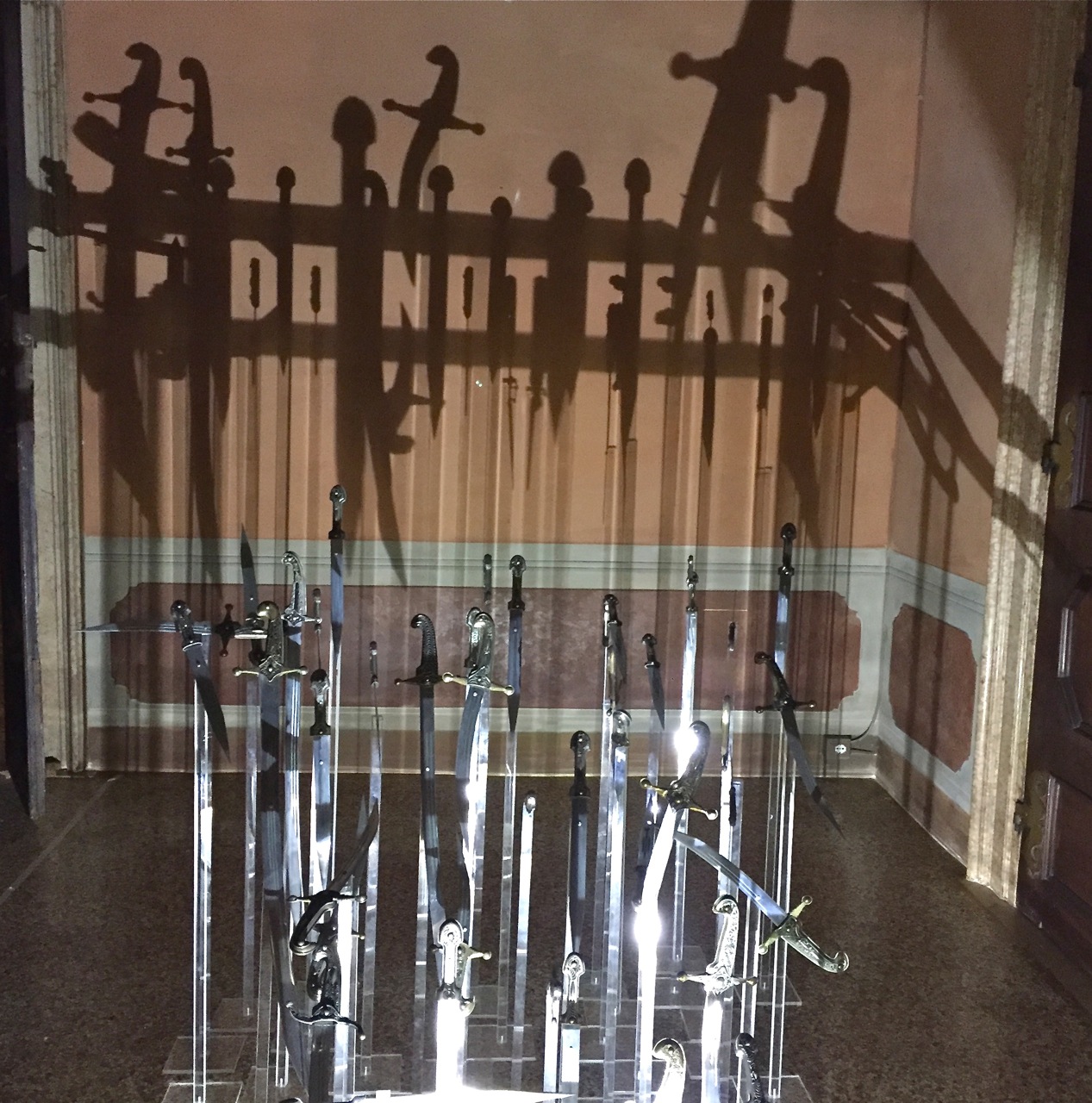
Rashad Alakbarov, "Do Not Fear," installation at Venice Biennale 2015

Rashad Alakbarov, “Do Not Fear,” installation at Venice Biennale 2015

We must love one another or die.

— W. H. Auden, “September 1, 1939”

In the early 1930s, about a hundred communists crashed a Nazi meeting in Bremen, Germany, determined to break it up. One of them, Richard Krebs, rose to interrupt a speech by Herman Göring, head of the notorious SA stormtroopers, a paramilitary group dedicated to political intimidation and violence. Krebs only got out a few words before the “brownshirts” rushed toward him. As Krebs later wrote,

“A terrifying mêlée followed. Blackjacks, brass knuckles, clubs, heavy buckled belts, glasses and bottles were the weapons used. Pieces of glass and chairs hurtled over the heads of the audience. Men from both sides broke off chair legs and used them as bludgeons. Women fainted in the crash and scream of battle. Already, dozens of heads and faces were bleeding, clothes were torn as the fighters dodged about amid masses of terrified but helpless spectators. The troopers fought like lions. Systematically they pressed us on towards the main exit. The band struck up a martial tune. Hermann Göring stood calmly on the stage, his fists on his hips.”[i]

A political life fraught with such violent thuggery once seemed unimaginable in contemporary America. What happened in Germany could never happen here, we tell ourselves. Physical violence as a routine form of political expression is not something we expect our leaders to tolerate, much less encourage. What, then, are we to make of the violent anger which has become a common feature of Donald Trump rallies?

At one such gathering, a man held up a sign, “Make America hate again!” The crowd happily obliged, ripping up the sign and roughing up the protester. At another rally, on March 10, a 78-year-old man in the crowd sucker-punched a young activist as he was being escorted out of the arena by Trump’s security guards. “He deserved it,” the man told a reporter. “Next time, we might have to kill him.”[ii]

In Ashley Parker’s excellent New York Times piece on this phenomenon, she sees the crowd’s violent reaction as “almost biological”:

“Trump supporters typically begin shouting, pointing, jeering — and sometimes kicking or spitting — at the protester, surrounding the offender in a tight circle, like antibodies trying to isolate and expel an unwanted invader from the bloodstream.”[iii]

Is Trump to blame for the passions of his followers? He has made some cursory disclaimers after the fact, but when the anger erupts he does little to discourage it.

On February 1, he told an Iowa crowd to be on the lookout for protesters with tomatoes. “If you see somebody getting ready to throw a tomato, knock the crap out of ‘em, would you? Seriously. Okay? Just knock the hell – I promise you, I will pay for the legal fees, I promise, I promise.” Later that month, as a protester was being ejected from another rally, Trump said, “I’d like to punch him in the face.”[iv] It is hard to listen to this stuff without thinking of Göring in Bremen, standing “calmly on the stage, his fists on his hips.”

When asked by reporters about the violence, Trump talks about “the good old days” when America wasn’t “weak,” and you were able to dish out a well-deserved pummeling. “This country has to toughen up,” he says. “These people are bringing us down.”[v]

Such scapegoating is one of the hallmarks of fascism. Instead of the hard work of developing concrete policies and building support for them, the leader simply invokes fear and hatred of “the other” to unite his followers. Trump repeatedly demonizes protesters as “nasty people” and blames them for initiating the violence, even though no reporter or camera has seen anything to support his claim, except for one thrown tomato that is said to have missed the mark.[vi] This one-sidedness may change, of course, for violence can be highly contagious.

Trump has argued that his supporters are not really angry people, but that they “do get angry when we see the stupidity with which our country is run and how it’s being destroyed.”[vii] His rhetoric bears a chilling resemblance to the Nazi justifications for Kristallnacht: “an expression of the people’s rage” …. “ “a just measure of indignation”… “our patience is exhausted.”[viii]

A few days ago, Trump described an incident at an earlier rally. “He was a rough guy and he was punching. And we had some people – some rough guys like we have right in here – and they started punching back. It was a beautiful thing.”[ix]

In this week’s Republican presidential debate, the three other candidates were given the opportunity to condemn the political violence of Trump’s mob, but they kept silent. Maybe they were hoping it would all just go away, without their having to risk the loss of any votes from “the base.” But silence in the face of evil is just endorsement by default.

We hear God invoked repeatedly in presidential campaigns by candidates who claim to be good Christians. But a “Christianity” so enamored of what theologian John Milbank calls the “ontology of violence” feels unrecognizable to me. Whether it is the manipulation of anger at a rally or policies of aggression against everyone who is “other,” such a politics is anathema to the transformative project of conforming the social body to the divine desire for justice, forgiveness, and peace.

Last October I had a conversation about American politics with a few British shape note singers in a London pub. They wanted to know what on earth the Trump spectacle was all about. I muttered the common wisdom of the moment about a clownish celebrity who would soon fade away. “Watch out,” warned one of the Brits, the daughter of an Anglican priest. “A single dumb candidate can make the whole process dumber, and drag everyone down to his level. That happened here when we elected our mayor. It could happen in America.”

She was right, as we now know, although “dumb” is the least of it. How far can we still sink? In Richard Evans’ acclaimed trilogy on the Third Reich, he describes Germany on the eve of the Nazi takeover in one disturbing sentence: “Years of beatings and killings and clashes on the streets had inured people to political violence and blunted their sensibilities.”[x]

The blunting of our own sensibilities should be worrying us. But how can we resist the downward pull of fear, hatred and violence without ourselves being corrupted by it, or sucked into its vortex of rage? How may we give concrete political form to the better angels of our nature?

The day after Martin Luther King was assassinated, Senator Robert Kennedy spoke against the violence permeating American culture in the 1960s:

“Some look for scapegoats, others look for conspiracies, but this much is clear: violence breeds violence, repression brings retaliation, and only a cleansing of our whole society can remove this sickness from our soul.”[xi]

Two months later, Bobby Kennedy himself would be cut down by the political violence he had so earnestly lamented. As for the rest of us, the day of our collective cleansing still remains sadly distant.


[i] Richard J. Evans, The Coming of the Third Reich (New York: Penguin Books, 2003), 270

[ii] Ashley Parker, “Riskiest Political Act: Protesting at Rallies for Donald Trump” (New York Times, March 10, 2016)

[iii] ibid.

[iv] Philip Bump, The Fix, Washington Post online, March 10, 2016

[v] Jim Salter & Jill Colvin, Associated Press, March 11, 2016

[vi] Daniel White, “Donald Trump Tells Crowd”, Time online, February 1, 2016

[vii] Salter & Colvin

[viii] Walter Laqueur & Judith Tydor Baumel, eds., The Holocaust Encyclopedia (New Haven: Yale UP 2001). 390

[ix] Jill Colvin & Michael Tarm, Associated Press, March 11, 2016

[x] Evans, 348

[xi] Robert F. Kennedy, Remarks to the Cleveland City Club, April 5, 1968

We are the singers of life, not of death

A Choir of Angels (detail), Simon Marmion, 1459

A Choir of Angels (detail), Simon Marmion, 1459

“The great truth that is too often forgotten is that it is in the nature of people to do good to one another.”

– Marilynne Robinson[i]

Gonna rise up, burning black holes in dark memories,
Gonna rise up, turning mistakes into gold.

– Eddie Vedder[ii]

One of my favorite stories by the naturalist Loren Eiseley recalls a moment of awakening. He was napping in a forest glade when a sudden commotion of birds roused him from sleep. They were circling a raven which clutched their small nestling in its beak. It was not only the nestling’s parents crying in protest. Birds of half a dozen other species also began to join in. “No one dared attack the raven. But they cried there in some instinctive common misery, the bereaved and the unbereaved. The glade filled with their soft rustling and their cries.” The raven sat unperturbed on its perch, a perfect symbol of pitiless mortality – “the bird of death,” Eiseley called it.

It was then I saw the judgment. It was the judgment of life against death … For in the midst of protest, [the birds] forgot the violence. There, in that clearing, the crystal note of a song sparrow lifted hesitantly in the hush. And finally, after painful fluttering, another took the song, and then another, the song passing from one bird to another, doubtfully at first, as though some evil thing were being slowly forgotten. Till suddenly they took heart and sang from many throats joyously together as birds are known to sing. They sang because life is sweet and sunlight beautiful. They sang under the brooding shadow of the raven. In simple truth they had forgotten the raven, for they were the singers of life, and not of death.[iii]

On Sunday night I experienced a similar miracle of transcendent exultation in a new musical at the Seattle Repertory Theater, Come From Away. A musical about 9/11 might sound like a dubious idea, but it succeeds brilliantly in turning the darkness into a song of unconquerable life and resilient spirit.

Like the birds in the glade, Come From Away shifts its focus away from the familiar 9/11 narrative of horror and death to tell a powerful counter-story in which the bonds of community and kindness prove stronger than the forces that divide and destroy. Like the utopian “no-places” of Renaissance romance – say the forest of Arden or Prospero’s island – the small town of Gander in New-Found-Land is on “the edge of the world,” a liminal space where both individuals and social groups, free from conventional and habitual constraints, can explore alternative ways of being and being-together.

An island town of 9000 people, Gander had once been a key refueling station for transatlantic flights, and its remote airport is still relied on for emergency situations. When all North American airspace was closed on 9/11, 38 planes were rerouted there, bringing nearly 7000 people who needed to be housed and fed for six days. The logistical challenges were enormous, but the emotional ones were even greater – so many people from different cultures, stranded far from home in those surreal days of uncertainty, shock and anxiety. Their planes had found a place to land, but what about their hearts?

Over those six days, remarkable bonds formed among both Newfoundlanders and passengers. It was an experience of love and goodness which none of them would ever forget. Ten years later, many of the “plane people” returned to Gander for an anniversary reunion to re-collect that extraordinary experiment in community. Two Canadian playwrights, Irene Sankoff and David Hein, went there as well, spending a month listening to thousands of stories. In four-hour interviews with hundreds of people, Sankoff and Hein compiled a remarkable record of the human spirit.

The play’s title is a Newfoundland colloquialism for “immigrant.” In a time when many are bashing immigrants as “them,” such a powerful reminder that we have all “come from away” feels like a well-timed gift of grace. As the Bible puts it, we are all strangers and pilgrims on this earth[iv], and the essential human project is the overcoming of fear and division to make connections and create community.

Sankoff and Hein were fascinated to learn that Newfoundland is where all the continents crashed together eons ago. “So, geologically,” they said, “there are pieces of Africa, Europe and America all right there. It’s this wonderful metaphor for the world coming together.”[v] The theologians say that we are made in the image of a God whose essence is relationality, and that human nature is most fully realized in communion. What happened in Gander was a test of that thesis.

The stories collected in 2011 were gradually consolidated into a coherent musical drama, with 12 actors representing nearly a hundred characters. There are no flawless heroes, exempt from the fears, frailties and foolishness common to all of us. There are no villains either. They are just people making their way through an unknown land without a map, exhibiting an innate desire to do good to one another. Both recognizable and sympathetic, these characters stood in for all of us, and what we might become.

And how brilliant to make it a musical. The driving Celtic rock score by a nine-piece onstage band was irresistible, and the songs made you want to shout and dance, even as tears streamed down your face. Beautifully crafted by Sankoff and Hein, the infectious music made us all believe in our common vocation as the singers of life against all odds.

In her book on the musical genre, Jane Feuer observes that “musicals are unparalleled in presenting a vision of human liberation … Part of the reason some of us love musicals so passionately is that they give us a glimpse of what it would be like to be free.” But she cautions that the genre can also fall into the trap of being about nothing more than its own energy. “In its endless reflexivity the musical can offer only itself, only entertainment, as its picture of utopia.” In such a case, the musical remains self-enclosed fantasy, untranslatable into daily reality.[vi]

But Come From Away, grounded in remembered stories of real goodness, offers something more than a temporary escape into fantasy. It proposes the richness of human community as an authentic prospect, however imperfectly realized in actual practice. The merging of Christian, Jewish and Muslim prayers into a single song was but one of many scenes in which the characters discovered that their best selves were grounded in the interrelatedness of mutual belonging.

And to the extent that this play manifested an ideal by which our failures to love one another might be measured and found wanting, it was not unlike liturgy. Neither theater nor liturgy are “real” life, but they can still exert a transformative power. Through symbol and metaphor, song and story, they can suggest a hypothetical alternative to our tired old stories of decline and fall, luring us toward a higher vision of human becoming. When we rose to our feet at play’s end for a prolonged ovation, we were not just thanking the company for a good time. We were, at least for the moment, subscribing to its vision. Whatever it was they showed us, we wanted to be part of it. As Marilynne Robinson puts it, human community is “a work of the imagination”[vii] – a life-giving story we tell as we strive to make it real, in ourselves and in our world.

When the house lights come up, we all go our separate ways, and the vision weakens in the glare of ordinary time. The same thing happens after a liturgy. Yet something of the dream remains. The intuition of a better way of being lodges deep within us, and over time, if properly nourished, it may produce real outcomes.


Related posts


Remember

No Place like Home

After Paris and Beirut, what kind of story shall we tell?


[i] Marilynne Robinson, “Imagination and Community,” in When I Was a Child I Read Books (New York: Farrar, Straus and Giroux, 2012), 33

[ii] Eddie Vedder, “Rise”, from the film, Into the Wild (2007)

[iii] Loren Eiseley, The Immense Journey (New York: Random House, 1957), 174-5

[iv] I Peter 2:11

[v] Interview with Shirley Fishman, Come From Away program notes (Seattle: Encore Arts Programs, Seattle Repertory Theater, Nov. 2015), 15

[vi] Jane Feuer, The Hollywood Musical (Bloomington, IN: Indiana University Press, 1982), 84

[vii] Robinson, 29