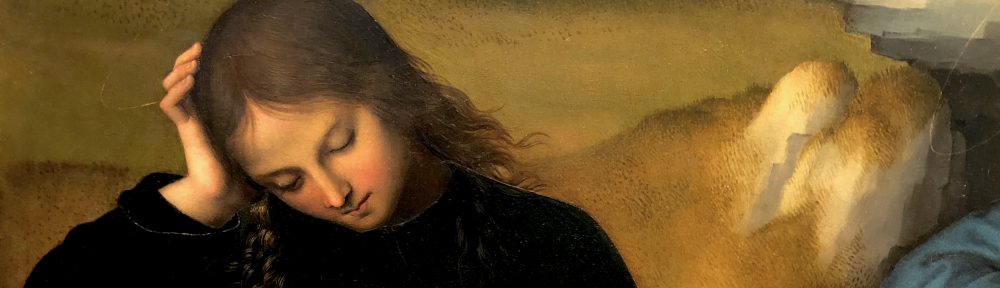

What Jesus Said About Vultures

Turkey vulture.

In all my years as a priest, I had never preached on the apocalyptic imagery of Luke 17:26-37, where people disappear without warning and Jesus concludes with an unnerving proverb: “Where the corpse is, there the vultures will gather.” This is not ideal preaching material, but with the help of the Epistle reading, Hebrews 11:29—12:2, I gave it a try last Sunday.

Today’s gospel [i] has quite a punchline: “Where the corpse is, there the vultures will gather.” It’s got to be pretty low on the list of favorite Jesus quotes, but it certainly gets our attention.

A couple of weeks ago I was at a raptor show at the High Desert Museum in eastern Oregon. A variety of hawks, owls and vultures flew swiftly among the seated spectators, who were warned to stay very still lest we be mistaken for prey. I did my best not to be a target, but a turkey vulture came close enough to brush my head with its wing. Perhaps it was preparing me for this strange gospel verse.

Some scholars say Jesus was simply using a common folk expression in response to a question about discerning the times, meaning something like “where there’s smoke, there’s fire.” Such expressions have nothing to do with smoke or fire or vultures or corpses. They’re just colorful ways of making a point. Still, Jesus’ choice of such a grim illustration puts a sharp edge on his message. It certainly gets our attention. And where the enigmatic text is, there the scholars will gather.

Who is the corpse? they wonder. Who are the vultures? One interpretation suggests the corpse could represent ancient Palestine, with the rapacious vultures being the occupying army of Rome. The Book of Revelation, perhaps inspired by the vultures in the gospel text, imagined the raptors of midheaven being summoned to feast on the remains of the proud powers struck down by divine judgment. An even more fantastical interpretation identifies the sharp-eyed buzzards, who in fact can spot carrion from 3 miles away, as those perceptive disciples who gather to consume the Corpus Christi, the Body of Christ given to feed our deepest hunger.

Well, none of these images is going to qualify for a stained glass window. And the vulture verse is perhaps profitless for the preacher.

And yet, it leaves a haunting impression. It’s unlike anything else Jesus ever said, and its gruesome tone puts an exclamation point on his discourse of crisis. A world is dying, he says. Just as a world died in the days of Noah, or in the days of Lot—names which recall destructive narratives of flood and fire—so it is happening now. The times are in no way normal, Jesus warns his listeners. Anyone who pretends that is not true, who thinks we can just go on about our business as usual—eating and drinking, buying and selling, planting and building—well, they are in for a surprise.

Come gather ’round people
Wherever you roam
And admit that the waters
Around you have grown
And accept it that soon
You’ll be drenched to the bone
If your time to you is worth savin’
You better start swimmin’
Or you’ll sink like a stone
For the times they are a-changin’ [ii]

When we sang that song 60 years ago, we thought the times were changing for the better. And that was true in many ways. But the flood of changes washing over us today do not feel like something better. When Jesus speaks of people being snatched up and disappeared without warning, he could be describing what’s happening right now in “the land of the free.” To paraphrase Jesus’ metaphor, “As it was in the days of Dietrich Bonhoeffer—in 1930s Germany—so shall it be in our own time.”

I pray that this will not be our fate, but the fact that such an outcome is even conceivable is a measure of the times. It can happen here. So what are the friends of God to do? How do we start swimming so we don’t sink like a stone?

We are not the first believers to suffer the worst of times. The Epistle to the Hebrews is clear about that. History isn’t always about the lilies of the field. It has its corpses and vultures as well.

But as the author of Hebrews insists, the faithful believe in the victory of God, and they act out that faith with their bodies. Some of God’s friends have “received the test of mocking and whipping and even chains and prison. They were stoned, cut apart in a slaughter; they died upon a sword. They traveled around in ragged clothing, impoverished, oppressed, afflicted.” But for all they suffered, those who kept the faith “subdued monarchies, did the work of justice … shut the mouths of lions, quenched mighty fires …” (Hebrews 11:29-12:2)

As people baptized into the Paschal Mystery, we understand that dying and rising, defeat and victory, are deeply intertwined. You can’t have one without the other.

When certain medieval women mystics contemplated the cross in prayer and vision, they saw not the triumph of death, but a kind of birth. For them the crucified Jesus was like a woman in labor, enduring pain and travail in order to bring us all to birth: 

Ah! Sweet Lord Jesus Christ, who ever saw a mother suffer such a birth! For when the hour of your delivery came you were placed on the hard bed of the cross and … in one day you gave birth to the whole world.” [iii]

To behold the death of Christ and call it birth is the central act of Christian imagination. It is why we declare victory at the cross. We don’t wait for Easter Sunday. We declare victory at the cross because the Passion isn’t just a story about the violent powers that always trample the weak and kill the prophets. It’s also a story about the Realm of God, where dry bones breathe and lost hopes dance, where the prodigal is welcomed home and the tears are wiped from every eye.

The Love that creates such a realm was nailed to a cross, but the cross did not consume it. Yes, death did what death does, but then God did what God does. And Love won. This is the story we belong to, and on the outcome of that story, we stake everything.

That is why we are here this morning. That is why we refuse to retreat to our private worlds, why we continue to gather in community at our Savior’s table: to nurture hope, shelter love’s flame, encourage one another, strengthen our hearts for service, eat the bread of life, pray without ceasing, sing our Alleluias and grow ever more fully into the visible, tangible body of Christ.

We are not alone in this journey. We are surrounded by a cloud of witnesses, all those ancestors in the faith, from Abraham and Sarah and Mary and Luke right on down to the wise and loving mentors we’ve known in our own lives, who have taught us how to walk in the Way of life and peace.

I once heard a preacher describe the cloud of witnesses as “the balcony people” who are looking down and cheering us on as we run the race that is set before us. It’s a wonderful and resonant image. I’m sure that each of you has some very special people in that balcony, shouting their encouragement. Listen. You can hear their voices echoing through the years.

St. Luke, pray for us … St. Mary, pray for us … St. Francis, pray for us … Oscar Romero, pray for us … Dorothy Day, pray for us … Mom and Dad, pray for us.  

Last Sunday I was in Eugene for the National Track & Field Championships, and in the men’s 800 meters I witnessed one of the most stunning moments in the history of middle-distance racing. A 16-year-old high school sophomore named Cooper Lutkenhaus had qualified for the elite competition by breaking the 29-year-old high school record, running the distance in 1:45. And after stumbling and almost falling in his first race at the championships, he managed to survive the first two rounds.

Much to his surprise, he had made the final. But with some of the world’s top 800 meter runners in the race, no one expected him to be anywhere close to the top three who would earn a trip to the World Championships in September.

Rounding the last turn, Cooper was doing really well for a 16-year-old, in  sixth place out of nine racers, 10 meters behind the leader. Then, in the last 100 meters, he passed one runner, and another, and another, and another, to cross the line in second place. His time was 1:42.27, not only a personal best by an unbelievable 3 seconds, but the 18th-best all-time and the fourth-best ever by an American.

Donavan Brazier, Cooper Lutkenhaus, and Bryce Hoppel finish 1-2-3 in the 2025 U.S. Track & Field Championships in Eugene, Oregon.

Now I’ve been at a noisy NBA final with Kareem and Magic and Larry Bird. I’ve been deafened by the 12th man [iv] at a Seahawks game. But the sound of the crowd cheering on young Cooper Lutkenhaus blew my ears off. The cloud of witnesses.

When we run the race that is set before us, there will be times when our lungs burn and our legs scream with lactic acid. There will be the races that disappoint, and workouts that feel listless or discouraging. We may even stumble and fall, more than once.

But always, always, the cloud of witnesses is cheering us on. They know from their own experience what the race is like. They all had their own moments of weakness and doubt. They became acquainted with suffering by training hard every day. They all had to learn how to get up after every fall, lay aside every weight, gulp the breath of the Spirit, and accept pain as the runner’s companion.

I’ve done my own share of racing, and when the pain comes, I try to greet it as a friend. “Hello, brother pain. I knew you’d show up. Well, here we go. I know you’re not going to kill me, right?. We’ll just take it step by step.”

“Even the fittest may stumble and fall (Isaiah 40:31). As Roisin Willis and Maggi Congdon finish 1-2 in the women’s 800 meters at the U.S. Championships, Sage Hurta-Klecker dives for the third and final spot on the World Championship team. In previous years, she had missed out on a championship podium twice due to falls, but this time her fall was a triumph. She made the team.

The perpetual contest between weariness and perseverance is familiar to every athlete—and every saint. You’re going to get tired. You’re going to get discouraged. You may faint and fall. But keep your eyes on the prize, hold on. On both good days and bad, you’ve got to put in the work, “lay aside every weight,” surrender to a power and a strength that is not your own, and stay in the flow.

I began with a raptor image, so let me close with another. This time it’s not a vulture, but an eagle, in a beautiful passage from the prophet Isaiah:

Even the youthful may faint and grow weary, 
even the fittest may stumble and fall,
but those who wait for the Lord shall renew their strength, 
they shall mount up with wings like eagles, 
they shall run and not be weary,
they shall walk and never grow tired. [v]
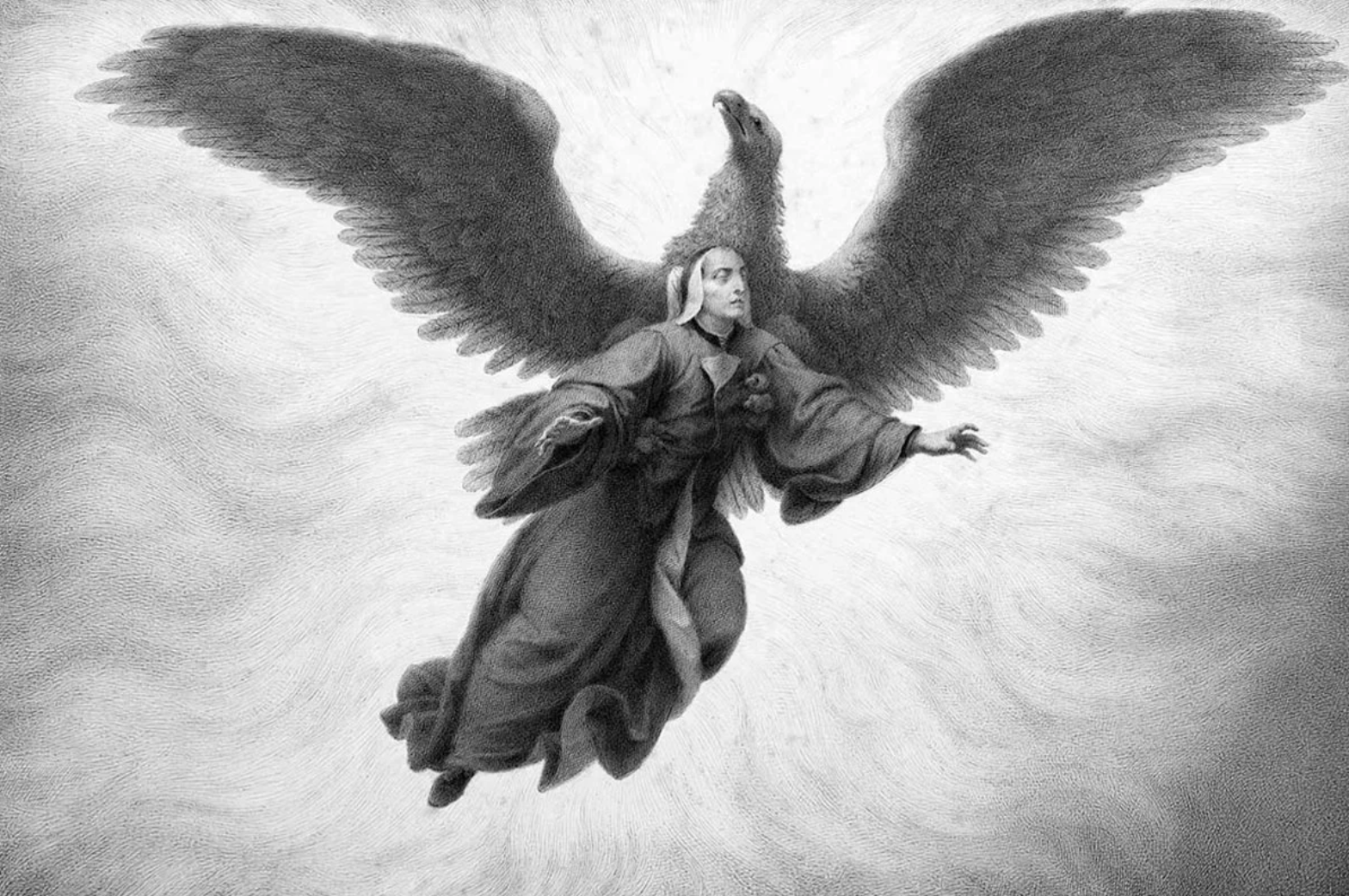
Francesco Scaramuzza, Dante and the Eagle (c. 1860). The sleeping Dante dreamed he was carried by an eagle, but it was really St. Lucy who helped the poet on his upward journey toward heaven’s light (Purgatorio ix).


This homily was preached at St. Luke’s Episcopal Church, Renton, WA, on the 9th Sunday after Pentecost, 2025.

Race photo and video by the author.

[i] The texts for the 8th Sunday after Pentecost are in Wilda C. Gafney, A Women’s Lectionary for the Whole Church, Year C, which differs significantly for the Revised Common Lectionary used by most liturgical churches.

[ii] Bob Dylan, “The Times They Are A-Changin’” (1964).

[iii] Marguerite d’Oingt (d. 1310).

[iv] The loudest crowd in professional football is in Seattle, where the fans are called “the 12th man” for their ability to influence the game by making it hard for the other team to hear their quarterback’s signals.

[v] Isaiah 40:30-31.
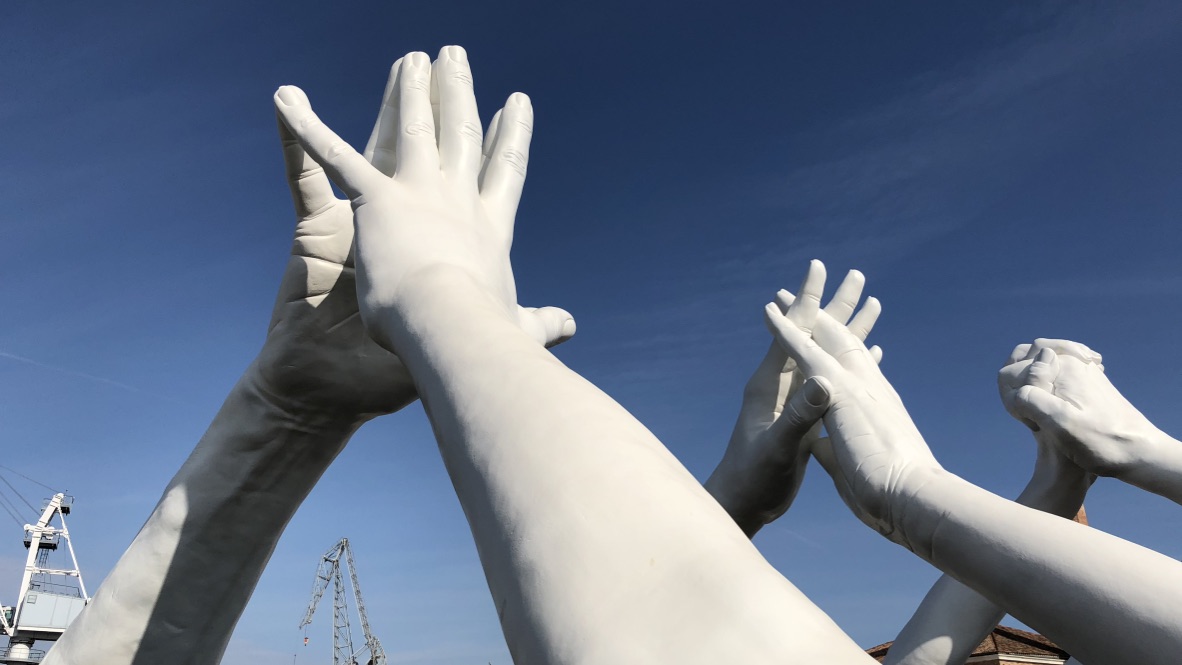
Three-in-One : One-in-Three

Lorenzo Quinn, Building Bridges (Venice Biennale 2019)

Sermon for Trinity Sunday 2024 at St. Barnabas Episcopal Church, Bainbridge Island, Washington

From late autumn to late spring, Christian liturgy takes us on a ritual journey through the gospel narrative, from the Incarnation and Epiphany of Christ to the dramatic finale of Passion, Resurrection, Ascension and Pentecost.This great sequence concludes with Trinity Sunday, which serves as a kind of epilogue.

The abrupt shift from the engaging world of story to the tangled thicket of doctrine can be a bit of a shock. It’s like going directly from a seminar in English literature to a class in advanced calculus. Our hearts sink and our heads explode. But fear not. The Trinity is no dreary abstraction. Nor is it a matter, as Lewis Carroll might say, of believing three impossible things before breakfast. We are not here to solve once and for all the puzzle of Three-in-One and One-in-Three. We are here to adore the mystery.

The first Christians were not inventive theorists speculating about the divine nature of a generic God. They were the friends of Jesus trying to make sense of the concrete, experiential data of salvation, beginning with the dramatic biblical events they had lived through and continuing to unfold in the common life of their believing communities. Their profound experiences of Jesus and the Holy Spirit had shaken the foundations of their monotheistic faith, and they were trying to sort out the implications.

Jesus and the Spirit had done for them what only God can do: heal, save, sanctify—even vanquish the power of death. Did that make Jesus and Spirit divine? And if so, what did that multiplication of divine persons do to their belief that God was one?  Jesus had told them, “I and the Father are one.” But it would take centuries to agree on what he meant.

Without losing the unity of God, how could the early Christian community account for the divine diversity revealed in the saving activities of Christ and the Spirit?

Once they began to call Jesus Kyrios (Lord), which happened very early in their worship and their storytelling, traditional monotheism was radically destabilized. The growing perception of the Holy Spirit as a guiding and empowering presence of deity in their communities only compounded the problem.

There were various attempts to solve the issue by downgrading Jesus and Spirit to subordinate, derivative, or semi-divine realities, by no means equal to the eternal and uncreated God. Such “heresies” were popular with those who wanted to keep God simple. But “orthodoxy” was unwilling to deny the fullness of divinity to either Christ or the Spirit. For them the bottom line was this: 

Only God can save us. Christ and Spirit, in the biblical revelation and Christian experience, are integral and essential to salvation. Therefore, they must be “of one substance with the Father.” That is to say, the Persons are all equally integral to the divine reality: God above us, the source and ground of all being; God with us and among us, the companion who is our way, our truth, and our life; and God within us, the energy and vitality of our deepest self. As the theologians put it:

“The Trinity is an account of God that says these are [each] irreducible and indispensable dimensions of the same reality, not different ones, and yet each has its own irreducible integrity.” [i]

And so, a trinitarian faith became foundational for the Christian understanding of divinity: God in three persons, blessed Trinity. But the inherent tension between the one and the three remains to this day. Human thought and human language can’t quite manage to think both things at the same time. It’s like waves and particles. Gregory of Nazianzus, one of most influential shapers of the fourth-century trinitarian consensus, admitted the futility of trying to corral the mystery with concepts. He suggested that we just go with the divine flow:  

“I cannot think of the One without immediately being surrounded by the radiance of the Three; nor can I discern the Three without at once being carried back into the One.” [ii]

In an amusing caricature of crudely literal images of the Three-in-One, British theologian Keith Ward imagines three omniscient individuals trying to have a conversation:

“I think I’ll create a universe,” says one. “I knew you were going to say that,” says the second. “I think I’ll create one as well,” says the third. “Well, it had better be the same as mine,” says number one. “You already know that it is,” says number two. “I knew you were going to say that,” says number three.[iii]

If we have difficulty with “God in three Persons,” it is because we think of a person as defined by his or her separateness. I’m me and you’re you! We may interact and even form deep connections, but my identity does not depend upon you. I am a self-contained unit. You can’t live in my skin and I can’t live in yours. That’s the cultural assumption, which goes back at least as far as Descartes in the seventeenth century and continues today in such debased forms as rampant consumerism and economic selfishness, where my needs and my desires take precedence over any wider sense of interdependence, community, or ecology.

But what we say about the Persons of the Trinity is quite different. Each Person is not an individual, separate subject who perceives the other Persons as objects. The Trinitarian persons experience one another not from the outside, but from the inside. They indwell each other in a mutual interiority.

But if the divine Persons are all inside each other, commingled, “of one being,” as the Creed says, what makes each Person distinct? To put it succinctly: the Persons are distinct because they are in relation with one another. No Father unless there is a Son. No Son without a Father. No Holy Spirit without Father and Son.

As Martin Buber observed, we are persons because we can say “Thou” to someone else. To be a person is to experience the difference – and the connection – that forms the space between two separate subjects. My consciousness is not alone in the universe. There are other centers of consciousness: Thou, I… Thou, I… The fact that you are not I is what creates self-consciousness, the awareness of my own difference from what is outside myself.

If we apply this to the Trinity, we say that there are Three Persons because there is relation within God, relation between the Source who begets, the Word who is begotten, and the Spirit who binds the two together and moves them outward in ever widening circles.

These relations are not occasional or accidental. They are eternal. There is an eternal sending within God, an eternal self-giving within God, an eternal exchange by which God is both Giver and Receiver simultaneously. God is Love giving itself away – self-emptying, self-diffusing, self-surrendering – and in so doing finds itself, receives itself, becomes itself. A French mystic put it this way: “it’s a case of un ‘je’ sans moi” (an “I” without a me).

Wallace Stevens wrote a poem about the process of giving ourselves over to a larger whole. He called it “the intensest rendezvous,” where we find ourselves drawn out of isolation “into one thing.” He wasn’t writing about the Trinity, but his words come as close as any to describing the essential dynamic of the divine Persons:

       Here, now, we forget each other and ourselves.
      We feel the obscurity of an order, a whole,
      A knowledge, that which arranged the rendezvous.[iv]

As Orthodox theologian John D. Zizioulas says in his influential text, Being as Communion, “To be and to be in relation are the same thing for the divine life … Therefore if Trinity is our guide, the most fundamental definition of being we can give is person-in-communion … The being of the one divine nature is the communion of the irreducibly different persons; the being of the individual persons is constituted by their relations with each other.” [v]

God is not a simple, static substance but an event of relationships. That’s why we say that God is love. “To be” has no ontological reality apart from “to be in relationship.” In the words of Anglican priest John Mbiti of Kenya, expressing the strongly communal mindset of African theology, “I am because we are, and since we are, therefore I am.” [vi]

Each Person contains the others and is contained by them in a shared communion of self-offering and self-surrender. But that continuous self-offering is never a one-way transaction, either one of self-emptying or one of being filled. It is always both at once – giving and receiving – as we ourselves know from our own mutual experience of love at its best. 

Trinitarian faith describes a God who is not solitary and alone, a God who is not an object which we can stand apart from and observe. The Trinity is an event of relationships: not three separate entities in isolation and independence from one another, but a union of subjects who are eternally interweaving and interpenetrating

This divine relationality is not something which an originally solitary God decided to take up at some point. God is eternally relational. Before there was an external creation to relate to, God’s own essential self was and is an event of perpetual relation. There was never simply being, but always being-withbeing-forbeing-in. To be and to be in relation are eternally identical.

When the Bible says, “God is love” (I John 4:16), it means that love is not just something God has or something God does; love is what God is.

As John Zizioulas puts it, “Love as God’s mode of existence … constitutes [divine] being.”[vii] Feminist theologian Elizabeth Johnson echoes this when she says, “being in communion constitutes God’s very essence.” [viii]  In other words, God is Love giving itself away—self-emptying, self-diffusing, self-surrendering—and in so doing finds itself, receives itself, becomes itself. The theologians of late antiquity borrowed a word from the arts to describe this process: perichoresis, which means to “dance around.”

Trinity is a dance, with Creator, Christ and Spirit in a continuous movement of giving and receiving, initiating and responding, weaving and mingling, going out and coming in. And while our attention may focus at times on a particular dancer, we must never lose sight of the larger choreography to which each dancer belongs: the eternal perichoresis of Three in One, One in Three.

As Jesus said, “losing” yourself and “finding” yourself are equivalent and simultaneous. In giving ourselves away, we receive ourselves back. This may be counterintuitive to the modernist mindset of autonomous individual self-possession, but it is the essence of communion: “a giving of oneself that can only come from the ongoing and endless reception of the other.” [ix]

If we had the space, I would invite you now to dance the divine perichoresis with your own bodies. We would join hands, circle round, spiral inward, weave in and out of the arches and tunnels of upraised arms, and manifest with our bodies the divine fullness of the Holy Trinity, which has been described as an “interdependence of equally present but diverse energies … in a state of circumvolving multiplicity.” [x] And thus we would, both symbolically and in fact, participate in the divine reality of “reciprocal delight” [xi] which transpires not only in heaven, but “on earth as it is in heaven.”

There are no spectators in the Trinitarian dance, which is always extending outward to draw us and all creation into its motions. As Jürgen Moltmann said, “to know God means to participate in the fullness of the divine life.” [xii] 

It’s not a matter of our trying to imitate the relational being of the loving, dancing God, as if we were inferior knock-offs of the real thing. God wants us to become ourselves the real thing. God wants to gather us into the divine perechoresis as full participants in the endless offering and receiving, pouring out and being filled, which is the dance of God and the life of heaven.

And while our dance with God has its mystical, mysterious, transcendent dimensions, it is also very concrete and specific to our historical life on this earth. The divine life of communion and self-diffusive love is the only antidote for the poisonous hatreds of this fearful age.

Because we ourselves are made in God’s image, who God is matters deeply, both for our own self-understanding and for our engagement with the world. The Trinity isn’t only God’s life. It is ours as well. It’s the shape of every story, the deep structure of the church, and the foundational pattern of reality.

Because God is communion, the eternal exchange of mutual giving and receiving, then God’s Church must live a life of communion as well. When Love’s perechoresis becomes our way of being in the world—as believers, as church—the Trinity is no longer just doctrine or idea. It is a practice, begetting justice, peace, joy, kindness, compassion, reconciliation, holiness, humility, wisdom, healing and countless other gifts. As theologian Miroslav Volf has said, “The Trinity is our social program.” [xiv]

The dance of Trinity is meant
For human flesh and bone;
When fear confines the dance in death,
God rolls away the stone. [xv]

The Church exists to participate in the liberating life of God, and to enable others to do the same. We exist to make divine communion not just an inner experience but a public truth. We don’t just feel God’s perichoresis. We don’t just feel Love’s eternal dance. We embody it. We live it. We show it. We share it.  

As the great Anglican preacher Austen Farrer put it so clearly a century ago:

“It is not required of us to think the Trinity.
We can do better; we can live the Trinity.” [xvi]


Photographs by the author.

[i] S. Mark Helm, The Depth of the Riches: A Trinitarian Theology of Religious Ends (Grand Rapids, MI: Eerdmans, 2003), 132.

[ii] Gregory of Nazianzus, q. in Karen Armstrong, The Case for God (New York: Knopf, 2009). 116-117.

[iii] Keith Ward, God: A Guide for the Perplexed (Oxford: Oneworld Publications, 2003), 235.

[iv] Wallace Stevens, “Final Soliloquy of the Interior Paramour,” Collected Poetry and Prose (NY: Library of America, 1997), 444.

[v] John D. Zizioulas, Being as Communion: Studies in Personhood and the Church (Crestwood, NY: St. Vladimir’s Seminary Press, 1993), 46.

[vi] quoted in Veli-Matti Kärkkäinen, The Trinity: Global Perspectives (Louisville: Westminster John Knox Press, 2007), 352.

[vii] Zizioulas, 46.

[viii] Elizabeth Johnson, She Who Is: The Mystery of God in Feminist Theological Discourse (NY: Crossroad, 1993), 227.

[ix] Graham Ward, “The Schizoid Christ,” in The Radical Orthodoxy Reader, ed. John Milbank and Simon Oliver (NY: Routledge, 2009), 241.

[x] David Bentley Hart, The Beauty of the Infinite: The Aesthetics of Christian Truth (Grand Rapids: Eerdmans 2003), 114.

[xi] St. Athanasius (c. 296-373), a bishop in Roman Egypt, was a key defender of Trinitarianism. 

[xii] Jürgen Moltmann, The Trinity and the Kingdom: The Doctrine of God, trans. Margaret Kohl (San Francisco: Harper & Row, 1981), 152.

[xiii] Richard Leach, “Come Join the Dance of Trinity.”

[xiv] Miroslav Volf, “‘The Trinity is Our Social Program’: The Doctrine of the Trinity and the Shape of Social Engagement,” Modern Theology 14, no. 3 (July 1998).

[xv] Leach.

[xvi] Austin Farrer, The Essential Sermons (London: SPCK, 1991), 78.

What’s Going On at the Asbury Revival?

Asbury University Revival (February 2023).

True religion, in great part, consists in holy affections.

— Jonathan Edwards

“After Thursday, I was like, okay, I’m going to go sleep. But [God] was like, ‘No, I have more for you.’”

— Lauren, Asbury University student

On February 8 the morning chapel service at Kentucky’s Asbury University concluded, as usual, with a spiritual song. Then most of the students filed out to go to class, but the band kept playing, and a few stayed behind to sing along around the altar. What happened next has startled the world.

“I was like, all right, we’re just going to be around here for one or two more songs, and we’re going to go to class,” said Lena, an Asbury student. “But there was like something in my soul that said no-no-no, we’ve just got to stay here. So I just stayed. A little while later I thought I had only been there like maybe an extra 20 minutes. It had been like 3 hours. It just started turning into something bigger and crazier.” 

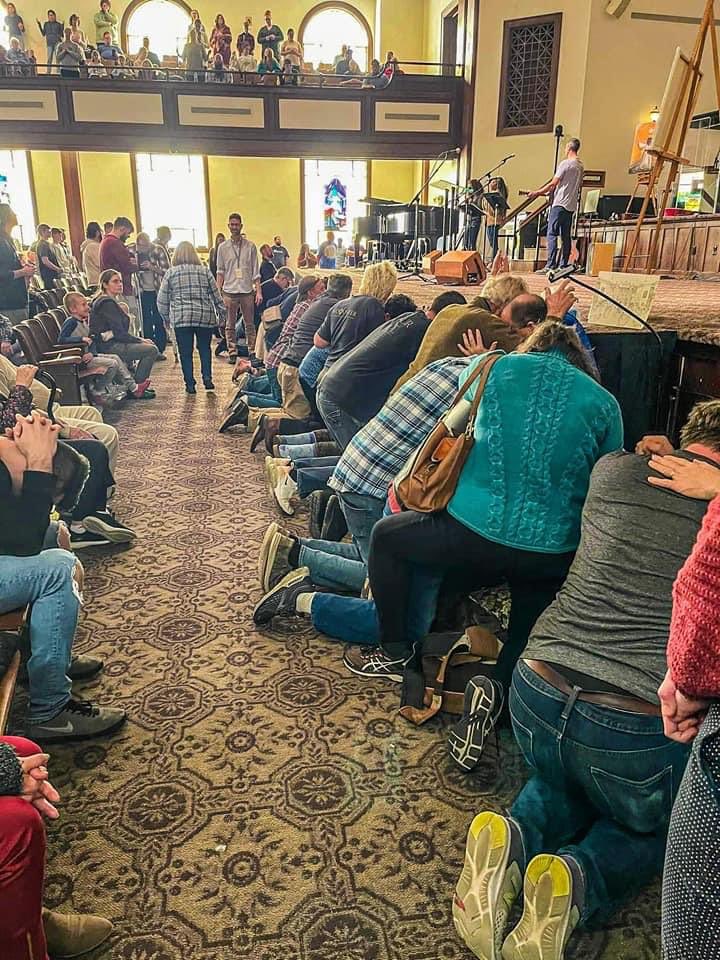
Word spread through the campus that people were still singing and praying in the chapel. Classrooms and dorms began to empty, and by the end of the day the 1500-seat worship space was packed with students and faculty, singing, praying, and testifying to the power of God in their lives. Two weeks later, it’s still happening, day and night without ceasing.

Live video on social media quickly went viral. People from all over North America began to converge on Asbury to join in. Still others flew in from faraway places like Finland, New Zealand, and Indonesia. University officials estimate that tens of thousands of pilgrims have shared in the experience. The line to get inside can be hours long.

It’s been called the Asbury Revival, but some are wary of this designation. Too many have been wounded or betrayed by manipulative gatherings and domineering evangelists in the name of “revival.” Some prefer to call it an “outpouring” (the university’s preference), a “renewal,” or an “awakening.” One student said she was switching from “revival” to “encounter” because the divine presence, not the internal experience of the worshipper, was the central meaning here. 

Whatever is happening, the watchword has been “radical humility.” Student Asher Braughton says, “I truly believe that the revival has been built on humility; that this revival isn’t focused just on one person—not one worship leader, not one pastor, not one speaker, not one student. It’s focused solely and only on Jesus Christ.” Or as one of the event’s speakers put it: “The only celebrity in this house is Jesus.”

During the “Great Awakening” in the eighteenth-century, the emotional excesses of the revivals worried the church establishment. Was it sincere? Was it of God? Historian George M. Marsden summarizes the criticisms in vivid terms: “Using vulgar appeals to sentiment, they would generate mass hysteria that they encouraged people to regard as evidence of the work of the Holy Spirit. Scores or even hundreds of people would shriek, swoon, or fall into fits.” 

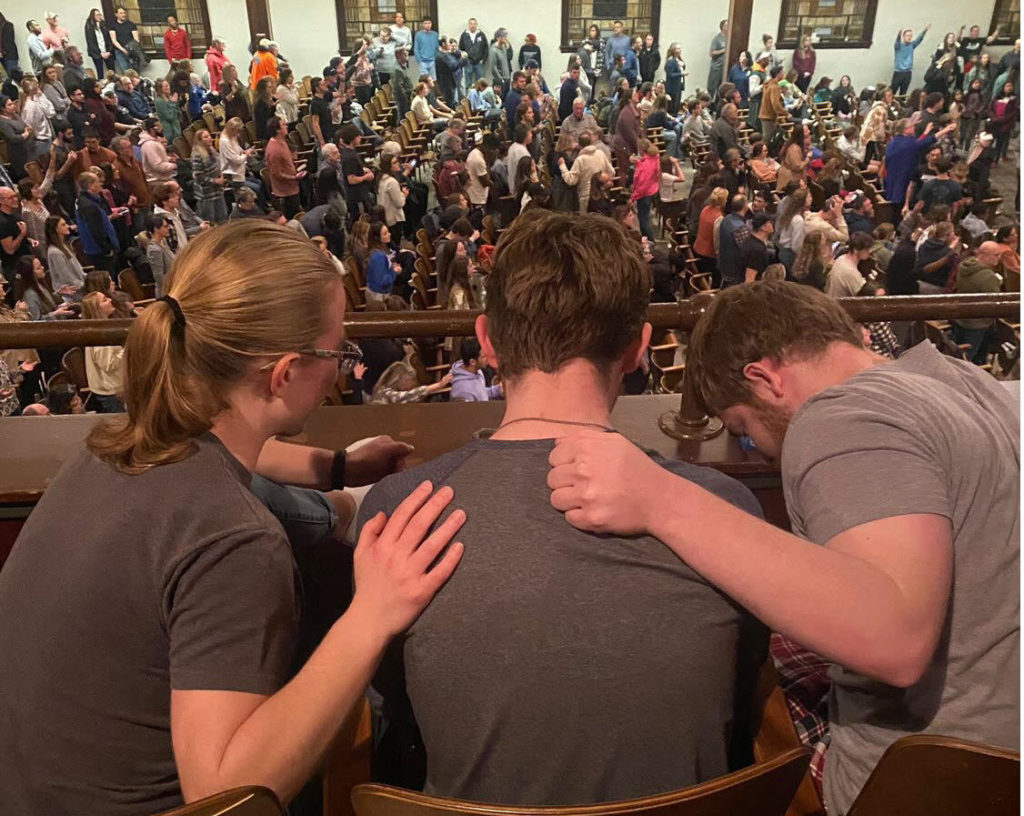
Although one student leader, mindful of the building’s aging fabric, had to announce that there would be “no jumping allowed in the balconies,” the tone in the room has been generally mellow. A youth minister described it as walking into “a holy hush.” There have been moments of exuberant cheering and clapping, but much of the music and prayer invites a tranquil surrender to the spiritual flow. Watching it online, I thought of Thomas Merton’s gently fervent plea: “Sink from your shallows, soul, into eternity.”

On the first day, Asbury professor Clint Baldwin was having lunch in the cafeteria when someone stopped at his table to say, “You know, the students are still in there, and they’re still worshipping the Lord. You should go over and see what’s happening. It’s a sweet, sweet thing.” Baldwin soon joined the awakening and saw that it was good. “This was just people saying we’re going to stay on and sit in the presence of the Lord and see what the Lord would have for us.”

Lauren, the student quoted in the epigraph, described the worship as all-consuming: “Nothing else matters anymore except being in the presence of Jesus and worshipping him for the rest of my life.” She acknowledged the hyperbole of this—she would of course continue with the life of a student—but her perspective on everything had been transformed. “Ways I have of viewing people negatively—it doesn’t matter anymore. Anxieties and worries that I have, it doesn’t even matter.… Whenever you can just let go and surrender and forgive, then, you’re just set free.”

The majority of worshippers are under 25. Living through a time of immense stress, they hunger for the healing peace of God. In spontaneous prayer groups around the chapel, or in testimonials from the stage, many have openly shared their deepest griefs and heaviest burdens. Their vulnerability has been met with tenderness and love. When a young woman shared her story of attempted suicide before the whole assembly, a multitude of women came forward to lay their hands on her. “An hour later she was dancing and smiling with a joy on her face that I had never seen before,” said one witness. 

“God is moving through this generation that has been so affected by mental health,” says Asher. “Once this revival ends, we can carry this message of goodness and forgiveness … The chains of suicide, the chains of depression, the chains of anxiety can be broken in Jesus.” Many of the songs reflect this hope in their melodic repetitions of heartfelt cries: 

Jesus, Jesus, you make the darkness tremble— 
your name is a light the shadows can’t deny …
You’re never gonna let, you’re never gonna let me down … 
He is for you, He is for you, He is for you …

There are of course critics and skeptics. All religious experience is bewildering, even suspect, for those who stand outside it. It is a reality both given and received, not grasped or possessed. Its truth abides in its own domain of experience. You can’t judge it at a distance, as a spectator. You have to go inside it, open your heart to it, be in loving relationship with it. As the mystics testify, certainty is only found within the experience.

Among believers, there is certainly a proper concern about delusion and self-deception. “Even Satan disguises himself as an angel of light” (2 Cor. 11:14). But religious experience can be tested by its fruits. Asbury’s president, Kevin J. Brown, is an encouraging witness to the Outpouring’s authenticity:

“Since the first day, there have been countless expressions and demonstrations of radical humility, compassion, confession, consecration, and surrender unto the Lord. We are witnessing the fruit of the Spirit: love, joy, peace, patience, kindness, generosity, faithfulness, gentleness and self-control.”

Some may worry that the strongly personal nature of the Asbury Outpouring excludes concerns beyond the self like racism, social justice, global conflict, and the fate of the planet. However, nothing I have seen or read so far suggests that these young people disconnect personal transformation from social change. Surrendering to God is inseparable from a lifetime of service to neighbor and world. One’s own soul is too small a kingdom for the Lord of history. The collective witness and shared compassion of the Outpouring bears witness to that truth. 

As for the abundance of deep feeling, vulnerability, open-heartedness, and the ecstatic willingness to be swept away, we need more, not less of that in the Christian life. Those kids are singing and praying and testifying as if their lives depend on it; as if God matters more than anything; as if Jesus will wipe away the tears from every eye; as if a new reality is breaking through the cracks of our broken world. 

But can it last? The particular happening in Asbury’s chapel is winding down this week. The university needs to resume its institutional mission, and the town of Wilmore, hospitable as it has been, can’t handle the crowds forever. “It is not ours to hold alone,” Brown says. “We are not the keepers of this movement … Pray that what is happening here will spread.” 

Although it seems a bit sad that this foretaste of heaven—singing around the throne for all eternity—must come to an end in the temporal world, the Holy Spirit blows where it will. Outbreaks of public Christian fervor and collective spiritual passion may turn up elsewhere, take new forms, or return to a dormant state until the next eruption. Revelation, not longevity, is the point of epiphanies. They have their moment and vanish, but their impact—and the truth they manifest—endures in hearts and minds and communities.

I have no doubt that many of those who are living through this experience will be forever changed by it, as will the worlds they inhabit and the people they touch. Professor Baldwin, recalling similar revivals at Asbury in the 1950s and 1970s, notes that “people still talk about those [past] moments in revival that shaped the trajectory of how they chose to live for the sake of the Lord onward from that. That’s a hope that we would have for this.”

Even watching online from afar, I have found myself deeply moved by the Spirit-filled assembly. I especially love the heartfelt singing and the manifestation of shared joy. One of my favorite parts was today’s invitation for people to come forward and recite their favorite verses from Scripture. When a small African-American boy read from the prophet Joel (2:28), delivering that luminous text with his boyish voice—innocent as Eden—I was blown away: 

Then I will pour out my spirit on all flesh; 
your sons and your daughters shall prophesy, 
your old ones shall dream dreams,
and your young ones shall see visions …

Joel’s prophecy has taken flesh at Asbury, day after day since the eighth of February—all those beautiful young faces, shining with God’s future. Like the rest of us, they will lose it and find it again and again. But they have set their feet upon the sacred Way. God bless them.


The Outpouring will continue to be streamed by Asbury University through Thursday, February 23, at https://www.asbury.edu/outpouring/

The words of Clint Baldwin, Asher Braughton, Lauren, Lena and Kyle (the youth minister) are taken from a February 12 conversation with Shane Claiborne on his YouTube channel, Red Letter Christians: “Update from the Asbury University Revival”

The words of Asbury President Kevin J. Brown can be found at the Outpouring link above.

Candlemas—Because We Hope to Turn Again

The Presentation of Christ ( Luttrell Psalter, 14c) links the gospel story to the candle rituals of February 2.

[On Candlemas] we keep the feast of Mary,
mother of the King, because she on that day
brought Christ, the Ruler’s child, to the temple.
Then after five nights winter is
carried out of the dwellings. 

The Menologium (English, 10th century) [1]

The first day of February is Candlemas Eve, and the second is Candlemas Day. As the fortieth day after the Nativity, Candlemas marks the final event in the Infancy narratives, when, in accordance with Jewish custom, Mary and Joseph presented the baby Jesus to be blessed in the Jerusalem temple. You can find a reflection on that gospel story in my 2019 post, “Consumed by Love: The Flames of Candlemas.” 

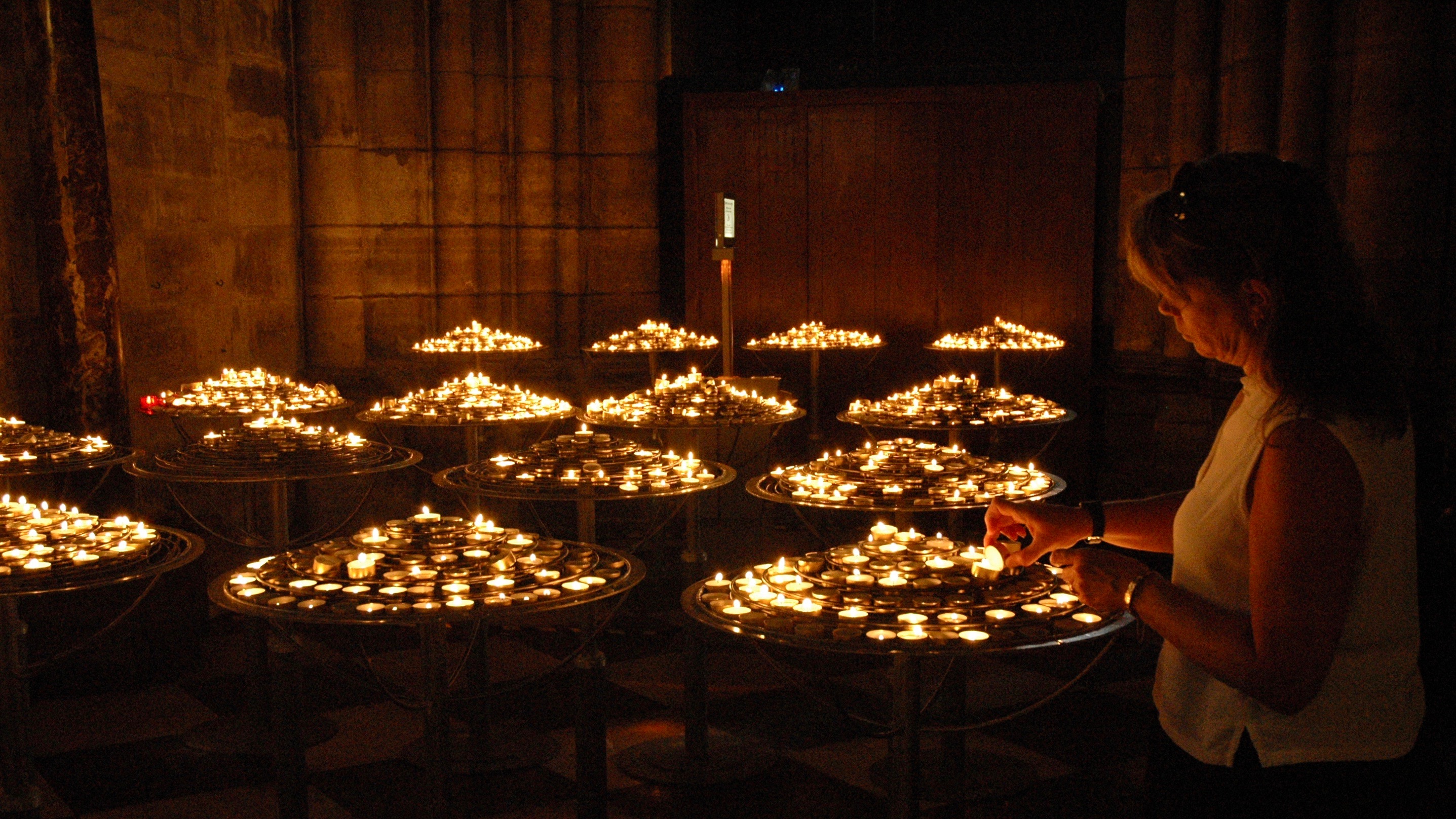
In medieval Europe, people would bring a candle to the church to be blessed on Candlemas. Then they would make a communal candlelight procession in honor of the Christ, whom Simeon, in the Presentation narrative, called “a light to enlighten the nations” (Luke 2:32). A Candlemas prayer beseeches the Light of the world “to pour into the hearts of your faithful people the brilliance of your eternal splendor, that we, who by these kindling flames light up this temple to your glory, may have the darkness of our souls dispelled.”

In the northern hemisphere, this celebration of light coincides with the lengthening of days. We’ve all begun to rejoice that the days are starting a little earlier, lasting a little longer. Sceptics who dismiss Christian festivals as hostile takeovers of pagan celebrations miss the point. The truth of the Incarnate Logos as the deep structure of creation does not compete with the patterns and rhythms of nature; it completes them. In Old English, sunne(“sun”) and sunu (“son”) are nearly identical, allowing a perfect theological pun: Christ is both sodfaesta sunnan leoma (“radiance of the true sun”) and sunu soþan fæder (“Son of the true Father”).

An early Anglo-Saxon poem on the winter solstice, beautifully translated by medieval scholar Eleanor Parker, celebrates the return of the light as Christological: 

As you, God born of God long ago,
Son of the true Father, eternally existed
without beginning in the glory of heaven,
so your own creation cries with confidence
to you now for their needs, that you send 
that bright sun to us, and come yourself
to lighten those who long have lived
surrounded by shadows and darkness, here
in everlasting night, who, shrouded by sins,
have had to endure death’s dark shadow. [2]

Winter’s cold and dark are not quickly undone. Poised midway between winter solstice and vernal equinox, Candlemas is a transitional feast—the last of winter, the first of spring. It will take time for spring to come: now still contends with not yet. “How long the winter has lasted,” lamented New England poet Jane Kenyon, “—like a Mahler / symphony, or an hour in the dentist’s chair.”[3] My friends in Minnesota, Iowa and Nebraska echo this seasonal weariness in their Facebook posts. But for those who are faithful and alert, Candlemas marks the turning point, reawakening the hope that spring is on its way.  

Long-term weather forecasts in early February have been going on for centuries, but they always hedge their bets. A sunny Candlemas is but a brief glimpse of future glory, more of a promise than a gift in hand. If the groundhog or the bear emerges from its burrow and sees its shadow, back it goes into hibernation, for spring is still six weeks away. Hope’s object will not be rushed, as traditional wisdom reminds us: 

If Candlemas Day is fair and clear,
There’ll be two winters in one year. (Scotland)

If Candlemas Day be sunny and warm,
Ye may mend yer auld mittens and look for a storm. (Cumbria)[4]

In other words, as T. S. Eliot put it, “wait without hope / For hope would be hope for the wrong thing.”[5] But for Ukrainians shivering in the shadow of war; for the homeless huddled in our frigid cities; for the abused and the outcast suffering storms of violence; for African-Americans terrorized by a nation that walks in darkness—Spring can never come soon enough. 

Let us keep the feast: 
Light a candle;
Trust the radiance;
Become the Spring.


[1] The Menologium, translated from Old English by Eleanor Parker in her fascinating and poetic book, Winters in the World: A Journey Through the Anglo-Saxon Year (London: Reaktion Books Ltd., 2022), 88-89. The “five nights” refers to the Anglo-Saxon reckoning of February 6 as the last day of winter before it is “carried out” to make room for spring.  

[2] Ibid., 71-72.

[3] Jane Kenyon, “Walking Alone in Late Winter,” in Collected Poems (Saint Paul, MN: Graywolf Press, 2005), 77. Personally, I will take Mahler over the dentist every time.

[4] Charles Kightly, The Customs and Ceremonies of Britain: An Encyclopedia of Living Traditions (London: Thames and Hudson, 1986), 66.

[5] T.S. Eliot, “East Coker, III” in Four Quartets (1943). The poet goes on to say, “Wait without thought, for you are not yet ready for thought: / So the darkness shall be the light, and the stillness the dancing.” Until it fully arrives, God’s future exceeds adequate description and cannot be grasped. The reader will note that this essay’s title is a positive reversal of the opening line of Eliot’s “Ash Wednesday.”

Gaudete!—The Advent Dance of Honesty and Hope

Our Lady of the Angels (Robert Graham, Los Angeles cathedral, 2002)

Gaudete! Gaudete! Christus est natus 
Ex Maria Virgine. Gaudete!

Rejoice! Rejoice! Christ is born of the Virgin Mary. Rejoice!

So goes the joyful refrain of a late medieval carol, and even though the celebration of the Divine Birth is still two weeks away, the note of rejoicing (GaudeteGaudete!) is already beginning to dispute the wintry gloom in our Scripture readings, our hymns, and our expectant hearts. 

For many centuries, the Third Sunday of Advent has been called Gaudete Sunday—Rejoice Sunday. In the Advent wreath, the somber blue is replaced by a brighter, warmer shade of rose. Churches lucky enough to have rose vestments will be using them today. And in the Common Lectionary cycle of readings, the word “rejoice” turns up in each of the three years. 

In Year C, the prophet Zephaniah exhorts his disheartened people, “Rejoice and exult with all your heart, O daughter Jerusalem” (Zephaniah 3:14). And St. Paul, overflowing with the Spirit, urges the first Christians to make joy a constant spiritual practice: “Rejoice in the Lord always,” he said. “Again I will say, Rejoice (Philippians 4:4)

In Year B, Isaiah tells us, “I will greatly rejoice in the Lord; my whole being shall exult in my God; for God has clothed me with the garments of salvation” (Isaiah 61:10), while Mary’s heart pours out the Magnificat’s ode to joy: “My spirit rejoices in God my Savior (Luke 1:47).

And now, in Year A, Isaiah promises that even the most barren and forsaken places will become a paradise in God’s future: “The desert shall rejoice and blossom,” he assures us. “God’s ransomed exiles shall return …Gladness and joy shall come upon them, while sorrow and sighing shall flee away” (Isaiah 35:10).

Such hopeful refrains lift up our hearts and light a bright candle in the dark. But we also heed the voice of St. James, who curbs our enthusiasm with his “Not so fast! The Kingdom doesn’t come all at once. We’ve got to be patient” (James 5:7). 

And we know he’s right. We still abide in a severely damaged history which seems to repeat itself rather than make real progress toward the horizon of God’s future. We have been shocked in recent years to see such seemingly outdated sins as overt racism and anti-Semitism come roaring back, like the alarming return of “conquered” diseases like polio and measles. 

The French thinker Jean Baudrillard wrote about the myth of human progress just before the Millennium, critiquing the optimistic talk of a New World Order by reminding us that humanity continues to have a serious waste disposal problem (theologians would call this Original Sin, the persistent flaw that burdens and bedevils every human endeavor).   

As Baudrillard put it, “The problem becomes one of waste. It is not just material substances, including nuclear ones, which pose a waste problem but also the defunct ideologies, bygone utopias, dead concepts and fossilized ideas which continue to pollute our mental space. Historical and intellectual refuse pose an even more serious problem than industrial waste. Who will rid us of the sediment of centuries of stupidity?” [i]

I ask that question every day when I see the news! But the genius of Advent is its ability to perform the difficult dance of honesty and hope. It doesn’t deny the darkness, but it also refuses to accept the black hole of unredeemed history as an inescapable fate. “Give us grace to cast away the works of darkness,” we pray, “and put on the armor of light”—not just in some distant utopian future, but “now, in the time of this mortal life.”

Now, now, now. But also not yetGaudete, but also Kyrie eleison. Rowan Williams, borrowing an image from Diadochus, a fifth-century bishop, describes Advent spirituality as the practice of “looking east in winter.” 

“Looking east in winter we feel the warmth of the sun on our faces, while still sensing an icy chill at our backs. Our divided and distorted awareness of the world is not healed instantly. But we are not looking at the phenomenon from a distance: we do truly sense the sun on our faces; and we have good reason to think that the climate and landscape of our humanity can indeed be warmed and transfigured.” [ii]

The next time there is a sunny morning, go stand somewhere on our island’s eastern shore. Feel the chill at your back, and the warming sunlight on your face. Do it without words. Let those contrary sensations of cold and warmth be your Advent prayer. 

Not every morning brings a bright sun, of course. Sometimes the warmth of hope is a matter of faith, not immediate experience. Yet even when we can’t feel it, God is redeeming the time and preparing the dawn. And when we pray, “Stir up your power, O Lord, and with great might come among us,” the Holy One is listening. 

“Stir up your power” is such a striking prayer, a bold cry of the heart to the One who saves. [iii] And because it is always the Collect-prayer for this day, Gaudete Sunday is also known as “Stir up” Sunday. But what do we mean when we call upon divine power? What does the power of God look like in the world we inhabit? 

Well, it looks a lot like what happened when Jesus arrived: “The blind see, the lame dance, the deaf hear, the dead are raised, and the poor receive good news” (Matthew 11:5). It’s not a violent head-on clash with the powers of this world—meeting them on their own bloody terms—but the liberation of the faithful into a new form of being, enabling the friends of God to “plant the seeds of resurrection amid the blind sufferings of history.” [iv]

In Roberto Rossellini’s film, Europe ‘51 (1952), Ingrid Bergman plays a wealthy woman who gives up all her privilege to serve the poor and vulnerable. Rossellini, who had made a joyful film about St. Francis two years earlier, wanted to explore what would happen if someone behaved like St. Francis in the contemporary world. As it turns out in Europe ‘51, Irene (Bergman’s character) is judged to be insane by her husband, her social class, her doctors, and her Church, and the film ends with her locked away in an asylum. The powers-that-be have decided that there is no place in the world for the impracticality of unconditional love. 

But even as Irene suffers this sad fate, we see her continue to be who she is, embodying God’s compassion for her fellow inmates. Like the incarnate God enclosed within the finite space of the Virgin’s womb, she can still practice heaven within the confines of the asylum. As she comforts a despairing woman who has tried to commit suicide, we see Irene, in a close-up reminiscent of an icon, speaking the words of Christ: “You are not alone. Don’t worry. I am with you. I will not leave you.” She becomes, in that moment, what we are all invited to become: an image of Christ for others.

“I am with you,” Irene (Ingrid Bergman) tells a distressed woman in Roberto Rossellini’s Europe ’51.

Stir up your power, O Lord, and with great might come among us. But God’s idea of “great might” is not the way the world understands it. No lightning bolts. No legions of angels. Just a babe in a manger, a tortured man on a cross, a disciple locked in an asylum. As W. H. Auden said in the Advent portion of his Christmas Oratorio: “The Real is what will strike you as really absurd.” Or as an old carol puts it, “Weakness shall the strong confound.” [v]

In another of his poems, “In Memory of W. B. Yeats,” Auden suggests that poetry operates much like divine power. Poetry “makes nothing happen,” he says. In other words, poetry doesn’t force its will upon the world, but in offering an alternate perspective for engaging reality, it makes the world different nonetheless. Auden describes poetry as if it were a stream, making its own way through the landscape. 

For poetry makes nothing happen: it survives
In the valley of its making where executives
Would never want to tamper, flows on south
From ranches of isolation and the busy griefs,
Raw towns that we believe and die in; it survives,
A way of happening, a mouth. 

In his analysis of this poem, John Burnside notes that poetry’s work is “to survive—not in some dogged but enfeebled fashion, hanging on, though barely noticed, in an indifferent world, but actively, on its own terms—that is, ‘in the valley of its own making.’” The ‘executives’—the powers-that-be—take no notice. It means nothing to them. But “poetry flows on, through and away from ‘the busy griefs’ and the ‘raw towns that we believe in and die in,’ its business is more fundamental, its true nature more elemental” than the ‘executives’ can imagine.[vi]

And just so does the power of God flow through the world. Not to force anything to happen in a blunt cause-and-effect way, but to exist, like the waters of baptism, as an inviting and life-giving reality: “It survives, / A way of happening, a mouth.” 

We find this same image of the flowing, living water in today’s passage from Isaiah: “For waters shall break forth in the wilderness, and streams in the desert; the burning sands shall become a pool, and the thirsty ground springs of water” (Isaiah 35:6-7).

The concluding words of Auden’s stanza, “a mouth,” may strike our ears jarringly after the metaphor of a quietly flowing stream, but both poetry and God are given to speech: In the beginning was the Word

And in the same way that the “Stir up” prayer beseeches the God who saves, Auden’s poem, written on the eve of World War II, calls upon the poet to speak a word against all the dark sorrows of the world: 

In the nightmare of the dark
All the dogs of Europe bark,
And the living nations wait,
Each sequestered in its hate …

Follow, poet, follow right
To the bottom of the night,
With your unconstraining voice
Still persuade us to rejoice … [vii]

There’s that word again: rejoice. We have prayed for a word of power today, and what we are given is: Gaudete! Rejoice! God’s power will never compel us to rejoice, or to hope, or to love. But it will always seek to persuade us, until the end of time. 

Maddy Prior and Steeleye Span sing my favorite version of Gaudete.

[i] Jean Baudrillard, The Illusion of the End, trans. Chris Turner (Stanford, CA: Stanford University Press, 1994), 26

[ii] Rowan Williams, Looking East in Winter: Contemporary Thought and the Eastern Christian Tradition (London: Bloomsbury Publishing, 2021), 8.

[iii] The Collect for the Third Sunday of Advent in the Book of Common Prayer: “Stir up your power, O Lord, and with great might come among us; and, because we are sorely hindered by our sins, let your bountiful grace and mercy speedily help and deliver us; through Jesus Christ our Lord, to whom, with you and the Holy Spirit, be honor and glory, now and for ever. Amen.”

[iv] I can’t locate the source of this quote from an old homily, but it may be from either Paul Evdokimov or Olivier Clément. 

[v] Auden’s line is from “For the Time Being: A Christmas Oratorio” (Collected Poems, Random House, 1976, p. 274). The carol line is from Gabriel’s Message (trans. J. M. Neale). Like Gaudete, it is in the famous Piae Cantiones collection of 1582.

[vi] John Burnside, The Music of Time: Poetry in the Twentieth Century (Princeton: Princeton University Press, 2020), 23.

[vii] W. H. Auden, “In Memory of W. B. Yeats” (Collected Poems, 197-198).

“Strangely light of heart”—Remembering Frederick Buechner

Writing as a holy task (St. Matthew writing his gospel, Ebbo Gospels, 9th century).

Praise, praise! I croak. Praise God for all that’s holy, cold, and dark. Praise him for all we lose, for all the river of the years bears off. Praise him for the stillness in the wake of pain. Praise him for emptiness … Praise him for dying and the peace of death. 

— Frederick Buechner, Godric [i]

Frederick Buechner, one of the greatest of contemporary Christian writers, has departed this life. Born July 11, 1926, he died on August 15, 2022. Buechner pursued a life of faith in an age of doubt, and his wrestling with the language and content of belief in books, sermons and lectures has inspired, instructed, and delighted countless believers and seekers.

My first encounter with his striking words and novel images was during my senior year in college. On the last Sunday of Advent, 1965, my father, James K. Friedrich, a priest and film producer, staged a dramatic reading of Buechner’s imaginative rendering of the Nativity story at All Saints Episcopal Church in Beverly Hills. Before a packed congregation, three distinguished Hollywood actors, two of whom were members of that parish, played the roles of Shepherd, Innkeeper, and Wise Man, each recalling his own experience on that strange night in Bethlehem.

Edward G. Robinson—whose original given name was Emmanuel—registered the Shepherd’s amazement with his familiar dusky growl: 

“The air wasn’t just emptiness any more. It was alive. Brightness everywhere, dipping and wheeling like a flock of birds. And what you always thought was silence stopped being silent and turned into the beating of wings, thousands and thousands of them. Only not wings, as you came to more, but voices—high, wild, like trumpets. The words I could never remember later, but something like what I’d yelled with my mouth full of bread, ‘By God, it’s good, brothers! The crust. The mud. Everything. Everything.’”

Frederic Worlock, a veteran character actor in dozens of films from How Green Was My Valley to 101 Dalmations, sounded the Innkeeper’s lament with his distinctive British voice:

“All your life long, you wait for your own true love to come – we all of us do – our destiny, our joy, our heart’s desire. So how am I to say it, gentlemen? When he came, I missed him.”

And the formidable Raymond Massey lent a patrician aura to the Wise Man’s melancholy reflection on his brief encounter with the Real.

“I will tell you two terrible things. What we saw on the face of the new-born child was his death. A fool could have seen it as well. It sat on his head like a crown or a bat, this death that he would die. And we saw, as sure as the earth beneath our feet, that to stay with him would be to share that death, and that is why we left—giving only our gifts, withholding the rest.”

Only in retrospect would the Magus realize that “to live without him is the real death … to die with him is the only life.” [ii]

You can hear a 23-minute recording of the 1965 performance, “A Christmas Triptych,” here:

Searching for the Holy One in our midst is a core theme of Buechner’s work. His vivid description of a papal mass on Christmas Eve, when the writer was in his early thirties, is one of my favorite moments in all his writings. When Pius XII, carried on a golden throne by Swiss guards, passed among the throng in St. Peter’s that night, his glasses “glittering in the candlelight,” he was “peering into the crowd with extraordinary intensity,” as though he were “looking for someone in particular.”

It was Christ he was looking for, thought Buechner, and a theologian might insist that the holy face was already “visible, however dimly, in the faces of all of us who had come there that night.” For the old pope that wasn’t enough. There was intense longing in his face, but Buechner also detected a “madness”—as if the pope were straining to exceed any settled account of reality. 

And it is the madness that has haunted me through the years.
Madness because I suspect he hoped 
that Christ himself had come back that night 
as more than just the deepest humanity of everyone’s humanity, 
that Impossibility itself stood there resplendent in that impossible place. [iii]

All of Buechner’s work is an attempt to put that Impossibility into words, that we might see and grasp its invitation to new life. His nine years as chaplain to Phillips Exeter Academy in New Hampshire were formative for him. The student body was a diverse and youthfully cynical lot, and Buechner’s challenge as a preacher was how to connect with the unwilling and the unbelieving. I attended an Episcopal school with compulsory chapel in the same years Buechner was at Exeter, and much later I would preach a sermon at Groton, Franklin Roosevelt’s Episcopal prep school. I know how daunting a roomful of resistant and dubious faces can be. For Buechner, the experience was a refiner’s fire. He learned how to make the case for faith in a fresh and accessible tongue. He did it with a remarkable gift for narrative and phrasing. “It’s on the house,” for example, was his translation of “divine grace.” But he also gained credibility by taking doubt seriously.

In our culture of disbelief, where the awareness of divine presence does not come naturally, even believers must live with persistent doubts. There is no way to prove there’s anything beyond the visible world, that our choices have an ultimate dimension, or that our heart’s desire has an abiding home. 

Buechner never denied the validity of doubt. The only thing certain about faith is that it may not be true. “How could God reveal himself in a way that would leave no room for doubt?” he said. “If there were no room for doubt, there would be no room for me. [iv] But it’s always “a fifty-fifty chance” between faith and doubt.[v] You have to choose—not between specific linguistic formulations, which even at their best cannot encompass the Real—but between saying Yes or No when Love invites you to dance. 

“To be a saint,” Buechner wrote, “is to work and weep for the broken and suffering of the world, but it is also to be strangely light of heart in the knowledge that there is something greater than the world that mends and renews. Maybe more than anything else, to be a saint is to know joy.” [vi]

In Buechner’s Nativity dialogues cited above, the Divine Mystery has appeared in the world. The Shepherd embraces it. The Innkeeper fails to notice. The Wise Man, reckoning the cost to himself, refuses the offer. Those remain our options as well. And in a lifetime of extraordinary writings, Frederick Buechner explored the urgency of the choices set before us. We can choose life; we can choose death. We can say Yes; we can say No. Or we can simply ignore the big questions and opt for the unexamined life.

One of Buechner’s great influences was the Scottish writer George MacDonald, who, like himself, was an ordained minister. In 1990, I heard Buechner conclude a lecture with lines from MacDonald’s novel, Thomas Wingfold, Curate. Published in 1876, it posited faith as a brave rejection of the depressing sway of Victorian doubt. The way of faith may not be provable, argues MacDonald’s fictional curate, but it will always be more beautiful—and more “true”—than the alternative. No wonder Buechner loved this passage:

Even if there be no hereafter, I would live my time believing in a grand thing that ought to be true if it is not. No facts can take the place of truths, and if these be not truths, then is the loftiest part of our nature a waste. Let me hold by the better than the actual, and fall into nothingness off the same precipice with Jesus and John and Paul and a thousand more, who were lovely in their lives, and with their death make even the nothingness into which they have passed like the garden of the Lord. I will go further … and say, I would rather die for evermore believing as Jesus believed, than live for evermore believing as those that deny him.

Buechner died at 96. When my mother died at the same age in 2010, I happened to find a quote from his novel Godric among her papers. I put those words on the cover of her requiem bulletin, below a Byzantine image of Christ rescuing the dead from their tombs: 

I see a star, said Godric, at the age of 100 and more. Sometimes this star is still, sometimes she dances. Within that little pool of Wear she winks at me. I wink at her. The secret that we share I cannot tell in full. But this much I will tell. What’s lost is nothing to what’s found and all the death that ever was, set next to life, would scarcely fill a cup. [vii]


[i] Frederick Buechner, Godric (San Francisco: Harper San Francisco, 1980/1983), 96.

[ii] The performance of the text as “A Christmas Triptych” was in December, 1965.Buechner’s text would be published the next year in The Magnificent Defeat (Seabury Press, 1966)..

[iii] Buechner, The Hungering Dark (San Francisco: Harper San Francisco, 1969/1985).

[iv] Ibid., The Alphabet of Grace (San Francisco: Harper San Francisco, 1970/1989), 47.

[v] Ibid., The Book of Bebb (San Francisco: Harper San Francisco, 2001), 143. In the novel, Bebb is asked what he believes. “I believe in everything.” “You make it sound easy,” the other says, and Bebb replies, “It’s hard as hell.” 

[vi] The Magnificent Defeat, 119.

[vii] Godric, 96.

“No Dove, no Church”—Keeping Pentecost in a Dispiriting Time

Gerard David, Annunciation (detail), 1506

“Hope does not disappoint us, because God’s love has been poured into our hearts
through the Holy Spirit which has been given to us. 

— Romans 5.5

What do you believe?
“I believe in everything.”
“You make it sound almost easy.”
“It’s hard as hell.” 

— Frederick Buechner, The Book of Bebb

Hope is hard to come by these days. Overwhelmed by climate apocalypse, exhausted by COVID, horrified by mass shootings, outraged by war crimes, saddened by the evisceration of democracy, savaged by racism, maddened by tribalism, sickened by political insanity, many of us have grown increasingly dispirited. Are we just going from bad to worse, or is hope still a viable practice? On this Pentecost, the Feast of the Holy Spirit, I choose hope, no question. But I have to admit, it’s hard as hell. 

My hope does not rest in any existing social mechanism or political ideology. As an American embedded in this historical moment, I will continue to support political efforts and movements to bend our political, economic, and social order toward justice and human flourishing. But recent years have left me with few illusions about the capacity of our frail and broken system to deliver us from crisis. Although the stupidest man in Congress complained last week that “you can’t even lie to Congress or lie to an FBI agent or they’re coming after you,” the safeguards aren’t what they used to be.[i] And the prospect of America becoming a dystopian “Gilead” is no longer inconceivable.[ii]

But despite the heretical and dangerous claims of America’s “Christian nationalists,” God’s friends do not rest their faith in any nation-state, which by its nature has no theological aim or sense of ultimate purpose (telos). “The Church as a community transcends every political order because it is animated by the Holy Spirit and has as its telos and aim friendship with God and neighbor.… What distinguishes the community that is the body of Christ is not only its redirection to humanity’s proper telos, but also the regeneration of the heart that makes redirection toward the pursuit of this telos possible.… As such, it stands in contrast to every other polis [communal society] insofar as no other shares its narrative (the Scriptures) or is the site for the Spirit’s regenerative, sacramental, and sanctifying presence.” [iii]

Is it realistic to expect communities of faith, consisting of flawed human beings, to be sites of the Spirit’s sanctifying and renewing presence? Many of us have encountered spiritless churches in our own day, and through the centuries far too many Christian communities have managed to extinguish the Pentecostal flame. But for God’s friends, “people of the Spirit” is who we must be. In the 17th century, Anglican bishop Lancelot Andrewes used a memorable image to preach the centrality of the Spirit to Christian identity: 

“The Holy Ghost is a Dove” he said, “and He makes Christ’s Spouse, the Church, a Dove … No Dove, no Church.” Noting that the dove is a symbol of peace and blessing, innocence and gentleness, he warned against all who “seek and do all that is in them to chase away this Dove, the Holy Ghost.” In its place they would have a monster of their own making, with “the beak and claws of a vulture.” Instead of an olive branch, this terrible creature would “have a match-light in her beak or a bloody knife.” [iv] (“Christians” who love your guns more than children, I’m looking at you!)

We may not always make the best Spirit-people, but that is our only true vocation—to receive the Holy Spirit into our hearts and our communities, not hoarding it for ourselves, but distributing its gifts for the repair of the world and the flourishing of humankind. 

Edwin Hatch, a nineteenth-century Oxford scholar who wrote the famous Spirit hymn, “Breathe on me, breath of God,” said that “the fellowship of the Divine Spirit is a sharing in [its] Divine activity, in an unresisting and untiring life, always moving, because motion and not rest is the essence of [the Spirit’s] nature—always moving with a blessing.”  In other words, the Holy Spirit is a gift, and gifts exist to be shared—passed around freely in perpetual circulation. As Jesus exhorted us, let your light so shine, that all the world may see and know Divine blessing. Or as Hatch put it:

“The blessing of God, if it be within us, must shine forth from us.
No one can see God face to face without [their] own face shining.” [v]

The gifts of the Spirit are many, but hope is my subject today, so I’ll stick with that. As divine gift, hope isn’t a mood that comes and goes. Nor is it something we work hard to produce out of our own psyches, willing it with all our might against all odds. Rather, it comes from beyond ourselves, as a gift from God, not to be grasped in blindness or indifference to the chaos and sufferings of history, but as an enduring disposition, a habit of being, practiced daily in confident fidelity to the divine future which “broods over the world warm breast and with ah! bright wings.” [vi]

I will close with two compelling affirmations of the nature of hope. May they be an encouragement to your own practice of life in the Spirit. The first is by theologian John Cobb: 

In spite of all the destructive forces [we] let loose against life on this planet, the Spirit of Life is at work in ever new and unforeseeable ways, countering and circumventing the obstacles [we] put in its path. In spite of my strong tendencies to complacency and despair, I experience the Spirit in myself as calling forth the realistic hope apart from which there is no hope, and I am confident that what I find in myself is occurring in others also.… what makes for life and love and hope is not simply the decision of one individual or another, but a Spirit that moves us all.” [vii]

And from the inimitable Frederick Buechner:

But the worst isn’t the last thing about the world. It’s the next to last thing. The last thing is the best. It’s the power from on high that comes into the world, that wells up from the rock-bottom worst of the world like a hidden spring. Can you believe it? The last, best thing is the laughing deep in the hearts of the saints, sometimes our hearts even. Yes. You are terribly loved and forgiven. Yes. You are healed. All is well. [viii]


[i] Louis Gohmert, a Republican representative from Texas, made this sadly revealing remark in an interview on right-wing media on June 3, 2022. 

[ii] Gilead is the name of the scary theocratic American state in Margaret Atwood’s The Handmaid’s Tale (1985). If you don’t have HBO, just watch the latest news from Texas and Florida. 

[iii] James K. A. Smith, Introducing Radical Orthodoxy: Mapping a Post-secular Theology (Grand Rapids, MI: Baker Academic, 2004), 237, 239.

[iv] Love’s Redeeming Work: The Anglican Quest for Holiness, eds. Geoffrey Rowell, Kenneth Stevenson, Rowan Williams (Oxford: Oxford University Press, 2001), 118.

[v] Ibid., 491.

[vi] The full line from Gerard Manley Hopkins’ poem, “God’s Grandeur,” is: Because the Holy Ghost over the bent / World broods with warm breast and ah! bright wings.” The gift of the Holy Spirit is the gift of God’s future, nurturing the new creation into being, even as the Spirit brooded creatively over the waters at the beginning of time.

[vii] John B. Cobb, Jr., Is It Too Late? A Theology of Ecology (Beverly Hills, CA: Bruce, 1971), cited in Marjorie Hewitt Suchoki, “Spirit in and through the World,” in Trinity in Process: A Relational Theory of God (New York: Continuum, 1997), 180.

[viii] Dale Brown, The Book of Buechner: A Journey Through His Writings (Louisville, KY: Westminster John Knox Press, 2006), 124.

All Souls Day: Will the Circle Be Unbroken?

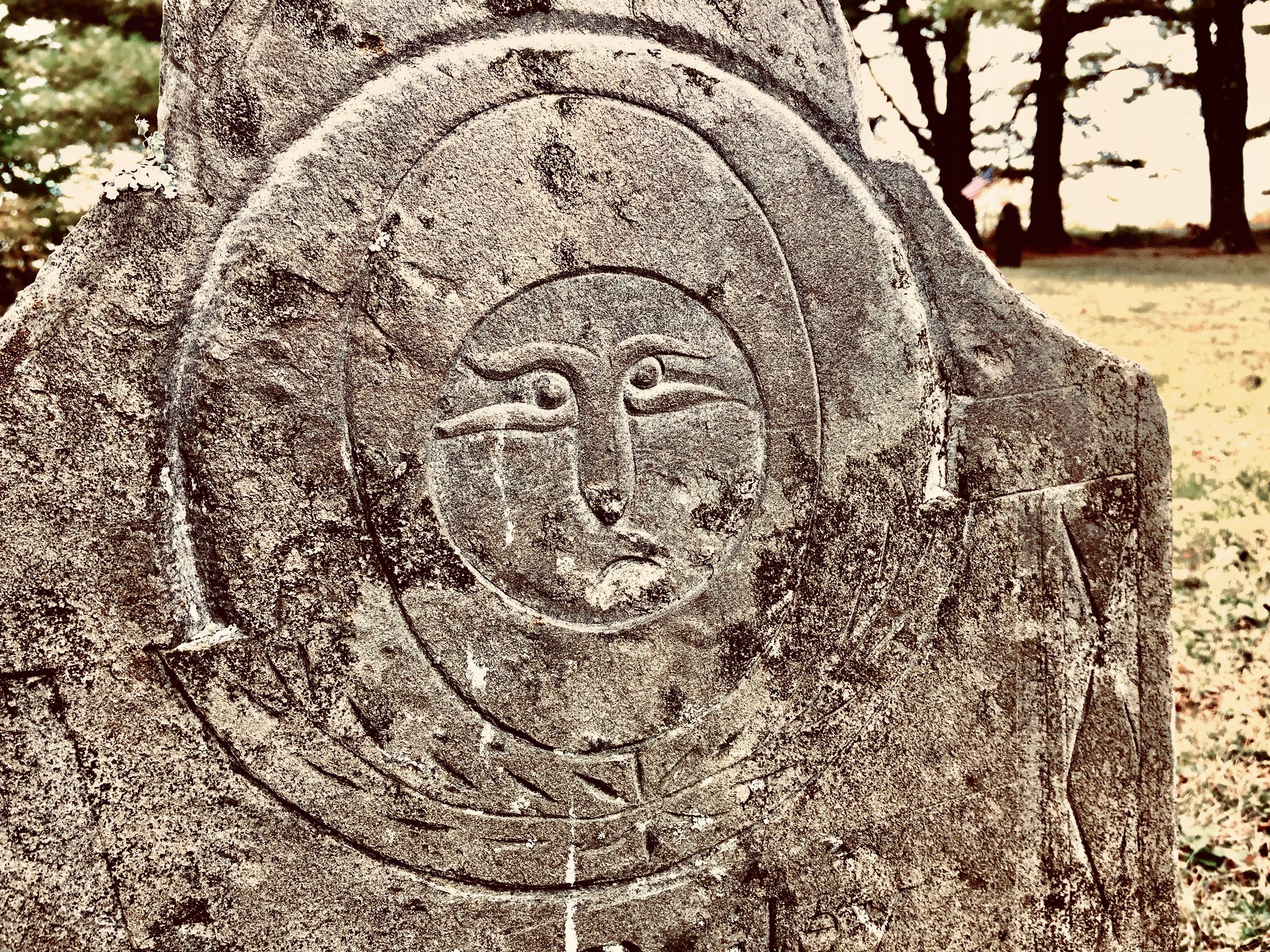
Gravestone, Peacham, Vermont.

Our experience shows us that death does not break our kinship bond. We turn to one another for help and support regardless of which side of death our relatives are on.

— Martin Brokenleg [i]

We pray for the dead, believing that, as they are drawn nearer to God, they are enabled to grow in the knowledge and understanding of God, in the service of God, and in the joy and fulfillment of God’s renewing love. We do not pray for the dead as those without hope, but trusting that the faithfulness of God will bring them to the completion and bliss for which every human soul was created. 

— Jon Hart Olson [ii]     


On All Souls Day (November 2), we call the dead to mind with stories, mementos, photographs, and rituals. In some ways, the dead never leave us. We still use the language they invented, live in the houses they built, learn from their wisdom, pay for their sins. And we carry their DNA inside our bodies. Bill Holm, a Minnesota poet, has noted the strong resemblances between his own living and dead:

When Jona at sixty traveled 
to her father’s farm in Iceland, 
the relatives looked down
at bony knuckles, veins
popping up, said: “See!
She has the Josephson hands
even after a hundred years…”

Now, when I bellow at parties, 
or look down at my own hands;
knuckles growing, veins
rising as I age, I think:
I’ll be living with all 
these dead people inside me.
How will I ever feed them?
They taught me, dragging carcasses
a thousand winters across
the tundra inside their own bodies. [iii]

“How will I ever feed them?” We certainly contain and nurture the legacy of the dead in our culture, in our very bodies, but is there any form of continuing relation with the dead as discrete entities who remain other than ourselves? Do the dead still exist somewhere, and can we still be in relation with them? In both the Odyssey and the Aeneid, the hero descends to the underworld to speak with the dead and get their advice. However eerie, it was a sensible quest. The dead have “been there, done that.” They possess the voice of experience. Robert Pogue Harrison explains what Homer and Virgil were up to when they put words in the mouths of the shades in Hades: “We lend voice to the dead so that they may speak to us from their underworld—address us, instruct us, reprove us, bless us, enlighten us, and in general alleviate the historical terror and loneliness of being in the world.” [iv]

As a person of faith, I believe this continuing presence to be more than the lingering effects of the departed on our bodies and our psyches. The communion of the living and the dead possesses an ontological dimension. The afterlife has an existence, a reality, outside our imagination. And it is not only in the past. It is part of our present, and our future. Whether we live or die, we all belong to a larger divine wholeness—“all the company of heaven”— from which we can never be separated. This wholeness, for which there are many names, is the Love that binds us all together. This interconnection, this “communion of saints,” cannot be broken, even by death.

Such radical sense of interdependence, where we all, as John Donne put it, “lie open to one another,” may not come naturally to people who value privacy and individuality and have the means to live without others. Among the world’s poor, however, survival depends on mutuality. People pool and share their resources, with no illusions that they can make it on their own. Community and family are absolutely necessary, and this solidarity is not broken by death. 

In her study of Mexico’s Días de los muertos, Juanita Garciagodoy writes that the poor do not regard the self as “atomistic, independent of the social body that constitutes its extended family and community. The physical body is not the private property of its owner with the array of rights to privacy and individualism and the independence from relations, friends, and neighbors the body of the typical “first worlder” claims. People are felt to be connected radically.” This connectedness includes the departed, as the Days of the Dead make clear. “Those people’s spirits are still part of the unit of the living. There is no question about their desert to be humored, fed, entertained, and regaled on dates of remembrance. Those who live with this understanding know that no one is an island.” [v]  

Dead or alive, we’re all in this together. The Mexican calaveras, cartoonish depictions of skeletons performing the activities of the living, make this point with comedic verve. I once saw a woodcut of three skeletons in festive dress, arms around each other, smiling and waving as they looked me in the eye. Below them, like a postcard greeting, were the words, Wish you were here!  

Gravestone, St. Peter’s churchyard, Lewes, Delaware.

My father died when I was 21. One of my best friends died when we were 30. But for the most part, death kept its distance in my younger days. Lately, however, the losses have begun to mount. The pandemic, tragically, has taken vast multitudes—“a huge number, impossible to count.”[vi] And on a personal level, the vanishing of loved ones grows way too frequent now that I’ve reached a certain age. In the past few years, I’ve addressed personal loss in my writing, and in honor of All Souls, my Day of the Dead “altar” will be a brief florilegium—flowers for the dead, if you will— from four of my requiem posts. 

When two of my most beloved elders, Joe and Phyllis Golowka, died within weeks of each other, I wrote (and preached) “You say goodbye, I say hello”: A Requiem Sermon

This is the story that God’s friends stake their lives on:
God has loved us into existence.
God sustains us every step of our life’s journey.
And even after our bodies give out,
God loves us too much to let us go.

Bill Fisher, born five days earlier than I, was a close friend for 59 years. In his final days, after he slipped into unconsciousness, I gave him last rites, and his earthly companions sang him to rest. In Paradisum: On the Death of a Friend, describes what happened next.

I entered his room alone to sing him one more song, “Waterloo Sunset.” We had both loved the quirky music of Ray Davies, and the song’s image of crossing over the river “to feel safe and sound” seemed so fitting.

And I won’t feel afraid
As long as I gaze on Waterloo Sunset
I am in paradise 

Another friend was taken suddenly early this year. In “When I begin the long work of rising”—A Tribute to David Fetcho, I quote one of his songs:

I want to go with you
to the other side of the light
where we’ll see
what the shadow reveals
will be such a relief …
time in its disguises 
won’t fool us anymore …

Days tumble on with minds of their own
they breathe in our lives, and make them their own
and time, time disappears
like the wind from a sail …
and every good day will be 
just another good day
of eternal life. [vii]

Anise Stevens, my sister’s child, left us far too soon at age 49. She died in the first minute of dawn on New Year’s Day, 2019. Through my tears, I preached “Trailing clouds of glory” at her requiem.

In her last weeks, Anise wondered about what lay ahead. That is the question. My sister Martha said to me before the funeral that her daughter is “on her way.” Then she recited Wordsworth’s evocative image of the next life as our native home to which we shall one day return:

Our birth is but a sleep and a forgetting; 
The Soul that rises with us, our life’s Star, 
Hath had elsewhere its setting 
And cometh from afar;
Not in entire forgetfulness, 
And not in utter nakedness, 
But trailing clouds of glory do we come 
From God, who is our home. [viii]

The author lays California wildflowers on the grave of William Wordsworth in St. Oswald’s churchyard, Grasmere, England (July 16, 1994).

I have always found Wordsworth’s hopeful and exuberant spirit an inspiration, so much so that I marked my fiftieth birthday with a pilgrimage to the poet’s grave. After nine miles of rambling through the Arcadian charms of English countryside, I arrived at dusk. I had brought along my copy of The Prelude, with two wildflowers from home, an orange California poppy and a pink Farewell-to-Spring, pressed within its pages. As a quarter moon set over the darkening hills beyond St. Oswald’s churchyard, I took out the flowers and laid them on the grassy grave. Then, in the fading light of a summer evening, I spoke the lines which epitomize my own trust in the providence and grace of the human journey:

The earth is all before me. With a heart
Joyous, nor scared at its own liberty,
I look about; and should the chosen guide 
Be nothing better than a wandering cloud,
I cannot miss my way. I breathe again! [ix]


[i] Martin Brokenleg, “Mitakuya owasin: You are all my relatives,” in The Witness, Vol. 76, No. 11 (Nov. 1993), p. 8. Brokenleg is an Episcopal priest and a member of the Rosebud Sioux tribe.

[ii] Jon Hart Olson, newsletter of Christ Church, OntarIo, CA (Nov. 1994). Jon was an Episcopal priest, colleague, mentor and friend.

[iii] Bill Holm, “Genealogy,” in The Dead Get By with Everything (Minneapolis: Milkweed Editions, 1991) 14.

[iv] Robert Pogue Harrison, The Dominion of the Dead (Chicago: University of Chicago Press, 2005) 150-1.

[v] Juanita Garciagodoy, Digging the Days of the Dead (Boulder, CO: University Press of Colorado, 2000), 269.

[vi] Revelation 7:9, from the liturgical readings for All Saints Day.

[vii] David Fetcho, “Just Another Good Day.” You can listen to the song here: https://soundcloud.com/ds_feco/just-another-good-day

[viii] William Wordsworth, “Ode on Intimations of Immortality from Recollections of Early Chiidhood.”

[ix] William Wordsworth, The Prelude, I.14-18. Wordsworth’s image is a happy reversal of Milton’s melancholy account of the Expulsion from Paradise, where the first humans’ outward journey has dimmer prospects: “The World was all before them, where to choose / Their place of rest, and Providence their guide: / They hand in hand with wandering steps and slow, / Through Eden took their solitary way” (Paradise Lost, 646-649).

Words Fail: Thinking the Divine Name(s)

“… “to think God without any conditions, not even that of Being.” — Jean-Luc Marion

It seems that we can use no words at all to refer to God.

— Thomas Aquinas [i]

As soon as there are words … direct intuition no longer has any chance. 

— Jacques Derrida [ii]   

Dionysius the Areopagite, a sixth-century Syrian mystic, made the classic case for theological modesty. We should not presume to say too much about God. When it comes to what he called the “Unutterable,” he said, words fail. An encounter with divine reality leaves us speechless. 

“Reject all that belongs to the perceptible and intelligible … and lift yourself as far as you are able to the point of being united in unknowing with the One who is beyond all being and all knowledge.” [iii]

Dionysius’ insistence on divine ineffability was a subversive counterbalance to the theological project of the ancient ecumenical councils, which devoted intense intellectual energy to the pursuit of dogmatic precision. Words, phrases, even individual letters had been fiercely debated over the course of several centuries. With the stakes so high, no one wanted to get it wrong. But Dionysius’ caution about saying too much would have a lasting influence on both mystics and theologians from the Middle Ages to post-modernity. 

Thomas Aquinas, whose exhaustive systematic theology, Summa Theologica, used 1.8 million words to speak of God, issued a striking caution in one of his shorter works: “as to the mode of signification [for God] goes, every name is defective.” [iv] A modern Catholic theologian, Karl Rahner, agreed, since transcendence “presents itself to us in the mode of withdrawal, of silence, of distance, of being always inexpressible, so that speaking of it, if it is to make sense, always requires listening to its silence.” [v]  That kind of listening without making words is hard, when our heads are so full of ideas. But if we desire accuracy, we must try, as Jean-Luc Marion has said, “to think God without any conditions, not even that of Being.” [vi]

It’s not just that God is unknowable; language itself is chronically imprecise—“a raid on the inarticulate,” T. S. Eliot called it, “with shabby equipment always deteriorating.” [vii] But of the One who is “the Wholly Other, for whom we have no words, and whom all our poor symbols insult,” can we say anything at all? [viii]

The “veil” before the Altar of Presence in the author’s worship installation, “Via Negativa.”

Even Dionysius admitted the necessity of God-talk. We need to understand something about ultimate Reality if we are to be in relation with it. In Divine Names, Dionysius wrote at length about the attributes of God, and so have countless Christian thinkers before or since. While God is always beyond our conceptual reach, we still have religious experiences through which we learn something of who—and how—God is for us. Sometimes we speak in literal terms, as when we say that God loves us. God’s love may be more perfect than human love and mediated in a different way, but it’s love all the same. 

Metaphors, on the other hand, use something familiar to tell us about the unfamiliar. God is not literally a shepherd, a shield, or shade from the heat, but God has been known to be like these things in some way. Those three are all biblical images, but every age provides new metaphors. A British youth minister told me that skateboarders use their experience of what they call “flow” as a kind of divine name. But metaphors are only provisional—“scaffoldings around invisible reality,” in Jerzy Peterkiewicz’s aptly metaphorical image, “liable to vanish” when pressed to become literal. [ix]

What can I say, my God, my life, my holy joy?
Or what can anyone say who speaks of you?”

— St. Augustine, Confessions [x]

St. Augustine’s questions were on my mind when I composed an experimental “creed” for an alternative liturgy at our local Episcopal parish.[xi] The Nicene Creed, crafted by the fourth-century Council of Nicaea to be a concise summary of orthodox belief, is still recited in the Sunday rites of most liturgical churches. Its insertion into the liturgy 150 years after the Council resulted from a now-forgotten doctrinal quarrel, and some of today’s liturgical theologians question its continued use in the rite. [xii]

My own intent, however, was not to critique the Nicene Creed per se, but to explore God-talk in terms of the One and the Many, drawing upon something Thomas Aquinas said about the names of God:

“[We] see the necessity of giving to God many names. For, since we cannot know Him naturally except by arriving at Him from His effects, the names by which we signify His perfection must be diverse, just as the perfections belonging to things are found to be diverse. Were we able to understand the divine essence itself as it is and give to it the name that belongs to it, we would express it by only one name. This is promised to those who will see God through His essence: “In that day there shall be one Lord, and His name shall be one” (Zech. 14:9). [xiii]

I divided the assembly into three parts. Each droned the same Latin text, slowly, in 4 beats: Crèdo in ùnum Dè-ùm (“I believe in one God,” the opening words of the Nicene Creed). They sang on a single tone in unison, but in three harmonizing pitches, with a 2-beat silence between the repetitions. As they continued their droning ground, I both chanted and spoke a descant of divine names.

The people’s repeated line was the One; my recitation of diverse names was the Many. The division of parts was a reverse complementarity: many sang the One and one sang the Many. I drew the names from many sources—hymns, prayers, theologians, mystics, poets, and one filmmaker—absorbed into my own prayer and preaching over the years. I can’t remember exactly where all of the names came from. Some you will recognize. A few sprang from my own religious experience. 

A divine name?

The torrent of words, coming and going so quickly, evoked multiple associations, perspectives and meanings without letting any single “name” linger long enough to permit an idolatrous fixation, as if it alone were the one most accurate or true. No sooner did a “name” appear than it was replaced by another—affirmation and negation in a perpetual dance, just the way Dionysius liked it. People told me later that they stopped trying to grasp individual words and simply sank into the flow, surrendering to the meditative state generated by their repetitive chanting and silent breathing. 

If any liturgists and musicians out there want to try your own variations, please feel free. Trained singers might add more complex harmonies (think Arvo Pärt), and a speech choir could explore creative arrangements of the many names. And of course, you or your community might want to compile a fresh list of names from your own traditions and personal experiences. That this particular list is woefully incomplete is part of the point.

Credo in unum Deum …

Holy and eternal God, 
Beauty so ancient and so new,
Source and sustainer of everything that is. 

Author of life, mender of destinies, 
desire of every heart, the meaning of every story.

Mystery of the world,
most deeply hidden and yet most near,
fount of our being, inexhaustible and overflowing. 
Grace abounding.

Constant and just, wiser than despair, 
joyful Yes against all negation.  

The great I am, beyond all knowing,
yet called by many names:

Creator, Sustainer, Pardoner, Gift-giver,
Goodness, Wisdom, Mercy, Truth, Faithfulness, Blessing,
Alpha and Omega, Ruler of time and history,
ineffable and untamable Spirit.

Presence. 
The depth in every moment.

Eloquent silence, dazzling darkness, blinding radiance,
so far beyond us—and so deep within us, 
in whom we live and move and have our being.

Holy One: Thou—Abba! ThouAmma! 
Love who loves us. 

Our true and lasting home. 

+

Jesus Christ, the Given One, eternally begotten,
who by the power of the Holy Spirit
became incarnate from the Virgin Mary:
fully human and fully divine.

Word made flesh, to live and die as one of us,
that we might see and know the self-diffusive love of God,
and realize the fullness of our humanity. 

As God’s icon, the face of love for us, 
Jesus renounced privilege and power,
living without weapons or self-protection,
giving himself away for the sake of others:
servant and sufferer, healer and helper,
Savior and friend! 

Handed over to the enemies of life,
Jesus died on the cross.
But on the third day he rose again,
breaking the power of death,
opening the way for us
to live in God forever.

+

Holy Spirit, Love’s consuming flame,
the eager, wild wind of divine surprise: 

Quickening power, creative energy, inner light,
divine imagination, disturber of the peace,
dearest freshness deep down things,
the strong force of love, drawing the universe into communion.

Sustainer, Sanctifier,
Counselor, Comforter,
Dancer.

The breath in every prayer, 
the longing in every heart.

+

Holy and undivided Trinity, 
your catholic and apostolic Church belongs to you alone.
We give thanks for the renewing power of our baptism,
making us Christ’s own forever—forgiven and free.

Grant us to live always in the light of resurrection,
overflowing with love and steadfast in hope.

May the faith we confess in this assembly
be visible in the lives we lead and the choices we make. 

Let all the people say: Amen!


Photographs by the author. The view of the sky through the arch of the south porch baldaquin of the Cathedral Basilica of St. Cecilia in Albi, France, is an image for the limits of theological speech: the stairs of language take us upward, but only so far. After that: a wordless sky. You can read about the “Via Negativa” installation here. Arne Pihl’s “Gentle” sculpture (2014-15) was part of an installation in a razed lot in Seattle, responding to questions about the future of a changing neighborhood.

[i] Thomas Aquinas, Summa Theologica 1a.13.1. Thomas quotes from Dionysius to support this statement.

[ii] Jacques Derrida cited in The Oxford Handbook of Philosophy and Religion, ed. William J. Wainwright (Oxford & New York: Oxford University Press, 2005), 489.

[iii] Dionysius the Areopagite, Mystical Theology 1.1, cited in Olivier Clément, The Roots of Christian Mysticism (Hyde Park, NY: New City Press, 1993), 247. The anonymous mystic’s name is a pseudonym taken from Acts 17:34 to suggest apostolic authority.

[iv] Thomas Aquinas, Summa contra Gentiles 30.3. Italics mine.

[v] Karl Rahner, S. J., Foundations of Christian Faith (1983), p. 64, cited in Thomas M. Kelly, Theology at the Void: The Retrieval of Experience (Notre Dame, IN: Notre Dame University Press, 2002), 130.

[vi] Jean-Luc Marion, God Without Being (1991), p. 45, cited in The Oxford Handbook of Philosophy and Religion, 484.

[vii] T. S. Eliot, “East Coker,” in Four Quartets.

[viii] Evelyn Underhill, Mysticism: The Nature and Development of Spiritual Consciousness (Oxford: Oneworld Publications 1999/2008, orig. published 1911), 337.

[ix] Jerzy Peterkiewicz, The Other Side of Silence: The Poet at the Limits of Language (London: Oxford University Press, 1970), 45.

[x] St. Augustine, Confessions 1.4. The full passage has a wonderful list of divine names: Summe, optime, potentissime, omnipotentissime, misericordissime et justissime, secretissime et presentissime, pulcherrime et fortissime; stabilis et incomprehensibilis; immutabilis, mutans omnia. Numquam novis, nunquam vetus, … Semper agens, semper quietus; colligens et non egens: portans et implens et protogens; creans et nutrigens et perficiens: quaerens cum nihil desit tibi … Quid dicimus, Deus meus, vita mea, dulcedo mea sacnta? Aut quid dicit aliquis, cum de te dicit? (“Highest, best, most potent, most omnipotent [transcendent], most merciful and most just, most deeply hidden and yet most near, fairest, yet strongest, steadfast, yet ungraspable, unchangeable, yet changing all things; never new, yet never old.… ever busy, yet ever at rest; gathering yet needing not; bearing, filling, guarding; creating, nourishing, and protecting; seeking though you have no wants … What can I say, my God, my life, my holy joy? Or what can any say who speaks of you?”).

[xi] St. Barnabas Episcopal Church, Bainbridge Island, WA.

[xii] In his 1995 commentary on the liturgy at St. Gregory of Nyssa Episcopal Church in San Francisco, Richard Fabian writes that Peter the Fuller, Patriarch of Antioch, whose Monophysite party was defeated at the Council of Chalcedon (451), inserted the creed into the cathedral liturgy to show his loyalty to the earlier Council of Nicaea (325). Though he was soon deposed, the creed remained, “a massive monument to doctrinal quarrels ever since.” Its inclusion was resisted in the western church, especially in England, but slipped into English worship in the 15th century, and incorporated into the Book of Common Prayer in the 16th. Today, some question its lack of inclusive language as well as the ancient Greek terminology whose original meanings are obscure to many. And some liturgists wonder about its effect on the natural flow of the rite. (Worship at St. Gregory’s, All Saints Company, 25-26).

[xiii] Summa contra Gentiles, 31.4. As to just how many names there are, I’ve always liked the number from Arthur C. Clarke’s short story, “The Nine Billion Names of God.”

“The deepest kind of life”—Is Religion Dying?

St. Mary’s, Fairford, Gloucestershire, England (Jim Friedrich)

For most of my life, a majority of Americans—around 70%—identified with a religion. In the twenty-first century, that stability in religious affiliation has collapsed, falling by 20 points in just two decades. The United States, long one of the world’s most religious countries, has become, rather suddenly, one of the least.

Rapid changes in society, technology, mobility and time management, along with the reluctance of younger generations to make institutional commitments of any kind, have contributed to this erosion. So have the manifold sins of believers and religious institutions, which publicly discredit the transformational claims of faith communities. If religious people behave badly, what’s the point?

The major religions have survived comparable challenges in the past. What may be different in these latter days is the degree to which the secular age has flattened reality into a strictly horizontal dimension, excluding the verticals of transcendence and depth. For growing numbers of Americans, God is neither felt nor thought. Religion’s windows into the divine invisible have been replaced by mirrors.

At least since the Enlightenment, critics and skeptics have been writing obituaries for religion. By the nineteenth century, doubt was in full flood. An appraisal in 1878 was typical: “one can hear faith decaying … This decay has been maturing for three hundred years, and their effects prophesied for fifty; indeed, not prophesied only but in some degree accomplished.” [i]  

Thirty years later, Thomas Hardy would write “God’s Funeral,” a somber poem about the death of belief. As the “strange and mystic form” of the expired deity passes by, borne by a great procession of mourners, the poet confesses the object of faith to be a delusion:

… tricked by our own early dream
And need of solace, we grew self-deceived,
Our making soon our maker did we deem,
And what we had imagined we believed.

Till, in Time’s stayless stealthy swing,
Uncompromising rude reality
Mangled the Monarch of our fashioning,
Who quivered, sank; and now has ceased to be.[ii]

At least Hardy felt sad about the demise of divinity (“Sadlier than those who wept in Babylon, / Whose Zion was a still abiding hope.”). These days, unbelief is more a matter of indifference than sorrow. How many people still take God into account, or think theologically, and shape their lives accordingly? Once God is gone, what’s the use of religion? 

The precipitous decline of religious affiliation in America has prompted anxious speculations about what’s next. In “America Without God,” Shadi Hamid, a senior fellow at the Brookings Institute, sees religious fervor being sublimated into political conviction.[iii] As we have seen in the case of the recent Trump cult, with its sociopathic savior, this can go very wrong. At least religion attempts to temper the zeal of believers with mandates of repentance and forgiveness, as well as the humility of unknowing in the presence of mystery. Politics, not so much.

In an article on the “Death of Faith,” journalist Murtaza Hussain deems the extinction of traditional religion in America to be only a matter of time. “Older expressions of religion are not completely absent in public, to be sure. But compared with the past, their influence over events feels akin to the light of a dead star.… The slow-rolling death of religion in American life begs the question, then, what type of new world will emerge from the wreckage of the old?” 

Hussain hopes that any emergent communal expressions will not repeat what he calls “the worst aspects of the old religions, including the moral censoriousness, judgmentalism, heresy-hunting and the persecution of those who think differently.” We should construct a new social imaginary, he suggests optimistically, “with the self-conscious idea of improving on the mistakes of organized religion.”[iv]   

Personally, I am not prepared to exchange Jesus, the sacraments, saints, centuries of wisdom, sacred conversation, communal prayer, or the Paschal Mystery for a mistake-free startup. While I may lament the Church’s manifold sins and grumble over its frustrations, I will continue to feast on its visions and receive its graces. Even the soul’s darkest nights are preferable to a world without divine depth or holy wonder. As Meister Eckhart said, “I would rather be in hell and have God, than in heaven and not have God.”[v]

Baron von Hügel (1852-1925)

In concluding his illuminating study of religious defections by the Victorians and their successors, A. N. Wilson quotes one of the era’s greatest religious thinkers, Baron von Hügel (1852-1925), who insisted that “religion was the deepest kind of life.” And to that, Wilson adds his own Amen: “And I am bound to say that compiling this study of those who tried to live without religion, or who chose to live within the limitations of a purely materialistic explanation for the problems of metaphysics, has not made me wish to revise the baron’s viewpoint.”[vi]

How, then, should the Church respond to declining numbers, or address widespread indifference to its priorities and practices? Shall we attempt to shape a social imaginary more congenial to “the deepest kind of life?” Do we welcome the death of antiquated forms in order to practice resurrection? Or should we wait and listen in faithful silence for a word not yet spoken? 

George Tyrrell (1861-1909)

George Tyrrell was an Irish Jesuit who urged the Church at the dawn of the 20th century to adapt and evolve in response to the challenges of modernity. His progressive views were out of step with his contemporaries, and when the anti-modernist Pius X became pope in 1903, Tyrrell’s fate was sealed. He was expelled from the Jesuits in 1906, denied the sacraments in 1907, excommunicated in 1908, and forbidden a Catholic burial in 1909. Half a century later, his views would be mostly vindicated at the Second Vatican Council. 

The fact that Tyrrell was wrong in 1906 and right in the 1960s demonstrates the tension between stability and innovation which is unavoidable—even necessary—within a living tradition. A great religious institution may not be able to turn on a dime, but it still contains within itself an ultimate loyalty to its transcendent and ineffable core, enabling it to adapt and survive. The secret of Christianity’s longevity is its rootedness in a reality which exceeds any particular institutional or theological expression. Transition, revolution, or even apparent catastrophe do not signify ultimate defeat if you are in covenant with the God of infinite surprise.  

As Orthodox theologian David Bentley Hart puts it, “the proof that any tradition is a living one is precisely that it does not fiercely cling to every aspect of what it has inherited but instead exhibits an often astonishing ruthlessness in shedding the past, out of obedience to some still more original spiritual imperative.”[vii]

Grave at Wesley’s Chapel, London (Jim Friedrich)

Dying to the old and rising into the new is a costly and painful process, but it is the ultimate vocation of every believer and every church. In a letter to a friend in April 1906, Tyrrell movingly expressed both the anguish and the hope of trusting in the unknown futurity of God: 

“I quite understand your desire for a life of prayer—the nostalgia for the old days ‘when His lamp shone about my head.’ God knows I feel it. But I think they will return for us all in some better form. I find the Breviary lives for me again after a long transition period of death. One has to pass through atheism to faith; the old God must be pulverized and forgotten before the new can reveal himself to us.” [viii]

Tyrrell’s “pulverized and forgotten” God sounds little different from Hardy’s “mangled Monarch,” except for one thing: resurrection. Hardy thought death was the end of the story. Tyrrell knew it was only the beginning. 


[i] W. H. Mallock, The Nineteenth Century, cited in A. N. Wilson, God’s Funeral (New York: W. W. Norton & Company, 1999), 164.

[ii] Full text and notes for Hardy’s poem: http://greatpoetryexplained.blogspot.com/2019/01/gods-funeral-by-thomas-hardy.html

[iii] Shadi Hamid, “America Without God,” The Atlantic (April 2021): https://www.theatlantic.com/magazine/archive/2021/04/america-politics-religion/618072/

[iv] Murtaza Hussain, “How the Death of Faith Will Hurt the Left,” Wisdom of Crowds (Sept. 15, 2020): https://wisdomofcrowds.live/death-of-faith-hurt-the-left/

[v]Meister Eckhart (c. 1260 – c. 1328), cited in Evelyn Underhill, Mysticism: The Nature and Development of Spiritual Consciousness, originally published 1911 (Oxford: Oneworld Publications, 1993), 209.

[vi] A. N. Wilson, 336.

[vii] David Bentley Hart, Theological Territories: A David Bentley Hart Digest (Notre Dame, IN: Notre Dame University Press, 2020), 106.

[viii] George Tyrrell, cited in A. N. Wilson, 351.