Ascension Day “Charade”? – The Puzzling Exit of Jesus

Ascension Day at the Episcopal Theological School, May 4, 1967 (Photo by Jim Friedrich)

I first fell in love with Ascension Day in the seventh grade, when my Episcopal school in Los Angeles kept the day holy by giving us the afternoon off. When solemn high mass ended at noon, 350 boys raced out of chapel to make the most of a sunny spring day. I may not have had a keen grasp of the Ascension’s theological significance, but if it meant a half-day vacation, I was all for it. So how did I spend that free time? I went to see the Crucifixion.

My father, James K. Friedrich, priest and film producer, was shooting the last episode of a 6-hour miniseries on the life of Christ. I met my friend Ricky McGarry, whose Catholic school also observed a half-day, and we took a bus to Hollywood’s Goldwyn Studio to visit the set. The irony of going to “Golgotha” on Ascension Day escaped me at the time. Although it could be said that the Fourth Gospel sees as much glorification on Mt. Calvary as Luke sees on the Mount of Olives, this was not an argument a seventh-grader was prepared to make.

The Rev. James K. Friedrich on the set of “Crucifixion and Resurrection” (1956)

My most memorable––and notorious––Ascension Day came a decade later, reported under the title “Ascension Day Charade “ in The Christian Century magazine.

On Ascension Day, May 4, approximately 40 men and a few women and children gathered at a conspicuous place at noon and conducted a premeditated, burlesque celebration of the day of Christ’s “Glorification.” To one end of a long cord they had fastened several gas-filled balloons; to the other, a crude effigy of the Christ made of tissue paper and cardboard. As high noon approached, the crowd began a hilarious countdown beginning at 100. The volume of the shouting and the air of boisterous jollity heightened until with a mighty shout of “Zero” and “Blast-off” from the crowd the cord holding the balloons and the effigy was released. A naïve bystander did not realize what the raucous crowd was mocking until, as the balloons ascended dragging behind them the paper Christ, he heard one of the men quote Scripture: “Men of Galilee, why do you stand looking up into heaven? This Jesus, who was taken up from you into heaven, will come in the same way as you saw him go into heaven.”

Who were these people? Were they Russian atheists or members of the Chinese Red Guard taunting Christians with their gibes? Were they “hippies” taking a trip on LSD or Black Muslims reviling Christianity? Where did this parody of the Ascension occur? It occurred on the campus of a highly respected seminary, and the men who contrived and conducted it were seminarians, studying for the office of pastor, prophet and priest in the high calling of Jesus Christ.

The unsigned editorial went on to shake its finger at such “profanations,” expressing “revulsion and pity,” and “a heavy sense of abiding sadness” over the “absurd and despicable” actions of those naughty seminarians.

On the day designated by the church and by generations of Christian people as a reminder of the exaltation of Christ, these people debased the Christ… What will they try next for thrills? The Black Mass?[i]

But another mainline publication, the Methodist Christian Advocate, jumped into the fray on the students’ behalf. It couldn’t resist needling the low church Century for fussing over a liturgical calendar item to which their liberal mainline constituency in fact paid scant attention. And it worried that the establishment’s “disturbing defensiveness about surface material” may signal that its symbols are already on the decline. In contrast, said the Advocate,

the seminarians who are able to deal so lightly with symbols of a previous day… are indicating a certain freedom toward their faith. Be reminded that they are seminary students, who presumably have some desire to serve their world through their church. Their lightness toward tradition may well reflect a desire to shake loose from dead forms in order to better serve the God who has called them.[ii]

Dear reader, it may not surprise you to learn that this controversial liturgical observance was cooked up in my seminary dorm room. A youthful Religious Imagineer, joined by two other first-year students at the Episcopal Theological School in Cambridge, Massachusetts, was seeking a dramatic finish to a series of spontaneous “art actions” during a four-day gathering of major church leaders. The conference agenda was certainly serious and daunting––the reunification of ten American denominations. But the addition of news media and right-wing Christian protestors to the mix was too tempting to resist. It seemed a good time for some religious guerilla theater.

Our helium-powered ascension was not mockery but play, with precedents going back to the medieval practice of tying a rope to an effigy of Christ and pulling it up through a hole in the church ceiling on the Feast of the Ascension. But in the late twentieth century, the explicitness of a material ‘figure’ rising into an empty sky prompted some discomfort among the Christian modernists in the crowd. How much were they being asked to believe about the Ascension? What was really at stake in our ‘Ascension Day Charade?’

The four gospels describe the earthly life of Jesus, his death, and various appearances to his followers after the resurrection. But only Luke describes the moment the appearances ended. Matthew provides a farewell scene on a mountain, but we never see Jesus actually leave. Instead, he promises to be with us always, to the end of time. Mark concludes his account with three women being told by a mysterious figure that the risen Christ is “not here.” But if they go back to Galilee, they will see him there. It’s like the teaser in a season finale: To be continued. John, who devotes several chapters to a long and moving farewell speech at the Last Supper, ends his gospel with a another conversation over food––a picnic breakfast at the beach––but now the talk seems less urgent, as though Jesus and his friends have all the time in the world together.

Only Luke delivers the emotional image of seeing the Incarnate One go for good, like Shane riding off into the sunset. As I wrote in my 2014 post on the Ascension, “Where Did Jesus Go?”:

Luke might have had Jesus disappear around a corner, or over a hill.
Or the disciples might have looked away for a moment, or blinked,
missing the exact moment of vanishing.
But the cloud is a nice touch. Artists have always loved it.
In any event, Jesus is suddenly gone.

Christians ever since have been left with a number of questions? Where did he go? Is he still locatable in space and time, or is he only in a transcendent, placeless realm? What form did he take in order to be in a ‘place’ beyond embodied existence? What does it mean to say Christ is still present and in relationship with us? Does the Ascension tell us anything about our own future?

If Jesus exchanged the spatially locatable body of a first century Jew for the omnipresence we attribute to the divine, can we still say he is fully human, or did the Word “unbecome” flesh in the Ascension? Did it somehow reverse or cancel the Incarnation?

Martin Luther, insisting that the ascended Christ was not “a stork in a nest in a treetop,”[iii] argued for his ubiquitious presence in the here and now, but that still leaves the particularity of Jesus in question. As one contemporaray theologian has framed the dilemma, “Christ everywhere really means Jesus of Nazareth nowhere.”[iv]

One ancient solution was to understand the Church as the continuation in space-time of Christ’s incarnate presence. Jesus’ individual body was succeeded by the community of the faithful, the visible ‘Body of Christ’ in the world. As Ephesians says, “The Church is Christ’s body, the completion of him who himself completes all things everywhere” (Eph.1:23). But where is the church which has truly fulfilled this high calling, except in momentary flashes of grace? We may be Christ’s hands and feet in the world, but we are still not all that good at it, despite centuries of practice. The perfection of Christ is not contained within the ecclesia, though we may hope to meet it there.

It was easier to take Luke’s ascension imagery seriously when the cosmos was vertically arranged into earth below, heaven above. The heavenly realm might be invisible, yet it could seem nonetheless near enough to shed its influence on the world below. Indeed, many paintings of the Ascension show heaven to be, as the Celts say, only about a foot and a half above our heads.

Pietro Perugino, The Ascension of Christ (1495-98)

Recent centuries have abandoned such a dualistic cosmos. Heaven as a separate place in the old sense has receded into infinity––and beyond!––distant and remote, unengaged with the mechanisms, causalities and presences of this world. But a God who has nowhere to ‘be’ in space-time is a God without ‘existence.’ In modernity’s cosmology, it isn’t just Jesus who has ascended out of sight, but the entire Godhead. The question became not just ‘where is Jesus?’ but ‘where is God?’

Theologians have puzzled over the seeming ‘unthinkability’ or absence of God within the social imaginary of modernity. I won’t go too far into the weeds to catalog the rich variety of their responses here, but they include thinking of God not as a noun (an object among others) but as a verb (known through actions, situations or relations), or expanding the notion of transcendence to mean not only ‘beyond’ but ‘within’––the hidden inner source of every possibility which Gerard Manley Hopkins called ‘the dearest freshness deep down things.’ But whatever the approach to the mystery of divine presence and absence, language fumbles when it reaches beyond the senses. In the matter of the divine who, what, where, when and how, words fail.

The true God is the unknown mystery of the world whose holiness is violated as soon as God acquires a name. God is beyond being and nonbeing, belief and unbelief, theism and atheism. God is hidden, holy, mysterious, the ineffable source of revelation and grace.[v]

The Ascension epitomizes the dilemma of locating and describing ‘the unknown mystery of the world.’ We may catch a glimpse the disappearing feet, but if Jesus has indeed returned to God, where exactly is that? And how do we ourselves get there?

The Ascension of Christ, Limoges (Late 16th century)

A nineteenth-century Danish theologian proposed a temporal approach to the question of ‘where.’ Instead of looking for the ascended Christ in space, might we discern him within the unfolding of time, replenishing and perfecting the world ‘with the energies of the future’?

The presence of Christ in the universe must be looked upon, not so much as actual being, but rather as an essential becoming; it must be treated as a progressive advent, a continual coming, in virtue of which, by the growing development of his fullness, he makes himself the center of the whole creation; and the creation itself is thus being prepared and created anew as a living, organic, and growing temple of Christ.[vi]

To contemplate the mystery of the ascended Christ as a process, shaping the interrelated destiny of everything that is, may prove a way to collapse the infinite distance between earth and heaven into a nearness, a presence, which can be known and experienced even if not understood. Wherever Christ went, it was to prepare a ‘place’––or situation––where we all may become our truest selves, completed at last in Christ’s glorified and expanded body. Like Dante at the end of Purgatorio, through the mystery of ascent we become ‘rifatto … puro e disposto a salire a le stelle’ (‘remade . . . pure and ready for the stars’).[vii]

So the ultimate question for Ascension Day may not be ‘where is Jesus?’, but ‘where are we?’ And where do we need to go from here to be with Christ and in Christ? An old shape note hymn says it perfectly:

Then he arose, ascended high
To show our feet the way…


Related post: Where Did Jesus Go?


[i] “Ascension Day Charade” (unsigned editorial), The Christian Century, vol. LXXXIV, No. 21 (May 24, 1967), 675-76.

[ii] “Jesus in the Clouds,” Christian Advocate, vol. XI, No. 12 (June 15, 1967)

[iii] Douglas Farrow, Ascension and Ecclesia: On the Significance of the Doctrine of the Ascension for Ecclesiology and Christian Cosmology (Edinburgh, Grand Rapids: T & T Clark, 1999), 269.

[iv] Ibid., 12.

[v] Gary Dorrien, The Word as True Myth: Interpreting Modern Theology (Louisville: Westminster John Knox Press, 1997), 238

[vi] Hans Martensen, in Farrow, 192.

[vii] Purgatorio xxxiii.141-143.

End photo by Marilyn Robertson.

To Plough and Harrow the Soul: The Shared Work of Art and Faith

Sandro Botticelli, Madonna and Child with Singing Angels (1477), Gemaeldegalerie, Berlin

[Art] makes us see in new and different ways, below the surface and beyond the obvious. Art opens up the truth hidden and within the ordinary; it provides a new entrance into reality and pushes us through that entrance. It leads us to what is really there and really going on. Far from subjective, it pierces the opaque subjectivity, the not seeing, of conventional life, of conventional viewing, and discloses reality.[i]

– Langdon Gilkey

The allotted function of art is not, as is often assumed, to put across ideas,
to propagate thoughts, to serve as example. The aim of art is to prepare a person
for death, to plough and harrow his soul, rendering it capable of turning to the good.[ii]

– Andrei Tarkovsky


In the blood-soaked trenches of World War I, a young German chaplain found respite from horror and death by looking at reproductions of great art in tattered magazines. Even in black and white, faintly viewed by candlelight, the images revealed to him “the existence of beauty.” As soon as the war ended, he went straight to the art museum in Berlin to see, for the first time, one of the paintings which had comforted him in battle: Botticelli’s Madonna and Child with Singing Angels.

Gazing up at it, I felt a state approaching ecstasy. . . As I stood there, bathed in the beauty its painter had envisioned so long ago, something of the divine source of all things came through to me. I turned away shaken … I believe there is an analogy between revelation and the way I felt … the experience goes beyond the way we encounter reality in our daily lives. It opens up depths experienced in no other way.[iii]

Ten years later, in 1927, a middle-aged Canadian painter saw an exhibition of modernist landscapes by the celebrated “Group of Seven.” That night she wrote in her journal:

Oh, God, what have I seen? Where have I been? Something has spoken to the very soul of me, wonderful, mighty, not of this world. Chords way down in my being have been touched. . . Something has called out of somewhere. Something in me is trying to answer.[iv]

The young German, Paul Tillich, would become one of the greatest theologians of the twentieth century, while Emily Carr, at age 56, would begin her most productive period as a painter, exploring the unique spirituality of Canadian landscapes.

Tillich and Carr each had a powerful, life-changing experience in the presence of paintings. Were they describing a religious experience or an aesthetic one? Whatever distinctions might be made between the religious and aesthetic dimensions of each encounter, what they had in common was the fundamental dynamic of revelation: call and response.

 Something has called out of somewhere.
Something in me is trying to answer.


Lawren Harris, North Shore, Lake Superior (1926)

Art, like religion, addresses us, hoping for a response. Art, like religion, wants to take us “deeper and deeper into the world.”[v] Art and Christianity have sometimes acted like rivals, but they really share a common task––to rescue us from what David Foster Wallace called “our tiny skull-sized kingdoms,”[vi] and awaken us to larger realities.

Gary Indiana, in his appreciation of the transcendental cinema of Robert Bresson, put it this way:

You go to a work of art and hope to be transformed. Quietly, secretly, to be roused from a waking sleep, agitated at some resonant depth in your psyche, shown something you couldn’t have shown yourself. Bresson shocks you into reconsidering your whole existence.[vii]

Not everyone welcomes this kind of engagement in art – or in religion, for that matter. Many would prefer art to remain a harmless commodity, a decoration, an amusement. The average time a museum visitor spends in front of a painting is about fifteen seconds. As for religion, how many churchgoers want a worship service to shock them into reconsidering their whole existence?

Once upon a time in the West, there was no such thing as religious art.[viii] There were simply religious beliefs and practices involving images, words, music, singing, architecture, drama and movement. But with the waning of the Middle Ages, art began to lose its preoccupation with sacred stories and theological themes. Artists turned their attention to the human being, the natural world, material objects and daily life, even as churches of the Reformation, wary of idolatry, began to strip images and ornaments from their places of worship.

Thus the typical modern narrative of art history shows religious concerns and perspectives being left in the dust with the rise of secular culture. The modern artist was expected to ignore religion or to mock it. Christian subjects and symbols, no longer a living language for many, began to lose their hold on the imaginative life of the West. Museums replaced churches as sites of popular devotion. And conventional wisdom concluded that good artists were not religious and religious artists were not good.

Barnett Newman’s fierce manifesto in 1948 declared art’s absolute independence from religious tradition:

We do not need the obsolete props of an outmoded and antiquated legend. We are creating images whose reality is self-evident and which are devoid of the props and crutches that evoke associations with outmoded images, both sublime and beautiful. We are freeing ourselves of the impediments of memory, association, nostalgia, legend, myth, or what have you, that have been the devices of Western European painting. Instead of making cathedrals out of Christ, man, or ‘life’, we are making them out of ourselves, out of our own feelings.[ix]

Some of that same antipathy lingers today. When a symposium on art and religion was held a few years ago, two prominent art critics refused to attend. They said it would be too “painful” to sit at a table where people talk about religion and art at the same time.[x]

Christians have made their own contribution to the divide. They have not always been comfortable with the questioning spirit and expressive freedom of artists. And many churches are simply out of touch with contemporary art, failing to regard engagement with the arts as a significant spiritual practice. Nor do they foster dialogue––or collaboration––with local artists, closing the door to the possibilities of mutual exchange.

But contemporary Christianity’s greatest failing with respect to the arts may be a lack of imagination––in our worship, our formation practices, and our theological conversations. Gerhard Richter, one of the world’s most celebrated living artists, thinks “the church is no longer adequate as a means of affording experience of the transcendental and of making religion real—and so art has been transformed from a means into the sole provider of religion.”[xi] It is a troubling indictment, and I hope we can prove him wrong with a rebirth of vision and wonder in our common life.

Meanwhile, the whole tired narrative of art leaving religion behind is being reexamined. A close look at the writings and conversations of modern and contemporary artists reveals a continuing interest in the transcendent, the numinous, and the sacramental. A lot of artists may have stopped going to church or painting traditional religious subjects, but few have ever abandoned the search for meaning or depth of presence in their work.[xii]

Many iconic figures of modern art openly recognized the spirituality of their work. “I want to paint men and women,” wrote Vincent van Gogh, “with that something of the eternal which the halo used to symbolize, and which we seek to communicate by the actual radiance and vibration of our coloring.”[xiii] Jean Miró hoped painting could “discover the religious essence, the magical significance of things.”[xiv] Mark Rothko believed that both the making and the viewing of his intensely colored canvases had a sacred dimension: “The people who weep before my pictures are having the same religious experience I had when I painted them.”[xv]

Roger Wagner, Menorah (1993)

There are an increasing number of well-respected Christian visual artists, such as Roger Wagner, Makoto Fujimura, and Terrence Malick, who are exploring Christian subjects, stories and symbols with fresh eyes and astonishing means. Many others, though not active in faith communities, still find in Christianity a deep language for the big questions of identity, purpose, and suffering.

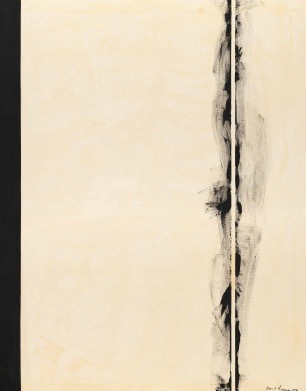
The persistence of Christian subjects and images, despite the immense erosion of the Church’s cultural presence, is exemplified in the case of Barnett Newman. Only ten years after his manifesto against the “outmoded images” of western art and religion (quoted above), he began to paint one of the sacred masterpieces of modern art: Stations of the Cross (1958-1966). In fourteen large abstract canvases of minimal content, he explored Christ’s anguished scream from the cross: My God, my God, why have you forsaken me? Newman called it “the unanswerable cry,” and in each of those paintings, often with only a thin black line in tension with––even overwhelmed by––the empty space around it, he questions our place in the larger whole. What does it mean to exist, to suffer, to desire? Are we alone, ignored, or loved?

Barnett Newman, Stations of the Cross, First Station (Jesus is Condemned)

Ultimately, it is not just the intentions or beliefs of the artists, nor their chosen subjects and styles, which make their art religious, for “any art that helps us penetrate the surface of things is religious, regardless of content or creator.”[xvi]  And whether art is a mirror of the human condition, a window into beauty both immanent and transcendent, or a hammer to shatter our complacencies, it shares many of the tasks and effects of religion.

Art and faith are, each in their own way:

  • Transformative: opening us up to the otherness of worlds beyond our isolated egos.
  • Revelatory: showing us what might otherwise remain invisible (suffering and injustice as well as more sublime realities).
  • Sacramental: making present to our senses the depth and beauty of a world “charged with the grandeur of God.”
  • Relational: connecting us with “Something” that not only desires to be known, but wants to address us.
  • Prophetic: making it impossible to avert our eyes from pain, suffering and injustice.
  • Formative: teaching us how to be receptive and pay the deepest attention.

Art and faith, then, are fundamentally allies, though they may not always act like it. Deepening the connections between them is, I believe, part of the Spirit’s dance. Or as Cirque du Soleil’s Michel Laprise puts the question:

A bridge to a new dimension? A magnetic portal to an invisible world? Yes! Why not? The Valley of Possible Impossibles, where dreams are on standby … waiting to be ushered into the now Abandoned dreams, collective dreams, mad, mad, mad utopian dreams … the unconscious into the conscious. Duality! Oneness!

Let the journey begin… [xvii]


Cirque du Soleil, Kurios (photo by Jim Friedrich)


Related posts

Do Not Fear: Reflections on the Venice Colloquium

“The artist formerly known as priest”


[i] Langdon Gilkey, “Can Art Fill the Vacuum?” in Art, Creativity, and the Sacred: An Anthology in Religion and Art, ed. Diane Apostolos-Cappadona (New York: Crossroad, 1984), 189-90.

[ii] Andrei Tarkovsky, Sculpting in Time: Reflections on the Cinema (Austin: University of Texas Press, 1986, 1987), 43.

[iii] Paul Tillich, q. in On Art and Architecture, ed. John Dillenberger and Jane Dillenberger (New York: Crossroad, 1987), 234-5.

[iv] Emily Carr, Hundreds and Thousands: The Journals of an Artist (Toronto: Irwin Publishing, 1966), 6.

[v] Mary Oliver, “The Journey,” in New and Selected Poems (Boston: Beacon Press, 1982), 114-5.

[vi] David Foster Wallace, This is Water: Some Thoughts, Delivered on a Significant Occasion, about Living a Compassionate Life (New York: Little, Brown and Company, 2009), 117.

[vii] Gary Indiana, “Movie Rites,” Artforum (April 2000, v38 i8).

[viii] See Hans Belting, Likeness and Presence: A History of the Image before the Era of Art (Chicago: University of Chicago Press, 1997)

[ix] Barnett Newman, “The Sublime is Now,” Tiger’s Eye (Dec. 1948), reprinted in The Sublime (Ed. Simon Morley, Documents of Contemporary Art, London: Whitechapel Gallery, 2010), 27.

[x] Re-Enchantment, ed. James Elkins & David Morgan (New York & London: Routledge, 2009), 110

[xi] Gerhard Richter: Text, Writing, Interviews and Letters, 1961-2007 (London: Thames & Hudson, 2009), 34.

[xii] Charlene Spretnak’s extensive documentation in The Spiritual Dynamic in Modern Art (New York: Palgrave Macmillan, 2014) makes the case persuasively.

[xiii] Spretnak, 40.

[xiv] Ibid., 102.

[xv] Ibid., 129.

[xvi] Daniel A. Siedell, God in the Gallery: A Christian Embrace of Modern Art (Grand Rapids, MI: Baker Academic, 2008), 164.

[xvii] Michel Laprise, Workbook for Cirque du Soleil’s Kurios: Cabinet of Curiosities (2014)

My body shall rest in hope: A Holy Saturday reflection

F. Holland Day, It is Finished (1898)

Over the next three days, Christians will undergo a ritual immersion into the death and resurrection of Jesus Christ. The liturgies of the Triduum – the Great Three Days – are where we do our best theology and our most heartfelt common prayer. Richly layered, multi-sensory, dramatic and moving, the Triduum is a three-act liturgy like no other. By the time it’s over you may be someone else. You can read more about the Triduum in my 2015 post, “The Journey is How We Know.”

The Last Supper, Crucifixion and Resurrection all find expansive liturgical expression in the rites of Maundy Thursday, Good Friday and the Easter Vigil, but the interval of Holy Saturday, when Jesus’ body lay in the tomb, has received relatively little ritual attention. It is a time to “wait without thought, for you are not ready for thought” (T.S. Eliot, “East Coker”). A time for the silent suspension of ritual. Still, I can’t help but wonder how to read the profound quiet of Holy Saturday.

So Joseph took the body and wrapped it in a clean linen cloth and laid it in his own new tomb which he had hewn in the rock. (Matthew 27: 59-60a)

After the anguished drama of the Crucifixion, the shouting mob, the screaming victims, the weeping witnesses, the coolly descriptive neutrality of this verse delivers the shock of finality. Jesus is dead and gone. The presence who had shaken the world like an earthquake is suddenly no longer. All that remains is “the body”––and the profound silence of an irreversible absence.

Enguerrand Quarten, Avignon Pieta (1456)

Everyone who has seen a loved one die knows this silence, knows the numbing realization that a voice so familiar will never be heard again on this earth. As W. H. Auden imagines the first hours after the cross, “we are not prepared / For silence so sudden and so soon; / The day is too hot, too bright, too still, / Too ever, the dead remains too nothing. / What shall we do until nightfall?”

And a 6th-century hymn for Holy Saturday laments:

Great silence reigns on earth this day!
Great loneliness embraces all!
For death has had its ruthless way,
And caught the Lord and Love of all.

Although theology likes to declare victory over death and sin on Good Friday, and Christian imagination has envisioned Holy Saturday as a triumphant storming of the gates of hell by Christus Victor, we must not deny Jesus’ full humanity by exempting him from the fate of every mortal: the complete and absolute draining away of life. “He descended into hell,” the condition of non-being, non-relation, and non-communication which are the opposites of God.

Hans Holbein the Younger,
The Dead Christ (1521)

Whatever “the Father” was doing on Holy Saturday, the Son was lying in the tomb, enduring the same lifeless solitude and silence which are every mortal’s fate. As Hans Urs von Balthasar astutely notes, this was the final form of the Redeemer’s solidarity with the rest of us. Among the dead, “solidarity means: being solitary like, and with, the others.” Stripped of all life and power, Jesus still found a way to keep us company. As we all shall one day be, he was dead and gone, passively awaiting the next move by the Creator who always makes something out of nothing.

In this final and utter surrender to death, the Incarnate One made even the dire extremities of the human condition part of divine experience. He took the nothingness and silence of nonexistence into the heart of the Creator, where it was finally and decisively overcome. As Irenaeus said, “only what has been endured can be healed and saved.” No matter how lost we get, no matter how deep we fall into the abyss, Christ has already gone there before us, making that abyss into a road––the unexpected path to life eternal.

And so my heart rejoices, my soul is glad;
even my body shall rest in hope.
For you will not abandon me to the grave,
nor let your beloved know decay.  (Psalm 16: 9-10)

Matthias Grunewald, Isenheim Altarpiece (1512-1516)


Related post: Are we too late for the Resurrection?


“You say goodbye, I say hello”: A Requiem Sermon

Joe and Phyllis Golowka (1940s)

I’ve brushed the dew on Jordan’s banks, the crossing must be near.

– Jefferson Hascall, “Angel Band” (1860)

This winter, my dear friends Joe and Phyllis Golowka died five weeks apart in their 71st year of marriage. I was privileged to preach the sermon today for their Requiem Eucharist at St. Paul’s Episcopal Church, Cambria, California.

In his younger days, Joe Golowka led teen backpacking trips in California’s Sierra as part of the camping program for the Episcopal Diocese of Los Angeles. I had the joy of being the chaplain on those hikes. At some point time caught up with Joe, and he decided to let a younger generation take over, but not before taking one last big trek. We made it a good one: a 10-day traverse of the Sierra Nevada, ascending the western slope along the Middle Fork of the Kings River, crossing two high passes at the crest of the range, and descending the steep eastern escarpment to the Owens Valley. It was one of those revelatory walks which, as John Muir once put it, open a thousand windows to show us God.

On our sixth day, we stopped around noon to make camp along a stream, Palisades Creek, so we wouldn’t have to make a steep climb to our next lake in the heat of day. Instead, we would get up at 4 the next morning, walk by the light of the full moon and a rosy dawn, and reach the lake at sunrise.

With the rest of the day suddenly free, Joe went fishing. He wandered down the stream until he found a pretty good spot, but after a while he got restless, and went looking for some place better. But the second place also failed to satisfy his longing for that holy grail of fishermen: the perfect fishing hole.

As the fairy tales teach us, the magic is always found in the third place––in this case, a slope of smooth granite where the stream rushed down into a quiet, shaded pool. As Joe approached, he saw golden trout leaping out of the pool into the cascade, only to be swept backward by the swift volume of water. Over and over again, the fish threw themselves against the stream’s powerful flow. But none of them could breach the crest of the cascading whitewater.

As Joe watched this spectacle of fierce desire, so thwarted yet so relentless, he felt the call to intervene on life’s behalf. He cast his barbless hook into the deep blue pool, and almost immediately, a trout tugged on his line. He pulled it out, slipped it unharmed off the hook, and tossed it upstream, beyond the cascade, where it could continue its hero’s journey. Again, Joe cast his line, and the same thing happened. Over and over, a trout would bite almost immediately, surrendering to Joe’s saving presence. It was as if the fish somehow understood that the fatal hook would prove to be the instrument of life, not death.

In the space of forty minutes, Joe caught and released thirty-four golden trout. Overcome by the sheer wonder of it, he finally had to stop. Miracles send a lot of voltage through your body. You need to step away and recover. He returned to camp shaking. When he finally shared his story at the evening campfire, it struck me that he had been privileged, for a moment, to share the work of our Creator and Redeemer–– rescuing the hopeless from the depths, casting living seeds into the future, turning a dead end into a gate of life.

And now, forty years later, Joe himself has gone through that gate, with his beloved Phyllis right behind him. They are in glory now, but what about us? Who will wipe the tears from our eyes?

Joe and Phyllis walked this earth for nearly a century. A presence we always took for granted has suddenly been withdrawn. The empty chair, the empty room, startle us with absence, and trouble us with longing.

There Is a time to be born and a time to die––this is the inescapable human condition––but acknowledging our mortal nature does not lessen our grief. Indeed, grief is the price of love, whenever that time comes when we must take the parting hand.

How we wish it were otherwise. Couldn’t we have had them just a little longer?

There’s an Irish song called “The Parting Glass.” They sing it in pubs at closing time. Its minor key and wistful words express the sorrow of ending the evening’s camaraderie as people go their separate ways into the night––a sorrow which feels like a rehearsal for the end of life itself:

Oh, all the comrades that e’er I had,
Are sorry for my going away.
And all the loved ones that e’er I had
Would wish me one more day to stay.
But since it falls unto my lot
That I should rise and you should not,
I’ll gently rise and softly call,
“Goodnight, and joy be with you all.”

I love that last line. The singer doesn’t just say farewell and disappear. He pronounces a blessing upon those who remain: “Joy be with you all.” Yes, we honor our dead by the tears we shed. We honor them even more by embracing the joy they wish for us.

The Bible describes the company of heaven as a great cloud of witnesses, cheering us on from above. The novelist George Eliot called the departed “the choir invisible whose music is the gladness of the world.”[i]

Give your sadness all the time it needs, but remember to hold a space in your heart for the ways the departed will return to you––the choir invisible whose music is the gladness of the world.

For the absence of a loved one in a bodily and temporal form
is succeeded by new forms of presence.

I once asked a group of high school students to write their own epitaph, and this is what one seventeen-year-old girl proposed for her imaginary tombstone:

You say goodbye,
I say hello.

The people who matter have a way of sticking around. Although death changes the relationship, it doesn’t end it. The dead continue to occupy our thoughts. They remain present to us in stories, memories, emotions, DNA (in some cases), and whatever else they left us with.

Our beloved Joe and Phyllis are no longer in one particular place. They are in every place we remember them. They are present when their voices echo in our ears, or in those places where we shared special times together. They are present whenever we think of them, or speak of them, or tell the stories that were their lives.

When C.S. Lewis wrote about the grief process after the death of his wife, he said that as the acute sense of loss began to fade, he wondered whether he was starting to forget her by being happy again, or whether he might betray the rich complexity of her being by reducing her to a fixed set of memories.

But once he just stopped worrying about it, he found that, as he put it, he “began to meet her everywhere.” It wasn’t a voice or an apparition, or even a big emotional experience. It was, he said, “a sort of unobstrusive but massive sense that she is, just as much as ever, a fact to be taken into account.”[ii]

Michael Smith, a folksinger from Chicago, described a similar sense of presence in a song about his late father.

I brought my father with me
I hope that you don’t mind
I couldn’t find it in me
To make him stay behind…

There are some ways I’m just like him
Some ways he was just like me
And sometimes when the mirror’s dim
His face is clear to see
Tonight the winds of heaven
Blow the stars across the sky
I brought my father with me
I couldn’t say goodbye [iii]

We have all  brought Joe and Phyllis with us this morning. And they will remain with each of us in countless ways. I can’t go on a hike without hearing Joe’s voice, telling me to pay attention, to take in the beauty offering itself in every moment. Don’t just stare down at the trail! Look around!

We carry Joe and Phyllis with us. But we also grieve their absence. They’ve been a presence in our lives for so long, It’s hard to believe they are gone. Our hearts go out to their family, especially to their children. Losing one’s parents is one of the hardest things we ever do, no matter how old they were or how old we are. There is great sorrow in that. It is a time to weep.

But it is also a time to dance.
We lament today, but we also praise.

Thank God we had Joe and Phyllis in our lives for so long.
Thank God that Joe was what only Joe could be,
that Phyllis was what only Phyllis could be.
Thank God for what Joe and Phyllis could only be together.
Thank God for what they gave us.
Thank God for the ways they loved and mentored and befriended us.
Thank God for the ways they blessed us.

Joe and Phyllis will live on in memory and story, and we take great comfort and pleasure in that. But we also make a deeper claim here. Joe’s life, and Phyllis’ life, are not just something we remember––because their journey is not over and done. They still have a future––with Christ and in Christ in the company of heaven. God loses no one.

Death is not the last word, the final chapter. It is, rather, the passage into the unimaginable fullness of unending life in God.

Death, be not proud. though some have called thee 
Mighty and dreadful, for thou art not so; 
For those whom thou think’st thou dost overthrow 
Die not . . .
One short sleep past, we wake eternally 
And death shall be no more . . .[iv]

So said John Donne, 17th century Anglican poet and priest, because he knew how the story goes: Love wins and death dies.

This is the story that God’s friends stake their lives on:
God has loved us into existence.
God sustains us every step of our life’s journey.
And even after our bodies give out,
God loves us too much to let us go.

This Requiem eucharist is above all a celebration of resurrection. In our hymns and our prayers we proclaim the God of life who has made death into the gate of heaven.

Everything we sing and pray today comes down to this: We are here to celebrate the entrance of Joe and Phyllis into the land of light and joy.

Some of you know how I love American shape note hymns. They were written at a time when people with shorter life expectancies had to look death in the face every day, and they still managed to proclaim the victory of life. Even at the grave, they made their song:

Why do we mourn departing friends,
Or shake at death’s alarms?
‘Tis but the voice that Jesus sends
to call them to his arms.[v]

Filled with delight, my raptured soul
Would here no longer stay,
Though Jordan’s wave around me roll,
Fearless, I’d launch away.
I am bound for the Promised Land,
I am bound for the Promised Land![vi]

Farewell, my friends, adieu, adieu,
I can no longer stay with you;
My glitt’ring crown appears in view,
All is well, all is well.[vii]

About the same time those hymns were written, Henry David Thoreau was on his deathbed in Concord, Massachusetts. A few days before he died, a family friend said to him, “You seem so near the brink of the dark river that I almost wonder how the opposite shore may appear to you.”

And Thoreau, who had spent his life carefully observing and describing what he saw in the fields and woods around Walden Pond, replied simply, “One world at a time.”[viii]

However curious we may be about what it’s like across that dark river between the worlds, we can’t see it from here. But I would venture to say that heaven is not so much a place as it is a relationship. We live in God and God lives in us. And that is true on both sides of the river. Whether we live or die, we are the Lord’s possession.

If you want more details, the Scriptures provide so many vivid images of what it means to be in God’s presence:

Isaiah says that wherever the oppressed begin to hear good news, and the prisons go out of business, and the tears of the brokenhearted are replaced by the oil of gladness, heaven is already happening. (Isaiah 61:1-3)

St. Paul assures us that nothing––neither death, nor life, nor angels, nor presidents, nor things to come, nor height, nor depth, nor anything else in all creation, can ever separate us from the love of God in Christ Jesus our Lord. Nothing. Not now, or ever. (Romans 8:38-9)

Today’s Epistle declares: “God will dwell with mortals, and they will be God’s family… Death will be no more; mourning and crying and pain will be no more.” (Revelation 21:3-4)

And Jesus our Brother tells us, “It is the will of the One who sent me that I shall lose nothing of all those entrusted to me. . . and I will raise them up on the last day.” (John 6:39-40)

By the way, when I think of the Last Day, I imagine it’s something like the shock of your first morning on a backpack with Joe. You’re in a peaceful sleep, snug in your down bag, content to postpone the shock of the cold mountain air.

Then, as sudden as the angel’s resurrection trumpet, a hand shakes you awake, and a voice shouts, “Rise and shine! Come out of that fluffy cocoon. This is the day which God has made, let us rejoice and be glad in it!” Those may not have been Joe’s exact words, but some of you were there on those mornings. You know what I’m talking about. The Day of Resurrection!

In a few minutes, we will collectively perform our central image for life in God:
We will gather around a table where Love bids us welcome,
to be richly nourished by the food of heaven.

There’s a place for everyone at God’s feast.
No one is excluded or banned or forgotten.
As they say at heaven’s gate, “Weary pilgrim, welcome home.”

One last thing.

Joe and Phyllis were both blessed to die at home, in hospice care, with family keeping vigil. My father-in-law, Arthur, did the same at the end of January, and I found a strangely beautiful grace in those last days. The soul’s departure is an awesome and holy thing to witness. It is life’s profoundest mystery.

When the time comes, people seem to know exactly what to do: their body gradually letting go as their attention shifts from this world to the next.

And as they depart from us, this is how we pray for them:
Receive them into the arms of your mercy,
into the blessed rest of everlasting peace,
and into the glorious company of the saints in light.[ix]

The contemplative monk Thomas Merton said that death is not something that just happens to us as passive recipients. It is, rather, something we do, an act of self-offering, what Merton called “the last free perfect act of love which is at once surrender and acceptance.”[x]

In other words, in the act of dying, we let everything go
and give ourselves over completely into the hands of God.
That is what Joe has done; that is what Phyllis has done.
And one day, you and I will do the same.

And God, as promised, will prove to be “mercy clothed in light.”[xi]

O glorious day! O blessed hope!
My soul leaps forward at the thought:
When, on that happy, happy land,
We’ll no more take the parting hand.
But with our blessed holy Lord
We’ll shout and sing with one accord.[xii]


Related post: Fathers, we must part


[i] From her poem, “O May I Join the Choir Invisible,” q. in All in the End is HarvestL An Anthology for Those Who Grieve, ed. Agnes Whitaker (London: Darton, Longman, & Todd, 1984, 1995), 83

[ii] C.S. Lewis, A Grief Observed, q. in All in the End, 105

[iii] Michael Smith, “I Brought My Father With Me,” on his album Time, 1994

[iv] John Donne, Holy Sonnets X in John Donne, The Complete English Poems, ed, C.A Patrides (London: Everyman’s Library, 1991), 440-1

[v] “China” in The Sacred Harp 163b (Bremen, GA: The Sacred Harp Publishing Company, 1991)

[vi] “The Promised Land” in ibid., 128

[vii] “All Is Well” in ibid., 122

[viii] Malcolm Clemens Young, The Spiritual Journal of Henry David Thoreau (Macon, GA: Mercer University Press, 2009), 8

[ix] Ministration at the Time of Death in The Book of Common Prayer (New York: Oxford University Press, 1979), 465

[x] From posthumous publication, Love and Living (1979, p. 103), q. in The Thomas Merton Encylopedia (Maryknoll, NY: Orbis Books, 2002), 107

[xi] Jane Kenyon’s sublime image is from her poem, “Notes from the Other Side,” in Jane Kenyon: Collected Poems (St. Paul, MN: Graywolf Press, 2005), 267

[xii] “Parting Hand” in The Sacred Harp, 62

The Temptation: A Gospel Play for Lent’s First Sunday

Duccio di Buoninsegna, The Temptation of Christ on the Mountain, Maesta Altarpiece (c. 1307)

Duccio di Buoninsegna, The Temptation of Christ on the Mountain, Maesta Altarpiece (c. 1307)

There are many ways to tell and experience our sacred stories. Sometimes those ancient texts cry out for the theatrical midrash of dramatized performance. This liturgical play was first performed as the gospel “reading” on the First Sunday of Lent, 1997, in front of the altar at St. Augustine’s Episcopal Church on Whidbey Island, Washington.

The allusions to other biblical stories (Exodus, Peter’s rebuke, Gethsemane) in this account reflects the gospel’s own intertextuality: framing Jesus’ wilderness story as a redo of his ancestors’ flawed pilgrimage. This time around, Jesus would get it right, trusting God where his desert predecessors had doubted and rebelled.

Everyone in the congregation was given two stones to strike together as “Satan’s Theme” before each temptation. The choir functioned as the offstage chorus.


Fade in environmental AUDIO of desert sounds. JESUS enters, attentive to what is around him in this desert place. At center stage, facing out, he takes a deep breath and assumes a posture of prayer. .

CHORUS (offstage)

You are my beloved child. This day have I begotten you.

The people click stones together as SATAN enters to stand near Jesus.
Satan signals for silence.

SATAN (pointing to a cairn of stones):

If you really are God’s beloved child, command these stones to turn into bread.

Jesus contemplates the stones as a CRUCIFER enters, bearing a cross made out of two crossed sticks. An apple is suspended from each end of the crossarm. ADAM and EVE enter. They approach the fruit curiously but hesitate to pluck it.

SATAN

Go ahead. Eat. It won’t kill you. Just one bite, and you’ll be like God.
You’ll know everything.

They each take an apple and bite into it. The taste is bitter. They look at their apples in disgust, then drop them and look around anxiously, as if suddenly aware of being in a more dangerous world. They back away from the “tree,” then turn and run away. The crucifer exits and THREE ISRAELITES enter.

FIRST ISRAELITE

After God rescued us from slavery in Egypt, we wandered for so many years in the wilderness. The desert was hard and bitter, and despite everything God had done for us, we began to complain.

SECOND ISRAELITE

It was crazy to come out here. No food, no water, nothing but stones and thorns.
What were we thinking?

THIRD ISRAELITE

Milk and honey, man. Freedom. The Promised Land . . .  What a joke.
We should have stayed in Egypt. I can’t stop thinking about those fleshpots.

CHORUS (as Israelites exit)

They tested God in their hearts, demanding food for their craving.
They railed against God and said,
“Can God make a feast even in this wilderness?
“Yes, God struck rock and water gushed out,
but can God provide bread and meat to feed us?”
Hearing this, God’s anger was kindled,
for the people had no faith;
they did not trust God’s power to save.  [Psalm 78:18-22]

SATAN

If you are the Christ, no use pretending to be like everybody else.
Don’t be too proud to use your power. People expect it. They need it.
They don’t want a savior who’s weak like them, believe me.
Come on! Let’s see what you’re made of. Turn these stones into bread.

JESUS

Bread is a gift from God — and the work of many hands.
A person who needs nothing from anyone––ends up all alone.
I accept the lesson that hunger teaches.

SATAN

Well, if you’re going to save the world, you’ve got to keep your strength up.

JESUS

As long as anyone is hungry, I will be hungry.

SATAN (offering Jesus a stone)

Take. Eat.

JESUS (taking the stone)

 Human beings do not live by bread alone…
 (He puts the stone on the altar)
.… but by every word that comes from the mouth of God.

The people click stones together. Satan produces a ladder, and gets Jesus to climb it.
Satan then signals for silence.

SATAN

If you are the Christ, throw yourself down from this pinnacle of the Temple.
For it is written, “God will command the angels to protect you;
they will bear you up in their arms, lest you dash your foot against a stone.”

JESUS

I will live without protection.
Where I’m going, angels can’t help.

PETER enters from the back of the congregation, making his way quickly to the ladder.

PETER

Let me through! Let me through!…
(reaching the foot of the ladder)
Rabbi! No! God forbid anything should happen to you.
You’ve got to get out of here. Go somewhere safe.

JESUS (looking down at Peter)

Get behind me, Satan! You’re blocking my way!
You don’t see the way God sees.

Peter continues to look up at Jesus for a few moments, then he drops his head and exits slowly, disconsolate, as Satan addresses Jesus.

SATAN

You know you’re headed for a fall, Jesus.
Aren’t you curious whether God’s going to catch you?
Come on! A little test flight — just to make sure. Jump…

Jesus lets go of the ladder, spreading arms wide as if about to fly — or be crucified.

CONGREGATION (led by Satan)

Jump!…Jump!…Jump!…. (continuing ad lib)

Jesus, as if awakened from a trance, drops his arms suddenly to clutch the ladder before he falls into space. The people stop shouting. Jesus descends carefully to the ground, and stands face to face with Satan.

JESUS

The Scriptures say, “Do not test God. Trust God.”

Jesus turns away from Satan to pray. The people click stones until Satan signals for silence. The ISRAELITES enter, all looking at their smartphones.

 FIRST ISRAELITE

Now when Moses did not come down from the mountain of God, the Israelites began to feel abandoned. So they melted down all their gold, and made themselves a new god, a god who would never leave them, a god who would always take care of them.

 SATAN

Come on, Jesus. I’m not your enemy. I know what people want. I know what you want.
I can give you anything you desire. Look.

Satan directs Jesus’ attention to a large screen displaying a montage of television commercials promising endless happiness and pleasure. The Israelites kneel before the images. Jesus glances at the screen, then turns his back to it. When the montage concludes, the Israelites stand up, pull out smartphones and exit, transfixed by their devices.  

SATAN

Jesus, how long are you going to stick with that two-bit operation of your father’s? Long hours, low pay, miserable working conditions, declining market share, insufficient capital. Am I right or am I right? It’s a dead end, pal. That’s not for you. You’re good, and you know it. You come and work for me, and I’ll guarantee you maximum exposure – worldwide markets, talk show, website, golden parachute… You can write your own ticket. Think of the good you could do with that kind of power. It’ll be fantastic, believe me.

Satan opens a bottle of champagne, fills a flute and offers it to Jesus.

Just say yes, and we’ll drink to your success.

An ANGEL enters holding a communion chalice. Jesus looks at the two different drinks before him, then turns to Satan and pushes aside his extended arm holding the flute.

JESUS

No. I serve God––and no one else!”

SATAN

Satan looks at Jesus a moment, then shrugs and drinks the champagne himself.

 We’ll meet again.

He exits. Jesus approaches the angel.

JESUS

Abba, if it is possible, let this cup pass me by.
Yet not my will, but yours be done.

The angel offers the chalice. Jesus accepts it, drinks deeply, then places it on the altar, kneeling before it. Then the angel gently brings Jesus to his feet and, with a comforting arm around his shoulders, leads him out. Desert sounds slowly fade out.


Related Posts

Via Negativa: A Lenten Worship Installation

The Desert and the Flood


Kieslowski’s Decalogue: A Masterpiece of Religious Cinema


Pawel (Wojciech Klata), Decalogue 1

Pawel (Wojciech Klata), Decalogue 1

If I had to formulate the message of my Decalogue, I’d say,
‘Live carefully, with your eyes open, and try not to cause pain.’

– Krzysztof Kieslowski[i]

The late Krzysztof Kieslowski’s Decalogue (1988), one of cinema’s great religious masterpieces, had its origins in the depressing bleakness of Polish life in the mid-1980s. “Chaos and disorder ruled . . . everywhere, everything, practically everybody’s life,” wrote the filmmaker. “Tension, a feeling of hopelessness, and a fear of yet worse to come were obvious. I sensed mutual indifference behind polite smiles and had the overwhelming impression that, more and more frequently, I was watching people who didn’t really know why they were living.”[ii]

Driven to explore the questions of why we suffer and how we live, Kieslowski collaborated with Krzysztof Piesiewicz (not a writer but a great talker) to develop a series of scripts based on the Ten Commandments, which he then directed as ten one-hour episodes for Polish television. Subsequent theatrical screenings of the 584-minute series brought him instant international acclaim. A beautiful new restoration is now available on Blu-ray, but if you ever get a chance to see it on the big screen, don’t miss it. I’ve done the full immersion twice––in the nineties, and two months ago­­––and each time I exited the theater deeply affected, as though emerging from an all-night liturgy.

To call this work “religious” may seem a misnomer to those who think religious art requires explicit messaging, dogmatic certainty or a happy resolution of narratives. Decalogue offers neither clear answers nor divine fixes. Instead, it combs the landscape of doubt and anguish for the elusive traces of a power or presence which we might call grace, or even “God.”

Kieslowski’s given name, Krzysztof, means “Christ,” but he staunchly resisted religious labels and institutions. He was, he said, an “agnostic mystic,” a searcher attuned to something beyond the immanent and empirical. In exploring the idea of the Commandments as transcendent guides for living, he argued that “an absolute point of reference does exist … it’s something which is lasting, absolute, evident and is not relative… especially for people like me, who are weak, who are looking for something, who don’t know.”[iii]

The Commandments are not so much about the dictates and prohibitions in themselves as they are about relationships. In setting limits on human failings––violence, acquisitiveness, exploitation, idolatry, etc.––they create a safe space to flourish in just relation with one another, while at the same time binding human community in a covenantal relationship with a transcendent “point of reference.” As they prod us toward love of God and neighbor, the Commandments foster the deep interconnectedness which theologians call the image and way of divinity.

Decalogue’s characters are no saints. They are as weak, muddled and lost as the rest of us. The ten films don’t show us how to keep the Commandments; they show us what happens when we break them––damage and suffering, yes, but possibilities of grace as well.

All the stories involve the residents of a single apartment building, an oppressive concrete high-rise where joy is a rare commodity. Many of its occupants are lonely, broken or suffering. No one smiles much. Since we see little interaction of its inhabitants with a wider socioeconomic environment, it feels like a closed world, a laboratory for experiments in human nature, with God and the film viewer as the only outside observers. The actors themselves were not always sure which commandment applied to their story, since correlations between story and commandment were not always clear in the scripts. And a single story might actually involve multiple commandments.

But even if what to do or how to live may not seem clear to either the characters or the viewers who watch their stories, Decalogue gives us people for whom choices clearly matter. As Kieslowski put it, they “live carefully.” Even when they make a bad choice, it is the product of thought, not just careless impulse. And they convey the sense that even in seemingly small decisions, souls may be won or lost.

The stories are varied and often unexpected in their narrative twists and turns. Every situation centers on family issues: parenting, childhood, conflict, rivalry, infidelity, reconcilation and loss. I won’t spoil the pleasure of anyone’s first viewing by describing the plots, but subjects range from Christmas, ice skating, and stamp collecting to voyeurism, incest, kidnapping, suicide, murder and the holocaust. The totality is less grim than it sounds­­––humor, kindness and even redemption play a part––although Decalogue 1 will break your heart (even as it reveals divine compassion in an unforgettable image), and the murder in Decalogue 5 is almost unwatchable (as is the capital punishment which mirrors the original crime). Kieslowski sought God even in the abysses of human experience. His films are like the homeless drunk in Decalogue 3, dragging a scrawny tree through the streets on Christmas Eve, caroling in a slurred voice, “God is being born.”

If God is really being born, where is the birthplace? How on earth do we find it? German theologian Eberhard Jüngel says that the primary God question for modernity is not “whether God is” or “what God is,” but “where God is.” Before we argue existence or essence, we need to locate divine presence in the stories and places we ourselves inhabit.

Kieslowski looked for it through cinema. His faithful doubt gives Decalogue an honest authenticity. What he finds is not overdetermined by prior theological conviction. As critic Joseph G. Kickasola writes, “There is no evidence that Kieslowski ever felt that he concretely found that Transcendent hope, but his films stand as a testament to the integrity of his search and his longing.”[iv]

How do you show the Divine on film? God’s immanent manifestations may certainly be glimpsed in moments of human forgiveness, reconciliation, healing and liberation. But how might God’s elusive and ineffable transcendent dimension be represented? One way is through film style, using abstraction, reflections, filters, lighting, color, music, sound, and editing to dislodge the eye from habitual perceptions and suggest the possibility of less empirical realities. Decalogue abounds with such visual epiphanies. It is a world full of signs, once you start looking for them.

Another cinematic means of representing invisible Reality is to show one thing while allowing it simultaneously to mean something else. In Decalogue 9, a man lies in the hospital after a bungled suicide attempt. His wife, reading his suicide note, thinks he is dead. A hospital nurse dials her number, and holds a phone to the immobile husband’s ear. His wife answers. “God, you’re there!” she says. He responds, “I am.” It’s a very human moment of reconciliation, but in the context of the story, one cannot miss the dual meaning of this exchange. The object of deepest longing (“God”), thought to be gone forever, has not only been found (“you’re there”), but it answers the seeker with the divine name (“I am”). Fade to black.

In Decalogue 1, a man who has suffered unspeakable loss enters a candlelit church. Angry at a God whose existence he doubts, he overturns an altar beneath a large icon of the Virgin. A candle on top of the icon tips over, spilling its hot wax, which then drips slowly down the Virgin’s cheek. For this viewer at least, this is not simply a mediating image of divine compassion. It feels like direct experience. I know it’s just wax sliding down a painted surface. I know I am watching a film. But still: I see God weeping for our sorrow.

Another indicator of transcendent reality is the recurring sense of fate or destiny suggested by compelling coincidences, as if some intentional, benevolent design is trying to assert itself amid the happenstance of human affairs. There are many such uncanny connections in Decalogue. But such evidence is inherently ambiguous. As Slavoj Žižek wonders, “Is this the final answer of the Real, the proof that we are not alone, that ‘someone is out there,’ or just another stupid coincidence?”[v]

And then there is the enigmatic stranger who neither speaks nor acts. Appearing in every story but one, he witnesses but never intervenes, though at one point we see him wipe away a tear. Like the three strangers in Abraham’s tent, or the one who wrestled all night with Jacob, he suggests divine presence in anonymous human form.

In Decalogue 1, his first appearance is next to a fire, evoking the burning bush. He always seems to possess a secret knowledge of the heart, indicated by his knowing gaze. He turns up, as if omnipresent, at key moments of decision or crisis. Whether he is a powerless divinity who can sympathize but not save, or a mysterious agency which bends human causality, however subtly, toward positve outcomes, remains indeterminate throughout the Decalogue. But crucial changes or differences sometimes follow in his wake.

The script simply calls him “the young man.” The actor, Artur Barcis, thought of him as the Christ. Kieslowski told the actor to play him “as if you were five centimeters off the ground.” One critic compares him to an icon, “materially bearing [God’s] presence and eternal gaze in the broken, desolate community and reminding us that the commandments have always been perceived (by the faithful) to have a living, transcendental dimension.”[vi]

Each time I watch, I am moved by the stranger, so perfectly expressive of God’s ineffable oscillation of presence and absence: a transcendence which cannot be possessed or summoned, though it will never truly abandon us. But perhaps Decalogue’s supreme revelation––an incarnational, unambiguously human image of the divine––is found in an exchange between Pawel, an eleven-year-old boy, and his aunt Irena. Pawel has a great curiosity about God, which his single-parent father, an unbeliever, cannot satisfy. So Pawel takes his questions to his devout Catholic aunt.

Pawel: Do you believe that God exists?
Irena:  Yes.
Pawel: What is God?

Irena puts her arms around Pawel and pulls him close.

Irena:  What do you feel now?
Pawel: I love you.
Irena:   Exactly. That’s what God is.


Related post:   The ten best religious films


[i] Annette Insdorf, Double Lives, Second Chances: The Cinema of Krzysztof Kieslowski (New York: Hyperion/Miramax Books, 1999), 124

[ii] ibid., 69-70

[iii] Monica Maurer, Krzysztof Kieslowski (North Pomfret, VT: Trafalgar Square Publishing, 2000), 13

[iv] Joseph G. Kickasola, The Films of Krzysztof Kieslowski: The Liminal Image (New York: Continuum, 2004), 89

[v] Slavoj Žižek, The Fright of Real Tears: Kryzysztov Kieslowski Between Theory and Philosophy (London: British Film Institute, 2001), 123

[vi] Kickasola, 165-6

The Monks Have No Sadness

Mount Calvary Monastery, Santa Barbara, California

Mount Calvary Monastery, Santa Barbara, California

To almost all the questions that might be asked about you the answer would be “perhaps.” Shall you have a large fortune, great talents, a long life? “Perhaps.” Will your last hour find you in the friendship of God? “Perhaps.” After this retreat, will you live long in a state of grace? “Perhaps.” Shall you be saved? “Perhaps.” But shall you die? “Yes. Certainly.”

– Ignatius of Loyola

I spent last night at Mount Calvary Monastery in Santa Barbara. During dinner I asked one of the older monks, whom I hadn’t seen for a while, how he was doing. “Oh,” he said, “I’m biodegrading on schedule.” Later, at Compline, he chanted in a faltering voice,

I will lie down in peace,
and sleep comes at once;
for you alone, Lord, make me dwell in safety.

Earlier in the day, on the plane to California, I had been reading Tracy Daugherty’s riveting biography of Joan Didion, The Last Love Song, which is suffused with the subject of mortality: not just the death of individuals, but the demise of our collective narratives as well. Even the best stories we tell about our lives and our world tend to unravel over time.

Didion’s late writings have explored the grief of private loss- the death of a husband, the death of a daughter- but they also connect with her lifelong attempts to make sense of the country and culture she inhabits. Didion has always been a keen observer and distinctive storyteller, but there have been times, like 1968 and 9/11, when she could no longer “believe in the narrative and the narrative’s intelligibility.”

Whether writing about her own physical decline and the pain of outliving those you love, or documenting the demise of a recognizable public world, Didion gives voice to the laments within us all. As Daugherty writes, “She helped us admit things we intuited but rarely aired: the fragility of our national myths and the constant nearness of death.”

Lately I find myself preoccupied with the coincidence of private and public loss. A friend and significant mentor lost his eldest child to cancer this week, just three months after losing his beloved wife of 71 years. Members of my own family have also had recent occasion to contemplate “the constant nearness of death.” Meanwhile, “the fragility of our national myths” has become all too clear. When President Obama described a lofty vision of democracy in his moving farewell address, it felt like the eulogy at America’s funeral. We wept not just for the noble beauty of his subject, but because we were feeling the loss of it so keenly.

Dragon tree, Mount Calvary Monastery

Dragon tree, Mount Calvary Monastery

After any profound loss, we wonder how we can go on. But we do. And we do it with “quiet confidence,” as the Book of Common Prayer says in the Burial Office, because death is never the end. From the dry bones of our shattered narratives, God will begin to construct a new and better story.

Yes, we’re all freaking out as January 20 draws near. How awful can it get? How do we survive? How do we resist? I’m looking for the same answers you are. But over the last 24 hours, it has been both consoling and empowering to keep the hours with the monks, chanting the psalmody which puts everything in a larger perspective:

Those who dwell in the shelter of the Most High
and abide in the shade of the Almighty
say to the Lord: “My refuge, my stronghold,
my God in whom I trust. (Psalm 91)

The Lord is my light and my help…
Though an army encamp against me,
my heart would not fear.
Though war break out against me,
Even then I would trust. (Psalm 27)

In the shadow of your wings I take refuge
till the storms of destruction pass by…
My heart is ready, O God,
my heart is ready.
I will sing, I will sing your praise.
Awake, my soul!
Awake, lyre and harp!
I will awake the dawn. (Psalm 57)

Faith is not an exemption from struggle, mortality and loss. God’s own self walked the way of the cross. But for the ready heart, enduring all things in quiet confidence like the old monk “biodegrading on schedule,” even the downward path will be the way up. And what St. Chrysostom said about monastics should apply to all:

“The monks have no sadness.
They wage war on the devil
as though they were performing a dance.”

Our Revels Now Are Ended

img_7265

Old Christmas is past,
Twelfth Night is the last,
And we bid you adieu,
great joy to the new.

– Welsh carol

For now the time of gifts is gone­–
O boys that grow, O snows that melt,
O bathos that the years must fill–
Here is dull earth to build upon
Undecorated; we have reached
Twelfth Night or what you will…

– Louis MacNeice[i]

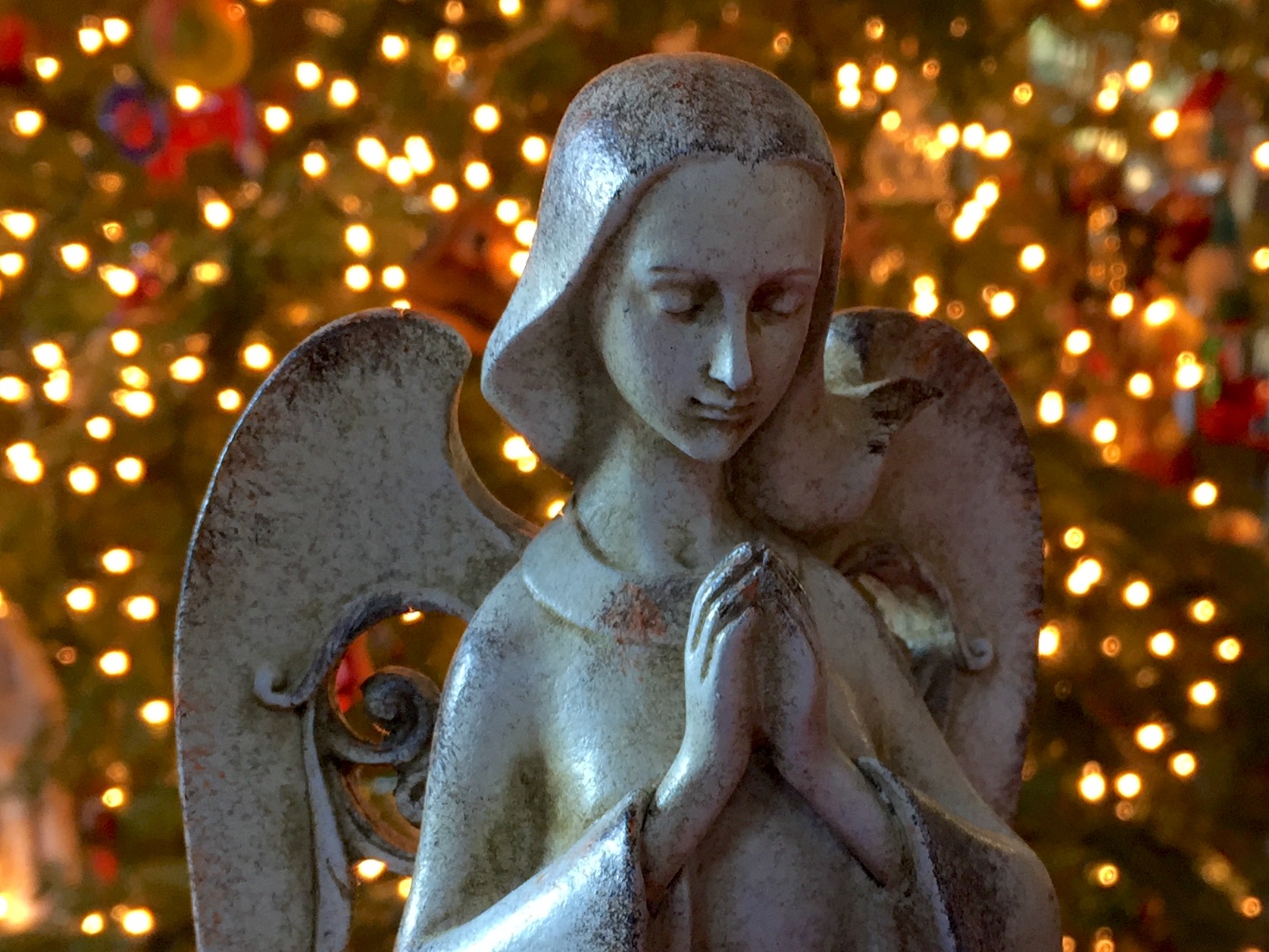
Christmas ends tonight. That may surprise those who thought it done by December 26th, or with the final New Year’s game. I do get funny looks when I utter “Merry Christmas on days 2 thourgh 11. But for those who keep the traditional Feast of the Incarnation, it is best when savored the full twelve days. With the gathering, gifting and communal celebrations mostly behind us, the last days of Christmas can be a peaceful inbreathing of wonder before ordinary time resumes. The angels have returned to heaven, but the starry nights are no less radiant. The shepherds have returned to their flock, but we still linger in the stable, desiring to adore the newborn Mystery just a little longer.

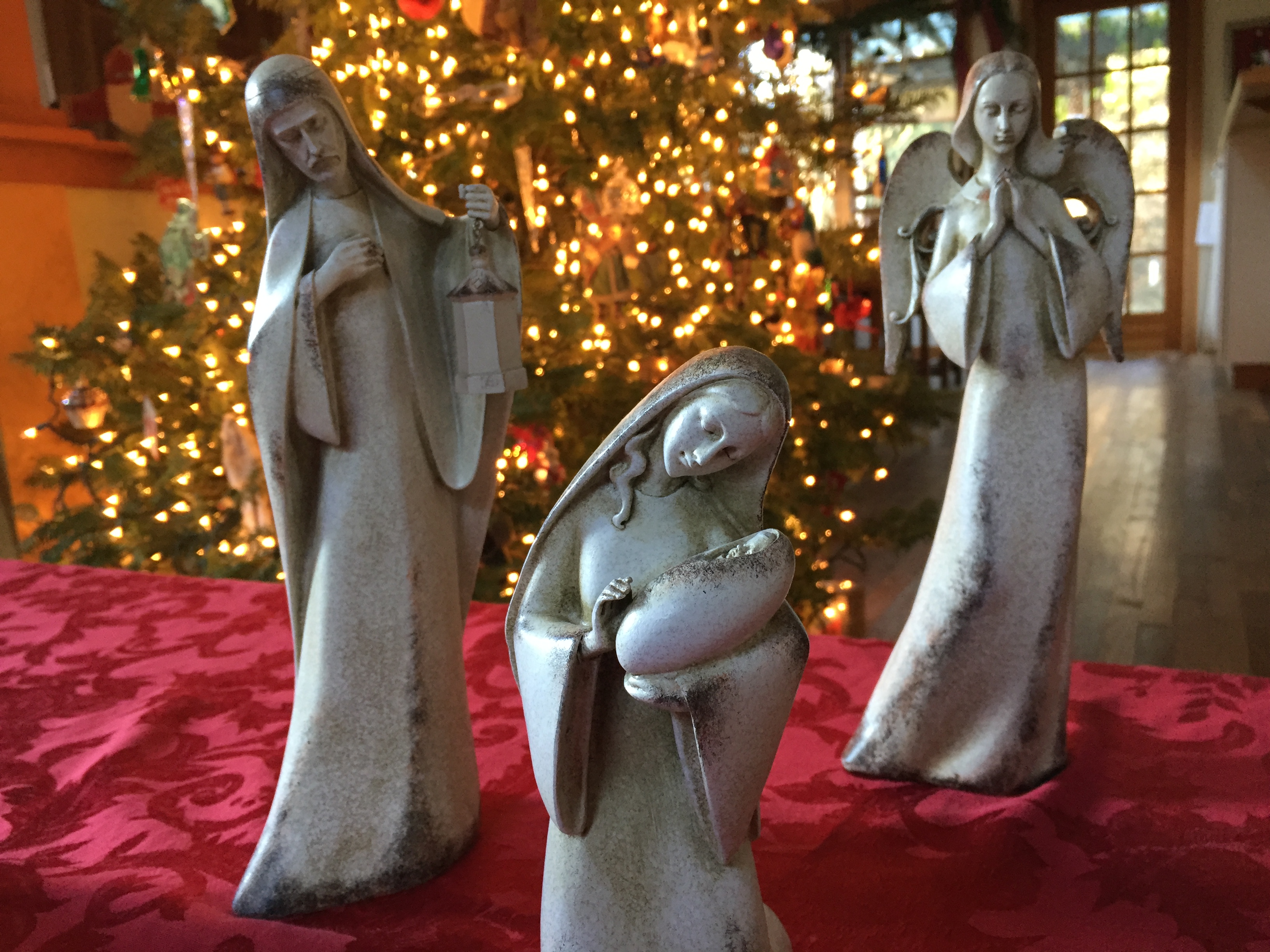
Poet Mary Oliver, experiencing an intuition of charged significance at a New England pond, wrote, “oh, what is that beautiful thing / that just happened?”[ii]– Her question perfectly expresses our devotional response to the Nativity. The event itself is but a moment, but its meaning generates a lifetime of reflection and adoration. So in these last days of Christmas I have continued to carol with guitar, bowed psaltery and hammered dulcimer, read the poems of Incarnation, contemplated the crèche by the light of the decorated evergreen, and gazed in attentive silence at our candlelit icon of Madonna and Child. Oh what is that beautiful thing that just happened?

 But tonight, it’s all about to end. A few savvy churches may observe the playful but largely forgotten Twelfth Night revels tonight, and tomorrow we will make some fuss about the arrival of the Magi to worship the holy Child, but then our retreat into festive space/time will be over and done. The Holy Family’s Christmas concluded that way: abruptly, with a quick exit to escape Herod’s swords. So too will ours, as we resume not only our private travails but also the current dismal prospects of our public life, so well described by W. H. Auden in his “Christmas Oratorio”:

The evil and armed draw near;
The weather smells of their hate
And the houses smell of our fear …

There’s no escaping history. We can’t stay dreaming forever in holy and silent nights. “Well, so that is that,” Auden wrote. “Now we must dismantle the tree, / Putting the decorations back into their cardboard boxes … The Christmas Feast is already a fading memory…”

But, for the time being, here we all are,
Back in the moderate Aristotelian city
Of darning and the Eight-Fifteen, where Euclid’s geometry
And Newton’s mechanics would account for our experience,
And the kitchen table exists because I scrub it.

As for the Christmas revelation of Incarnate Love, will it also fade away in the glare of the everyday, after being too briefly entertained as only “an agreeable possibility?”[iii]

Joseph Pieper, writing about the way we wish each other well at Christmas, says that “the real thing we are wishing is the ‘success’ of the festive celebration itself, not just its outer forms and enrichments, not the trimmings, but the gift that is meant to be the true fruit of the festival: renewal, transformation, rebirth.”[iv]

Renewal. Transformation. Rebirth. Were these among the gifts you received this Christmas? And if so, what are you going to do with them? How will your life be different, now that you have seen the Child of Bethlehem? How will your world be different?

img_7267

Thirty-five years ago, on the Ninth Day of Christmas, I was running on the beach in Santa Monica, California, when I saw four young men standing along the shore, gazing out at the vast Pacific. They wore sweatshirts printed with their school name: IOWA. They had come west for the Rose Bowl, held the previous day. Their team had lost to Washington, 28-0, but now they were discovering the real reason for their journey: the sea.  It was perhaps the first time they had ever seen it. They were standing quite still, not talking, transfixed by its boundless liquid infinity. Wonder shone from their faces.

Earth and sky had been washed clean by a pre-dawn storm. Cumulus billows erupted along the horizon, while the morning sun, having won its battle with the longest nights, blazed above us in a pure blue heaven. It was one of those days when the world seemed freshly made.

I continued running down the beach, but when I returned twenty minutes later, the Iowans were still there, staring at the sea, taking all the time they needed to absorb so much wonder.

I thought to myself: When they return to Iowa, will they carry that bright ocean with them? Would we someday hear about puzzled farmers who swore they’d heard waves roaring in their cornfields?

And when you leave Christmas behind, heading home to your Nazareths, or fleeing to distant Egypts, will you carry its bright immensity with you? Will the people you encounter ever hear its roar?


[i] “Twelfth Night,” q. in William Sansom, The Book of Christmas (New York: McGraw-Hill, 1968), 187

[ii] Mary Oliver, “At Blackwater Pond,” New and Selected Poems (Boston: Beacon Press, 1992), 226

[iii] W.H. Auden, “For the Time Being: A Christmas Oratorio” in Collected Poems, ed. Edward Mendelson (New York: Random House, 1976): “The evil and armed” is in Advent section, 272; the rest is in “The Flight into Egypt,” 307

[iv] Joseph Pieper, In Tune with the World: A Theory of Festivity, trans. Richard & Clara Winston (New York: Harcourt, Brace & World, 1965), 30-31

Foolishness and Hope on the Eve of 2017

Tarot card designed by Pamela Colman Smith

Tarot card designed by Pamela Colman Smith

The free animal has its decrease perpetually behind it,
and God in front.

– Rainer Maria Rilke, Duino Elegies

150 years ago, German immigrants in Philadelphia fired guns out their windows at midnight on New Year’s Eve. “Murdering the old year,” they called it. At the end of such a crazy and dispiriting year, we may envy them. Preparing for our own New Year, we abandon the wreckage of 2016 with little regret. But is there any appetite for what lies ahead in a country poised on the brink of insanity and ruin? The Zero card in the Tarot’s Major Arcana provides a vivid image of our situation, but take note: the Fool himself does not share our fear.

He is festively attired, holding a bright flower beneath a happy sun. The precipice holds no terror. The abyss seems not even to exist for him. His attention is instead on the open sky, and his expression is calmly expectant. He walks in trust as a child of the Light. In the eyes of the world he is indeed a fool, advancing heedlessly toward nonexistence. But to people of faith his foolishness is the wisdom of Christ, who has been defying gravity ever since the resurrection.

We too would do well not to be mesmerized by the abyss, but to focus on the greater power already and always at work amid the blind sufferings of history. God neither causes nor prevents those sufferings, but divine ingenuity always outwits them in the end. I realize that is a big claim in the face of history’s unspeakable horrors, and I do not mean to trivialize their enormity, but the alternative is nihilism or despair. If we belong to a story of life not death, then we must insist on its narrative truth, even in our darkest hour.

No one can say exactly where and how the divine work of repairing the world will manifest itself in 2017, but I have already seen it coming to birth in a widely shared desire to get involved in the work of resisting evil, protecting the vulnerable, and advancing the common good. Yesterday’s Episcopal prayer for the Feast of Holy Innocents states our agenda perfectly: to “frustrate the designs of evil tyrants and establish [God’s] rule of justice, love, and peace.”

May we all, boldly and joyfully, do that holy dance, even on the edge of the precipice, not in terror of the abyss, but trusting in the love that enfolds us in every moment. What better way to celebrate and embody the Christmas feast, which declares the generative power of God pouring itself into the particulars of human experience? As Thomas Merton reminds us, “we exist solely for this: to be the place God has chosen for his Presence. If once we begin to recognize, humbly but truly, the real value of our own self, we would see that this value was the sign of God in our being, the signature of God upon our being.”

As we adore the great mystery of Incarnation–“the signature of God upon our being,”–let the beauty of this primal truth be the Star that guides us out of the old year into the new.

+

At year’s end, allow me to thank you, dear reader, for taking the time to reflect on the writings posted here, and for sharing them with others. Your attention, comments and supportive sharing are deeply nourishing and greatly appreciated. My New Year’s prayer for you is expressed in these lines from Edward Pusey, a nineteenth-century priest:

God ripen you more and more. Each day is a day of growth.
God says to you. “Open thy mouth and I will fill it.”
Only long…the parched soil, by its cracks, opens itself
for the rain from heaven and invites it.
The parched soil cries out to the living God.

Oh then long and long and long, and God will fill thee.
More love, more love, more love.

Caroling in the Dark: A Christmas Meditation

"And a little child shall lead them." (Isaiah 11:6)

“And a little child shall lead them.” (Isaiah 11:6)


Herod then with fear was filled.
(Medieval carol)

The first Christmas Eve, in the old legends, was “so hallowed and so gracious” a time that flowers bloomed in the Bethlehem snow, kindly beasts knelt to warm the Child with hay-scented breath, the birds of dawning sang all night long, and angels bent near the earth to sing of peace.

Oh that it were so again! Desperate to exit the gloom and foreboding of the present time, “we too would thither bend our joyful footsteps”–to see the birth of New Possibility, to welcome the marriage of heaven and earth, to recover hope for what we might become. But the Christmas story is not about escaping this broken world. It is about repairing it.

The Incarnation began with unconditional acceptance of the human condition. To know our griefs and carry our sorrows, God began mortal life as a refugee from political violence and ended it as a victim of torture and capital punishment. Risk and violence were not confined to the latter days of Jesus. They were there from the start.

That is why, only a few days after singing “Silent Night” at the holy manger, the Christian calendar insists that we take time to remember Herod’s slaughter of Bethlehem’s children. We are allowed no illusions about how the story goes: Love is born into the world, and the powers try to kill it.

Only Matthew’s gospel records Herod’s monstrous act. Its clear parallel to the Exodus story, where Pharoah’s slaughter of the Hebrew children fails to eliminate the child of destiny, suggests some narrative invention. There are no other historical accounts to corroborate Matthew’s tale. But who cannot testify to the truth it contains? The powers will stop at nothing to achieve their ends. That, too, is part of the Christmas story.

Julia Hartwig, a Polish poet, gives a harrowing account of the massacre. It seems haunted by memories of Auschwitz, but reading it today I think of Aleppo.

While the innocents were being massacred who says
that flowers didn’t bloom, that the air didn’t breathe bewildering scents
that birds didn’t rise to the heights of their most accomplished songs
that young lovers didn’t twine in love’s embraces

But would it have been fitting if a scribe of the time had shown this
and not the monstrous uproar on a street drenched with blood
the wild screams of mothers with infants torn from their arms
the scuffling, the senseless laughter of soldiers
aroused by the touch of women’s bodies and young breast warm with milk

Flaming torches tumbled down stone steps
there seemed no hope of rescue
and violent horror soon gave way to the still more awful numbness of despair

At that moment covered by the southern night’s light shadow
a bearded man leaning on a staff and a girl with a child in her arms
were fleeing lands ruled by the cruel tyrant
carrying the world’s hope to a safer place…[1]

And the good news? The coming of God means the shaking of the powers. Even as a baby, the incarnate God struck fear into the hearts of rulers and oppressors. And when Jesus grew up and began to bear witness to the purposes of God, he made it impossible for the powers of this world to claim divine sanction for their monstrous behavior. They still try. Even “pious” rulers can do terrible things, as we know all too well. But the incarnate God has torn the mask from power’s face. By dying at its hands, like all the other victims of hatred, violence, and abuse, the Word made flesh has made absolutely clear which side God is on.

Like the women of Bethlehem weeping for her children, we are not easily consoled in the face of so much human suffering. And yet, even in the worst of times, we must never forget the kind of story we are in. It is, ultimately, a story of mercy and possibility:

I am going to tell of God’s kindness to the people of Israel… All of God’s deeds of mercy… All of God’s many acts of faithful love. (Isaiah 63:7)

Isaiah wrote these encouraging words in his own darkest hour. His people were in exile from the land of promise. Hope was dead and gone; their story had reached its bitter end. And yet, said the prophet, it is precisely in the place of desolation and loss that we are called to make our song. It is how we resist.

Sixty-three years ago, such a song was composed on a scrap of paper in a Soviet labor camp by a Latvian prisoner, one of 50,000 Latvians condemned to exile and imprisonment in Siberia under Joseph Stalin, a twentieth-century Herod, after the Second World War.

When the Kings College choir was touring Latvia in the summer of 2007, singer Emma Disley spotted the carol, scrawled on its original piece of paper, in a museum. She transcribed it and brought it back to England, where it was arranged for four-part choir and sung, in Latvian, in that year’s worldwide Christmas Eve broadcast.

The text was by a Latvian writer in exile, Valda Mora. As for the woman who composed the tune, we know neither her name nor her fate. All we do know is that she wrote it down on a scrap of paper as a handmade Christmas card for a fellow prisoner, Marta Zalaiskalnson, on Christmas Day 1953. Marta, who had been in the labor camp since 1945, sewed the paper into the lining of her dress so that her Soviet guards wouldn’t find it.[2]

The history of this carol has a lot to teach us about faith and hope. Born in a time of terrible darkness, it concedes nothing to the powers. Instead, calmly and assuredly, it sings of only one thing: the Light which has come into the world, a Light which the darkness can never extinguish.

On this holy night earth and heaven shine,
On this night the heart and stars commune,
And enmity fades, each loves the other,
And o’er the stillness warm wings hover.

On this night your footsteps glimmer;
This night transfigures doubt to hope;
This night must banish every sorrow,
And teach you to forgive and love.

On this holy night, in this holy night,
On this holy night, each loves the other;
On this holy night, in this holy night,
On this holy night, each loves the other.

On this night the gates of heaven open,
Above earth’s darkness arc the burning stars,
And softly on each person’s head this night
The Lord in blessing lays His loving hand.


Photograph adapted from an uncredited image of a demonstration against an Islamophobic national registry. Source: MoveOn.org email 12.22/2016.

[1] “Who Says,” by Julia Hartwig, trans. Stanislaw Baranczak and Clare Cavanagh

[2] Translation by Mara Kalnins. The carol was arranged by Stephen Cleobury. The 2007 Lessons and Carols bulletin is at http://www.kings.cam.ac.uk/sites/default/files/chapel/festival-nine-lessons-2007.pdf