“God is alive, surprising us everywhere”

Advent moon 2014

I know people who can’t stop crying. America has gone mad. Those who “love evil more than good, and lying more than speaking the truth” (Psalm 52:3) are the new normal. Democracy’s traditional safeguards­–checks and balances, constitutional law, vigilant journalism, the Electoral College, the voices of principle, factual empiricism, and a healthy sense of shame–are being undermined or ignored with impunity. “Who is like the beast, and who can fight against it?” (Rev. 13:4)

That cry of despair in the Book of Revelation is answered by heaven itself: “Look, I am making all things new.” (21:5) The world of evil and suffering will not stand forever. The world of God is being born, and we are invited to make our home in it. That does not mean we get to exit cleanly the dying world for a more perfect one. History consists of both worlds messily mixed like the wheat and the tares. We interact with both simultaneously. But we can still decide which world claims our allegiance: the world of death or the world of life, the world of hate or the world of love.

The Scripture, hymns and prayers of Advent are cognizant of the old broken world and the damage it can do. This prophetic season, mindful of time’s arc bending toward justice, calls every believer to engage evil not just as critics but as activists, resisting it wherever and however we can. But Advent also reminds us that the powers we contend with are neither ultimate nor lasting. The best way to resist the darkness is to be a bearer of the light. Don’t fixate on the dying world, granting it more seriousness than it deserves. Live in the coming dawn, even before you can see it. Be a prisoner of hope.

For most of us, such hope is sustained less by awesome displays of divine power than by small moments of daily grace, the merest hints of benevolent Presence bathing the ordinary with a holy light. Advent spirituality–the poetics of hope–is mostly a matter of paying attention. And while I wish I could report a grand vision of the beast and his minions being cast into a lake of fire, my own Advent revelations this year have been small and personal.

The first was ten days ago, when I was taking a bus to the Roman Catholic cathedral in Seattle for a concert by the Medieval Women’s Choir. I struck up a conversation with a homeless woman who was on her way to a women’s shelter at a local Episcopal church. When we got off the bus, I offered to haul her rolling suitcase for her, since we were going in the same direction. As we walked, she shared her story. Now 72, she had to stop working years ago due to a variety of illnesses. She now has colon cancer. She hopes to get into a housing project soon. Her conversation was articulate and insightful. When we parted, I gave her some money to see her through the weekend. “Give me your hands,” she said. She took them into hers, and began to pray for me and my ministry with eloquent, heartfelt words. Whatever I may have given her, this impoverished woman bestowed upon me far greater riches.

Later, at the concert, the women’s choir sang a 13th century English carol that made a lovely Latin pun about Gabriel’s annunciation to Mary:

Verbum bonum et suave
Pandit intus in conclave,
Et ex Eva formans ave,
Eve verso nomine.

The good and sweet word
Spreads through the room
Forming “ave” out of “Eva”
By changing Eve’s name.[1]

Forming “ave” out of Eva. As I listened, it occurred to me that the “good and sweet” words the woman had prayed over me had transformed her from “Eva”–a mortal woman of the Seattle streets–into a kind of angelic messenger. Had Gabriel himself appeared to utter an “ave,” I could not have been more sure of the divine presence behind that chance meeting.

My second Advent revelation also involved a concert, this time by the Seattle Pro Musica, whose exquisite renderings of seasonal choral music from many centuries moved me to tears more than once. It wasn’t simply that the pieces, ranging from Dufay and Praetorius to contemporary composers like Morten Lauridsen and Eric Whitacre, were sublime marriages of text and music, flawlessly performed. It was that such perfect beauty was being offered up in the gloom of the post-election nightmare. That is why I wept. Those superb voices, expressing everything that is best within the human heart and soul, seemed so brave and yet so vulnerable as we sink deeper and deeper into the American abyss. When the powers of hell have done their worst, what will be left of such beauty? Will all of it, human and divine, just be swept away?

One of the carols they sang, an e.e. cummings text in a setting by Joshua Shank (b. 1980), provided the answer I sought:

mind without soul may blast some universe
to might have been, and stop ten thousand stars
but not one heartbeat of this child; nor shall
even prevail a million questionings against the silence of his mother’s smile
–whose only secret all creation sings.[2]

My third Advent revelation began with a dream the following night. A woman (my soul?) asked me why I liked living in this place. I said I enjoyed the balance of nature and culture. You can hike in a mountain wilderness and attend a symphony on the same day. “Is nature where God has gone?” she asked, perhaps echoing my recent immersion in Thoreau studies. “God is alive, surprising us everywhere,” I told her, aware that it was not exactly a reply to her question. But that’s what came out of my mouth.

Then I awoke. Bright moonlight shone through the window. Though it was only 3 a.m., I felt impelled to go outside for a better view before the big moon disappeared into the Douglas-firs. Small masses of low cumulus clouds raced across the lunar face, veiling and unveiling its brightness. Orion stood watch on the moon’s right. Faint barking of distant seals. A coyote’s cry. Winter cold. Silence. What did the night want to tell me?

God is alive, surprising us everywhere. The message of a dream, intimating something more real than language. But what? Not an idea in my mind. A feeling in my body. I tried briefly to give it words. Nearness. Urgency. Strength. Presence. Then I let the words go, and rested in whatever it was. In times so dark and dangerous, it felt . . . consoling. Heaven and earth may pass away, but this Presence will not. We are not alone. Perhaps, even loved.


Related post

Ten Ways to Keep a Holy Advent

[1] Missus Gabriel de celis is a late 13th century chant for the Solemnity of Mary (Jan. 1). English translation by Ginger Warfield & Ali Corbin

[2] Text from “from spiralling ecstatically” by e.e. cummings. Joseph Shanks’ piece is called “Winter”

The World’s End (An Advent Manifesto)

Standing Rock police assault Water Protectors with fire hoses.

Standing Rock police assault Water Protectors with fire hoses.

Advent is not just a season of quiet waiting.
It is also a time of protest and vision.

As the election consequences unfold, Advent seems less a ritual preparation for Christmas than a realistic description of where we find ourselves in a darkening world. Pitting hope against despair, Advent calls us to “cast away the works of darkness and put on the armor of light.” My last post proposed 7 Spiritual Practices for the Time of Trial. I want to follow that by revisiting a post from November 2014, an Advent manifesto which seems even more timely today. 

When I was 8 years old, I read in LIFE magazine that in so many millions of years, the sun would burn out and life on earth would cease. This worried me, so I asked my parents, “If the world is going to end, how come we say “world without end” when we pray?” And they told me what the Bible says, that heaven and earth may pass away, but God remains. That relieved some of my anxiety, but I still wasn’t sure I liked the idea of the world ending, even if God was in charge.

Of course the world ends all the time. When I moved from California to Puget Sound in the 1990’s, my first Northwest winter felt like a biblical apocalypse: the sun was darkened and the moon gave no light.

Who among us has not seen their world end? Adolescents exiled from childhood. Black teenagers robbed of their future. Elders deprived of their health. Unemployment …retirement …divorce … the death of a parent, a spouse, a child — in every one of these, a world comes to an end.

For anyone who has known serious loss, this is more than metaphor. The experience of grief can be so total and unrelenting that you can’t see anything beyond it. You can’t imagine the future. It feels like the end of the world.

The stars are not wanted now: put out every one;
Pack up the moon and dismantle the sun;
Pour away the ocean and sweep up the wood;
For nothing now can ever come to any good. [i]

W.H. Auden was invoking apocalyptic metaphors to express personal loss, but shared, public worlds also come to an end. As in 1789, or 1914. The Holocaust. Hiroshima. 9/11.My Lord, what a morning, when the stars begin to fall.

But why bring up such dreary stuff on this first day of the new Christian year? Shouldn’t we be breaking out the party hats, blowing horns and shouting “Happy New Year?” The wisdom of the Advent season is that it never begins with “A Holy Trinity Production,” or “The Creator of the World Presents.” No, it always opens with “The End.” Advent knows that every beginning involves some kind of ending. In this season’s Scripture, preaching and prayers, the present arrangements of collective and personal life are judged and found wanting. God’s imagination is far too rich and fertile to settle for our barren and diminished versions of human possibility.

Selfishness, greed, consumerism? Fear, racism and violence? Poverty, militarism, war, environmental degradation? That’s the best we can do? Really? God must be saying, “Come on, people. I made you a little lower than the angels, and this is what you came up with?”

George Eliot said “it is never too late to become what you might have been.” But to get to that “might have been” requires an Exodus into the wilderness beyond the way things are; an Exodus beyond even the best we can imagine for ourselves, into a place of unknowing, where only God possesses the language to speak our future into being.

So much of what we hear and pray and sing in Advent is profoundly disruptive. Bob Franke’s great Advent song, “Stir up your power,” gets right to it in the first line: This world may no longer stand. We are meant to be unsettled, to be driven beyond our narrow boundaries, our constricted realities, toward a beckoning horizon. The Christian life is a perpetual series of departures for a better place.

The world as it is – the world of racial hatred and toxic violence and economic injustice and perpetual war and addictive consumerism and pollution for profit and all the other evils which poison our common life – this world has no future in the emergent Kingdom of God.This world may no longer stand.

But the story doesn’t stop there. In my end is my beginning.[ii] Even when we have gone far astray, even when our story seems over, God remains deeply present in the processes of creation, tenderly leading and luring us into newness of life, making a way where there is no way, opening doors that none can shut.

Advent people do not just wring their hands or shake their heads over the latest news from Ferguson or the Middle East. We work and pray for something better. What we can do on our own is limited, but when we offer our priorities and energies to the larger purposes of God, Love will have its way with us.

As the Christian mystic Hadewijch put it in the thirteenth century:

Since I gave myself to Love’s service,
Whether I lose or win,
I am resolved:
I will always give her thanks,
Whether I lose or win;
I will stand in her power. [iii]

It is not always easy to stand in Love’s power and keep the faith. In some situations it is almost unimaginable. Forty years ago the African-American author James Baldwin wrote:

To be an Afro-American, or an American black, is to be in the situation, intolerably exaggerated, of all those who have ever found themselves part of a civilization which they could in no wise honorably defend – which they were compelled, indeed, endlessly to attack and condemn – and who yet spoke out of the most passionate love, hoping to make the kingdom new, to make it honorable and worthy of life. [iv]

This passionate mixture of protest and love sounds a lot like the Old Testament prophets who permeate our Advent lectionary, making their prophetic plea for history to be broken open by divine justice:

O that you would tear open the heavens and come down …
to make your name known to those who resist you,
so that the nations might tremble at your presence! [v]

Advent is not just a season of quiet waiting. It is also a time of protest and vision. Advent announces an insurgency against the way things are, a revolution to scatter the proud, cast down the mighty, raise the lowly, gather the lost, free the captive, and bind up the brokenhearted. Advent re-imagines the world as paradise restored, a new heaven and new earth suffused with the peace of God.

this is the day of broken sky
this is the space of conflagration-breath
speaking border-trespass
this is the feathered swoop of heaven
on the wing of now …
forking lightning into language …
breaking god into prison …
breaking the truth from jail! …

This is the fire-tongued fork of holy-ghost howl
making love on the tongue …
spitting flames of reconciliation
in the sky of war
making messiah-praise out of the air itself!

this is pentecost in your head
like becoming what you never dared
for the first time and forever

This ecstatic prophecy is from a poem by Jim Perkinson. [vi] He was talking about Pentecost, but his theme fits Advent as well:

“the day of broken sky”
the earth in conflagration
God breaking into the prisons
the truth being set loose at last
and “the fire-tongued fork of holy-ghost howl
making love on the tongue …
making messiah-praise out of the air itself!”

And each of us, all of us, becoming what we never dared.

When Jesus tells us to stay awake, he is warning us not to sleep through the day of God’s coming. Stay alert. Pay attention. Don’t miss it! Become what you never dared. Shake off the sleep of complacency, the sleep of complicity, the sleep of despair. Awake and greet the new dawn.

Jan Richardson describes this dawning reality in her beautiful poem, “Drawing Near.” [vii]

It is difficult to see it from here,
I know,
but trust me when I say
this blessing is inscribed
on the horizon.
Is written on
that far point
you can hardly see…

Richardson accurately expresses the sense of distant horizon that prevents the dominant reality of the moment from closing in on us and locking us in. That reality wants to be believed as fixed and final, permanent and stable. But the horizon calls every finality into question, disrupting its stability with the boundlessness of divine possibility. The horizon draws our attention from what is given to what may yet be. Keeping our eye on the horizon, feeling its pull, is the spiritual practice of Advent. Richardson’s poem expresses the deep longing produced by the distance between the already and the not-yet.

And then the poet discovers what every pilgrim knows: the goal of our long journey is something that has already been inscribed deep within us even before our journey began. Even before the day we were born, we were marked as God’s own forever.

And that is where Advent ultimately leaves us – finding that the thing we have been seeking so long has been with us all the time – within us, and all around us. While we have been walking our Camino to the Promised land, our feet have already been on holy ground, every step of the way. And the God of the far horizon turns out to be the path as well, keeping us company as we stride deeper and deeper into the world.

So when Advent people talk about the end of the world, we are speaking about end in the sense of purpose rather than termination. The word “apocalypse” means “unveiling,” and the apocalypse in our future will not be an annihilation, but a revealing of the world’s ultimate purpose and destiny.

Yes, all the inadequate, incomplete versions of world will come to an end (some of them kicking and screaming!), but creation as it was intended will be restored, not discarded. Like a poet who creates a new language out of old words, Love will remake the ruins and recover the lost. And the Holy One who is the mystery of the world will be its light and its life forever.

This Advent faith is expressed memorably in a short story by British writer Carol Lake, “The Day of Judgment.” On the Last Day of the world, God sails into England aboard a new Ark. But instead of bringing history to a close and pronouncing judgment on everyone, God leaves the Ark to enter the city of Derby. Heading for the run-down inner city neighborhood of Rosehill, he joins the crowd at a local pub, a multi-ethnic mix of the working poor and the unemployed. And there God gets so caught up in being with these people that he loses track of time, and the Ark sails away without him, heading off for the horizon of eternity. As the story describes it:

The Ark is on the edge of the horizon now, its destination the heartlessness of perfection. Most of the inmates already know what they are going to find – endless fruit, endless harmony, endless entropy, endless endless compassion, black and white in endless inane tableaux of equality. It sails off to a perfect world; the sky has turned into rich primary colors and in the distance the Ark bobs about on a bright blue sea.” [viii]

Meanwhile, God is still in that Rosehill pub, in the very heart of imperfection. If you had walked in there, you would have had a hard time picking him out. He blended right in. But if you were paying attention, you might notice that there was now something different about Rosehill. The old non-descript streets and dilapidated buildings had taken on a strange beauty. Maybe it was the warm slant of afternoon light, but people were beginning to see their neighborhood in a new way. And their own faces, too, seemed to glow with an inner radiance, as if they were carrying a wonderful secret, tacitly shared with everyone around them, as if they suddenly knew there was more to life than meets the eye.

They were still poor, the world was still a mess, but something new was in the air, a spirit of change was awakening. And from that day on, the people of Rosehill found themselves becoming what they’d never dared, for the first time and forever.


[i] W.H. Auden, “Twelve Songs (ix)”, Collected Poems, ed. Edward Mendelson (NY: Random House, 1976), 120

[ii] T.S. Eliot, “East Coker,” Collected Poems 1909-1962 (London: Faber and Faber Ltd, 1974), 191

[iii] Hadewijch: The Complete Works, trans. Mother Columba Hart, Classics of Western Spirituality (Mahwah, NJ: Paulist Press, 1980), 213

[iv] James Baldwin, No Name in the Street (NY: Dell, 1972), 194

[v] Isaiah 64:1-2

[vi] Jim Perkinson, “tongues-talk,” q. in Catherine Keller, On the Mystery: Discerning God in Process (Minneapolis: Fortress Press, 2008), 157-8

[vii] Jan Richardson, “Drawing Near” (http://adventdoor.com/2012/11/25/advent-1-drawing-near)

[viii] Carol Lake, Rosehill: Portraits from a Midlands City (London: Bloomsbury, 1989), 119

Dreading and Hoping All: Thoughts about Halloween

img_2957

Nor dread nor hope attend
A dying animal;
A man awaits his end
Dreading and hoping all.

— William Butler Yeats[i]

The Lord is my light and my rescue.
Whom then should I fear?

— Psalm 27:1


When children assume alternative identities to roam the streets on All Hallows Eve (Halloween), they are performing an ancient ritual of interaction between the realms of the seen and the unseen, the living and the dead. The proliferation of characters from pop culture may have diluted the otherworldly explicitness of the more traditional ghosts, monsters and witches, but the strangeness remains. Whatever the costumes may be, for one night an entire generation disappears into a procession of fantastic and otherworldly beings, disturbing the settled normality of our neighborhoods.

The American Halloween traces its origins to Samhain (“summer’s end”), the Celtic New Year marking the end of harvest and the onset of winter. As the zero point between an exhausted past and time’s renewal, Samhain (pronounced SAH-win) was considered a critical moment for both nature and humanity. Life itself hung in the balance (would Spring ever return?), and the boundary between the visible world and whatever lay beyond it grew thin and porous. Spirits, fairies, and even the human dead were thought to be abroad at such a time, because everything was at stake and everyone wanted a vote in whatever happened.

The ancient Celts were ambivalent about the disruptive presence of so many immigrants from the Other Side. They lit fires and carried jack-o-lanterns to guide and warm the spirits in the autumnal night, but also to ward them off. They set out food and drink not just for hospitality but also for appeasement. They wore masks and costumes to imitate and honor the uncanny beings, but also to scare them away, or prevent them from recognizing and harming the vulnerable humans behind the masks.

In their uneasy relationship with the mysteries of death and transcendence, were the Celts so unlike ourselves? We sense in otherness both threat and gift. It stirs both dread and hope.

I know that some Christians, both past and present, have fretted about the “paganism” of seasonal rituals, as though deep attention to the rhythms and patterns of cosmos and psyche will deform rather than enrich our collective wisdom. But I think we would do well to consider the gifts of ancestral experience in the matter of living harmoniously with time and nature. How might we use pre-Christian dimensions of All Hallows Eve, for example, to take us deeper into an authentic spiritual practice of embodied, earthly existence?

Many years ago, as liturgical artist-in-residence at St. John’s Episcopal Church in Los Angeles, I designed an All Hallows Eve ritual incorporating the Halloween themes of mortality, anxiety and the otherworldly into a eucharistic celebration for All Saints’ Day. The luminosity of saintly lives would shine even brighter, I thought, against the deepest black of our mortal uncertainty and fear.

Our publicity described the event as “an autumnal ritual to mark the season of darkening with ancient customs, wherein life and light are reaffirmed. We will conclude with a festival eucharist for All Saints’ Day.”

Many participants came dressed as their favorite saint (broadly defined to include such non-canonical moderns as John Muir, Emily Dickinson, Mark Rothko, Martin Luther King and Dorothy Day). Those without costumes were provided with a symbol to carry, such as a lantern (truth-seeker), book (theologian or writer), musical instrument (musician), or protest sign (activist). Everyone wore a mask to help us disappear for the moment into an anonymous collectivity.

Some 200 strong, with drums, kazoos and other noisemakers, we processed outside, around the block, behind a large papier-maché sun, which would soon enact for us the season’s decline into winter. When we finally made our way into the church, our only light was the flickering glow of a few dozen jack-o-lanterns scattered around the interior.

Once everyone was inside, with the sun symbol lifted high at the head of the nave, the presider said:

As the sun departs from us, depriving us of light and warmth, call to mind the things which make you afraid or anxious, the things which darken your own lives and turn your hearts cold. Consider as well all the forces and follies which threaten the health of this planet and the well-being of God’s creatures.

And when the sun has gone, take off your mask, and face the darkness with all the trust and faith that is in you. We are not alone. The true Light of the world remains, hidden within the deepest night.

Audio of flowing electronic drones began the fill the vast Romanesque space as the sun made its slow way back down the nave and out the door. Once it had disappeared, the music faded out, and with thoughtful solemnity we all began to remove our masks. Our true faces revealed at last, we simply waited in the quiet darkness with prayerful attention.

Several minutes passed.
Then an unaccompanied singer, somewhere in the dark, broke the silence:

For all the saints,
who from their labors rest,
who thee, by faith, before the world confessed.
Thy name, O Jesus, be forever blessed.
Alleluia, alleluia.[ii]

This initiated a series of theatrical blackouts depicting the saints. A spotlight would come on to show a performer employing words, music or movement to represent a particular saint. When the spot switched off, another saint was illumined in a different part of the church. There were nine saints in all.

After the final blackout, all these saints, now robed in white and carrying candles, converged toward the altar as an unseen narrator read from Revelation 7:

After that I saw a huge number, impossible to count,
from every nation, tribe, people and language,
standing before the throne and before the Lamb . . .

The saints were all standing together at the altar when the reader concluded:

They will hunger no more, and thirst no more . . .
and God will wipe away every tear from their eyes.

Then the saints all raised their candles high and shouted with one voice: “Free at last! Free at last! Thank God Almighty, I’m free at last!” The organ began to play variations on Vaughan Williams’ great hymn for All Saints as our own hand candles were lit by the saints moving among us, until everyone was joined in a luminous refutation of eternal darkness.

The eucharistic feast of the redeemed had begun,

and God, as promised,
proves to be mercy clothed in light.[iii]


[i] “Death,” q. in Sandra M. Gilbert, Death’s Door: Modern Dying and the Ways We Grieve (New York: W. W. Norton & Company, 2006), 127

[ii] Text by William Walsham How (1823-1897), in The Hymnal 1982 (New York: The Church Hymnal Corporation), 287

[iii] Jane Kenyon, “Notes from the Other Side,” in Collected Poems (St. Paul, MN: Graywolf Press, 2005), 267

The Faithful Centurion: A Homily for the 2nd Sunday of Pentecost

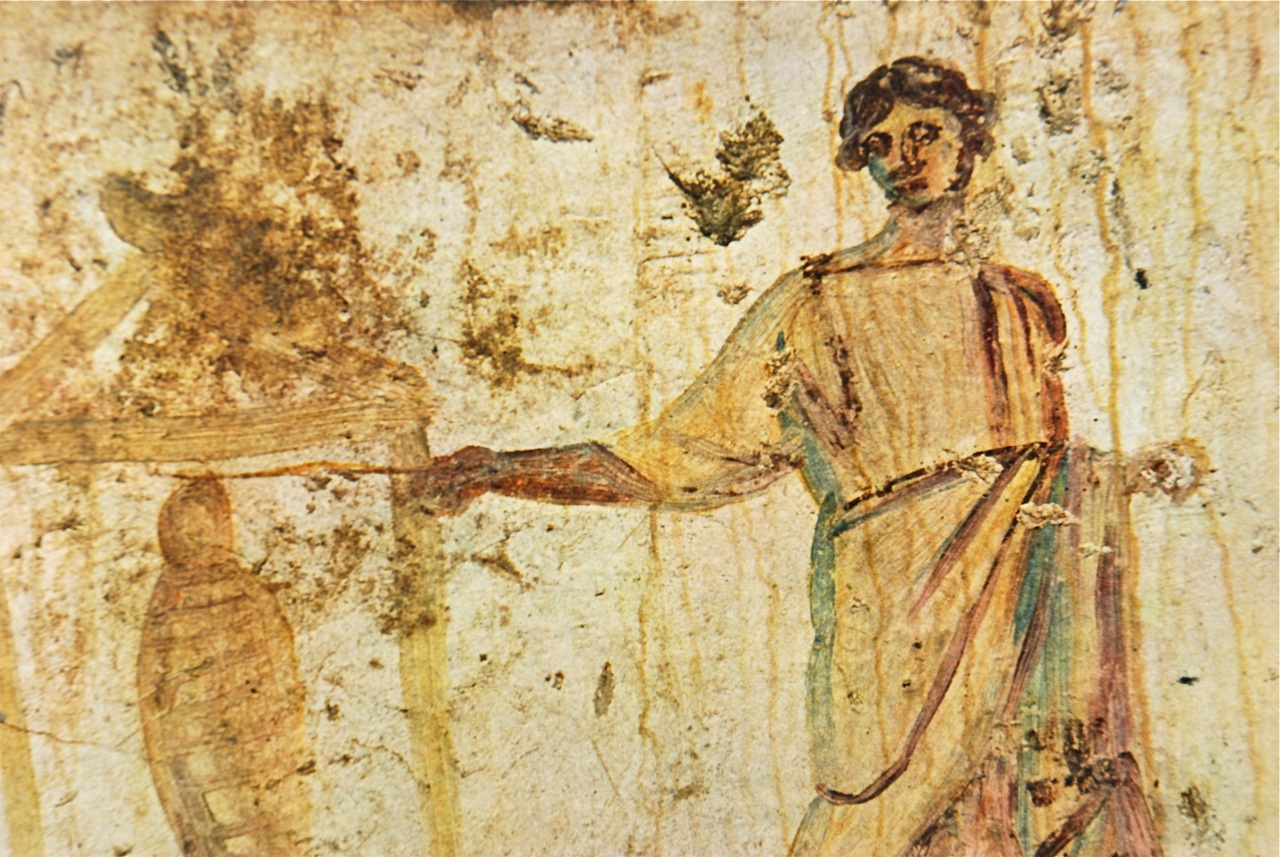
Jesus raises the dead with a wand (Roman catacomb, 3rd century)

Jesus raises the dead with a wand (Roman catacomb, 3rd century)

The gospel story for the Second Sunday of Pentecost[i] describes a world in which things don’t happen the way they’re supposed to.

A Roman centurion treats his slave more like a friend than a piece of property. When the slave gets sick and is close to death, the centurion implores the Jewish community to help him find a healer.

Normally, Jews and Romans were not on the best of terms. Occupying armies just don’t get much love, and besides, doesn’t everybody know that foreigners are just “not our kind?” If only we could build a wall high enough to keep them out!

But this Roman centurion has somehow made friends with the local Jewish elders. He has even built a synagogue for them. So they are happy to help.

The Roman has heard some stories about Jesus and his healing gifts, so he asks the elders to go beg Jesus, that he might come and heal his slave.

Now we’ve heard a lot of stories about Jesus getting the local clergy mad at him, so we may be surprised to learn that there were also some of them who admired Jesus, and maintained good relations with him. That is clearly the case here. And what the elders say to Jesus is this: “The centurion is worthy of having you do this for him, for he loves our people.”

So far, not much is going the way we would expect. A centurion treats his slave like a friend. A Roman loves the Jews, and the Jews love him back. And as for Jesus and the local clergy, they are getting along swimmingly.

But there are more surprises to come.

Jesus goes with the elders to find the centurion’s house, but just before they arrive, the centurion sends some friends out to say, “Lord, do not trouble yourself, for I am not worthy that you should come under my roof; that is why I did not presume to come to you myself. But only speak the word, and my servant shall be healed. For I know something about authority, since I have soldiers serving under me. I say to one, `Go,’ and he goes, and to another, `Come,’ and he comes, and I say to my slave, `Do this,’ and the slave does it.”

How strange to see a Roman officer humbling himself before a wandering Jewish rabbi. “I am not worthy that you should come under my roof,” he says.

And Jesus is “amazed.” That word in the gospel is usually applied to people who are amazed at Jesus. But here it is Jesus’ turn to be amazed. And why? Because the centurion has total faith in the power of Jesus to heal his slave, even at a distance.

“Just as I command my slaves to come and go as I wish, I believe that you have the power to command sickness and death to depart from my house. Only say the word.”

It may seem a little odd that this exchange doesn’t take place directly between Jesus and the centurion. The centurion communicates through intermediaries. This is, he says, because he is not worthy to have Jesus even enter his house. It’s a pretty extraordinary bit of deference on behalf of the powerful Roman.

In any case, Jesus turns to the crowd which has been tagging along because this was clearly the most interesting thing happening in Capernaum that day, and says, “You know what? I haven’t found this kind of faith among any of you folks who go to church. You all could learn something from this centurion fellow. You may call him an unbeliever, but he’s just given you some of the best spiritual teaching you’re ever going to get.”

And then, because this wants to be an odd story from beginning to end, the servant is suddenly well without Jesus ever saying a prayer or speaking a healing word. This miracle happens offstage, and we only hear about it later.

Notice that Jesus never actually meets the centurion or the slave. Everything happens at a distance, through intermediaries, rather the way that prayer works. We may not meet Jesus directly, in the flesh, but his effect on us is still palpable and powerful. And as the centurion believed, it is faith that makes that connection happen.

This strange little story is about a world which is repeatedly and radically disrupted: social and cultural barriers are crossed, enemies act like friends, the master/slave hierarchy is upended, earthly power humbles itself, the religious experts are schooled by a pagan outsider and oh, by the way, a healing miracle happens without any fanfare or even the slightest tangible demonstration of cause and effect. Just another day in the life of the God of surprises.

We could take a number of things from this story, but today my question is this: Who outside our own faith communities has something essential to teach us? And are we capable of appreciative amazement? Are we capable of receiving that teaching with gratitude and humility?

Where are the ones, beyond our institutional and theological boundaries, who are practicing social imagination and nurturing a better future? Where are the ones who are already doing holy work without even knowing God’s name?

Who are the ones
living a practical faith
serving a need
working for change
refusing injustice
breaking boundaries
loving enemies
making peace
showing mercy
finding the lost
tending the sick
visiting the prisoner
binding wounds
soothing the suffering
comforting the afflicted
nourishing wonder
fostering delight
shielding the joyous
organizing the powerless
repairing the world
welcoming the Kingdom . . .

Who are they and how can we learn from them?
How can we support them?
How can we join them?


[i] Luke 7:1-10 (Revised Common Lectionary, Year C)

Cinematic Resurrections (Part 2)

image

And is not the language of the cinema of its very nature a way of telling stories that carry a reasoned argument, as it were, reasoning by way of stories? Here one can see how the narrative dimension – constitutive of the cinema – complements the icon’s symbolic dimension: and it is by dint of this bringing together of icon and story that the cinema can be a language uniquely capable of mediating transcendence.[i]

— Bruno Forte

The danger, however, that in our attempt to conceive and understand [the Resurrection] we in fact suppress the very revolution that the story embodies, naturalize the alienness of its ideas, tame the violence it does to our logic, and anesthetize its wounding of our pride.[ii]

— Alan E. Lewis


In Part 1 of Cinematic Resurrections, we looked at how Jesus films have represented the event of Jesus’ rising as well as the stories of his empty tomb. But the sensory appearances of the risen Christ present an even greater challenge for the filmmaker, involving a tension between visual plausibility and underlying truth. What really happened in the appearances, and what might that have looked like?

In the gospel texts, these appearances are not presented as private, interior experiences, subjective and dreamlike. They always convey a sense of concreteness and physicality, experienced as something outside the observer. Jesus has a bodily presence which occupies the spaces of encounter.

There is of course an inherent strangeness to meeting someone whose death you just witnessed. And the appearances stories do have a certain inexplicable “now you see me, now you don’t” quality. Jesus comes and goes at will. He is not barred by locked doors, nor does he ever linger for a proper goodbye, since “I am with you always.”

But the strangest aspect of the appearance stories, given their transcendent and astonishing subject, is their plainness. Jesus does not glow with supernal light, as in the mystical Transfiguration story, nor does he radiate the sublime and fearsome grandeur with which he appears in the Book of Revelation. The risen Christ is so down-to-earth that he is mistaken for a gardener. Later we find him barbecuing fish on the beach,

He still has human form, but something about him has changed. Catching sight of him is not enough to make the connection between the crucified teacher and this man from God knows where. Recognition is triggered not by his appearance, but by something he says or does, such as “Peace be with you,” or the breaking of bread at Emmaus (beautifully shown in The Miracle Maker). But even after the disciples discern the Risen One’s identity (“It’s Jesus!”), they still sense that something is different, something which begins to make them fall to their knees.

Both identity and difference are essential components of the Resurrection. The risen Christ is not a different person from the one who was crucified. At the same time, his body has undergone an incomprehensible transformation. As Wolfhart Pannenberg puts it, “Resurrection has to be understood in terms of transformation of the old life into the new one rather than in terms of replacing the perishable body by a new one.”[iii]

It is hard to convey this sense of “same but different” on film when a single actor plays Jesus both before and after the resurrection. In King of Kings (1961), for example, it is still clearly the boyish Jeffrey Hunter, apparently unaffected by the harrowing passage through death into divine futurity, who meets Mary Magdalene outside the tomb. In Jesus (1999), the risen Christ has lost nothing of the California cool which Jeremy Sisto brought to his pre-Easter Jesus. Such scenes are all familiarity without the slightest trace of difference— it’s the same actor, the same affect, the same voice.

Many of the films convey a sense of difference in the way the disciples respond to the appearances. When Jesus comes into their midst, they do not resume their accustomed rapport with their old companion of the road. They don’t rush to embrace him as you would a long-lost friend. They are respectfully hesitant to approach. Is this fear of the uncanny, or is it the beginning of worship? Then they move from astonishment and wonder to a place of prayerful receptivity. They bow their heads or close their eyes as Jesus speaks to them, touches them, or breathes the Holy Spirit upon them (as in The Gospel of John). The risen Christ soothes the anxious heart. Peace be with you.

How far can a film go in representing a resurrection appearance? Whar are the rules of engagement for the visual artist? Son of God (2014) attempts to communicate the strangeness of the Resurrection in two interesting scenes. In the first, we follow Magdalene from the glare of the Middle Eastern sun into the darkness of the tomb. As she puzzles over the grave cloths, the camera shifts to reveal the tomb entrance, and there is Jesus, just outside in the bright light of day.

Since the lens aperture is open wide to compensate for the dimness of the cave, the figure standing in the sunlight is extremely overexposed. The details of his face and body are burned out, erased by intense luminosity. This is not a special effect added to the image in post-production. It is simply how a camera sees under those conditions. With the cinematic eye calibrated to the darkness of death’s realm, we are literally blinded by the light.

So Mary sees, but does not recognize, until Jesus speaks her name. “Teacher?” she answers, hesitant but hopeful. Then her face tells us— she knows him. But the distance between them remains: she in the tomb, Jesus in the light. “Go and tell the others,” he says. “I am here.” Then he turns to walk away, and after a few steps his figure vanishes into the white light.

The encounter feels both plausible and strange at the same time. In this world but not of it. It has the naturalness of story, something which might have happened that way, but also the transcendent otherness of an icon. It’s only a movie— the artifice of representation using actors, camera and music, but it has the capacity to draw the viewer into effective proximity to what is being represented.

Then, the same film gives us an upper room appearance scene unique to the genre— an audacious attempt to bridge the ineffable transition from physical presence to sacramental presence. Once the sensory appearances of Jesus ceased not long after the Resurrection, the eucharist became the tangible and revelatory sign that Christ is now present in all times and places. This scene creatively depicts a single presence behind both experiences.

Peter and John, doubting Magdalene’s news, go back to the tomb with her. Peter enters alone, finds the burial shroud, and takes it outside to John and Mary. “Now do you believe me?” she says. But John shakes his head: “He’s gone.” Suddenly a strong gust of wind whirls a cloud of dust through the frame. It’s like a little Pentecost, the Spirit blowing Peter’s mind with the truth. “Gone?” he says. “No! He’s back.”

They run into town, pick up bread from a street seller and take it to the other disciples, waiting in the upper room. “I need a cup,” Peter cries. “And some wine.” Thomas, bewildered by Peter’s excitement, asks what happened. Peter doesn’t reply. There’s no time to waste.

He joins the others at table, breaking the bread and pouring the wine. “His body … his blood,” he says fervently, as if these things were Jesus himself. Offering the cup to the dubious Thomas, he begins to repeat their teacher’s words: “I am the way, the truth . . . ” but the final line, “and the life,” is spoken by a different voice, off camera. At first we see only a close shot of Thomas, glancing up in surprise. Then we see what he sees: Jesus, coming into focus as he enters the open door. Thomas looks down at the table. “No,” he says. “No, this isn’t real.”

Jesus just smiles, and begins to walk around the table, pausing to lay a hand of blessing on each disciple. In the gospel stories of the upper room, Jesus speaks the words, “Peace be with you,” but here his wordless gesture says it all. When he reaches Thomas, he sits down to face him. Jesus shows him his wounded hand, and then gently caresses the doubter’s cheek with it. Love becomes the evidence Thomas has been longing for.

Like Luke’s Emmaus story, this film scene blends narrative and symbol. Is it describing an original and unique appearance of the risen Christ, or is it representing the common experience of every believer who shares the bread of life and the cup of salvation? I would say both.

What happened then, happens now. What happened there, happens here. And whatever the nature of the first resurrection appearances, those stories are deeply flavored by eucharistic practice. When the lector, deacon or presider says the words, Jesus speaks. When the bread is shared and the wine poured out for many, “he’s back.” And whenever two or three gather in Christ’s name, the peace which passes all understanding is bestowed all over again. As it was in the beginning, is now, and will be forever.

…. I looked
at him, not with the eye
only, but with the whole
of my being, overflowing with
him as a chalice would
with the sea…[iv]


Related Posts

Cinematic Resurrections (Part 1)

Are we too late for the Resurrection?


[i] Bruno Forte, The Portal of Beauty: Towards a Theology of Aesthetics (Grand Rapids, MI: Eerdmans, 2008), 108

[ii] Alan E. Lewis, Between Cross and Resurrection: A Theology of Holy Saturday (Grand Rapids: Eerdmans, 2001), 27

[iii] Wolfhart Pannenberg, “History and the Reality of the Resurrection,” in Resurrection Reconsidered, ed. Gavin D’Costa (Oxford: Oneworld Publications, 1996), 70

[iv] R.S. Thomas, “Suddenly”, in Collected Poems: 1945-1990 (London: Phoenix Giant, 1993), 283

Are we too late for the Resurrection?

Guercino, "The Incredulity of Thomas" (1621)

Guercino, “The Incredulity of Thomas” (1621)

What we have heard,
what we have seen with our eyes,
what we have looked at and touched with our hands—
the Word of life— this is our theme . . .
We declare to you what we have seen and heard,
so that you too may share our life.    (I John 1:1,3)

The Easter Vigil is a night of wonders. Beginning after dark on Holy Saturday, God’s friends gather around a fire under the stars, as poets and singers, accompanied by the sounds of loon, whale and wolf, take us back to the beginning of time, when all things came to be. Then we follow the Paschal Candle, symbol of the risen Christ, into the Story Space to experience creative retellings of our sacred narratives, recalling God’s unfailing covenant with us throughout history. Theater, storytelling, music and multimedia immerse us in the rich play of Scriptural meanings. After that we process into the church, to the font of new birth, renewing our baptismal vows by candlelight. Suddenly, the contemplative quiet is broken by a great tumult of drums, bells, chimes (and sometimes fireworks!) as we welcome the first eucharist of Easter, sharing the feast of heaven with bread and champagne,and dancing our praises around God’s table.[i]

The Easter Vigil is the Christian dreamtime, the molten core of our worship life, but for those who missed it, who didn’t arrive at church until Easter morning, it exists only as a rumor of something quite out of the ordinary, hard to imagine after the fact. I could describe what happened in great detail, but a considerable amount of the joy and the wonder would be lost in the telling. Hearing about it is not the same as actually experiencing it.

Just ask Thomas the Doubter. He had missed out when the risen Christ first appeared to the other disciples.[ii] Oh Thomas, it was so amazing, so incredible! If only you had been there. “No way,” he says. “I just can’t see it. You must have been dreaming.” And so Thomas became known as the Doubter, and the Church made him patron saint of the blind. And yet, we always honor Thomas by telling this story on the Second Sunday of Easter, as if to say,

We welcome those who take questions seriously;
we believe that faith and doubt must dance together;
we are in fact a community of those
who wrestle with God’s absences
as well as God’s presences.

Another Thomas, the 20th century Welsh poet and Anglican priest, R. S. Thomas, wrote a poem about this gospel story:

His are the echoes
We follow, the footprints he has just
Left. We put our hands in
His side hoping to find
It warm.[iii]

The sense of belatedness, of arriving too late, haunts every religious tradition whose foundations lie in definitive past events. Even Jesus’ closest friends, who had shared a last supper with him just days before, felt the warmth of his presence quickly cooling into memory.

But then they discovered that Christ does not come to us out of the past, locked within well-worn expectations. The risen One comes out of the future, often in a form we don’t expect: the stranger, the other, the outcast, even the enemy. If we only look for Jesus in the vacated tombs of past experience, we will get the admonishing angel: “He is not here. He’s already waiting for you somewhere else. Go and see.”

For a while after the resurrection of Jesus, there were sensory appearances in a form the disciples could recognize and relate to in the old familiar ways. They spoke with him. They ate with him. They experienced his peace. And their primal witness remains vital. A positive identification of the risen One as the same person who died on the cross was essential to the core Easter message: Jesus lives! Not a memory, substitute, or simulacrum, but a continuing presence which not even death could kill.

These appearances eventually ceased, but before they did, Thomas finally got his moment with the Jesus he had known. It blew away his doubts and drove him to his knees. But then Jesus said, “Blessed are those who have not seen, and yet believe.” And later he said, “I am with you always, even to the end of time.”

In other words, Christ’s resurrection is not limited to the personal experiences of a few first century people. If that were the case, then it would be something we could only hear about later but never experience for ourselves. Like Thomas before his late encounter, we would have only Christ’s absence.

But the Easter faith affirms the continuing presence of the living Christ among us, now and always. That presence is not always clear or obvious. Even the saints wrestle with doubt and absence. Sometimes divinity seems to withdraw for a time. Sometimes it is we who are absent— distracted, inattentive, looking in the wrong place, using the wrong language. Divine presence can’t be switched on, or grasped possessively. It is elusive. It is fond of surprise.

But we are not left without clues. Jesus tells us, “If you want to keep experiencing me, love one another. Forgive one another.”[iv] Thus we meet the risen Christ in the life of forgiveness, reconciliation, peace, justice, love. Where love and charity abound, there God is, there Christ is. It’s not enough to proclaim resurrection. We need to embody it.

As Rowan Williams explains: “the believer’s life is a testimony to the risen-ness of Jesus: he or she demonstrates that Jesus is not dead by living a life in which Jesus is the never-failing source of affirmation, challenge, enrichment and enlargement.”[v]

The Book of Acts tells us the first believers made their common life a “laboratory of the resurrection”[vi]— not just a theological mystery but a daily practice, rejecting the economics of selfishness and scarcity for radical acts of generosity and compassion. Their belief was a practice of entrusting themselves to the renewing force of divine love that is never exhausted by the sufferings of the world. In other words, resurrections have consequences.

These are large claims, of course, and not universally embraced. But for me resurrection’s greatest challenge is not that I am being asked to believe something difficult; it is that I am being asked to do something difficult:

to be utterly transformed by immersion into the dying-and-rising of Christ,
to become my baptismal self,
to cast off the rags of ego and fear
and be clothed in “garments of indescribable light.”[vii]

It’s not intellectual or empirical doubt that makes me hesitate at the threshold of the risen life. It’s not that I think such transformation to be impossible. No, for countless saints have already demonstrated its possibility. My doubt concerns myself. Am I up to it?

Have you ever stood on a rock
twenty feet above the surface
of an icy mountain lake?
The summer day is hot;
you know the water will refresh you.
You are caked with grime and sweat from hours of hiking.
It will feel so good to wash it all away.

You imagine the explosive energy of the splash,
the exhilarating shock of glacial waters.
And you anticipate the joy of swimming,
the bliss of weightlessness
setting you free from the gravity of things.

But you hesitate.
You doubt.
The water is dark.
Are there rocks beneath the surface?
Will the sudden cold take your breath away?
The very act of stepping out into nothing
is resisted by an inner voice of self-preservation.

There’s no way to stop the mind’s questions or the body’s fears.
They persist for as long as you stand there.
The lake doesn’t get any warmer.
The boulder doesn’t get any lower.

Then you just lean out into space
and let yourself go.


Related Posts

Just a dream? Reflection on the Easter Vigil

Christ is risen!


[i] Although most Easter Vigils don’t happen quite this way, they can, and (IMHO) should. I have been curating them this way for several decades in various worship communities, and I believe that such a rich interplay of ritual and the arts, engaging all the senses in a multigenerational, visionary happening, at once contemplative, playful, and ecstatic, does true justice to our celebration of the Paschal Mystery – the passage from darkness and death into the risen life..

[ii] John 20:24-29

[iii] R.S. Thomas, “Via Negativa,” Collected Poems: 1945-1990 (London: Phoenix Giant, 1995), 220

[iv] My gloss on the Farewell Discourse in the Fourth Gospel (John 14-17)

[v] Rowan Williams, Resurrection (New York: The Pilgrim Press NY, 1984), 62-3

[vi] Dumitru Staniloae, q. in Olivier Clement, The Roots of Christian Mysticism (Hyde Park, NY: New City Press, 1993), 82

[vii] Pseudo-Macarius (desert father, c. 400, Mesopotamia/Asia Minor) First Homily

Keeping the faith in a time of terror

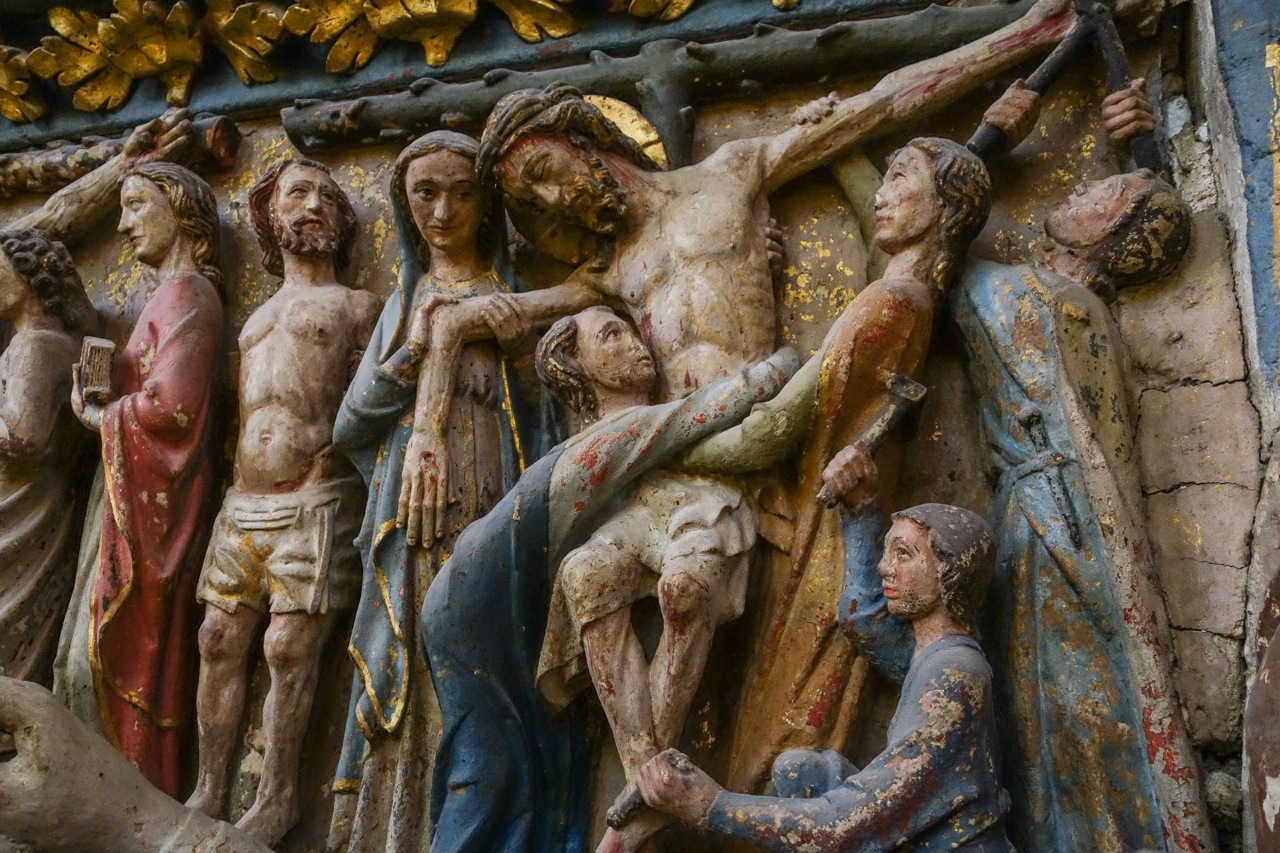
The Deposition (early Gothic; Leon cathedral on the Camino de Santiago)

The Deposition (early Gothic; Leon cathedral on the Camino de Santiago)

Keep your mind in hell, and despair not.

— Staretz Silouan[i]

Ah, children, ah, dear friends, do not be afraid of life!

— Fyodor Dostoevsky[ii]

How do we sing the Lord’s song in the shadow of terror? In solidarity with all the victims of Brussels and the whole human family this week, I protest, I rage, I grieve, I pray. But I must also try to think.

Indiscriminate terror has long been a scourge on this earth, but its globalization through television and social media has now made it emotionally inescapable. Were I to dwell in the uttermost parts of the sea, I could not flee from its presence.[iii]

So as we try to absorb the terrible news from Brussels, how do we “despair not” even in the face of monstrous evil? No simple task, and easy answers seem disrespectful in the time of weeping. But I do believe the antidote to despair is to keep the faith. We must never forget the sacred story we belong to. Even at the grave we make our song: Alleluia, alleluia, alleluia.[iv]

The terrorist, on the other hand, belongs to a story which for most of us in inconceivable. Terror is “the language of being noticed,”[v] a kind of performative rhetoric designed to bring a neglected or disregarded worldview into the open by subjecting others to the violent norms of its alternate reality. They see themselves as global victims, in search of a global audience for their cruel narrative. Mark Juergensmeyer, in his study of religious violence, explains this terrorist rationale:

If the world is perceived as peaceful, violent acts appear as terrorism. If the world is thought to be at war, violent acts may be regarded as legitimate. They may be seen as preemptive strikes, as defensive tactics in an ongoing battle, or as symbols indicating to the world that it is indeed in a state of grave and ultimate conflict.[vi]

In the minds of many terrorists, the war they are so eager to wage is apocalyptic, a cosmic conflict of good and evil in which there is no compromise or bridging of differences. They are, in Don DeLillo’s term, “lethal believers.” And the very worst thing we could do in response would be to play the part they have written for us: satanic enemies in a cosmic struggle. The proposals of certain American presidential candidates to “bomb the hell out of them,” or bring back the good old days of torture, would play perfectly into the terrorists’ hands, conceding the primacy of their deadly story.

However, I choose to belong to a better story, the one enacted and embodied in the powerful liturgies of Christ’s Passion. Step by step on the Way of the Cross this Holy Week, Christians will bring to mind and heart the saving journey which Jesus made, without weapons, into the abyss of suffering and death.

Renouncing all violence and hatred, Jesus remained faithful to the end. After pouring his whole life into a ministry of healing, forgiveness, and reconciliation, he continued to show us the face of love even as he was tortured on the cross. “Father, forgive,” he said with his dying breath. To the last moment, in his most bitter hour, he remained the human who shows us God by doing what God does.

Which story do we choose to live in? The story of terror and violence, or the story of self-diffusive love? Both are costly in the end, but only one leads to new and unconquerable life. Even after Brussels, the word remains: Be not afraid! Love makes the abyss into a Way.

The cross shows us how it is possible to absorb evil and neutralize its effects, rather than pass on the anger and live in bitterness. Turning the other cheek, going the extra mile, giving away your coat to the robber who steals your shirt, loving enemies, doing good to those who hate, blessing those who curse us – all this turns out to be an intelligent and intelligible Christian way of living.[vii]

When medieval women mystics contemplated the cross in prayer and vision, they saw not death’s triumph but a kind of birth. The crucified Jesus was like a woman in labor, enduring pain and travail in order to bring us all to birth: Ah! Sweet Lord Jesus Christ, who ever saw a mother suffer such a birth! For when the hour of your delivery came you were placed on the hard bed of the cross and … in one day you gave birth to the whole world.[viii]

To see such a death and call it birth is the central act of Christian imagination. It is why we declare victory at the cross. We don’t wait for Easter Sunday. We declare victory at the cross, because the Passion isn’t just a story about violent powers that always trample the weak and kill the prophets. It’s also a story about the Realm of God, where dry bones breathe and lost hopes dance, where the prodigal is welcomed home and the tears are wiped from every eye. The Love that makes such a realm was nailed to a cross, but was not consumed by it. Death did what death does, and God did what God does.

And on the outcome of that story, I stake everything.


Related posts

We are the singers of life, not of death

After Paris and Beirut, what story shall we tell?

Beyond Punch and Judy: The art of nonviolent resistance


[i] Staretz Silouan (1866-1938) was a Russian monk on Mt. Athos in Greece. Appearing as an epigraph to Gillian Rose’s book, Love’s Work, I found this provocative saying in Andrew Shanks’ Against Innocence: Gillian Rose’s Reception and Gift of Faith (London: SCM Press, 2008), 9. Rose herself added this typically intense comment: “What Staretz Silouan is talking about is the subjective experience of God-forsakenness,” and even there finding God. “I want to sob and sob and sob,” she says, “until the prolonged shrieking becomes a shout of joy.”

[ii] From Alyosha Karamazov’s final speech in Dostoevsky’s The Brothers Karamazov, trans. Richard Pevear and Larissa Volokhonsky (New York: Vintage Classics, 1991), 776

[iii] cf. Psalm 139:6, 8

[iv] Burial of the Dead, Episcopal Book of Common Prayer, 499

[v] Don DeLillo, quoted in Mark Juergensmeyer, Terror in the Mind of God: The Global Rise of Religious Violence, (Berkeley: University of California Press, 2000 ), 139

[vi] Juergensmeyer, 10

[vii] David Wood, in Consuming Passion: Why the Killing of Jesus Really Matters, eds. Simon Barrow & Jonathan Bartley (London: Darton, Longman and Todd, 2007), 118

[viii] Marguerite d’Oingt (d. 1310)

The voice that allows us to remain human

Moses before the Burning Bush, 13th century icon, Monastery of St. Catherine, Mt. Sinai

Moses before the Burning Bush, 13th century icon, Monastery of St. Catherine, Mt. Sinai

Even in the darkest hours of mankind, there might be a voice within us that allows us to remain human.

– László Nemes, director of Son of Saul, accepting the Oscar for Best Foreign Film

These words, spoken last night at the Academy Awards, struck me with particular force, since one of the most famous accounts of that voice had just been told in the morning liturgy. Although Exodus 3: 1-15, the story of the burning bush, does not describe a voice coming from “within,” I believe that the voice which Moses heard at the foot of God’s mountain was the same voice which the Hungarian filmmaker longs to hear, the same voice we all long to hear in a dark time when the humanity of our country, our world, and ourselves is being called into question.

Whether it speaks in an interior whisper, or calls to us from an exterior source, the voice “that allows us to remain human,” to remember (or discover) our true humanity, is the voice which has been speaking us into being since the beginning of the world. It is the voice of revelation.

Revelation, in the words of Ashton Nichols, is “a moment when the soul of the recipient is filled with something outside the self. A literal inspiration occurs. Consciousness finds itself flooded, or breathed into, or simply filled, by a force it ascribes to an external agency. The metaphoric agent may be a wind, a flash of light, or a disembodied voice. Divine grace descends; the voice of God is heard in the whirlwind; a spirit inspires the prophet or poet with a truth that comes from outside the self and is incorporated into the soul of the recipient.”[i]

The sense of a truth coming from “outside the self” may seem a contradiction to Nemes’ “voice within us,” but only if we understand ourselves as separate, autonomous beings more or less self-contained and complete. If we are made in the image of the Trinitarian God, then we are part of a larger, interdependent flow of self-diffusive love in which outside and inside, or divine and human, are not strict opposites, but partners in a dance. We are constituted by a process of receiving our being from somewhere else, and in turn giving ourselves away. We “lose” our life to find it, as Jesus said. Like that bush in the Sinai, we burn with divine fire, yet are not consumed.

The first time I went to the Holy Land, in 1989, I saw a burning bush. It happened to be Ascension Day. I was visiting the Anglican sisters in Ramallah, with whom my mother had once worked to teach and care for Palestinian Christian children. Since a border closing prevented us from going to mass at a Benedictine church known for its beautiful chanting, a couple of the sisters took me for a walk in the local hills. As we descended a ravine, we encountered a shepherd with his small flock. And behind him, a little further on, I saw, with considerable astonishment, a burning bush. Why it was on fire, I never learned. If it spoke, I did not hear. Sometimes the voice is for the shepherd’s ears only. But I never forgot the wonder of it.

The bush which will burn and speak to you, or me, is out there somewhere, waiting for the proper moment of holy meeting. Anglican poet/priest R. S. Thomas described his own encounter in “The Bright Field.”

I have seen the sun break through
to illuminate a small field
for a while, and gone my way
and forgotten it. But that was the pearl
of great price, the one field that had
the treasure in it. I realize now
that I must give all that I have
to possess it. Life is not hurrying

on to a receding future, nor hankering after
an imagined past. It is the turning
aside like Moses to the miracle
of the lit bush, to a brightness
that seemed as transitory as your youth
once, but is the eternity that awaits you.

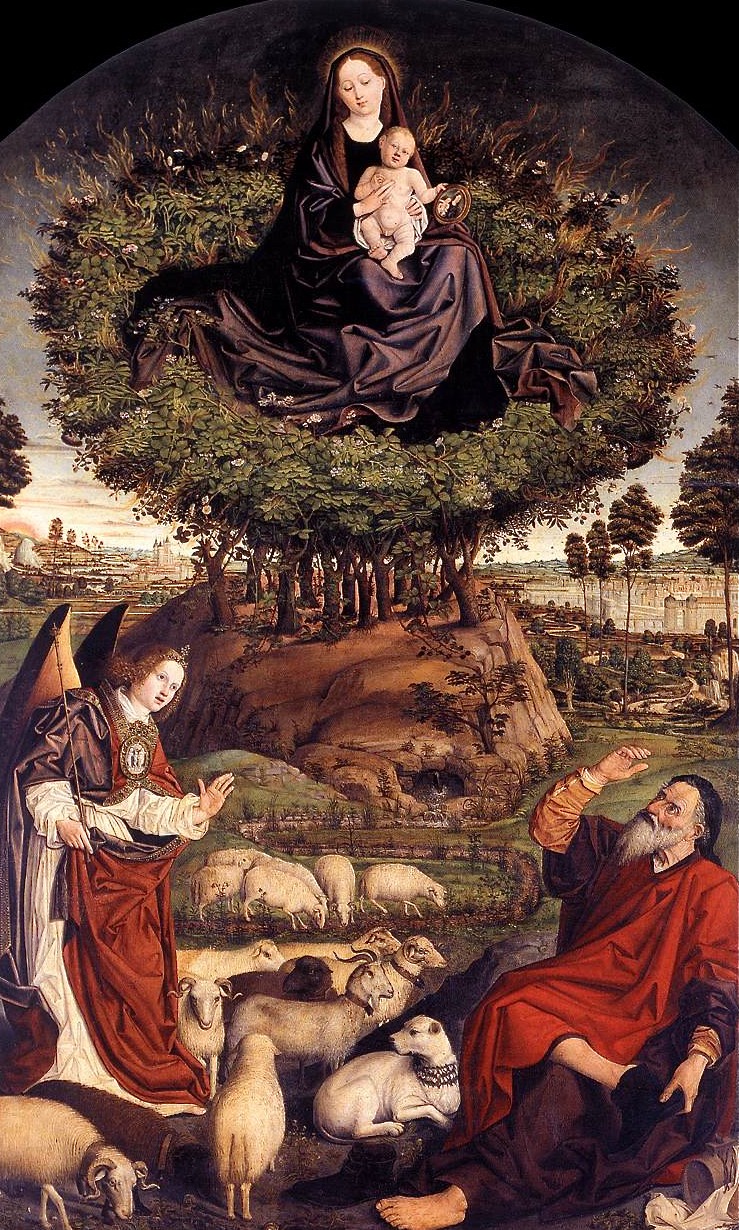
Mary in The Burning Bush, Nicolas Froment (1475-6)

Mary in The Burning Bush, Nicolas Froment (1475-6)

In an exquisite fifteenth-century tryptich by Nicolas Froment, Moses beholds the Madonna and Christ Child in the “burning” bush. There are no prominent flames. The Word made flesh is both voice and fire. God incarnate is the ultimate revelation by whom and through whom and in whom we may, at last, become fully human.


[i] Ashton Nichols, The Poetics of Epiphany: Nineteenth Century Origins of the Modern Literary Movement

Is holiness a Lenten obligation?

Bench carving, Cathedral of Seville, Spain

Bench carving, Cathedral of Seville, Spain

In the liturgical rite for Ash Wednesday, the priest stands up before the people and invites them “to the observance of a holy Lent.” It is a solemn and noble custom. But is it a serious proposal? And if so, what is actually being asked of the faithful?

When people hear the word “holy,” they often think “devout” or “virtuous,” but qodesh, the word for holiness in the Hebrew Bible, is not a moral or behavioral term. It means “apartness,” conveying an inherent, critical difference between what is holy and what is not.

The word itself is set apart. Unlike other divine attributes like power, justice and love, holiness has no analogue in the everyday life of Israel. It doesn’t refer to a common experience and then say God is like that. Instead, it evokes the one quality of God which is unlike anything we know.

In ancient Judaism, holiness meant the radical otherness of God, the Holy One. The divine presence is not to be approached easily or casually, either by our bodies or by our language. God dwells in a sacred zone which is highly charged, difficult and risky to enter.

Israel’s worship practices grew up around this strict sense of separation. At the center of cultic life was a holy of holies, a space set apart from contamination by the world. And only priests, who were themselves set apart and highly trained in the intricacies of access, were allowed to have contact with this sacred center. There was a sense that if the sphere of holiness were to be contaminated or carelessly regarded, the presence of the Holy One might withdraw from Israel, and that would be disastrous.

Leviticus, not a book I spend a lot of time with, contains a long section known as the Holiness Code because of its repeated use of holy and holiness, as well as related terms like sanctify, hallow, consecrate, dedicate, and sacred. It is filled with detailed prescriptions ranging from ritual practice to sexual behavior. Many of these seem archaic and largely inapplicable today. But may we still find something valid in the impulse to preserve the “holy” from profanation or inattention?

The sacred is made present by the attention we give to it. For example, if you come to a labyrinth occupying an open space, do you just walk straight across it, or do you go around it, acknowledging it as a space set apart for prayerful activity? Or does it only become holy space when it is put to its intended use, rather than just lying there as a decorative floor pattern?

I once led a weeklong family retreat for a Nevada parish on the eastern shore of Lake Tahoe. There was a beautiful stone church, with a large window looking across the water to the high peaks of the Sierra mountains. The space around the altar was large enough to hold all of us, so we did most of our worship there, in the intimacy of a circle.

I asked everyone to do two things each time they came inside the altar rails. One was to remove their shoes, like Moses at the Burning Bush. The other was to perform an action of their choice to mark their entrance into holy space: they could lift their hands in prayer, bow, genuflect, cross themselves, kiss the altar, or prostrate themselves on the floor. Most of the children, being the enthusiastically embodied creatures they are, opted for prostration! The effect of these physical observances was tangible. The attention we gave changed the quality of being there. It became for us holy ground.

But what Leviticus is after, and what a holy Lent is about, is more than the quality of a space or the attention we pay to it. Holiness is meant to be something contagious, something which gets inside us and changes us forever.

You shall be holy, for I your God am holy (Leviticus 19:2). God is not content to limit holiness to Godself. God’s people are invited to be holy as well. Not just our sanctuaries, but ourselves, are made to be set apart, consecrated, sanctified, hallowed. Biblical theologian Walter Brueggemann has called this the “obligation tradition,” where “the purpose of Israel’s life is to host the holiness of Yahweh.”[i]

As biblical people gradually figured out, hosting divine holiness means more than maintaining ritual purity or devotional piety. It means embodying justice and peace as well, uncontaminated by the dehumanizing, violent and oppressive practices of the dominant culture. Such holiness requires the consecration and dedication of every aspect of life to the will and purpose of God.

Leviticus 19:9-18 provides some excellent guidelines for our own time:

  • Don’t keep all your food for yourselves
  • Remember the poor and the immigrant
  • Don’t steal, lie, or defraud one another
  • Don’t exploit your workers
  • Be mindful of those with special needs
  • Be fair and just in your dealings with others
  • Don’t slander, seek revenge, or carry grudges
  • Love your neighbor as yourself

The nice thing about such a list is that these are all things we can do. They are not perfections only achievable in a messianic future. We can perform them right now. Jesus offered a similar list. Is somebody hungry? Feed them. Is anybody thirsty? Get them some water. And if curing the sick or setting the prisoner free seems beyond you, surely you can at least visit them. This is not impossible stuff.

Holiness, an attribute of God, becomes for us a practice.
Not something we are, but something we do.

Of course the specific obligations of holiness are not always clear. It is one thing to separate yourself by going to the desert, the monastery, or a countercultural refuge. It is quite another to live in contemporary society with its inevitable complicity in the evils by which the system maintains itself: militarism, consumerism, economic injustice and violence against the planet. How do we say no to the evil and yes to the good in a world of such complex interdependence?

And yet, Scripture remains insistent that we continue to strive for sanctification, dedicating our lives to God and separating ourselves from whatever is not of God.

  • God chose us in Christ to be holy and blameless, full of love (Ephesians 1:4)
  • Clothe yourselves with the new self, created according to the likeness of God in true righteousness and holiness (Ephesians 4:24)
  • Surrender your bodies to righteousness in order to create a holy life (Romans 6:19)

Surrender. Is this too much to ask? Is a holy life too much to ask? Does it set the bar so high that we just abandon the field to an elite corps of ethical heroes: the few, the proud, the saints?

Even worse, does a religion of obligation veer us toward “works righteousness,” overestimating our powers and denying the need for grace? Well, even Calvin admitted the possibility of making progress in personal goodness. He echoed the purity language of Leviticus when he wrote:

Ever since the Holy Spirit dedicated us as temples to the Lord, we should make it our endeavor to show forth the glory of God, and guard against being profaned by the defilement of sin. Ever since our soul and body were destined to heavenly incorruptibility and an unfading crown, we should earnestly strive to keep them pure and uncorrupted against the day of the Lord.[ii]

But where do we begin? Thomas Aquinas outlined three stages of holiness: First, distance yourself from sin and wrong inclinations (holiness as an act of separation, turning your back on sin and turning toward God). Second, work on cultivating the virtues in your life (holiness as a daily practice). Finally, rest in loving union with God (holiness as communion with the Holy One).

This triptych of holiness is echoed in my favorite collect in the service of Morning Prayer:

  • drive far from us all wrong desires (separation)
  • incline our hearts to keep your law, and guide our feet into the way of peace (practice)
  • that, having done your will with cheerfulness during the day, we may, when night comes, rejoice to give you thanks (communion)

Or to put this in the simplest terms:

  • What do I need to let go of?
  • What do I need to acquire and cultivate?
  • In whose reality do I want to dwell?

It’s not about effort, of course. Sola fide, sola gratia, soli Deo. Only faith, only grace, only God. As Augustine knew, “When God crowns our merits, God crowns nothing but God’s own gifts.”[iii]

And it’s never done, this holiness business. It’s an open-ended process of continual striving. Gregory of Nyssa said, “The perfection of human nature consists perhaps in its very growth in goodness.”[iv] In other words, holiness isn’t something we achieve, it’s a commitment to growth.

And as an old eucharistic prayer suggests, the time to start is now:

And here we offer and present unto thee, O Lord,
our selves, our souls and bodies,
to be a reasonable, holy, and living sacrifice unto thee.[v]

What if, every day during Lent, each of us were to make such a prayer?
Here I offer and present to you, O God, my ________.

Just fill in the blank with whatever the time and place requires.


Related posts

Grace me guide

Heart work and heaven work


[i] Walter Brueggemann, Theology of the Old Testament: Testimony, Dispute, Advocacy (Minneapolis: Fortress Press, 1997), 428

[ii] John Calvin, Institutes 3.6.3

[iii] Augustine, Epistle 154, 5.16

[iv] Gregory of Nyssa, Life of Moses 10

[v] Thomas Cranmer, Book of Common Prayer (1549), based on Romans 12:1, in the Episcopal Book of Common Prayer (1979), 336.

Ash Wednesday: A time for self-compassion


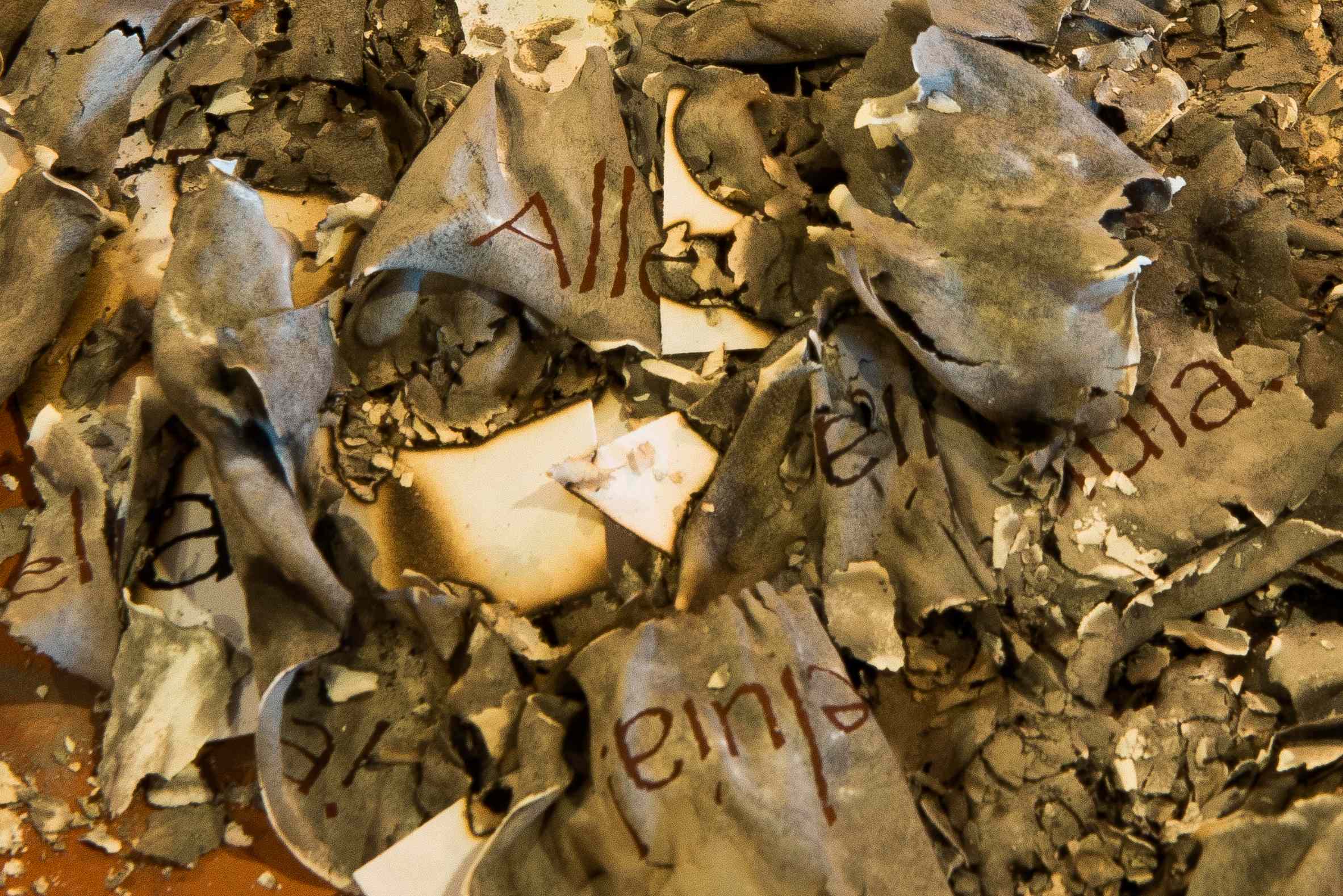
Alleluia ashes 2sm

There is a really deep well inside me. And in it dwells God. Sometimes I am there too. But more often stones and grit block the well, and God is buried beneath. Then he must be dug out again.

– Etty Hillesum[i]


Hillesum’s evocative image expresses the duality of the Lenten season. On the one hand, God is not the end product of spiritual attainment, something brought closer through our own efforts. The deep well of divinity is already present within us, “more intimate to me than I am to myself.”[ii] We don’t have to go somewhere else to find it. Lent is a time to tune in, go deep, and pay heightened attention to the Presence we often miss.

At the same time, our awareness of – and relationship with – this Presence may be hindered or obstructed by any number of things, requiring some real digging on our part. The trouble is, that digging can quickly become a self-improvement project, with Lent’s success judged by the quality and success of our efforts. We imagine a more spiritually heroic self, and strive to make it come true.

The ancient Desert Fathers and Mothers, who fled the corruption and distractions of their culture to seek a holier life in the wastelands beyond Empire, might seem at first glance to be overflowing with heroic aspiration. A typical regimen would be to “get up early every day and acquire the beginning of every virtue and commandment of God. Use great patience, with fear and long-suffering, in the love of God, with all the fervor of your soul and body. Exercise great humility, bear with interior distress, be vigilant and pray often with reverence and groaning, with purity of speech and control of your eyes… Do your work in peace. Persevere in keeping vigil, in hunger and thirst, cold and nakedness, and in sufferings.”[iii]

Such rigorous spiritual practice wasn’t for the halfhearted. But it risked the competitive sin of pride. Paul of Pherme, for instance, undertook the project of “continual prayer” – 300 prayers per day, keeping count with a pile of 300 pebbles in his lap. After each prayer, he tossed away one pebble. But he was crestfallen to learn of a certain woman who had been saying 700 prayers per day for thirty years! He would never catch up. Another desert father, Macarius the Alexandrian, warned Paul that his spiritual life lacked both balance and humility. But Macarius was no moderate. He once did penance for swatting a mosquito by moving to a swamp to endure six months of insect bites, without ever raising a hand in defense.[iv]

Thankfully, the extremists were not the norm. More prevalent was a spirit of deep humility about one’s capacities. John Climacus was a seventh-century monk at Mt. Sinai. His image of the spiritual life as a “Ladder of Divine Ascent” was later pictured in a famous twelfth-century icon.

Ladder of Divine Ascent, St. Catherine's Monastery, Mt. Sinai (12th century)

Ladder of Divine Ascent, St. Catherine’s Monastery, Mt. Sinai (12th century)

If you have ever climbed a very tall ladder, or done any rock-climbing, you know the degree of both effort and risk involved. John’s image makes it very clear that the spiritual life is strenuous and challenging. “We need to exercise ourselves greatly,” he wrote, “to lay upon ourselves many hidden labors after a life of negligence.” But then he said,

Be of good heart. If the passions lord it over us and we are weak, let us with great confidence offer to Christ our spiritual weakness and our impotence . . . He will help us irrespective of what we deserve, on the sole condition that we descend continually to the bottom, into the abyss of humility.[v]

So we don’t have to be heroes after all. What a relief! Humility, not heroism, is the way up the ladder. As the Rule of Saint Benedict teaches us, “by trying to climb we descend, and by humility we ascend.”[vi] That’s why Ash Wednesday strikes just the right note for the beginning of Lent. It brings us down to earth as creatures of ashes, dust and mud, undermining any pretensions of Promethean heroism. The Lenten journey is come-as-you-are.

Mary Oliver puts this perfectly: “You do not have to be good. / You do not have to walk on your knees / for a hundred miles through the desert, repenting. / You only have to let the soft animal of your body love what it loves.”[vii] Or as Simone Weil suggested, self-compassion means to “accept what one is, at a given moment, as a fact – even one’s shame.”

In the 1988 Winter Olympics, American speed skater Dan Jansen was favored in the 500 and 1000 meter events. On the morning of the 500 final, he learned his sister had just died from leukemia. His focus clearly elsewhere, he fell on the first turn of his race and never finished. He would also fall and fail in the 1000 meters. At the 1992 Olympics, he again failed to win the medals expected of him. The 1994 Oympics offered him one last chance, and he came to the line of the 500 meter race as the clear favorite, the only skater ever to break 36 seconds, which he had done four times. But after one slight slip on the ice, he finished out of the medals yet again.

Ash Wednesday came just after that race, and I reflected on Jansen’s story in my homily. Although Jansen would finally win a gold medal a few days later (in the one race where he was an underdog), it was his “failures” that resonated with people. After the liturgy, a therapist in the congregation told me that many of her clients that week had talked with her about Jansen’s story, and how much it moved them. If the world’s greatest skater could fall, then maybe it was all right for them to fall as well. You don’t have to be a hero, only yourself, letting the soft animal of your body love what it loves.

In his youth, the poet David Whyte was hiking in the Himalayas when he came to a deep chasm. The only way across was a rickety old rope bridge with many missing slats. Although he was a confident, experienced mountaineer, he suddenly froze at the prospect of traversing the abyss on so treacherous a path. He sat down on the ground and stared at the bridge for hours, unable to proceed. “There are times when the hero has to sit down,” he said later. “At some bridges in life the part of you that always gets it done has to sit down.” Then an old Tibetan woman came along, gathering yak dung for fuel. She walked with a limp. “Namaste,” she said with a smile. Then she turned and limped across the bridge. Immediately, without thinking, he rose up and followed. Sometimes, he realized, it is “the old interior angel,” the unheroic, limping, unequipped part of ourselves, that gets us to the other side.[viii]

Remember that you are dust, and no hero. Whether your Lent will be a time of giving up, going deep, or reaching out, may it always be done with a generous measure of self-compassion.

As Mary Gauthier sings so beautifully, we could all use a little mercy now.


Related posts

George Herbert: Heart work and heaven work

Solitude (Part 1)

Solitude (Part 2)


[i] Etty Hillesum, An Interrupted Life (New York: Henry Holt and Company, 1996), August 25, 1941 (two years before she died in Auschwitz)

[ii] St. Augustine, Confessions III.

[iii] The Apophthegmata (Sayings of the Desert Fathers), in William Harmless, S.J., Desert Christians: An Introduction to the Literature of Early Monasticism (Oxford and New York: Oxford University Press, 2004), 199-200

[iv] ibid., 288

[v] John Climacus, Ladder of Divine Ascent, 1st Step, 17, in Olivier Clement, The Roots of Christian Mysticism (New York: New City Press, 1993), 152

[vi] ibid., 156 (Rule of St. Benedict VII)

[vii] Mary Oliver, “Wild Geese,” New and Selected Poems (Boston: Beacon Press, 1992), 110

[viii] From a talk given by David Whyte in the 1990’s