The light we may not see: Thoughts on dust and transfiguration

"Beauty": Olafur Eliasson (1993)

“Beauty”: Olafur Eliasson (1993)

Tomorrow is Candlemas, celebrating the presentation of the baby Jesus in the Jerusalem temple. In liturgical tradition it is the final feast day in the sequential narrative of Christ’s birth. A great procession of candles is its distinctive feature, but few churches observe this lovely ritual of light anymore. In the United States, the second day of February is better known for a groundhog and his shadow.

An old English carol, “Candlemas Eve,” describes the practice of replacing the Christmas greens in homes to bring the midwinter celebrations to a close:

Down with the rosemary and bay,
Down with the mistletoe,
Instead of holly now up-raise
The greener box for show.

The final verse will resonate with anyone who feels a little wistful when they take down the Christmas decorations.

Thus times do shift, thus times do shift,
Each thing its time doth hold;
New things succeed, new things succeed,
As former things grow old.

You can hear Kate Rusby’s lovely rendition of the carol here.

After Candlemas, the season of Incarnation is not quite done. In next Sunday’s Epiphany finale, the lectionary readings will see it out with a blaze of glory. In complementary stories from the two Testaments, the divine is made brilliantly manifest in a sensory manner. On the summit of Mt. Sinai, Moses enters the “cloud of unknowing” to speak with God. And at the top of Galilee’s Mt. Tabor, Jesus’ own divinity is seen to shine with a visible brilliance in his “Transfiguration.”

In a course I teach on “Jesus and the Movies,” one of the questions we consider is how both the divinity and the humanity of Jesus are represented cinematically. Is it something the actor shows with his face or his body language? Is it an action he performs, or the way he is lit, or a certain music cue played whenever his divinity comes to the fore? An affectionate conversation with his mother, a flash of irritation, or a playful water fight with his disciples at a village well show him as recognizably human. Miraculous power and a commanding presence suggest the divine, though it is often the lighting, the music, and the reactions of others – in other words, acts of interpretation rather than disinterested observation – which make this clear.

The ecumenical councils of the early church struggled for centuries with how to avoid emphasizing either the humanity or the divinity of Jesus at the expense of the other. The fifth-century formulation of “fully human and fully divine” did not exactly settle the question. It continues to be a paradox – a “possible impossible” – which rightly resists comfortable appropriation. It is especially difficult when there is so little consensus about the nature of either humanity or divinity. God is largely unthinkable for secular culture, and the last hundred years have confused and darkened our understanding of humanity. How then can we even state the paradox when we have lost the language for both of its terms?

From its very beginning, Christianity has had to wrestle with a disturbing question: If God is the power and the beauty and the glory, how can a disgraced, disfigured, and crucified human bear any resemblance to the divine? I like Reinhold Niebuhr’s approach. Instead of figuring out how to explain “Jesus is God,” better to say that “God is like Jesus.” Once God owns the vulnerability and the suffering of self-diffusing love, fully divine and fully human start to look much more alike.

But what about the way Jesus shines in his Transfiguration? Doesn’t that indicate the presence of something utterly “other” at work in Jesus, transcending the strictly human? I have written elsewhere about the symbolic dimensions of this strange story. Whatever the facts behind the text, it seems to ring true both psychologically and spiritually. Even if, as the gospels tell us, the divinity of Jesus was always in him, not everyone saw it, and no one saw it all the time.

The Transfiguration isn’t just a story about Jesus. It is a sign of the light desiring to break forth from within each of us. Contemplation isn’t a spectator sport. It demands participation. The Epistle reading for Last Epiphany insists that the divine light is not just something we may see, but something that we are also made to reflect:

All of us, with our unveiled faces like mirrors reflecting the glory of the Lord, are being transformed into the image that we reflect in brighter and brighter glory. (II Cor. 3:18)

St. Paul’s metaphor was inspired by the story of Moses descending the slopes of Mt. Sinai after being in God’s presence. As Exodus relates, “Moses did not know that the skin of his face shone because he had been talking with God.” (Exodus 34:29) I love this detail. Moses shone with God’s reflected light, but he didn’t know it. Yet it would be quite evident to his friends when he returned to them. Let your light so shine.

We ourselves have been made to receive divine light, to partake of it, to shine and dazzle with its holy beauty, until our own bodies become “the luminous seeds of resurrection planted amid the blind sufferings of history.”[i]

Robert Bresson, the French film director, shunned professional actors. He hated what actors usually do in films, which is to explain their characters and link their actions to understandable motivations, thus denying the elusive mystery of being human, a mystery whose secret is ultimately beyond us. “The important thing, said Bresson, “is not what they show me, but what they hide from me, and above all what they do not know is in them.”[ii] Claude Laydu, the protagonist in Diary of a Country Priest, said that he did not realize he was playing a saint until he saw the finished film.

In nine days many of us will kneel to be anointed with ashes. We will be told to remember that we are dust. But after that we will undertake the long journey to Easter in the faith that our dust is mixed with a Light which we ourselves may not yet see or even know.


Related posts

The Woven Light: Reflections on the Transfiguration

Ten questions to ask about your own picture of Jesus

Delightful! Wonderful! Incomparable!


[i] Although I can’t find the source for this quote, I believe it comes from Olivier Clement, an Orthodox theologian in France.

[ii] Quoted in Keith Reader, Robert Bresson (Manchester and New York: Manchester University Press, 2000), p. 5, n. 12.

Ten questions to ask about your own picture of Jesus

"I was a teenage Jesus" - Jeffrey Hunter as Jesus in Nicholas Ray's King of Kings (1961)

“I was a teenage Jesus” – Jeffrey Hunter as Jesus in Nicholas Ray’s King of Kings (1961)

Are you the Expected One, or should we look for someone else? (Matthew 11:3)

Who do you say that I am? (Mark 8:29)

I’m teaching a course this month on “Jesus and the Movies” at the Graduate Theological Union in Berkeley, California. We are examining nineteen feature films on Jesus, made between 1912 and 2014, through the lenses of biblical criticism, Christology, film theory, and cultural contexts.

But we are also considering our own personal perspectives on the protagonist of “the greatest story ever told.” What influences have shaped our own image(s) of Jesus? How do we picture Jesus? What do we expect him to do? How do we expect him to be? How is our understanding of Jesus enlarged, challenged, confirmed, contradicted or disappointed by what we see on the screen?

Robert Powell, whose portrayal of Jesus in Franco Zefferelli’s Jesus of Nazareth (1977) was generally well received by the public, said some years later that “No one can play Jesus. Not really.” And many critics have agreed. The casting of boyish teen heartthrob Jeffrey Hunter (who was actually 33 when he played the part) elicited sneers of “I Was a Teenage Jesus.” Max von Sydow, praised by some for restoring virility to the role, was ripped by others for “an aphorism-spouting, Confucius-say edge to his speech, an overtone of pomposity.” Jesus Christ Superstar’s Ted Neely was dismissed as “a droopy little fellow with sad eyes and long hair, followed by nondescript young people without any particular place to go.” And Willem Dafoe’s troubled and uncertain Jesus caused NPR’s Tom Shales to say that “this Jesus wonders, wonders, wonders who — who wrote the book of love?”

My take on the subject is that no actor has to be the Jesus, and that no single film needs to be definitive. They only need to show us the “old, old story” in some fresh way, to reveal some dimension we might otherwise have missed. But any claim to have finally gotten it “right” would be idolatry. As Rowan Williams has noted:

If you think representation is copying or reproducing, quite clearly, there is no way you can do this as a religious believer. Not even if you think you are reproducing what Jesus looked like when he was on earth. If on the other hand you think ‘I need to find some kind of vehicle which will put me in touch with the action that underlies and sustains these events’, then of course you won’t necessarily look for a realistic picture… No, you don’t want to represent just the human facts, nor do you want to take refuge in abstract representations … you are put in touch with something, but you mustn’t think it’s a copy.[i]

So the actors and filmmakers are freed of the burden of factual replication. They merely have to put us in touch with that certain something contained in the Jesus story. And in provoking our own responses, both positive and negative, they make us reexamine the nature and history of our own images and ideas for Jesus.

From the Internet, definitely a "not-Jesus".

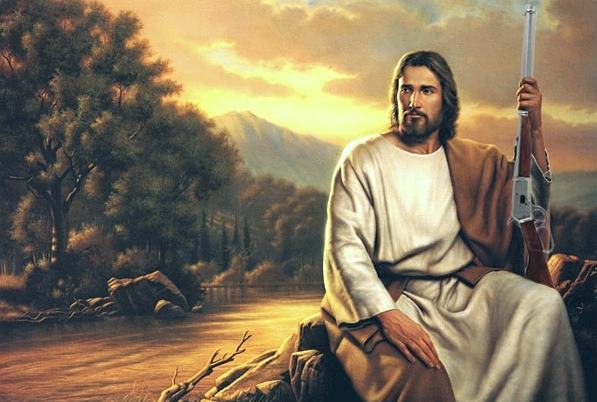
From the Internet, definitely a “not-Jesus.”

That being said, here are ten preliminary questions to consider when Jesus asks the big one: “Who do you say that I am?”

  1. Where did your first images of Jesus come from? Have any of those become obsolete?
  2. What later images, experiences, and understandings caused those first images to grow, develop, change?
  3. What are your criteria for authenticity? Scripture, theological presuppositions, historical probability, psychological plausibility, inner experience, worship, moral resonance, etc.?
  4. Then vs. Now: Is Jesus only in the past, or can we encounter him in the present? Can faith communities receive information about Jesus that adds to the picture (as in the Fourth Gospel or the Book of Revelation)? Can individuals, such as Julian of Norwich in her visions of the Passion, be shown “new” things about the Jesus story? Can a painter, or a filmmaker, show us something new about Jesus? How can such new insights. assertions, or revelations be tested?
  5. Is historical investigation enough to reach the “real” Jesus? Is faith enough? Or do they shape and influence each other?
  6. What is the role of art, including film, in showing us Jesus? Can different images/actors/styles add to our understanding and experience of Jesus? What are the criteria that affect our receptivity?
  7. If a particular movie Jesus or scene doesn’t fit our own ideas. images, or understandings, do we reject it entirely, or do we engage with it, let its difference be a way to explore and test our presuppositions? Do we say, “That’s not Jesus,” and move on? Or do we wrestle till dawn with that stranger to see whether it might bless us?
  8. All language is difference: this is not that. Can even the not-Jesuses help define who Jesus is?
  9. Ontological Christology vs. functional Christology (being vs. doing): Do the identity of Jesus, and the authenticity of his representations, lie in who he is: a person in whom both human and divine are perfectly integrated (and then manifested in personality, charisma, appearance, and the way he feels to us)? Or does it lie in what he does, what he says, and how the story goes, regardless of our affective responses to his manner of being?
  10. If a particular representation of Jesus makes you uncomfortable, can that be a good thing?


Related Posts

The Ten Best Jesus Movies

My 10 Favorite Jesus Movie Moments


[i] “Faith and Image,” a conversation between Rowan Williams and Neil MacGregor, Art and Christianity 75 (Autumn 2013), 3

Unsilent Night: An Advent Revelation

Sun in black sky

Last Saturday after dark, about 60 people gathered at a Seattle’s On the Boards theater to begin a neighborhood walk called “Unsilent Night.” Created in 1992 by New York composer Phil Kline, it is a “luminous soundscape” enacted for 45 minutes on a single night in December. This year, 37 American and Canadian cities joined in.

Participants downloaded one of 4 separate but complementary music tracks of ambient minimalism on their phones, and carried portable speakers as they walked the streets together in a collective mobile sound sculpture. NPR has described Unsilent Night this way: “chiming and chants bounce off walls and windows, transforming the coldest urban area with the warmth of musical fellowship.”

And so we began, moving block by block, a mesmerizing river of sound flowing slowly along the sidewalks of the city. An initial shimmering of bright cascading notes eventually evolved into the low rumble of droning chords, succeeded by percussive xylophone patterns, as if Steve Reich were composing for gamelan. Those metallic notes later gave way to more drones and electronic chords, which became the ground for choral fragments: Gregorian chants, wordless repetitions of ‘ah’ pitched at varied intervals, and melismatic Alleluias. Despite this discernible evolution of musical shifts and changes, the cumulative effect felt unhurried and relaxed.

The Queen Anne neighborhood is a lively mix of small shops, restaurants, and theaters, plus a cinema and basketball arena. A diverse assortment of people was already out looking for the heart of Saturday night, so there were many witnesses to our sonic procession. But surprisingly few showed much reaction. Some stared blankly, as if this unexpected phenomenon eluded their emotional register. They simply didn’t know what to make of it. Others looked away, perhaps wishing us into invisibility. Such a thing should not be happening in their world, so they pretended it wasn’t. Still others wore earbuds, disabling any receptivity to a reality beyond their own self-enclosure.

Yet some indeed had ears to hear, responding with smiles or looks of wonder. Car windows rolled down to let in the sound. The Latino doorman of a boutique hotel grinned ear to ear as we passed. A homeless woman in a wheelchair gave us a knowing smile, as if we were a welcome sign of sad times ending.

Like the best liturgy, it created community out of strangers through a shared action, and forged our collectivity into both sign and instrument of mystery and wonder. It was a perfect rite for Advent, contesting the old order while announcing an “impossible possible” drawing near. For the 45 minutes of the sound sculpture, sidewalks designed for functionality (keep moving to your next purchase, or go home!) became spaces for play. The ugliness of traffic noise was challenged by sweeter sounds. Strangers were invited to smile at one another, forgetting their solitudes for a few precious moments. And the birth of something deeply poetic usurped the accustomed prose of urban life.

As Twylene Moyer has written concerning participatory public art, it invites us “to re-evaluate what we mean by quality of life, to reassess what we think we know, and to reconsider how we choose to live with ourselves and each other.”[i] Why shouldn’t we feel fully at home in our public spaces, experiencing them as places of human affection and delight, inclusiveness and solidarity, joy and wonder? Why can’t we?

Theologian Langdon Gilkey makes an even more sweeping claim for such a re-visioning process. Art, he says, “makes us see in new and different ways, below the surface and beyond the obvious. Art opens up the truth hidden and within the ordinary; it provides a new entrance into reality and pushes us through that entrance. It leads us to what is really there and really going on. Far from subjective, it pierces the opaque subjectivity, the not seeing, of conventional life, of conventional viewing, and discloses reality.”[ii]

Seeing “the truth hidden and within the ordinary,” piercing the “not seeing of conventional life” with the inbreaking of deeper reality – these comprise the essence of Christianity’s annual Advent project. Not everyone welcomes this kind of seeing, and many reject its very possibility. But for at least some of us who experienced the wonder of Unsilent Night, a richer account of the universe, making room for the transcendent, felt more persuasive than the alternatives.

As I walked in this procession of glorious sound, an Advent hymn came to mind:

Hark! a thrilling voice is sounding.
“Christ is nigh,” it seems to say.

Not everyone would put the name of Christ to what we did and the sound we made together, but that doesn’t alter the content of the experience.

If God is more of a situation than an object, then the community, relationality, mystery, beauty, wonder, delight, and communion produced by the event seemed apt expressions of divinity taking “place,” or “being here now.” You didn’t have to name it to live it.

Toward the end of our walk we were led into a bit of open space set back from the street, where the music was not so compromised by traffic noise. And there our little speakers, one by one, began to ring with a peal of sonorous bell tones, until we were all immersed in such a joyous tintinnabulation that I could imagine myself in heaven. Every face I saw around me glowed with amazement. If the Incarnation were a sound, this would be it, suddenly sanctifying a scrubby vacant lot in Queen Anne.

As the bells faded, we processed one more block, back to our starting point, where we stood in what felt like a prayer circle while the final portion of the composition slowly faded into silence. Some closed their eyes, and everyone seemed rapt and attentive, in a state of peace and gratitude.

Once the music ended, the spell was quickly broken. We went our separate ways, strangers once more, but perhaps “no longer at ease here, in the old dispensation.”[iii] For a moment we had known something better, and would not forget.


[i] Twylene Moyer, Artists Reclaim the Commons: New Works/New Territories/New Publics (Ed. Glenn Harper and Twylene Moyer, Hamilton, NJ: isc Press, 2013), 8


[ii] Langdon Gilkey, from an address given at the Art Institute of Chicago, published as “Can Art Fill the Vacuum?” in Art, Creativity and the Sacred: An Anthology in Religion and Art, ed. Diane Apostolos-Cappadona (New York: Crossroad, 1984), 189-90

[iii] The phrase is from T. S. Eliot’s “Journey of the Magi,” expressing the incompatibility of what the Magi had experienced in Bethlehem with the unredeemed world to which they returned.

The O Antiphons: “Drenched in the speech of God”

Giovanni Bellini, Madonna and Child with Saints Catherine and Magdalene (detail), c. 1500, Accademia, Venice

Giovanni Bellini, Madonna and Child with Saints Catherine and Magdalene (detail), c. 1500, Accademia, Venice

When belief in God is the matter to be decided, the central question is whether you can and should allow yourself to retain or be drawn into the patterns of thought that make the believer’s world what it is.

– David M. Holley

Pierced by the light of God…drenched in the speech of God,
your body bloomed, swelling with the breath of God.

– Hildegard of Bingen

One of the joys of Advent’s final days is the praying of the O Antiphons, seven eloquent supplications based on biblical images or attributes of the divine. Liturgically, they begin and end the Magnificat at Vespers from December 17th to December 23rd, but they can also be a rich resource for personal prayer as Christ-mass draws near. I tape each day’s particular antiphon to the mirror where I begin and end my day. Doors, dashboards and desks would also be good places to encounter these compelling texts, letting them awaken our attention over and over throughout the day.

Today’s antiphon, in my free paraphrase:

O Sophia, you are the truth of harmonious form,
the pattern of existence, the shapeliness of love.
Come: illumine us, enable us, empower us
to live in your Wisdom, your Torah, your Way.

The best-known version of the O Antiphons is the hymn, “O Come, O Come Emmanuel.” You can find my own variations on the seven antiphons here.

In my December 17 post last year, I wrote:

Each antiphon is both greeting and supplication to the God who comes to save us:

O Sapientia, O Adonai, O Radix Jesse, O Clavis David,
O Oriens, O Rex Gentium, O Emmanuel … O … O … O …

O is such an evocative word. We use it when we come upone something outside ourselves, often unexpected, something that engages us face to face.

 “O” can be an inhalation, a gasp, the cry of astonishment at the heart of every encounter with the Holy. If our place of prayer were suddenly filled with smoke and angels, or if the Holy called us out of a burning bush, our first response might well be “O!”

 There is also the O of understanding, or recognition: “O, now I see, now I get it.” Or even, “O, it’s you!”

 And then there is the ecstatic O, expressing delight, wonder, the sigh of surrender: Ohhhhhhh!

 Each of these is a fitting response when we meet the divine:

 Astonishment
Recognition
Surrender

As the Antiphons return this year, I happen to be reading David M. Holley’s illuminating book, Meaning and Mystery: What it Means to Believe in God. In fresh and thoughtful ways, he suggests that God is not a hypothesis to be tested or a puzzle to be solved by detached observers, but an experience to be encountered by receptive participants, those who know how to say “O!”

Thinking of God as a hypothesis to be inferred from specifiable data means starting from an understanding of a world that does not presuppose God, but belief in God is not a matter of moving from such a world to a reality in which God is included. It is a matter of finding yourself within the kind of world where God is implicit already.[i]

In other words, the truth of belief isn’t something that can be decided from a position outside of the patterns of life and thought that constitute a religious view of the world. If you want to experience God, learn to genuflect, learn to pray, learn to sing and dance in the presence of the Holy.

Astonishment. Recognition. Surrender.

It is certainly possible to live inside an alternative story, where God is absent or nonexistent. But I find that a bleak and unpromising account of reality. This old world, beset by human folly, massive violence, economic injustice, and dispiriting politics, needs divine imagination more than ever.

The prophet Zephaniah responded to his own dark times with a profound hope in God’s Advent as a redemptive rewrite of the human story. Amid the current proliferation of hateful speech, faithless fear and violent bluster, how we long with Zephaniah for a new story, a better language.

At that time I will change the speech of the peoples to a pure speech, that all of them may call on the holy Name and serve God with one accord.[ii]

May that day come when we are all “drenched in the speech of God,” whose language is justice, peace, mercy, forgiveness, compassion, communion.

O Desire of all nations and peoples,
you are the strong force that draws us toward you,
the pattern which choreographs creation
to Love’s bright music.
Come: teach us the steps
that we may dance with you.


Related posts

Praying the O Antiphons

Ten Ways to Keep a Holy Advent

[i] David M. Holley, Meaning and Mystery: What it Means to Believe in God (Malden, MA: Wiley-Blackwell, 2010), 47-48 [the epigraph is also Holley, p. 48]

[ii] Zephaniah 3:9

“God isn’t fixing this”

Advent installation by Jim Friedrich at St. John's Episcopal Church, Los Angeles (1977)

Advent installation by Jim Friedrich at St. John’s Episcopal Church, Los Angeles (1977)

O come, O come Emmanuel,
and ransom captive Israel.

Once upon a time, worshippers entered their church on the Second Sunday of Advent to find a great wall between themselves and the sanctuary. The beautiful mosaics, the richly colored marble walls, and the magnificent carved Christ above the high altar were all hidden from view by this strange iconostasis, made from front pages of the Los Angeles Times. Instead of the images of holy men and women that adorn a traditional altar screen, there were banner headlines screaming catastrophe and mayhem.

When the assembly was seated, a mime came up the aisle to stand before the wall, searching for some way through it. His movements and gestures indicated perplexity, frustration, and finally discouragement. Then a voice from beyond the wall cried out,

Jerusalem, turn your eyes to the east,
see the joy that is coming to you from God. (Baruch 4:36).

Responding to the voice, the mime tore a small hole in the wall, and peeked through. He seemed entranced by what he saw.

The voice continued:

Take off the garment of your sorrow and affliction, O Jerusalem,
and put on forever the beauty of God’s glory. (Baruch 5:1)

The mime began to tear down the wall, encouraging others to join him. One by one, people rose from their pews to rip down the veil “of sorrow and affliction,” until the beauty of God’s sanctuary was finally revealed.

This simple but powerful ritual, the prelude to a eucharist I curated forty years ago at St. John’s Episcopal Church in Los Angeles, comes to mind whenever I hear that passage from Baruch in the December lectionary. It’s what we pray for each Advent from our place on this side of the wall: Good Lord, deliver us. Stir up your power. Tear down the wall between us. Show us your glory.

That wall of headlines reflected my ongoing interest in connecting Advent themes with the news of the world. The WTO protests in Seattle (1999) and the Occupy Movement (2011) both coincided nicely with Advent, mirroring its prophetic themes of judging the present order with the hope and vision of something better.[i] And just last week, the front page of the New York Daily News supplied a marvelous Advent provocation. By noon, it had 11 million Facebook views, and 74,000 shares.

New York Daily News, 12/3/15

New York Daily News, 12/3/15

The headline was a sharp rebuke to the shameless politicians who promise prayers for the victims of gun violence while refusing to do anything about the guns. Calling them “cowards who could truly end gun scourge” but instead “hide behind pious platitudes,” the newspaper offered a blunt theological assertion: “God isn’t fixing this.”[ii]

The daily office Old Testament readings for early Advent, calling the world to account for its evils, say much the same thing. To those who refuse to “renounce the dictates of our own wicked hearts,”[iii] the prophets imagine God declaring, “You made your own bed. Now lie in it.” (Thankfully, the prophets always redeem their rants in the end with comforting decrees of mercy and salvation).

However, the Lieutenant Governor of Texas was not comfortable with the Daily News’ riff on the old biblical idea that God sometimes gets fed up with human folly. His photoshopped revision was posted on Facebook and Twitter.

God hears our prayers

Of course this clueless retort (note the unfortunate juxtaposition of the headline with the red banner above it) did not actually answer the question of whether – or how – God acts in the world to “fix” things. It was just a clumsy attempt by a presumed gun lover to change the subject. Platitudes about prayer in the abstract are safe because they have no consequences, unlike real prayer, which always implicates the petitioner in a process of change and action. If we pray for an end to gun violence, we obligate ourselves to do all in our power to reduce it. Prayer is a call for action; it politicizes what we pray for. Prayer is not simply leaving things up to God. It is an act of volunteering to be part of God’s solution.

But is there such a thing as God’s solution? Does God – can God – fix things? It is not a question with a clear and simple answer. Human freedom has thrown a monkey wrench into the story of the world, while God has surrendered absolute control of the narrative. If we make a mess of things, God is not an indulgent parent rushing in to cover for us. We don’t get to multiply our weapons and then wonder why God allows so much violence.

So where does that leave us? In the Advent section of his Christmas Oratorio,[iv] W. H. Auden describes a closed-in, godless world where hope is absent.

Alone, alone about a dreadful wood
Of conscious evil runs a lost mankind …
The Pilgrim Way has led to the abyss.

But what if we are not alone? What if there is a God who can make the abyss into a way? What if an unexpected future is breaking through the walls of our self-made prison? The Advent message is to embrace this hope, as we take off the garments of sorrow and affliction to welcome the God of joy into our midst.

Whatever the “solution” (salvation) may be in the tangled histories of the world and the soul, it is a long-term, sometimes excruciating, process, requiring honest engagement with the consequences of human sin in acts of confession, repentance, reconciliation, justice, healing, sacrifice, and transformation. And I submit that these are not simply things we do with God, as though God were only a helper from the outside. They are things we do in God, or God does in us, as our own intentions and actions become the embodiment – the incarnation – of divine purpose.

So yes, I believe that God is fixing the world, but not in the short run. And not without us.


[i] I preached on both these events at the time, with mixed results. Some were not so ready to find traces of God in social movements which trouble the powers-that-be. One church subsequently banned me from its pulpit for being too “partisan.” Guilty as charged.

[ii] New York Daily News, December 3, 2015.

[iii] Baruch 2:8

[iv] W. H. Auden, For the Time Being: A Christmas Oratorio, in Collected Poems, ed. Edward Mendelson (New York: Random House, 1976), 273

After Paris and Beirut, what kind of story shall we tell?

Barthelemy Toguo, wood stamp from tree trunk, Venice Biennale 2015

Barthelemy Toguo, wood stamp from tree trunk, Venice Biennale 2015

We played the pipes for you,
and you wouldn’t dance,
we sang dirges,
and you wouldn’t cry. (Luke 7:32)

This was, as Jesus observed, the perennial cry of the poor children in the marketplace, playing their instruments for the crowd, hoping for a handout. Every street performer could relate to this description of an unresponsive audience, but Jesus wasn’t using the image to address their plight. Instead, he was characterizing his critics as childish in their contradictory complaints about the prophets in their midst. They whined that John the Baptist was too austere and antisocial, but they didn’t like Jesus’ partying with sinners any better.

The failure of others to respond appropriately to the tunes we play for them could also describe the incredible discord among competing versions of reality in these days of terrorist violence. The actions of those living in alternative realities to our own seem inexplicable, and our often clueless responses to those actions fail to produce the intended results. We pipe, but they don’t dance. We bomb, but they don’t submit. We reason, but they won’t be persuaded.

In a long and unsettling article in The Atlantic last March, Graeme Wood diagnosed ISIS as a “dystopian alternate reality” grounded in an apocalyptic worldview. According to Wood, the western violent response to the Islamic State not only feeds their medieval narrative of Crusaders versus Muslims, it is the longed-for fulfillment of millenarian prophecy. In the Syrian farmland around the city of Dabiq, the armies of Islam will face down the armies of “Rome” (the West). This decisive battle will inaugurate the End of Days, resolving all the tribulations of history into a final triumph of God’s people.

In this narrative, the escalation of American military involvement would not be a deterrent, but an incentive. As Wood put it: “During fighting in Iraq in December [2014], after mujahideen (perhaps inaccurately) reported having seen American soldiers in battle, Islamic State Twitter accounts erupted in spasms of pleasure, like overenthusiastic hosts or hostesses upon the arrival of the first guests at a party.”[i]

If Wood is correct, then ISIS is operating from premises which we would dismiss as senseless and fantastic. But then what do we make of a recent poll on religion and politics, where1000 American adults were asked, “Do you think that the end of the world, as predicted in the Book of Revelation, will happen?”[ii] The results suggest that alternate realities are not exclusive to other cultures:

Yes, in my lifetime (13%)
Yes, but not in my lifetime (39%)
No (25%)
Not sure (22%)

I’m not sure what “not sure” means in this case, but I’m guessing some of those folks are at least conceding the possibility. In any case, more than half of those surveyed embraced the literal fulfillment of a highly metaphorical text with its problematic mixture of sacred violence and sublimely consoling imagery.

When they said “yes” to Revelation, did they mean verse 21:4? God will wipe every tear from their eyes. Death will be no more; mourning and crying will be no more. Or were they thinking of 11:18? The time has come to destroy those who are destroying the earth.

 Who knows? Polls on religious belief are misleading because they cannot measure ambiguity and nuance, nor do they distinguish between proposition and practice. Religion is not just what people say; it is what they do. And the correlation between the two is not always clear. If 52% of Americans believe that Revelation is predictive of human history, does that make us more or less likely to choose war as the means to “erase ISIS from the face of the earth?”[iii]

There is no consensus about the human story. The world is full of alternate realities. Sometimes we choose which story we want to live inside of. Sometimes the story chooses us. ISIS is living a story which seems crazy and evil, easily rejected by the majority of humanity who live outside it. But a consensus on competing narratives is harder to achieve when we consider our own national life.

The argument about Syrian immigrants is a perfect example. More than half of the state governors in America want to shut the door on them, while the President, speaking for many others, says that is not who we are as a people. Who is right? It depends on which story you are living inside of. Just in time for our national celebration of the Pilgrim immigrants, we get to choose between xenophobia and the Statue of Liberty. Of course my own framing of this debate tells you which story I live in.

My alternate reality, the story which I have chosen and which has chosen me, begins at the eucharistic table, where everyone is welcome, forgiveness is shared, no one goes hungry, and love is the costly gift. I may falter in my daily embodiment of that story, but I have no desire to belong to any other.

After 9/11, Americans had to choose what kind of story we wanted to live in. Many of our choices proved disastrous and toxic, but there were some who chose a better story, a better way. One of the finest articulations of that better way was a manifesto written by the Catholic Worker of Los Angeles in September, 2011. In the wake of Paris and Beirut, its eloquent faith still resonates:

Even after all this…

Our grief will not be short-circuited with cries of vengeance nor with acts of retribution. We will not cooperate with incitements to become that which we most oppose, namely perpetrators of violence.

We will honor the deeper levels of grief, acknowledging the woundedness inflicted upon us, and the woundedness that our nation has inflicted upon others…

We invite you to participate with us in all our wildest dreams and visions for peace. For now we sadly know that our affluence, our power, our possessions cannot serve as protection from harm. We invite you to clamber off the wheel of violence. It is the only worthy legacy we can offer to those who have died…

We are Catholic Workers and we still believe… the only solution is love.


[i] Graeme Wood, “What ISIS Really Wants,” The Atlantic (March 2015): http://www.theatlantic.com/magazine/archive/2015/03/what-isis-really-wants/384980/

[ii] YouGov/Huffington Post poll conducted Nov. 10-11, 2015. In the same poll, 42% said the earth was created in 6 days, but only 4% believed the pyramids were used for grain silos! https://today.yougov.com/news/2015/11/11/poll-results-bible-politics/

[iii] The quote is from a liberal politician I admire who is not an advocate for war. His use of the phrase suggests a rather apocalyptic consensus about the goal if not the means.


Do not fear: Reflections on the Venice Colloquium

image

The greatest thing a human soul ever does in this world is to see something, and tell what it saw in a plain way. Hundreds of people can talk for one who can think, but thousands can think for one who can see. To see clearly is poetry, prophecy, and religion – all in one.

– John Ruskin[i]

I can’t understand why people are frightened of new ideas.
I’m frightened of the old ones.

– John Cage[ii]

John Ruskin, the influential Victorian oracle on all things pertaining to the visual arts, had a particular passion for Venice. As a young man, he made repeated visits to analyze and record, in words, drawings and watercolors, the endangered architecture of the place he described as “a ghost upon the sands of the sea, so weak, so quiet, – so bereft of all but her loveliness, that we might well doubt, as we watched her faint reflection in the mirage of the lagoon, which was the City, and which was the Shadow.”[iii]

A city floating on the sea, a mirage of reflections and watery light, an endless play of surfaces and mazes, seems more imagined than built. Ruskin’s fevered description of San Marco celebrates this fantastic evanescence:

… as if in ecstasy, the crests of the arches break into a marble foam, and toss themselves far into the blue sky in flashes and wreaths of sculptured spray, as if the breakers on the Lido shore had been frost-bound before they fell, and the sea-nymphs had inlaid them with coral and amethyst.[iv]

Artists, writers, and dreamers have long made pilgrimage to Venice not just to admire its beautiful treasures, but to be immersed in its spectral fancies, a provocative analog for their own imaginative processes. When a small group of Christian creatives gathered there for the Venice Colloquium in late October, we arrived with that same longing for inspiration and discovery.

Our collective intention was to “dream the Church that wants to be.” It was born of a shared sense of urgency about the state of imagination in the common life of God’s friends. In my last post, I wrote that “the practice of holy imagination is like a sanctuary lamp in the life of the Church. If not duly attended to, it is in danger of going out.” In a week of group conversations and Venetian wanderings, we tended the flame as best we could.

We had little interest in being theological spin doctors, cranking out persuasive messages or illustrative answers. Art is not argument or propaganda. Its purpose is not to answer questions, make a point, or silence doubt. The artist should not know what is going to happen when she goes to work. One of our group, a painter, said, “I am not trying to get a message out with my work, but to evoke a deep experience. What right do I have to impose my meanings on the incredible lives of other people?”

“Church,” said another, “has become the place where you go if you know, rather than the place to find out. It has become the place of the answer instead of the question.” Could we possibly abandon the project of collecting the best answers and devote our attention to curating the best questions? Where would that lead? Would we just get lost in the maze of unknowability? Or as the Psalmist says, is there anywhere we can go where God is not?

Where can I escape from your Spirit?
Where can I flee from your presence?
If I climb up to heaven, you are there;
if I make my bed in the underworld, you are there.[v]

When we discussed the drag imposed on creativity by the institutional rage for order, the young leader of an “emergent” Christian community spoke up: “I want a wild church, where things are out of our control.” For Christians concerned about communal stability and institutional sustainability, that might sound like a recipe for chaos. But as our sacred stories remind us, chaos is prelude to creation. And if anyone thinks the Church is not in need of some serious re-creation, they aren’t paying attention.

The worship spaces of Venice, with their monumental forms of marble and mosaic, their exuberant decoration, their Bellinis, Titians, and Tintorettos, express a religious confidence that is nearly incomprehensible to our own time. More frequented by tourists than believers, they seem like gorgeous tombs for an expired past. Then what shall we say when the prophet asks: Can these bones live?

Jaume Plensa,

Jaume Plensa, “Together”

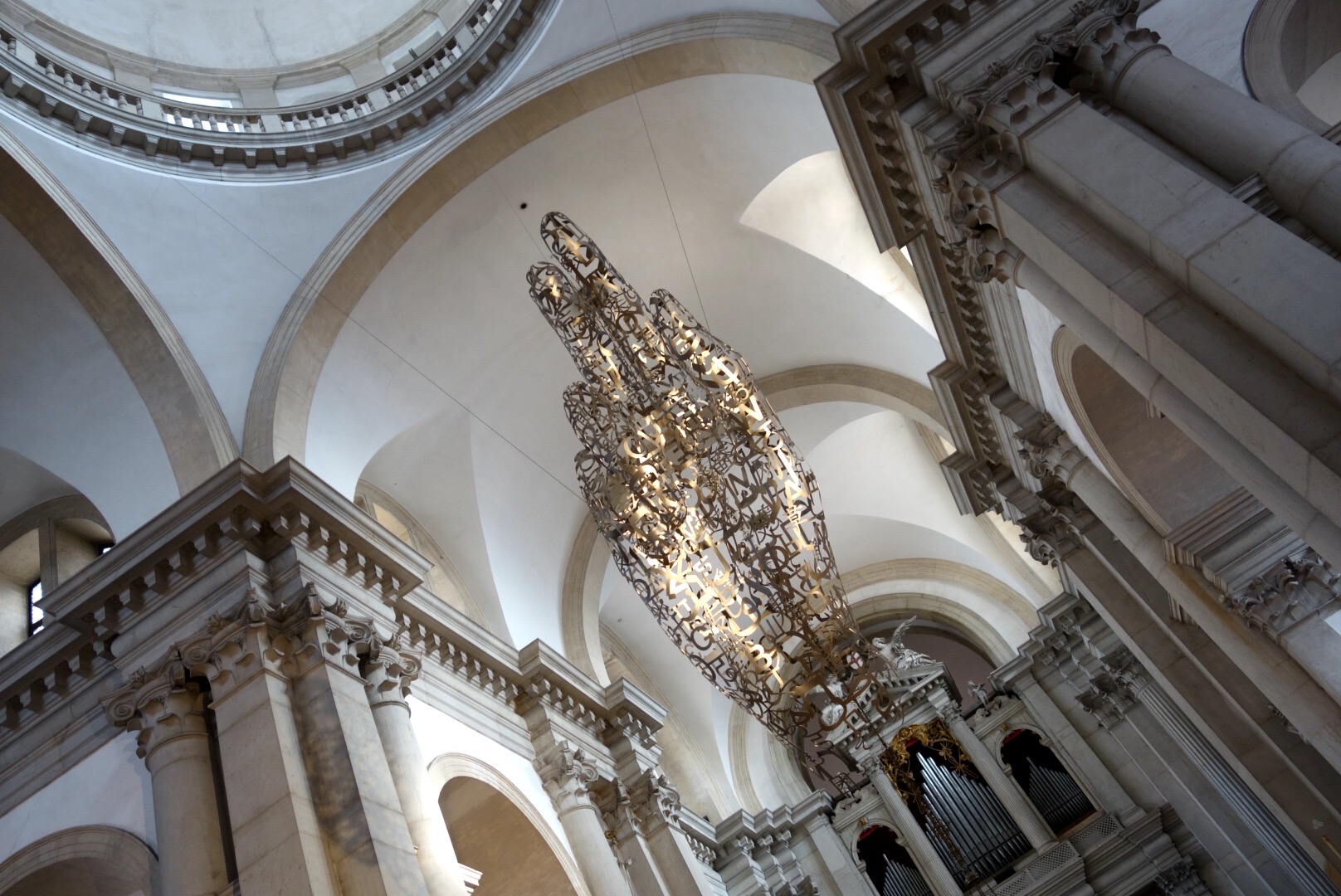
One Sunday morning I attended mass at San Giorgio Maggiore. There were less than forty people present in its vast interior. But as soon as the liturgy ended, many more people began to stream into the church. They had come not to worship, but to experience a contemporary art installation, part of the Biennale art exposition taking place throughout the city. A giant head, made of thick wire, faced the altar from the nave. Consisting of far more empty space than substance, it was a ghostly, immaterial presence, in but not of this world. A great golden hand, suspended over the crossing, bestowed upon that serene and mysterious face a perpetual blessing.

Jaume Plensa,

Jaume Plensa, “Together”

The contrast between the sparsely attended mass and the popular artwork could be interpreted as a simple duality of irreconcilable opposites: religion vs. art, old vs. new, moribund vs. vibrant, neglected vs. popular. But that would be too facile, ignoring the deep connections between the artwork and the worship space it inhabited.

It was not accidental that the head, modeled on a girl of Chinese and Spanish ancestry, faced the altar from the nave, like any common worshipper, or that the blessing hand mimicked the gesture of countless priests who had presided in that place for a thousand years. The work couldn’t be detached from Christian ritual without evacuating much of its meaning.

At the same time, there was something universal about a blessing hand and a receptive face. The extreme magnification of head and hand functioned like a cinematic close-up, focusing on the act of blessing in isolation from any specific ritual context or tradition. We didn’t see the vested body of a Catholic priest, or encounter the sociology of a local congregation. We only saw a hand that blesses and a face that receives. For me, the elemental humanity of this universal gesture reinforced rather than replaced the meaning of Christian blessing.

So instead of a rivalry between art and religion, there was a conversation, in which each informed and enriched the other. An explanatory text said that Jaume Plensa’s artwork, entitled Together, employed “a metaphorical language that will connect people of many faiths and of no faith.”

The conversation between art and religion, and among artists of many faiths and no faith, can only be tentative and experimental in an age of fragmentation and doubt. It will also be wild and unpredictable. If any of our small group came to Venice thinking we might collectively forge a vision of what the Christian artist is called to be in such a time, in such a Church, we were soon awakened from that fond dream. There will be no manifesto from the Venice Colloquium. We have returned to our homes with no answers, only more questions. And some lasting images.

Another Biennale work, Rashad Alakbarov’s The Union of Fire and Water, provided particular inspiration. As part of an installation evoking the turbulent political history of Azerbaijan, an array of swords and daggers was arranged in such a way that a message was created from their shadows: Do not fear. The instruments of violence and death had been transformed into an utterance of encouragement and hope. It was reminiscent of the Arma Christi, where the implements of Christ’s suffering become symbols of salvation.

Through the play of light and shadow, the handwriting on the wall was there for all to see. For artists out on the road of unknowing, with the voices of caution and order tugging us backward lest we lose our way, it seemed like a word from heaven. Do not fear.

Rashad Alakbarov,

Rashad Alakbarov, “The Union of Fire and Water”

[i] John Ruskin, Modern Painters III (IV: 333), abridged and edited by David Barrie (New York: Alfred A. Knopf, 1987), 404

[ii] q. in Kay Larson, Where the Heart Beats: John Cage, Zen Buddhism, and the Inner Life of Artists (New York: The Penguin Group, 2012), x

[iii] Ruskin, The Stones of Venice I, 9:17, quoted in Ruskin’s Venice: The Stones Revisited, ed. Sarah Quill (Farnham, Surrey: Lund Humphries, 2015), 41

[iv] The Stones of Venice (10:82-3), ibid., 55

[v] Psalm 139: 6-7


Late summer days and the shadows of impermanence

Nelson Cruz

Nelson Cruz

It was supposed to be the Mariners’ year in major league baseball. With a few weeks still left in the regular season, Seattle’s star pitcher has 17 wins, and their best batter has hit 40 home runs. These are great numbers. But the team itself has been out of the pennant race since July. For a long time, the Mariners just couldn’t score when they needed to, lost a lot of close games, and are currently 7 games out of first place, and 6 games below .500. With only 20 games left, their chances of making the playoffs are virtually nil.

So has their season lost all its meaning? Was it all for nothing? If a season is worthwhile only if you win the championship, then only one team can ever stave off meaninglessness. But as basketball legend Bill Russell has noted, in sports “the basic unit of time is the moment. Sports fans and players appreciate each instant.”[i] We enjoy the evening highlights on ESPN even if we don’t follow a particular team, even if our own team is having a bad year, because we are witnessing the timeless essence of the sport: a great pitch, the crack of the bat, a stolen base, a diving catch.

Sportswriter Meg Rowley, in an artful post called “How I learned to stop worrying and love Nelson Cruz,” reminds us that every game, every team, has moments of pure skill and beauty with a value unto themselves, regardless of their relevance to the overall standings. We watch the games even if they don’t “matter” in the long run, because we love those moments.

I once saw Sandy Koufax strike out 18 Giants. I remember cheering and laughing with my dad from a bleacher seat high above right field. I remember Wally Moon blasting a 3-run homer to win the game in the bottom of the ninth. But I didn’t remember, until I looked it up, was the year it happened, or the fact that this dramatic win helped the Dodgers go on to win the World Series. Seasons come and go, fortunes rise and fall, but the special moments endure.

Citing the Mariners’ Nelson Cruz (40 home runs) and the Detroit Tigers’ Miguel Cabrera, who is hitting .351 and will probably win the batting title for a team that is 19 games out of first place, Rowley says that “every season is really about appreciating great performances in the face of eventual failure.” Every team but one will fail in the end. And even the winner is unlikely to repeat next season. “It’s all futile. But guys like Cruz and Cabrera make that futility beautiful … for a couple of at-bats every game, Cruz and Cabrera keep the futility at bay.”[ii]

As I savor the luscious local weather of late summer in Puget Sound, I am also conscious of its imminent departure. No matter how many perfect moments have adorned these summer months, no one gets a winning season in the game with time. The day will come when night falls early, the birds have gone, and it’s too cold to sit outside in the garden with a book.

Emily Dickinson, who loved the “sacrament of summer days,” was haunted by the shadow of impermanence that falls across our sunlit lawns. The times when we forget that shadow, like the brief return of balmy weather in Indian summer, are but a “fraud that cannot cheat the Bee.”[iii] Yet Dickinson’s poetry, in its act of acute noticing, in its cherishing of the beauty which is all the more precious for its brevity, keeps the futility at bay. She could not solve the puzzle of where it was all headed, this ephemeral life. She wasn’t sure whether the future would turn out to be consummation or cessation (to borrow John Dewey’s evocative duality). Despite her inheritance of Christian vocabulary, she was steeped in nineteenth century doubt. But she always stepped to the plate and took her swings, and her readers still share the pleasure of her every at-bat.

I am currently reading Vera Brittain’s Testament of Youth, her moving memoir of the generation who came of age on the eve of the First World War. Her descriptions of “carefree summers” before the war are especially poignant because both writer and reader know what is about to happen. When, in 1915, she received news about the death of one of her ‘summer friends’ – the kind of people “with whom one dances and plays games and perhaps flirts a little,” she wrote to her fiancé serving on the front that “it gives one the shock of incongruity to imagine the Angel of Death brooding over one’s light and pleasant acquaintances, and to think of them with all their lightness and pleasantries shed away.”[iv]

The dream of summer as a timeless sabbath from mortality soon vanished in the trenches, and with it many of Brittain’s generation, including her brother and her lover. But did the shortness of those young and precious lives invalidate whatever love and meaning and joy they did experience, however briefly?

Like Emily Dickinson, Gustav Mahler confronted the shadow of impermanence in all of his work. He said specifically of his Second Symphony (“Resurrection”) that he was asking the big questions: “What did you live for? Why did you suffer? Is it all only a vast terrifying joke?”[v] With the vast orchestral intensity for which he was famous, Mahler takes the listener through a sonic storm of anguish and despair, hope and fear, apocalypse and catharsis, until the extraordinary moment when the chorus refutes the turmoil with the astonishing serenity, verging on silence, of its glorious invitation: Rise again.

I first heard the Resurrection Symphony from the third row of the Los Angeles Philharmonic. Zubin Mehta conducted, and Jessye Norman led the singers in the exultant affirmation of the finale, as voices, strings, brass and percussion carried us in a gigantic wave of sound across the abyss of loss into the transcendent:

Arise, yes, you will arise from the dead,
my heart, in an instant!
What you have overcome
will carry you to God.

In Thomas Mann’s Doctor Faustus, when a fictional composer describes the final passage of his valedictory work, he captures something of what I experienced that night at the end of Mahler’s Resurrection:

It would be the hope beyond hopelessness, the transcendence of despair … Hear the close, listen to it with me! One group of instruments after the other drops out, and what remains, with which the work dies away, is the high g of a cello, the last word, and the last suspended sound, in a pianissima fermata, slowly fading. Then there is nothing more. Silence and night. But the note that continues to hang and pulsate in the silence, the note that is no more, for which only the soul listens, and which was once the expression of sorrow, is no longer that but changes its meaning, and endures like a light in the darkness.[vi]

In the emotionally charged silence which followed the Philharmonic’s inspired performance, no one dared clap or even whisper. Mehta kept his arms high and extended, seemingly frozen in his final gesture, for a very long thirty seconds, forbidding us to drown out “the note that is no more” with the harshness of applause. Norman’s eyes welled up. Some of the orchestra wiped away tears. It was the closest I’ve come to eternity.

At last, very slowly, Mehta lowered his arms. When they finally reached his side, his shoulders relaxed, and we were all released back into time. We rose to our feet and thundered our joy. Yes, that sublime moment had kept futility at bay. More than that, it had carried us to God.

[i] Bill Russell, Second Wind, quoted in Lapham’s Quarterly: Time, Vol. vii, No. 4, Fall 2014, p. 118

[ii] Posted at http://www.foxsports.com/mlb/just-a-bit-outside/story/good-players-bad-teams-nelson-cruz-seattle-mariners-micuel-cabrera-detroit-tigers-090915

[iii] The Complete Poems of Emily Dickinson, ed. Thomas H. Johnson (Boston: Little, Brown and Company, 1960), #130, p. 61

[iv] Vera Brittain, Testament of Youth: An Autobiographical Study of the Years 1900-1925 (New York: Penguin Group, 2004), 158

[v] q. in Philip Kitcher, Deaths in Venice: The Cases of Gustav von Aschenbach (New York: Columbia University Press, 2013), 141

[vi] ibid., 178

“Owl among the ruins” – What shall we do with empty churches?

Netherlands church converted to private residence.

Netherlands church converted to private residence.

Entering into a church is a metaphor for entering into a shared world of symbolic narratives and meanings, somewhat like entering into a story and discovering the richness and internal coherence of its structure.   – Richard Kieckhefer[i]

A space’s or a building’s ‘sacredness’ is, with rare exception, neither a permanent nor an absolute black-or-white condition. The sacrality of even the most natural or ‘found’ sanctuary is vulnerable to defilement, and thus desacralization.[ii]   – Lindsay Jones

Where once the spire of the cathedral or the steeple of the church gave the first glimpse of city or village, today it is the Sears and Hancock buildings.[iii]    – Nicholas Wolterstorff

Fifty years ago on Thanksgiving Day, a group of friends shared a festive meal in a former Episcopal church in Great Barrington, Massachusetts. First constructed in 1829 as St. James Chapel, then enlarged and renamed as Trinity Church in 1866, the white wooden structure, with pointed Gothic windows, steeply pitched roof and tall attached tower displays the Platonic ideal of a New England church, the transcendent anchor of so many Northeastern towns. But its congregation had dwindled over the years. In 1964 it was deconsecrated and sold to Alice and Ray Brock, who put a bedroom in the tower and made it their home.

As Arlo Guthrie tells it in his song, “Alice’s Restaurant,” the new owners had “a lot of room downstairs where the pews used to be. Havin’ all that room, seein’ as how they took out all the pews, they decided that they didn’t have to take out their garbage for a long time.” So after dinner, Arlo and friends offered to take all that garbage to the dump in their VW bus. But when they found the dump closed for Thanksgiving, they improvised, emptying their load onto an unofficial garbage pile spotted on a side road. Guthrie was arrested for littering, an offense which would eventually make him “unfit” for the draft. Absurd but true, and Guthrie’s 18-minute song about it became a uniquely comic anthem of the antiwar movement. Many of us would sing its joyful chorus as we marched on the Pentagon in November, 1967.

I thought about Alice and Arlo and old Trinity Church when I read an article by Inga Saffron about the fate of struggling churches in Philadelphia: “In the rush to build houses, churches are being discarded.” Her subject was St. Laurentius, an historic Gothic Revival church built in 1882 with the nickels and dimes of Polish immigrants. A prominent symbol of the city’s Polish heritage, but no longer a viable parish, it was slated for demolition by the Roman Catholic Archdiocese. The property would be sold to housing developers.

It’s a familiar problem. When neighborhoods change or religious affiliation declines, church buildings often lose their sustainability. In addition, significant changes in liturgical understanding and practice make many inherited structures unsatisfactory venues for the renewal of worship. Since historical preservation is not the primary mission of Christianity, religious institutions cannot be expected to hold onto every property in perpetuity.

But the decision to abandon a church building is not without impact on the surrounding community. What happens when a church’s physical and symbolic presence is erased from the landscape? As Saffron writes, “Certainly, Philadelphia’s archdiocese is stuck with far more buildings than it can use. But it’s dispiriting that it has taken to treating their disposition as purely a business problem, compounding the community trauma brought on by the closings of so many churches and schools . . . {T]he city can’t be just houses. It needs the punctuation of civic monuments – churches, schools, libraries, and even old factories. Without those larger structures to break up the relentless grid, our blocks would be run-on sentences, without meaning.”[iv]

It’s hard to imagine a Europe without its cathedrals, England without its country parishes, or a New England village green without its white church. And many residents of Philadelphia’s Fishtown neighborhood have protested the potential disappearance of St. Laurentius. “Can you imagine Fishtown being Fishtown without it?” Saffron asks.

At a city hearing on St. Laurentius, architect Susan Feenan argued for the preservation of historic structures. “I have no delusions about this building being a Catholic church again,” she said, “but a neighborhood without old buildings is like a child without grandparents.”[v]

However, if a building is no longer functions as shelter for a living congregation, or is no longer suitable as an enlivening worship space, is there an alternative to demolition, so that it may continue at least as an aesthetic presence and a repository of historical and cultural memory, without draining the Christian resources needed for mission and service?

One solution has been repurposing – the conversion of churches to primarily secular uses. In the last decade, 52 Philadelphia churches have found a new life without religion. Some of these conversions retain a community function, such as art gallery, bookstore, school, brew pub or restaurant. Some become offices or private residences. There are many examples of converted churches on the web. Their creative adaptation of challenging interiors is impressive, and they are all alluring. Who would not want to spend time in these lovely spaces?

I confess to some uneasiness here. I feel a certain melancholy in deconsecration. A sense of loss. Loss of community, loss of shared symbols, loss of faith, loss of God. Generations of prayers and hymns have thinned to fading echoes. Spatial or visual symbols, detached from their roots like cut flowers, seems sadly bereft and disregarded. The meaning of the space has been disconnected from the intentions of its builders. One couple who has taken up residence in an old Serbian Orthodox church “couldn’t live with all the wall paintings,” and they covered most of them up. The starry ceiling, happily free of explicit religious narratives, did please them, so it survived.

I’m not saying the Church should hold on to specific buildings when their day is done, no matter how many beloved memories they contain. Death and resurrection is the pattern we live by. Death is not the opposite of resurrection, but its necessary component. Sometimes we just need to let go so that the new may happen.

But the continuing physical presence of religious buildings provides a vital sign of a reality beyond our human projects and mirrored desires. Their importance is not only aesthetic and emotional. It is also spiritual, imploring all who pass by: Don’t forget!

Even a repurposed church retains a memory, a trace of the faith that built it. And that trace puts a question mark to the depthless horizontality of materialist culture. Can you dwell within or among such places without pausing to wonder?

Of all the options for church conversion, the residential privatization of sacred communal spaces seems the most troubling. Places once devoted to public welcome and communal prayer seem substantially trivialized when their function is reduced to the personal pleasure of the lucky few. But make old churches into places of public conviviality and conversation, of art and music, teaching and learning, or feeding and sheltering the poor, and Jesus will be there as surely as he was in the midst of the old worship community.

And whatever happened to the former church of “Alice’s Restaurant”? After being a private residence under several owners, it was bought by Arlo Guthrie in 1991, who turned it into the Guthrie Center at the Old Trinity Church. Reconsecrated as a home for all religions by his guru, Ma Jaya Sati Bhagavati, it provides social assistance, communal hospitality, educational events, concerts and lectures, and interfaith services. Sometimes a building just knows what it wants to be.

[i] Richard Kieckhefer, Theology in Stone: Church Architecture from Byzantium to Berkeley (Oxford: Oxford University Press, 2004), 135

[ii] Lindsay Jones, The Hermeneutics of Sacred Architecture: Experience, Integration, Comparison – Vol. Two, Hermeneutical Calisthentics: A Morphology of Ritual-Architectural Priorities (Cambridge, MA: Harvard University Press, 2000), 291

[iii] Nicholas Wolterstorff, Art in Action p. 23, quoted in T.J. Gorringe, A Theology of the Built Environment: Justice, Empowerment, Redemption (Cambridge: Cambridge University Press, 2002), 199

[iv] Inga Saffron, “In the rush to build houses, churches are being discarded”: http://articles.philly.com/2015-06-06/entertainment/63090297_1_historic-register-fishtown-based-st

[v] http://articles.philly.com/2015-07-11/news/64310933_1_fishtown-preservation-law-church-architect

But now I see

Window in Hereford Cathedral for Anglican visionary Thomas Traherne (Tom Denny, 2007)

Window in Hereford Cathedral for Anglican visionary Thomas Traherne (Tom Denny, 2007)

President Obama began his eloquent and moving eulogy for the Rev. Clementa Pinckney with a New Testament reference: “The Bible calls us to hope. To persevere, and have faith in things not seen … We are here to remember a man of God who lived by faith. A man who believed in things not seen.”[i]

According to physicists, 95% of the known universe is hidden from human observation. In reviewing a recent book on the subject of invisibility, Kathryn Schulz writes that the “whole realm of the visible is governed by the invisible … we can see a fragment of the what of things, but nothing at all of the why. Gravity, electricity, magnetism, economic forces, the processes that sustain life as well as those that eventually end it – all this is invisible. We cannot even see the most important parts of our own selves: our thoughts, feelings, personalities, psyches, morals, minds, souls.” Her conclusion sounds a note of causality which Aquinas would have admired: “Our planet, our solar system, our galaxy, our universe: all of it, all of us, are pushed, pulled, spun, shifted, set in motion, and held together by what we cannot see.”[ii]

Most of that invisibility is an inherent property of the unseen, but to that imperceptibility we human beings contribute our own forms of blindness. Some of that blindness is benign and adaptive, as we protect ourselves from sensory overload by only seeing what is necessary or unusual. But we also suffer moral blindness, closing our eyes to things we would rather not see, many of which the President boldly named in his oration.

“For too long,” he said, “we’ve been blind to the way past injustices continue to shape the present.” Blind about poverty, blind about racism, blind about our criminal justice system, blind about the unconscious impulse “to call Johnny back for a job interview but not Jamal.” As the congregation took up the cry – for too long! – he added, “For too long, we’ve been blind to the unique mayhem that gun violence inflicts upon this nation. Sporadically, our eyes are open: When eight of our brothers and sisters are cut down in a church basement, 12 in a movie theater, 26 in an elementary school. But I hope we also see the 30 precious lives cut short by gun violence in this country every single day; the countless more whose lives are forever changed — the survivors crippled, the children traumatized and fearful every day as they walk to school, the husband who will never feel his wife’s warm touch, the entire communities whose grief overflows every time they have to watch what happened to them happen to some other place.”

But it wasn’t just evil which became visible in Charleston. We also saw an answering goodness. As the philosopher Alfred North Whitehead insisted, “The kingdom of heaven is not the isolation of good from evil. It is the overcoming of evil by good.” When evil occurs, it is “met with a novel consequent as to issue in the restoration of goodness.”[iii] This novel consequent has taken many forms in recent days, most dramatically in the costly expressions of forgiveness by those so cruelly bereaved. It was not what the world expected to see.

“Oh, but God works in mysterious ways,” the President reminded us. “God has different ideas … Blinded by hatred, the alleged killer could not see the grace surrounding Reverend Pinckney and that Bible study group — the light of love that shone as they opened the church doors and invited a stranger to join in their prayer circle. The alleged killer could have never anticipated the way the families of the fallen would respond when they saw him in court — in the midst of unspeakable grief, with words of forgiveness. He couldn’t imagine that.”[iv]

Inspiring words, received by an inspired congregation. If we ever wonder whether church is worth the bother, do we need more evidence than Charleston? The radical forgiveness and faith we have witnessed there are not accidental. They have been uniquely forged and nurtured over time within a community of biblical witness, shared practice and common language. Church is where God’s friends do the collective work, generation after generation, to preserve and evolve the repertoire of faith in our stories, our praises and our actions.

Without church, we wouldn’t know how to name – or sing – “amazing grace.” We would lack the eyes – and the language – for “things unseen.” Without church, the President could never deploy Scripture with such resonance, or begin to sing a beloved hymn in the assurance that he would not have to finish it alone.

https://www.youtube.com/watch?v=7WAWAnJOnRI

[i] Hebrews 11:1

[ii] Kathryn Schulz, “Sight Unseen: The Hows and Whys of Invisibility,” The New Yorker, April 13, 2015, 75-79

[iii] Alfred North Whitehead, Religion in the Making (New York: Fordham Press, 1996), 155

[iv] The full text of President Obama’s eulogy for the Rev. Clementa Pinckney on June 26, 2015, is widely available on the Internet.