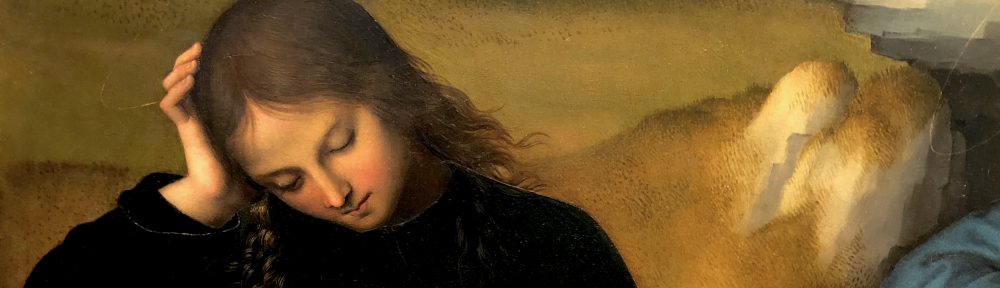
The light we may not see: Thoughts on dust and transfiguration

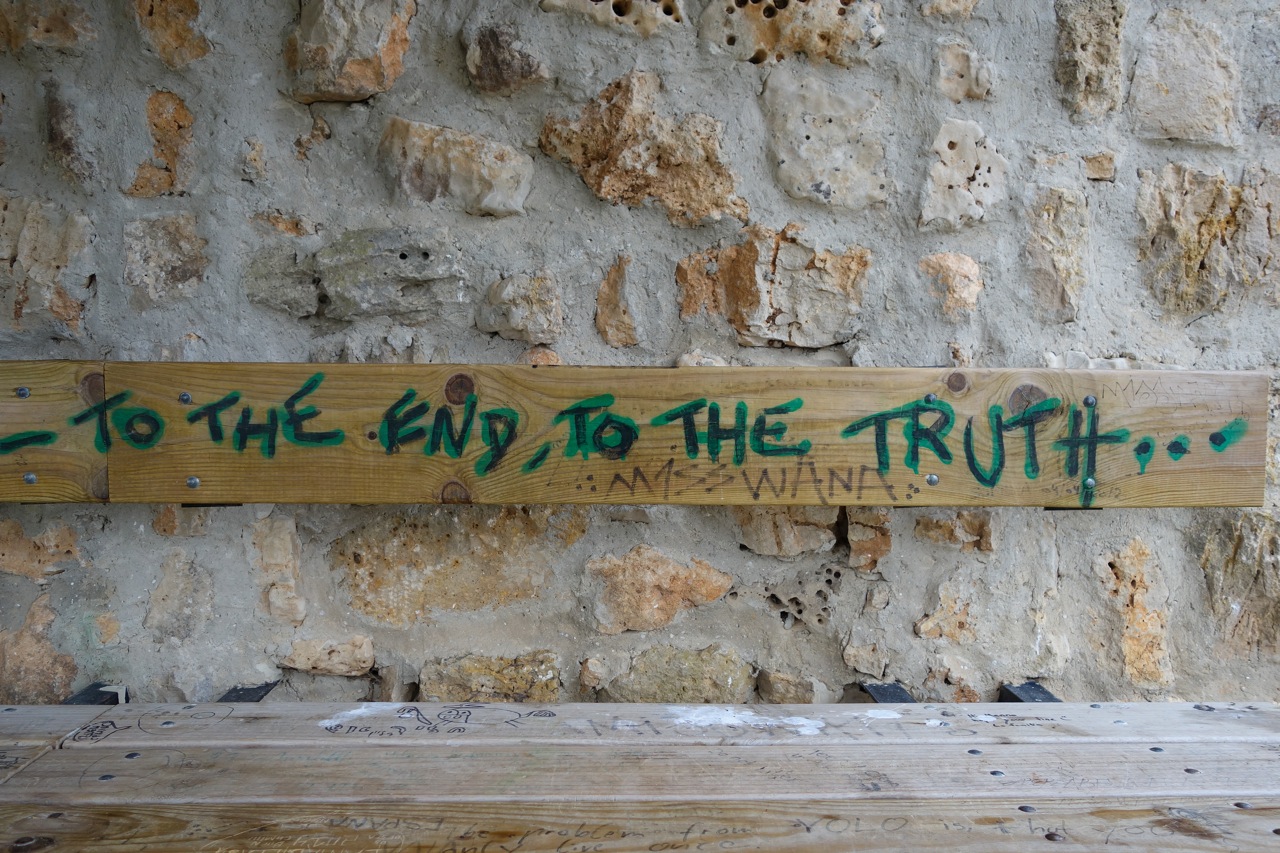
"Beauty": Olafur Eliasson (1993)

“Beauty”: Olafur Eliasson (1993)

Tomorrow is Candlemas, celebrating the presentation of the baby Jesus in the Jerusalem temple. In liturgical tradition it is the final feast day in the sequential narrative of Christ’s birth. A great procession of candles is its distinctive feature, but few churches observe this lovely ritual of light anymore. In the United States, the second day of February is better known for a groundhog and his shadow.

An old English carol, “Candlemas Eve,” describes the practice of replacing the Christmas greens in homes to bring the midwinter celebrations to a close:

Down with the rosemary and bay,
Down with the mistletoe,
Instead of holly now up-raise
The greener box for show.

The final verse will resonate with anyone who feels a little wistful when they take down the Christmas decorations.

Thus times do shift, thus times do shift,
Each thing its time doth hold;
New things succeed, new things succeed,
As former things grow old.

You can hear Kate Rusby’s lovely rendition of the carol here.

After Candlemas, the season of Incarnation is not quite done. In next Sunday’s Epiphany finale, the lectionary readings will see it out with a blaze of glory. In complementary stories from the two Testaments, the divine is made brilliantly manifest in a sensory manner. On the summit of Mt. Sinai, Moses enters the “cloud of unknowing” to speak with God. And at the top of Galilee’s Mt. Tabor, Jesus’ own divinity is seen to shine with a visible brilliance in his “Transfiguration.”

In a course I teach on “Jesus and the Movies,” one of the questions we consider is how both the divinity and the humanity of Jesus are represented cinematically. Is it something the actor shows with his face or his body language? Is it an action he performs, or the way he is lit, or a certain music cue played whenever his divinity comes to the fore? An affectionate conversation with his mother, a flash of irritation, or a playful water fight with his disciples at a village well show him as recognizably human. Miraculous power and a commanding presence suggest the divine, though it is often the lighting, the music, and the reactions of others – in other words, acts of interpretation rather than disinterested observation – which make this clear.

The ecumenical councils of the early church struggled for centuries with how to avoid emphasizing either the humanity or the divinity of Jesus at the expense of the other. The fifth-century formulation of “fully human and fully divine” did not exactly settle the question. It continues to be a paradox – a “possible impossible” – which rightly resists comfortable appropriation. It is especially difficult when there is so little consensus about the nature of either humanity or divinity. God is largely unthinkable for secular culture, and the last hundred years have confused and darkened our understanding of humanity. How then can we even state the paradox when we have lost the language for both of its terms?

From its very beginning, Christianity has had to wrestle with a disturbing question: If God is the power and the beauty and the glory, how can a disgraced, disfigured, and crucified human bear any resemblance to the divine? I like Reinhold Niebuhr’s approach. Instead of figuring out how to explain “Jesus is God,” better to say that “God is like Jesus.” Once God owns the vulnerability and the suffering of self-diffusing love, fully divine and fully human start to look much more alike.

But what about the way Jesus shines in his Transfiguration? Doesn’t that indicate the presence of something utterly “other” at work in Jesus, transcending the strictly human? I have written elsewhere about the symbolic dimensions of this strange story. Whatever the facts behind the text, it seems to ring true both psychologically and spiritually. Even if, as the gospels tell us, the divinity of Jesus was always in him, not everyone saw it, and no one saw it all the time.

The Transfiguration isn’t just a story about Jesus. It is a sign of the light desiring to break forth from within each of us. Contemplation isn’t a spectator sport. It demands participation. The Epistle reading for Last Epiphany insists that the divine light is not just something we may see, but something that we are also made to reflect:

All of us, with our unveiled faces like mirrors reflecting the glory of the Lord, are being transformed into the image that we reflect in brighter and brighter glory. (II Cor. 3:18)

St. Paul’s metaphor was inspired by the story of Moses descending the slopes of Mt. Sinai after being in God’s presence. As Exodus relates, “Moses did not know that the skin of his face shone because he had been talking with God.” (Exodus 34:29) I love this detail. Moses shone with God’s reflected light, but he didn’t know it. Yet it would be quite evident to his friends when he returned to them. Let your light so shine.

We ourselves have been made to receive divine light, to partake of it, to shine and dazzle with its holy beauty, until our own bodies become “the luminous seeds of resurrection planted amid the blind sufferings of history.”[i]

Robert Bresson, the French film director, shunned professional actors. He hated what actors usually do in films, which is to explain their characters and link their actions to understandable motivations, thus denying the elusive mystery of being human, a mystery whose secret is ultimately beyond us. “The important thing, said Bresson, “is not what they show me, but what they hide from me, and above all what they do not know is in them.”[ii] Claude Laydu, the protagonist in Diary of a Country Priest, said that he did not realize he was playing a saint until he saw the finished film.

In nine days many of us will kneel to be anointed with ashes. We will be told to remember that we are dust. But after that we will undertake the long journey to Easter in the faith that our dust is mixed with a Light which we ourselves may not yet see or even know.


Related posts

The Woven Light: Reflections on the Transfiguration

Ten questions to ask about your own picture of Jesus

Delightful! Wonderful! Incomparable!


[i] Although I can’t find the source for this quote, I believe it comes from Olivier Clement, an Orthodox theologian in France.

[ii] Quoted in Keith Reader, Robert Bresson (Manchester and New York: Manchester University Press, 2000), p. 5, n. 12.

Ten questions to ask about your own picture of Jesus

"I was a teenage Jesus" - Jeffrey Hunter as Jesus in Nicholas Ray's King of Kings (1961)

“I was a teenage Jesus” – Jeffrey Hunter as Jesus in Nicholas Ray’s King of Kings (1961)

Are you the Expected One, or should we look for someone else? (Matthew 11:3)

Who do you say that I am? (Mark 8:29)

I’m teaching a course this month on “Jesus and the Movies” at the Graduate Theological Union in Berkeley, California. We are examining nineteen feature films on Jesus, made between 1912 and 2014, through the lenses of biblical criticism, Christology, film theory, and cultural contexts.

But we are also considering our own personal perspectives on the protagonist of “the greatest story ever told.” What influences have shaped our own image(s) of Jesus? How do we picture Jesus? What do we expect him to do? How do we expect him to be? How is our understanding of Jesus enlarged, challenged, confirmed, contradicted or disappointed by what we see on the screen?

Robert Powell, whose portrayal of Jesus in Franco Zefferelli’s Jesus of Nazareth (1977) was generally well received by the public, said some years later that “No one can play Jesus. Not really.” And many critics have agreed. The casting of boyish teen heartthrob Jeffrey Hunter (who was actually 33 when he played the part) elicited sneers of “I Was a Teenage Jesus.” Max von Sydow, praised by some for restoring virility to the role, was ripped by others for “an aphorism-spouting, Confucius-say edge to his speech, an overtone of pomposity.” Jesus Christ Superstar’s Ted Neely was dismissed as “a droopy little fellow with sad eyes and long hair, followed by nondescript young people without any particular place to go.” And Willem Dafoe’s troubled and uncertain Jesus caused NPR’s Tom Shales to say that “this Jesus wonders, wonders, wonders who — who wrote the book of love?”

My take on the subject is that no actor has to be the Jesus, and that no single film needs to be definitive. They only need to show us the “old, old story” in some fresh way, to reveal some dimension we might otherwise have missed. But any claim to have finally gotten it “right” would be idolatry. As Rowan Williams has noted:

If you think representation is copying or reproducing, quite clearly, there is no way you can do this as a religious believer. Not even if you think you are reproducing what Jesus looked like when he was on earth. If on the other hand you think ‘I need to find some kind of vehicle which will put me in touch with the action that underlies and sustains these events’, then of course you won’t necessarily look for a realistic picture… No, you don’t want to represent just the human facts, nor do you want to take refuge in abstract representations … you are put in touch with something, but you mustn’t think it’s a copy.[i]

So the actors and filmmakers are freed of the burden of factual replication. They merely have to put us in touch with that certain something contained in the Jesus story. And in provoking our own responses, both positive and negative, they make us reexamine the nature and history of our own images and ideas for Jesus.

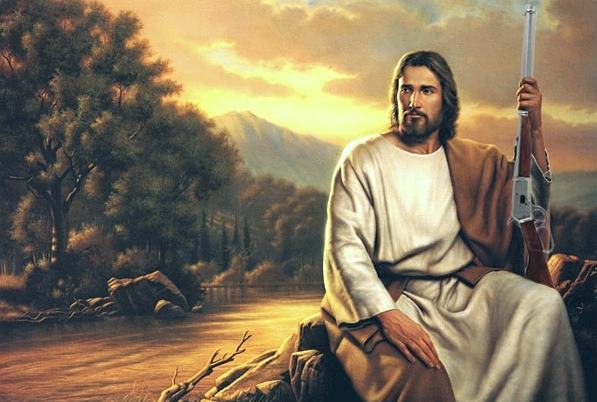
From the Internet, definitely a "not-Jesus".

From the Internet, definitely a “not-Jesus.”

That being said, here are ten preliminary questions to consider when Jesus asks the big one: “Who do you say that I am?”

  1. Where did your first images of Jesus come from? Have any of those become obsolete?
  2. What later images, experiences, and understandings caused those first images to grow, develop, change?
  3. What are your criteria for authenticity? Scripture, theological presuppositions, historical probability, psychological plausibility, inner experience, worship, moral resonance, etc.?
  4. Then vs. Now: Is Jesus only in the past, or can we encounter him in the present? Can faith communities receive information about Jesus that adds to the picture (as in the Fourth Gospel or the Book of Revelation)? Can individuals, such as Julian of Norwich in her visions of the Passion, be shown “new” things about the Jesus story? Can a painter, or a filmmaker, show us something new about Jesus? How can such new insights. assertions, or revelations be tested?
  5. Is historical investigation enough to reach the “real” Jesus? Is faith enough? Or do they shape and influence each other?
  6. What is the role of art, including film, in showing us Jesus? Can different images/actors/styles add to our understanding and experience of Jesus? What are the criteria that affect our receptivity?
  7. If a particular movie Jesus or scene doesn’t fit our own ideas. images, or understandings, do we reject it entirely, or do we engage with it, let its difference be a way to explore and test our presuppositions? Do we say, “That’s not Jesus,” and move on? Or do we wrestle till dawn with that stranger to see whether it might bless us?
  8. All language is difference: this is not that. Can even the not-Jesuses help define who Jesus is?
  9. Ontological Christology vs. functional Christology (being vs. doing): Do the identity of Jesus, and the authenticity of his representations, lie in who he is: a person in whom both human and divine are perfectly integrated (and then manifested in personality, charisma, appearance, and the way he feels to us)? Or does it lie in what he does, what he says, and how the story goes, regardless of our affective responses to his manner of being?
  10. If a particular representation of Jesus makes you uncomfortable, can that be a good thing?


Related Posts

The Ten Best Jesus Movies

My 10 Favorite Jesus Movie Moments


[i] “Faith and Image,” a conversation between Rowan Williams and Neil MacGregor, Art and Christianity 75 (Autumn 2013), 3

Feast of the Epiphany: The worst time of year for such a journey

Along the Camino de Santiago, April 2014

Along the Camino de Santiago, April 2014

It is not commended to stand ‘gazing up into heaven’ too long; not on Christ himself ascending, much less on his star. For [the Magi] sat not still gazing on the star. Their vidimus begat venimus; their seeing made them come, come a great journey.

— Lancelot Andrewes, sermon for Christmas Day, 1622[i]

When T. S. Eliot wrote his great Epiphany poem, “Journey of the Magi,”[ii] he borrowed freely from a Nativity sermon preached in 1622 by the English bishop, Lancelot Andrewes:

A cold coming they had of it at this time of the year, just the worst time of the year to take a journey, and specially a long journey. The ways deep, the weather sharp, the days short, the sun farthest off, in solstitio brumali, ‘the very dead of winter.’

Andrewes, who oversaw the translation of the King James Bible, had a gift for elegantly expressive language, and Eliot altered the original only slightly to make the first lines of his poem:

‘A cold coming we had of it,
Just the worst time of the year
For a journey, and such a long journey:
The ways deep and the weather sharp,
The very dead of winter.’

The liturgical and theological focus of today’s Feast of the Epiphany is the universal reach of the Light of the World. The three Magi, coming from faraway places to do homage to the Christ Child, signify that whatever was revealed in Bethlehem was not confined to a single culture, language, or tradition. The babe in the manger would ultimately spark recognition in every longing heart.

But Eliot’s particular focus is on the psychology and spirituality of the Magi themselves, or at least the one whose voice speaks the poem. He recites the complaints common to pilgrims: bad roads, bad weather, bad food, unpleasant companions, inhospitable strangers, and the homesick yearning for one’s own bed. He wonders whether the journey might be ‘all folly.’

The bleak desert crossing resounds with haunting echoes of The Waste Land, heightening the relief we feel when the traveler finally comes to “a temperate valley … smelling of vegetation.” But instead of the sweet, unblemished beatitude of a Nativity scene, the Magus is baffled by a series of disparate sights whose meanings are still in the future: vine branches, empty wine-skins, pieces of silver, three trees on a hill, the pale horse of the Apocalypse.

As for the actual moment of arrival, of seeing the long-sought Epiphany, it is described with the utmost reticence, as though words must fail before such a mystery:

… it was (you may say) satisfactory.

Then what? The Magi go back home, to the world they knew,

But no longer at ease here, in the old dispensation,
With an alien people clutching their gods.

Whatever Bethlehem had shown them, nothing in their lives would ever, could ever, be the same. This holy Birth had also brought a kind of death: the ‘old dispensation,’ whatever the Magi had settled for up to now, could no longer stand. The world of the past – erring, broken, lost, in love with the wrong thing – was being swept away. Behold, I make all things new.

In Andrewes’ 1622 sermon, he played nicely upon the Latin verbs for having seen (vidimus) and having come (venimus). What the Magi saw made them come. ‘Their vidimus begat venimus.’ But in our own day, says the preacher, we are apt to hold ourselves back, and resist the journey of transformation:

And we, what should we have done? Sure these men of the East will rise in judgment against the men of the West, that is with us, and their faith against ours in this point. . . . Our fashion is to see and see again before we stir a foot, specially if it be to the worship of Christ. Come such a journey at such a time? No; but fairly have put it off to the spring of the year, till the days longer, and the ways fairer, and the weather warmer, till better travelling to Christ. Our Epiphany would sure have fallen in Easter week at the soonest.

I am well acquainted with such spiritual procrastination. It is a practice not so easy to shed. We do prefer our comfort zones. Or as Andrewes put it, ‘We love to make no great haste.’

And yet, despite our best evasions, there may come a time when we find ourselves on a strange and arduous journey into that Place where everything is changed. Whether we choose the journey, or the journey chooses us, doesn’t really matter. In either case, once we have encountered the Epiphany, we will be ‘no longer at ease here, in the old dispensation.’

And then what?

[i] Andrewes’ complete sermon may be found here.

[ii] “Journey of the Magi,” T. S. Eliot: Collected Poems 1909-1962 (London: Faber and Faber, Ltd., 1974), 99

“God isn’t fixing this”

Advent installation by Jim Friedrich at St. John's Episcopal Church, Los Angeles (1977)

Advent installation by Jim Friedrich at St. John’s Episcopal Church, Los Angeles (1977)

O come, O come Emmanuel,
and ransom captive Israel.

Once upon a time, worshippers entered their church on the Second Sunday of Advent to find a great wall between themselves and the sanctuary. The beautiful mosaics, the richly colored marble walls, and the magnificent carved Christ above the high altar were all hidden from view by this strange iconostasis, made from front pages of the Los Angeles Times. Instead of the images of holy men and women that adorn a traditional altar screen, there were banner headlines screaming catastrophe and mayhem.

When the assembly was seated, a mime came up the aisle to stand before the wall, searching for some way through it. His movements and gestures indicated perplexity, frustration, and finally discouragement. Then a voice from beyond the wall cried out,

Jerusalem, turn your eyes to the east,
see the joy that is coming to you from God. (Baruch 4:36).

Responding to the voice, the mime tore a small hole in the wall, and peeked through. He seemed entranced by what he saw.

The voice continued:

Take off the garment of your sorrow and affliction, O Jerusalem,
and put on forever the beauty of God’s glory. (Baruch 5:1)

The mime began to tear down the wall, encouraging others to join him. One by one, people rose from their pews to rip down the veil “of sorrow and affliction,” until the beauty of God’s sanctuary was finally revealed.

This simple but powerful ritual, the prelude to a eucharist I curated forty years ago at St. John’s Episcopal Church in Los Angeles, comes to mind whenever I hear that passage from Baruch in the December lectionary. It’s what we pray for each Advent from our place on this side of the wall: Good Lord, deliver us. Stir up your power. Tear down the wall between us. Show us your glory.

That wall of headlines reflected my ongoing interest in connecting Advent themes with the news of the world. The WTO protests in Seattle (1999) and the Occupy Movement (2011) both coincided nicely with Advent, mirroring its prophetic themes of judging the present order with the hope and vision of something better.[i] And just last week, the front page of the New York Daily News supplied a marvelous Advent provocation. By noon, it had 11 million Facebook views, and 74,000 shares.

New York Daily News, 12/3/15

New York Daily News, 12/3/15

The headline was a sharp rebuke to the shameless politicians who promise prayers for the victims of gun violence while refusing to do anything about the guns. Calling them “cowards who could truly end gun scourge” but instead “hide behind pious platitudes,” the newspaper offered a blunt theological assertion: “God isn’t fixing this.”[ii]

The daily office Old Testament readings for early Advent, calling the world to account for its evils, say much the same thing. To those who refuse to “renounce the dictates of our own wicked hearts,”[iii] the prophets imagine God declaring, “You made your own bed. Now lie in it.” (Thankfully, the prophets always redeem their rants in the end with comforting decrees of mercy and salvation).

However, the Lieutenant Governor of Texas was not comfortable with the Daily News’ riff on the old biblical idea that God sometimes gets fed up with human folly. His photoshopped revision was posted on Facebook and Twitter.

God hears our prayers

Of course this clueless retort (note the unfortunate juxtaposition of the headline with the red banner above it) did not actually answer the question of whether – or how – God acts in the world to “fix” things. It was just a clumsy attempt by a presumed gun lover to change the subject. Platitudes about prayer in the abstract are safe because they have no consequences, unlike real prayer, which always implicates the petitioner in a process of change and action. If we pray for an end to gun violence, we obligate ourselves to do all in our power to reduce it. Prayer is a call for action; it politicizes what we pray for. Prayer is not simply leaving things up to God. It is an act of volunteering to be part of God’s solution.

But is there such a thing as God’s solution? Does God – can God – fix things? It is not a question with a clear and simple answer. Human freedom has thrown a monkey wrench into the story of the world, while God has surrendered absolute control of the narrative. If we make a mess of things, God is not an indulgent parent rushing in to cover for us. We don’t get to multiply our weapons and then wonder why God allows so much violence.

So where does that leave us? In the Advent section of his Christmas Oratorio,[iv] W. H. Auden describes a closed-in, godless world where hope is absent.

Alone, alone about a dreadful wood
Of conscious evil runs a lost mankind …
The Pilgrim Way has led to the abyss.

But what if we are not alone? What if there is a God who can make the abyss into a way? What if an unexpected future is breaking through the walls of our self-made prison? The Advent message is to embrace this hope, as we take off the garments of sorrow and affliction to welcome the God of joy into our midst.

Whatever the “solution” (salvation) may be in the tangled histories of the world and the soul, it is a long-term, sometimes excruciating, process, requiring honest engagement with the consequences of human sin in acts of confession, repentance, reconciliation, justice, healing, sacrifice, and transformation. And I submit that these are not simply things we do with God, as though God were only a helper from the outside. They are things we do in God, or God does in us, as our own intentions and actions become the embodiment – the incarnation – of divine purpose.

So yes, I believe that God is fixing the world, but not in the short run. And not without us.


[i] I preached on both these events at the time, with mixed results. Some were not so ready to find traces of God in social movements which trouble the powers-that-be. One church subsequently banned me from its pulpit for being too “partisan.” Guilty as charged.

[ii] New York Daily News, December 3, 2015.

[iii] Baruch 2:8

[iv] W. H. Auden, For the Time Being: A Christmas Oratorio, in Collected Poems, ed. Edward Mendelson (New York: Random House, 1976), 273

After Paris and Beirut, what kind of story shall we tell?

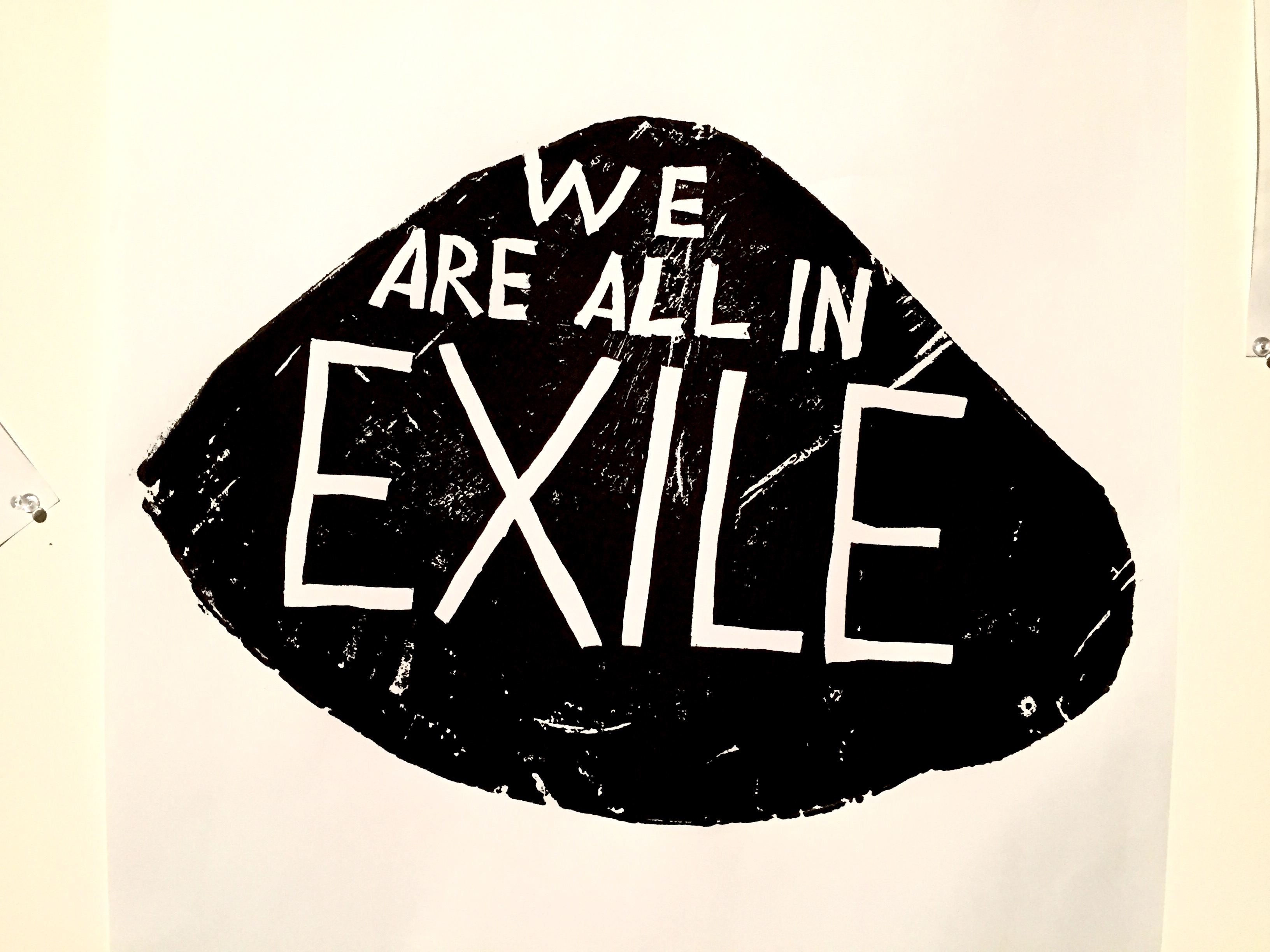
Barthelemy Toguo, wood stamp from tree trunk, Venice Biennale 2015

Barthelemy Toguo, wood stamp from tree trunk, Venice Biennale 2015

We played the pipes for you,
and you wouldn’t dance,
we sang dirges,
and you wouldn’t cry. (Luke 7:32)

This was, as Jesus observed, the perennial cry of the poor children in the marketplace, playing their instruments for the crowd, hoping for a handout. Every street performer could relate to this description of an unresponsive audience, but Jesus wasn’t using the image to address their plight. Instead, he was characterizing his critics as childish in their contradictory complaints about the prophets in their midst. They whined that John the Baptist was too austere and antisocial, but they didn’t like Jesus’ partying with sinners any better.

The failure of others to respond appropriately to the tunes we play for them could also describe the incredible discord among competing versions of reality in these days of terrorist violence. The actions of those living in alternative realities to our own seem inexplicable, and our often clueless responses to those actions fail to produce the intended results. We pipe, but they don’t dance. We bomb, but they don’t submit. We reason, but they won’t be persuaded.

In a long and unsettling article in The Atlantic last March, Graeme Wood diagnosed ISIS as a “dystopian alternate reality” grounded in an apocalyptic worldview. According to Wood, the western violent response to the Islamic State not only feeds their medieval narrative of Crusaders versus Muslims, it is the longed-for fulfillment of millenarian prophecy. In the Syrian farmland around the city of Dabiq, the armies of Islam will face down the armies of “Rome” (the West). This decisive battle will inaugurate the End of Days, resolving all the tribulations of history into a final triumph of God’s people.

In this narrative, the escalation of American military involvement would not be a deterrent, but an incentive. As Wood put it: “During fighting in Iraq in December [2014], after mujahideen (perhaps inaccurately) reported having seen American soldiers in battle, Islamic State Twitter accounts erupted in spasms of pleasure, like overenthusiastic hosts or hostesses upon the arrival of the first guests at a party.”[i]

If Wood is correct, then ISIS is operating from premises which we would dismiss as senseless and fantastic. But then what do we make of a recent poll on religion and politics, where1000 American adults were asked, “Do you think that the end of the world, as predicted in the Book of Revelation, will happen?”[ii] The results suggest that alternate realities are not exclusive to other cultures:

Yes, in my lifetime (13%)
Yes, but not in my lifetime (39%)
No (25%)
Not sure (22%)

I’m not sure what “not sure” means in this case, but I’m guessing some of those folks are at least conceding the possibility. In any case, more than half of those surveyed embraced the literal fulfillment of a highly metaphorical text with its problematic mixture of sacred violence and sublimely consoling imagery.

When they said “yes” to Revelation, did they mean verse 21:4? God will wipe every tear from their eyes. Death will be no more; mourning and crying will be no more. Or were they thinking of 11:18? The time has come to destroy those who are destroying the earth.

 Who knows? Polls on religious belief are misleading because they cannot measure ambiguity and nuance, nor do they distinguish between proposition and practice. Religion is not just what people say; it is what they do. And the correlation between the two is not always clear. If 52% of Americans believe that Revelation is predictive of human history, does that make us more or less likely to choose war as the means to “erase ISIS from the face of the earth?”[iii]

There is no consensus about the human story. The world is full of alternate realities. Sometimes we choose which story we want to live inside of. Sometimes the story chooses us. ISIS is living a story which seems crazy and evil, easily rejected by the majority of humanity who live outside it. But a consensus on competing narratives is harder to achieve when we consider our own national life.

The argument about Syrian immigrants is a perfect example. More than half of the state governors in America want to shut the door on them, while the President, speaking for many others, says that is not who we are as a people. Who is right? It depends on which story you are living inside of. Just in time for our national celebration of the Pilgrim immigrants, we get to choose between xenophobia and the Statue of Liberty. Of course my own framing of this debate tells you which story I live in.

My alternate reality, the story which I have chosen and which has chosen me, begins at the eucharistic table, where everyone is welcome, forgiveness is shared, no one goes hungry, and love is the costly gift. I may falter in my daily embodiment of that story, but I have no desire to belong to any other.

After 9/11, Americans had to choose what kind of story we wanted to live in. Many of our choices proved disastrous and toxic, but there were some who chose a better story, a better way. One of the finest articulations of that better way was a manifesto written by the Catholic Worker of Los Angeles in September, 2011. In the wake of Paris and Beirut, its eloquent faith still resonates:

Even after all this…

Our grief will not be short-circuited with cries of vengeance nor with acts of retribution. We will not cooperate with incitements to become that which we most oppose, namely perpetrators of violence.

We will honor the deeper levels of grief, acknowledging the woundedness inflicted upon us, and the woundedness that our nation has inflicted upon others…

We invite you to participate with us in all our wildest dreams and visions for peace. For now we sadly know that our affluence, our power, our possessions cannot serve as protection from harm. We invite you to clamber off the wheel of violence. It is the only worthy legacy we can offer to those who have died…

We are Catholic Workers and we still believe… the only solution is love.


[i] Graeme Wood, “What ISIS Really Wants,” The Atlantic (March 2015): http://www.theatlantic.com/magazine/archive/2015/03/what-isis-really-wants/384980/

[ii] YouGov/Huffington Post poll conducted Nov. 10-11, 2015. In the same poll, 42% said the earth was created in 6 days, but only 4% believed the pyramids were used for grain silos! https://today.yougov.com/news/2015/11/11/poll-results-bible-politics/

[iii] The quote is from a liberal politician I admire who is not an advocate for war. His use of the phrase suggests a rather apocalyptic consensus about the goal if not the means.


“Show me a coin” – A stewardship reflection

Roman coin with the head of the emperor Tiberius. The inscription may contain a claim of divinity.

Roman coin with the head of the emperor Tiberius. The inscription may contain a claim of divinity.

When the temple clergy in Jerusalem sent their stooges to ask Jesus a loaded question, they thought they had him cornered: Should we pay taxes to Caesar or not? If Jesus endorsed the Roman tax, he’d lose the crowd. If he encouraged nonpayment, he’d lose his freedom. His famous answer, of course, outsmarted his opponents and postponed his arrest for a few precious days.

“Show me a coin,” he said. One of them dug into his pockets and pulled out a coin, stamped with the image of the Roman emperor. “Whose picture is on it?” They all looked at the coin, straight men headed for a fall. “Caesar,” they said. Duh! “Well then,” Jesus said. “Give to Caesar the things that are Caesar’s, and to God the things that are God’s.”

We always smile at the Teacher’s wit. I like to think that Jesus pocketed the coin with a wink before walking away. But when the amusement fades, we are left with a puzzle. What does this saying mean for us? Is it a teaching, or even a commandment? What are we being asked to do with the money in our own pockets? The colorful Southern theologian Will Campbell, himself a country preacher, once said to me that if we give to God what belongs to God, there won’t be anything left for Caesar!

I loved what Will said – it had his characteristic prophetic edge – but it didn’t really solve the practicalities of being faithful to God while sharing in the costs and benefits of a complex economy. Most of us are not among the brave few who refuse participation by taxation in the military-industrial complex. We send in our check and accept our complicity in the mixed blessings of the system, which does provide for much common good along with its regrettably baneful effects (drones, for instance).

It’s like Monty Python’s Life of Brian, where a dissident complains, “The Romans took everything from us, and what have they ever given us in return?” His followers, to his chagrin, come up with a long list of benefits, including the aqueducts, sanitation, roads, irrigation, education, public baths, and even the absence of war in the Pax Romana.

While we live in this world, Jesus’ aphorism on taxes will never be an “answer” in the sense of an unambiguous guide for specific action. Instead, it persists as a question that interrogates every individual as well as every system. What does belong to God, exactly? And how then do we return to God what is God’s own?

Pooling our resources through taxation in order to educate our children, feed the hungry, protect the environment, provide universal health care and so on, might be regarded as one form of return, to which we subscribe as citizens with varying degrees of enthusiasm. Common good requires common action. Pooling our resources through church pledging to sustain a community of faith and grow God’s mission to the world is a less messy and more direct form of “giving to God what belongs to God.” Charitable giving is yet another kind of return.

This is how we live as citizens of heaven: we keep the gifts moving – in circulation – rather than hoard them for ourselves.

And did you notice that in this gospel story of the coin the notion of “belonging to” refers only to God or Caesar? We ourselves own nothing. We are but recipients and stewards. The only thing that really belongs to us, Jesus says, is the giving.

The Woven Light: Reflections on the Transfiguration

James Turrell, Arrowhead (2009)

James Turrell, Arrowhead (2009)

We would have thrown our clothes away for lightness,
But that even they, though sour and travel stained,
Seemed, like our flesh, made of immortal substance.
And the soiled flax and wool lay light upon us.
Like friendly wonders, flower and flock entwined
As in a morning field. Was it a vision?
Or did we see that day the unseeable
One glory of the everlasting world
Perpetually at work, though never seen
Since Eden locked the gate that’s everywhere
And nowhere?…

– Edwin Muir, “The Transfiguration”

Martin Scorcese’s 1988 film, The Last Temptation of Christ,” was criticized by many for its eccentric portrayal of a Jesus deeply conflicted by the fierce struggle between his two natures. As one reviewer wondered, “Is he God or is he nuts?” Scorcese, who specializes in tormented, confused male characters full of nervous intensity, defended his approach as an attempt to explore Christ’s humanity without the blinding glow of divine self-assurance that made many movie Jesuses seem stiff, complacent and unreal.

“What we were taught in Catholic schools emphasized the divine side of Jesus,” said Scorcese, who had considered priesthood in his adolescence. “Jesus would walk into the room and you would know he was God. Maybe he glowed in the dark or something, I don’t know, but this is the impression they gave us as children.”

The Jesus of Matthew, Mark and Luke does not glow, except in that strange moment called the Transfiguration, celebrated on August 6th in the liturgical calendar. This feast day goes largely unnoticed now in the western churches, who have essentially transferred it to the last Sunday of Epiphany. This neglect of August 6 is in part a concession to the decline of weekday celebrations, but it may also reflect a discomfort with the story itself, which feels like myth or vision rather than actual history. Not even the risen Christ matched the glow of the Transfiguration. What are we being asked to believe here?

We can never know the phenomenon behind the reported perceptions by Peter, James and John. But the symbolic dimensions of the narrative are clear, linking the incident to the ancestral epiphanies of Moses and Elijah. There is a mountain, where earth below meets heaven above. There is a cloud of unknowing, veiling divine presence in hiddenness and mystery. And there is a voice, making contact with human sense, rupturing the boundary between holy and profane to affirm the unique filial status of Jesus as God’s Beloved “Son.”

But what about that “dazzling” glow? What did the disciples actually see in Jesus on that mountain? Was it an unrepeatable moment, a temporary endowment bestowed upon Jesus to make a point to doubting disciples, or was it something Jesus always possessed?

Gregory of Palamas, a 14th century Orthodox theologian, argued the latter. He based his influential meditation practice of Hesychasm on contemplation of the “uncreated light” first seen at the Transfiguration. This light, he taught, was not an ephemeral experience of the senses but the unmediated presence of God. Although this holy light could be seen through physical eyes, it was not a natural light. It was, in fact, the uncreated energies of the Godhead, the splendor of the age to come, a light shining from God’s future into the present moment.

Christ is transfigured, not by putting on some quality he did not possess previously, nor by changing into something he never was before, but by revealing to his disciples what he truly was, in opening their eyes and in giving sight to those who were blind. For while remaining identical to what he had been before, he appeared to the disciples in his splendor; he is indeed the true light, the radiance of glory.[i]

Whatever we make of Gregory’s metaphysical claims, which were disputed by many of his contemporaries, the spiritual resonance of light is undeniable and universal. It is always seems to be about something more than physics. It seems inevitably imbued with Spirit.

Annie Dillard describes “mornings, when light spreads over the pastures like wings, and fans a secret color into everything, and beats the trees senseless with beauty…Outside it is bright…It is the one glare of holiness; it is bare and unspeakable. There is no speech or language; there is nothing, no one thing, nor motion nor time. There is only this everything.”[ii]

Where does such light come from? Is it something that happens to our eyes but is not really in the world, or is it somehow there, in the heart of things, “born of the one light Eden saw play?” Is it not just a simulacrum of divinity, but a direct manifestation?

James Turrell, Breathing Light (2013)

James Turrell, Breathing Light (2013)

James Turrell, one of the most celebrated of the contemporary “Light and Space” artists nurtured under California skies, has been exploring light and its effects since the 1960s. His mesmerizing spaces invite participants to experience not objects made visible by light, but light itself in an astonishing repertoire of varying colors and brightness. If there are walls, they seem to dissolve into the immateriality of radiance. If there is a ceiling, it may have a large opening inviting us to contemplate the luminous canopy of sky. “Light,” says Turrell, “is not so much something that reveals as it is itself the revelation.”

We eat light, drink it in through our skins. With a little more exposure to light, you feel part of things physically. I like the power of light and space physically because then you can order it materially. Seeing is a very sensuous act – there’s a sweet deliciousness to feeling yourself see something.[iii]

For many of us fortunate to have savored the deliciousness of Turrell’s light spaces, feeling ourselves see something is not just an intellectual or psychological act. It is spiritual – the “glare of holiness … beating us senseless with beauty.”

Turrell’s own Quaker tradition says that prayerful attention is “going inside to greet the light.” But is the radiance of divine beauty just in our souls, or does it permeate the universe? Does it show itself to us here, there and everywhere, as it did to Peter, James and John?

David Bentley Hart, an Orthodox theologian, proposes creation as a manifestation of God’s infinite luminosity, what he calls “the agile radiance of the Spirit.”[iv] We see this radiance not by looking away from the world, but by looking more deeply into it. But when the light is in eclipse, what then? “Sometimes,” says Bruce Cockburn, “you have to kick the darkness till it bleeds daylight.” Even at the Transfiguration, according to an Anglican midrash by a seventeenth-century bishop, Moses and Elijah felt impelled to warn Jesus about the suffering and darkness awaiting him once he descended the mountain:

A strange opportunity … when his face shone like the sun, to tell him it must be blubbered and spat upon;… and whilst he was Transfigured on the Mount, to tell him how he must be Disfigured on the Cross![v]

The poet Kathleen Raine perfectly describes the utter bleakness when “the curtain is down, the veil drawn” over the world’s deep radiance. “Nothing means or is,” she says.[vi]

Yet I saw once
The woven light of which all these are made
Otherwise than this. To have seen
Is to know always.

[i] St. Gregory Palamas, The Triads, in Richard Harries, Art and the Beauty of God: A Christian Understanding (London: Mowbray, 1993), 85

[ii] Annie Dillard, Holy the Firm (New York: Harper Perennial, 1998), 67-8

[iii] q. in Michael Govan, “Inner Light: The Radical Reality of James Turrell”, James Turrell: A Retrospective (New York: DelMonico Books, 2014), 13

[iv] The Beauty of the Infinite: The Aesthetics of Christian Truth (David Bentley Hart, Eerdmans 2003), 292

[v] Joseph Hall, Contemplations upon the principal passages of the Old and New Testaments, 1612-28, found on Google Books, p. 383

[vi] Kathleen Raine, in Harries, 87

But now I see

Window in Hereford Cathedral for Anglican visionary Thomas Traherne (Tom Denny, 2007)

Window in Hereford Cathedral for Anglican visionary Thomas Traherne (Tom Denny, 2007)

President Obama began his eloquent and moving eulogy for the Rev. Clementa Pinckney with a New Testament reference: “The Bible calls us to hope. To persevere, and have faith in things not seen … We are here to remember a man of God who lived by faith. A man who believed in things not seen.”[i]

According to physicists, 95% of the known universe is hidden from human observation. In reviewing a recent book on the subject of invisibility, Kathryn Schulz writes that the “whole realm of the visible is governed by the invisible … we can see a fragment of the what of things, but nothing at all of the why. Gravity, electricity, magnetism, economic forces, the processes that sustain life as well as those that eventually end it – all this is invisible. We cannot even see the most important parts of our own selves: our thoughts, feelings, personalities, psyches, morals, minds, souls.” Her conclusion sounds a note of causality which Aquinas would have admired: “Our planet, our solar system, our galaxy, our universe: all of it, all of us, are pushed, pulled, spun, shifted, set in motion, and held together by what we cannot see.”[ii]

Most of that invisibility is an inherent property of the unseen, but to that imperceptibility we human beings contribute our own forms of blindness. Some of that blindness is benign and adaptive, as we protect ourselves from sensory overload by only seeing what is necessary or unusual. But we also suffer moral blindness, closing our eyes to things we would rather not see, many of which the President boldly named in his oration.

“For too long,” he said, “we’ve been blind to the way past injustices continue to shape the present.” Blind about poverty, blind about racism, blind about our criminal justice system, blind about the unconscious impulse “to call Johnny back for a job interview but not Jamal.” As the congregation took up the cry – for too long! – he added, “For too long, we’ve been blind to the unique mayhem that gun violence inflicts upon this nation. Sporadically, our eyes are open: When eight of our brothers and sisters are cut down in a church basement, 12 in a movie theater, 26 in an elementary school. But I hope we also see the 30 precious lives cut short by gun violence in this country every single day; the countless more whose lives are forever changed — the survivors crippled, the children traumatized and fearful every day as they walk to school, the husband who will never feel his wife’s warm touch, the entire communities whose grief overflows every time they have to watch what happened to them happen to some other place.”

But it wasn’t just evil which became visible in Charleston. We also saw an answering goodness. As the philosopher Alfred North Whitehead insisted, “The kingdom of heaven is not the isolation of good from evil. It is the overcoming of evil by good.” When evil occurs, it is “met with a novel consequent as to issue in the restoration of goodness.”[iii] This novel consequent has taken many forms in recent days, most dramatically in the costly expressions of forgiveness by those so cruelly bereaved. It was not what the world expected to see.

“Oh, but God works in mysterious ways,” the President reminded us. “God has different ideas … Blinded by hatred, the alleged killer could not see the grace surrounding Reverend Pinckney and that Bible study group — the light of love that shone as they opened the church doors and invited a stranger to join in their prayer circle. The alleged killer could have never anticipated the way the families of the fallen would respond when they saw him in court — in the midst of unspeakable grief, with words of forgiveness. He couldn’t imagine that.”[iv]

Inspiring words, received by an inspired congregation. If we ever wonder whether church is worth the bother, do we need more evidence than Charleston? The radical forgiveness and faith we have witnessed there are not accidental. They have been uniquely forged and nurtured over time within a community of biblical witness, shared practice and common language. Church is where God’s friends do the collective work, generation after generation, to preserve and evolve the repertoire of faith in our stories, our praises and our actions.

Without church, we wouldn’t know how to name – or sing – “amazing grace.” We would lack the eyes – and the language – for “things unseen.” Without church, the President could never deploy Scripture with such resonance, or begin to sing a beloved hymn in the assurance that he would not have to finish it alone.

[i] Hebrews 11:1

[ii] Kathryn Schulz, “Sight Unseen: The Hows and Whys of Invisibility,” The New Yorker, April 13, 2015, 75-79

[iii] Alfred North Whitehead, Religion in the Making (New York: Fordham Press, 1996), 155

[iv] The full text of President Obama’s eulogy for the Rev. Clementa Pinckney on June 26, 2015, is widely available on the Internet.

Three things you should know about the Trinity (Part 2)

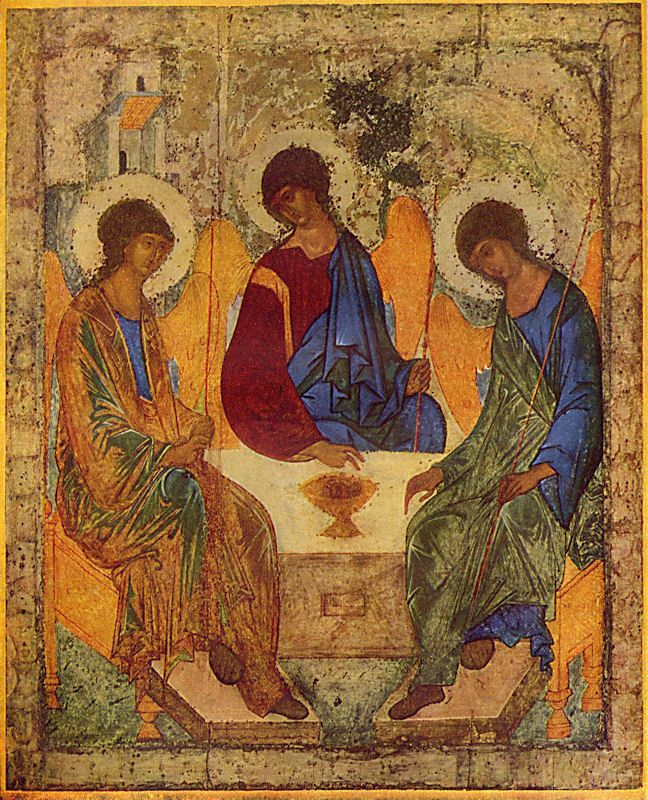
Andrei Rublev, The Holy Trinity (1425)

Andrei Rublev, The Holy Trinity (1425)

Trinitarian doctrine, like other key Christian doctrines, was hammered out, not in sterile study, but rather in the midst of lived spirituality, prayer, and the worship life of the church.[i]

                                                                        – Veli-Matti Kärkkäinen

The Trinity has to do with the lives of each of us, our daily experiences, our struggles to follow our conscience, our love and our joy, our bearing the sufferings of the world and the tragedies of human existence; it also has to do with the struggle against social injustice, with efforts at building a more human form of society, with the sacrifices and martyrdom that these endeavors so often bring. If we fail to include the Trinity in our personal and social odyssey, we shall have failed to show the saving mystery[ii]

– Leonardo Boff

Part 2: You can’t make this stuff up

Early in the twelfth century, a German monk named Rupert of Deutz went into a church where mass was being said by a white-haired bishop. At the offertory procession he experienced a vision of the Holy Trinity:

On the right at the edge of the altar stood three persons of such revered bearing and dignity that no tongue could describe them. Two were quite old, that is, with very white hair; the third was a beautiful youth of royal dignity …[iii]

A century later, Hadewijch of Antwerp, one of those remarkable women mystics who flourished in the late middle ages, also had a vision of the Trinity. But instead of three white males, what she saw was a dark whirlpool, which she described as “divine fruition in its hidden storms.” Hovering over this whirlpool was a spinning disc, on which sat a figure wearing the countenance of God – the face of God – on whose breast were written the words, “The Most Loved of All Beloveds.”

We may find Hadewijch’s vision more congenial: it is genderless, and less crudely specific than Rupert’s. And the tempestuous whirlpool, a flood of energy ceaselessly flowing through the universe, conveys a dynamic image of divinity that resembles the postmodern cosmologies of process theology and quantum physics. It’s probably easier for most of us to believe in a divine whirlpool than in three white guys.

But the crucial difference between Rupert and Hadewijch is not in the relative resonance of their imagery, but rather in what happens next. Rupert remains an observer, one who stands apart and sees God as an object. But Hadewijch does not remain separate from what she sees:

Then I saw myself received in union by the One who sat there in the whirlpool upon the circling disc, and there I became one with him in the certainty of union… In that depth I saw myself swallowed up. Then I received the certainty of being received, in this form, in my Beloved, and my Beloved also in me.

Rupert’s knowledge of God remained conceptual. Hadewijch’s knowledge of God became experiential. She was gathered into the circulating current of divinity. She became part of its flow, and that divine flow became part of her.

The language she uses for this experience is not mathematical or philosophical. Her language is the language of the heart. She describes being “swallowed up… in my Beloved, and my Beloved also in me.”[iv] Love, she discovered, is the way the soul knows. Love is the way the soul sees.

I begin this reflection with a mystic’s personal testimony because Trinitarian theology was not forged by inventive theorists, but by faithful Christians trying to make sense of the concrete, experiential data of salvation, beginning with the biblical narrative and continuing in the ongoing history of believing communities. Based on our collective and personal experience of being “saved” (or, if you prefer: healed, forgiven, reborn, renewed, resurrected, empowered), what can we say about the God who has done this? Trinitarian reflection began within an ancient community deeply grounded in the monotheism of Judaism, which had, over the centuries, found ultimate reality to be not a plurality of disconnected or contradictory energies but a coherent unity. But once the early Christians began to attribute divinity to both Jesus and the Holy Spirit, a simple self-contained oneness was no longer sufficient to describe the Reality.

Without losing the unity of God, how could they account for the divine diversity revealed in the saving activities of Christ and the Spirit? Once they began to call Jesus “Lord” (Kyrios), which happened very early in their worship and their storytelling, traditional monotheism was radically destabilized. The growing perception of the Holy Spirit as a guiding and empowering presence of deity in their communities only compounded the problem.

There were various attempts to solve the problem by downgrading Jesus and Spirit to subordinate, derivative, or semi-divine realities, by no means equal to the eternal and uncreated God. Such “heresies” were popular with those who wanted to keep God simple. But “orthodoxy” was unwilling to deny the fullness of divinity to either Christ or the Spirit. Only God can save us. Christ and Spirit, in the biblical revelation and Christian experience, are integral and essential to salvation. Therefore, they must be equally integral to the Holy One who is the Creator and Redeemer of all things.

The question wasn’t only metaphysical (What is the relation between the one and the many or the finite and the infinite?) or logical (How can One be Three and Three be One?). Trinitarian reflection was also a deep engagement with the question of suffering. If God incarnate in Christ chose to share the human condition, to live and die as one of us, does that mean that vulnerability and suffering have become part of God’s own history? And if these human elements have been added to the divine life through specific temporal events, has time itself disturbed the perfect calm of eternity? If God has been affected and changed by events in time and history, what can we then say about the consistency and transcendence of the divine nature? How can God be decisively linked to the history of the world without losing freedom or transcendence? Can a changeless God weep? Can we be saved by a God without weapons?

In his comprehensive survey of contemporary Trinitarian thought, Veli-Matti Kärkkäinen argues that “the assumption of humanity by God, the Son, means that human capacity to suffer is not foreign to the being of God. How else could one speak of God as love? … It is more biblical to think of God as passionate love, the Father who chooses to engage the suffering of the world, than as a Transcendent One whose separation from the world’s suffering guards his freedom.”[v] Robert Jenson, a foremost North American authority on the Trinity, rejects the notion of divine detachment from creation in dramatically succinct terms: “God … is what happens with Jesus… God is what will come of Jesus and us, together.”[vi]

The problems and paradoxes that arise from such far-reaching assertions have been debated and puzzled over throughout Christian history, and the recent profusion of Trinitarian theology has become an incredibly rich conversation. There is, of course, no final version of God awaiting discovery, no definitive outcome to all this reflection, only an endless attentiveness to the Mystery which may consent to dance with language, but always outruns it in the end.

So why presume to talk about the Trinity at all? Why can’t we simply say and think and pray to “God” and leave it at that? We can’t do that because Christians don’t belong to a theoretical God, a reasonable and logical divine construct worked up by professional philosophers. We belong to the self-revealing but complicated God of the Bible who has, in the form and activity of Christ and the Holy Spirit, rescued us from our own folly and gathered us into the communion that is the very life of God. And no matter what diverse strategies of insight and understanding we may employ, what we can actually say about the Trinity is always grounded in experience, both the experience of our ancestors encoded in Scripture and tradition and the contemporary revelations of communal and personal life.

Trinitarian thought isn’t made out of thin air or abstract speculation. It is produced and nourished by the concrete, tangible history of Christian experience. However each day manifests for us “the means of grace” and “the hope of glory,” whatever the myriad ways by which we love and serve and witness, we need the threefold name to account for the diversity of God’s relations with us. Anything less would impoverish our prayer and considerably reduce the scope of our attention.

For most theologians, our experience of God as threefold also reflects a Trinitarian life within God’s own self. Since God’s inner life is beyond our sight, this can only be an assumption. But it is a crucial one. If God is trustworthy and self-revealing, it must be that when we meet God as Trinity, we get the real thing. God isn’t just pretending to be Three for us; God’s own inner life is constituted by relationality and communion.

Finally, how shall we address or invoke this Mystery, which a Japanese theologian intriguingly calls “Three Betweennesses in One Concord?”[vii] The traditional “Father, Son, and Holy Spirit,” despite its authoritative pedigree, is distractingly masculine for many, and various substitutes have arisen, each with their own impediments. “Creator, Redeemer, Sanctifier,” for example, is a bit impersonal, and risks reducing the three Persons to job descriptions. Likewise, “Source, Word, Spirit,” “Creator, Liberator, Comforter,” “Parent, Child, Paraclete,” “Mother, Daughter, Spirit,” and “Mother, Lover, Friend” all have their particular assets and liabilities. My own current preference, since I suspect that God is more verb than noun, is “Love who loves us[viii], Word who saves us, Spirit who revives us.”

I leave the last word to 16th century reformer Philip Melanchthon, who said, “We adore the mysteries of the Godhead. That is better than to investigate them.”[ix]

[This is the second of three reflections on the Trinity. The first, on the essential relationality of God, may be found here.]

[i] Veli-Matti Kärkkäinen, The Trinity: Global Perspectives (Louisville: Westminster John Knox Press, 2007), 35

[ii] ibid., xv-xvi

[iii] Bernard McGinn, The Growth of Mysticism: Gregory the Great Through the 12th Century (New York: The Crossroad Publishing Company, 1994), 330

[iv] ibid., The Flowering of Mysticism (New York: The Crossroad Publishing Company, 1998), 212-16

[v] Veli-Matti Kärkkäinen, 99

[vi] Robert W. Jenson, The Triune Identity: God According to the Gospel (Philadelphia: Fortress Press, 1982), 22-3

[vii] Nozumu Miyahira, in Kärkkäinen, 314

[viii] I take this resonant phrase from Terrence Malick’s transcendent film, To the Wonder.

[ix] Kärkkäinen, xvi

Cave of the Apocalypse

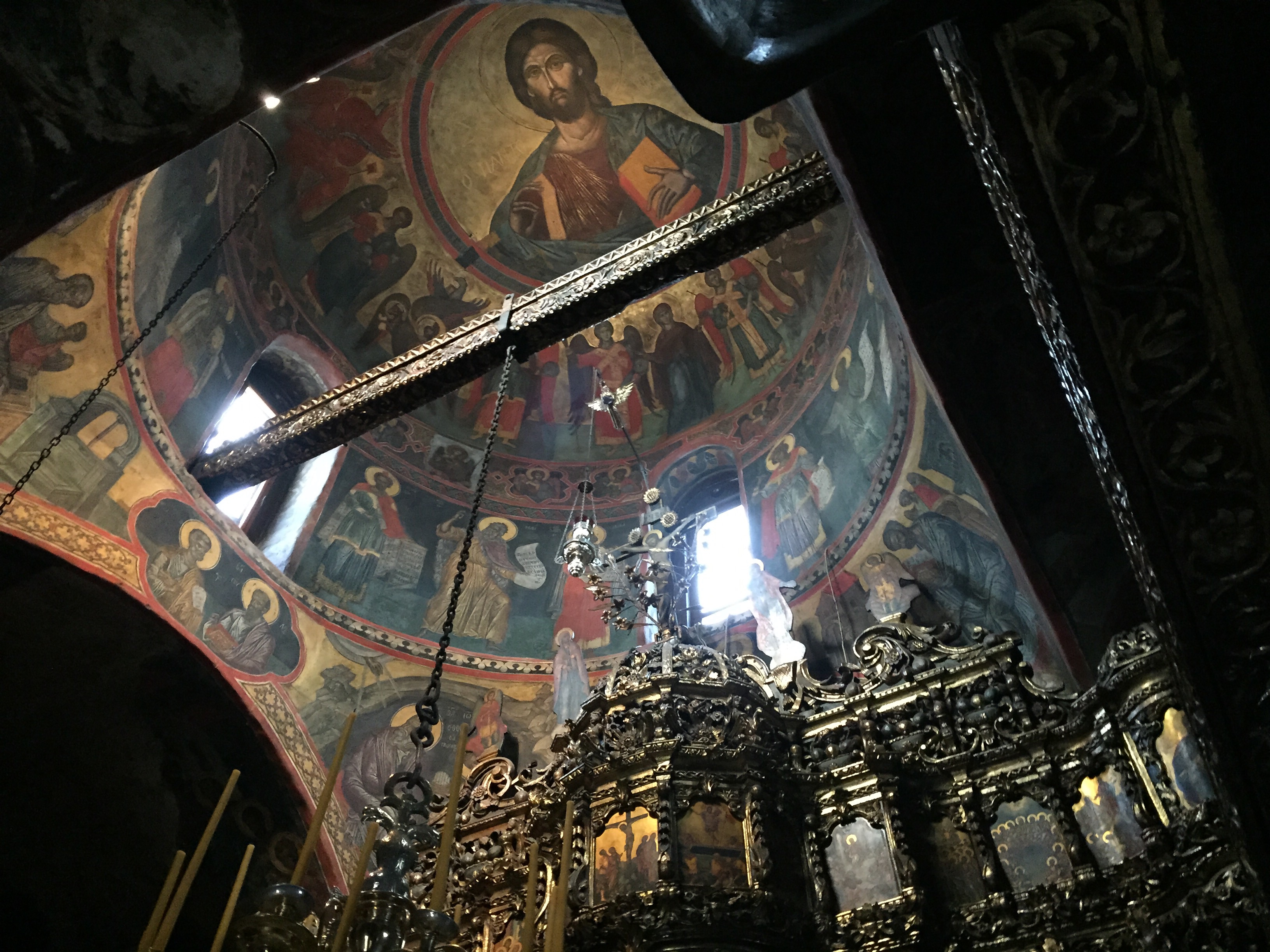
Katholikon of the Holy Monastery of St. John the Theologian

Katholikon of the Holy Monastery of St. John the Theologian


I, John … was on the island called Patmos because of the word of God and the testimony of Jesus. I was in the spirit on the Lord’s day, and I heard behind me a loud voice saying, ‘Write in a book what you see …’    (Rev. 1:9-11)

Patmos is one of the smaller Dodecanese Islands, a grueling 8-hour middle-of-the-night ferry ride east of Athens. It has gorgeous bays and quiet beaches, superb mountain views, charming villages and, at least not in summer’s high season, a tranquil predominance of locals over tourists. The outsiders I have met are themselves “regulars,” returning again and again because they love it. Yesterday a man from the Netherlands told me this was his 23rd straight year of month-long visits.

Patmos is also a place of pilgrimage, where St. John the Theologian (or “the Divine,” as we say in the western church), fell into a swoon and saw things which have intrigued, puzzled, disturbed and inspired readers ever since. The Book of Revelation has, regretfully, provided horrific weapons of mass destruction for hellfire preachers, but it is also the source for many sublime hymns and prayers in my own Anglican tradition.

Most scholars think that the book’s author is not the same person who wrote the Fourth Gospel. Language, style and themes are too different in the two works. But “tradition” has always preferred to link the Galilean fisherman “whom Jesus loved” with both the mystical composer of the Fourth Gospel and the visionary exiled to Patmos. It exemplifies the arc of discipleship as potentially a long, strange trip. As we sang in a hymn at my own ordination years ago, “the peace of God, it is no peace … Young John, who trimmed the flapping sail, homeless in Patmos died; Peter, who hauled the teeming net, headdown was crucified.”

So the Christian can’t come to Patmos and simply lie on the beach or relax in the taverna. The Holy Monastery of St. John the Theologian beckons from the high ridge above the  port. Its dark-hued fortress of lion-colored stone makes somber contrast with the whitewashed village around it, as if to say that the ascent of this hill is serious business.

The monastery rises above the village of Chora.

The monastery rises above the village of Chora.

If you rise early, you can experience the awesome richness of the monastery’s Katholikon (main church) in solitude. The brilliant wall paintings, recently cleaned, immerse you in holy images. Along with the intricately carved iconostasis, hanging oil lamps, and numerous icons, they effect a ceaseless engagement of the eye. Some might find this distracting for prayer, but for me the sense that there is always more than I can take in – the visual inexhaustibility of Orthodox interiors – can lead to a kind of surrender, overwhelming and transcending the subjectivity of my own thoughts and perceptions. Here is Mystery. Give over to it. Lose yourself in it.

The monastery museum holds an eclectic assortment of treasures, including a 6th century gospel book, a 1499 Venetian collection of Aristophanes’ comedies, a 6th century BC bust of Dionysus (god of wine and ecstasy), the largest Orthodox collection of 5th-6th century Coptic textiles, preserved by the dryness of Egyptian tombs, and a police blotter in Arabic from the late 15th century, when Byzantine territories had fallen under Muslim control (“The Cadi [Judge] of the Palace is ordered to find three Patmians who were kidnapped by pirates.”).

Below the monastery, halfway up the hill from the sea, is the Cave of the Apocalypse. Here, according to tradition, John lay on the stone floor for several days while the vision unfolded. The cave is not large, but the insertion of a wooden iconostasis into its contours, along with icons and hanging lamps, has made it a compelling place for worship, prayer and veneration. John’s private ecstasy has been reimagined through specific features of the cave. Here is the cleft from which the Voice spoke. Here is the corner when he laid his head to rest between revelations. Here are the fissures where the Trinitarian God divided the rock into three parts with an earthquake.

Literal belief in the details of the cave’s legends is not required to make the site holy. It is holy because centuries of believers have given a particular kind of attention here to a Reality which yearns to make itself known in the innermost heart, for which a sheltering, enclosing cave is a tangible, sensory analogy.

Another mystical theologian, St. Bonaventure, said, “When you pray, gather up your whole self, enter with your Beloved into the chamber of your heart, and there remain alone with your Beloved, forgetting all exterior concerns.” The Cave, for the attentive, can mirror the chamber of the heart.

I entered it three times during my week here. The first time was the Sunday liturgy, full of incense and chanting voices. It was beautiful, but I had no revelations, or even deep feelings. God was present, but I was a bit absent. I was tired from a long, sleepless ferry ride. And I knew that whatever the Cave offered was not a tourist experience you can just walk in and collect.

So I went back a few days later. The voices I heard then were those of tour guides. Most just reeled off the legends uncritically as if they were prosaic facts. Here this and that happened, blah blah blah, now let’s go back to the bus. But one guide, a Greek woman speaking both in English and German, really got into it.

“People think that the Book of Revelation is about judgment and punishment. That is there, of course, but by the time you get to Chapter 21, you find what it is really about: a new world, a new heaven, a new earth, where we will be with God, and God with us.

“John’s message is trying to wake us up, to make us see that we are all one because God is with us and in us. Our original condition of oneness will be restored in the end. We lost that unity in the beginning because we had free will, and we chose to have our own experience, and forgot our connection with one another.

“If a bomb falls on someone in Syria, we think, ‘Thank God that didn’t happen to me.’ But what happens to others happens to all of us. John is trying to wake us up to this. And when he talks about the destruction of the earth, we have to think about how much closer we ourselves are to bringing that about today, unless we remember what we were made for and what we are a part of.”

When I thanked her afterward for her ‘preaching,’ she said, “I want to tell people what they don’t know, what they don’t hear in the schools, what the priests won’t tell you.” She was pretty sour on the institutional church. “I was baptized Greek Orthodox. I believe in Christ and the power of the sacraments, but I don’t belong to any church. I’m kind of a revolutionary.” I asked her name. “Vera,” she said. “Like veritas– the truth.”

This morning, my last on Patmos, I returned to the Cave for a third time. Two cantors and a priest were chanting the Divine Liturgy. I was the only other person present. This time, the spirit of prayer came easily, like a morning breeze. I received no visions, heard no voices except the beautiful earthly ones I stood among. But it was more than enough. When the priest handed out the holy bread at the end, I was aware of my outsider status as non-Orthodox. But the priest, who had the face of a Baroque Apostle, turned to me with a slight nod. And so I ate the bread of heaven, and departed well satisfied.