Is holiness a Lenten obligation?

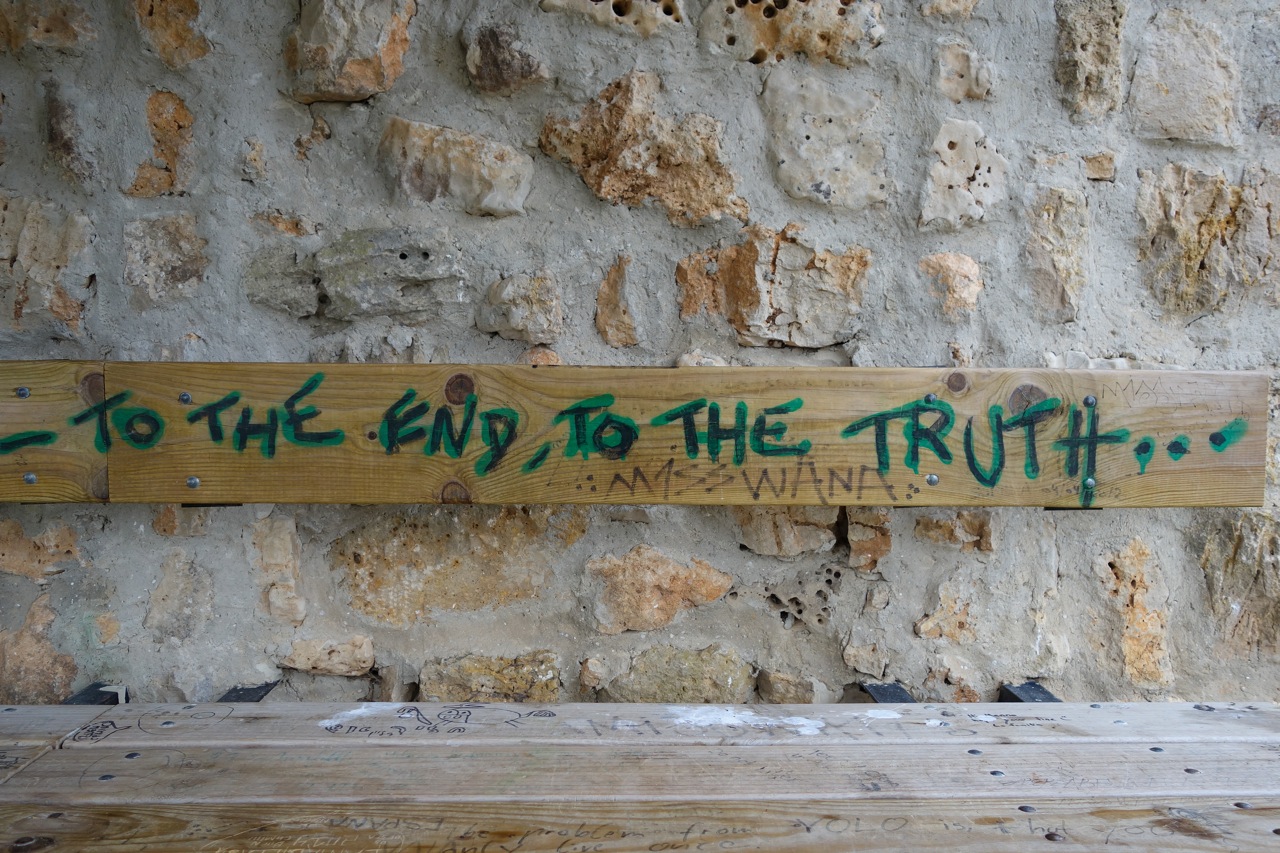
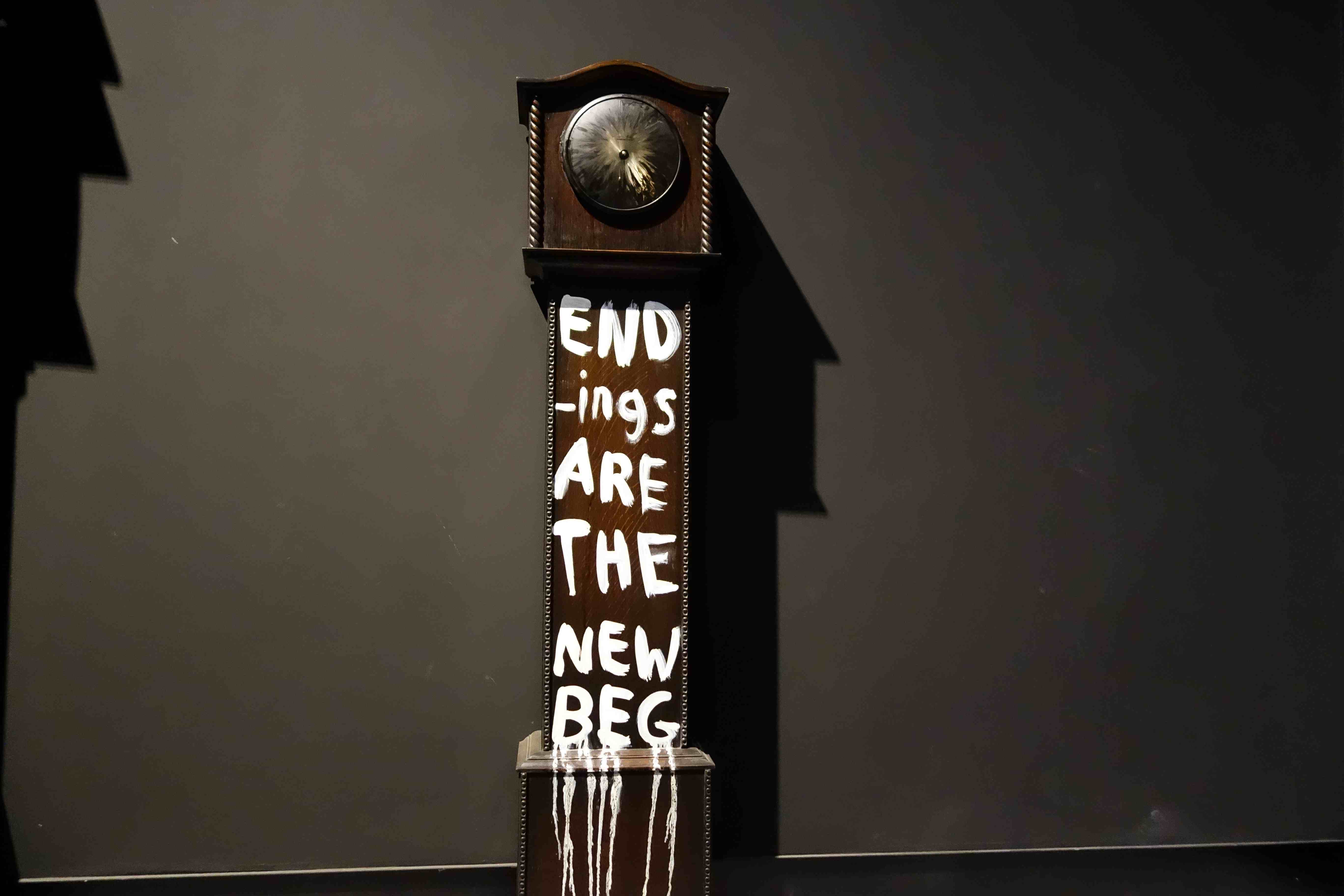
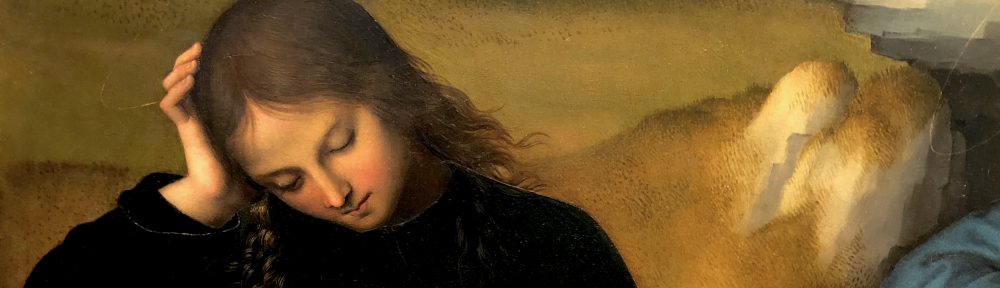
Bench carving, Cathedral of Seville, Spain

Bench carving, Cathedral of Seville, Spain

In the liturgical rite for Ash Wednesday, the priest stands up before the people and invites them “to the observance of a holy Lent.” It is a solemn and noble custom. But is it a serious proposal? And if so, what is actually being asked of the faithful?

When people hear the word “holy,” they often think “devout” or “virtuous,” but qodesh, the word for holiness in the Hebrew Bible, is not a moral or behavioral term. It means “apartness,” conveying an inherent, critical difference between what is holy and what is not.

The word itself is set apart. Unlike other divine attributes like power, justice and love, holiness has no analogue in the everyday life of Israel. It doesn’t refer to a common experience and then say God is like that. Instead, it evokes the one quality of God which is unlike anything we know.

In ancient Judaism, holiness meant the radical otherness of God, the Holy One. The divine presence is not to be approached easily or casually, either by our bodies or by our language. God dwells in a sacred zone which is highly charged, difficult and risky to enter.

Israel’s worship practices grew up around this strict sense of separation. At the center of cultic life was a holy of holies, a space set apart from contamination by the world. And only priests, who were themselves set apart and highly trained in the intricacies of access, were allowed to have contact with this sacred center. There was a sense that if the sphere of holiness were to be contaminated or carelessly regarded, the presence of the Holy One might withdraw from Israel, and that would be disastrous.

Leviticus, not a book I spend a lot of time with, contains a long section known as the Holiness Code because of its repeated use of holy and holiness, as well as related terms like sanctify, hallow, consecrate, dedicate, and sacred. It is filled with detailed prescriptions ranging from ritual practice to sexual behavior. Many of these seem archaic and largely inapplicable today. But may we still find something valid in the impulse to preserve the “holy” from profanation or inattention?

The sacred is made present by the attention we give to it. For example, if you come to a labyrinth occupying an open space, do you just walk straight across it, or do you go around it, acknowledging it as a space set apart for prayerful activity? Or does it only become holy space when it is put to its intended use, rather than just lying there as a decorative floor pattern?

I once led a weeklong family retreat for a Nevada parish on the eastern shore of Lake Tahoe. There was a beautiful stone church, with a large window looking across the water to the high peaks of the Sierra mountains. The space around the altar was large enough to hold all of us, so we did most of our worship there, in the intimacy of a circle.

I asked everyone to do two things each time they came inside the altar rails. One was to remove their shoes, like Moses at the Burning Bush. The other was to perform an action of their choice to mark their entrance into holy space: they could lift their hands in prayer, bow, genuflect, cross themselves, kiss the altar, or prostrate themselves on the floor. Most of the children, being the enthusiastically embodied creatures they are, opted for prostration! The effect of these physical observances was tangible. The attention we gave changed the quality of being there. It became for us holy ground.

But what Leviticus is after, and what a holy Lent is about, is more than the quality of a space or the attention we pay to it. Holiness is meant to be something contagious, something which gets inside us and changes us forever.

You shall be holy, for I your God am holy (Leviticus 19:2). God is not content to limit holiness to Godself. God’s people are invited to be holy as well. Not just our sanctuaries, but ourselves, are made to be set apart, consecrated, sanctified, hallowed. Biblical theologian Walter Brueggemann has called this the “obligation tradition,” where “the purpose of Israel’s life is to host the holiness of Yahweh.”[i]

As biblical people gradually figured out, hosting divine holiness means more than maintaining ritual purity or devotional piety. It means embodying justice and peace as well, uncontaminated by the dehumanizing, violent and oppressive practices of the dominant culture. Such holiness requires the consecration and dedication of every aspect of life to the will and purpose of God.

Leviticus 19:9-18 provides some excellent guidelines for our own time:

  • Don’t keep all your food for yourselves
  • Remember the poor and the immigrant
  • Don’t steal, lie, or defraud one another
  • Don’t exploit your workers
  • Be mindful of those with special needs
  • Be fair and just in your dealings with others
  • Don’t slander, seek revenge, or carry grudges
  • Love your neighbor as yourself

The nice thing about such a list is that these are all things we can do. They are not perfections only achievable in a messianic future. We can perform them right now. Jesus offered a similar list. Is somebody hungry? Feed them. Is anybody thirsty? Get them some water. And if curing the sick or setting the prisoner free seems beyond you, surely you can at least visit them. This is not impossible stuff.

Holiness, an attribute of God, becomes for us a practice.
Not something we are, but something we do.

Of course the specific obligations of holiness are not always clear. It is one thing to separate yourself by going to the desert, the monastery, or a countercultural refuge. It is quite another to live in contemporary society with its inevitable complicity in the evils by which the system maintains itself: militarism, consumerism, economic injustice and violence against the planet. How do we say no to the evil and yes to the good in a world of such complex interdependence?

And yet, Scripture remains insistent that we continue to strive for sanctification, dedicating our lives to God and separating ourselves from whatever is not of God.

  • God chose us in Christ to be holy and blameless, full of love (Ephesians 1:4)
  • Clothe yourselves with the new self, created according to the likeness of God in true righteousness and holiness (Ephesians 4:24)
  • Surrender your bodies to righteousness in order to create a holy life (Romans 6:19)

Surrender. Is this too much to ask? Is a holy life too much to ask? Does it set the bar so high that we just abandon the field to an elite corps of ethical heroes: the few, the proud, the saints?

Even worse, does a religion of obligation veer us toward “works righteousness,” overestimating our powers and denying the need for grace? Well, even Calvin admitted the possibility of making progress in personal goodness. He echoed the purity language of Leviticus when he wrote:

Ever since the Holy Spirit dedicated us as temples to the Lord, we should make it our endeavor to show forth the glory of God, and guard against being profaned by the defilement of sin. Ever since our soul and body were destined to heavenly incorruptibility and an unfading crown, we should earnestly strive to keep them pure and uncorrupted against the day of the Lord.[ii]

But where do we begin? Thomas Aquinas outlined three stages of holiness: First, distance yourself from sin and wrong inclinations (holiness as an act of separation, turning your back on sin and turning toward God). Second, work on cultivating the virtues in your life (holiness as a daily practice). Finally, rest in loving union with God (holiness as communion with the Holy One).

This triptych of holiness is echoed in my favorite collect in the service of Morning Prayer:

  • drive far from us all wrong desires (separation)
  • incline our hearts to keep your law, and guide our feet into the way of peace (practice)
  • that, having done your will with cheerfulness during the day, we may, when night comes, rejoice to give you thanks (communion)

Or to put this in the simplest terms:

  • What do I need to let go of?
  • What do I need to acquire and cultivate?
  • In whose reality do I want to dwell?

It’s not about effort, of course. Sola fide, sola gratia, soli Deo. Only faith, only grace, only God. As Augustine knew, “When God crowns our merits, God crowns nothing but God’s own gifts.”[iii]

And it’s never done, this holiness business. It’s an open-ended process of continual striving. Gregory of Nyssa said, “The perfection of human nature consists perhaps in its very growth in goodness.”[iv] In other words, holiness isn’t something we achieve, it’s a commitment to growth.

And as an old eucharistic prayer suggests, the time to start is now:

And here we offer and present unto thee, O Lord,
our selves, our souls and bodies,
to be a reasonable, holy, and living sacrifice unto thee.[v]

What if, every day during Lent, each of us were to make such a prayer?
Here I offer and present to you, O God, my ________.

Just fill in the blank with whatever the time and place requires.


Related posts

Grace me guide

Heart work and heaven work


[i] Walter Brueggemann, Theology of the Old Testament: Testimony, Dispute, Advocacy (Minneapolis: Fortress Press, 1997), 428

[ii] John Calvin, Institutes 3.6.3

[iii] Augustine, Epistle 154, 5.16

[iv] Gregory of Nyssa, Life of Moses 10

[v] Thomas Cranmer, Book of Common Prayer (1549), based on Romans 12:1, in the Episcopal Book of Common Prayer (1979), 336.

Ash Wednesday: A time for self-compassion


Alleluia ashes 2sm

There is a really deep well inside me. And in it dwells God. Sometimes I am there too. But more often stones and grit block the well, and God is buried beneath. Then he must be dug out again.

– Etty Hillesum[i]


Hillesum’s evocative image expresses the duality of the Lenten season. On the one hand, God is not the end product of spiritual attainment, something brought closer through our own efforts. The deep well of divinity is already present within us, “more intimate to me than I am to myself.”[ii] We don’t have to go somewhere else to find it. Lent is a time to tune in, go deep, and pay heightened attention to the Presence we often miss.

At the same time, our awareness of – and relationship with – this Presence may be hindered or obstructed by any number of things, requiring some real digging on our part. The trouble is, that digging can quickly become a self-improvement project, with Lent’s success judged by the quality and success of our efforts. We imagine a more spiritually heroic self, and strive to make it come true.

The ancient Desert Fathers and Mothers, who fled the corruption and distractions of their culture to seek a holier life in the wastelands beyond Empire, might seem at first glance to be overflowing with heroic aspiration. A typical regimen would be to “get up early every day and acquire the beginning of every virtue and commandment of God. Use great patience, with fear and long-suffering, in the love of God, with all the fervor of your soul and body. Exercise great humility, bear with interior distress, be vigilant and pray often with reverence and groaning, with purity of speech and control of your eyes… Do your work in peace. Persevere in keeping vigil, in hunger and thirst, cold and nakedness, and in sufferings.”[iii]

Such rigorous spiritual practice wasn’t for the halfhearted. But it risked the competitive sin of pride. Paul of Pherme, for instance, undertook the project of “continual prayer” – 300 prayers per day, keeping count with a pile of 300 pebbles in his lap. After each prayer, he tossed away one pebble. But he was crestfallen to learn of a certain woman who had been saying 700 prayers per day for thirty years! He would never catch up. Another desert father, Macarius the Alexandrian, warned Paul that his spiritual life lacked both balance and humility. But Macarius was no moderate. He once did penance for swatting a mosquito by moving to a swamp to endure six months of insect bites, without ever raising a hand in defense.[iv]

Thankfully, the extremists were not the norm. More prevalent was a spirit of deep humility about one’s capacities. John Climacus was a seventh-century monk at Mt. Sinai. His image of the spiritual life as a “Ladder of Divine Ascent” was later pictured in a famous twelfth-century icon.

Ladder of Divine Ascent, St. Catherine's Monastery, Mt. Sinai (12th century)

Ladder of Divine Ascent, St. Catherine’s Monastery, Mt. Sinai (12th century)

If you have ever climbed a very tall ladder, or done any rock-climbing, you know the degree of both effort and risk involved. John’s image makes it very clear that the spiritual life is strenuous and challenging. “We need to exercise ourselves greatly,” he wrote, “to lay upon ourselves many hidden labors after a life of negligence.” But then he said,

Be of good heart. If the passions lord it over us and we are weak, let us with great confidence offer to Christ our spiritual weakness and our impotence . . . He will help us irrespective of what we deserve, on the sole condition that we descend continually to the bottom, into the abyss of humility.[v]

So we don’t have to be heroes after all. What a relief! Humility, not heroism, is the way up the ladder. As the Rule of Saint Benedict teaches us, “by trying to climb we descend, and by humility we ascend.”[vi] That’s why Ash Wednesday strikes just the right note for the beginning of Lent. It brings us down to earth as creatures of ashes, dust and mud, undermining any pretensions of Promethean heroism. The Lenten journey is come-as-you-are.

Mary Oliver puts this perfectly: “You do not have to be good. / You do not have to walk on your knees / for a hundred miles through the desert, repenting. / You only have to let the soft animal of your body love what it loves.”[vii] Or as Simone Weil suggested, self-compassion means to “accept what one is, at a given moment, as a fact – even one’s shame.”

In the 1988 Winter Olympics, American speed skater Dan Jansen was favored in the 500 and 1000 meter events. On the morning of the 500 final, he learned his sister had just died from leukemia. His focus clearly elsewhere, he fell on the first turn of his race and never finished. He would also fall and fail in the 1000 meters. At the 1992 Olympics, he again failed to win the medals expected of him. The 1994 Oympics offered him one last chance, and he came to the line of the 500 meter race as the clear favorite, the only skater ever to break 36 seconds, which he had done four times. But after one slight slip on the ice, he finished out of the medals yet again.

Ash Wednesday came just after that race, and I reflected on Jansen’s story in my homily. Although Jansen would finally win a gold medal a few days later (in the one race where he was an underdog), it was his “failures” that resonated with people. After the liturgy, a therapist in the congregation told me that many of her clients that week had talked with her about Jansen’s story, and how much it moved them. If the world’s greatest skater could fall, then maybe it was all right for them to fall as well. You don’t have to be a hero, only yourself, letting the soft animal of your body love what it loves.

In his youth, the poet David Whyte was hiking in the Himalayas when he came to a deep chasm. The only way across was a rickety old rope bridge with many missing slats. Although he was a confident, experienced mountaineer, he suddenly froze at the prospect of traversing the abyss on so treacherous a path. He sat down on the ground and stared at the bridge for hours, unable to proceed. “There are times when the hero has to sit down,” he said later. “At some bridges in life the part of you that always gets it done has to sit down.” Then an old Tibetan woman came along, gathering yak dung for fuel. She walked with a limp. “Namaste,” she said with a smile. Then she turned and limped across the bridge. Immediately, without thinking, he rose up and followed. Sometimes, he realized, it is “the old interior angel,” the unheroic, limping, unequipped part of ourselves, that gets us to the other side.[viii]

Remember that you are dust, and no hero. Whether your Lent will be a time of giving up, going deep, or reaching out, may it always be done with a generous measure of self-compassion.

As Mary Gauthier sings so beautifully, we could all use a little mercy now.


Related posts

George Herbert: Heart work and heaven work

Solitude (Part 1)

Solitude (Part 2)


[i] Etty Hillesum, An Interrupted Life (New York: Henry Holt and Company, 1996), August 25, 1941 (two years before she died in Auschwitz)

[ii] St. Augustine, Confessions III.

[iii] The Apophthegmata (Sayings of the Desert Fathers), in William Harmless, S.J., Desert Christians: An Introduction to the Literature of Early Monasticism (Oxford and New York: Oxford University Press, 2004), 199-200

[iv] ibid., 288

[v] John Climacus, Ladder of Divine Ascent, 1st Step, 17, in Olivier Clement, The Roots of Christian Mysticism (New York: New City Press, 1993), 152

[vi] ibid., 156 (Rule of St. Benedict VII)

[vii] Mary Oliver, “Wild Geese,” New and Selected Poems (Boston: Beacon Press, 1992), 110

[viii] From a talk given by David Whyte in the 1990’s


The light we may not see: Thoughts on dust and transfiguration

"Beauty": Olafur Eliasson (1993)

“Beauty”: Olafur Eliasson (1993)

Tomorrow is Candlemas, celebrating the presentation of the baby Jesus in the Jerusalem temple. In liturgical tradition it is the final feast day in the sequential narrative of Christ’s birth. A great procession of candles is its distinctive feature, but few churches observe this lovely ritual of light anymore. In the United States, the second day of February is better known for a groundhog and his shadow.

An old English carol, “Candlemas Eve,” describes the practice of replacing the Christmas greens in homes to bring the midwinter celebrations to a close:

Down with the rosemary and bay,
Down with the mistletoe,
Instead of holly now up-raise
The greener box for show.

The final verse will resonate with anyone who feels a little wistful when they take down the Christmas decorations.

Thus times do shift, thus times do shift,
Each thing its time doth hold;
New things succeed, new things succeed,
As former things grow old.

You can hear Kate Rusby’s lovely rendition of the carol here.

After Candlemas, the season of Incarnation is not quite done. In next Sunday’s Epiphany finale, the lectionary readings will see it out with a blaze of glory. In complementary stories from the two Testaments, the divine is made brilliantly manifest in a sensory manner. On the summit of Mt. Sinai, Moses enters the “cloud of unknowing” to speak with God. And at the top of Galilee’s Mt. Tabor, Jesus’ own divinity is seen to shine with a visible brilliance in his “Transfiguration.”

In a course I teach on “Jesus and the Movies,” one of the questions we consider is how both the divinity and the humanity of Jesus are represented cinematically. Is it something the actor shows with his face or his body language? Is it an action he performs, or the way he is lit, or a certain music cue played whenever his divinity comes to the fore? An affectionate conversation with his mother, a flash of irritation, or a playful water fight with his disciples at a village well show him as recognizably human. Miraculous power and a commanding presence suggest the divine, though it is often the lighting, the music, and the reactions of others – in other words, acts of interpretation rather than disinterested observation – which make this clear.

The ecumenical councils of the early church struggled for centuries with how to avoid emphasizing either the humanity or the divinity of Jesus at the expense of the other. The fifth-century formulation of “fully human and fully divine” did not exactly settle the question. It continues to be a paradox – a “possible impossible” – which rightly resists comfortable appropriation. It is especially difficult when there is so little consensus about the nature of either humanity or divinity. God is largely unthinkable for secular culture, and the last hundred years have confused and darkened our understanding of humanity. How then can we even state the paradox when we have lost the language for both of its terms?

From its very beginning, Christianity has had to wrestle with a disturbing question: If God is the power and the beauty and the glory, how can a disgraced, disfigured, and crucified human bear any resemblance to the divine? I like Reinhold Niebuhr’s approach. Instead of figuring out how to explain “Jesus is God,” better to say that “God is like Jesus.” Once God owns the vulnerability and the suffering of self-diffusing love, fully divine and fully human start to look much more alike.

But what about the way Jesus shines in his Transfiguration? Doesn’t that indicate the presence of something utterly “other” at work in Jesus, transcending the strictly human? I have written elsewhere about the symbolic dimensions of this strange story. Whatever the facts behind the text, it seems to ring true both psychologically and spiritually. Even if, as the gospels tell us, the divinity of Jesus was always in him, not everyone saw it, and no one saw it all the time.

The Transfiguration isn’t just a story about Jesus. It is a sign of the light desiring to break forth from within each of us. Contemplation isn’t a spectator sport. It demands participation. The Epistle reading for Last Epiphany insists that the divine light is not just something we may see, but something that we are also made to reflect:

All of us, with our unveiled faces like mirrors reflecting the glory of the Lord, are being transformed into the image that we reflect in brighter and brighter glory. (II Cor. 3:18)

St. Paul’s metaphor was inspired by the story of Moses descending the slopes of Mt. Sinai after being in God’s presence. As Exodus relates, “Moses did not know that the skin of his face shone because he had been talking with God.” (Exodus 34:29) I love this detail. Moses shone with God’s reflected light, but he didn’t know it. Yet it would be quite evident to his friends when he returned to them. Let your light so shine.

We ourselves have been made to receive divine light, to partake of it, to shine and dazzle with its holy beauty, until our own bodies become “the luminous seeds of resurrection planted amid the blind sufferings of history.”[i]

Robert Bresson, the French film director, shunned professional actors. He hated what actors usually do in films, which is to explain their characters and link their actions to understandable motivations, thus denying the elusive mystery of being human, a mystery whose secret is ultimately beyond us. “The important thing, said Bresson, “is not what they show me, but what they hide from me, and above all what they do not know is in them.”[ii] Claude Laydu, the protagonist in Diary of a Country Priest, said that he did not realize he was playing a saint until he saw the finished film.

In nine days many of us will kneel to be anointed with ashes. We will be told to remember that we are dust. But after that we will undertake the long journey to Easter in the faith that our dust is mixed with a Light which we ourselves may not yet see or even know.


Related posts

The Woven Light: Reflections on the Transfiguration

Ten questions to ask about your own picture of Jesus

Delightful! Wonderful! Incomparable!


[i] Although I can’t find the source for this quote, I believe it comes from Olivier Clement, an Orthodox theologian in France.

[ii] Quoted in Keith Reader, Robert Bresson (Manchester and New York: Manchester University Press, 2000), p. 5, n. 12.

Feast of the Epiphany: The worst time of year for such a journey

Along the Camino de Santiago, April 2014

Along the Camino de Santiago, April 2014

It is not commended to stand ‘gazing up into heaven’ too long; not on Christ himself ascending, much less on his star. For [the Magi] sat not still gazing on the star. Their vidimus begat venimus; their seeing made them come, come a great journey.

— Lancelot Andrewes, sermon for Christmas Day, 1622[i]

When T. S. Eliot wrote his great Epiphany poem, “Journey of the Magi,”[ii] he borrowed freely from a Nativity sermon preached in 1622 by the English bishop, Lancelot Andrewes:

A cold coming they had of it at this time of the year, just the worst time of the year to take a journey, and specially a long journey. The ways deep, the weather sharp, the days short, the sun farthest off, in solstitio brumali, ‘the very dead of winter.’

Andrewes, who oversaw the translation of the King James Bible, had a gift for elegantly expressive language, and Eliot altered the original only slightly to make the first lines of his poem:

‘A cold coming we had of it,
Just the worst time of the year
For a journey, and such a long journey:
The ways deep and the weather sharp,
The very dead of winter.’

The liturgical and theological focus of today’s Feast of the Epiphany is the universal reach of the Light of the World. The three Magi, coming from faraway places to do homage to the Christ Child, signify that whatever was revealed in Bethlehem was not confined to a single culture, language, or tradition. The babe in the manger would ultimately spark recognition in every longing heart.

But Eliot’s particular focus is on the psychology and spirituality of the Magi themselves, or at least the one whose voice speaks the poem. He recites the complaints common to pilgrims: bad roads, bad weather, bad food, unpleasant companions, inhospitable strangers, and the homesick yearning for one’s own bed. He wonders whether the journey might be ‘all folly.’

The bleak desert crossing resounds with haunting echoes of The Waste Land, heightening the relief we feel when the traveler finally comes to “a temperate valley … smelling of vegetation.” But instead of the sweet, unblemished beatitude of a Nativity scene, the Magus is baffled by a series of disparate sights whose meanings are still in the future: vine branches, empty wine-skins, pieces of silver, three trees on a hill, the pale horse of the Apocalypse.

As for the actual moment of arrival, of seeing the long-sought Epiphany, it is described with the utmost reticence, as though words must fail before such a mystery:

… it was (you may say) satisfactory.

Then what? The Magi go back home, to the world they knew,

But no longer at ease here, in the old dispensation,
With an alien people clutching their gods.

Whatever Bethlehem had shown them, nothing in their lives would ever, could ever, be the same. This holy Birth had also brought a kind of death: the ‘old dispensation,’ whatever the Magi had settled for up to now, could no longer stand. The world of the past – erring, broken, lost, in love with the wrong thing – was being swept away. Behold, I make all things new.

In Andrewes’ 1622 sermon, he played nicely upon the Latin verbs for having seen (vidimus) and having come (venimus). What the Magi saw made them come. ‘Their vidimus begat venimus.’ But in our own day, says the preacher, we are apt to hold ourselves back, and resist the journey of transformation:

And we, what should we have done? Sure these men of the East will rise in judgment against the men of the West, that is with us, and their faith against ours in this point. . . . Our fashion is to see and see again before we stir a foot, specially if it be to the worship of Christ. Come such a journey at such a time? No; but fairly have put it off to the spring of the year, till the days longer, and the ways fairer, and the weather warmer, till better travelling to Christ. Our Epiphany would sure have fallen in Easter week at the soonest.

I am well acquainted with such spiritual procrastination. It is a practice not so easy to shed. We do prefer our comfort zones. Or as Andrewes put it, ‘We love to make no great haste.’

And yet, despite our best evasions, there may come a time when we find ourselves on a strange and arduous journey into that Place where everything is changed. Whether we choose the journey, or the journey chooses us, doesn’t really matter. In either case, once we have encountered the Epiphany, we will be ‘no longer at ease here, in the old dispensation.’

And then what?

[i] Andrewes’ complete sermon may be found here.

[ii] “Journey of the Magi,” T. S. Eliot: Collected Poems 1909-1962 (London: Faber and Faber, Ltd., 1974), 99

Tick Tock: Thoughts for New Year’s Eve

Fiona Hall installation, Australian pavilion, Venice Biennale 2015

Fiona Hall installation, Australian pavilion, Venice Biennale 2015

I lived like the Puri Indians, of whom it is said that “for yesterday, today, and tomorrow they have only one word, and they express the variety of meaning by pointing backward for yesterday, forward for tomorrow, and overhead for the passing day.”

— Henry David Thoreau

I’ve been on a calendar, but never on time.

— Marilyn Monroe


The Clock is a 24-hour video by Christian Marclay in which each and every minute of a day is represented in one or more scenes from old movies. The exact time of any particular minute is either spoken by a character, seen in a close-up of a clock or watch, or simply glimpsed on a clock or digital display in the background as the camera pans across a room or street. For some particularly notable minutes, such as high noon, The Clock might draw from five or six different films over the course of 60 seconds. For less significant minutes, sometimes only one scene was found by the team of researchers, who spent two years viewing thousands of films in search of lost time. And for a surprisingly small number of minutes in the wee hours of the morning, a generic “middle-of-the-night” scene had to be employed (often from film noir).

The video is run by a computer program which goes to whatever the local time is when “play” is pressed, so the work itself functions as a reliable timepiece. When I watched it, in one sitting, in the theater of the Los Angeles County Art Museum two years ago, it started at noon on Saturday and finished at noon the next day. It was a memorable and vastly entertaining journey. I was especially struck by the degree to which our lives are organized by the mechanized measurement of time. Sure, we all know that, but to see scene after scene of alarms going off, children heading for school, lunch breaks, quitting time, dinners served, and so on, made the point in a way that could be a little unsettling. How free are we, really?

For me, the most unique part of that marathon viewing experience was the act of consciously noticing every single minute of a 24-hour period (except when I dozed briefly a few times, plus three quick bathroom breaks, hoping I wouldn’t miss much). Now it’s noon, now it’s 12:01, now it’s 12:02 … I didn’t need an extraordinary degree of mindfulness. It was actually quite effortless to stay focused on the screen. The diversity of the selected scenes was the perfect stimulant. When I watched Andy Warhol’s 8-hour film of a man sleeping in the 1960s, my mind wandered far and wide during that interminable screening of sameness. But The Clock kept me watching by showing a great many things, not just one big thing. Curiosity alone was enough to keep me paying attention. What will the next minute contain?

New Year’s Eve is, for a brief time, like viewing Marclay’s video. Tonight, the majority of the human race will pay close attention, minute by minute, to the passing of time in the countdown of hours, minutes and seconds to 2016.

Of course, there is no universal Now when everyone will shout or kiss in unison. As Einstein taught us, what time it is depends on where in the universe you are standing. Whether anything is past, present, or future varies with the location of the observer. At our house, we will bang the drum, strike the wind gong, and blow the train whistle in synchronization with a reality already in the past: the ball drop 3 hours earlier in Times Square.

Even further back, in 1949, Einstein’s friend Kurt Godël offered a mathematical proof for time travel. If time has a spatial quality allowing us to move backward and forward in it, then time in the sense of irreversible passing does not exist. Past and future become places we can (theoretically) go. And if this is so, then we are close to the old theological image of all times being simultaneous to God. As William Blake put it,

I see the past, present, and future, existing all at once
Before me.

Be that as it may, who among us actually lives above time’s flow, as though there is neither past nor present nor future? Who does not feel, particularly at turnings, transitions, and departures, what Susan Sontag called “time’s relentless melt?” We live on the knife edge between old and new, memory and regret, loss and hope. When we dance tonight at midnight, may it prove just wide enough for our wild steps.

Would you have it any other way, this life of falling and rising, losing and finding? Virginia Woolf’s Orlando describes an alternative existence: the protagonist is free from the dictates of time, living on from century to century while everyone else is passing away. But not being wedded to any particular generation or era has a price. “Her loves are wild with passion, but seem to leave no trace, and by the novel’s end she is left occasionally wounded, but always without the pleasure of a scar.”[i]

It seems fitting that the world festival of the turning of time comes in the middle of the Twelve Days of Christmas, since the Incarnation is God’s decisive embrace of the temporal and finite, while extending – simultaneously – an invitation to us humans to embody in ourselves the divine kenosis – the eternal self-emptying that constitutes God’s trinitarian life. In other words, both human and divine are all about giving over and letting go. Never just being, but also becoming.

There is much more to be said about all this, but the sun is low in the sky, and it’s high time to prepare a welcome for the New Year, which I pray will be full of wonder, delight, illumination, and meaningful change for you, dear reader, and everyone you love.

In the meantime, I leave you with this lovely praise of temporality from D. H. Lawrence:

Life, the ever-present, knows no finality, no finished crystallization. The perfect rose is only a running flame, emerging and flowing off, and never in any sense at rest, static, finished. Herein lies its transcendent loveliness. The whole tide of all life and all time suddenly heaves, and appears before us as an apparition, a revelation…

Don’t give me the infinite or the eternal … Give me the still, white seething, the incandescence and the coldness of the incarnate moment: the moment, the quick of all change and haste and opposition: the moment, the immediate present, the now… Here, in this very instant moment, up bubbles the stream of time, out of the wells of futurity, flowing to the oceans of the past. The source, the issue, the creative quick….[ii]


Related post: The Angel of Possibility


[i] Colin Dickey, “Reelin’ in the Years”, Lapham’s Quarterly VII:4, Fall 2014, p. 221

[ii] ibid., 117 (from D. H. Lawrence, the preface to New Poems, 1920)

Brief prologue for the Nativity

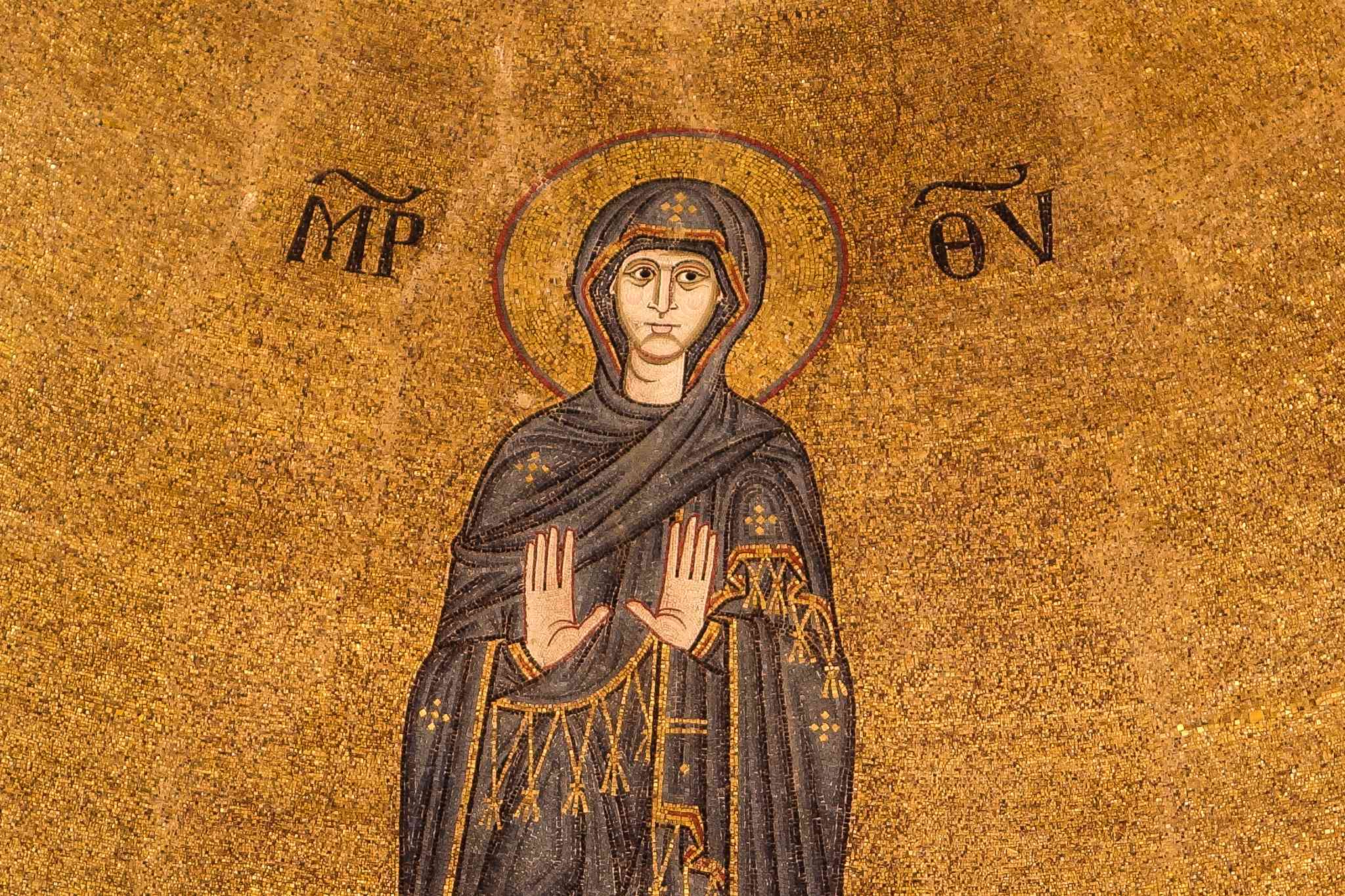
Apse mosaic, Basilica dei Santi Maria e Donato, Murano, Venezia (12th century)

Apse mosaic, Basilica dei Santi Maria e Donato, Murano, Venezia (12th century)

Dear readers, in these last hours before the Feast of the Nativity, let me wish you all a very Merry Christmas. Thank you for your interest in what happens here, and for your thoughtful reading and supportive comments. I am grateful for your visits. May the twelve days of Christmas bring you much joy and blessing.

In lieu of a post today, I offer these three passages as prologue to Christmas Eve:

Today the Virgin is on her way to the cave where she will give birth in a manner beyond understanding to the Word who is, in all eternity. Rejoice, therefore, universe, when you hear it heralded: with the angels and shepherds, glorify the Holy One who chose to be seen as a new-born babe, while remaining God in all eternity.

— Preparation of the Nativity, Orthodox liturgy

“I suppose they try to make you believe an awful lot of nonsense?” “Is it nonsense? I wish it were. It sometimes sounds terribly sensible to me.” “But my dear Sebastian, you can’t seriously believe it all.” “Can’t I?” “I mean about Christmas and the star and the three kings and the ox and the ass.” “Oh yes, I believe that. It’s a lovely idea.” “But you can’t believe things because they’re a lovely idea.” “But I do. That’s how I believe.”

— Evelyn Waugh, Brideshead Revisited


I am the blossom pressed in a book,
found again after two hundred years…

I am the maker, the lover, and the keeper…

When the young girl who starves
sits down to a table
she will sit beside me…

I am food on the prisoner’s plate…

I am water rushing to the wellhead,
filling the pitcher until it spills…

I am the patient gardener
of the dry and weedy garden…

I am the stone step,
the latch, and the working hinge…

I am the heart, contracted by joy…
the longest hair, white
before the rest…

I am there in the basket of fruit
presented to the widow…

I am the musk rose opening
unattended, the fern on the boggy summit…

I am the one whose love
overcomes you, already with you
when you think to call my name…

— Jane Kenyon, “Briefly It Enters, and Briefly Speaks”


Related post: How Can This Be?

Unsilent Night: An Advent Revelation

Sun in black sky

Last Saturday after dark, about 60 people gathered at a Seattle’s On the Boards theater to begin a neighborhood walk called “Unsilent Night.” Created in 1992 by New York composer Phil Kline, it is a “luminous soundscape” enacted for 45 minutes on a single night in December. This year, 37 American and Canadian cities joined in.

Participants downloaded one of 4 separate but complementary music tracks of ambient minimalism on their phones, and carried portable speakers as they walked the streets together in a collective mobile sound sculpture. NPR has described Unsilent Night this way: “chiming and chants bounce off walls and windows, transforming the coldest urban area with the warmth of musical fellowship.”

And so we began, moving block by block, a mesmerizing river of sound flowing slowly along the sidewalks of the city. An initial shimmering of bright cascading notes eventually evolved into the low rumble of droning chords, succeeded by percussive xylophone patterns, as if Steve Reich were composing for gamelan. Those metallic notes later gave way to more drones and electronic chords, which became the ground for choral fragments: Gregorian chants, wordless repetitions of ‘ah’ pitched at varied intervals, and melismatic Alleluias. Despite this discernible evolution of musical shifts and changes, the cumulative effect felt unhurried and relaxed.

The Queen Anne neighborhood is a lively mix of small shops, restaurants, and theaters, plus a cinema and basketball arena. A diverse assortment of people was already out looking for the heart of Saturday night, so there were many witnesses to our sonic procession. But surprisingly few showed much reaction. Some stared blankly, as if this unexpected phenomenon eluded their emotional register. They simply didn’t know what to make of it. Others looked away, perhaps wishing us into invisibility. Such a thing should not be happening in their world, so they pretended it wasn’t. Still others wore earbuds, disabling any receptivity to a reality beyond their own self-enclosure.

Yet some indeed had ears to hear, responding with smiles or looks of wonder. Car windows rolled down to let in the sound. The Latino doorman of a boutique hotel grinned ear to ear as we passed. A homeless woman in a wheelchair gave us a knowing smile, as if we were a welcome sign of sad times ending.

Like the best liturgy, it created community out of strangers through a shared action, and forged our collectivity into both sign and instrument of mystery and wonder. It was a perfect rite for Advent, contesting the old order while announcing an “impossible possible” drawing near. For the 45 minutes of the sound sculpture, sidewalks designed for functionality (keep moving to your next purchase, or go home!) became spaces for play. The ugliness of traffic noise was challenged by sweeter sounds. Strangers were invited to smile at one another, forgetting their solitudes for a few precious moments. And the birth of something deeply poetic usurped the accustomed prose of urban life.

As Twylene Moyer has written concerning participatory public art, it invites us “to re-evaluate what we mean by quality of life, to reassess what we think we know, and to reconsider how we choose to live with ourselves and each other.”[i] Why shouldn’t we feel fully at home in our public spaces, experiencing them as places of human affection and delight, inclusiveness and solidarity, joy and wonder? Why can’t we?

Theologian Langdon Gilkey makes an even more sweeping claim for such a re-visioning process. Art, he says, “makes us see in new and different ways, below the surface and beyond the obvious. Art opens up the truth hidden and within the ordinary; it provides a new entrance into reality and pushes us through that entrance. It leads us to what is really there and really going on. Far from subjective, it pierces the opaque subjectivity, the not seeing, of conventional life, of conventional viewing, and discloses reality.”[ii]

Seeing “the truth hidden and within the ordinary,” piercing the “not seeing of conventional life” with the inbreaking of deeper reality – these comprise the essence of Christianity’s annual Advent project. Not everyone welcomes this kind of seeing, and many reject its very possibility. But for at least some of us who experienced the wonder of Unsilent Night, a richer account of the universe, making room for the transcendent, felt more persuasive than the alternatives.

As I walked in this procession of glorious sound, an Advent hymn came to mind:

Hark! a thrilling voice is sounding.
“Christ is nigh,” it seems to say.

Not everyone would put the name of Christ to what we did and the sound we made together, but that doesn’t alter the content of the experience.

If God is more of a situation than an object, then the community, relationality, mystery, beauty, wonder, delight, and communion produced by the event seemed apt expressions of divinity taking “place,” or “being here now.” You didn’t have to name it to live it.

Toward the end of our walk we were led into a bit of open space set back from the street, where the music was not so compromised by traffic noise. And there our little speakers, one by one, began to ring with a peal of sonorous bell tones, until we were all immersed in such a joyous tintinnabulation that I could imagine myself in heaven. Every face I saw around me glowed with amazement. If the Incarnation were a sound, this would be it, suddenly sanctifying a scrubby vacant lot in Queen Anne.

As the bells faded, we processed one more block, back to our starting point, where we stood in what felt like a prayer circle while the final portion of the composition slowly faded into silence. Some closed their eyes, and everyone seemed rapt and attentive, in a state of peace and gratitude.

Once the music ended, the spell was quickly broken. We went our separate ways, strangers once more, but perhaps “no longer at ease here, in the old dispensation.”[iii] For a moment we had known something better, and would not forget.


[i] Twylene Moyer, Artists Reclaim the Commons: New Works/New Territories/New Publics (Ed. Glenn Harper and Twylene Moyer, Hamilton, NJ: isc Press, 2013), 8


[ii] Langdon Gilkey, from an address given at the Art Institute of Chicago, published as “Can Art Fill the Vacuum?” in Art, Creativity and the Sacred: An Anthology in Religion and Art, ed. Diane Apostolos-Cappadona (New York: Crossroad, 1984), 189-90

[iii] The phrase is from T. S. Eliot’s “Journey of the Magi,” expressing the incompatibility of what the Magi had experienced in Bethlehem with the unredeemed world to which they returned.

“God isn’t fixing this”

Advent installation by Jim Friedrich at St. John's Episcopal Church, Los Angeles (1977)

Advent installation by Jim Friedrich at St. John’s Episcopal Church, Los Angeles (1977)

O come, O come Emmanuel,
and ransom captive Israel.

Once upon a time, worshippers entered their church on the Second Sunday of Advent to find a great wall between themselves and the sanctuary. The beautiful mosaics, the richly colored marble walls, and the magnificent carved Christ above the high altar were all hidden from view by this strange iconostasis, made from front pages of the Los Angeles Times. Instead of the images of holy men and women that adorn a traditional altar screen, there were banner headlines screaming catastrophe and mayhem.

When the assembly was seated, a mime came up the aisle to stand before the wall, searching for some way through it. His movements and gestures indicated perplexity, frustration, and finally discouragement. Then a voice from beyond the wall cried out,

Jerusalem, turn your eyes to the east,
see the joy that is coming to you from God. (Baruch 4:36).

Responding to the voice, the mime tore a small hole in the wall, and peeked through. He seemed entranced by what he saw.

The voice continued:

Take off the garment of your sorrow and affliction, O Jerusalem,
and put on forever the beauty of God’s glory. (Baruch 5:1)

The mime began to tear down the wall, encouraging others to join him. One by one, people rose from their pews to rip down the veil “of sorrow and affliction,” until the beauty of God’s sanctuary was finally revealed.

This simple but powerful ritual, the prelude to a eucharist I curated forty years ago at St. John’s Episcopal Church in Los Angeles, comes to mind whenever I hear that passage from Baruch in the December lectionary. It’s what we pray for each Advent from our place on this side of the wall: Good Lord, deliver us. Stir up your power. Tear down the wall between us. Show us your glory.

That wall of headlines reflected my ongoing interest in connecting Advent themes with the news of the world. The WTO protests in Seattle (1999) and the Occupy Movement (2011) both coincided nicely with Advent, mirroring its prophetic themes of judging the present order with the hope and vision of something better.[i] And just last week, the front page of the New York Daily News supplied a marvelous Advent provocation. By noon, it had 11 million Facebook views, and 74,000 shares.

New York Daily News, 12/3/15

New York Daily News, 12/3/15

The headline was a sharp rebuke to the shameless politicians who promise prayers for the victims of gun violence while refusing to do anything about the guns. Calling them “cowards who could truly end gun scourge” but instead “hide behind pious platitudes,” the newspaper offered a blunt theological assertion: “God isn’t fixing this.”[ii]

The daily office Old Testament readings for early Advent, calling the world to account for its evils, say much the same thing. To those who refuse to “renounce the dictates of our own wicked hearts,”[iii] the prophets imagine God declaring, “You made your own bed. Now lie in it.” (Thankfully, the prophets always redeem their rants in the end with comforting decrees of mercy and salvation).

However, the Lieutenant Governor of Texas was not comfortable with the Daily News’ riff on the old biblical idea that God sometimes gets fed up with human folly. His photoshopped revision was posted on Facebook and Twitter.

God hears our prayers

Of course this clueless retort (note the unfortunate juxtaposition of the headline with the red banner above it) did not actually answer the question of whether – or how – God acts in the world to “fix” things. It was just a clumsy attempt by a presumed gun lover to change the subject. Platitudes about prayer in the abstract are safe because they have no consequences, unlike real prayer, which always implicates the petitioner in a process of change and action. If we pray for an end to gun violence, we obligate ourselves to do all in our power to reduce it. Prayer is a call for action; it politicizes what we pray for. Prayer is not simply leaving things up to God. It is an act of volunteering to be part of God’s solution.

But is there such a thing as God’s solution? Does God – can God – fix things? It is not a question with a clear and simple answer. Human freedom has thrown a monkey wrench into the story of the world, while God has surrendered absolute control of the narrative. If we make a mess of things, God is not an indulgent parent rushing in to cover for us. We don’t get to multiply our weapons and then wonder why God allows so much violence.

So where does that leave us? In the Advent section of his Christmas Oratorio,[iv] W. H. Auden describes a closed-in, godless world where hope is absent.

Alone, alone about a dreadful wood
Of conscious evil runs a lost mankind …
The Pilgrim Way has led to the abyss.

But what if we are not alone? What if there is a God who can make the abyss into a way? What if an unexpected future is breaking through the walls of our self-made prison? The Advent message is to embrace this hope, as we take off the garments of sorrow and affliction to welcome the God of joy into our midst.

Whatever the “solution” (salvation) may be in the tangled histories of the world and the soul, it is a long-term, sometimes excruciating, process, requiring honest engagement with the consequences of human sin in acts of confession, repentance, reconciliation, justice, healing, sacrifice, and transformation. And I submit that these are not simply things we do with God, as though God were only a helper from the outside. They are things we do in God, or God does in us, as our own intentions and actions become the embodiment – the incarnation – of divine purpose.

So yes, I believe that God is fixing the world, but not in the short run. And not without us.


[i] I preached on both these events at the time, with mixed results. Some were not so ready to find traces of God in social movements which trouble the powers-that-be. One church subsequently banned me from its pulpit for being too “partisan.” Guilty as charged.

[ii] New York Daily News, December 3, 2015.

[iii] Baruch 2:8

[iv] W. H. Auden, For the Time Being: A Christmas Oratorio, in Collected Poems, ed. Edward Mendelson (New York: Random House, 1976), 273

Reprise: Ten Ways to Keep a Holy Advent

image

Here in Puget Sound, the first Sunday of Advent has begun in darkness, fog, and frost. It is for many of us a deeply felt time, the season where we wait expectantly for the dawning of the New. The spiritual practice of waiting is not a state of passivity, but rather the cultivation of attention, lest we miss what is being offered to us in the unfolding of God’s future.

I do not usually do re-runs of old posts, but some readers found last December’s “Ten Ways to Keep a Holy Advent” a useful list, and you can access it here. I hope you will find some blessing in it. And please feel free to share it with your communities.

Three things you should know about the Trinity (Part 2)

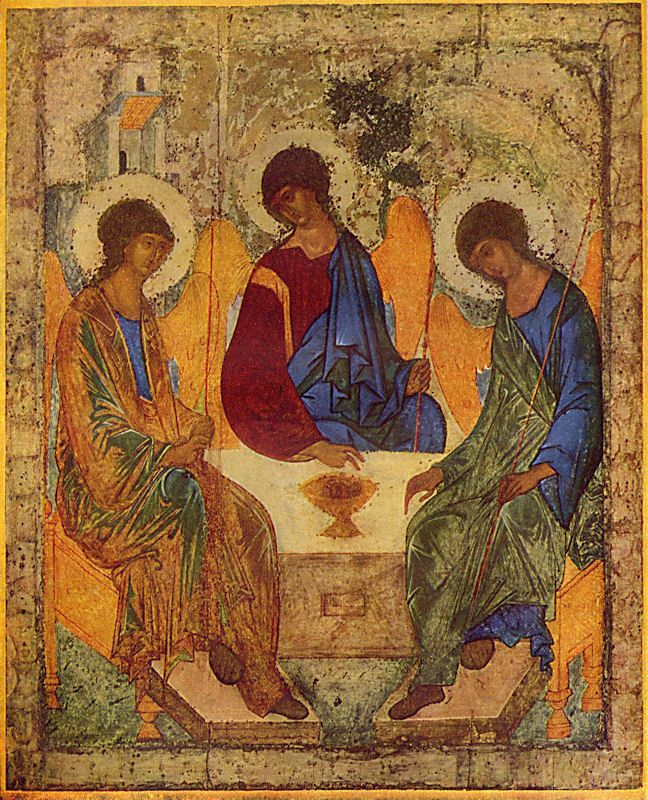
Andrei Rublev, The Holy Trinity (1425)

Andrei Rublev, The Holy Trinity (1425)

Trinitarian doctrine, like other key Christian doctrines, was hammered out, not in sterile study, but rather in the midst of lived spirituality, prayer, and the worship life of the church.[i]

                                                                        – Veli-Matti Kärkkäinen

The Trinity has to do with the lives of each of us, our daily experiences, our struggles to follow our conscience, our love and our joy, our bearing the sufferings of the world and the tragedies of human existence; it also has to do with the struggle against social injustice, with efforts at building a more human form of society, with the sacrifices and martyrdom that these endeavors so often bring. If we fail to include the Trinity in our personal and social odyssey, we shall have failed to show the saving mystery[ii]

– Leonardo Boff

Part 2: You can’t make this stuff up

Early in the twelfth century, a German monk named Rupert of Deutz went into a church where mass was being said by a white-haired bishop. At the offertory procession he experienced a vision of the Holy Trinity:

On the right at the edge of the altar stood three persons of such revered bearing and dignity that no tongue could describe them. Two were quite old, that is, with very white hair; the third was a beautiful youth of royal dignity …[iii]

A century later, Hadewijch of Antwerp, one of those remarkable women mystics who flourished in the late middle ages, also had a vision of the Trinity. But instead of three white males, what she saw was a dark whirlpool, which she described as “divine fruition in its hidden storms.” Hovering over this whirlpool was a spinning disc, on which sat a figure wearing the countenance of God – the face of God – on whose breast were written the words, “The Most Loved of All Beloveds.”

We may find Hadewijch’s vision more congenial: it is genderless, and less crudely specific than Rupert’s. And the tempestuous whirlpool, a flood of energy ceaselessly flowing through the universe, conveys a dynamic image of divinity that resembles the postmodern cosmologies of process theology and quantum physics. It’s probably easier for most of us to believe in a divine whirlpool than in three white guys.

But the crucial difference between Rupert and Hadewijch is not in the relative resonance of their imagery, but rather in what happens next. Rupert remains an observer, one who stands apart and sees God as an object. But Hadewijch does not remain separate from what she sees:

Then I saw myself received in union by the One who sat there in the whirlpool upon the circling disc, and there I became one with him in the certainty of union… In that depth I saw myself swallowed up. Then I received the certainty of being received, in this form, in my Beloved, and my Beloved also in me.

Rupert’s knowledge of God remained conceptual. Hadewijch’s knowledge of God became experiential. She was gathered into the circulating current of divinity. She became part of its flow, and that divine flow became part of her.

The language she uses for this experience is not mathematical or philosophical. Her language is the language of the heart. She describes being “swallowed up… in my Beloved, and my Beloved also in me.”[iv] Love, she discovered, is the way the soul knows. Love is the way the soul sees.

I begin this reflection with a mystic’s personal testimony because Trinitarian theology was not forged by inventive theorists, but by faithful Christians trying to make sense of the concrete, experiential data of salvation, beginning with the biblical narrative and continuing in the ongoing history of believing communities. Based on our collective and personal experience of being “saved” (or, if you prefer: healed, forgiven, reborn, renewed, resurrected, empowered), what can we say about the God who has done this? Trinitarian reflection began within an ancient community deeply grounded in the monotheism of Judaism, which had, over the centuries, found ultimate reality to be not a plurality of disconnected or contradictory energies but a coherent unity. But once the early Christians began to attribute divinity to both Jesus and the Holy Spirit, a simple self-contained oneness was no longer sufficient to describe the Reality.

Without losing the unity of God, how could they account for the divine diversity revealed in the saving activities of Christ and the Spirit? Once they began to call Jesus “Lord” (Kyrios), which happened very early in their worship and their storytelling, traditional monotheism was radically destabilized. The growing perception of the Holy Spirit as a guiding and empowering presence of deity in their communities only compounded the problem.

There were various attempts to solve the problem by downgrading Jesus and Spirit to subordinate, derivative, or semi-divine realities, by no means equal to the eternal and uncreated God. Such “heresies” were popular with those who wanted to keep God simple. But “orthodoxy” was unwilling to deny the fullness of divinity to either Christ or the Spirit. Only God can save us. Christ and Spirit, in the biblical revelation and Christian experience, are integral and essential to salvation. Therefore, they must be equally integral to the Holy One who is the Creator and Redeemer of all things.

The question wasn’t only metaphysical (What is the relation between the one and the many or the finite and the infinite?) or logical (How can One be Three and Three be One?). Trinitarian reflection was also a deep engagement with the question of suffering. If God incarnate in Christ chose to share the human condition, to live and die as one of us, does that mean that vulnerability and suffering have become part of God’s own history? And if these human elements have been added to the divine life through specific temporal events, has time itself disturbed the perfect calm of eternity? If God has been affected and changed by events in time and history, what can we then say about the consistency and transcendence of the divine nature? How can God be decisively linked to the history of the world without losing freedom or transcendence? Can a changeless God weep? Can we be saved by a God without weapons?

In his comprehensive survey of contemporary Trinitarian thought, Veli-Matti Kärkkäinen argues that “the assumption of humanity by God, the Son, means that human capacity to suffer is not foreign to the being of God. How else could one speak of God as love? … It is more biblical to think of God as passionate love, the Father who chooses to engage the suffering of the world, than as a Transcendent One whose separation from the world’s suffering guards his freedom.”[v] Robert Jenson, a foremost North American authority on the Trinity, rejects the notion of divine detachment from creation in dramatically succinct terms: “God … is what happens with Jesus… God is what will come of Jesus and us, together.”[vi]

The problems and paradoxes that arise from such far-reaching assertions have been debated and puzzled over throughout Christian history, and the recent profusion of Trinitarian theology has become an incredibly rich conversation. There is, of course, no final version of God awaiting discovery, no definitive outcome to all this reflection, only an endless attentiveness to the Mystery which may consent to dance with language, but always outruns it in the end.

So why presume to talk about the Trinity at all? Why can’t we simply say and think and pray to “God” and leave it at that? We can’t do that because Christians don’t belong to a theoretical God, a reasonable and logical divine construct worked up by professional philosophers. We belong to the self-revealing but complicated God of the Bible who has, in the form and activity of Christ and the Holy Spirit, rescued us from our own folly and gathered us into the communion that is the very life of God. And no matter what diverse strategies of insight and understanding we may employ, what we can actually say about the Trinity is always grounded in experience, both the experience of our ancestors encoded in Scripture and tradition and the contemporary revelations of communal and personal life.

Trinitarian thought isn’t made out of thin air or abstract speculation. It is produced and nourished by the concrete, tangible history of Christian experience. However each day manifests for us “the means of grace” and “the hope of glory,” whatever the myriad ways by which we love and serve and witness, we need the threefold name to account for the diversity of God’s relations with us. Anything less would impoverish our prayer and considerably reduce the scope of our attention.

For most theologians, our experience of God as threefold also reflects a Trinitarian life within God’s own self. Since God’s inner life is beyond our sight, this can only be an assumption. But it is a crucial one. If God is trustworthy and self-revealing, it must be that when we meet God as Trinity, we get the real thing. God isn’t just pretending to be Three for us; God’s own inner life is constituted by relationality and communion.

Finally, how shall we address or invoke this Mystery, which a Japanese theologian intriguingly calls “Three Betweennesses in One Concord?”[vii] The traditional “Father, Son, and Holy Spirit,” despite its authoritative pedigree, is distractingly masculine for many, and various substitutes have arisen, each with their own impediments. “Creator, Redeemer, Sanctifier,” for example, is a bit impersonal, and risks reducing the three Persons to job descriptions. Likewise, “Source, Word, Spirit,” “Creator, Liberator, Comforter,” “Parent, Child, Paraclete,” “Mother, Daughter, Spirit,” and “Mother, Lover, Friend” all have their particular assets and liabilities. My own current preference, since I suspect that God is more verb than noun, is “Love who loves us[viii], Word who saves us, Spirit who revives us.”

I leave the last word to 16th century reformer Philip Melanchthon, who said, “We adore the mysteries of the Godhead. That is better than to investigate them.”[ix]

[This is the second of three reflections on the Trinity. The first, on the essential relationality of God, may be found here.]

[i] Veli-Matti Kärkkäinen, The Trinity: Global Perspectives (Louisville: Westminster John Knox Press, 2007), 35

[ii] ibid., xv-xvi

[iii] Bernard McGinn, The Growth of Mysticism: Gregory the Great Through the 12th Century (New York: The Crossroad Publishing Company, 1994), 330

[iv] ibid., The Flowering of Mysticism (New York: The Crossroad Publishing Company, 1998), 212-16

[v] Veli-Matti Kärkkäinen, 99

[vi] Robert W. Jenson, The Triune Identity: God According to the Gospel (Philadelphia: Fortress Press, 1982), 22-3

[vii] Nozumu Miyahira, in Kärkkäinen, 314

[viii] I take this resonant phrase from Terrence Malick’s transcendent film, To the Wonder.

[ix] Kärkkäinen, xvi