God is a dance we do

Elaine Friedrich and friends, c. 1933

Elaine Friedrich and friends, c. 1933

At the end of last Sunday’s eucharist, we sang “You shall go out with joy,” a contemporary hymn with the infectious rhythm of Mediterranean dance.[i] The words, the tune, and the smiling worshippers all seemed to say the same thing: the Spirit really wanted to move in that place. So before we went our separate ways, I invited the congregation to repeat the song, while all who wished stepped into the open space before the altar for an impromptu circle dance. With joined hands, we circled round, spiraled inward, wove in and out of the arches and tunnels of upraised arms, manifesting with our bodies the divine fullness attributed to the Holy Trinity: an “interdependence of equally present but diverse energies … in a state of circumvolving multiplicity.”[ii] Or as St. Athanasius said more simply of the triune God, we were participating in the divine reality of “reciprocal delight.”

Communal dance is an early Christian image for the divine reality, due in part to a pun on the Greek word, perechoresis. This term (from peri = “around,” and chorein = “make room for,” “contain”) was appropriated in the fourth century to express the Trinitarian unity-in-diversity. Perechoresis implies a shared existence, a being-in-one-another where each Person, while remaining uniquely distinct, penetrates the others as each and all become the subject, not the object, of one another.

The Trinity is not a simple, static substance but an event of relationships. It is why we can say that God is love. “To be” has no ontological reality apart from “to be in relationship.” In the words of Anglican priest John Mbiti of Kenya, expressing the strongly communal mindset of African theology, “I am because we are, and since we are, therefore I am.”[iii]

Each Person contains the others and is contained by them in a shared communion of self-offering and self-surrender. But that continuous self-offering is never a one-way transaction, either one of self-emptying or one of being filled. It is always both at once – giving and receiving – as we ourselves know from our own mutual experience of love at its best. As Jesus said, “losing” yourself and “finding” yourself are equivalent and simultaneous. In giving ourselves away, we receive ourselves back. This may be counterintuitive to the modernist mindset of autonomous individual self-possession, but it is the essence of communion: “a giving of oneself that can only come from the ongoing and endless reception of the other.”[iv] This “being in communion” is explored more fully in Part 1: God is relational.

Now here’s the Greek pun: perechoresis also can mean “to dance around,” and the ancient theologians quickly seized on that image as an accessibly concrete description of a complex process. Trinity is a dance, with Creator, Christ and Spirit in a continuous movement of giving and receiving, initiating and responding, weaving and mingling, going out and coming in. And while our attention may focus at times on a particular dancer, we must never lose sight of the larger choreography to which each dancer belongs: the eternal perichoresis of Three in One, One in Three.

“I am the dance and I still go on” (Dancers at Elaine Friedrich’s Requiem)

Wallace Stevens made a poem about the process of giving ourselves over to a larger whole, “the intensest rendezvous” where we find ourselves drawn out of isolation “into one thing.” He wasn’t writing about dance or the Trinity, but his words come as close as any to describing their essential motion:

Here, now, we forget each other and ourselves.
We feel the obscurity of an order, a whole,
A knowledge, that which arranged the rendezvous.[v]

My mother Elaine knew the joy of the “intensest rendezvous” of perechoresis. She started dancing as a little girl, and as a teenager in the 1920’s she taught dance to younger children for ten cents a lesson. While studying at Northwestern she took workshops in Chicago with some of the great pioneers of modern dance, Doris Humphrey and José Limón. Her teachers encouraged her to apply to Martha Graham’s company. But then she met my father, and a career in dance was set aside for a more domestic life. I owe my own existence to that sacrificial act. Still, she remained a dancer in her heart, and later in life became a great advocate of sacred dance. Whatever I learned from her about the divine dimensions of “dancing around,” of giving yourself over to the cosmic “Love that moves the sun and all the other stars,”[vi] remains a vital part of my theological education.

There are no spectators in the Trinitarian dance, which is always extending outward to draw us and all creation into its motions. As Jürgen Moltmann said, “to know God means to participate in the fullness of the divine life.”[vii] It’s not a matter of our trying to imitate the relational being of the loving, dancing God, as if we were inferior knock-offs of the real thing. God wants us to become ourselves the real thing. God wants to gather us into the divine perechoresis as full participants in the endless offering and receiving, pouring out and being filled, which is the dance of God and the life of heaven.

And while our dance with God has its mystical, mysterious, transcendent dimensions, it is also very concrete and specific to our historical life on this earth, in this present time. As Miroslav Volf has said, “The Trinity is our social program.”[viii] We are called to make God not just an inner experience but a public truth. When Love’s dance becomes our way of being in the world – as believers, as church – the Trinity is no longer just doctrine. It is a practice, begetting justice, peace, joy, kindness, compassion, reconciliation, holiness, humility, wisdom, healing and countless other gifts.

Liberation theologian Justo L. Gonzales puts it well: “If the Trinity is the doctrine of a God whose very life is a life of sharing, its clear consequence is that those who claim belief in such a God must live a similar life … for if God is love, life without love is life without God; and if this is a sharing love, such as we see in the Trinity, then life without sharing is life without God…”[ix] So, in the immortal words of Lewis Carroll’s Mock Turtle: Will you, won’t you, will you, won’t you, won’t you join the dance?[x]

My mother was still dancing in her nineties, mostly in the gentle motions of Tai Chi. A year before her death at 96, she was asked to lead a dance prayer in her retirement community’s chapel. It was no longer easy for her to stand, so she performed the prayer seated, while the elderly congregation echoed her gestures with their own frail bodies. The prayer was Daniel Schutte’s well-known anthem, “Here I am, Lord.”[xi] In this video you can only see Elaine, but I’m pretty sure she was dancing with the whole company of heaven.

[This is the final post of a 3-part series on the Trinity. Part 1 was “God is relational,” and Part 2, on the experiential foundations of Trinitarian belief, was “You can’t make this stuff up.”]

[i] Words by Steffi Geiser Rubin, music by Stuart Dauermann (© 1975 Lillenas Publishing Company)

[ii] David Bentley Hart, The Beauty of the Infinite: The Aesthetics of Christian Truth (Grand Rapids: Eerdmans 2003), 114

[iii] q. in Veli-Matti Kärkkäinen, The Trinity: Global Perspectives (Louisville: Westminster John Knox Press, 2007), 352

[iv] Graham Ward, “The Schizoid Christ,” in The Radical Orthodoxy Reader, ed. John Milbank and Simon Oliver (NY: Routledge, 2009), 241

[v] Wallace Stevens, “Final Soliloquy of the Interior Paramour,” Collected Poetry and Prose (NY: Library of America, 1997), 444

[vi] Dante, Paradiso xxxiii, 145, trans. Robert & Jean Hollander (NY: Doubleday, 2007), 827

[vii] Jürgen Moltmann, The Trinity and the Kingdom: The Doctrine of God, trans. Margaret Kohl (San Francisco: Harper & Row, 1981), 152

[viii] Miroslav Volf, “‘The Trinity is Our Social Program’: The Doctrine of the Trinity and the Shape of Social Engagement,” Modern Theology 14, no. 3 (July 1998)

[ix] The Trinity: Global Perspectives, 301

[x] From the Mock Turtle’s song in Alice in Wonderland by Anglican cleric Charles Dodgson (Lewis Carroll)

[xi] Daniel Schutte, © OCP Publications 1981

Cave of the Apocalypse

Katholikon of the Holy Monastery of St. John the Theologian

Katholikon of the Holy Monastery of St. John the Theologian


I, John … was on the island called Patmos because of the word of God and the testimony of Jesus. I was in the spirit on the Lord’s day, and I heard behind me a loud voice saying, ‘Write in a book what you see …’    (Rev. 1:9-11)

Patmos is one of the smaller Dodecanese Islands, a grueling 8-hour middle-of-the-night ferry ride east of Athens. It has gorgeous bays and quiet beaches, superb mountain views, charming villages and, at least not in summer’s high season, a tranquil predominance of locals over tourists. The outsiders I have met are themselves “regulars,” returning again and again because they love it. Yesterday a man from the Netherlands told me this was his 23rd straight year of month-long visits.

Patmos is also a place of pilgrimage, where St. John the Theologian (or “the Divine,” as we say in the western church), fell into a swoon and saw things which have intrigued, puzzled, disturbed and inspired readers ever since. The Book of Revelation has, regretfully, provided horrific weapons of mass destruction for hellfire preachers, but it is also the source for many sublime hymns and prayers in my own Anglican tradition.

Most scholars think that the book’s author is not the same person who wrote the Fourth Gospel. Language, style and themes are too different in the two works. But “tradition” has always preferred to link the Galilean fisherman “whom Jesus loved” with both the mystical composer of the Fourth Gospel and the visionary exiled to Patmos. It exemplifies the arc of discipleship as potentially a long, strange trip. As we sang in a hymn at my own ordination years ago, “the peace of God, it is no peace … Young John, who trimmed the flapping sail, homeless in Patmos died; Peter, who hauled the teeming net, headdown was crucified.”

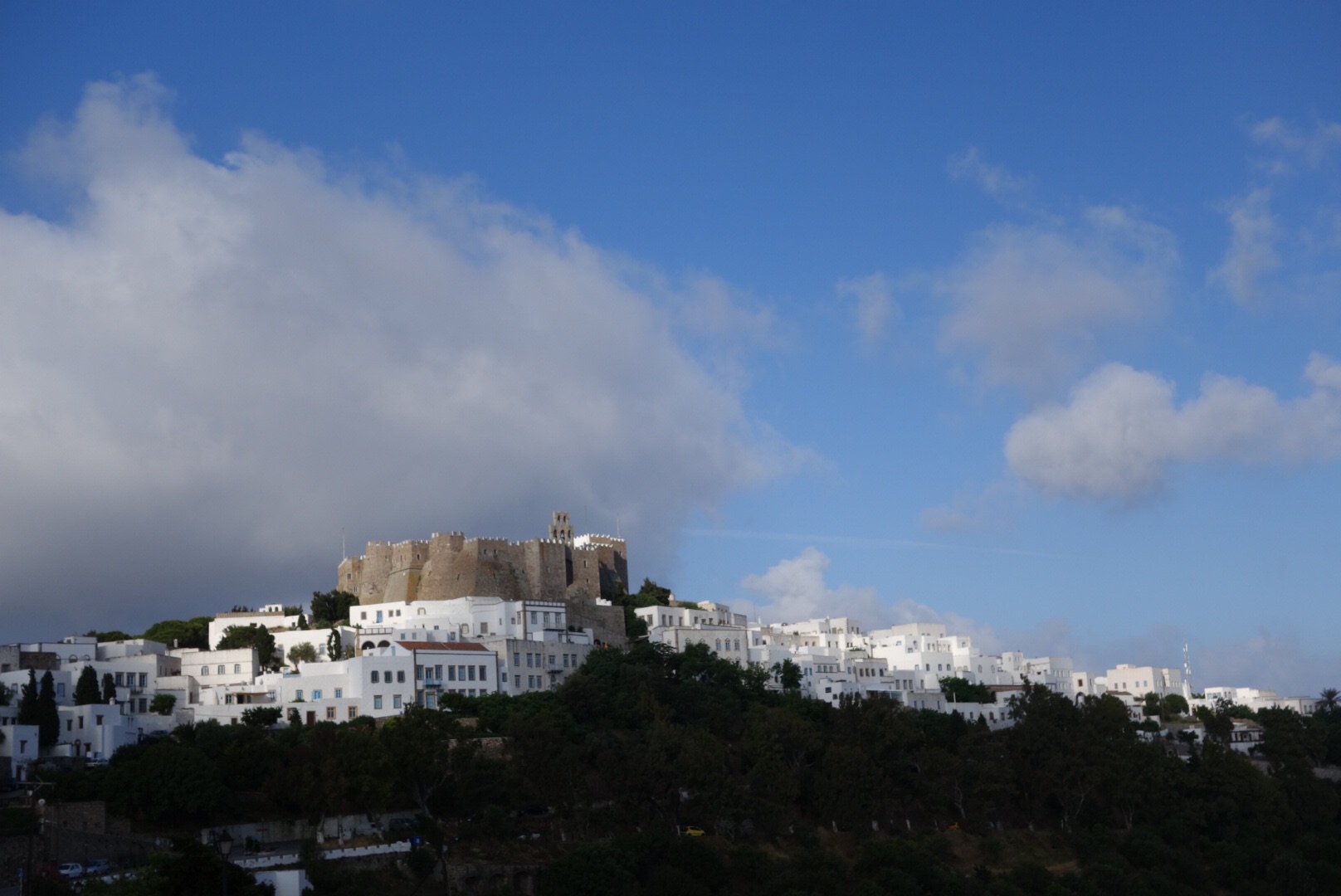
So the Christian can’t come to Patmos and simply lie on the beach or relax in the taverna. The Holy Monastery of St. John the Theologian beckons from the high ridge above the  port. Its dark-hued fortress of lion-colored stone makes somber contrast with the whitewashed village around it, as if to say that the ascent of this hill is serious business.

The monastery rises above the village of Chora.

The monastery rises above the village of Chora.

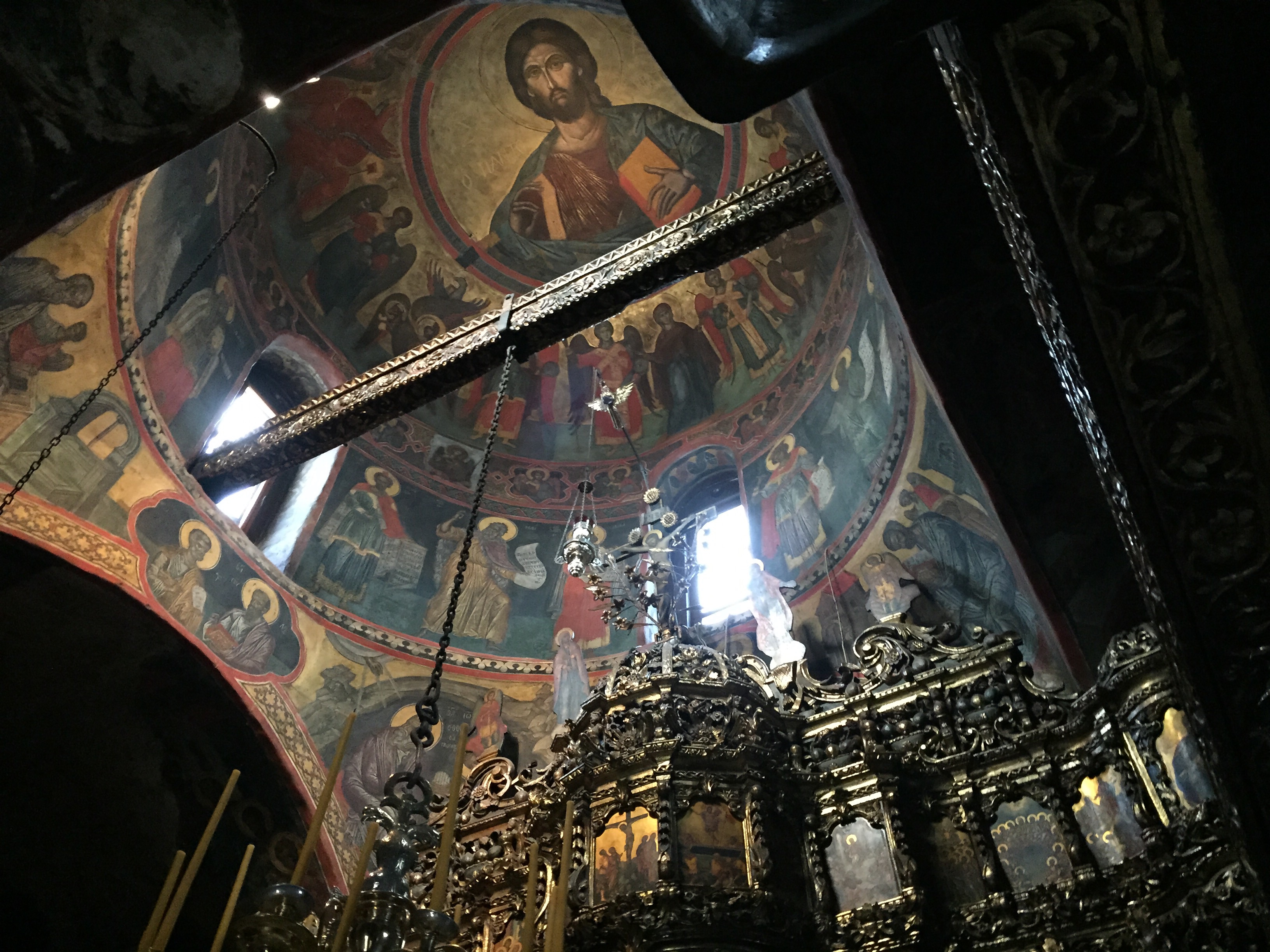
If you rise early, you can experience the awesome richness of the monastery’s Katholikon (main church) in solitude. The brilliant wall paintings, recently cleaned, immerse you in holy images. Along with the intricately carved iconostasis, hanging oil lamps, and numerous icons, they effect a ceaseless engagement of the eye. Some might find this distracting for prayer, but for me the sense that there is always more than I can take in – the visual inexhaustibility of Orthodox interiors – can lead to a kind of surrender, overwhelming and transcending the subjectivity of my own thoughts and perceptions. Here is Mystery. Give over to it. Lose yourself in it.

The monastery museum holds an eclectic assortment of treasures, including a 6th century gospel book, a 1499 Venetian collection of Aristophanes’ comedies, a 6th century BC bust of Dionysus (god of wine and ecstasy), the largest Orthodox collection of 5th-6th century Coptic textiles, preserved by the dryness of Egyptian tombs, and a police blotter in Arabic from the late 15th century, when Byzantine territories had fallen under Muslim control (“The Cadi [Judge] of the Palace is ordered to find three Patmians who were kidnapped by pirates.”).

Below the monastery, halfway up the hill from the sea, is the Cave of the Apocalypse. Here, according to tradition, John lay on the stone floor for several days while the vision unfolded. The cave is not large, but the insertion of a wooden iconostasis into its contours, along with icons and hanging lamps, has made it a compelling place for worship, prayer and veneration. John’s private ecstasy has been reimagined through specific features of the cave. Here is the cleft from which the Voice spoke. Here is the corner when he laid his head to rest between revelations. Here are the fissures where the Trinitarian God divided the rock into three parts with an earthquake.

Literal belief in the details of the cave’s legends is not required to make the site holy. It is holy because centuries of believers have given a particular kind of attention here to a Reality which yearns to make itself known in the innermost heart, for which a sheltering, enclosing cave is a tangible, sensory analogy.

Another mystical theologian, St. Bonaventure, said, “When you pray, gather up your whole self, enter with your Beloved into the chamber of your heart, and there remain alone with your Beloved, forgetting all exterior concerns.” The Cave, for the attentive, can mirror the chamber of the heart.

I entered it three times during my week here. The first time was the Sunday liturgy, full of incense and chanting voices. It was beautiful, but I had no revelations, or even deep feelings. God was present, but I was a bit absent. I was tired from a long, sleepless ferry ride. And I knew that whatever the Cave offered was not a tourist experience you can just walk in and collect.

So I went back a few days later. The voices I heard then were those of tour guides. Most just reeled off the legends uncritically as if they were prosaic facts. Here this and that happened, blah blah blah, now let’s go back to the bus. But one guide, a Greek woman speaking both in English and German, really got into it.

“People think that the Book of Revelation is about judgment and punishment. That is there, of course, but by the time you get to Chapter 21, you find what it is really about: a new world, a new heaven, a new earth, where we will be with God, and God with us.

“John’s message is trying to wake us up, to make us see that we are all one because God is with us and in us. Our original condition of oneness will be restored in the end. We lost that unity in the beginning because we had free will, and we chose to have our own experience, and forgot our connection with one another.

“If a bomb falls on someone in Syria, we think, ‘Thank God that didn’t happen to me.’ But what happens to others happens to all of us. John is trying to wake us up to this. And when he talks about the destruction of the earth, we have to think about how much closer we ourselves are to bringing that about today, unless we remember what we were made for and what we are a part of.”

When I thanked her afterward for her ‘preaching,’ she said, “I want to tell people what they don’t know, what they don’t hear in the schools, what the priests won’t tell you.” She was pretty sour on the institutional church. “I was baptized Greek Orthodox. I believe in Christ and the power of the sacraments, but I don’t belong to any church. I’m kind of a revolutionary.” I asked her name. “Vera,” she said. “Like veritas– the truth.”

This morning, my last on Patmos, I returned to the Cave for a third time. Two cantors and a priest were chanting the Divine Liturgy. I was the only other person present. This time, the spirit of prayer came easily, like a morning breeze. I received no visions, heard no voices except the beautiful earthly ones I stood among. But it was more than enough. When the priest handed out the holy bread at the end, I was aware of my outsider status as non-Orthodox. But the priest, who had the face of a Baroque Apostle, turned to me with a slight nod. And so I ate the bread of heaven, and departed well satisfied.

Just a dream? – Reflections on the Easter Vigil

Byz Res mosaic

On Holy Saturday in Jerusalem, an hour past sunset 26 years ago, I greeted the Resurrection with the Ethiopian community in their courtyard on the roof above the Church of the Holy Sepulchre. Processing around a small cupola representing the empty tomb, they sang and danced with torches and umbrellas. Their graceful, white-robed bodies and joyful faces were vivid icons of the risen life, producing in me a state of dreamlike wonder. As I later made my way through the deserted stone passages of the old city in search of the midnight liturgy at the Russian church, I fell into an apocryphal reverie.

I imagined the risen Jesus quietly reversing the steps of his Via Dolorosa, away from the cross, away from the mindless crowd now sleeping off its orgiastic fury, away from the city of betrayals and farewells, away from the awful time of trial. Going home. To Galilee.

Of course we don’t know how the Resurrection actually happened, nor do we grasp the concept of passing out of existence only to return the same yet different. Perhaps the closest we come is our daily rising from sleep, when it may take a moment before we remember who we are and reconnect with the continuity of personal identity that somehow survives the abyss of unconsciousness. Even so, there sometimes remains a strange sense that we have crossed over into a new space and time full of unimagined possibilities. We are not quite the same person who closed his or her eyes the night before. Behold, says Jesus, I make all things new.

The sublime intensity of Holy Week, culminating in the Triduum, or Great Three Days of Maundy Thursday, Good Friday and the Easter Vigil, can produce a similar effect on the faithful who make the long journey from the Last Supper to the first Alleluia. We not only learn something along the Way of the Cross to the place of Resurrection, we become something as well. When it’s over, we are somebody else. Forgiven. Set free. Made new.

As I said in the Vigil homily on Saturday night, “we have made an exodus from our tired old stories of death and loss into God’s new story of possibility and promise.” Any Vigil worth its salt will enable us to dwell for a few hours in the light of that new story, the light that penetrates our shadows with the bright splendor of God’s future. And when it’s over, we may wonder: What just happened? Was it only a dream?

One of the striking things about the Easter Vigil is that there is no single representation of the Resurrection. The gospel reading might describe dazzling messengers announcing it after the fact, but the event itself is never described in the text. The closest the liturgy gets to a specific resurrection moment is when the Presider launches the eucharist with a shout of Christ is risen, and a holy tumult is made with chimes, bells and drums while all the lights switch on to banish the darkness. But the victory of Life and Love is actually manifested repeatedly throughout the liturgy in symbol, word and sacrament, as well as in the faces and gestures of the assembly. The liturgy as a whole is an experiential analog of the Paschal Mystery.

Here are a few of this year’s many resonant manifestations for me:

  • The New Fire: It is always moving, after we have all been scattered from the bare and mournful church interior of Good Friday, to see how many return the next night to gather outside around the New Fire with expectant faces. Death has done its worst, and we have come to make our reply: Love wins anyway. I especially rejoiced to see the children, already dressed for the Ark story in their animal costumes, standing right up front with their floppy ears and shaggy coats. As St. Paul said, not just humanity, but the whole creation, eagerly awaits the day of renewal.
  • The Creation: “Once upon a time, human beings had no story. Only the gods did things worth telling.” So began the Prologue to our sacred stories, concluding with the discovery, by an ancient “tribe of nobodies” that their own lives were, in fact, part of something much, much larger. “Human beings had become a story told by God.” Then out of the darkness a voice said, “Let there be light!” Projected on a 15’ screen, we saw the first light of the creation, from Terence Malick’s film, Tree of Life, continuing with spectacular cinematic images of earth’s evolution up through the arrival of the birds. Then the film switched off and a monkey and frog entered to cavort among the assembly, until a flute sounded, and the musical “breath of God” turned them into the first humans. They straightened up, removed their wooden Indonesian masks, and became suddenly conscious of their own humanity. “Adam and Eve” were played by pre-teens, but when they cautiously crossed the gap between them to touch hands and connect with the strange and unknown “other,” they gave us a transcendent image far beyond their years.
  • The Red Sea: This central metaphor for the Paschal Mystery of “crossing over” from death to life was a complex interplay of live actors, projected images (documentary-looking Exodus images from DeMille’s 1927 silent, The Ten Commandments, plus Civil Rights footage from the Selma to Birmingham march of 1965), soundscapes (6 separate cues to mark different stages of the story), and dramatic theatrical lighting. After the Red Sea had been crossed, the narrator concluded by saying, “When the world says no, the power of God is …”. The Israelites, all played by children, completed the sentence by shouting, “YES!” The brave sound of those young voices will long stay with me.
  • “Hallelujah”: After each story, we sang a song and said a prayer to reflect the story’s themes. The last story, The Valley of Dry Bones, was followed by Leonard Cohen’s “Hallelujah,” with powerful Easter lyrics by Scott Lawrence. Our hand candles were relit as we sang: “no darkness can conceal the light within you … hallelujah, hallelujah…” All those candlelit faces, all those beautiful voices raised in song, said Resurrection as powerfully as anything else we did that night.
  • The Dance: At the end, following communion, we invited people to come out of their seats to gather in a great circle to dance. I had been warned to expect only a half-hearted response. Episcopalians are reserved, I was told. Dancing in church might be outside some people’s comfort level. But as we sang a couple of choruses of “I will raise them up” from the Bread of Life hymn, everyone did in fact rise up and come out of their pews. We joined hands, and off we went, circling and spiraling as we sang the Easter Troparion (“Christ is risen from the dead, trampling down death by death”) and “Jesus Christ is risen today.” Resurrection wasn’t just something we heard about or thought about, it was something we embodied, something we danced. As Christ shows us every Easter, “I am the Dance and I still go on.” Amen to that! We proved it with our bodies.

When the Vigil was over, we each went our separate ways. The Vigil “set” was struck, like a circus tent, leaving behind little trace of what had taken place. Had it all – not just the Vigil but the entire Triduum – been just a dream, soon to fade in the glare of everyday life and ordinary time? Or had our extraordinary journey together, soaked in Paschal images, revealed something essential, enduring and profoundly transformative?

Whether in this year’s Triduum, in my Jerusalem Holy Week long ago, or in many other memorable traverses of the Paschal Mystery, I do believe I have encountered, embodied, and imbibed the core of our faith: Christ lives. Love wins. We shall be changed.

The resonant images and experiences of the Triduum have been planted deep within me, year by year. They may still have to struggle in my poor soil or compete with the choking thorns of my world, but as the collect-prayer for Thursday of Easter Week asks, “Grant that all who have been reborn into the fellowship of Christ’s Body may show forth in their lives what they profess by their faith.”

God, bring that day closer!

The journey is how we know

The Paschal Moon will be full on Holy Saturday.

The Paschal Moon will be full on Holy Saturday.

Monday in Holy Week: for a liturgist, the next few days comprise the precious last bit of calm before hitting the rapids of the Triduum, the Great Three Days of Maundy Thursday, Good Friday, and the Easter Vigil.

For those who undertake this marathon ritual experience, it is the molten core of our worship life, a sacramental immersion into the Paschal Mystery of dying and rising with Christ. It is where we do our best theology and our most heartfelt common prayer. Richly layered, multi-sensory, dramatic and moving, the Triduum is a liturgy like no other.

I say “liturgy” singular, even though there are three distinctive rites between sundown Thursday and the late hours of Saturday night. It is one single liturgy with successive parts, like a three-act play or a symphony in three movements. At the end of the first two parts, there is no blessing or dismissal. The people simply exit in silence to rest up until the liturgy continues the next day.

Each of the parts has an integral relation to the other two. There is of course a narrative relationship: the three parts follow the sequence of Jesus’ last days. But there is also a theological relationship: each part finds its full meaning only in relation to the others. “No rising without dying” is the prime example of this interrelationship, but there are many others, such as the theme of community. The disciples gathered so memorably on Thursday evening, then scattered by Friday’s betrayals and denials, are themselves resurrected from the isolation of sin and shame by the Christ who returns as Forgiveness. We learn this all over again by being in the story.

These aren’t things we just hear about or think about. We enact them with our bodies and emotions. We taste the warm table fellowship of the Last Supper, and the bitter cup of Gethsemane. We ascend Golgotha’s hill to gaze Wondrous Love in the face and kiss the wood which proved the “tree of glory” for the “healing of the nations.” We wait out the long silence of Holy Saturday until the New Fire contradicts the darkness and the Easter Acclamation (“Christ is risen!”) ignites a miracle of collective joy that was barely conceivable the day before.

To treat the Triduum as a la carte, or to skip it altogether, would be to miss the richness of the interrelated whole. Imagine only seeing one act of Hamlet, or skipping the final movement of Beethoven’s Ninth. There are things we can only find out by entering into them fully. The journey is how we know.

This is, of course, the passionate liturgist talking. If I were a parish priest, I would acknowledge the many demands of my parishioner’s lives and the realities of a 24/7 secularized culture, where going to church three nights in a row is not just rare – it’s incomprehensible. And we don’t want to shame the faithful, or call them wrong because they only do Palm Sunday and Easter, bypassing the Triduum entirely. Lives get busy.

But still, every year, even the most indulgent and compassionate pastor continues to issue the invitation to exit ordinary time and habitual existence in order to “enter with joy upon the contemplation of those mighty acts, whereby [God has] given us life and immortality,” because the Triduum is too good, too important, not to share. Something very specific to the process happens to those who make the journey. It’s like the Camino de Santiago in that respect. Even the most casual pilgrim is affected by the simple fact of going all the way from beginning to end, whatever their state of mind and heart when they first set out. The journey is how they know.

For me, a year without the Triduum experience is unimaginable. I have done it with the Orthodox in Jerusalem (no problem with attendance there!) and last year observed it with a small group of believers as we walked the Camino. But mostly I have done it as liturgical artist-in-residence at various parishes in California and Washington.

This year I’m collaborating with St. Stephen’s Episcopal Church in Seattle, where we will add some distinctive touches to the tradition. On Maundy Thursday, Sidney Carter’s “Bitter Was the Night” will be sung over a didgeridoo drone during the Stripping of the Altar. The sacred stories at the Easter Vigil will employ drama, film and soundscapes. God will be played by a 7-year-old girl in the Valley of Dry Bones. Music will mix medieval chant and Holy Week hymns with folk traditions and contemporary songwriters. You can read more about it here.

In the apocryphal Acts of John, Jesus leads his disciples in a dance. Some are resistant, but he tells them, “Those who do not dance do not know what happens.” By the time we reach the Vigil finale Saturday night, dancing around the altar to “Jesus Christ is Risen Today,” we will all know what happens.

Via Negativa: A Lenten worship installation

"Desert Words" from "Via Negativa" worship installation by Jim Friedrich

“Desert Words” from “Via Negativa” worship installation by Jim Friedrich

“The trouble with going to the desert is that you risk meeting God there.” These words of a French monk, which I heard decades ago in a documentary on the Little Brothers of Jesus, have haunted me ever since. Anyone who has spent serious time in the desert knows that the monk was right. Flee the culture’s house of mirrors for the counter-world of rocks and sand, silence and emptiness, and like Elijah you too may hear the “voice of thin silence.” You may meet the necessary Other.

I wrote these words in an introduction to my Lenten worship installation Via Negativa, an experiential journey through a symbolic desert. A worship installation is more like an art gallery than the theater model of traditional Western liturgy. Instead of finding a seat and remaining there (except for the Peace and Communion), you move around, follow your own path, pay attention at your own pace, linger where something in particular calls to you. An installation also resembles the labyrinth in being a mixture of both solitude and community. You do it in your own way, yet always aware that you make the journey in the company of fellow pilgrims.

The installation introduction goes on to say:

In this installation, you are invited to make your own exodus out of the ordinary into a desert made of signs, symbols and experiences. There is no path. You wander as you will, or as the Spirit wills, though the Burning Bush is best deferred until you have spent some time here.

There is a multitude of texts: like grains of sand they are too vast to consume in their entirety. But somewhere amid those endless texts are words that may whisper a message just for you. Open a book at random. Consider the many juxtapositions of word and image scattered around the space. Read the “the shifting language of sand, traces, and mirage.”[i] Inhabit “a fragile tent of words erected in the desert” where we are “struck with infinity and the letter.”[ii]

There are also images, sounds, places to linger, practices to enact. It is better not to hurry. There is no time in the desert, only space. Wander. Explore. Abide. Pay attention. Take off your shoes. You stand on holy ground.      

The installation occupies three rooms. In the first room, there are images and texts representing the “Egypt” which need to be left behind – the personal and cultural distractions, distortions, oppressions and addictions which mar or obscure the goodness of creation and the Imago Dei within us all. A monitor shows a video loop of the Exodus story from The Electronic Campfire, a video I produced of creatively told biblical stories from the Easter Vigil.

The second room contains a small tent where you can listen to a recording of sayings and stories of the early Christian Desert Fathers and Mothers, playing softly from a small portable speaker. There are printed collections of these texts available as well. Sitting on a Persian carpet inside the tent, you may linger to hear and read the wisdom of those ancient spiritual explorers. A sign outside the entrance displays a key text from that tradition: Go sit in your cell, and your cell will teach you everything.

The third room represents the desert itself, that indeterminate space free of human constructs, which for millennia has drawn the hungry of spirit. As God tells Hosea, “I will lure her into the wilderness; there I will speak tenderly to her heart.”[iii] The video artist Bill Viola describes the value of this alternate reality as well as any:

“I want to go to a place that seems like it’s at the end of the world. A vantage point from which one can stand and peer out into the void – the world beyond… There is nothing to lean on. No references… You finally realize that the void is yourself. It is like some huge mirror for your mind. Clear and uncluttered, it is the opposite of our urban distractive spaces. Out here, the unbound mind can run free. Imagination reigns. Space becomes a projection screen. Inside becomes outside. You can see what you are.”[iv]

At the entrance to the third room, a sign invites you to take off your shoes before entering the “desert.” Once inside, you begin to read, see, hear, touch, smell, taste and do:

  • Torn fragments of a large desert map scattered across the entry floor, with a sign: “Throw away your maps.”
  • Dozens of magazine photographs and postcard images of the desert, each accompanied by a text related to desert spirituality. These numerous pairings of image and text are designed to provoke endless reflection.
  • Various books and guides on desert natural history, geology and spirituality.
  • Large signs hanging from the ceiling proclaiming key themes of desert spirituality, such as T. S. Eliot’s “Teach us to sit still, even among these rocks.”[v]
"Via Negativa" installation by Jim Friedrich

“Via Negativa” installation by Jim Friedrich

  • At different locations, three video monitors:
    • A slide show of desert wildflowers
    • A montage of desert film footage (time lapse of cloud shadows moving across dry landscapes, dreamlike images of humans and animals on sand dunes, the Temptation scene from Pasolini’s Gospel According to St. Matthew, and a desert father atop his 40-foot pillar in Luis Buñuel’sSimon of the Desert).
    • A live image of whoever is standing in front of the monitor, to which this text is attached: You do not go into the desert to find identity, but to lose it, to lose your personality, to become anonymous.[vi]
  • A large rectangle of sand containing over 70 words naming dimensions of the desert quest (deprivation, emptiness, hunger, listening, negation, repentance, solitude, tears, trial, unknowing, waiting, etc.) Each word seems on the verge of erasure by the enveloping sand.
"Desert Words" from "Via Negativa" worship installation by Jim Friedrich

“Desert Words” from “Via Negativa” worship installation by Jim Friedrich

  • A pile of rocks contains a couple of iPods. You can sit among the rocks, put on headphones, and listen to a trilogy of desert songs by the great Bob Franke: “Walking in the Wilderness,” “Israelite” (“nobody suffers here another night”), and “Holy Ground” (“on holy ground you better not play no tourist”)[vii]. Or you may be swept into trance by Steve Reich’s “Desert Music.”
  • A woven basket with “manna” (fry bread), water trickling from a pile of rocks with cups for drinking, and a pillar of fire (Paschal Candle), each with accompanying biblical texts.
  • The fragrance of sage incense and the recorded sounds of desert birds and insects.
  • Large medieval images of Jesus confronting Satan, hanging above a small table where a small New Testament is opened to the Temptation story. Also on the table: a plate with a bread-shaped stone, and a chalice filled with sand. Another text asks, “Can God make a banquet in the wilderness?”[viii]
  • Nearby, a ladder holds referents to Mt. Sinai on every rung: a book of Sinai photographs, incense grains from St. Catherine’s monastery at the foot of Sinai, a collection of sayings by St. Nilus of Sinai, a reproduction of the Sinai monastery’s famous icon, “The Ladder of Divine Ascent,” and – at the top of the ladder – the Ten Commandments in Hebrew and English.
  • Finally, the Burning Bush, reached by following a winding path of stones past a “veil” with the single word, Absence, on the front. When you reach the other side of the veil, the single word is Presence. set above an altar with a large photograph of a burning bush (Richard Misrach’s “Desert Fire #81”), illumined by many candles.
"Burning Bush" - Richard Misrach's "Desert Fire #81" in "Via Negativa" worship installation

“Burning Bush” – Richard Misrach’s “Desert Fire #81” in “Via Negativa” worship installation

Of course, there is no substitute for doing the real desert in real time. I have never forgotten a solitary Lenten retreat years ago in California’s eastern Mojave – sleeping on sand dunes beneath the moon, listening to silence, trying (unsuccessfully) to pray the entire Psalter in one sitting in the cool of a remote cave. But you can’t become a desert father in a few days. My mind wandered. I failed to find the burning bush.

And yet my brief immersion in desert’s “no-where” lodged itself deep within me. The Via Negativa installation is an attempt to give it symbolic form. Like any liturgy, it compresses a universe of meaning into the space of an hour or two, providing mere glimpses and fragments. But perhaps – like any liturgy – it can plant a few seeds for God to cultivate in the fullness of time.


[i] David Jasper, The Sacred Desert: Religion, Literature, Art, and Culture (Oxford: Blackwell Publishing, 2004) 181

[ii] Jacques Derrida, q. in Jasper, p. 161

[iii] Hosea 2:14

[iv] Bill Viola, Reasons for Knocking at an Empty House: Writings 1973-1994 (London: Thames & Hudson, 1995) 54

[v] “Ash Wednesday,” T.S. Eliot: Collected Poems 1909-1962 (London: Faber & Faber, 2002) 95

[vi] Edmond Jabés, q. in Jasper, p. 2

[vii] The first two songs are on Franke’s powerful Desert Questions album. “Holy Ground” is on In This Night.

[viii] Psalm 78:19

Simple gifts

Shakers dance

Who will bow and bend like a willow
Who will turn and twist and reel
In the gale of simple freedom …

– Shaker spiritual

John Ciardi said that the poet is known by the valor of his refusals. So too the saint. But the austerity of self-limitation is not what we might have expected from the Wooster Group, the edgy New York City troupe long known for its Dionysian blends of experimental theater and multimedia technologies. Their latest production, however, not only reincarnates the music of the Shakers, it does so with a minimalist restraint worthy of that nearly extinct American sect.

Early Shaker Spirituals: A Record Album Interpretation presents all 20 songs from side A of a 1976 LP recorded at the dwindling Shaker community in Sabbathday Lake, Maine. After the liner notes for each song are read aloud, four women in plain 19th century dress sing along with the actual spinning record as it is transmitted to them through wireless receivers. The voice of Suzzy Roche is especially haunting, lean and lonesome and saturated with pastness like a faded tintype. While we listen to these contemporary reproductions of long departed voices, we sometimes hear the faint traces of the original recorded sound leaking into the room from the women’s earpieces. As the New York Times has written: “The aural effect is subtle and eerie, suggesting a kind of phantasmal possession of the present by the past or, if you prefer, the eternal.”[i]

Sitting quietly, passive and still, replicating out loud what they are hearing in their ear, the singers seem to be channeling something not of their own making, a transcendent voice entering the present world by first passing through their own souls and bodies. It feels like the spiritual ventriloquism of biblical prophecy. What shall I sing? Sing this. How fitting for a repertoire which the Shakers often attributed to the gifts of unseen spirits or divine inspiration.

The contrast of the singers’ personal inexpressiveness with such passionate, ecstatic and sometimes eschatological song texts (“with leaping and with dancing / we’ll hail the jubilee”) only strengthens the sense of otherness. What they sing does not come from them, but through them. It is not a spontaneous construct whipped up by emotional display. Such unassertive transparency achieves a strange oracular force. We hear a message from beyond.

Even when the singers rise from their chairs to approximate the original Shaker dances, it is not an exaltation of the self, but a yielding to the higher rhythms of divine choreography. As they reel, turn and twist to “shake out all the starch and stiffening,” they do not express. They surrender.

When I saw this compelling performance the other night in Los Angeles’ Redcat Theater, I was transported – whether to the past, or to the eternal, who can say? But I came away touched by a larger world than my ordinary domain. Voices distant in time had spoken to me. And is this not analogous to the eucharistic liturgy? We listen to ancient voices as if they were here and now, and speak their words from our own lips. Transparent presiders at the altar reproduce actions first performed in Jerusalem 2000 years ago. If we manage to keep our ego out of the way in the liturgy, the eternal Word, like that 1976 Shaker recording, may be heard and received in the fresh particularity of the now.

Some of the Wooster Group might take issue with my theological interpretation. Frances McDormand, the ensemble’s best-known actress, has resisted the religious dimensions of the Shaker tradition, preferring to stress the communal qualities of their musical environment. “It’s not religiously based,” she said in an interview. “It’s more poetic. There are parables to it, but it’s not about Jesus so it’s a little bit easier to take.”[ii]

Such indifference to Christian theology and practice is the common currency of secular modernity, the default position posing a perpetual challenge to those who would speak of faith. Many people think of Jesus and Christianity as something over and done, at least for them.

And yet, here is a cutting edge theater troupe performing religious songs without irony or ridicule, in a creative simulacrum of the otherness of the music’s reputedly transcendent source. While I won’t presume to baptize the Wooster Group, or attribute overt belief where it is explicitly denied, I still wonder whether there might yet be something larger at work in the world than any of us are able either to understand or admit. Whatever the Wooster Group actually thinks about what they are doing, and whatever ideas I might have about it, the “simple gifts” of love and delight go on being given and being received. Whether the mechanism of that exchange can be adequately described or named is perhaps the least important part of the whole thing. Experience trumps the language we put to it. In the end, you don’t need to possess the perfect map before you can dwell in “the valley of love and delight.” You’re already there. Its song is already whispering in your ear.

[i] Ben Brantley, The New York Times, May 29, 2014

[ii] James Kim interview with Frances McDormand, KPPC radio, Jan. 21, 2015


A musical tsunami

A musical tsunami. The heavy metal of the 19th century. That’s how some have tried to convey the volcanic eruption of sound known as shape note singing. It’s already loud as you walk from your car toward the meeting room where over a hundred singers are gathered for an all-day singing. When you open the door to come inside, it blasts and sears you like heat from a forge.

Shape note singing, like jazz, is a uniquely American form. It began in New England churches of the late 18th century, but soon proved too raucous and untamed for that staid ecclesiastical environment, and had to migrate to the free-form churches of the South. When more fashionably modern gospel music began to displace it in the early 20thth century, shape note’s habitat shrank to scattered pockets of entrenched tradition, until it was “rediscovered” in the mid-20th century folk music revival. While there are still southern singers whose shape note heritage goes back many generations, there are many more who have entered this musical fold on their own, not only in the United States and Canada, but in the UK, Germany and Poland as well. Shape note singing has a way of grabbing hold of you and never letting go.

People gather weekly or monthly to sing for a couple of hours in small groups all over the United States, but the annual regional conventions – Saturday and Sunday all-day singings of a hundred or more from many states, singing about 95 songs per day – are the molten core of the tradition. These marathons of massed voices take everything you’ve got. By late Sunday afternoon, your voice is gone but your heart is full.

The musical notation uses (usually four) different shapes for the notes – triangle, rectangle, diamond, and the familiar oval. Representing the solfège syllables (fa-sol-la-mi), they provide a guide to the intervals between the notes, making sight-reading easier for untrained singers. Since the shapes are sung once prior to the actual words, the first time through a tune makes a strange syllabic murmur, like an incantation in a forgotten tongue.

The singing style is raw, nasal, straight-tone (no vibrato), full-throttle all the way. “If you can hear the person next to you, you’re not singing loud enough,” they like to say. Each voice-part sits together on one side of the “hollow square,” facing inward toward the leader (anyone who wishes takes a turn in the center, picking the next song and beating time for all to follow). There are slow songs, fast songs, and fugueing tunes with staggered entrances. And whether you are racing through an exhilarating major key or dragging out a slow, mournful minor key song about death and dying, you feel great when you’re done. There’s always something deeper at work than either text or tune in the performance of this strange and wonderful music.

Singers consist of Christians and non-Christians, theological progressives and traditionalists, seekers and unbelievers. No one, including me, embraces all the lyrics, some of which come out of a 19th century Protestant mindset and language not in fashion today. But theology is never discussed at a singing, and no one suggests changing the lyrics. That would be poor manners toward those who created the tradition. Shape note singing is not about doctrine but about relationships – with those who have gone before us, with the music they have given us, and with each other.

So a shape note gathering is not a community of shared faith. There is no creed or sustained reflection on the meaning of what we sing together. But when singers are asked about their experience, they usually invoke words like power, spirit, joy, catharsis, community, love, even transformation. So while there is no theology, ecclesiology or missiology in shape note singings, they are, is some ways, not so unlike what we hope for from church. As the (not shape note) hymn says:

How often, making music, we have found
a new dimension in the world of sound,
as worship moved us to a more profound “Alleluia!”

In my own Episcopal tradition, congregational singing is often tepid, even anemic. There are any number of reasons for this. We are products of our American culture, where communal singing is a lost art. We still have some English church heritage in our blood, so expressiveness and emotion are often repressed in worship. We lead hymns with loud pipe organs that won’t let us hear our own voices. And our hymnal melodies are written in the soprano line, which means that men either don’t even try to sing those high notes or else pitch them an octave lower, making their voices inaudible (in shape note, the melody is in the tenor). My father, an Episcopal priest and an enthusiastic man, could not bear weak singing. He was never afraid to stop a hymn in the middle to exhort people to sing louder. He would have loved shape note singing!

How I wish our church liturgies could always embody the spirit, power and energy of a shape note convention. Every liturgist and church musician needs to go to an all-day singing and then think very hard about the contrasts of what they experience in the hollow square with whatever happens back in their own worship gatherings.

At last weekend’s All-California Shape Note Convention, I was the chaplain at the Saturday session, responsible for the prayers at the beginning and end of the day. This was my opening prayer:

Come, Holy Spirit, breath of life eternal,
and occupy this hollow square,
that in these precious hours together
we may be united in holy sound and tuneful praise,
our souls and bodies resounding
with all that is deep and rich within us.
Draw us together with the bonds of affection;
let no one be a stranger here.
And send us a blessing today,
lift up our voices today,
make us your Sacred Harp today.
We pray this in your holy Name. Amen.

Advent Adventures in Worship (Part 2: Homecoming)

%22Journey%22 sm

In Part 1, I explained the rationale for cultivating innovation and surprise in Advent liturgies, and described a multimedia preaching “performance” in 1968. The subject of Part 2 is an experiential journey taken by the congregation through a very early example of a worship installation, curated at a Los Angeles church on the Third Sunday of Advent, 1972.

St. John’s Episcopal Church, situated between downtown Los Angeles and the University of Southern California, is one of the most beautiful churches in the city. Modeled after a late 12th century Romanesque Italian church, it is a cathedral-sized longitudinal space with a high ceiling (it would later become the Pro-cathedral of the Diocese of Los Angeles). The interior walls are plain concrete, but the chancel is adorned with colorful marble and mosaics, drawing the eye of worshippers from the monotone of the nave toward the alluring colors surrounding the high altar, where a spectacular carving of the risen Christ is the terminus that completes and fulfills the spatial momentum.

Built by a prosperous white congregation in the 1920’s, St. John’s in 1972 was multicultural, with African-Americans comprising the majority, along with Anglicans of Belizean descent and a sizeable contingent of white liberals. For many of the members it was a destination church, known for both its liturgy and its social witness. I had attended seminary with its new rector, Bill Persell, who brought me in to start a monthly evening liturgy called The Third Sunday, a “liturgy lab” developing cutting edge experiential eucharists, grounded in the arts and organized around themes ranging from the liturgical year to politics and the environment. Every month about 200 people, many driving an hour or more, made a pilgrimage to those unusual and compelling evening liturgies.

For the Advent liturgy, people stood in the back of the nave, facing away from the distant altar, for spoken choruses from W. H. Auden’s Christmas oratorio, For the Time Being, interwoven with sung verses from the hymn, Sleepers Wake. After several Scripture readings, people were taken “eastward” (toward the altar) in small groups to begin a multi-sensory journey through the ambulatory, a long enclosed passageway circling behind the chancel.

The journey began in the baptistry, where each person (let’s call them “pilgrims”) was sprinkled with water from the font as the priest said, “Awake, O sleeper. Rise from the dead, and Christ will be your light.” (Ephesians 5:14) From there the pilgrims proceeded through a succession of sounds (mostly recordings of poetry) and images (projected film and slides). The first poem was the beginning of Dante’s Inferno, recited in the doleful voice of John Ciardi (“Midway in my life’s journey I went astray in a dark wood …”). Beyond that the path descended into the claustrophobic space of the boiler room, where “hell” consisted of seeing only your own image played back on several closed-circuit video monitors.

Ascending back into the ambulatory, the journey continued through a succession of projected images of a broken and longing world. At the halfway point an audio loop played Matthew Arnold’s “Dover Beach” (“the Sea of Faith was once, too, at the full … But now I only hear its melancholy, long, withdrawing roar …”). Beyond that bleak utterance the path entered a section of total darkness, where the pilgrims had to feel their way along the walls toward a dim blue light somewhere beyond the curve. It was an experiential analogy of faith’s “dark night.”

Near the far end of the U-shaped passage, the voice of T. S. Eliot intoned the end of his Four Quartets (“And the end of all our exploring will be to arrive where we started and know the place for the first time”). Leading the group to a curtained doorway, the guide then spoke words from Auden’s For the Time Being:

For the garden is the only place there is,
but you will not find it until you have looked for it everywhere
and found nowhere that is not a desert.[i]

Passing through the curtain, the pilgrims exited the cramped space of the ambulatory into the luminous openness of a candlelit chapel with golden mosaic walls, where they waited to welcome those who came after them. The luminous environment and the loving smiles seemed an apt icon for the future being prepared for the friends of God. Advent indeed.

Once everyone had made the journey, we gathered round the altar in the main church for the eucharist. My faded copy of the mimeographed bulletin provides a quote from Andre Hamman, D.F.M. as the epigraph for this “homecoming” section of the liturgy:

“The terminus of the Exodus is the reassembly of the people of God to celebrate the definitive and universal Pasch … The baptized can quit everything, lose everything, but [s]he has found the family where the living God resides.”[ii]

The ritual journey we made that night was a pioneering incorporation of installation art into liturgical practice. As Claire Bishop has written, installations, by being ‘theatrical’, ‘immersive’, or ‘experiential’, make the participation of the ‘viewer’ an inherent part of the work:

“… it addresses the viewer directly as a literal presence in the space [rather than] a pair of disembodied eyes that survey the work from a distance … Instead of representing texture, space, light and so on, installation art presents these elements directly for us to experience. This introduces an emphasis on sensory immediacy, on physical participation (the viewer must walk into and around the work), and on a heightened awareness of other visitors who become part of the piece.”[iii]

By disrupting the usual patterns of worship (starting the liturgy facing “backward,” getting out of the pews to explore the building’s “residual” spaces normally unused during worship), and initiating a journey of discovery, we allowed the worshippers to enter the ritual in a more embodied and attentive way. As I wrote at the time, “The one who journeys, discovers, overcomes ordeals and finally attains a center where he or she can dwell [becomes] more aware of what it means to be somewhere, to leave it and arrive somewhere else. “ Even if it is the same place “known for the first time”.

My influences in the design of this worship installation were the biblical Exodus, Dante’s 3-stage journey of Inferno – Purgatorio – Paradiso, and the major Advent theme of endings becoming beginnings. It was all about movement away from, passage through, arrival at … “The James Joyce Memorial Liquid Theater,” an experimental work created by Los Angeles’ brilliant Company Theater, also had significant impact on my thinking about ritual experience. In that play, each member of the audience was gently guided by actors through a series of mysterious spaces and multi-sensory experiences.

My conception was also shaped by childhood memories of the funhouse on the pier at Santa Monica’s Ocean Park, where I had loved the harrowing thrill of passing through narrow, zigzagging corridors (some of them totally dark), as the muffled sound of surf leaked through the floorboards. For me, the Advent installation was a kind of “theological funhouse.”

In the 1970’s, installation art was becoming a conscious practice, but I am not sure how early it began to be explored by liturgists. Worship installations are now a staple of alternative worship, but I suspect that what we did at St. John’s in 1972 was pretty rare. This is how I summed it up afterward:

The journey was a dying (baptismal figure, narrowing of space, sounds and images of a yearning world, an unknown way, darkness) and a rising (emergence into an open, “transcendent” space, and being gathered into the community of the eucharist). It was a losing (leaving the original assembly and the main space) and a finding (rediscovering the community and the original space).

In other words, our Exodus had brought us home.

[i] W. H. Auden, For the Time Being: A Christmas Oratorio, Collected Poems, ed. Edward Mendelson (New York: Random House, 1976), 274

[ii] Alas, I no longer have the source for this.

[iii] Claire Bishop, Installation Art: A Critical History (New York: Routledge, 2005)

Advent adventures in worship (Part 1: The Electric Eschaton)

Multimedia liturgy at Greenbelt Festival in 2006

Multimedia liturgy at Greenbelt Festival in 2006

When I engage in worship design, there is usually some kind of balance – or tension – between tradition and innovation. Tradition is valued for its accumulated wisdom, its hard-won knowledge of what works and what is fitting or ‘true.’ Tradition grounds worship in a shared language and culture by which we are deeply formed over time. And the stability of tradition as something familiar and repeated makes it a repository of meaningful associations, memories and feelings for the community.

Innovation is equally valuable, not only as an antidote for rigidity, staleness, and the idolatry of accustomed forms, but also as a welcoming of divine surprise and the freshening winds of the Spirit. Whenever we enter a new environment, our senses go on heightened alert until we get our bearings. We need to pay close attention. You can’t sleepwalk through strange territory. And so it is with innovative worship. As Jesus counseled, it is imperative to ‘stay awake,’ and even slight shifts in the forms and practices of worship can help this happen.

As the liturgical season when the old is judged and found wanting and the new is never quite what anyone expects, Advent seems particularly suited to a disruption of routine and the intrusion of novelty into the worship experience. Unusual texts and music, film clips, drama, choral readings, dance, and generous silences are among the options. I once showed up as John the Baptist, walking barefoot up the aisle of a congregation who (except for the rector who planned this surprise) did not know my face. I shouted about broods of vipers, warned them to repent, and urged them to keep watch for the One who is coming. Then I left as suddenly as I had arrived. Reviews were mixed!

The two most adventurous Advent liturgies I have curated were both a long time ago, when experiment was in the air for both the culture and the church. Whether such experiences now seem merely aberrant curiosities, relics of a vanished past, or pioneering models with continuing resonance for emerging forms of church, others can judge. But if you will indulge me, I would like to read them into the record, for what it’s worth.

The first took place in 1968 at the chapel of the Episcopal Theological School in Cambridge, Massachusetts, where I was in my last year of seminary. Every senior was required to preach once to the community, and my turn came in the third week of Advent. Since I was experimenting at the time with both 16mm film and audiotape collage, I decided to do a multi-media sermon, which I called The Electric Eschaton.

1968 was a year of apocalyptic turbulence, so there was no shortage of material for Advent preaching. During the summer and fall I gathered hours of audio from television and radio: news, commercials, fragments of movie dialogue and TV shows, as though they were pieces of a great cultural puzzle that could collectively convey the dynamics of a world in upheaval. There was no Internet for searching and downloading. There weren’t even VCRs. Anything I taped was acquired during live broadcasts, using a cassette recorder with a microphone placed near the television or radio.

As a child I had been fascinated by the random sampling of sounds produced by the continuous slow turning of an AM radio dial late at night. Pulled out of context and juxtaposed with one another by pure chance, these slices of voice, music and static together created their own kind of coherence, both familiar and strange, like utterances from a Delphic oracle or the collective unconscious.

When an old school friend, John White, played me his own experiment with sound collage in June of ‘68, I was hooked by this fascinating art form. I would return to seminary in the fall with a box of tapes to begin the construction of The Electric Eschaton, mixing my collected sounds with bits of rock and roll, hymnody, and poetry recordings. From Wolfman Jack to Humphrey Bogart, Mick Jagger to Soupy Sales, E. E. Cummings to Frank Zappa, The Wizard of Oz to Johnny Guitar, the voices are wildly diverse. And the juxtapositions are often intense. A choir sings “O come, O come, Emmanuel” while a jazz singer screams in anguish. The sounds of police beating demonstrators at the Democratic Convention is accompanied by an ad for “the cleaning breakthrough of the century … with fantastic power to break down and disintegrate dirt and stains.” The collage begins with the blustering of a faux deity, the “great and powerful” Wizard of Oz, and ends with a plaintive supplication for deliverance to whoever might be listening (“please don’t be long, please don’t be long”).

You can listen to The Electric Eschaton (20:25) here (headphones recommended):

Is this all just sound and fury, signifying nothing, or as the postmodernists have it, an endless play of signifiers with no final meaning? Some may think so. But to me it was an explicitly theological project, where human longing and divine reality were foundational assumptions, though much of the work was a product of intuition and chance rather than formal design. It felt, like all art (and prayer?), both playful and serious.

Recently I read about a 1951 John Cage performance (“Imaginary Landscape No. 4”) where 12 people each sat by a radio on stage, turning the dials according to a “score” created in advance purely by chance (the throwing of coins). And whatever came out of each radio was in itself a matter of chance. For Cage it was an effort to erase all will and let the combinations of sound happen without his control. In doing so, Cage said, “I saw that all things are related. We don’t have to bring about relationships.”[i] The Electric Eschaton was not as random as Cage’s work, but it perhaps shared with him a sense of pattern underlying the flux of things.

In the laborious assembly of so many fragments, I kept hearing key Advent themes: “I am waiting” … “I can’t reach you” … “what took you so long?” … “it’s so hard loving you” … “so tired, tired of waiting” … “please answer the stupid phone” … “I hear you calling my name” … “here it comes.” A Dantean sense of humanity lost in a dark wood was also pervasive: “my burden is heavy” … “can’t we have something to feel” … “I see a golden calf pointing back at me” … “he could not live much longer with that poison in his system.” And there were echoes of Isaiah in all of it: The people that walked in darkness… What shall I cry? All flesh is grass …. Comfort, comfort my people.

The sermon was performed in a packed chapel at Evening Prayer. There was no one in the pulpit, only a silent, flickering television – a bit of subversive parody, challenging my own apparently absent authority as preacher. Slide and film images were projected on large screens while the sound collage filled the space. When the last strains of “please don’t be long” faded out, the projectors shut down and a jazz drummer began to improvise in total darkness while several female voices shouted out phrases from the liturgy (Lighten our darkness!). After a minute or two of this, drummer and voices ceased, and “Also Sprach Zarathustra” (the famous theme from the year’s trippiest film, 2001) came on full volume, followed by the joyous ‘na-na-na’ chorus of “Hey Jude.” The chapel lights were switched back on for the Beatles song. Most of the people began to dance and sing in a great spiral. The scheduled benediction and closing hymn seemed superfluous at that point, so the presiding minister just let the dance play out as the liturgical finale.

So what happened that night? The sound collage had been a great Advent cry in the darkness, often painful and stricken. What could a preacher have said at the end to counter the cumulative force of that collage? Beautiful words by one person to a seated congregation would not have sufficed. The divine “answer” had to be nonverbal and eventful: first the Strauss, then the dance. As it turned out, a community united in embodied joy proved unimaginably eloquent. The dance was not a rebuttal of the darkness, locked in the dualism of perpetual combat. It was rather an ecstatic overflow of being that the darkness could never comprehend.

[Part 2 will appear in my next post]

[i] q. in Kay Larson, Where the Heart Beats: John Cage, Zen Buddhism, and the Inner Life of Artists (New York: The Penguin Press, 2012), 175

For all the saints

Fra Angelico saints

Dorothy Day, the feisty co-founder of the Catholic Worker movement, has been called the most interesting and significant figure in the history of American Catholicism. Deeply nourished by a discipline of liturgy and prayer, she devoted her life not only to serving the poor on a daily basis, but also to challenging the very forces that create poverty in the first place. She was a pacifist and activist who sometimes practiced civil disobedience to resist militarism. racism and systemic greed. For her faithful witness to the way of Jesus, she was investigated, jailed, and even shot at. Basically, she understood that the Christian life not only produces thoughts, feelings, and beliefs; it also produces actions that make a difference. It produces people who make a difference.

But “don’t call me a saint,” she warned. “When they call you a saint, it means basically that you’re not to be taken seriously.”

The same sort of neglect has been applied to the Beatitudes, and all the other teachings of Jesus: they are dismissed as unattainable ideals rather than guides to the way we might actually live our lives.

And what do you say? Is it enough for the friends of Jesus, the friends of God, to sit on the sidelines and cheer on the great athletes of sanctity whom we ourselves could never hope to imitate? Or is it about time for the rest of us to get in the game?

When we gather for worship, we may be consoled, we may be inspired, we may be refreshed. Sometimes some of those things happen, sometimes all of them happen, sometimes none of them happen.

But what always happens is, God speaks to us in Word and Sacrament, and then sends us out into the world with an assignment: to do the work we have been given to do.

So what exactly is our assignment, on this Feast of All Saints, 2014? It’s right there in the gospel. First of all, Jesus says, you need to turn the world’s values upside down. You need to look at everything in a new way.

The poor will be blessed with the gift of the kingdom,
while the rich will have to learn the hard way that life can’t be owned.

Everyone who weeps will find out what grace and comfort mean,
while those who are smug and self-satisfied
will be unable to grasp their deepest need.

And if you are marginalized and scorned because you follow me, says Jesus,
you are in such good company,
for that is exactly how the saints were treated.

Jesus never gives easy assignments. Discipleship isn’t kindergarten. It’s graduate school. And if you want to get your PhD, here’s the deal:

Love your enemies, do good to those who hate you,
bless those who curse you, pray for those who abuse you.
If anyone needs something, give it to them;
and if anyone should relieve you of your attachments,
don’t make a fuss.
Just let it all go.

When Jesus says such things, is he really talking to us? The saints have always thought so, and they have responded accordingly.

So many of their biographies begin with them giving all their money to the poor, and then the rest of the story tells how they keep giving themselves away to God. Saints are the ones whose discipleship knows no limits. They can seem extravagant, immoderate, audacious, even a little weird.

Risking everything. Pouring out everything. Holding nothing back.
Trusting completely the One they follow, even when the way is rough and steep.
No longer looking out for number one,
but giving themselves away in works of love and mercy.

And you mean to be one too, don’t you?

You never know when you’re going to get the call. It could come in a sudden flash of revelation, or it could come on the freeway when someone cuts you off and you must decide whether to respond with anger or with love.

But when the call does come, you know what to say.
People in the Bible said it all the time.
The saints said it all the time.
Here I am.

Here I am. At your disposal. Your will be done.

Martin Luther King, Jr. wrote about how the call came to him: “Almost out of nowhere I heard a voice. ‘Martin Luther, stand up for righteousness. Stand up for justice. Stand up for truth. And lo, I will be with you, even until the end of the world.’” After that, King said, “I was ready to face anything.”

And some of you will remember Dag Hammarskjöld, elected Secretary-General of the United Nations in 1953, who was a tireless worker for world peace. In 1961 he died in a plane crash on his way to deal with a crisis in Africa, and it was only after his death that the world learned that he was not just a famous and effective public figure, but a Christian mystic as well, with a profound and faithful inner life.

Hammarskjöld wrote this about his own call:

I don’t know Who – or what – put the question. I do not know when it was put. I don’t even remember answering. But at some moment I did answer Yes to Someone – or Something – and from that hour I was certain that existence is meaningful and that, therefore, life, in self-surrender, had a goal.

Most of us don’t get such a definitive summons. Sometimes it comes as gradually as the dawn, making its way slowly into our awareness. But wherever we are in that process of awakening, we are being called every day, every hour, to sanctify the moment with a word or an action that makes God visible to others, and plants another seed of resurrection in the soil of ordinary time.

It doesn’t always have to be extraordinary or monumental. Henri Nouwen, in a short list of questions, shows just how simple the work of a saint can be:

Did I offer peace today?
Did I bring a smile to someone’s face?
Did I say words of healing?
Did I let go of my anger and resentments?
Did I forgive?
Did I love?

But you may be thinking: What’s it going to cost me to follow Jesus?
Well, that’s the tricky part. It will cost no less than everything.
But it will also bring perfect joy.

Whatever saints need to give up, whatever their ordeals, whatever their sufferings, saints are not, by and large, a gloomy lot. Even under the most extreme duress, they manage to sound a note of joy.

Sheila Cassidy, a British physician, forged a striking image for this saintly joy in her own experience in a Chilean prison in the 1970’s. She had been imprisoned for treating a wounded revolutionary, and for a while she was tortured. When the torture finally stopped, and she was able to collect herself, her first impulse was to scream out to God for deliverance, begging to be released.

But then another response rose up in her. In her words, it was “to hold out my empty hands to God, not in supplication, but in offering. I would say, not ‘Please let me out’ but ‘Here I am, Lord, take me. I trust you. Do with me what you will….’ In my powerlessness and captivity there remained to me one freedom: I could abandon myself into the hands of God.”

And the image that emerged for her from that moment was of a bird in a cage, which could either “exhaust itself battering its wings against the bars, or else learn to live within the confines of its prison, and find, to its surprise, that it has the strength to sing.”

And how does it go – the song of the caged bird?
I believe it sounds something like this:

I see God in … the marks of … love in every visible thing and it sometimes happens that I am seized by a supreme joy which is above all other joys.

These are the words of a Dutch priest. He wrote them in the concentration camp at Dachau, before he was killed for preaching in defense of the Jews. Such profound joy under duress is not unique among the friends of Jesus. Saints and martyrs have sung this song in every age. Even in the hour of trial, even at the brink of the grave, they have sung this song, because they knew the secret.

They knew that beneath everything, within everything, beyond everything,
there is a Love which is stronger than suffering,
stronger than evil, stronger than death.
It has brought all things into being
It sustains us on our journey
It will guide us safely home.

This Love calls us in every moment – indeed, it is calling right here, right now – to follow, to serve, to embody, to manifest, to surrender. All the saints before us said yes to this call, over and over again. And they are cheering us on to do the same.

Will you say yes to Jesus, yes to God?
Will you stand with the saints today?
Will you join their song?
Will you share their work?
Will you bear their sacrifice?
Will you embrace their perfect joy?