A century ago, American poet Vachel LIndsay’s poem put it perfectly:
This is the sin against the Holy Ghost: — To speak of bloody power as right divine, And call on God to guard each vile chief’s house, And for such chiefs, turn men to wolves and swine:—
To go forth killing in White Mercy’s name, Making the trenches stink with spattered brains, Tearing the nerves and arteries apart, Sowing with flesh the unreaped golden plains.
In any Church’s name, to sack fair towns, And turn each home into a screaming sty, To make the little children fugitive, And have their mothers for a quick death cry,—
This is the sin against the Holy Ghost: This is the sin no purging can atone:— To send forth rapine in the name of Christ:— To set the face, and make the heart a stone.
Marc Chagall, Moses at the Burning Bush (1960-1966): Uniting “incompatible distances.”
I have written repeatedly about major moments of the year such as Christmas, Easter and New Year’s Eve, but the only individual person (other than Jesus) to make repeated appearances on this site is the seventeenth-century Anglican poet-priest, George Herbert (1593-1633). I enjoy many poets, but Herbert’s psalmic verse is a regular part of my prayer life, and I am particularly partial to priests for whom art is a spiritual practice.https://jimfriedrich.com/2015/02/27/heart-work-and-heaven-work/
In “Mans medley,” the poet tests the tension between the earthly and heavenly elements in humanity’s hybrid nature. Just as a musical medley is composed of contrasting parts, so are we a unique blend of animal and angel. When Herbert was seven years old, playgoers first heard Hamlet pondering this paradox of human existence: “how like an angel in apprehension” is this “quintessence of dust”. Ten years after Herbert’s poems were published, Sir Thomas Browne wrote that “we are only that amphibious piece between a corporall and spirituall essence, that middle forme that links these two together” and “unites incompatible distances.” [i]
Mans medley
Hark, how the birds do sing, And woods do ring. All creatures have their joy: and man hath his.| Yet if we rightly measure, Mans joy and pleasure Rather hereafter, then in present, is.
To this life things of sense Make their pretence: In th’ other Angels have a right by birth: Man ties them both alone, And makes them one, With th’ one hand touching heav’n, with th’ other earth.
In soul he mounts and flies, In flesh he dies. He wears a stuffe whose thread is course and round, But trimm’d with curious lace, And should take place After the trimming, not the stuffe and ground.
Not that he may not here Taste of the cheer, But as birds drink, and straight lift up their head, So he must sip and think Of better drink He may attain to, after he is dead.
But as his joyes are double; So is his trouble. He hath two winters, other things but one: Bothe frosts and thoughts do nip, And bite his lip; And he of all things fears two deaths alone.
Yet ev’n the greatest griefs May be reliefs, Could he but take them right, and in their wayes. Happie is he, whose heart Hath found the art To turn his double pains to double praise.
The poem begins with a cheerful celebration of creation: Birds sing, forests ring, and all creatures, humans included, “have their joy.” But difference soon declares itself: below and above, material and spiritual, this life and the next. Only humans partake in each of the oppositions, with “th’ one hand touching heav’n, with th’ other earth.” This is a great privilege. The human alone “ties them both” and “makes them one,” but as the next verse reminds us, our mixed nature is also a problem. We may “flie with angels” as Herbert says in another poem, but we also “fall with dust.”[ii] In soul we mount and fly, but in flesh we die.
“Medley” is related to “motley,” and the image in verse 3 of being clothed in an awkward mixture of fine and coarse materials illustrates our chronic discomfort with humanity’s hybrid nature. To resolve the clashing colors of our mortal outfit, some have sought to suppress, downgrade, or disregard either the earthly or the heavenly. But Herbert seeks to harmonize them in the human medley. Let our joys be “double,” that we may “taste of the cheer” in our sensory existence while continuing to cultivate our taste for the “better drink” of spiritual reality.
The verse about the sipping birds is my favorite part of the poem. Unlike the generalized trope of singing birds in the poem’s first line, the birds in verse 4 are keenly observed in a way that was rare until the Romantics and naturalists of later centuries. The birds don’t keep their beaks in the water until they’re done, but follow each sip with a lifting of the head. Here Herbert takes a homely image from the visible world and makes it a lively spiritual metaphor. Like the birds, we should not gulp down reality without giving it our proper attention. We must learn to “sip and think,” alternating our experience with thoughtful reflection.
And from there the meanings multiply. The “better drink” evokes the sacred wine of the Eucharist, while also recalling the water Jesus changed into wine at the Cana wedding feast. Sip and think. Sip and think. Could that be the essence of spiritual practice?
Our mortality is touched upon in verse 3 (“In flesh he dies”) and verse 4 (“after he is dead”), but verse 5 stops to face our fate directly. As both physical and spiritual creatures, we alone fear “two deaths”—the death of the body and the death of the soul. As dwellers in a secular age, some no longer worry about the fate of body and soul in the afterlife, but is anxiety over a failing body, a shriveled soul or an emotionally dead heart any improvement on the medieval fear of hell? There are many kinds of death, but the inward ones may be the worst.
Marc Chagall, The Prophet Jeremiah (1968).
Herbert doesn’t leave us there. As he warns in his manual of advice for country parsons, “nature will not bear everlasting droopings.” We need to stand on the rock of hope, and remember joy. “Yet ev’n the greatest griefs,” he says, “May be reliefs, / Could he but take them right … / Happy is he whose heart / Hath found the art / To turn his double pains to double praise.”
We may wonder what it means specifically to “take them right.” We could all use some detailed instruction in the art of turning pain into praise, given the rapid escalation of pain in our collective life by a heartless coterie of dead souls. Herbert doesn’t spell it out in this poem, but turning pain into praise is a major theme in his work.
In both our personal spiritual journeys and our collective project of repairing the world, we must practice many virtues: patience, persistence, resistance, constancy, solidarity, compassion, humility—and, crucially, faith, hope and love—if we are to keep moving toward the light. And it is my firm conviction that the antidote to despair is trust in what I would call divine intention: the abiding and faithful Mystery whose desire is the flourishing of creation. That doesn’t mean everything goes perfectly. The Cross is planted deep in human history. But God will not leave us comfortless. The divine Yes has more future in it than a billion Nevers. Here’s how Herbert says it:
I knew that thou wast in the grief, To guide and govern it to my relief, Making a scepter of the rod:
Hadst thou not had thy part, Sure the unruly sigh had broke my heart. [iii]
Virgin and St. John at the Cross, Flanders or Northern France (early 16th century).
[i] Sir Thomas Browne, Religio Medici xxxiv (1643).
Illustration by Shepard Fairey from a photograph by Delphine Diallo.
Last night, at a campaign rally in Pennsyvlania, Donald Trump told the crowd that immigrants are “changing the character of small towns and villages all over our country and changing them forever. They will never be the same … And I’ll say it now: You have to get ’em the hell out! You have to get ’em out … Can’t have it! They’ve destroyed us.” The MAGA mob responded with a chant that would make Hitler smile: SEND THEM BACK! SEND THEM BACK!
At the beginning of this century, the Episcopal Diocese of Chicago asked me to compile texts of the immigrant experience for a public reading in celebration of America’s rich diversity. I first posted these here in 2018. May these eloquent American voices remind us of our common origins as strangers and sojourners. In a country beset with what Canadian scholar Henry A. Giroux has called the “violence of organized forgetting,” remembering is a crucial act of resistance.
Sing to me, call me home in languages I do not yet understand, to childhoods I have not yet experienced, to loves that have not yet touched me. Fill me with the details of our lives. Filling up, emptying out and diving in. It is the holy spirit of existence, the flesh, the blood, the naked truth that will not be covered. Tell me everything, all the details – flesh, blood, bone.
– Lisa Kahaleole Chang Hall
From Asia, you crossed a bridge of land, now called the Bering Strait, now swallowed in water. No human steps to follow, you slowly found your way on pathless grounds… Travelers lost in time – walking, chanting, dancing – tracks on mapless earth, no man-made lines, no borders. Arriving not in ships, with no supplies, waving no flags, claiming nothing, naming no piece of dirt for wealthy lords of earth. You did not come to own; you came to live.
– Benjamin Alire Sáenz
America is also the nameless foreigner, the homeless refugee, the hungry boy begging for a job, the illiterate immigrant… All of us, from the first Adams to the last Filipino, native born or alien, educated or illiterate – We are America!
– Carlos Bulosan
She is the woman hanging from the 13th floor window in east Chicago… She sees Lake Michigan lapping at the shores of herself…She sees other women hanging from many-floored windows counting their lives in the palms of their hands and in the palms of their children’s hands.
She is the woman hanging from the 13th floor window on the Indian side of town… crying for the lost beauty of her own life.
– Joy Harjo
I am not any of the faces you have put on me america
every mask has slipped i am not any of the names
or sounds you have called me the tones have nearly
made me deaf this dark skin, both of us have tried to bleach…
– Safiya Henderson-Holmes
I know now that I once longed to be white. How? you ask. Let me tell you the ways.
when I was growing up, people told me I was dark and I believed my own darkness in the mirror, in my soul, my own narrow vision.
when I was growing up, my sisters with fair skin got praised for their beauty and I fell further, crushed between high walls.
when I was growing up, I read magazines and saw blonde movie stars, white skin, sensuous lips, and to be elevated, to become a woman, a desirable woman, I began to wear imaginary pale skin.
when I was growing up, I was proud of my English, my grammar, my spelling, fitting into the group of smart children, smart Chinese children, fitting in, belonging, getting in line.
– Nellie Wong
These men died with the wrong names, Na’aim Jazeeny, from the beautiful valley of Jezzine, died as Nephew Sam, Sine Hussin died without relatives and because they cut away his last name at Ellis Island, there was no way to trace him back even to Lebanon, and Im’a Brahim had no other name than mother of Brahim even my own father lost his, went from Hussein Hamode Subh’ to Sam Hamod. There is something lost in the blood, something lost down to the bone in these small changes. A man in a dark blue suit at Ellis Island says, with tiredness and authority, “You only need two names in America” and suddenly – as cleanly as the air, you’ve lost your name. At first, it’s hardly even noticeable – and it’s easier, you move about as an American – but looking back the loss of your name cuts away some other part, something unspeakable is lost.
– Sam Hamod
I am Marilyn Mei Ling Chin… Of course, the name had been changed somewhere between Angel Island and the sea, when my father the paper son in the late 1950’s obsessed with some bombshell blonde transliterated “Mei Ling” to Marilyn… and there I was, a wayward pink baby, named after some tragic white woman, swollen with gin and Nembutal.
– Marilyn Chin
“This is my country,” we sang, And a few years ago there would have been A scent of figs in the air, mangoes, And someone playing the oud along a clear stream.
But now it was “My country ’tis of thee” And I sang it out with all my heart… “Land where my fathers died,” I bellowed, And it was not too hard to imagine A host of my great uncles and -grandfathers Stunned from their graves in the Turkish interior And finding themselves suddenly On a rock among maize and poultry And Squanto shaking their hands.
– Gregory Djanikian
If I am a newcomer to your country, why teach me about my ancestors? I need to know about seventeenth-century Puritans in order to make sense of the rebellion I notice everywhere in the American city. Teach me about mad British kings so I will understand the American penchant for iconoclasm. Teach me about cowboys and Indians; I should know that tragedies created the country that will create me.
– Richard Rodriguez
Names will change faces will change but not much else the President will still be white and male and wasp still speak with forked tongue… still uphold the laws of dead white men still dream about big white monuments and big white memorials ain’t nothin’ changed ain’t nothin’ changed at all.
– Lamont B. Steptoe
My dream of America is like dà bính lòuh with people of all persuasions and tastes sitting down around a common pot chopsticks and basket scoops here and there some cooking squid and others beef some tofu and watercress all in one broth like a stew that really isn’t as each one chooses what she wishes to eat only that the pot and fire are shared along with the good company and the sweet soup spooned out at the end of the meal.
– Wing Tek Lum
today we will not be invisible nor silent as the pilgrims of yesterday continue their war of attrition forever trying, but never succeeding in their battle to rid the americas of us convincing others and ourselves that we have been assimilated and eliminated,
but we remember who we are
we are the spirit of endurance that lives in the cities and reservations of north america and in the barrios and countryside of Nicaragua, Chile Guatemala, El Salvador
and in all the earth and rivers of the americas.
– Victoria Lena Manyarrows
We are a beautiful people with African imaginations full of masks and dances and swelling chants with African eyes, and noses, and arms, though we sprawl in gray chains in a place full of winters, when what we want is sun.
We have been captured, brothers and sisters. And we labor to make our getaway, into the ancient image, into a new correspondence with ourselves and our black family. We need magic now we need the spells, to raise up return, destroy, and create. What will be the sacred words?
– Amiri Baraka
Living on borders, and in margins, keeping intact one’s shifting and multiple identity and integrity, is like trying to swim in a new element… There is an exhilaration in being a participant in the further evolution of humankind.
– Gloria E. Anzaldúa
We are connected to one another in time and by blood. Each of us is so related, we’re practically the same person living infinite versions of the great human adventure.
– Maxine Hong Kingston
When both of us look backward…we see and are devoted to telling about the lines of people that we see stretching back, breaking, surviving, somehow, somehow, and incredibly, culminating in someone who can tell a story.
— Louise Erdrich
I am a woman who wants to go home but never figured out where it is or why to go there…I have lost the words to chant my bloodline.
— Lisa Harris
We are the sum of all our ancestors. Some speak louder than others but they all remain present, alive in our very blood and bone.
— Lisa Kahaleole Chang Hall
I have the same name as 1 grandfather, 3 cousins, 3 nephews, and 1 uncle. The uncle disappeared when he was 15, just took off and caught a freight (they say). He’s discussed each year when the family has a reunion, he causes uneasiness in the clan, he is an empty space. My father’s mother, who is 93, and who keeps the Family Bible with everybody’s birth dates (and death dates) in it, always mentions him. There is no place in her Bible for ‘wherabouts unknown.’
— Etheridge Knight
When the census taker, a woman of African descent…came to my door, I looked into the face of my sister….She did not ask me my racial background but checked off the box next to Black American/African American/Afro-Cuban American/Black African….
I met her eyes and said, “I’m not Black; I’m Other, Mixed, Black and White.” …She did not smile, smirk, or frown, but checked the box marked “Other,” and lifted her eyes quickly to mine again. I wanted to see her erase “Black.” She did not do so in my presence….
I had been focused on my personal freedom, on my right to define who I am, on my responsibility to my sense of self. The dignity of the census taker was not a part of my mental equation…
She thanked me. But the price of my self-definition had been the wall I felt I’d built between us before I ever closed the door.
— Sarah Willie
I am not African. Africa is in me, but I cannot return…I am not european. Europe lives in me, but I have no home there. I am new. History made me….I was born at the crossroads and I am whole.
— Sarah Willie
Auntie Raylene, an accomplished chanter and dancer, told us about the necessity of remembering and honoring where we come from….During the question-and-answer session, a worried West African immigrant brother asked her, “But…what if our parents and grandparents refuse to tell us anything? They don’t want to talk about the old days. They are afraid. Or they don’t remember.”
She looked at him with great love and said, “Then you go back further, to the source,” and her hand swept back with assurance to the beginning of time, to the birth of life.
– Lisa Kahaleole Chang Hall
Remember your birth, how your mother struggled to give you form and breath. You are evidence of her life, and her mother’s, and hers.
Remember your father. He is your life, also. Remember the earth whose skin you are: red earth, black earth, yellow earth, white earth brown earth, we are earth….
Remember that you are all people and that all people are you. Remember that you are this universe and that this universe is you.
Remember that all is in motion, is growing, is you. Remember that language comes from this. Remember the dance that language is, that life is. Remember.
– Joy Harjo
We the People art images are available here as free downloads. Shepard Fairey’s image of 12-year-old Menelik is from a photograph by French and Senegalese artist Delphine Diallo. The texts are drawn from several wonderful collections: UA:Unsettling America: An Anthology of Contemporary Multicultural Poetry , ed. Maria Mazziotti Gillan & Jennifer Gillan (Penguin,1994)… N: Names We Call Home: Autobiography on Racial Identity, eds. Becky Thompson, Sangeeta Tyagi (Routledge, 1995) … and another anthology which has vanished from my library and my memory, though I have traced original sources for most of its selections. In order: Hall (N 241), Sáenz (Calendar of Dust), Bulosan (http://bulosan.org/in-his-words), Harjo (UA 29-30), Henderson-Holmes (UA 60), Wong (UA 55), Hamod (UA130), Chin (UA 134), Djanikian (UA 215), Rodriguez (source unknown), Steptoe (UA 250), Lum (UA 322-23), Manyarrows (UA 330), Baraka (UA 155), Anzaldúa (Borderlands/La Frontera: The New Mestiza), Kingston & Erdrich (third anthology), Harris (N xv), Hall (N 241ff.), Knight (The Essential Etheridge Knight), Willie (N 276, 278), Hall (241ff.), Harjo (She Had Some Horses)
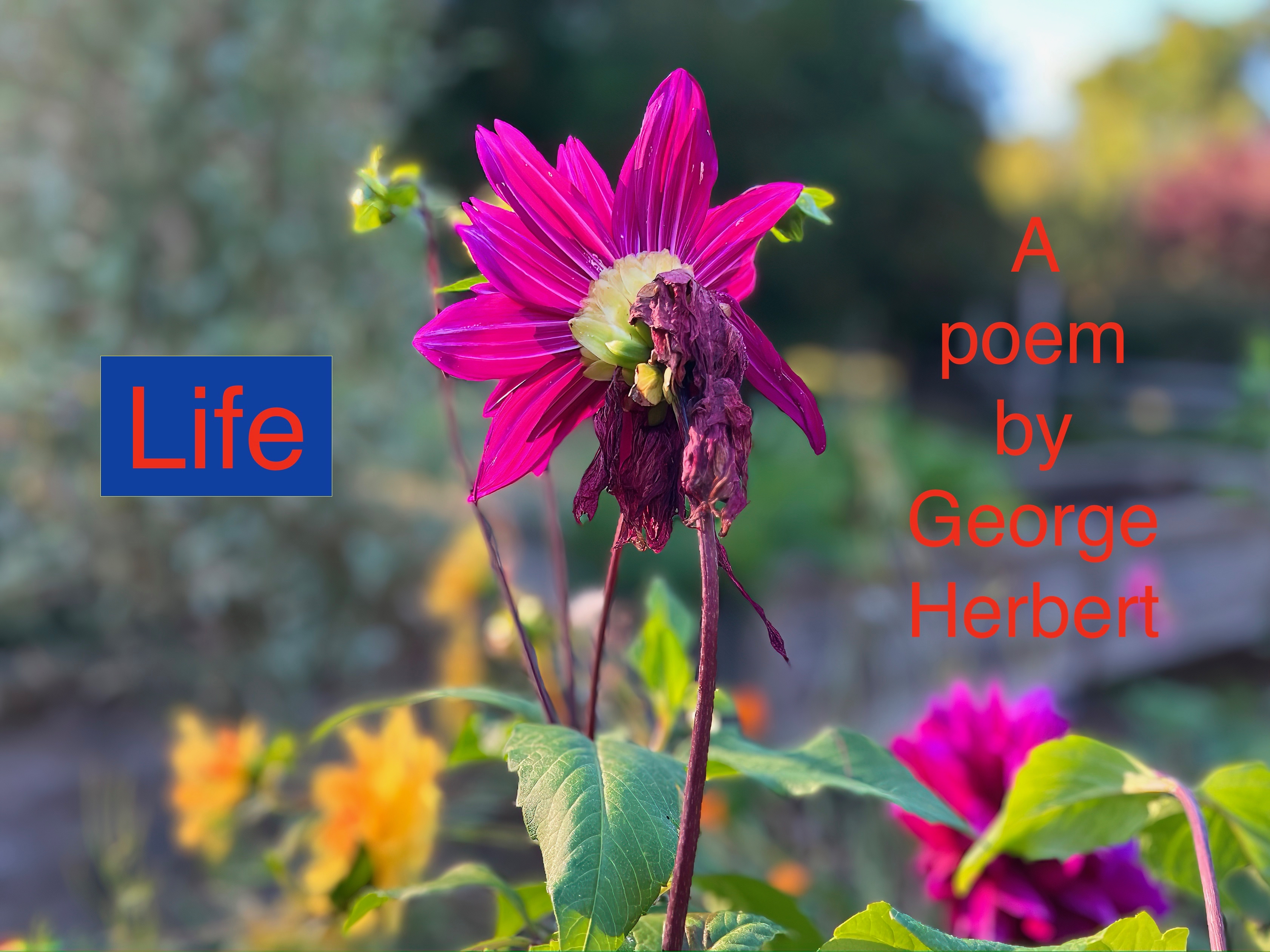
This is the fifth time in ten years of blogging that I have observed the feast day of poet-priest George Herbert—”the greatest devotional poet in the English language”[i]—with a reflection on his poetic “heart work and heaven work.”[ii] For me, in our spiritually impoverished secular age, he remains an indispensable guide for a life of prayer. As I wrote in a previous post,
“Herbert’s passionate engagement with the Transcendent––among us, within us, over-against us––was not theoretical or abstract, but intimate and experiential, employing the first-person form of lyric poetry to open a clearing where his inmost feelings could show themselves to both the speaker and his readers. In his striking play of words, images and sounds, a consort of meanings both public and private, we overhear Herbert’s prayers, and witness the argument of his soul. The brilliance of his poetic invention is never for its own sake. He seeks not to show off his skill, but to surrender his will.”
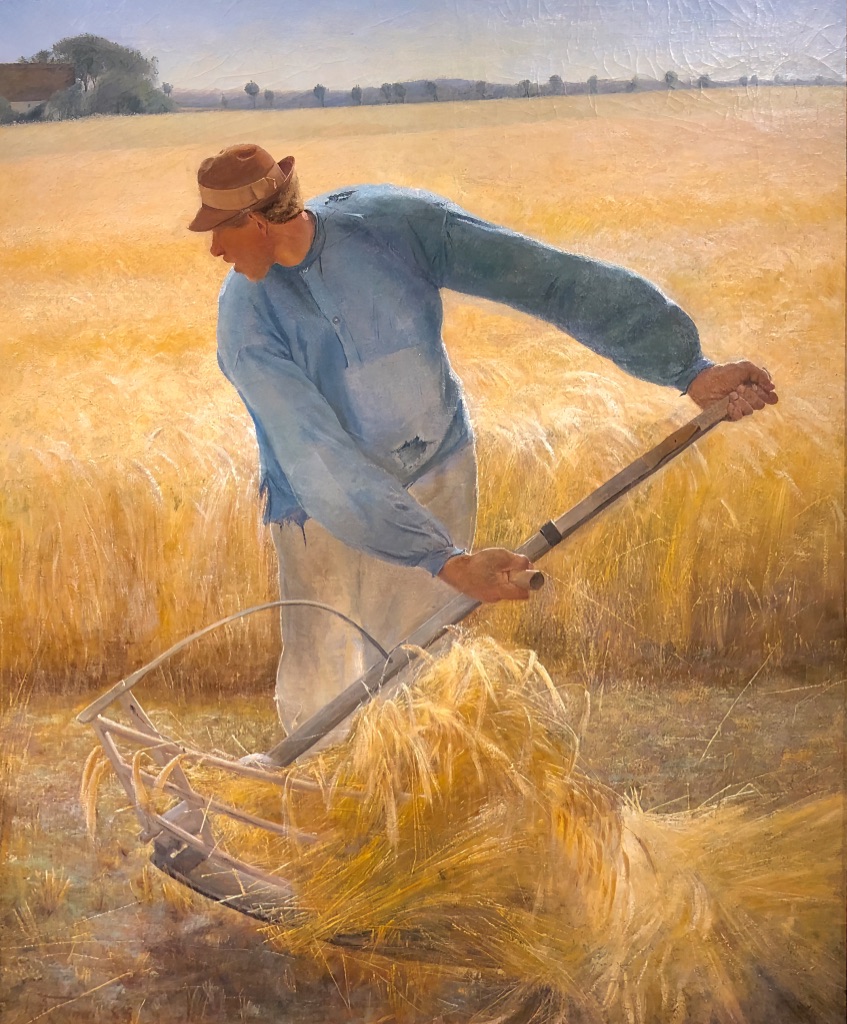
You can find more general information about Herbert’s life and works in the links at the end of this post. Today I want to look at two poems about the inescapable mortality of the human condition. In the first, “Time,” the poet meets up with the Grim Reaper, wielding his scythe used to harvest the ripe field of human souls. He is, of course, the personification of the temporal flow that sweeps us all toward death. Instead of cowering in fear, the poet initiates a playful bantering, as if Time were his equal. Courteously, Time calls the poet “Sir,” and lets him do most of the talking.
Meeting with Time, slack thing, said I,
Thy sithe is dull; whet it for shame.
No marvell Sir, he did replie,
If it at length deserve some blame:
     But where one man would have me grinde it,
     Twentie for one too sharp do finde it.

Perhaps some such of old did passe,
Who above all things lov’d this life:
To whom thy sithe a hatchet was,
Which now is but a pruning knife.
     Christs coming hath made man thy debter,
     Since by thy cutting he grows better.

And in his blessing thou art blest:
For where thou onely wert before
An executioner at best;
Thou art a gard’ner now, and more,
     An usher to convey our souls
     Beyond the utmost starres and poles.

And this is that makes life so long,
While it detains us from our God.
Ev’n pleasures here increase the wrong,
And length of dayes lengthen the rod.
     Who wants the place, where God doth dwell,
     Partakes already half of hell.

Of what strange length must that needs be,
Which ev’n eternitie excludes!
Thus farre Time heard me patiently:
Then chafing said, This man deludes:
     What do I here before his doore?
     He doth not crave lesse time, but more.
From the first moment, the poet disses Time—none other than Mr. Death—calling him “slack” (meaning lazy and slow), and mocking his scythe as shamefully dull. Herbert’s health was poor when this was written (he would die at 40), and his jibe may have been the black humor of a dying man: With such a failing body, how come I’m still here? You need to sharpen your blade, Mr. Death!
But the poet’s surprisingly light tone here is a form not of denial, but of faith. For the believer, Time’s fatal blade brings not annihilation, but new growth: “By thy cutting he grows better.” We’re not sure what Time makes of this argument, but when the poet begins a more speculative discourse about time and eternity, wondering whether they intersect or remain totally separate, Time loses his patience. Why is he standing here listening to this mortal prattle on, wasting Time’s time?
What do I here before his doore? / He doth not crave lesse time, but more. Mr. Death thinks the poet is stalling, trying to gain a little more time with his philosophical filibuster. But knowing the poet’s faith, we may assume that Time is mistaken. What the poet craves is not more time, but eternity: freedom from temporality itself, in “the place where God doth dwell” beyond the binaries of here and there, then and now, presence and absence.
When the 20th-century poet and critic Paul Zweig was diagnosed with lymphoma in his forties, he wrote about his oncologist’s assurances that he might still have a “long time” left.
“Listening to my doctor was delicate. I took in every shrug, every rise and fall of his voice. I weighed his words on a fine scale, to detect hope or despair. Then I called up another doctor, to hear how the words sounded in his voice. I triangulated and compared all to find something that would shut off the terror for a while.” [iii]
Zweig’s “terror” feels searingly authentic. Can we say the same about Herbert’s tranquility? And what happens next, when Time finally loses its patience with us? Herbert does not say. Cannot say, in fact. No one can. Does the silence after the final line signify emptiness (nothing at all), or absolute wholeness (God all in all)? Your answer will shape your religious practice.
Our second poem, “Life,” surprises us when we discover it’s really about death. But isn’t that how life is?—surprising us by coming to an end. Whether it be bitter or sweet, our continued existence seems so convincing. Until it’s not.
The poem’s imagery is very simple. A small bundle of cut flowers, already starting to wither by midday, becomes, through the poet’s act of sustained attention, a metaphor for his own mortality. The materiality of the flowers—which the reader is enabled by the text to see, smell, and touch—is a striking example of Herbert’s “sacramental poetics.” The 16th-century Reformation debates about real Presence haunted the religious poetry of the 17th century. What is the relationship between matter and spirit? Can bread and wine be God, and still remain their material selves? Or as Herbert put it, “how shall I know / Whether in these gifts thou bee so …” [iv]
The inseparability of sign and signified, visible and invisible, matter and spirit was foundational for Herbert. The sacramental bread and wine are capable of “Leaping the wall that parts / Our souls and fleshly hearts.”[v] (The HC 1633) But the sacred elements never vanish into abstractions, mere ideas. They remain material objects we can taste and see with our own material bodies. As Kimberly Johnson explains in Made Flesh: Sacrament and Poetics in Post-Reformation England:
“Just as in the Incarnation the Word was made flesh, such that material and spiritual ontologies might be maintained simultaneously, Herbert’s poetics endorses a representational system wherein the material is not supplanted by spiritual significance but persists as a site of sensory participation … Poetry, as Herbert recognizes, is an embodied art. It activates the flesh as a perceptual instrument and preserves in its nonreferential features the incarnational properties of language, and it is because of these qualities that poetry serves, for Herbert, a sacramental function.” [vi]
In “Life,” the words that engage our senses are not disposable means for grasping abstractions; the flowers remain outward and visible objects in the world (heard, seen, smelled, felt) which are at the same time inseparable from the inward and spiritual meanings they signify. As you read the next poem, notice how the text takes hold of your senses.
I Made a posie, while the day ran by:
Here will I smell my remnant out, and tie
                      My life within this band.
But Time did becken to the flowers, and they
By noon most cunningly did steal away,
                      And wither'd in my hand.

My hand was next to them, and then my heart:
I took, without more thinking, in good part
                      Times gentle admonition:
Who did so sweetly deaths sad taste convey,
Making my minde to smell my fatall day;
                      Yet sugring the suspicion.

Farewell deare flowers, sweetly your time ye spent,
Fit, while ye liv'd, for smell or ornament,
                      And after death for cures.
I follow straight without complaints or grief,
Since if my sent be good, I care not if
                      It be as short as yours.
Following the structural pattern of the 17th-century “poetry of meditation,” whose sensuous imagery was strongly influenced by the Ignatian “application of the senses” to biblical visualizations, “Life” begins by declaring its topic. The speaker has made a “posie” (meaning both a posy of flowers and the “poesy” of Herbert’s verse, adroitly binding those flowers to the written text which offers them to our senses). Next comes a statement of the meditation’s purpose: by comparing his life to the flowers, the poet will “smell my remnant out.” Using the verb’s secondary meaning—to discern as if by smell (think of “sniff out”)—the poet proposes to reflect on the remainder of his life. The rest of the poem moves through a series of sensations and feelings to reach its conclusion of acceptance and resolution in the face of death.[vii]
Before the first stanza ends, the flowers have already withered, though the day is but half done. In the second stanza, the poet absorbs the flowers’ fate with his senses, his feelings, and his thought. He can’t help but “smell” his “fatall day.” This time, however, the sense of smell seems less metaphorical: even the reader cannot miss the whiff of decay.
And yet, Time’s admonition is “gentle.” The flowers are not mowed down by a sharpened scythe, but softly “beckened” to “steal away.” The idea of death is so “sweetly” conveyed by this natural process that it feels sugar-coated and easy to swallow. And like the flowers which have spent their allotted time pouring out their sweet fragrance, the poet resolves to follow their example “without complaints or grief.” As long as his “sent” (scent) is fragrant with goodness, then whatever the actual date on which he is sent to God, all is well. How long we live doesn’t matter nearly so much as how well we live.
In our own violent and dispirited age, we may wonder over the lack of anguish, or fear, or rage, or grief in these poems. Where is “the terror?” How gently—and confidently—do Herbert’s speakers go into death’s good night. Many will find such tranquil surrender to be false, naïve, archaic, unrealistic, incomprehensible, or simply impossible. Nevertheless, Herbert’s poetry remains to pose the vital question: Are we still capable of imagining “Such a Way, as gives us breath … Such a Life, as killeth death?” [viii]
Going gently: The Starry Mountain Singers perform Sam & Peter Amidon’s exquisite arrangement of “All Is Well.”
[i] Helen Wilcox, The English Poems of George Herbert (Cambridge, UK/NY: Cambridge University Press, 2007), xxi. This extensively footnoted collection is indispensable for navigating Herbert’s 17th-century idioms and discovering the wide variety of interpretive strategies applied to his deeply-layered texts over the years.
[ii] This term was applied to Herbert by his contemporary Richard Baxter, a Puritan divine. Herbert’s feast day is February 27.
[iii] Paul Zweig, Departures (New York: Penguin Books, 1988), q. in Death (Lapham’s Quarterly, Vol. VI, No. 4, Fall 2013, p. 210). Zweig wrote this c. 1981, and died in 1984.
[vi] Kimberly Johnson, Made Flesh: Sacrament and Poetics in Post-Reformation England (Philadelphia, PA: University of Pennsylvania Press, 2014), 60-61.
[vii] Louis L. Martz, The Poetry of Meditation (New Haven, CT: Yale University Press, 1962), 58-59. This classic study covers the poets who applied the spiritual exercises of the Counter-Reformation to their poetry and compositional practice: John Donne, George Herbert, Henry Vaughan, Richard Crashaw, Richard Baxter, and Robert Southwell.
[viii] George Herbert, “The Call.” This beautiful poem, set to a memorable tune by Ralph Vaughan Williams, is #487 in the Episcopal Hymnal 1982.
Peering into the unknown in Jónsi’s FLÓÐ, a multi-sensory installation in Seattle’s Nordic Museum.
I have been writings this blog since 2014, and the turning of time at the New Year has always provoked an annual reflection on our temporal existence. If, as 2023 slips away, you’re in the mood for one of those essays, here are some links:
Hope has been my recurring theme at year’s end. On the eve of 2024, it’s a precious commodity. Two years ago, I wrote Tending Hope’s Flame on an Anxious New Year’s Eve. With the flag of hope tattered and torn by endless battles, I drew inspiration from Thoreau, who continued his quiet work of studying the natural world even as the Civil War ravaged the American consciousness. We must, he argued, refuse the hypnotic spell of the chaos which seeks to seduce our gaze. The refusal to take our eye from the transcendent goodness and beauty at the heart of things is “the only fatal weapon you can direct against evil.”
As midnight fast approaches, I don’t have much to add, except a few lines from W. H. Auden’s New Year Letter (January 1940). Written in search of a foundation for living amid amid the chaos of war and the collapse of the known order nearly a century ago, some of it speaks directly to our own present moment:
The situation of our time Surrounds us like a baffling crime …
We find ourselves in Purgatory, Back on the same old mountain side With only guessing for a guide …
The New Year brings an earth afraid …
But then Auden addresses a particular friend who has been for him a shelter from the storm:
We fall down in the dance, we make The old ridiculous mistake, But always there are such as you, Forgiving, helping what we do …
Tonight let’s raise a glass to the ones who forgive, and the ones who help. And that brings me to the photograph I took last summer while immersed in FLÓÐ (Flood), a multi-sensory simulation of oceanic depths by Icelandic artist Jónsi. The two figures gazing into the mist remind me of old illustrations of Dante and Virgil in the Inferno. No matter how unsettling the sights along the way, the companions of the Divine Comedy are usually seen side by side, slightly apart from the next horror, retaining enough detachment from the chaos and pain to analyze and learn from it, without getting sucked into it themselves. And whenever the pilgrim Dante misunderstands what he sees, or succumbs to fear, his guide is there to help.
Virgil leads Dante out of Hell (14c MS).
One of my favorite Divine Comedy illustrations is in a 14th-century manuscript of Dante’s poem. Having traversed the dark way to stand once more beneath the stars, Virgil reaches back to pull Dante out of the pit as well. It’s like that beautiful line in “Auld Lang Syne”:
And here’s a hand, my trusty friend, And gie’s a hand o’ thine.
As we make our own way through the peril and promise of the coming year, may the helpers be there when we need them. And God willing, may we all “take a cup o’ kindness yet.”
Happy New Year, dear Reader. May peace and wisdom abound in the days to come! Thank you for your thoughtful attention in 2023. I’ll see you again on the other side.
“Only a sweet and virtuous soul, / Like season’d timber, never gives …”
Today is the feast day of George Herbert (1593-1633), one of my favorite poets. It is fitting that we remember him at the beginning of Lent, for his poems are imbued with the season’s themes of repentance and renewal. He was a student of what the Book of Common Prayer calls our “unruly wills and affections,” and could be brutally honest about his own need for divine grace.
The Herbert whom we meet in his poems is a person very much in process: unfinished, imperfect, always aspiring to something higher. He cared deeply about formation and growth – his own as well as that of his congregation. As poet and priest he used all possible art to move those with ears to hear.
Herbert’s spiritual environment seems so alive with correspondences between visible things and deeper, invisible realities. The Mystery of the world is met in the humblest of circumstances. The burning bush flashes through the surface of the ordinary. Everyday phenomena are saturated with significance.
This year let us honor “the holy Mr. Herbert” (as his parishioners called him) by examining a single poem. Perhaps we will make this an annual tradition on February 27. For today, the poem is “Virtue.”
Sweet day, so cool, so calm, so bright, The bridal of the earth and sky; The dew shall weep thy fall to-night, For thou must die.
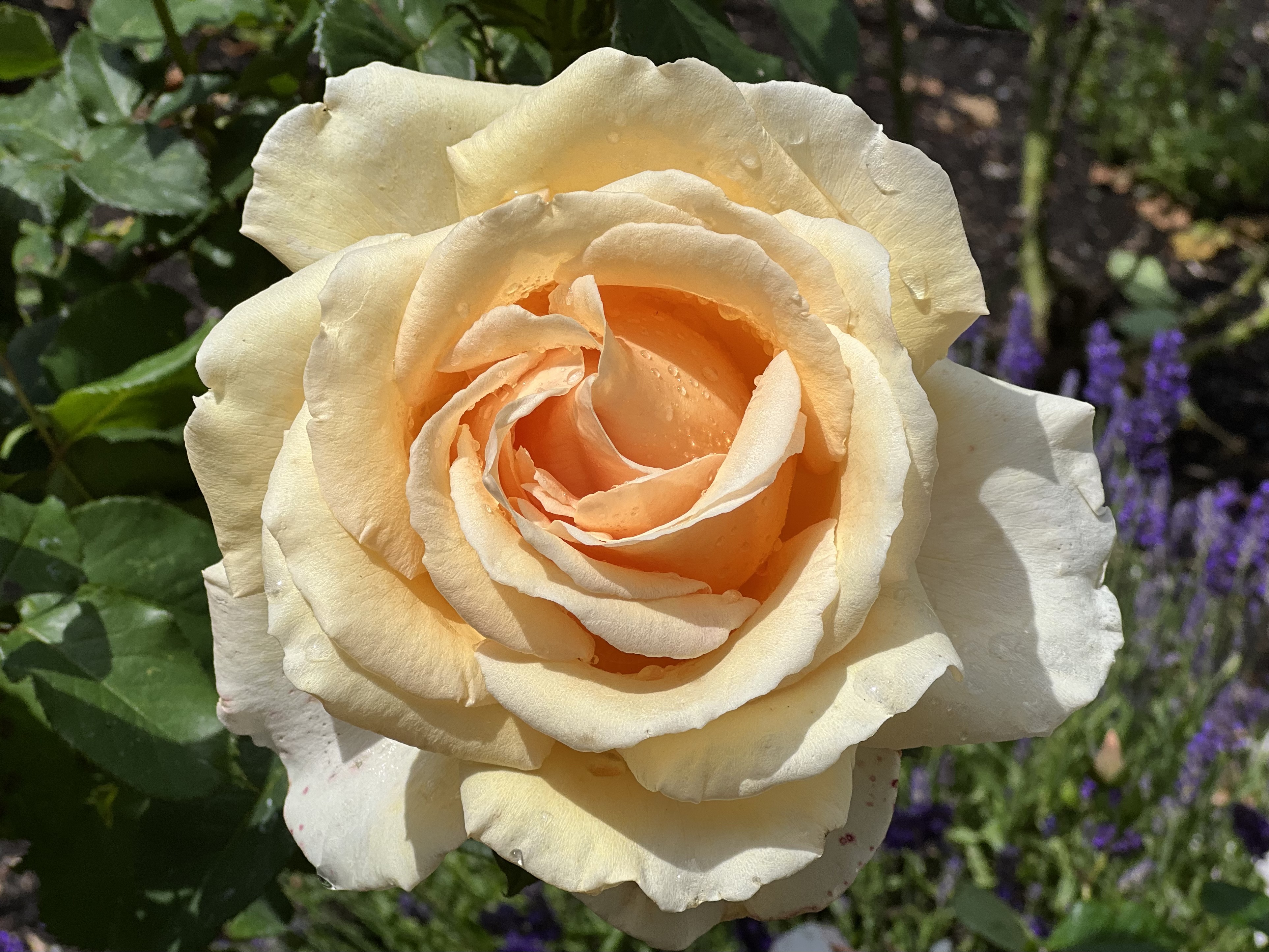
Sweet rose, whose hue angry and brave Bids the rash gazer wipe his eye; Thy root is ever in its grave, And thou must die.
Sweet spring, full of sweet days and roses, A box where sweets compacted lie; My music shows ye have your closes, And all must die.
Only a sweet and virtuous soul, Like season’d timber, never gives; But though the whole world turn to coal, Then chiefly lives.
“Sweet rose … thy root is ever in its grave.”
The poem has been called “one of the purest lyrics in the language.” [i] The predominance of one-syllable words exemplifies its “fine poetic thrift.” [ii] The sixteen short lines, divided into four quatrains, overflow—almost miraculously—with diverse images, references and meanings. For example, “The bridal [wedding] of the earth and sky“ invokes the Easter Vigil’s Exultet: How blessed is this night, when earth and heaven are joined. “Thy root is ever in its grave” describes the paradox of mortal life with stunning brevity: even at our liveliest, we are dying creatures. Or as we say on Ash Wednesday: Remember that you are dust.
The poem’s opening line establishes rhythmic beat of successive iambs (short-long): “Sweet day, so cool, so calm, so bright.” This pattern is more or less followed in the first three lines of the first three quatrains, but each fourth line slams on the brakes with its sober message of mortality, delivered in a series of strong beats like the striking of a drum or the tolling of a bell: Forthoumust die … And thou must die … And all must die.
Although an apocalyptic wisdom throughout the poem reminds us that days end, flowers wither, seasons pass and worlds burn (“turn to [char]coal”), the first three quatrains seem more celebratory than melancholy. The word “sweet” occurs six times. The inevitable terminations of temporal existence need not diminish whatever pleasures and joys we experience in the moment. However, as the poem’s conclusion insists, the “soul”—our innermost self or enduring identity—can partake of something deeper and more lasting, an essential and enduring stability at its core.
The governing images of the final quatrain, “season’d timber” and “turned to coal,” each call up a constellation of meanings. Timber suggests both the cedars of Lebanon and the cross. And the seasoning of wood represents the testing of the soul, which, by God’s grace, “never gives”—never gives in, never gives up. As Herbert scholar John Drury explains, “Timber is seasoned by being left to dehydrate out of doors undercover for several years, enduring, like the soul, the extremes of weather and the seasons. After that it is stable and strong.” [iii]
But wood is flammable, and the doomsday image of a world-ending fire takes us to the brink of ancient fears of annihilation. But Herbert deftly steers us instead into a place of hope and promise. Wood tested by fire can become a glowing ember, an image of liveliness. Likewise can the tested soul become “a quick [living] coal / of mortall fire,” as Herbert says in another poem, “Employment (II).” And even should the world’s last embers cool and turn to dust, the soul which belongs to God will “chiefly” live. “Chiefly” means particularly, or mostly, but it may also reference Christ, the Chief of history, in whom all are made alive.
Unlike the last line of the first three quatrains, with their percussive stresses hammering out our doom, the stresses of the very last line, reduced from four to three, seem gentler and, aided by the use of a two-syllable word, more lilting: “Thenchief-ly lives.” Try reading just the fourth line of each quatrain in succession, and notice the difference in tone at the last.
As it always is with God, life has the last word.
[i] Arnold Stein, George Herbert’s Lyrics (Johns Hopkins, 1968), cited in Helen Wilcox, The English Poems of George Herbert(Cambridge: Cambridge University Press, 2007), 81. I am indebebted to Professor Wilcox for her richly annotated collection of Herbert’s English poems, each of which also includes summaries of the best Herbert criticism over the years. Since his poetry can be difficult and many of his terms archaic, her book is indispensable.
[ii] John Drury, Music at Midnight: The Life and Poetry of George Herbert (Chicago: Chicago University Press, 2014), 59. A must-read if you want to go deeper.
Deschutes River, Oregon, April 2121 (Jim Friedrich)
Poetry’s work is the clarification and magnification of being. Each time we enter its word-woven and musical invocation, we give ourselves over to a different mode of knowing: to poetry’s knowing, and to the increase of existence it brings, unlike any other.
Spirituality and poetry share a common task: “the increase of existence.” This is holy work, and much of it involves coming to terms with time. Whether we waste it, use it, lose it or save it, it is never ours to keep. It is a gift that comes and goes. Whatever is meant by the increase of existence, it cannot be a matter of longevity. That would deny the fullness of time to those who die too soon, and I believe the universe to be kinder than that. No, the increase of existence is not in its length, but in its depth, what T. S. Eliot called “a lifetime burning in every moment.” [ii]
Russian theologian Sergei Bulgakov described this depth as a relationship with the eternal:
“For [the human person], eternity is not a specially qualified time that will arrive after temporal life, as an event in time itself; rather, it is the depth of [our] own being, a depth known in time and ceaselessly revealing itself. Eternity is [our] rootedness in God, and this eternal life both begins and is accomplished in temporal life.”[iii]
In a recent New Yorker cartoon, a small boy tells his bemused parents, “You’re just lucky you don’t have your whole life looming in front of you.” I wonder if that becomes funnier, the older you get. Certainly the nature of time feels different when it starts to run out. Some of us would not mind a little more looming in our later years.
Marilyn Robertson, Santa Cruz, California, January 2018 (Jim Friedrich)
My oldest sibling, Marilyn Robertson, is a poet. In her latest collection, “Small Birds Passing,” time is on her mind. “I like the moreness of time at low tide,” she writes. “Time for a stretch, a sigh. / Time for nothing perfect.[iv] But the stillness of the unhurried moment, the sense of “moreness,” is not inherent to time itself. It is rather the product of our own attentive awareness.
Days won’t wait for us. Hours drift away. Time never got the hang of lingering.
Yet what if we dropped everything, Stood still. Looked around.
That red leaf. Those cloud-sheep. All the small birds passing.[v]
In the first hour and the last, and all the moments in between, pay attention. Sink into the depth of things. Increase existence. Such temporal depth does not come naturally to a society obsessed with speed and surface. We need teachers.
Animals keep trying to tell me how to live:
cat, sunning herself on the grape arbor,
dog, bouncing along the path, in love with everything,
and rabbit, the ardent listener,
her soft antenna ears always tuned to the present.[vi]
In “One Thing,” Moon joins Rabbit in modeling a spiritual practice:
One thing about a rabbit, or the moon, is that they don’t waste time fretting about what to do with the rest of their days.
They are living them, one after another, those tidy packages of hours with their beginnings, their middles and their ends.
Rabbit, hopping along a path through woods, into briars and out again without so much as a scratch on its soft jumpy body,
and Moon, sailing across the infinite ocean of sky, spilling her poetry of light into every window she can find.
And yet, no matter how adept at sounding the depths of the given moment, poets and pilgrims of a certain age cannot help glancing toward life’s horizon. There are too many goodbyes in our latter days, too many deaths, to let us forget the “tears of things.”[vii]
All the farewells in a lifetime. All the ships that sail away, becoming pinpoints. Becoming specks.
“You just missed her.” “He said to say goodbye.”
All the clicks of latches, shutting of lids. “Stand back. The doors are closing.”
There are roads. We have feet. What we leave behind will soon forget our names.
All the losses. All the last words. The telephone ringing, ringing in the night.[viii]
The last line could signify the news of death, received by phone at an untimely hour, but I hear it as a call to someone who is no longer there to pick up. The unanswered phone is a heartbreaking image of disconnection—the permanent loss of a precious voice. And then what? Is everything, in the end, gone for good? Or does the eternity we experience in the “depth known in time” persist for us beyond the grave? In “After,” the poet admits our essential unknowing in this matter.
After the fire, what will I be?
A thing with feathers? Or that little pile of ashes
just there, where the water heater used to be.
And though the poet in her reticence prefers to let the “Thick pages of theology fly / out the window,”[ix] she nevertheless intimates the possibility of resurrection. The title of the collection’s last poem, “The Story So Far,” locates the octogenarian poet in the middle, not the end, of her divine comedy:
[i] Jane Hirshfield, Nine Gates: Entering the Mind of Poetry (New York: Harper Collins, 1997), vii.
[ii] T. S. Eliot, “East Coker” in Four Quartets. The poet goes on to say, “We must be still and still moving / Into another intensity / For a further union, a deeper communion …” In other words, deeper and deeper into God.
[iii] Sergei Bulgakov (1877-1944), The Lamb of God (Grand Rapids, MI: Eerdman’s, 2008), 135. This classic in Christology was originally published in 1933.
[iv] Marilyn Robertson, “Low Tide,” in Small Birds Passing (2020). All her poems and excerpts are from this chap-book.
[vii] This poignant phrase is from Virgil’s Aeneid, Book I.462. The Latin, lacrimae rerum, lacks the preposition which English requires, creating the ambiguity in translation of “tears for things” vs. “tears of things.” Seamus Heaney’s rendering speaks to the immensity of our grief in this time of pandemic: “There are tears at the heart of things.”
“No longer at ease here, in the old dispensation.” — Leonardo da Vinci, Adoration of the Magi (detail, 1481).
Three days before the 2016 election, I posted The Top Ten Reasons To Stop Trump Now. All of them, sadly, turned out to be valid forecasts, but three of them remain especially worrying over the next two weeks:
Nuclear threat Giving control of the world’s most powerful military, not to mention the nuclear codes, to an emotional toddler is clearly insane.
FascismBelieve me. I alone can make America great. Everyone else is stupid. Trump is part of a worldwide erosion of democracy by a resurgent authoritarianism. Fear and hate have made many sell their souls to naked power. When fascism spread in 1930’s Europe, Americans were confident that “it can’t happen here.” Now we aren’t so sure.
Hatred Racism, bigotry, misogyny, bullying, scapegoating and political violence have been making a shocking comeback, with Trump as their enthusiastic cheerleader. He has endorsed and normalized the most vile sins of the American shadow. God help us should he and his alt-right thugs and cronies ever come to power.
I wrote my warning on November 3, 2016. I wish I’d been wrong.
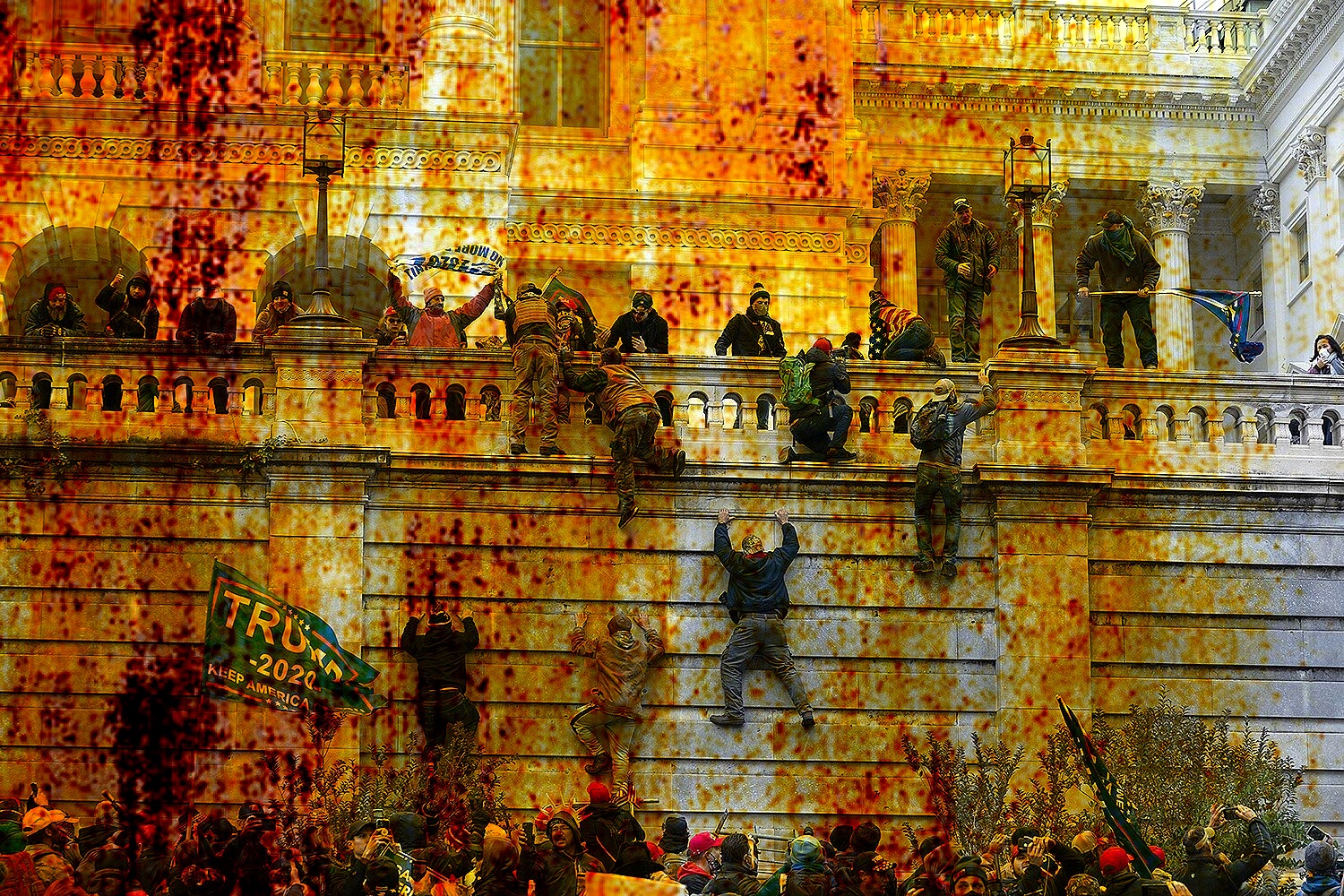
After yesterday’s insurrection, many are calling for the immediate removal of the President from power, and I add my voice to theirs. His seditious incitement of a coup may have been ridiculously futile, but it cannot be indulged as another childish tantrum. It was both physically dangerous and symbolically toxic. It will take our country a long time to live it down.
Breaking the law and shaming his country should be reason enough for immediate removal. But we should also be genuinely worried about the dangerous unpredictability of a cornered rat. He still controls the nuclear codes. He is still an unstable sociopath, a clear and present danger to America. As a Republican congressman put it today in calling for Trump’s removal, we need “to ensure the next few weeks are safe for the American people, and that we have a sane captain on the ship.”
One way or another, Trump will exit, but the venom that produced him will remain in our system for a long time to come. The alternative universes of social media continue to erode the very notion of a Union. It’s now all too easy to secede from consensual reality. Millions upon millions are joining delusional confederacies of bitterness and hate. And unprincipled, power-hungry cynics like Senators Josh Hawley (educated at Stanford and Yale) and Ted Cruz ( Princeton and Harvard) will continue to harvest money and votes from the killing fields of ignorance and bigotry.
For Christians, the defilement of the Capitol also tainted the Feast of the Epiphany, when we celebrate the manifestation, or revealing, of Christ’s light to the whole wide world. The Episcopal Collect for the Epiphany prays for the Beatific Vision: “Lead us, who know you now by faith, to your presence, where we may see your glory face to face.” Sadly, what the world beheld on Epiphany was not the Light of the world, but an eruption of darkness from the vilest murk of the American id.
As with any healing, you can’t begin treatment until you get a diagnosis. Could yesterday’s “epiphany,” revealing the seriousness of our affliction, be the beginning of a cure? Speaker of the House Nancy Pelosi, herself a Catholic who knows the sacred feasts, expressed this hope. “Let us pray,” she said, “that this instigation to violence will provide an epiphany for our country to heal.”
The bizarre coincidence of the insurrection with the culminating celebration of the Nativity calls to mind the famous ending of William Butler Yeats’ “Second Coming:”
And what rough beast, its hour come round at last, Slouches towards Bethlehem to be born?
All of us who were transfixed by the slouching horror on our screens yesterday feel the resonance of Yeats’ disturbing image. But my preferred poem for the day would be T. S. Eliot’s “Journey of the Magi,” a first-person account of the original Bethlehem Epiphany. Like every pilgrim, the speaker has tales to tell about the hardships of the quest. However, about the moment of revelation—beholding the Incarnate God face to face—he is curiously reticent, as though it would diminish the experience to put it into words.
Once he returns home, with time to reflect, the Magus finds himself “no longer at ease here, in the old dispensation, / With an alien people clutching their gods.” Having looked divine Love in the face, he finds a world without that love to be less than “satisfactory.” No longer able to settle for anything less than what he glimpsed in the Bethlehem stable, he finds himself “no longer at ease.” The journey to the Divine birth becomes for him a kind of death, a perishing of his old world and his old self.
In the light of the Epiphany—the revealing of ultimate truth—the Magus is transformed. He will never be the same. Dare we say the same about yesterday’s terrible “epiphany”? Has seeing our own darkness face to face shaken us to the core? Has it shocked us into renouncing its terrible sway? If we suddenly find ourselves “no longer at ease here,” thanks be to God! Our journey toward the Dawn can begin at last.
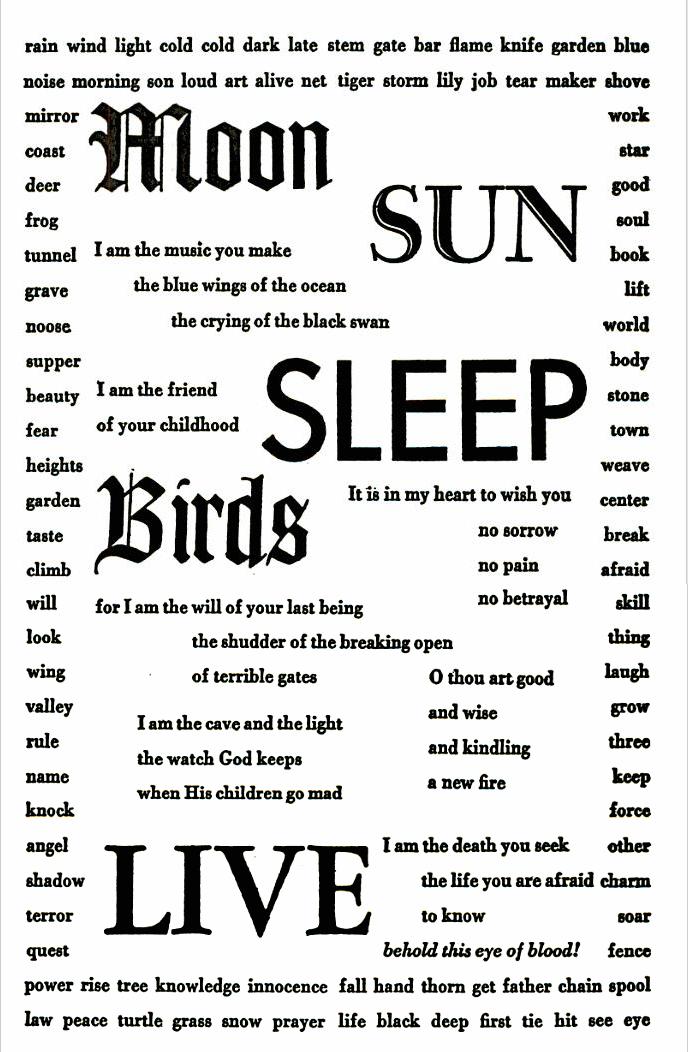
Live long enough, and a single word can acquire a multitude of associations. Pick any word in Kenneth Patchen’s poem, for example. What images and narratives does it summon from your memory? What feelings does it unlock? I’ll get us started with the five large words.
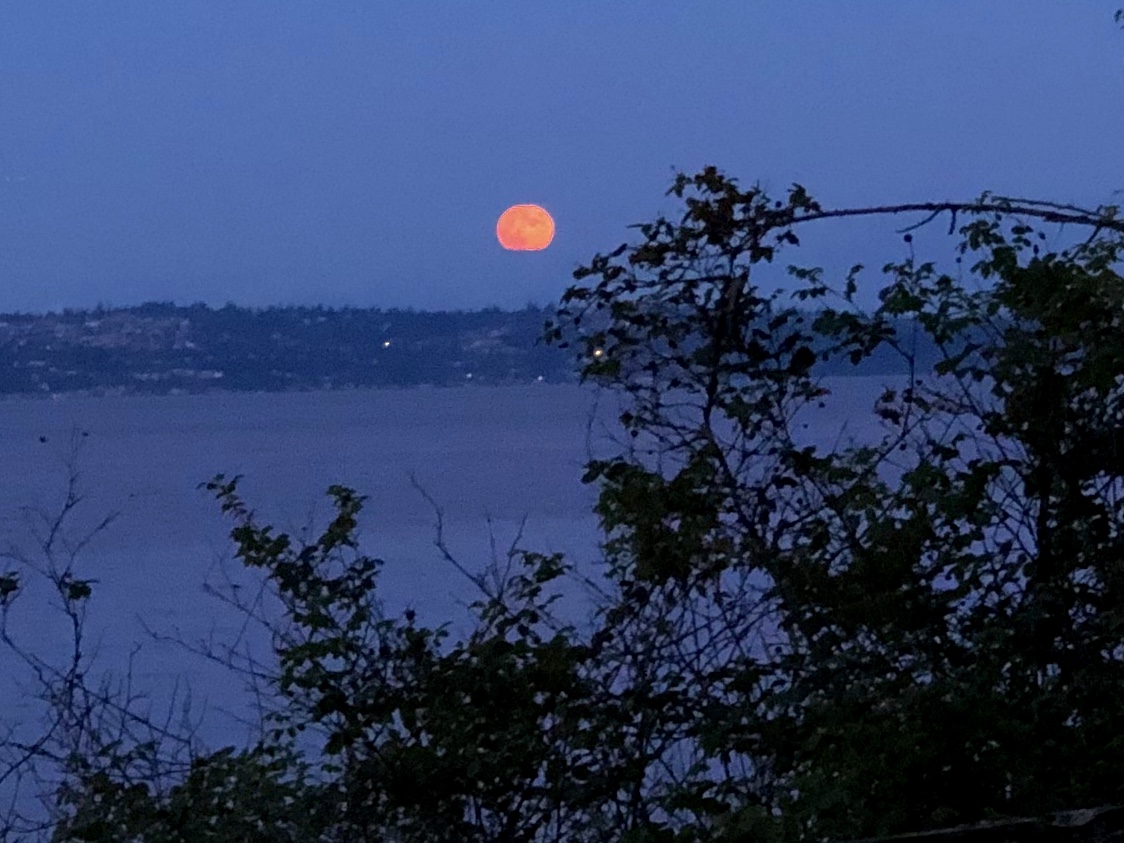
Full moon rising on the 50th anniversary of the Apollo 11 launch (July 16, 2019).
Moon: Since the day of my birth, 912 full moons have risen into the evening sky. Whenever I am able and the sky is clear, I find an open view to the east and wait for its appearing. The moon’s predictability has never dulled the thrilling instant when its bright curved edge breaks the horizon. Over the four weeks of waning and waxing that follow, its slow dance of vanishing and renewal attunes us ever so gently to the temporal flow. The diurnal sequence of sunrise and sunset seems rushed in comparison.
I’ve had my eye on the moon since I was old enough to notice the sky. I remember specific moons the way one remembers luminous conversations: the Wyoming moon sparkling the fresh powder in a midnight ski run down Teton Pass; the Minnesota moon rising beyond the Mississippi River as we warm ourselves by a driftwood fire; the Florida moon shining down on the circus tent where 400 Episcopal collegians celebrate Epiphany all night till dawn; the Los Angeles moon traversing the sky behind a 7-hour performance of Indonesian shadow puppets; the glowing tip of a rising crescent climaxing a night of falling stars in the High Sierra; the lunar eclipse stunning three priests with wonder on a Northwest beach; the many moons lighting the way on mountain trails and desert dunes; and last year’s spectacular birthday moon, rising on the 50th anniversary of humanity’s first trip to the lunar surface.
The most recent full moon rises over Puget Sound on the Fourth of July.
When the full moon first appears, silence is best. It resembles the host of the Blessed Sacrament, a white disc lifted up before our contemplative eyes. The only words I can specifically recall from a moonrise were spoken by an American woman on the Scottish isle of Iona. “You know,” she said, “I’m 55 years old, and I’ve never seen the moonrise before.”
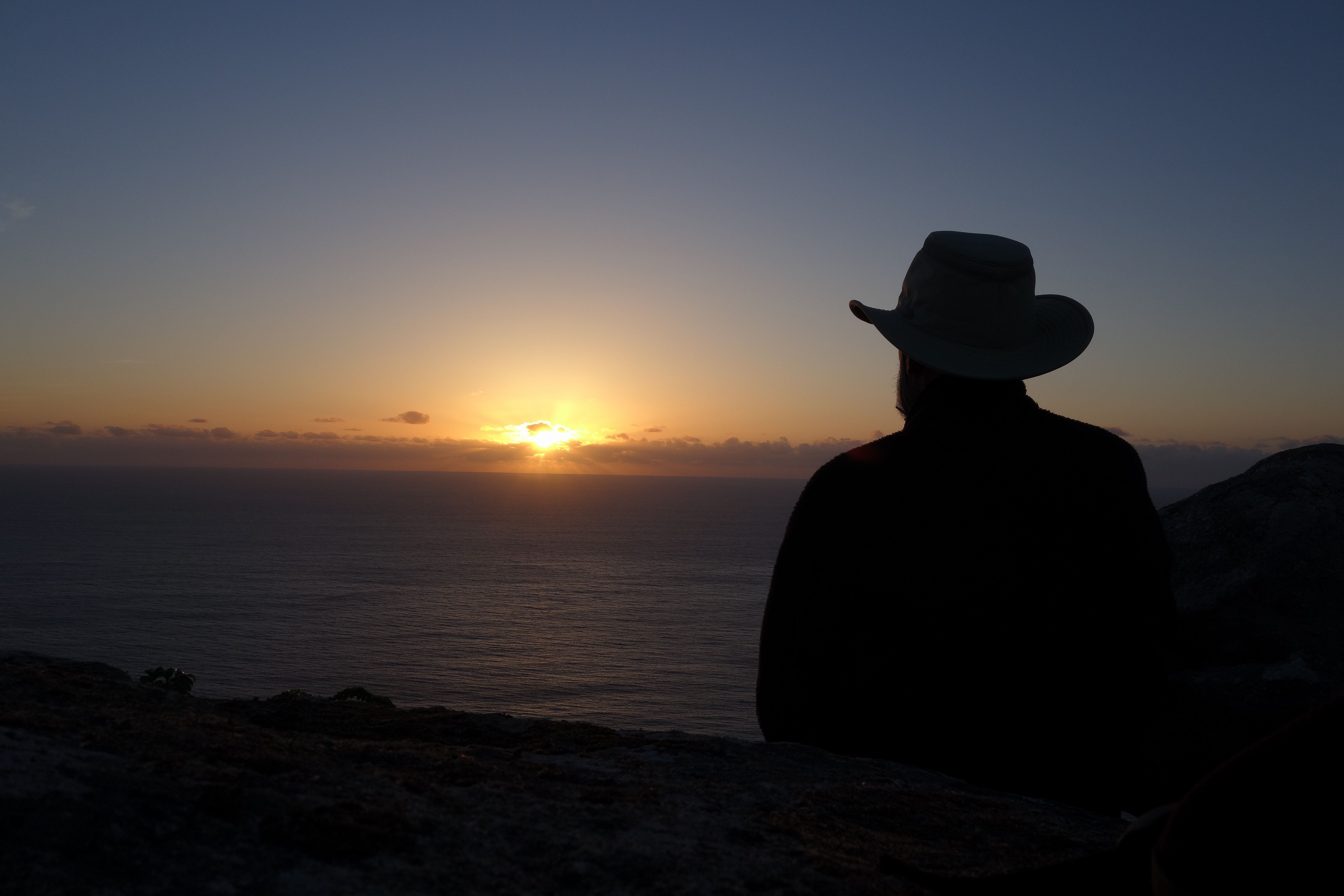
The sun sets over “the edge of the world” at Finisterre, the western terminus of the Camino de Santiago.
Sun: The sun is a perennial symbol of life-giving energy and joyful radiance. And while climate change has certainly complicated both its literal and metaphorical meanings, we still welcome its warmth and light after a freezing night or a long winter, we still feel uplifted by its brilliance after a dreary stretch of sunless days. Even as we address the growing imbalance in our weather and our seasons, we remember to treasure in every moment the blessings we struggle to preserve.
A benevolent sun still has the power to cheer us, and the rhythms of night and day remain foundational for an embodied and temporal spirituality. Embrace each morning as the gift of creation’s new-made world, make each evening a vesper song of thanks. And in between, let us live as children of the light. Love whatever is good and beautiful and true, and work to transform whatever is not.
Sunlight, like our own breath, is easy to take for granted. Without it, life would be impossible. Even when night comes and goes, the transitions are gradual enough to ease the shock of the sun’s disappearance. We never experience the sun being abruptly switched off, except during a total eclipse. Watching the sun become a black disc, which can be viewed with the naked eye, is pure wonder, one of this world’s most unforgettable experiences. But the sudden disappearance of light from earth and sky is eerie and unsettling—so sudden, so absolute, like an apocalypse. Its return is equally swift, like the first moment of creation: Let there be light.
I shot this video clip of an Oregon landscape during the 2017 solar eclipse. I was gazing directly at the sun, of course, but the camera recorded what was happening on the earth. The shot is in real time. It only takes about 30 seconds for the darkness to vanish.
Sleep: In 1979, after several days of sleep deprivation, I grabbed a red-eye flight from Los Angeles to New York to visit my brilliant friend Bob Sealy, a critical mentor to me in cinema, theater, the art of conversation, and all things New York. I arrived in Manhattan around 8 a.m., utterly exhausted. Bob was busy with revisions of his new play at Café La MaMa, and had arranged a place for me to nap while he worked––a windowless storage room in a seedy building reminiscent of Forties film noir. I stretched out on a dingy couch. When Bob closed the door I was left in total darkness, and soon fell into a dreamless sleep.
Ministry of Fear (Fritz Lang, 1944)
Hours later, the door swung open, awakening me from the depths of slumber into a confused state of mental fog. The room was still so dark. A faceless silhouette loomed in the doorway. For a moment, I didn’t know where I was, who he was, or what I was doing there. It was a nightmarish scene straight out of Fritz Lang. Then Bob switched on the light and my stupor began to fade. He led me out to the daylight world, the realism of city streets. But I had not entirely quit the darkness. The noirish image of that moment lingers to this day.
“Don’t watch the story,” Bob once told me about the movies. “Watch the image.” The story will go on its way toward a conclusion, but a vivid and suggestive image can detach itself from the plot to call up something deep and enduring in the psyche. Where is that dark room inside me? Who is at the door?
A goldfinch in our peach tree. They arrive at Easter and depart in the fall.
Birds: As we shelter in place until the pandemic passes, our only regular visitors are the birds––robins, goldfinches, juncos, pine siskins, red-winged blackbirds, black-capped chickadees, spotted towhees, red-breasted nuthatches, golden-crowned kinglets, house and purple finches, varied thrushes, cedar waxwings, sparrows, wrens, ring-necked pheasants, and a pair of mallards. More rarely, a bald eagle may perch atop a Douglas-fir, or a blue heron land on the grass.
A blue heron drops in for a visit.
But the specific bird that came to mind when I first looked at Patchen’s poem was a mountain chickadee in the summer of 1973. While backpacking in California’s Desolation Valley near Lake Tahoe, I had paused to stretch out in a green meadow, leaning back on my elbows with my knees sticking up. I was in no hurry, and had settled into the stillness of reverie when the little bird landed on my right knee. It perched there calmly for some time. I like to think it was being sociable, signaling across the gulf between species the underlying kinship of all created beings. Perhaps it just mistook me for a log. But I have never forgotten our brief communion.
The author at the family plot in Red Wing, Minnesota (June 2006).
Live: My great-grandfather, John Michael Friedrich, immigrated to Red Wing, Minnesota, in the 1860s. He died young, only 47, and for his male descendants, longevity has been in limited supply. John Michael had two sons, Charles Edward (died at 67) and John Harry (34). Charles Edward had four sons: John (72), Edward (20), my father James (62) and his twin brother Louis (8 months). John had two sons, Jack (50) and Brad (75). I am currently the oldest living male of the line, and today I become the first to reach 76. It is a humbling milestone, and I feel my ancestors cheering me on.
In these latter days, to borrow a line from Blade Runner, I want “the same answers as everybody else: Where did I come from? Where am I going? How long have I got?” But meanwhile, more moons! More suns! More birds! More sleeping and waking! As long as God gives me breath.
And then? For the pilgrim, the road goes ever on and on, in this life and the next.
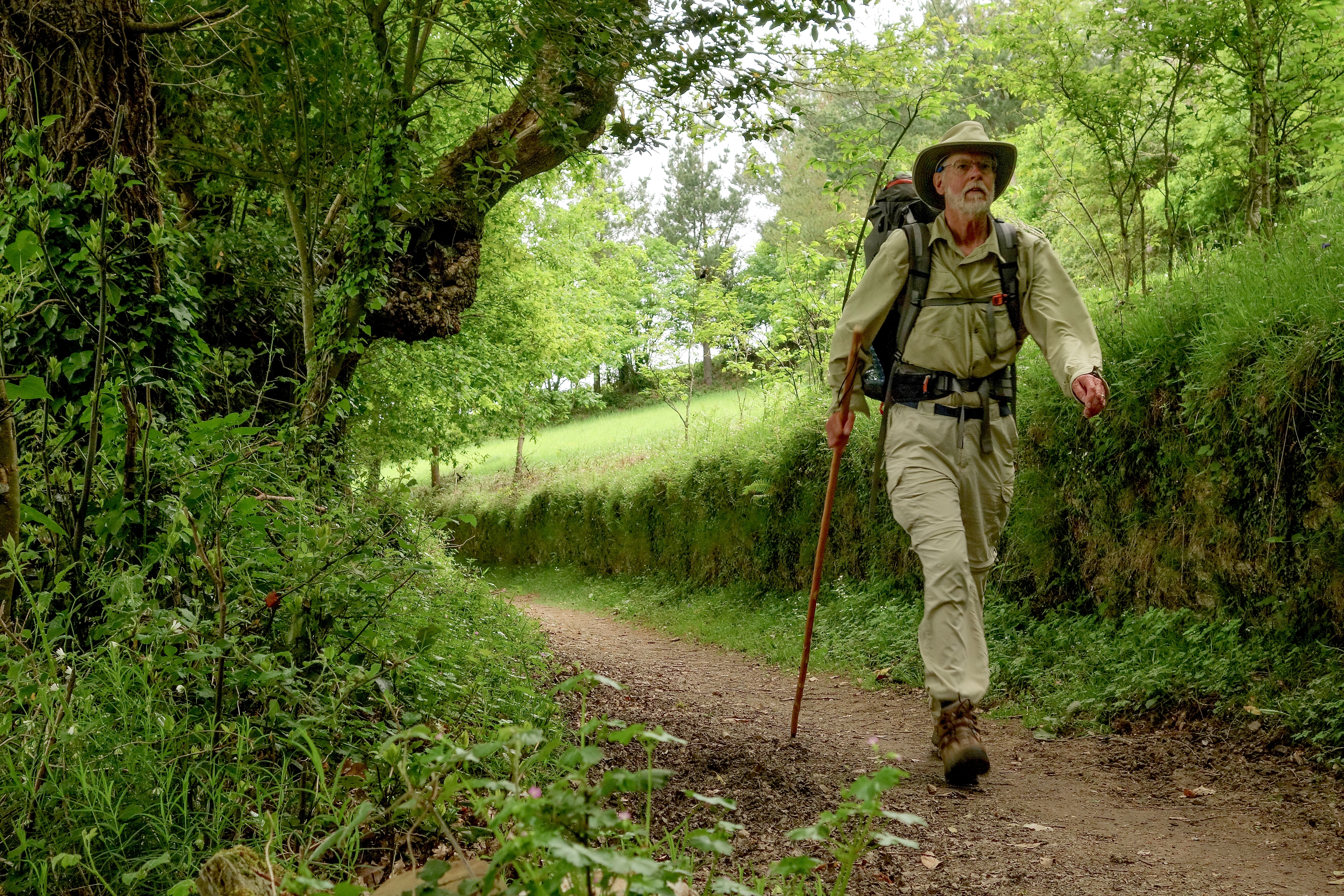
The road goes ever on and on … (Camino de Santiago, Galicia, 2014)
The author watches the Solstice sunset from Friedrich Point on Lake Pepin, Minnesota.
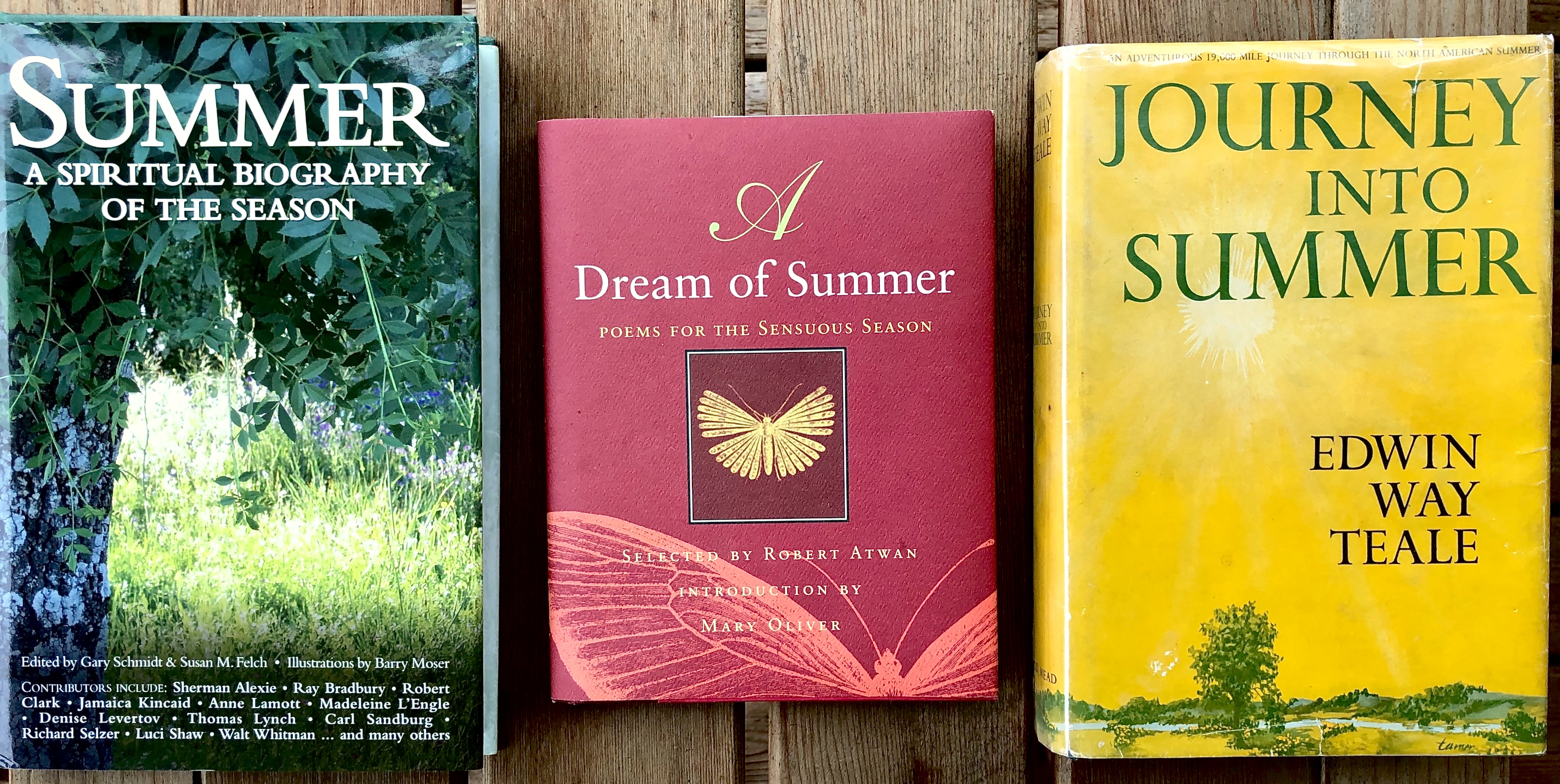
For 150 years, James Thomson’s The Seasons was one of the most widely read books in the English-speaking world. Its ornate classical style and lack of emotional inwardness fell out of favor in the Romantic era, but it still sits on my shelf along with other great ruminations on the circle of time, like Edwin Way Teale’s quartet of road trips through the American seasons, the “spiritual biographies” of Spring, Summer, Autumn and Winter compiled by Gary Schmidt and Susan Felch, and the four diminutive volumes of seasonal poetry selected by Robert Atwan.
Essential summer reading.
Thomson’s Summer begins:
From brightening fields of ether fair-disclosed,
Child of the Sun, refulgent Summer comes . . .
Hence let me haste into the mid-wood shade,
Where scarce a sunbeam wanders through the gloom,
And on the dark-green grass, beside the brink
Of haunted stream that by the roots of oak
Rolls o’er the rocky channel, lie at large
And sing the glories of the circling year.
But the poet’s encyclopedic survey of the world beneath the summer sun is not simply an inventory of its pleasures and beauties, for Nature is not uniformly benign. Storms, floods, drought and earthquakes are part of the mix. Et in Arcadia ego. Thomson’s description of a plague (“the great destroyer”) feels ripped from current headlines. Pandemic mutes “the voice of joy,” sickens human communities and empties public spaces. People shelter in place, hoping to escape the “awful rage” of pestilence, as “o’er the prostrate city black Despair / Extends her raven wing.”
The sullen door,
Yet uninfected, on its cautious hinge
Fearing to turn, abhors society:
Dependents, friends, relations, Love himself,
Savaged by woe, forget the tender tie,
The sweet engagement of the feeling heart.
Who among us is not “savaged by woe,” cut off as we are from tender ties and seasonal rituals? But the poet, trusting the Providence “of powers exceeding far his own,” does not leave us there. He envisions the evils of this world subdued within a larger harmony, and even in the time of trial faith knows, impossibly, that all shall be well. “Nature from the storm / Shines out afresh; and through the lightened air / A higher lustre and a clearer calm / Diffusive tremble; while, as if in sign / Of danger past, a glittering robe of joy, / Set off abundant by the yellow ray, / Invests the fields, yet dropping from distress.”
Summer 2020 does not arrive robed in joy. Tonight’s dark and deadly Trumpist rally in Tulsa, a demonic parody of traditional Summer Solstice affirmations of light and life, seems to augur a summer of darkness. But we must not succumb to the pestilence without––or the pestilence within. We must live as children of the light, refusing the gloom and resisting the storm. Already, voices are rising across our tormented country, demanding “a higher lustre and a clearer calm.” And each of us, in ways both great and small, must continue to welcome the light, and to remember our joy.
Enough for us to know that this dark state,
In wayward passions lost and vain pursuits,
This infancy of being, cannot prove
The final issue of the works of God,
By boundless love and perfect wisdom formed,
And ever rising with the rising mind.
Poetry excerpts are from James Thomson, Summer (1727), part of his quartet, The Seasons (1730).











 The religious imagineer