Are we too late for the Resurrection?

Guercino, "The Incredulity of Thomas" (1621)

Guercino, “The Incredulity of Thomas” (1621)

What we have heard,
what we have seen with our eyes,
what we have looked at and touched with our hands—
the Word of life— this is our theme . . .
We declare to you what we have seen and heard,
so that you too may share our life.    (I John 1:1,3)

The Easter Vigil is a night of wonders. Beginning after dark on Holy Saturday, God’s friends gather around a fire under the stars, as poets and singers, accompanied by the sounds of loon, whale and wolf, take us back to the beginning of time, when all things came to be. Then we follow the Paschal Candle, symbol of the risen Christ, into the Story Space to experience creative retellings of our sacred narratives, recalling God’s unfailing covenant with us throughout history. Theater, storytelling, music and multimedia immerse us in the rich play of Scriptural meanings. After that we process into the church, to the font of new birth, renewing our baptismal vows by candlelight. Suddenly, the contemplative quiet is broken by a great tumult of drums, bells, chimes (and sometimes fireworks!) as we welcome the first eucharist of Easter, sharing the feast of heaven with bread and champagne,and dancing our praises around God’s table.[i]

The Easter Vigil is the Christian dreamtime, the molten core of our worship life, but for those who missed it, who didn’t arrive at church until Easter morning, it exists only as a rumor of something quite out of the ordinary, hard to imagine after the fact. I could describe what happened in great detail, but a considerable amount of the joy and the wonder would be lost in the telling. Hearing about it is not the same as actually experiencing it.

Just ask Thomas the Doubter. He had missed out when the risen Christ first appeared to the other disciples.[ii] Oh Thomas, it was so amazing, so incredible! If only you had been there. “No way,” he says. “I just can’t see it. You must have been dreaming.” And so Thomas became known as the Doubter, and the Church made him patron saint of the blind. And yet, we always honor Thomas by telling this story on the Second Sunday of Easter, as if to say,

We welcome those who take questions seriously;
we believe that faith and doubt must dance together;
we are in fact a community of those
who wrestle with God’s absences
as well as God’s presences.

Another Thomas, the 20th century Welsh poet and Anglican priest, R. S. Thomas, wrote a poem about this gospel story:

His are the echoes
We follow, the footprints he has just
Left. We put our hands in
His side hoping to find
It warm.[iii]

The sense of belatedness, of arriving too late, haunts every religious tradition whose foundations lie in definitive past events. Even Jesus’ closest friends, who had shared a last supper with him just days before, felt the warmth of his presence quickly cooling into memory.

But then they discovered that Christ does not come to us out of the past, locked within well-worn expectations. The risen One comes out of the future, often in a form we don’t expect: the stranger, the other, the outcast, even the enemy. If we only look for Jesus in the vacated tombs of past experience, we will get the admonishing angel: “He is not here. He’s already waiting for you somewhere else. Go and see.”

For a while after the resurrection of Jesus, there were sensory appearances in a form the disciples could recognize and relate to in the old familiar ways. They spoke with him. They ate with him. They experienced his peace. And their primal witness remains vital. A positive identification of the risen One as the same person who died on the cross was essential to the core Easter message: Jesus lives! Not a memory, substitute, or simulacrum, but a continuing presence which not even death could kill.

These appearances eventually ceased, but before they did, Thomas finally got his moment with the Jesus he had known. It blew away his doubts and drove him to his knees. But then Jesus said, “Blessed are those who have not seen, and yet believe.” And later he said, “I am with you always, even to the end of time.”

In other words, Christ’s resurrection is not limited to the personal experiences of a few first century people. If that were the case, then it would be something we could only hear about later but never experience for ourselves. Like Thomas before his late encounter, we would have only Christ’s absence.

But the Easter faith affirms the continuing presence of the living Christ among us, now and always. That presence is not always clear or obvious. Even the saints wrestle with doubt and absence. Sometimes divinity seems to withdraw for a time. Sometimes it is we who are absent— distracted, inattentive, looking in the wrong place, using the wrong language. Divine presence can’t be switched on, or grasped possessively. It is elusive. It is fond of surprise.

But we are not left without clues. Jesus tells us, “If you want to keep experiencing me, love one another. Forgive one another.”[iv] Thus we meet the risen Christ in the life of forgiveness, reconciliation, peace, justice, love. Where love and charity abound, there God is, there Christ is. It’s not enough to proclaim resurrection. We need to embody it.

As Rowan Williams explains: “the believer’s life is a testimony to the risen-ness of Jesus: he or she demonstrates that Jesus is not dead by living a life in which Jesus is the never-failing source of affirmation, challenge, enrichment and enlargement.”[v]

The Book of Acts tells us the first believers made their common life a “laboratory of the resurrection”[vi]— not just a theological mystery but a daily practice, rejecting the economics of selfishness and scarcity for radical acts of generosity and compassion. Their belief was a practice of entrusting themselves to the renewing force of divine love that is never exhausted by the sufferings of the world. In other words, resurrections have consequences.

These are large claims, of course, and not universally embraced. But for me resurrection’s greatest challenge is not that I am being asked to believe something difficult; it is that I am being asked to do something difficult:

to be utterly transformed by immersion into the dying-and-rising of Christ,
to become my baptismal self,
to cast off the rags of ego and fear
and be clothed in “garments of indescribable light.”[vii]

It’s not intellectual or empirical doubt that makes me hesitate at the threshold of the risen life. It’s not that I think such transformation to be impossible. No, for countless saints have already demonstrated its possibility. My doubt concerns myself. Am I up to it?

Have you ever stood on a rock
twenty feet above the surface
of an icy mountain lake?
The summer day is hot;
you know the water will refresh you.
You are caked with grime and sweat from hours of hiking.
It will feel so good to wash it all away.

You imagine the explosive energy of the splash,
the exhilarating shock of glacial waters.
And you anticipate the joy of swimming,
the bliss of weightlessness
setting you free from the gravity of things.

But you hesitate.
You doubt.
The water is dark.
Are there rocks beneath the surface?
Will the sudden cold take your breath away?
The very act of stepping out into nothing
is resisted by an inner voice of self-preservation.

There’s no way to stop the mind’s questions or the body’s fears.
They persist for as long as you stand there.
The lake doesn’t get any warmer.
The boulder doesn’t get any lower.

Then you just lean out into space
and let yourself go.


Related Posts

Just a dream? Reflection on the Easter Vigil

Christ is risen!


[i] Although most Easter Vigils don’t happen quite this way, they can, and (IMHO) should. I have been curating them this way for several decades in various worship communities, and I believe that such a rich interplay of ritual and the arts, engaging all the senses in a multigenerational, visionary happening, at once contemplative, playful, and ecstatic, does true justice to our celebration of the Paschal Mystery – the passage from darkness and death into the risen life..

[ii] John 20:24-29

[iii] R.S. Thomas, “Via Negativa,” Collected Poems: 1945-1990 (London: Phoenix Giant, 1995), 220

[iv] My gloss on the Farewell Discourse in the Fourth Gospel (John 14-17)

[v] Rowan Williams, Resurrection (New York: The Pilgrim Press NY, 1984), 62-3

[vi] Dumitru Staniloae, q. in Olivier Clement, The Roots of Christian Mysticism (Hyde Park, NY: New City Press, 1993), 82

[vii] Pseudo-Macarius (desert father, c. 400, Mesopotamia/Asia Minor) First Homily

Feast of the Epiphany: The worst time of year for such a journey

Along the Camino de Santiago, April 2014

Along the Camino de Santiago, April 2014

It is not commended to stand ‘gazing up into heaven’ too long; not on Christ himself ascending, much less on his star. For [the Magi] sat not still gazing on the star. Their vidimus begat venimus; their seeing made them come, come a great journey.

— Lancelot Andrewes, sermon for Christmas Day, 1622[i]

When T. S. Eliot wrote his great Epiphany poem, “Journey of the Magi,”[ii] he borrowed freely from a Nativity sermon preached in 1622 by the English bishop, Lancelot Andrewes:

A cold coming they had of it at this time of the year, just the worst time of the year to take a journey, and specially a long journey. The ways deep, the weather sharp, the days short, the sun farthest off, in solstitio brumali, ‘the very dead of winter.’

Andrewes, who oversaw the translation of the King James Bible, had a gift for elegantly expressive language, and Eliot altered the original only slightly to make the first lines of his poem:

‘A cold coming we had of it,
Just the worst time of the year
For a journey, and such a long journey:
The ways deep and the weather sharp,
The very dead of winter.’

The liturgical and theological focus of today’s Feast of the Epiphany is the universal reach of the Light of the World. The three Magi, coming from faraway places to do homage to the Christ Child, signify that whatever was revealed in Bethlehem was not confined to a single culture, language, or tradition. The babe in the manger would ultimately spark recognition in every longing heart.

But Eliot’s particular focus is on the psychology and spirituality of the Magi themselves, or at least the one whose voice speaks the poem. He recites the complaints common to pilgrims: bad roads, bad weather, bad food, unpleasant companions, inhospitable strangers, and the homesick yearning for one’s own bed. He wonders whether the journey might be ‘all folly.’

The bleak desert crossing resounds with haunting echoes of The Waste Land, heightening the relief we feel when the traveler finally comes to “a temperate valley … smelling of vegetation.” But instead of the sweet, unblemished beatitude of a Nativity scene, the Magus is baffled by a series of disparate sights whose meanings are still in the future: vine branches, empty wine-skins, pieces of silver, three trees on a hill, the pale horse of the Apocalypse.

As for the actual moment of arrival, of seeing the long-sought Epiphany, it is described with the utmost reticence, as though words must fail before such a mystery:

… it was (you may say) satisfactory.

Then what? The Magi go back home, to the world they knew,

But no longer at ease here, in the old dispensation,
With an alien people clutching their gods.

Whatever Bethlehem had shown them, nothing in their lives would ever, could ever, be the same. This holy Birth had also brought a kind of death: the ‘old dispensation,’ whatever the Magi had settled for up to now, could no longer stand. The world of the past – erring, broken, lost, in love with the wrong thing – was being swept away. Behold, I make all things new.

In Andrewes’ 1622 sermon, he played nicely upon the Latin verbs for having seen (vidimus) and having come (venimus). What the Magi saw made them come. ‘Their vidimus begat venimus.’ But in our own day, says the preacher, we are apt to hold ourselves back, and resist the journey of transformation:

And we, what should we have done? Sure these men of the East will rise in judgment against the men of the West, that is with us, and their faith against ours in this point. . . . Our fashion is to see and see again before we stir a foot, specially if it be to the worship of Christ. Come such a journey at such a time? No; but fairly have put it off to the spring of the year, till the days longer, and the ways fairer, and the weather warmer, till better travelling to Christ. Our Epiphany would sure have fallen in Easter week at the soonest.

I am well acquainted with such spiritual procrastination. It is a practice not so easy to shed. We do prefer our comfort zones. Or as Andrewes put it, ‘We love to make no great haste.’

And yet, despite our best evasions, there may come a time when we find ourselves on a strange and arduous journey into that Place where everything is changed. Whether we choose the journey, or the journey chooses us, doesn’t really matter. In either case, once we have encountered the Epiphany, we will be ‘no longer at ease here, in the old dispensation.’

And then what?

[i] Andrewes’ complete sermon may be found here.

[ii] “Journey of the Magi,” T. S. Eliot: Collected Poems 1909-1962 (London: Faber and Faber, Ltd., 1974), 99

Sweet miracle of our empty hands

Young priest in the Chapel of the Transfiguration, Grand Tetons National Park (1976)

Young priest in the Chapel of the Transfiguration, Grand Tetons National Park (1976)

When I preached at my wife Karen’s ordination on All Souls Day, 2010, I reflected on the peculiar vocation of priesthood. Since today, the Feast of Hildegard of Bingen, is the 45th anniversary of my own ordination, it seems fitting to publish it here.

In nineteenth-century Paris, there was a certain priest who was not quite right in the head, and one day he walked into a bakery, made the sign of the cross over the assorted breads, and said Hoc est corpus meum (This is my body) – the Words of Institution from the eucharistic prayer. When the Archbishop of Paris heard what had happened, he bought up every baguette and croissant in the shop, and reverently consumed them.

This story reflects an understanding of priesthood and sacrament which we do not share, but it does raise questions about the power that is conferred in ordination. What will happen to Karen tonight when the Holy Spirit is called down, and the hands of bishop and priests are laid on her head? How will she be different? What is the nature of the gift she will receive?

Priesthood has a certain aura. You wear special vestments, preside over worship in the name of the whole assembly, and stand at altar and pulpit to speak for God and Christ as though you were heaven’s ambassador. You are called and set apart by God and the Church to do holy things.

Eventually, the doers of holy things are sometimes regarded as possessors of an occupational holiness. The distinctiveness of what priests do becomes a distinctiveness in who priests are. The parson is seen as a kind of model person.

At its best, this understanding of a priest as a walking icon of the Christian life has produced some remarkable saints, clergy who have indeed exemplified a godly life, clergy whose words, actions, and faithfulness manage to bring God a little closer. At its worst, this attribution of holiness to the priest has let everyone else off the hook. We don’t have to be faithful or devout. The priest does that for us.

But in our own day, we have been rediscovering, to our joy, the ministry of all the baptized. All of us, clergy and laity, are empowered and called to be ministers of the gospel, to be doers of the Word in all the times and places of our lives.

Whatever is true, whatever is honorable, whatever is just, whatever is pure, whatever is pleasing, whatever is commendable [i] – that’s on every Christian’s agenda. When the saints go marching in, we are all “in that number.”

Our common vocation as ministers was beautifully summarized by Paul Moore, the late bishop of New York. When he retired, his last words to his people were these: “You are messengers clothed in the beauty of God. Take hope, be strong, be brave, be free, be open, be loving, and hold up the vision of the Heavenly City.”

You are all messengers clothed in the beauty of God, and you will be reminded of that again tonight, when you renew your baptismal vows and are sprinkled with water from the baptismal font, in the hope that Isaiah’s cry may ever be on your own lips: Here am I; send me.

But if we are all ministers, then what is so distinctive about the role of priest? If your understanding of priesthood is purely functional, based on what a priest does, the ministry of the baptized creates a crisis of definition as more and more of the priest’s jobs are outsourced to the laity.

Parish administration, pastoral counseling, preaching, teaching, evangelism, social witness and outreach, worship planning and a great deal of worship leading can all be done by laypeople. There are really only three things that a priest can do that a layperson cannot: preside at the eucharist, pronounce God’s forgiveness after confession, and give God’s blessing.

Just these three things. But perhaps they are not such little things.
Bread, forgiveness, blessing.
The things that priests give, in the name of God, in the name of Christ.
Bread, forgiveness, blessing.

It’s actually quite a lot, really, requiring no less than everything – and a lifetime of preparation. Why a lifetime of preparation? Can’t anyone do these things? Speak some words, perform a few actions? Simple, yes. Easy, not so much.

Ritual is like art, requiring natural gifts, extensive training, and a deep grasp of the cluster of conditions that constitute ritual practice: theology, history, the meaning of sign and symbol, the nuances of body language, gesture and gaze, and so forth.

Karen comes to this calling with her own particular identity, her own unique blend of gifts and qualities. Priesthood is always an embodied phenomenon, something only realized in the form of particular persons. In that respect, each priest is different.

But when the Church sets a person apart in ordination, she becomes more than her individual self. Whenever Karen puts on her priestly stole, she will become 2000 years old, a public representative of the cumulative tradition and collective wisdom of the Church.

As priest, she will be a keeper and guardian of our sacred stories, whose task it is to tend the flame of their saving grace. At the same time, she is given the privilege of being entrusted with the stories of her people, helping them to understand that their own lives are also sacred stories.

The priestly role is not for everyone. It requires a delicate balance between self-awareness and transparency to Spirit, the sensitivity to be attuned not only to one’s own self but also to all the other selves in the room, and to the Holy One in whose presence we gather.

At the eucharist, who the presider is, and how the presider is, both have an effect on the assembly’s understanding of what is really going on when we gather to worship.

The performance of ritual doesn’t happen by accident. It is the product of charism, call and holiness of life. It is a full-time, serious business, as Richard Baxter insisted in the seventeenth century when he said to worship leaders:

[A]bove all be much in secret prayer and meditation. There you must fetch the heavenly fire that must kindle your sacrifices. Remember that you cannot decline and neglect your duty to your own hurt alone; many will be losers by it as well as you. For your people’s sake, therefore, look to your hearts… If [your hearts] be then cold, how [are they] likely to warm the hearts of [your] hearers?[ii]

In its essence, priesthood is a concrete and visible expression of belief: belief in the presence of God, and belief in the meaning and destiny of the eucharistic assembly as the body of Christ.

Every time the priest stands at the altar and says the holy words, the whole assembly is alerted to the fact that we all stand on the border between earth and heaven, the visible and the invisible. The border is where worship is conducted: it is where God gives us the bread of life and we offer in return “our selves, our souls and bodies, to be a reasonable, holy and living sacrifice”[iii] unto God.

The priest’s ritual words and actions make clear to the assembly what is going on at the border. It’s not a place where we escape the world; it’s where we discover just how sacred the world is. Ordinary bread and wine become the food of heaven and the cup of salvation.

As Gordon Lathrop puts it, the eucharistic assembly is “a hole in the fabric of things, through which life-giving power flows into the world.”[iv]

But the priestly work of bread, forgiveness and blessing is something that belongs to the entire body of Christ – not just the priest, not just this particular assembly, but the whole Church of God’s people throughout the world and throughout all time.

You and I are all priests in a cosmic sacrament, standing in the place of Christ, seeing with the eyes of Christ, in order to make visible and tangible the eucharistic nature of all things. As priests, we look at our neighbor with the most sacred attention – and intention – and say, This is my body, that is to say, Christ’s body.

We look at the stranger and say, This is my body.
We look at our enemy and say, This is my body.
We even look at bread and wine,
ordinary matter, the stuff of the universe,
and say, This is my body.

And so, to return to that bakery in Paris, we may assume that the bread was already sacred before the priest ever got there, and that every crumb was already worthy of reverent consumption. But we would never know these things had not Jesus, and every priest since, taken bread, said the blessing, broken it, and passed it around.

When I was preparing to preach this sermon, I emailed some of my ordained friends around the country, asking if they had any words of counsel or encouragement for a priest at the beginning of her journey.

One priest repeated what a Methodist minister told him at his own ordination 30 years ago: “You can’t help anybody in their relationship with God unless you are completely human.”

Another said that “who you are is infinitely more important to God and the world than the words you speak, the lists you complete or the sermons you write.”

A priest ordained for 46 years offered this advice: “Try to see [God’s people] the way God sees them.”

A seminary classmate who went on to become parish priest, cathedral dean, and diocesan bishop said, “Never leave or forget your diaconal calling. Jesus came as one who serves. As a priest, you must first of all be a servant.”

And a priest I’ve known since elementary school simply said, “Give all to God.”

I also asked my friends if they could provide a few words that distilled for them the essence of priesthood. One of the best teachers I’ve ever had – an Old Testament professor, seminary dean, parish rector, and priest for 63 years – described it this way:

living with and for sisters and brothers
being the body of christ
celebrating with brothers and sisters
word and sacrament and pastoral act
christ recalling us reshaping us refreshing us
being christ’s body for the world

A priest and poet who has worked since the 1960’s in parishes, campus ministry, foreign missions, and the national church office, offered this succinct couplet:

Everything we share is broken;
and yet we remember the whole and make it present.

Another longtime priest wrote: “Yours is to walk with people to the Mystery and back.”

 And finally, the canon to the ordinary in a Midwest diocese, a woman ordained five years ago, quoted a 16th century Sufi mystic:

Go where you are sent
Wait until you are shown what to do
Do it with your whole self
Remain until you have done what you were sent to do
Walk away with empty hands

Empty hands. I have loved this image ever since I first encountered it, just before my own ordination, in Robert Bresson’s film of the Georges Bernanos novel, Diary of a Country Priest.

The story, a retrospective account narrated with passages from a young priest’s journal, turns on a dramatic and transformative pastoral encounter with a parishioner. In one of the great scenes of cinema, fraught with a severe and holy beauty, we witness “a supernatural storm.”[v] And somehow, by what the young and inexperienced priest says to this woman, but even more by who he is, the woman’s hardened heart is broken open, and she is filled with grace and peace.

That night, the priest learns the woman has suddenly died. He hurries to the vigil where her body lies. We see him kneel by her bed to make the sign of the cross over her. At the same time, we hear his voice describe the moment as he would later record it in his journal:

“Be at peace,” I told her.
And she had knelt to
receive this peace.
May she keep it forever.
It will be I that gave it to her.
Oh miracle –
thus to be able to give
what we ourselves do not possess,
sweet miracle of our empty hands.

Sweet miracle of our empty hands. Let us pray that Karen, like every priest before her, may go to the altar of God, the God of her joy, with empty hands:

Hands that offer, and hands that receive,
hands that feed, and hands that heal,
hands that welcome, and hands that bless.

[i] Philippians 4:8

[ii] Christopher Cocksworth and Rosalind Brown, Being a Priest Today: Exploring Priestly Identity (Norwich: Canterbury Press, 2006), 150

[iii] From Thomas Cranmer’s 16th century eucharistic prayer, retained in Rite I of The Book of Common Prayer (1979), 336

[iv] Gordon Lathrop, q. in Graham Hughes, Worship as Meaning: A Liturgical Theology for Late Modernity (Cambridge: Cambridge University Press, 2003), 150

[v] André Bazin, trans. Hugh Gray, What is Cinema? (Berkeley: University of California Press, 1967), 137
The Desert and the Flood (Homily for Lent 1)

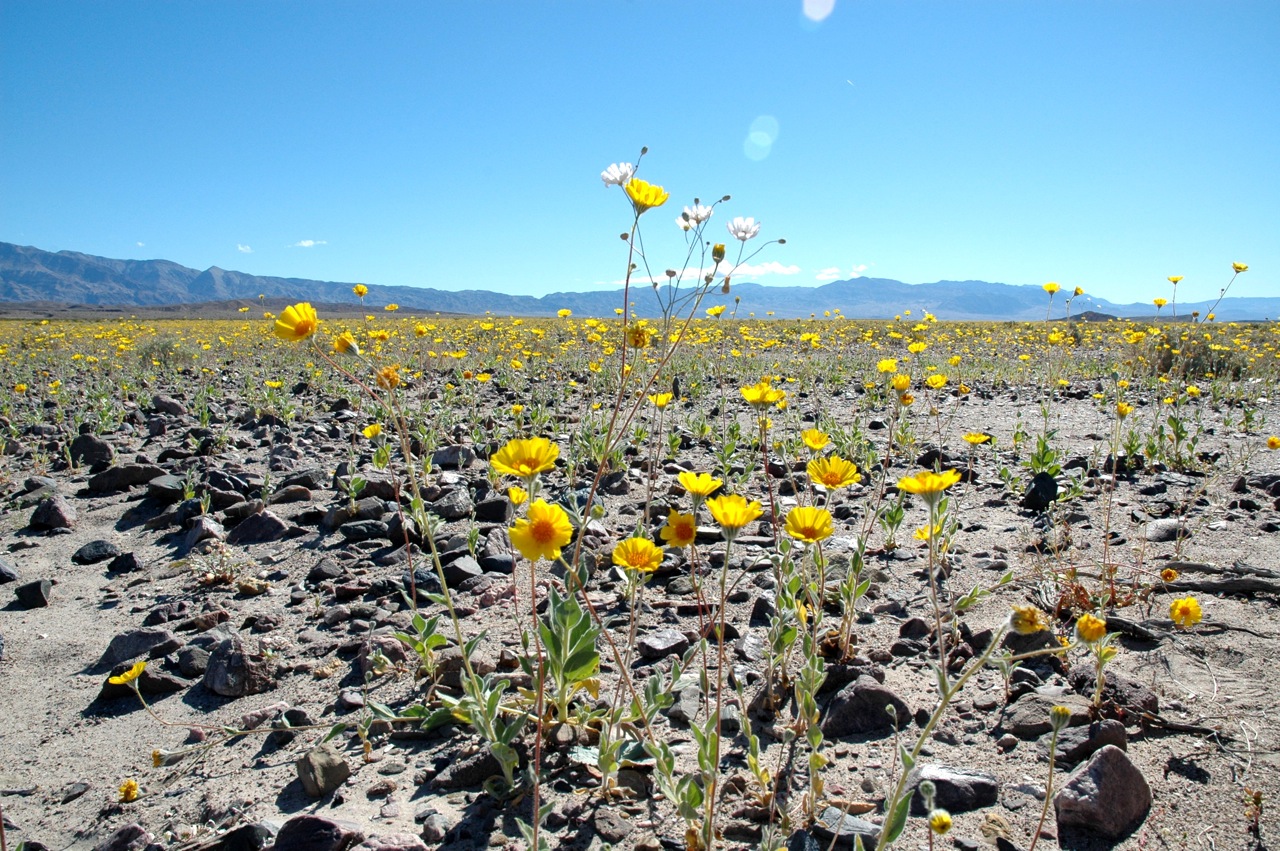
Death Valley flowers

Today’s Old Testament reading takes us to the end of the great Flood in Genesis. Many people have trouble with this story, because they read it as a tale of crime and punishment, with an angry father god who will get us if we don’t behave.

But the rest of Scripture won’t let us read it that way. The rest of Scripture, including the ending of the Flood story itself – the rainbow and the promise – shows us the face of God as the face of love. God doesn’t want to kill us. God wants to make a covenant with us. God wants to marry us.

So what is the Flood story really about? It actually generates a multitude of meanings, but one of the central ones has to do with violence. Genesis says that God looked upon the earth and saw that it was filled with violence. Sound familiar?

Violence is what happens when we put ourselves in the center instead of God, and try to make the world over in our own image. We are unable to honor or even see the existence of other beings as independent of our own desire. We lose all curiosity for anything outside ourselves.

Violence is intolerance of difference: other selves, other perspectives, other cultures are treated as obstacles to our desire, and must be made either to serve us or be swept away. This intolerance of difference, of otherness, may be seen in the rhetoric of terrorists, as well as its mirror image in the anti-Muslim ranting of certain American politicians. It is may also be seen in the recent outbreaks of overt racism in this country. Fear and hatred of those not like us has become far too common.

Such boundless self-assertion, says the Bible, is the foundational violence that threatens to swallow the whole earth. The Flood is not a punishment imposed from the outside; it is what we have made of ourselves.

When we are hostile to those who are not like us, who are not useful in the boundless expansion of our swelling desire, we destroy the balances and boundaries of which the world is made. You can see this violence in relationships, on the freeway, in the crucifixion of Nature, in the current phenomenon of endless war. If we let creation’s harmonious balance be smashed by human violence, we will all be washed away, the innocent and guilty alike. Not even the billionaire profiteers will be able to hide on that day.

A world drowning in its own violence.
Is this an ancient myth, or the daily news?

But the Flood story has a surprise ending. Instead of destruction, new possibility. Instead of anger, love. Instead of violence, reverence for all beings with whom we share the planet. God tears up all the sad old tragedy scripts and gives us a comedy instead. God invites us to join in the re-imagination of the world. God writes a new story in our hearts.

This is why the Epistle of Peter links the waters of the Flood to the waters of baptism. Both are the ending of an old story and the birthing of a new one. When our old selves drown in the depths of the font, we are reborn in Christ. No longer I, but Christ in me, as Paul says.

But before Christ could become our future, he first had to become himself. We are all tempted to live some other life than our own, to wear other people’s faces instead of becoming what God made us to be. Jesus was no exception. He could have lived some other life. Tradition says that he was tempted to dominate others and to escape the Way of the Cross.

“You don’t have to suffer,” Satan told him. “Not you. You were born King of the World. Think of the good you could do with all that power.”

But if Jesus had not lived with the poor and the outcast, if he had spent his time making rich and powerful friends, would he have been Jesus? If he had led a violent uprising to overthrow Roman tyranny, if he had devoted his life to reforming the religious establishment, would he have been Jesus? If he had turned stones into bread, or not risen from the dead, would he have been Jesus?

“Ask me whether what I have done is my life.”
writes poet William Stafford.[i]
Ask me whether what I have done is my life.

Well, what Jesus did was his life. So, we may wonder, how do we do our own lives? To answer that question, we must go, with Jesus, to the desert.

The desert is the emptiness where there’s no place to hide. In the desert, you come face to face with yourself, your demons, and your God. Nothing is defined there, nothing known in advance. Your scripts are no good in the desert. Your evasions are futile. Whatever makes you want to turn around and run back to the safety of your old illusions is the very thing that is trying to kill you.

Only in the desert is the silence deep enough for you to hear the whisper of your innermost heart. And what is your heart trying to tell you? Listen. Listen to your heart.

As Parker Palmer says:

“Before you tell your lives what you intend to do with it, listen for what it intends to do with you … Vocation does not come from willfulness. It comes from listening. I must listen to my life and try to understand what it is truly about – quite apart from what I would like it to be about… Vocation does not mean a goal that I pursue. It means a calling that I hear. Before I can tell my life what I want to do with it, I must listen to my life telling me who I am…”[ii]

We’re always making up stories about ourselves. Sometimes we’re heroes, sometimes we’re victims. But all of these stories are fictions that make us deaf and blind to what our life is actually trying to tell us. What are the stories that you need to let go of in order to let your life speak? If you are going to give up anything this Lent, give up those tired old stories about yourself. They are no longer true.

When we are baptized, we die to our old fictions; we let go of the old stories by which we try to direct our lives. That’s why the Flood story is one of the great images for baptism. There are all those people of Noah’s time clinging to their own fictions, sinking down under the weight of their false identities just as we ourselves sink under the weight of our own fictions.

And when in baptism we are freed from the burden of our false selves, we rise, newly buoyant, to the surface; we are pulled out of the water and given a new story, a new name, which is our true self, our true life, which has been wanting to speak to us all these years.

That is the work we have come to do, as we begin our long Lenten journey, as we step out into that desert where every fiction will be stripped away. At first it will feel like loss, like too much giving up. We may even want to turn around and quit, like the Israelites who complained in the midst of their own desert journey: Let’s go back! It wasn’t so bad, being slaves in Egypt!

But with God’s help, we will keep going, deeper and deeper into that desert, determined to save the only life we can save,[iii] and there will come a day, some 40 days hence, when we will reach the other side. And there we will hear a voice, a voice that calls us each by name.

Come to the waters, the voice will say.
Come to the life-giving pool of the baptismal font.
Come to the Easter waters, and dive in.
Wash yourselves clean of the old fictions, the tired stories,
and rise again out of the watery depths,
newborn, with a new name,
a name which is: Not I but Christ in me.
And this new name, this new self,
is what our life has been trying to tell us all these years.

As Derek Walcott describes it,

The day will come when with elation you will greet
yourself arriving at your own door, in your own mirror,
And each will smile at the other’s welcome
Saying, “Sit here, eat, you will love again
the stranger who was yourself …
the stranger who has loved you all your life …
who knows you by heart.[iv]

The desert is wide, the journey long, but keep on keeping on, because it will lead you, step by step, into the heart of the Beloved who has loved you all your life, who knows you by heart.

And when we finally draw near the end of our Lenten journey, everything that the desert is about, everything the Christian faith is about, everything our very lives are about, will be intensified and distilled in the incomparable passage from death to life which we call the Paschal Mystery: the life-giving mystery experienced both ritually and personally in the Great Three Days of Holy Week: Maundy Thursday, Good Friday, and the Easter Vigil.

Right now, in these first lean and hungry days of the Lenten desert, the transformative joy of the Easter feast may seem unimaginable. But beyond the hunger and thirst, beyond the trials and temptations, the doubts and the stumbles, beyond even the faded Hosannas and the terrible shouts of “Crucify! Crucify!,” there will rise the jubilant Alleluias of the Easter Vigil, breaking at last the stony silence of defeat and death.

The great journey begins here. Now.
And when it’s over,
you will be somebody else:
Not I, but Christ in me.

[i] William Stafford, “Ask Me”

[ii] Parker Palmer, Let Your Life Speak: Listening for the Voice of Vocation (San Francisco: Jossey-Bass, Inc. 2000) 3-4

[iii] Mary Oliver, “The Journey”

[iv] Derek Walcott, “Love after Love”