Praying the Hours (1): “Reclaiming my time”

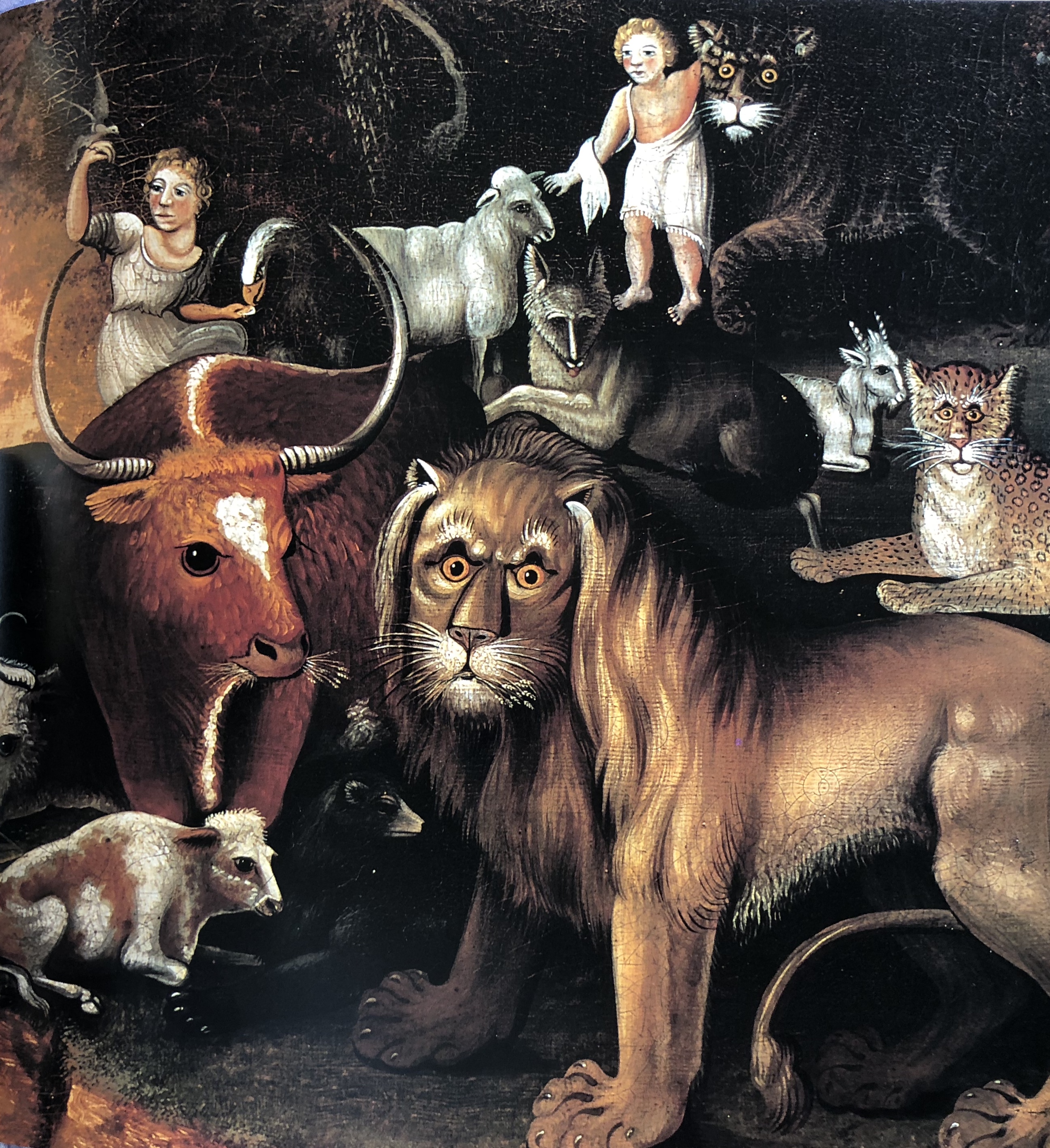
Book of Hours (c. 1475)

— I wasted time and now time doth waste me.  

— William Shakespeare, Richard II

The Abba Moses asked Abba Silvanus, “Can a person every day make a beginning of the good life?” The Abba Silvanus answered him, “If he be diligent, he can every day and every hour begin the good life anew.” 

— Sayings of the Desert Fathers      

When wrongdoers are questioned by congressional committees, they try to evade self-incrimination through rambling, irrelevant responses to pointed questions. Since each committee member is given very limited time to interrogate a witness, those who have something to hide try to “run out the clock,” hoping that time will expire before the truth can be revealed. A skillful questioner will shut down such verbal evasions with a parliamentary phrase: “Reclaiming my time.”  Whenever those words are uttered, the witness must cease to babble, allowing the questioner to attempt a more productive use of the allotted time. 

I love that phrase—“Reclaiming my time”—for its spiritual implications. It seems a perfect description of the ancient spiritual practice of “praying the hours”—setting aside certain moments or periods of each day to reclaim our time from whatever is wasting it. I don’t mean wasting in the sense of failing to perform ceaseless labors of “doing” rather than “being.” An hour daydreaming in the hammock, reading poetry or playing the guitar is not misspent, however much the voices within or without may cry, “Get back to work!” No, by wasting time I mean the failure to enjoy its fullness or attend to its depth. I mean forgetting the sheer wonder of being here in this moment, this story, this life. I mean failing to understand that time, as W. H. Auden reminds us, “is our choice of how to love and why.”[i]

Judaism, Christianity and Islam all developed cyclical prayer practices for reclaiming time. Through words, music, attentive silence and bodily postures, the faithful pause periodically during the day to remember, praise and thank the divine Source in whom we live and move and have our being. Prayer times synchronize the believer’s consciousness with the natural sequence of the day: morning, midday, evening and night. For Christian monastics, for whose life of “unceasing prayer” there were no secular hours, only sacred ones, seven divine “offices” became the norm. The pattern was Scriptural—“Seven times a day I praise you” (Psalm 119:164)—but also natural: the sequence of hours reflects the changes in the quality of light and sound as well as the energy levels of our bodies.

There are seven traditional, or “canonical”[ii] hours. Some of the specific times are variable in accord with changing seasons and differences in latitude, but the “seven times” span the length between waking and retiring. An eighth “hour,” Vigils (or Matins), was combined with Lauds to keep the list at seven, but it really stands apart from the chronology of the waking hours, in the timeless interval between the days, when monastics rise from sleep to dwell prayerfully in the deepest dark of ineffable Mystery. 

Vigils (Midnight or later)          Waiting and reverie
Lauds (4-5 am or daybreak)     Waking
Prime (6 am)                            Beginning
Terce (9 am)                             Doing
Sext (Noon)                              Pausing
None (3 pm)                             Doing
Vespers (Sunset)                      Ending
Compline (Bedtime)               
Surrendering

In the late Middle Ages, devout laypersons created a demand for a portable “Book of Hours”—a sequence of devotional texts and images structured on the monastic daily pattern. For two and a half centuries, these prayer books were the most widely read texts in Europe. But once the sacredness of time was eclipsed by modernity, hours became commodities, acquired and spent in labor and leisure, but no longer burning with divine Presence. Most people no longer “had time”—or inclination—to pause and pray seven times a day. 

If you are ever able to go on retreat to pray the hours with a monastic community, do it, as often as you can. Your relationship with time will be deepened and renewed. But how might we pray the hours when we are on our own in the secular world, immersed in the ordinary circumstances and flow of our lives? Given all the demands on our time and attention, is it possible to forge a sustainable practice?  I believe that it is not only possible, but absolutely necessary, in order to reclaim our time as gift and blessing.

As St. Anselm of Canterbury urged the faithful in the twelfth century: 

“Flee for a while from your tasks, hide yourself for a little space from the turmoil of your thoughts. Come, cast aside your burdensome cares, and put aside your laborious pursuits.… Give your time to God, and rest in the Divine for a little while. Enter into the inner chamber of your mind, shut out all things save God …”[iii]

In a 24/7 world, it’s hard to make any space to shut out “all things.” As Kathleen Deignan writes in her contemporary Book of Hours: “There is no room for the mysterious spaciousness of being, no time for presence, no room for nature, no time for quiet, for thought, for presence.”[iv]

During the many months of pandemic shutdowns and lockdowns, our habitual relationship with time has been significantly disrupted . So many routines which shape our customary lives, like going to work or school, have been altered or cancelled. The annual round of seasonal markers—liturgical celebrations, sporting events, holiday weekends, performing arts series, music festivals, vacation travel, graduations, birthday parties—has suffered a similar fate. Sheltering-in-place homogenizes our waking lives with an enervating sameness. Sometimes I forget what day of the week it is. 

Time blurs and dis-integrates, loses its shape, becomes increasingly subjective as we disconnect from the larger rhythms and measures of season, cosmos, and tradition. Our temporality seems less firmly structured by the interplay of memory and hope, planning and expectation, coming and going, activity and rest, labor and festivity, variety and difference. 

In Martin Amis’ short story, “The Time Disease,” a fear of time itself acts like a virus, attacking the balance that integrates past, present and future in human consciousness. Having lost the capacity to believe themselves part of a meaningful narrative with a redemptive future, people have grown numb to hope, deathly afraid of “coming down with time.” The story, published in 1987, is set in the year 2020! 

COVID-19 reminds us daily of our ephemeral and vulnerable condition: finite, mortal, subject to immense forces beyond our control. At the same time, it has weakened our ritual relation to time, by erasing the recurring collective markers, like the first communal shouts of “Alleluia!” at the end of Holy Week, or the joyous tumult of fireworks at a Fourth of July picnic, which affirm a sense of regularity, continuity and renewal. The future has become radically uncertain. We don’t know what tomorrow will bring, much less next year. Fewer of us are making long term plans right now. But it still remains within our power to receive and embrace the gift of this day, this hour, this moment. We can, through conscious practice, sink deeper and deeper into the mystery of being-here-now.

Praying the hours

I am the appointed hour,
The “now” that cuts 
Time like a blade.

— Thomas Merton, “Song: If you seek…”

An hour is not an hour, it is a vase full of scents and sounds and projects and climates.

— Marcel Proust, Swann’s Way    

Rather than pass the time, we must invite it in. 

— Walter Benjamin, The Arcades Project     

In The Cloud of Unknowing, an anonymous medieval mystic calls us to practice mindfulness: “Be attentive to time and how you spend it. Nothing is more precious. This is evident when you recall that in one tiny moment heaven may be gained or lost. God, the master of time, never gives the future. He gives only the present, moment by moment.”[v]  But such mindfulness is not native to moderns, as Hugh Rayment-Pickard laments:

“We ignore the time that is open to us. We diminish ourselves by wishing time to pass. We are, for the most part, incapable of real concentration. Our days are broken by distraction, scrambled into muddles of chores, errands, impulses, evasions, interruptions and delays, besotted with routine. We characteristically fail to see the ways in which a given period can be expanded, deepened and slowed by the exercise of will and awareness.”[vi]

This condition of un-mindful triviality is good for some laughs in Sarah Dunn’s “A Day in the Life of an American Slacker, circa 1994,” a diaristic parody of the Book of Hours. After rising at noon, the Slacker’s day includes naps, television, café idling and aimless wandering, but also the following highlights:

12:45 p.m.       Plan the world tour you would take if any of your relatives happened to die and handed you a pile of money.

1:52 p.m.         Peruse an op-ed article stating that your generation represents ‘the final exhaustion of civilization.’ Resolve to fire off a scathing yet piquant rebuttal.

2:42 p.m.         [During a commercial break in an episode of “Hogan’s Heroes,” think about starting a new project]: a flow chart in which you … categorize and classify every philosopher throughout time …

After more wandering, napping, drinking, and all of 17 minutes dedicated to “hunker down with Schopenhauer,” the Slacker’s day concludes: 

11:05 p.m.       Return home.
11:30 p.m.       Putter around your room.
11:48 p.m.       Rake the sand in your Zen rock garden.
12:15 a.m.       Alphabetize your cassettes.
12:33 a.m.       Practice your dart game.
1:00 a.m.         Assume the fetal position for late night infomercial viewing.
1:26 a.m.         Stare near-crippling bout of existential angst in the face.
1:57 a.m.         Once again, glorious sleep.[vii]   

Will time so waste us? Or can we restore our souls—and our daily experience— with an attentive, receptive relation to temporality, and the eternity from which it springs? As the monastic communities discovered while the ancient world was collapsing all around them, praying the hours at the beginning, middle, and end of each day is a deeply transformative practice. It changes the quality of the day, and it changes us. 

There are a number of excellent contemporary guides to help us pray the hours in our wordly precincts beyond the cloister. In Music of Silence: A Sacred Journey Through the Hours of the Day, Br. David Steindl-Rast and Sharon Lebell describe the canonical hours as “seasons”: each stage of the day has its own character, its own virtue, its own meaning: 

“The hours are the inner structure for living consciously and responsively through the stages of the day.… The message of the hours is to live daily with the real rhythms of the day. to live responsively, consciously … We learn to listen to the music of the moment, to hear its sweet implorings, its sober directives.”[viii]

In Seven Sacred Pauses: Living Mindfully Through the Hours of the Day, Macrina Wiederkehr sees the hours as an antidote for contemporary hurry-sickness: 

“We practice pausing to remember the sacredness of our names, who we are, and what we plan on doing with the incredible gift of our lives—and how we can learn to be in the midst of so much doing.”[ix]

In Wisdom Distilled from the Daily: Living the Rule of St. Benedict Today, Sr. Joan Chittister reminds us that prayer is not a mood but a practice: 

“To pray only when we feel like it is more to seek consolation than to risk conversion. To pray only when it suits us is to want God on our own terms. To pray only when it is convenient is to make the God-life a very low priority in a list of better opportunities. To pray only when it feels good is to court total emptiness when we most need to be filled. The hard fact is that nobody finds time for prayer. The time must be taken. There will always be something more pressing to do, something more important to be about than the apparently fruitless, empty act of prayer. But … without prayer, the energy for the rest of life runs down.”[x]

Grounding ourselves in a daily prayer practice is vital in the best of times. In 2020’s massive tsunami of pandemic, climate disaster, social unrest and political madness, it is a lifesaver, a shelter from the storm. Tossed between the Scylla and Charybdis of high anxiety and profound melancholy, many of us are exhausted or worse. We need proven tools for survival—and renewal. 

This post is the first in a series on praying the hours. Subsequent posts will explore various dimensions and qualities of the hours contained within the day’s three main divisions: Beginning (Vigils, Lauds, Prime); Middle (Terce, Sext, None); and End (Vespers, Compline). The series will conclude with some suggestions for adapting the hours to the diverse and demanding lives we actually live. As Benedictine John Chapman counsels, “Pray as you can, not as you can’t.”[xi]   

For further reading

Elizabeth Yates, A Book of Hours (Norton, CT: Vineyard Books, 1976). This classic little volume has 2 pages of prayers and reflections for each of the 24 hours. I have opened this often over the years.

Brother David Steidl-Rast & Sharon Lebell, Music of Silence: A Sacred Journey Through the Hours of the Day(Brooklyn, NY: Ulysses Press, 2001). A wise and indispensable treasury of reflections on each of the hours. 

Macrina Wiederkehr, Seven Sacred Pauses: Living Mindfully Through the Hours of the Day (Notre Dame, IN: Sorin Books, 2008). A thoughtful exploration of the 7 hours, with many excellent texts and thoughts to inspire your own construction of a daily practice. 

Kathleen Deignan, ed., Thomas Merton: A Book of Hours (Notre Dame, IN: Sorin Books, 2007). Contemplative rites for a 7-day cycle for Dawn, Day, Dusk and Dark, consisting entirely of prose and poetic texts by Thomas Merton, with a helpful introduction by Deignan. Much of the imagery is drawn from the natural world surrounding the famous contemplative’s Kentucky hermitage, tincturing the devotions with a deep awareness of the seasons of the day and of the year. 

Joan Chittister OSB, Wisdom Distilled from the Daily: Living the Rule of St. Benedict Today (New York: Harper One, 1991). Chittister’s attractive Benedictine balance of attention and receptivity provides an accessible foundation for a daily prayer practice.

Mark Barrett OSB, Crossing: Reclaiming the Landscape of Our Lives (Harrisburg, PA: Morehouse Publishing, 2008). Another Benedictine offers fruitful and imaginative reflections on each of the canonical hours. 

Kenneth V. Peterson, Prayer as Night Falls: Experiencing Compline (Brewster, MA: Paraclete Press, 2013). This thorough appreciation of the last office of the day blends liturgical history, theology, and personal experience. The perspectives on Compline illumine our approach to all of the hours. Peterson’s website provides glorious examples of Compline choral music discussed in the book: http://prayerasnightfalls.com

World Enough and Time: On Creativity and Slowing Down (Christian McEwen, Peterborough, NH: Bauhan Publishing, 2011). Not a religious text per se, it invites us into a way of being which is essential for mindful living and praying. It’s delightful reading, celebrating what Thoreau called “the bloom of the present moment.”

Robert Grudin, Time and the Art of Living (New York: Ticknor & Fields, 1988). A fertile appreciation of our relationship with time, and how to deepen it.

Hugh Rayment-Pickard, The Myths of Time: From St. Augustine to American Beauty (London: Darton, Longman and Todd Ltd., 2004). An accessible read on the theology of time. 

Kevin Jackson, The Book of Hours: An Anthology (London/New York/Woodstock NY: The Overlook Press, 2007). A secular celebration of every hour of the day, with a wide range of literary excerpts. While not about prayer or spirituality, it is great fun, and will sharpen your sense of each hour’s aspects.

There are many books and websites with liturgies for praying the hours. The Episcopal Book of Common Prayer has daily offices for Morning, Noon, Evening and Compline. A number of other Anglican prayer books can be found at http://justus.anglican.org/resources/bcp/

Roman Catholic rites can be accessed at https://divineoffice.org

Phyllis Tickle’s 3-volume seasonal compilations for the Divine Hours are available from Doubleday.

Forward Movement’s Hour by Hour has 4 daily offices for each day of the week. 

For a much more extensive list of publications and websites, see Kenneth Peterson’s wonderful array of resources in Prayer as Night Falls (listed above), pp. 205-213.

Finally, my 2015 post about time, Tick Tock: Thoughts for New Year’s Eve, a discussion of Christian Marclay’s 24-hour video, The Clock, has some bearing on the subject of praying the hours. 


[i] W. H. Auden, “For the Time Being: A Christmas Oratorio” (1941-42), in Collected Poems (New York: Random House, 1976), 297.

[ii] “Canon” in Greek meant a straight rod, used for measuring or aligning. In Church usage, the word designated right rule, measure, or proper order, as in the biblical canon, canon law, or the canonical hours.

[iii] Elizabeth Yates, A Book of Hours (Norton, CT: Vineyard Books, 1976), 42.

[iv] Kathleen Deignan, ed., Thomas Merton: A Book of Hours (Notre Dame, IN: Sorin Books, 2007), 32.

[v] The Cloud of Unknowing, an anonymous English work of the late 14th century, cited in Robert Grudin, Time and the Art of Living (New York: Ticknor & Fields, 1988), 92.

[vi] Hugh Rayment-Pickard, The Myths of Time: From St. Augustine to American Beauty (London: Darton, Longman and Todd Ltd., 2004), 20.

[vii] Sarah Dunn, “A Day in the Life of an American Slacker, circa 1994,” in The Official Slacker Handbook, cited in Kevin Jackson, The Book of Hours: An Anthology (London/New York/Woodstock NY: The Overlook Press, 2007), 62-64.

[viii] Brother David Steidl-Rast & Sharon Lebell, Music of Silence: A Sacred Journey Through the Hours of the Day (Brooklyn, NY: Ulysses Press, 2001).

[ix] Macrina Wiederkehr, Seven Sacred Pauses: Living Mindfully Through the Hours of the Day (Notre Dame, IN: Sorin Books, 2008), 13.

[x] Joan Chittister OSB, Wisdom Distilled from the Daily: Living the Rule of St. Benedict Today (New York: Harper One, 1991), 31.

[xi] Mark Barrett OSB, Crossing: Reclaiming the Landscape of Our Lives (Harrisburg, PA: Morehouse Publishing, 2008), 26.

Love Among the Ruins: Roberto Rossellini’s “Journey to Italy”

Alex (George Sanders) and Katherine (Ingrid Bergman) on the road to Naples.

Alexander:       “Where are we?”
Katherine:       “Oh, I don’t know exactly.”

— Opening lines of Journey to Italy


The first shot of Roberto Rossellini’s 1954 film, Journey to Italy, is through the windshield of a speeding Bentley on an open stretch of country road. It is an image of pure velocity, revealing neither origin nor goal, but only the fact of motion. Inhabiting the subjective eye of the camera, we know only that we are rushing forward, out of the past, into the unknown.

Then we see who is inside the car. Alex and Katherine Joyce are Londoners, on their way to Naples to sell a villa inherited from their Uncle Homer. We deduce from their clothes—his tweed jacket and her leopard-skin coat—that they are a couple of means, accustomed to shaping their own story. But the names “Joyce” and “Homer,” invoking the great voyager Ulysses, suggests that their journey will take them beyond the familiar into the land of unknowing. “Where are we?” “Oh, I don’t know exactly.”

For the Joyces, Naples, along with nearby Vesuvius and Pompeii, is radically elsewhere—neither Rome nor Milan, and certainly not London. In the Italian south, modernity has not erased the archaic remnants of mythic memory or silenced the primal voices of earth, sea, and sky. The ancient past is not dead and gone. It speaks through rituals and ruins. It erupts from the depths of history, utters forgotten tongues.

Time slows in the south. The north’s purposeful hurry dissipates beneath the Neapolitan sun. The forward rush of the opening scene is replaced by aimless drift. A firm sense of story—beginning, middle, and end—dissipates into Mediterranean languor. The eventful developments we expect from movie narrative are absent. Like Dante in the dark wood, Alex and Katherine have strayed from the straight road of storytelling. They have lost their way.

The Italian south doesn’t create their malaise; it reveals it. “I’m getting sick of this crazy country,” Alex complains. “It poisons you with laziness. I want to get back home, back to work.” Without the familiar fictions of their London life, the habitual doings and distractions which postpone the honest reckonings of a hungry heart, they find themselves face to face with the alienation, egoism and fatigue of a failing marriage. They hardly know what to say to each other. When they do, the words are often abrasive or wounding.

Rossellini’s leads were actors whose own lives were in emotional disarray. Both Ingrid Bergman (Katherine) and George Sanders (Alex) had recent divorces, and Bergman’s current affair with Rossellini—a scandal at the time—was coming apart. She was tearful on the set. Sanders, recruited precisely for his sour and cynical manner, was also unhappy. With his biggest roles behind him, what was he doing with a largely nonprofessional cast in a low-budget art film?

Rossellini’s practice of handing out dialogue at the last minute kept his actors off balance, so they couldn’t overthink their performance in advance . Trained in the conventions of Hollywood’s highly scripted and plot-driven narratives, Bergman and Sanders often seem at a loss in a film where so little happens. His confusion and her uncertainty infused their roles with authenticity, blurring the line between fiction and documentary.

“All those shots of eyes looking.” —Jacques Rivette

“The film opens a breach and all cinema on pain of death must pass through it.”

— Jacques Rivette on Journey to Italy [i]

Journey is more than the story of a marriage. Its wider theme is the malady of the secular age. Both Alex and Katherine are imprisoned within themselves, unable to connect with each other or the world. To borrow a phrase from Jean-Luc Godard, they are “castaways of the western world, survivors of the shipwreck of modernity.” [ii]  Journey would pave the way for a cinema of alienation, haunted with the ghostly nonbeing of lives “lacking in purpose, in passion, in zest, in a sense of community, in ordinary human responsiveness, in the ability to communicate.…” [iii]

This was a new kind of cinema, born of twentieth-century trauma. After the Holocaust and Hiroshima, it became impossible to limit the art of film to self-contained stories, within which the actors can take action to resolve problems and produce definitive and satisfying conclusions. The damage and disfigurement of humanity, its existential crisis and utter lostness, had to find authentic representation in movies about “nothing.” That is to say, their true subject would not be a narrative but a condition.

French film scholar Antoine de Baecque writes about the impact on filmmakers of the shocking footage shot during the liberation of the Nazi death camps. The idea of “aestheticizing horror” through fictional recreations of the camps seemed obscene at the time. “I could never do that,” said American director Samuel Fuller. “How can you do it better than the Germans?”[iv]  But those terrible images lodged themselves permanently in the psyches of directors like Rossellini, Antonioni, Resnais and Godard. As de Baecque writes:

“These images born of the war, which deeply marked cinema and filmmakers at the time, did a kind of subterranean work, a ‘reworking’ so to speak, subconsciously—since they never actually appear in postwar films—and then resurfaced in films (often ten years later) in definite forms, like traumatic memory that, little by little, had bored its way into the history of cinema. An art form had lost its innocence, and the great auteurs would no longer be making the same kinds of films.” They could only “return to the real by getting out of the studio to film the world.” [v]

Skulls of unknown dead at the cave cemetery of Fontanelle in Naples.

In Journey, the memory of death resurfaces again and again. We see the charnel house skulls in a Naples cemetery, a funeral cortège rounding a corner to block our progress, and the ruins of Pompeii, where a thousand Romans were buried alive by the eruption of Mount Vesuvius in 79 A.D. Even when Alex and Katherine bask in the pleasant Mediterranean sun, the volcano looms behind them as a reminder of mortality.

Sunbathing at Homer’s villa, with Vesuvius in the background.

Two people have lost their way in a world of death. Is there no exit? The spirituality of Naples wants to speak, but Alex has no ears to hear, no curiosity beyond his enclosure of self-absorption. Katherine, however, proves more adventurous. When she drives into Naples from the villa, the film cuts between her “entombment” inside the car and the fecundity of street life all around her—strolling lovers, pregnant women, sidewalk vendors. The contrast between the carefully composed studio shot of Katherine behind the wheel and the cinéma vérité footage of the street creates an unstable mix of fiction and documentary. The wall between herself and a wider reality is starting to crumble.

The polished studio shot of Katherine encased in her car contrasts with the documentary realism of the street scenes around her.

“That’s what God is for, to make our lies truth.”

— Iris Murdoch, The Good Apprentice

In writing about the novels of Iris Murdoch, theologian Paul S. Fiddes describes the ‘unselving’ of self-enclosed characters. He could be writing about the Joyces as well. Like Murdoch’s protagonists, they “learn, or fail to learn, to be truthful, which means giving attention to what is real around them. At one level … this means noticing people as they actually are, rather than as we want them to be for our convenience. It means delighting in all the contingent details of the world, recognizing the ‘otherness’ of people and things, and living with all the hazards of accident. At the very least the disciples of goodness accept the ‘muddle’ of the world, and at the best they experience its amazing variety as being the Sublime.” [vi]

Katherine’s tourist itinerary of Naples thus becomes something more: a journey into the depths of the past—the cave of an ancient Sibyl, an ossuary of anonymous skulls, galleries of Roman sculpture, the ruins of Pompeii. Here she begins to face what Rose Macaulay called “the ruins of the soul; the shadowy dreams that lurked tenebrously in the cellars of consciousness; in the mysterious corridors and arcades of dreams, the wilderness that stretches not without but within.” [vii] Remnants of a vanished past, signifying the paradoxical dance of time and eternity, interrogate the meaning of her present existence. As we are now, so you shall soon be. What are you doing with the tiny slice of time you’ve been given? When you’re gone, what remains?

In the archaeological museum, the eyes of the past interrogate the modern viewer.

 When Katherine looks at statues, they stare back. Who are you? The “I” of the camera, a third subjectivity, looks at both—at the statue, then at Katherine. In the museum and the other visited sites, the film becomes a documentary of Ingrid Bergman’s face, “a sensory surface on which the sounds and images are imprinted. The film appears to rest entirely on her reactions.” [viii]

When Katherine gazes into the sulphur pits of Vesuvius, where subterranean energies surface into visibility, we are reminded of Dante’s Inferno, the classic template for every descent into the soul’s hidden depths.

Katherine and her guide at the sulphur pits of Vesuvius.

Gustave Doré: Dante and Virgil in the 8th circle of hell.

The crisis point in Journey follows a bitter argument between Katherine and Alex. At the very moment Alex says the fatal word—“divorce”—they are interrupted by Burton, the villa’s property manager, who insists they come immediately to the excavation at Pompeii, where a pair of “bodies” is about to be uncovered.

When Pompeii was buried under six meters of volcanic ash two thousand years ago, its inhabitants died instantly. Their bodies dissolved over time, leaving hollow forms in the hardened ash. During the shooting of Journey to Italy, archaeologists were in the process of injecting plaster into those forms to recreate the ancient “bodies,” and Rossellini was allowed to film the fictional Joyces watching the real uncovering of a buried past.

“You must come!” Burton had told them. “Imagine—to actually see the shape of a man just as he was then, the moment when he was surprised by death.” In fact, what they do see is two people, a couple who took their last breath lying side by side as lovers.

The forms are real plaster, but at the same time they are fictional figures, reimagined into the visible from the empty shapes left behind by the dead. They are, in effect, tangible expressions of nothingness, which might also be said about the hollow and aimless lives of the Joyces. For any viewer, those plaster forms of vanished Pompeiians prompt unsettling meditations on life and death, presence and absence, and our own essential nothingness. I myself contemplated Pompeii’s plaster ghosts almost fifty years ago, and I can still recall the melancholy—and the fascination—those forms evoked in me. As Julian of Norwich put it in the 14th century, without divine love sustaining us in every moment, we would all sink into nonbeing.

Alex and Katherine watch the unearthing of the ancient couple at Pompeii.

What the Joyces behold, as they watch the archaeologists brush away the ash from the plaster forms, is history made visible. Staring into the abyss of time, they are confronted by the smallness and brevity of their own lives. Their own nothingness surfaces into awareness. The falsity of their solipsistic lives, independent of a larger world and ignorant of death, begins to give way.

The image of the ancient lovers is itself a shock, history’s rebuke to their own loveless marriage. Perhaps most terrible of all is the photographic nature of the forms, capturing a single instant of the past and removing it from the flow of time. The Roman lovers are a still image, frozen in a moment with no future. For Katherine and Alex, stuck in a hell of their own making, it displays the horror of an existence which cannot change, a deadness with no exit. They recognize themselves—sans embrace—in the plaster forms.

Katherine recoils and bursts into tears, demanding that they leave the site. As the couple descends a flight of ancient stairs to find their car, Katherine asks her husband, “Is this the way out?” It is another Dantean moment: the way down is the only way up.

Once back in their car, they try to put some distance between themselves and the place which has tried their souls. But the south will not let them go. Passing through the town of Maiori on the Amalfi Coast, they are blocked by a great crowd jamming the central square. It is a procession for San Gennaro, the only Christian festival to claim an annual miracle: the liquefication of the martyred bishop’s dried blood. The persistence of this claim in a skeptical age highlights the archaic strangeness of a region where the past seems so unperturbed by modernity. And in this land of miracles, Journey to Italy reaches its miraculous conclusion.

Unable to drive any further, Katherine and Alex get out their car, the symbol of their isolation from and control over exterior circumstance. Immersed in the teeming crowd, they seem nakedly exposed to the energies all around them. When Katherine is suddenly swept away by a surge of bodies, Alex runs to rescue her. They embrace. Suddenly—miraculously—awakening to a forgotten but genuine bond between them, they confess their folly and profess their love.

The miraculous reconciliation defies expectations.

It’s a Hollywood ending, but one in quotes, because this is a modernist work, where the real and ambiguous world insists on breaking into the neatly scripted story. If the revelations and crisis that preceded this moment only result in a happy ending for the couple, who might then resume their distance from the world if not each other, it is not a true unselving. It would allow the lie of autonomous lives to carry on.

Alex and Katherine embrace as the camera pulls away.

The film’s true miracle is not the “happy ending” of the Joyces’ embrace and the lovely closeup of famous movie stars. Rather, it is their disappearance into the larger world of humanity and history, and through that, into the ultimate mystery of the world, whom we call divine. And this miracle happens when the camera, on a crane, pulls away from the couple to sweep over the crowd. The Joyces are not forgotten, but they are now understood as part of a much larger world. But this world is not anonymous and impersonal. The uniquely personal remains undiminished in this great communion of mortal beings, as the final shot, now at eye level, watches face after face after face pass by, into a collective future that never stops unfolding.

Every age will see a film differently. I’ve watched Journey to Italy many times over the years, but viewing it during the pandemic has touched an existential nerve. Larger realities are breaking into our settled world, and we will never be the same. Our own Vesuvius looms on the horizon.

Film critic Laura Mulvey, in her commentary on the excavation scene, points out that cinema itself, not just particular films, confronts us with our mortality:

“The figures of the excavation are formed by an imprint left by the original. Film too is an imprint.…The presence of the human figure on celluloid is one more layer, one more trace of the past brought to life and preserved.… With the coming of death and the passing of time, Ingrid Bergman and George Sanders, as well as the passersby in Naples, are now themselves dead, their images fossilized on celluloid, just as the figures of Pompeii were cast in plaster.” [ix]

“Life is so short,” says Katherine among the ruins. And as today’s pandemic spreads its shadow over the earth, and climate change undermines the stability of the physical world, we too have become more conscious of our vulnerability and our brevity, and less able to maintain the illusion of untouched autonomous lives. We can no longer keep death at a safe distance; we dance every day on the razor’s edge between being and nonbeing. Who knows when we, too, will be “surprised by death?”

But in the long run of time, the question of my fate or your fate must give way to a larger perspective. We are all in this together, and—come what may—I believe we will, in the end, be gathered into the great procession of a redeemed humanity, shouting “Glory!” for all eternity. It will no longer be death that takes us by surprise, but grace.

Love among the ruins. “Life is so short.”


Journey to Italy (1954) is the third feature in a trilogy of “voyage” films which Rossellini made with Ingrid Bergman, who left a successful Hollywood career to make these art films—some of her best work—with the Italian director, with whom she would fall in love. All 3 films involve a transformative journey into an unfamiliar and challenging place—a barren island in Stromboli (1950), the world of the poor in Europe ’51 (1952), and the mysterious south of Italy in Journey. In the U.S., The Criterion Collection has produced a beautifully mastered box set of the Trilogy, with excellent commentaries, to which I am indebted, on the discs and in the booklet. Journey to Italy can be streamed, but (in the U.S. at least), it is available on disc only in the box set, which is definitely worth having if you love film.


[i] Cited in James Quandt’s commentary, “Surprised by Death: Roberto Rossellini’s Voyage Trilogy,” on the Criterion disc, 3 Films by Roberto Rossellini with Ingrid Bergman (2013). Rivette, along with Godard, Resnais, and Truffaut, would be greatly influenced by this film, and often praised it in their writings.

[ii] Godard is describing his own film, Contempt (1963), which was itself an hommage to Journey to Italy. Cited in Quandt’s commentary.

[iii] This quote from Richard Gilman’s “About Nothing—with Precision,” Theater Arts 46, no. 7 (July 1962), p. 11. Gilman is writing about another Italian director, Michelangelo Antonioni, who would take the theme of alienation to the limit in films like La Notte (1961), where the alienated couple remains stuck in their private hell, unlike the couple in Journey to Italy. Rossellini regarded Antonioni’s films as too pessimistic, but both filmmakers were dealing with the same modern malady: alienation, drift, and emptiness. Gilman is cited in Seymour Chatman, Antonioni, or, the Surface of the World (Berkeley, CA: University of California Press, 1985),

[iv] Cited in Antoine de Baecque, Camera Historica: The Century in Cinema, trans. Ninon Vinsonneau & Jonathan Magidoff (New York: Columbia University, 2008), 68. Fuller shot footage for the U.S. Army during the liberation of the camp at Falkenau (you can find it on YouTube), but he never tried to recreate the horror in a fictional way. He did show his actors watching documentary footage in Verboten!(1959). The fictional shots pale when intercut with real images of mass death.

[v] Antoine de Baecque, 45.

[vi] Paul S. Fiddes, Freedom and Limit: A Dialogue between Literature and Christian Doctrine (Macon, GA: Mercer University Press, 1999), 173.

[vii] Rose Macaulay, The World My Wilderness (1950), cited in Christopher Woodward, In Ruins (New York: Pantheon Books, 2001), 231. Macaulay’s character is contemplating the bomb craters and ruined buildings in 1946 London. The remnants of past destruction bear thematic resemblance to Pompeii and evoke similar responses.

[viii] Antoine de Baecque, 65.

[ix] Laura Mulvey is a noted British film theorist. Her richly informative commentary is on the Criterion disc.

“Seek ye first”—Scenes from the Camino de Santiago

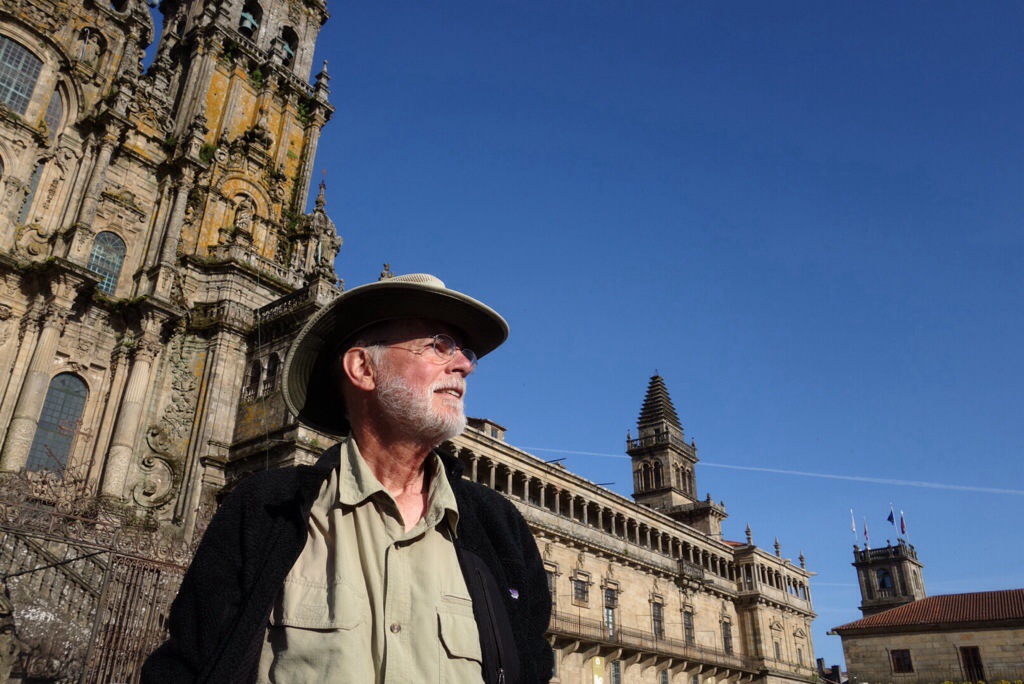
A 500 mile pilgrimage led me to the Cathedral of Santiago (May 11, 2014).

Today is the Feast of St. James, whose tomb in Galicia has drawn countless pilgrims to trek across Spain for 13 centuries. I walked the 500-mile Camino de Santiago in 2014, and this blog began with my dispatches along the way. It was, as every pilgrim will tell you, an indelible experience, and you can read about my own journey in the links below.

It took me 33 days, averaging 15 miles a day, but now you can do it in about 2 minutes.

For tomorrow’s segment of the virtual liturgy streaming on Sundays from our parish during lockdown, I combined images (in sequential order) from my Camino with a pre-COVID  recording of the parish choir singing “Seek Ye First.” It seemed a fitting way to honor the saint on his feast day.

The pilgrimage begins with a rainy day in the French Pyrenees, and ends inside the Santiago cathedral with the spectacular censing at the daily “Pilgrims’ Mass.”

Buen Camino!


Blog posts from the Camino de Santiago

The First Day (April 8)

Pamplona (April 10)

Cherish Every Step (April 11)

Palm Sunday (April 13)

Semana Santa (April 14)

Small Steps (April 15)

Jesus’ Bakery (April 17)

Christ is Risen! (April 20)

Hospital for the Soul (April 24)

By the Numbers (April 25)

Walking (April 29)

The Third Phase (May 1)

A Mountain Day (May 2)

The Movement of Hearts and Souls (May 7)

Surrender (May 9)

Songs to Sing and Tales to Tell (May 10)

Arrival (May 11)

The End of the World (May 15)


“Water the earth with the tears of your joy”: An Earth Day Reflection

Marilyn in Henry Cowell Redwoods State Park, Felton, CA, 2016 (Photo by Jim Friedrich)

That’s the trouble with people, their root problem. Life runs alongside them, unseen. Right here, right next. Creating the soil. Cycling water. Trading in nutrients. Making weather. Building atmosphere. Feeding and curing and sheltering more kinds of creatures than people know how to count.

A chorus of living wood sings to the woman: If your mind were only a slightly greener thing, we’d drown you in meaning.

The pine she leans against says: Listen. There’s something you need to hear.

–– Richard Powers, The Overstory


Toward the end of the last century, I sat in a circle of religious environmentalists in a California wilderness. Each of us wore a mask we had made to represent a species or element of the nonhuman world: bear, eagle, butterfly, elephant, whale, mountain, river, redwood, maple leaf, wind, ocean, wetland, desert––some part of Creation which had “chosen” us to speak for them in a Council of All Beings.[i]

We began by describing our particular existences, what it was like to be whatever we were.  Then we shared our worries and our sorrows over the harm being inflicted upon us by the human race. At some point, two volunteers removed their masks, resuming their human identity in order to receive the complaints of their fellow creatures––complaints so often unheard or ignored.

Listen. There’s something you need to hear.
If your mind were only a slightly greener thing,
we’d drown you in meaning. [ii]

The Council spoke its anger as well as its hurt. Afterward, participants in the exercise seemed both surprised and shaken by the surges of fierce emotion in such a playful exercise. It was a foretaste of the Last Judgment: humanity has a lot to answer for. But judgment was not the last word. Before the Council adjourned, each of its nonhuman members was asked to give the humans one of its own attributes to assist them in the healing of a wounded Creation. The mountain gave patience. The butterfly, transformation. The bear, strength. The river, ceaseless flow. The leaf: letting go. Renewed by such generous wisdom, we departed in peace.

On the 50th annual celebration of Earth Day, despite decades of progress in both awareness and behavior, the wellbeing of “all creatures great and small” remains under grave threat. Climate change, mass extinctions, degradations of air, water and soil, destruction of habitats, deforestation, deregulation. . . who can count the ways? And the incapacity of our political and economic systems to respond justly, rapidly, or effectively is disheartening at best, fatal at worst.

In the United States, we can certainly point to the unfettered greed, stupidity, and maliciousness in White House and Senate as deplorable accelerants of environmental conflagration, but the problem goes deeper than the heartless actions of particular villains. Our entire culture has an attitude problem. Or rather, we have lost track of the narrative. We have forgotten what kind of story we are in.

The earth is the Lord’s and all that is in it,
the world and all who dwell therein. (Psalm 24:1)

Who believes this anymore? Fewer and fewer. And even the faithful among us find ourselves deeply embedded in the systems and premises of secularity, where nature is not divine creation or sacred web, but an exploitable resource, valued primarily for the usefulness it provides or the pleasure it gives. Drained of its inherent sacredness, it no longer commands reverence. Its value is entirely contingent on human needs and desires.

Erazim Kohák, Czech philosopher and environmentalist, frames this epistemic crisis in the starkest terms:

“If there is no God, then nature is not a creation, lovingly crafted and evolved with purpose and value by its Creator. It can only be a cosmic accident, dead matter contingently propelled by blind force, ordered by efficient causality. In such a context, a moral subject, living his life in terms of value and purpose, would indeed be an anomaly, precariously rising above it in a moment of Promethean defiance only to sink again into the absurdity from which he rose. If God were dead, so would nature be––and humans could be no more than embattled strangers, doomed to defeat, as we have largely convinced ourselves we in fact are.” [iii]

Fifty years ago, the first Earth Day initiated an impressive legacy of awareness and action on behalf of the earth and all that is in it. And I pray that today will be a time of renewal and rededication to the immense labor of protecting, preserving and nurturing the natural world. But our work must not be limited to the scientific, the political and the economic. It must also, I believe, include the spiritual––the recovery of the Sacred in our collective awareness.

Christian ethicist Richard L. Fern has written, “the experience of living in an ‘enchanted world,’ a place of belonging where personal and communal destinies matter all the way down, depends, not surprisingly, on the adoption of a religious point of view.”[iv] But what would that look like? And how might we get there?

I have no idea. Maybe we begin by entering a forest, or sitting by a lake, becoming still enough to listen, letting our mind become “a slightly greener thing.” Perhaps then the earth may whisper its forgotten secret.

Thrush song, stream song, holy love
That flows through earthly forms and folds,
The song of Heaven’s Sabbath fleshed
In throat and ear, in stream and stone,
A grace living here as we live . . .

–– Wendell Berry, “Sabbaths, 1982––IV”

May each of us, in our own unique way, realize the grace of belonging to the “holy love that flows through earthly forms.” And may our collective awareness likewise awaken to the mystery of the world. And then . . . ?

In The Brothers Karamozov, the young monk Alyosha, suddenly filled with grace after a spiritual crisis, falls prostrate on the bare earth to kiss it, just as the Orthodox do reverence to holy icons. This scene has raised theological eyebrows, but Rowan Williams interprets Alyosha’s dramatic gesture to mean that “the earth is another defaced icon, whose inner and nonnegotiable dignity is secured only when its relation to the creator is acknowledged.”[v] In other words, when the earth is understood as a created reality, a material expression of divine intention and divine love, it becomes, like an icon, a window into the eternal reality in which it lives and moves and has its being. Dostoevky’s description[vi] of Alyosha’s revelation is one of literature’s most ecstatic moments:

The silence of the earth seemed to merge with the silence of the heavens, the mystery of the earth touched the mystery of the stars. . . Alyosha stood gazing and suddenly, as if he had been cut down, threw himself to the earth.

He did not know why he was embracing it, he did not try to understand why he longed so irresistibly to kiss it, to kiss all of it, but he was kissing it, weeping, sobbing, and watering it with his tears, and he vowed ecstatically to love it, to love it unto ages of ages. “Water the earth with the tears of your joy, and love those tears. . . ,” rang in his soul. What was he weeping for? Oh, in his rapture he wept even for the stars that shone on him from the abyss, and “he was not ashamed of this ecstasy.” It was as if threads from all those innumerable worlds of God all came together in his soul, and it was trembling all over, “touching other worlds.” He wanted to forgive everyone and for everything, and to ask forgiveness, oh, not for himself! but for all and for everything. . .

Comet Falls, Mount Rainier National Park, July 2005 (Photo by Jim Friedrich/Karen Haig)

+

The divine power that sustains the universe has been described as an immeasurable flow or fountain of energy, and in celebration of Earth Day’s semicentennial, I offer this video pairing of Charles-Marie Widor’s exuberant Toccata for organ, played by Paul Roy, with footage of three western rivers I shot over the last two summers. May it be an icon of the divine energeia, pouring ceaselessly through the life of the world.


[i] The Council of All Beings is a communal ritual developed by Joanna Macy. https://www.rainforestinfo.org.au/deep-eco/Joanna%20Macy.htm

[ii] Richard Powers, The Overstory (New York: W. W. Norton & Company, 2018), 4. See epigraph above. Powers’ extraordinary novel takes the reader into a new way of seeing the natural world and one’s own place in it.

[iii] Erazim Kohák, The Embers and the Stars: A Philosophical Inquiry into the Moral Sense of Nature, 1984, p. 5), cited in Richard L. Fern, Nature, God and Humanity: Envisioning an Ethics of Nature (Cambridge, UK: Cambridge University Press, 2002), 120. Kohák died at 86 on Feb. 8, 2020.

[iv] Fern, 121.

[v] Rowan Williams, Dostoevsky: Language, Faith and Fiction (London: Continuum, 2008), 225.

[vi] Fyodor Dostoevsky, The Brothers Karamazov, trans. by Richard Pever & Larissa Volokhonsky (New York: Vintage Classics, 1990), 362.

Jesus and the Woman at the Well: A Homily for Lent 3

Churches are shuttered here in Puget Sound, to maintain social distancing in the pandemic. If I were preaching on this Sunday’s gospel, it would go something like this. Meanwhile, dear reader, stay safe, be well, and pray for all who are suffering or fearful in this harrowing time.

Jesus and the Samaritan woman (12c Jruchi Gospels, Georgia)

If I were called in
to construct a religion
I should make use of water.

Going to church
Would entail a fording
to dry, different clothes;

My liturgy would employ
Images of sousing,
A furious devout drench,

And I should raise in the east
A glass of water
Where any-angled light
Would congregate endlessly.

–– Philip Larkin, “Water”

A glass of water might not strike you as sacred, unless you’ve been in the desert about three days without a drink. At that point, which is the longest humans can go without water, you would find that glass to be the most blessed of sacraments: the water of life indeed.

Desert people know the sacredness of water. When the ancient Jews wandered the wilderness of Sinai, thirst was their constant companion. They cried out to God with parched tongues. Not politely, like Episcopalians. They complained bitterly and their faith wavered, until God made water pour out of barren rock. Now maybe the Israelites simply found a seepage of brackish water coming out of a rocky cliff. But it was enough to supply their need. They recognized it as a miracle then, and they remembered it as miracle ever after:

God made streams come out of the rock,
and poured down water like rivers.   (Psalm 78:16)

And once the Jews reached the Promised Land and built the Temple, they would gather every autumn, just before the rains ended the summer drought, to remember how God had preserved them in their wanderings, and to re-imagine their future as a consummation of the Providential love which their ancestors had sipped from a rock in the desert’s deadly furnace.

At this festival, the words of the prophet Zechariah was recited:

And I will pour out a spirit of compassion and supplication
on the house of David and the inhabitants of Jerusalem…

When that day comes,
a fountain will be opened for the house of David
and the inhabitants of Jerusalem,
to wash sin and impurity away. (Zech. 12:10, 13:1)

And every morning of the seven-day festival, a procession descended to the Gihon spring at the foot of the Temple hill. The people carried festal plumes made of palm, myrtle and willow branches––trees which signal the presence of water in arid lands. And from the spring a priest would fill a golden pitcher as the choir sang a verse from Isaiah:

With joy you will draw water from the wells of salvation. (Isaiah 12:3)

Then the procession ascended to the Temple through the Gate of the Waters to circle the altar chanting, “We beg you, Lord, save us! We beg you, Lord, give us good fortune!” Finally, the priest with the golden pitcher poured the water into a silver spout, draining it onto the surface of the altar.

And it was at this solemn moment, the gospel of John tells us, that Jesus suddenly cried out from the congregation, “Let anyone who is thirsty come to me! Let anyone who believes in me come and drink.”

It is a startling scene, and you can imagine the offense it caused––this country preacher from Galilee offering himself as the new Temple from which will flow the living waters of salvation. Who was he to claim the divine prerogative? Only God can satisfy the soul’s deepest thirst.

A few chapters earlier in John’s gospel (John 4:5-42), Jesus makes the same invitation in a very different setting––no crowds, no special occasion––just a quiet well in a small town. Jesus is sitting by himself in the noonday sun. A woman comes by to draw water.

The story of the woman at the well has sometimes been interpreted as an expose of the woman’s past: “WOMAN HAS 5 HUSBANDS––FILM AT 11.” But subtler readings have seen the husbands as metaphors for Samaritan apostasy. The Samaritans were the ones who abandoned the god of their ancestors and began to worship five different deities imported from other middle eastern cultures. They had been looking for love in all the wrong places, and until they renewed their covenant relationship with the God of the Exodus, they had, in the language of this metaphor, “no husband.”

But Jesus is not there to condemn the woman––or her people. He is there to give her something. He doesn’t demean her as a woman, a Samaritan, or a serial divorcee. He treats her with respect, as does the gospel writer. It’s the longest conversation Jesus has with anyone in the gospels. The woman is bright and assertive, fully capable of following Jesus as he leads her from what she knows to what she doesn’t know, drawing her closer and closer to the wellspring of salvation.

The meeting place is significant. As John’s original audience would know, the well is a place where future spouses meet. Abraham’s servant found Isaac’s bride at a well. And it was at a well that Jacob met Rachel and Moses met Zipporah. So the setting, as well as the dialogue, is charged with marital imagery. There is a candor and intimacy to their playful banter, and you could say that Jesus is wooing the woman––wooing her into a covenant relationship with God, a relationship that is intimate and life-giving, a relationship that involves a full partnership in the divine task of transforming and redeeming the world.

 It was one of those moments when deep calls to deep.

It joined us together, the well,
the well led me into you…   (Karol Wojtyla)

There was a dawn I remember
when my soul heard something
from your soul. I drank water
from your spring and felt
the current take me.    (Rumi)

Deep calls to deep. Something in the woman responds to something in Jesus. Her own longing, her own thirst, leads her toward the source of life. The fountain of grace constantly draws to itself all those who thirst, said Gregory of Nyssa. He was a fourth century theologian who saw thirst as a gift from God, because it was a built-in mechanism to prevent us from walling ourselves up within the prison of self-sufficiency.

God has created our tendency to thirst and to move toward the divine by a command that is constant and perpetual. . . The one who is rising towards God constantly experiences this continual incitement toward further progress.

In other words, thirst reminds us that we need something beyond ourselves.
Thirst draws us toward God.

As a deer longs for flowing streams,
so my soul longs for you, O God.
My soul thirsts for God,
for the living God. (Psalm 42:1-2)

And if we aren’t in touch with our thirst, we are in serious trouble. Thirty years ago I was in the Sinai desert with a group of pilgrims. Each of us had a partner, and each pair was responsible for reminding each other to drink some water every fifteen or twenty minutes. In the desert, the air is so dry that you can become unaware that you are sweating, and it is possible to become seriously dehydrated before you feel thirsty. So we all had to remind each other not to forget to drink. We helped each other stay in touch with our thirst.

Water isn’t just a metaphor for an ethereal idea. Water is a very practical, everyday miracle and divine gift, as many still know in parts of our world where you can’t just turn on the tap.

Gail Ramshaw writes about such places: “Twice a day, women walk the distance to the local well, to carry back on heads or shoulders the pots of water needed to live. To drink, cook, wash vessels, wash clothes, wash themselves, bathe wounds, clean the house, water the animals…Whether washing off the newborn, washing off the corpse, washing out her monthly rags, or wiping up the family vomit, it is the woman in many societies who aches for a source of endlessly flowing water, a fountain of pure water filling every need.”

What is your thirst?
What is your need?
Where do you go to find living water?
Is the water a gift we receive from outside ourselves,
or is the well to be found in our innermost heart?

As the Church began to explore this question over the centuries, both answers were given. The Latin west emphasized the water’s origins outside ourselves. Jesus is the Source, bestowing God’s Spirit upon us. Blood and water flowed from his side at the cross, and all the baptized have bathed in that precious stream.

But the Byzantine east looked to the Source within us. As Jesus says, Whoever believes in me, from within them shall flow rivers of living water. Once we have found Jesus and received the Spirit, we have within us a fountain that never fails, a well that never runs dry.

Gregory of Nyssa, taking his imagery from the Song of Songs, says that “the bride embraces and holds what flows into the well of her soul, and thus she becomes a storehouse of that living water that flows, or rather rushes down, from Lebanon.” The Source of living water may be far off, way up in those snowy mountains of Lebanon or in the eternal being of God, but it is making its way down through the divine watershed until it bubbles up within the well of our own heart, our own soul.

Has this been true for you? Sometimes you are a well which contains only the water which has come in from outside, and you are very conscious of your own emptiness, your own dryness, and you know that you are receiving a gift not of your own making. You are dry as dust and ashes, waiting to be drenched with Easter water.

And sometimes you are a spring whose water gushes up from your deepest places, and you are aware that a gift is being given through you that will quench the thirst of others, and you are surprised and grateful to be part of love’s graceful dance.

What’s it going to be for you today? Are you here to drink from the well of life? Or is this your day to become, like Jesus, the water-giver for some stranger who just happens to be sitting next to you? Sometimes one, sometimes the other, sometimes both.

Now the gospel isn’t just about satisfying our own thirst.
Living water is meant to be passed around.
Water that stops moving becomes stagnant.

After the Samaritan woman reaches the point in the conversation when she begins to grasp what Jesus is offering, what does she do? She runs off to tell her neighbors about this amazing water she has found. She doesn’t hoard that water for herself, after her own needs have been met. She keeps the gift moving. And soon her neighbors find the water of life welling up in them.

Did you notice in the story what happens to her jar? Like the fisherman leaving their nets, she leaves her jar behind, so joyous the message, so urgent the task, to help her friends taste living water for themselves.

She won’t need that jar, by the way.
Living water will flow wherever she goes,
as long as she remains in God.
Just strike the rock, and streams will gush.

I find it encouraging, to see the woman run off like that, so eager to share the gospel before she herself fully grasps it. That means that you and I don’t have to wait until we get it all figured out. We can start right now to share the living water. Even beginners can do Love’s work and manifest Love’s joy.

One final point. I love the line, “He told me everything I have ever done!” He knows everything about me, and he’s still interested.  There is nothing we can do to make God love us any more than God already does. We know this, don’t we? God is infinite love. We can’t earn God’s love, because it is freely given. There is nothing we can do to make God love us more.

But––equally important––we can do to make God love us less. Sometimes we forget this important truth. God knows my whole story––even the messy parts––and I am still God’s beloved.

“He told me everything I have ever done!” And the way that Christ tells the story of the woman––as well as the story you and the story of me––is that every step of the way, however halting or circuitous, turns out in the end to be a journey to the well.

I heard the voice of Jesus say,
“Behold, I freely give
The living water; thirsty one,
Stoop down, and drink, and live!”
I came to Jesus, and I drank
Of that lifegiving stream;
My thirst was quenched,
My soul revived,
and now I live in him.   (Horatius Bonar)

Lorraine Coleman, an African-American writer, tells of the first time her mother took her to town in the South. She ran toward the drinking fountains, hurrying right past the one labeled “white” to turn on the one marked “colored”. She was so disappointed. The water was clear. She had expected a rainbow of colors.

Let us run to the waters with that kind of eagerness, that kind of expectation. We will not be disappointed. The fountain of God will not let us down. In it we will find the rainbow; we will find the light that darkness cannot overcome; we will find the streams of mercy.

Then the angel showed me the river of life, clear as crystal, flowing from the throne of God and of the Lamb…The Spirit and the Bride say, “Come! . . . Let everyone who is thirsty, come. Let anyone who wishes take the water of life as a gift.” (Rev 22:1, 17)

If we really want it, it’s there for the taking. In her poem, “Like the Samaritan Woman by the Well,” Benedictine nun Hae-in Lee describes the beatitude of such a gift to such a seeker:

My long stagnant sorrow and thirst
like drops of water in my jar
have risen up to dance, all smiling now.

Let all who are thirsty, come.


Tune My Heart to Sing Thy Grace: George Herbert’s “Denial”

Gianlorenzo Bernini, St. Jerome (Siena Cathedral, 1661-1663). The saint holds the crucifix like a violin.

“Negative grace” . . . is experienced as a game of “take-away,” in which God strips us, removing things that are barriers to a naked confrontation. God takes away distraction after distraction, until our time and space take on the harsh contours of the desert.”

–– W. Paul Jones [i]

Thus in the desert you will find that God is simultaneously present and absent, proximate and remote, visible and invisible, manifest and hidden. God can receive you with great tenderness and then abandon you on the cross of loneliness. God consoles you and torments you at the same time. God heals you only to wound you again. God may speak to you today and ignore you tomorrow.

–– Alessandro Pronzato [ii]


Although “Lent” comes from a word for springtime, the season of fresh and abundant growth, its dominant metaphor is the desert, with its connotations of aridity and spareness. The spiritual journey back to the garden must go by way of the desert. Distractions, distortions and comfortable illusions must be stripped away to make room for a grace beyond our own cramped imaginings. As W. Paul Jones puts it, the desert is “a game of take-away.”

As every saint will tell you, the spiritual life is not always satisfaction. Sometimes it is deprivation, a “negative grace” that draws us (or forces us) out of our settled and static states into the disorienting vastness of divine imagination. No longer sheltered by the old complacencies, we experience a lack, an absence, a desolation, which nothing familiar can fill or assuage. In retrospect, we understand this as a necessary passage into a reality richer and deeper than our old “self,” but whenever we are in the midst of the Cloud of Unknowing or lost in the Land of Unlikeness, we are subject to the anguish of abandonment. My God, my God, why have your forsaken me?

George Herbert, whose feast day (February 27) follows Ash Wednesday this year, was a seventeenth-century poet-priest who wrote elegant and moving verse about the motions of the soul and the life of faith. Although honest about his own shortcomings and inner struggles, he was consistently conversant with the God of grace, and his poems were usually grounded in a sense of reliable­­––if sometimes challenging––reciprocity with his Maker and Redeemer.

Come, my Joy, my Love, my Heart:
Such a Joy, as none can move:
Such a Love, as none can part:
Such a Heart as joys in love. (“The Call”)

But even “the holy Mr. Herbert,” as his parishioners called him, spent time in the desert of divine absence and spiritual desolation.  “Denial” is one of his unhappiest poems, lamenting a God who is not only hidden, but unresponsive, seemingly deaf to Herbert’s prayers: “O that thou shouldst give dust a tongue / To cry to thee, / And then not hear it crying!”

The brokenness of the meter matches the poet’s broken heart. As Herbert biographer John Drury notes, “iambs (short-longs) jostle discordantly with trochees (long-shorts). The lines of each verse are, apart from the two minimally two-feet lines, unequal in length (four, two, five, three, two feet). There is near-chaos.” [iii]

In all but the last stanza, the concluding line is dispiriting: “disorder. . . alarms . . . no hearing . . . no hearing . . . discontented.” And each stanza’s ending fails to rhyme with any other line, intensifying the sense of disconnection and alienation from a larger whole. Only the poem’s final line is granted the mending grace of rhyme.

When my devotions could not pierce
Thy silent ears;
Then was my heart broken, as was my verse:
My breast was full of fears
And disorder:

My bent thoughts, like a brittle bow,
Did fly asunder:
Each took his way; some would to pleasures go,
Some to the wars and thunder
Of alarms.

As good go anywhere, they say,
As to benumb
Both knees and heart, in crying night and day,
Come, come, my God, O come,
But no hearing.

O that thou shouldst give dust a tongue
To cry to thee,
And then not hear it crying! all day long
My heart was in my knee,
But no hearing.

Therefore my soul lay out of sight,
Untun’d, unstrung:
My feeble spirit, unable to look right,
Like a nipped blossom, hung
Discontented.

O cheer and tune my heartless breast,
Defer no time;
That so thy favors granting my request,
They and my mind may chime,
And mend my rhyme.

“But no hearing,” occurring twice at the poem’s center, poses deep crisis for a person of prayer. Yet faith teaches us to bear divine silence patiently. Silence does not always mean absence or indifference. It can, sometimes, be a profounder form of speech. But the fifth stanza adds the image of being unseen to the one of being unheard: “my soul lay out of sight, / Untun’d, unstrung.”

Herbert loved music. It is said that when he was near death, he suddenly rose from his bed and called for one of his instruments, so that he might play and sing for his God. According to Izaak Walton’s account, as he tuned the instrument he prayed, “My God, my God! My music shall find thee. And ev’ry string shall have his attribute to sing.”

So Herbert’s image of the soul as an instrument untuned and forgotten, like the abandoned harps hung on willow trees by the rivers of Babylon (Psalm 137:2), conveys a sense of utter forlornness. “What wonders shall we feel, when we shall see / Thy full-ey’d love!” wrote Herbert in “The Glance.” Such a gaze shall “look us out of pain.” But in “Denial,” God’s “sweet and gracious eye” no longer rests upon him. It no longer sees him at all, as if he doesn’t exist.

Or so it seems to the disconsolate soul. And yet Herbert continues to speak as if God is still there, as if his prayer might still be heard. “O cheer and tune my heartless breast,” he cries, using his favorite musical image for the restoration of the soul’s lost consonance, when “thy favors . . . and my mind may chime” (like bells in harmony) and so “mend my [broken] rhyme.”

That final word puts an end to the discordant lack of rhymed endings in the previous stanzas. Just as the poem’s broken meter signifies the disorder in Herbert’s soul, so this restoration of missing rhyme anticipates the grace of a mended life. Furthermore, the double meaning of the last word (“rhyme” was sometimes spelled “rime,” which also means frost) suggests an additional connotation of renewal:  the heart’s long winter will soon be mended by the coming of spring.


[i] W. Paul Jones, A Season in the Desert: Making Time Holy (Brewster, MA: Paraclete Press, 2000), 96.

[ii] Alessandro Pronzato, Meditations on the Sand (1982, p. 45), cited in John Moses, The Desert: An Anthology for Lent (Norwich, UK: Canterbury Press, 1997), 31.

[iii] John Drury, Music at Midnight: The Life and Poetry of George Herbert (Chicago: University of Chicago Press, 1960), 331.

Farewell to a Decade. And then?

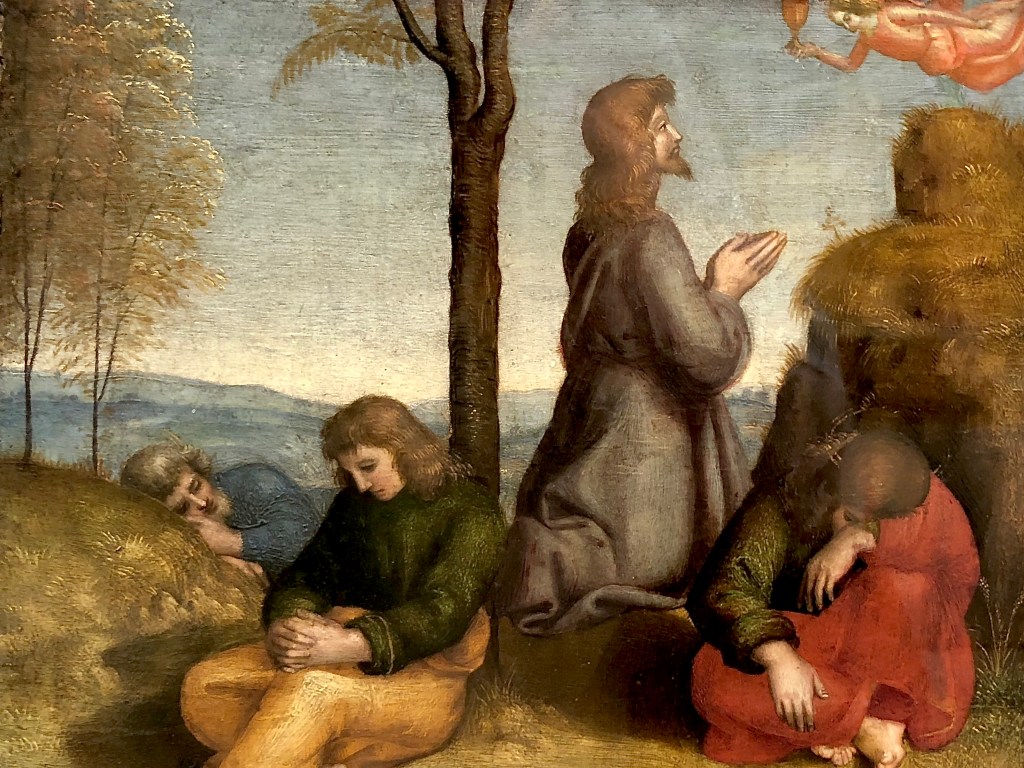
Raphael, The Agony in the Garden (c. 1504). “Keep a fire burning in your eye, and pay attention to the open sky: you never know what will be coming down” (Jackson Browne, “For a Dancer”).

On New Year’s Eve, 1969, I was twenty-five years old. I had begun the Sixties as a high school sophomore, and was ending it as a freshly-ordained minister in the Episcopal Church. A decade marked by so much historical drama and cultural transformation deserved a memorable farewell, but I found myself stuck at a tedious party with strangers and small talk in a Los Angeles suburb.

I slipped away and drove to the sea, arriving at the edge of the continent an hour before midnight. The big parking lot for Santa Monica’s popular public beach was deserted. I pulled up close to the sand, about a hundred yards from the surf. A “baptismal” immersion at the turning of time was my plan. But first, in the decade’s last hour, I would list in my journal the personal highlights for each of the last ten years: 

Three graduations and one ordination, my first guitar, my first romance, my first grand tour of Europe, an apartment fire consuming my theological library, two mystical experiences, one miracle, and the death of my father. And, a month before decade’s end, rolling over six times at sixty miles an hour in a Volkswagen bus––and walking away unbroken, intensely aware of the gift of futurity. I had been given more time to do whatever I was here to do. It was like being born again into a world glowing with possibility and presence. 

As I was writing these things down, a police car pulled up next to me. A young man parked by himself in an empty lot late at night was an object of suspicion under any circumstances, but the authorities at the time were on the lookout for the Zodiac Killer, who had been terrorizing California with a series of ghastly murders. Could this be the policeman’s lucky night?

He got out of his car and walked over to mine. I rolled down my window. When he asked what I was doing, I told him I was remembering the Sixties in my journal. He wondered if I would let him see what I was writing. It was very first draftish, but I handed it over willingly. My first reader! He scanned the pages, mumbling aloud my poor words along with a few inserted quotes:

“There must be some way out of here, said the joker to the thief…” (Bob Dylan)

“The world of the past is gone. Behold, I make all things new.” (Revelation 21)

Fortunately, this did not strike him as serial killer material, so he wished me a Happy New Year and bid me goodnight. I walked down the sea in time to make ritual welcome to the 1970s.

The 2010s will depart less dramatically. There will be a backward glance with photos and stories­­––gratitude for the gifts, lament for the losses­­––along with expressions of astonishment at the accelerating speed of our allotted span in these latter days. At midnight we will stand on our porch blowing kazoos and train whistles, banging gongs and beating drums, to drive away the spirits of gloom. Then we’ll return inside to greet the New with dancing and champagne by the Christmas tree.

As the American Civil War broke out in the spring of 1861, Henry David Thoreau, known for his outspoken opposition to slavery, wrote nothing about the conflict in his Journal. Rather, he continued to record his curiosity and delight over specimens and experiences of the natural world. A friend asked him how he could ignore “the Leviathan of Slavery” threatening to swallow the country like Jonah. Thoreau replied that refusing to let our attention be consumed by the hypnotic gaze of chaos “is just the most fatal, and indeed the only fatal, weapon you can direct against evil.” [i]

I know people who will spend this evening in prayer and vigil, aware that we are on the verge of an apocalyptic year, when the fate of this country and the fate of the planet are at stake as at no other time in living memory. 2020 promises an immense struggle requiring the best of us, and I am grateful for those who plan to welcome the New Year with their most prayerful attention, keeping their eye on the Light rather than being transfixed by the dark abyss of malevolence. 

I will join the fight on the morrow. But for tonight, by dancing and making merry, I will continue to remember and affirm a future beyond the battle, the new heaven and new earth where the tears are wiped from every eye and God’s beloved people rejoice once more in the light of hope and human flourishing. 

                                                                        +

Thank you, as always, dear reader, for the gift of your attentive reading and generous sharing of what I post here. Time is a precious commodity, and I appreciate your choice of spending some of it with The Religious Imagineer. I wish you a most happy––and redemptive––New Year. 

I began this blog halfway through this decade, and have posted a reflection on time, memory and hope every New Year’s Eve since 2014. You can find those writings at the following links:

The Angel of Possibility (2014)

Tick, Tock: Thoughts for New Year’s Eve (2015)

Foolishness and Hope on the Eve of 2017 (2016)

At the Mercy of the Future (2017)

On New Year’s Eve, My Inner Clown is Full of Hope (2018)


[i] Laura Dassow Walls, Henry David Thoreau: A Life (Chicago: University of Chicago Press, 2017), 479-80. I commend this book highly. It is a beautifully written, richly informative, and quite moving narrative of one of America’s most remarkable figures. 

O Rex Gentium (Dec. 22)

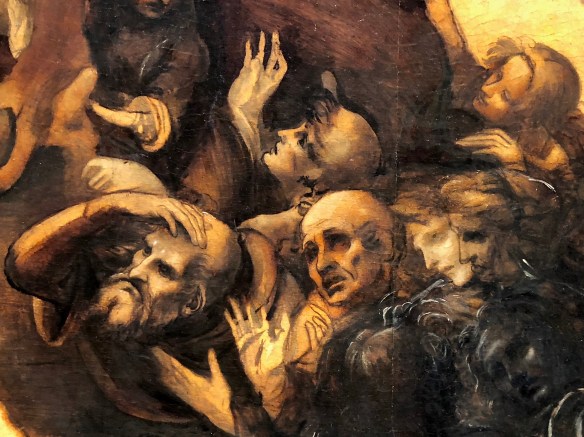
Leonardo da Vinci, Adoration of the Magi (detail, c. 1481-2, Uffizi Gallery, Florence).

O Desire 
of all nations and people,
you are the strong force
that draws us toward you,
the pattern which choreographs creation
to Love’s bright music.


Come: teach us the steps
that we may dance with you.

The sixth Antiphon goes to the heart of the Advent mystery: we are made of longing, born with a core of desire, an unquenchable thirst, for something we lack. Advent invites us to remember our longing and identify our deepest desire.

Some people think that Christianity is about the eradication of desire. Not so. Faith is the education of desire, weaning it from false objects and inadequate attainments, and directing it toward its true and ultimate end, the divine communion of the holy and undivided Trinity, the ceaseless dance of love which we are invited to share. 

Thomas Traherne, 17th-century Anglican poet, said, “Be sensible of your wants, that you may be sensible of your treasures.” What he meant was, if we want to know who we are, and why we are here, we need to pay attention to our deepest hunger, our deepest longing. What do we really want? What do we long for above all else?

When you figure that out––that is where you’ll find God: in the place where your desire is strongest. It doesn’t matter what name it goes by. Pay attention. Dig deeper. God is there.

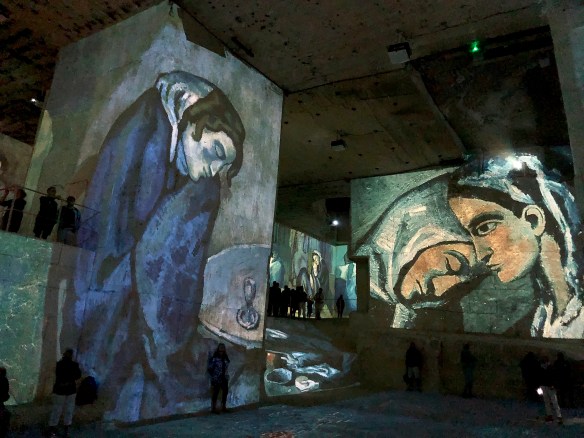
Projections of Picasso’s art on the surfaces of a limestone cave (Carrieres des Lumieres, Les Baux de Provence, 2018).

Backpacking with the Saints (Part 3)

Osservanza Master (Siena), St. Anthony the Abbot in the Wilderness, c. 1435

“The saints I travel with are more than companions on the trail. When I’m backpacking, I listen to their silences, their laughter, their readiness to jolt me out of my distractions. Back home I ask them for their prayers, for help in understanding and interpreting them aright. We even work together at letting the wilderness take us places where neither of us might have gone before in our thinking. Ours is a vigorous, intimate discourse. We wrangle back and forth; they humble me by the depth of their passion. I sense the weight of my responsibility to them, but I love them as well. The ‘communion of saints’ is far more than a line in the creed for me. These endearing trail-weathered mavericks are my teachers––giant sequoias that fill me with awe.”

–– Belden C. Lane

The fourth and final theme of Belden C. Lane’s Backpacking with the Saints returns us to the place where we started. But we are no longer the same. The journey has changed us. “Delight (Returning Home with Gifts)” invokes a quartet of spirited and joyous saints to help us discern the gifts we have found in the wild, not only for ourselves but for the whole human community.

Lane’s first gift for the return is discernment, the clarity to realize our deepest desire. And our teacher here is the thirteenth-century Sufi poet and God-intoxicated mystic Jelaluddin Rumi, whose playful and earthy metaphors sweep us past our distractions and evasions to take us where more cautious and “serious” language cannot go. We are flutes blown with divine breath, or dry tinder for Love’s fire. We are chickpeas tossed into a boiling pot until we are made soft and flavorful. We are lovers crazy to get lost in the Beloved. “I became Him,” Rumi said. “Then he threw myself out of me.”

For both the mystic and the soulful hiker, God is everywhere, including the inmost self. A pilgrimage out into the wild is also a journey inward, toward the revelation of our true desire. Once we drink from the source of all our yearning, we can return with an awakened heart. “You are the Kaaba,” Rumi tells us. “Walk around yourself in wonder.”

Palouse Falls, Washington (August 21, 2014)

The second gift to take home is community, and Lane’s teacher is Teilhard de Chardin (1881-1955), the Jesuit scientist and theologian who saw Christ as the strong force of the cosmos, drawing all things together in an evolutionary process of convergence. “Love alone,” he wrote, “is capable of uniting living beings in such a way as to complete and fulfill them, for it alone takes them and joins them by what is deepest in themselves.”

Teilhard was officially silenced by a hierarchy uneasy with his visionary breadth, but he never ceased to celebrate the holiness woven into every atom and every star. As disciples of the one who said, “This is my body,” we must treat matter with proper reverence, he insisted. “By means of all created things, without exception, the divine assails us, penetrates us, and molds us. We imagined it as distant and inaccessible, when in fact we live steeped in its burning layers.”

God is the mystery of the world, whose interdependent ecology mimes the trinitarian dance of eternal self-offering. Everything depends on everything else. Community in its purest form is communion. The wilderness wants to tell us this, and Lane is a good listener. Out in the wild on a starry night, a raucous Compline of bullfrogs and peepers signifies for him the perpetual liturgy of praise in which we all have a voice. “We join together as fragments of a greater whole, standing in awe at the immense and holy company that constitutes our common life.”

Edward Hicks, The Peaceable Kingdom (c. 1837)

Mohandas Gandhi is the next guide, and the gift is justice. Gandhi’s reverence for all living things, his compassionate attention to suffering, and his willingness to put himself at risk to restore community, all model just and loving practice in our endangered global habitat.

It’s hard not to spend time in the natural world without falling in love. Like all love affairs, it brings joys and blessings, but also great responsibility. Love is a fierce protector. We who love Creation must guard what is vulnerable and restore what is damaged. We must confess our complicity in the wounding of Creation, and refrain from further harm. We must speak and act on behalf of the whole community of created beings, loving our neighbors––both human and nonhuman––as ourselves. We must walk gently and reverently upon God’s earth.

Lane argues that a passion for earth justice is one of the greatest gifts we bring home from our wilderness encounters. His quote from Edward Abbey says it all: “Sentiment without action is the ruin of the soul.”

Fernandez Pass, west of the Minarets, Yosemite National Park (Sept. 8, 2008)

Holy Folly is the final gift, and Thomas Merton is the perfect guide. When Merton became the most famous monk of the twentieth century, his comic spirit laughed off the demon of self-importance. “If you see a meditation going by, shoot it,” he said.

Lane calls Merton a “Zen clown,” and links the monk’s notorious playful side to the tradition of holy fool, whose vocation is to mock our complacencies, subvert every oppression, and celebrate surprise. As Lane says, the holy fool “invites you to laugh at yourself and the silly pretensions that crowd your life. The gift of the fool may be the most telling of all the benefits that derive from backpacking as spiritual practice. There’s no end to the stories you can tell of dumb mistakes you’ve made on the trail. Self-effacement is easy, even for gearheads and hard-core hikers.”

Every spiritual journey is an embrace of profound folly. You leave the safe harbor of the familiar for the wild sea of unknowing. You trust in something you can’t see or even name. You sail off the edge of the maps, into God knows where.

From Via Negativa: A Worship Installation (text adapted from Richard Shelton)

My vicarious walks with Lane through the wild terrain of his book have illumined not only my hiking life, but the rest of my story as well. And what moves me most about him is a hard-won ability to embrace the gifts of the wild with both humility and courage.

He tells a story of going on a men’s retreat with Franciscan contemplative Richard Rohr in the Arizona desert. Rohr sent each of the group into the dry depths of Aravaipa Canyon for a solo overnight, a kind of vision quest. He told them to listen to whatever teachers might appear, and not to be surprised if they are given a new name in their place of solitude.

After dark, the desert wind kicked up, the kind of wind that bores into your nervous system with “an incessant, disturbing presence.” Unable to sleep, Lane suddenly “felt an urge to tell a story, as if the stars and whirling cottonwood leaves were asking for relief from the monotony of the wind.”

Perched on a sandstone ledge, face to the tempest, he began to recite every story he could think of, plus the many more which welled up from the forgotten places in his mind. “Then,” he writes, “in the darkness before dawn, I heard it.”

“A voice carried on the wind that seemed to speak inside my body. I didn’t think it. I simply received it, with an undeniable certainty. Four words addressed to me: “Speaks with the Wind.” Nothing more. But I knew in that moment that I had been called . . . I had been named.”

His account deflects the solemnity of that wilderness baptism with some self-deprecation. Who did he think he was, Kevin Costner dancing with wolves? But he knew the voice within spoke truly. And, to our great benefit, he consented to be “one that could speak in, with, and for the places I had learned to love and the saints who had taught me there.”

“It wasn’t about me,” he says. “But it required me.”


Joe Golowka, my backpacking mentor, Sespe Creek Wilderness (March 29, 1981)

All quotations are from Backpacking with the Saints: Wilderness Hiking as Spiritual Practice by Belden C. Lane (Oxford University Press, 2015).

 All photographs by Jim Friedrich


Backpacking with the Saints (Part 2)

Death Valley National Park, Holy Week 2005

You do not go into the desert to find identity but to lose it, to lose your personality, to become anonymous. You make yourself void. You become silence. It is very hard to live with silence. The real silence is death and this is terrible. It is very hard in the desert. You must become more silent than the silence around you. And then something extraordinary happens: you hear silence speak.

–– Edmond Jabés

In Part 1 of my commentary on Belden C. Lane’s book about “wilderness hiking as spiritual practice,” we explored his first two themes: Departure and Discipline. Here we shall look at his third theme.

The Philosophical Promenade, Keith Beckley / Dennis Evans (Seattle’s I-90 Trail, March 17. 2014)

Descent (When the Trail Gets Rough)

As a longtime backpacker, Lane knows that not every hike is a victory march. In fact, if you don’t encounter obstacles, setbacks, tribulations and the occasional failure, you’re kind of missing the point. Dante, history’s most famous trekker, discovered on his very first day in the wild that the experience of “descent” is not only inevitable, but necessary. Over the years, Lane has learned to welcome the hard parts as his teachers.

“Backpacking as a spiritual practice is about making yourself vulnerable in order to be stretched into something new. It’s the need to recognize your limits, to be taken to the end of yourself where resources are exhausted and you stumble in blind faith toward that which is more than you. In the beauty-mixed-with-terror of a backcountry wilderness, you begin to discover that for which the mystics had no language.”

Fear, failure, and death are Lane’s categories of descent. As with his other subjects, he chooses appropriate saints to guide him. His companion in the way of fear is John of the Cross, the sixteenth-century Spanish mystic who spent nine months locked in a dark space too small to stand up in. Abused by his ecclesiastical captors and frequently beaten, he struggled with boredom, doubt and despair. When he was close to death, he made a miraculous escape in the dead of night. But his cruel experience of confinement ultimately clarified and deepened his praise of the soul’s “dark night” as the passage into the place where love abides.

To reach the place you know not, John realized, you must go by a way which you know not. Satisfaction, assurance––even divine presence––will seem to go missing in the dark night, because whatever you “know” and the consolations you’re attached to are being stripped away to make room for something unimaginably greater. As T. S. Eliot would put it four centuries later, “wait without hope, for hope would be hope for the wrong thing.” Only thus did the suffering saint become the passionate singer of divine love.

When you are in the dark night, you don’t yet know it to be a passage into the light. The darkness feels real and absolute, full of terror. You are not yet the future self who has made it through. When Lane hiked the Maze, a bewildering and dangerous array of interlocking canyons in Utah, its confusing paths and frequent dead ends triggered an unsettling engagement with his personal demons. A confined, horizonless space where you can get permanently lost, or washed away by a flash flood, was the perfect place to descend to one’s inner depths.

The suicide of a father when Lane was thirteen, his mother facing death with Alzheimer’s, a mentor taken by cancer, the heart attack of a close friend––all the terrible losses came to visit in that arid canyon, whispering their ancient fears. But that’s not where the story ends, because the dark night doesn’t just take away. It also gives, and as John of the Cross discovered, it seems to know exactly what you need. Lane’s own story bears witness:

“There in the dark night, wandering through a maze, the impossible may happen. You find yourself moving beyond the fear and confusion you’ve been carrying for years. It’s no longer necessary to ‘fix’ what was unresolved in your parents’ lives. You can leave the past––there at the canyon wall, on the floor of the Maze, finally and for good.”

Mt. Whitney summit, 30 minutes before lightning and snow (September 5, 1998)

Failure is the next layer in Lane’s archaeology of descent. His pilgrimage to climb the highest American peak outside Alaska came short by 1700 vertical feet. California’s Mt. Whitney (14,505’) may not pose the same technical challenges as the glacial summits of higher or more northerly mountains. In summer the trail can be snow-free all the way. But the air is thin, the way steep, and the weather fickle. When I climbed Whitney twenty-one years ago, the sky went from sunshine to lightning to snow in half an hour.

Lane ascended Whitney with a friend in late spring, when lingering snow made footing unsure and an enveloping cloud reduced visibility to zero. He could barely see his own feet, and a sudden panic about falling into an unseen abyss forced him to turn back. His friend continued on, and later reported on the stunning views Lane had missed. To make it worse, some 12-year-old boy scouts back at base camp regaled him with their own tales of reaching the top. “Failure,” Lane writes, “felt like an indictment of my own worth as a person, confirmation of a deeper defect in character.”

His unsuccessful climb has stuck with him as a vivid metaphor for his own struggles to prove himself. Whether he was feeling out of place in a demanding graduate school, or worrying about being good enough as a teacher or writer, he felt the pressure of high expectations. Whether we’re trying to live up to our own ideas of perfection or somebody else’s, the pinnacle of “success” is a killer climb. What happens when you just can’t go all the way?

Martin Luther is Lane’s companion on this particular trail. Tortured by angst, guilt and a damaging penitential system, the great reformer learned the hard way that when we come short, when we mess up, we remain the beloved of God. “All of his life, Luther had feared an angry, demanding God, only to discover in the end that God had been wanting to love and forgive all along.” The life of grace has nothing to do with striving for perfection. It is, rather, an economy of perpetual forgiveness and compassion. God’s love is not earned, nor is it ever withdrawn. All we have to do, as Paul Tillich said, is to “accept our acceptance.”

For Lane, the most important mountains are the ones we don’t climb. “Every failure is an invitation to growth. Mistakes are occasions for grace, opportunities to choose a different path. They make forgiveness possible. Only in the absence of success can you know yourself to be loved without cause.”

Banff National Park, Alberta, Canada (August 21, 2012)

Lane’s trajectory of descent concludes with death, the point of no return. The literal end of our mortal span is not the only death we face. We all experience many little deaths throughout our life, as one stage or condition ends and another takes its place. And for the spiritually adventurous, there is the hardest death of all: the annihilation of the inauthentic self.

Letting go of the old life, the old self, or the old story is always challenging. Sometimes we have to be dragged kicking and screaming into the new life, even if it’s infinitely better. What Lane calls “the wild and reckless beauty” of untamed places can help us transcend our limiting self-descriptions and receive an identity far more luminous and vast.

“Inherently we sense that the uncaring majesty of wilderness has the potential of breaking us open to love. Each passage to a new self begins with an allurement that threatens to kill, even as it ignites a new fire within.”

A few years before his retirement from thirty years of university teaching, in the company of his dog and the anonymous author of The Cloud of Unknowing, Lane ascended a wild section of Missouri’s Ozark Plateau to undergo a ritual death, releasing his hold on an identity which was passing away. On Mudlick Mountain, named for some of the oldest exposed rock in the world, he chose a primitive stone shelter as his “death lodge”––a place to bid farewell to the old life and prepare himself for the new.

“My hope was to trade the mind of the scholar for the heart of a vagabond poet. . . In my backpack I’d brought along the last few pages of a scholarly book I’d been writing. I read these to the dog and the hickory trees, offered thanks for the work I’d been given, and then burned the pages in the fireplace.”

Finally, like the prophet Ezekiel, he shaved his head to welcome old age and celebrate his imminent freedom from “impression management.” It’s a poignant image. The aging scholar consenting to vanish. The ashes of his writings now cold in the fireplace. His faithful dog––whose  last breath would come during Lane’s drafting of the death chapter––quietly living in the moment.

It’s like a quatrain from Li Po, an 8th-century poet cited in Lane’s book. On a mountain overlooking China’s Shuiyan River, Li Po wrote:

The birds have vanished into the sky,
and now the last cloud drains away.
We sit together, the mountain and I,
until only the mountain remains.

Sunrise view of Mt. Whitney from Trail Camp at 12,000′ (September 5, 1998)


Except for the epigraph, all quotations are from Backpacking with the Saints: Wilderness Hiking as Spiritual Practice by Belden C. Lane (Oxford University Press, 2015).

All photographs were taken on my own hikes.

 Lane’s final theme, Delight (Returning Home with Gifts), will be the subject of my next post.