Seventy times seven

Jacopo da Pontormo, Deposition (1525-26), Capponi Chapel, Santa Felicita, Florence

Jacopo da Pontormo, Deposition (1525-26), Capponi Chapel, Santa Felicita, Florence

A homily on Matthew 18:21-35 for the 14th Sunday after Pentecost (and 9/11)

So Peter comes up to Jesus and says, “Lord, forgiveness is really hard work. When do I get to quit?”

And Jesus says, “Peter, sometimes you’re as dumb as a rock. If you want to stay with me, you can never stop forgiving.”

“But Lord, you don’t expect me to forgive everyone, do you?”

“Yes, Peter. Everyone.”

          The Gospel of the Lord.

I once led a workshop exercise based on the Flood story. We all wrote on cards the types of people we thought the world would be better off without – drug dealers, terrorists, polluters, tax collectors and sinners, etc. – and we put our cards in a pile in the center of our circle. Each person had to pick a card, becoming the character they drew. Then they each had to make a case for themselves, to persuade us to let them come aboard the ark rather than be left to die in the flood. Most of us had at least one or two people we didn’t want to sail with, but some of the women – though none of the men – voted to forgive everyone.

How would you vote? Saved, or drowned?

The driver who cut you off on the freeway?
The neighbor who won’t quiet her barking dogs?
The priest who failed to visit you when you were sick?

How would you vote?

The colleague who stabbed you in the back?
The friend who let you down?
The spouse who betrayed you?

How would you vote?

The football player who knocked out his fiancé in an elevator?
The fanatics who flew the planes into the towers?
The lawyers and politicians who made torture a national policy?
The men who beheaded American journalists on YouTube?

Let’s be clear. Forgiveness doesn’t mean condoning or tolerating wicked acts. It doesn’t mean a wife should stay with an abusive husband, or that we can’t feel shock and outrage when we witness hateful instances of oppression or racism or brutality.

What forgiveness does mean is that
we don’t let those things have the last word.

We all know about this on a personal level. You may never forget a wounding encounter, but you know you can’t let it fester inside forever, you can’t give it power over you forever. At some point, you have to let it go.

Tell the truth about it, to the offender if possible, and to yourself. Don’t minimize the damage. But don’t hold on to the hurt. Don’t make your life about the hurt.

Forgiveness means leaving resentment behind. It means letting go of the reactive desire for punishment. There was a POW who said he could never forgive his captors. So a friend told him, “Then they’ve still got you in their prison.”

Rabbi Harold Kushner told a woman who was betrayed and abandoned by her husband: “I’m not asking you to forgive him because what he did was acceptable… I’m asking you to forgive because he doesn’t deserve the power to live in your head and turn you into a bitter angry woman…. you keep holding on to him. You’re not hurting him by holding on to that resentment. You’re hurting yourself.”

That’s all true as far as it goes. We can be bigger than our hurts. We can live in the present, not the past. But when Jesus told us to forgive, he wasn’t just talking about our personal well-being.

He was talking about a radical revolution in human relations.
He was telling us to exit the endless cycle of violence and retribution.
He was telling us to choose life, not death.

Those terrorists who committed atrocities on YouTube,
they want our rage, they welcome our hate,
because it means we are consenting to play their game of death,
adding our own tributaries of anger to their river of violence.

So we are presented with a clear choice:
Either forgive them,
or become them.

Jesus is asking something very hard of us.
Yes, maybe we can forgive the ordinary hurts of daily life.
But how can we forgive those monsters on YouTube?
That goes against human nature. That seems impossible.

Maybe it was impossible once. But Jesus, who died forgiving his own killers, has redefined what is possible. Jesus has opened the door to redemption for even the worst of sinners.

They may not always go through that door – some may choose to remain in the godless hell of their own self-will, but we are not allowed to close the door on them. We are not allowed to deny anyone the possibility of redemption, the possibility of reconciliation and healing.

God wants to do something new with this world, and as long as we perpetuate the cycle of violence and vengeance, that new thing cannot happen.

If we say that there are some people who cannot be saved, we are limiting the power and grace of God, and we are refusing our own vocation to be God’s agents of grace and forgiveness not only for the people we know, but for the stranger and the enemy as well.

We can do this, Jesus assures us. We can forgive – not because we are saints with extraordinary powers, but because we are sinners who have ourselves been forgiven.

Just ask St. Paul, who reminds us this morning not to judge one another, who asks us to remember that since we all belong to God, we also belong to one another. These are the words of the man who held the coats for Stephen’s murderers while they stoned the first Christian martyr.

If that stoning had been on YouTube, we might still be holding that horrifying image in our minds, still hating Paul as a monster instead of reading his words as Scripture. Paul knew what it meant to be forgiven, and that’s why he could be so eloquent about grace.

“We all stand before the judgment seat of God,” he says.
Lord have mercy. Christ have mercy.

When Peter asked his question about forgiveness, Jesus told him a story.

A slave who owes his master a gazillion dollars is forgiven this unpayable debt, but then he goes right out and finds a fellow slave who happens to owe him fifty cents. He grabs him by the throat.
“Pay me now!” he says.
“Have mercy!” the man cries. “I cannot pay you.”
“That’s not my problem,” he says, and throws the man into a dungeon until he can pay what he owes.

It’s one of Jesus’ craziest stories, and it’s meant to be. The absurdity of the parable puts a spotlight on our own absurdity when we who have been forgiven so much refuse to pass that forgiveness on to others.

If we say we have no sin, we are only deceiving ourselves. It’s not just a matter of how we act as individuals. We must also acknowledge our inescapable participation, conscious or unconscious, voluntary or involuntary, in all the systemic processes that negate the flourishing of life on earth. Just by functioning within the habitual realities and practices of a fallen and imperfect world, we become complicit in the things that fall short of God’s intention, the things that disappoint God’s hope for us.

And still, God loves us.
And still, God forgives us.
And still, God keeps heaven’s door open
and leaves the light on for us.

Perhaps you saw the extraordinary film, Of Gods and Men, which came out a few years ago. It tells the true story of eight French Catholic monks who lived in the mountains of Algeria during a time of civil war and terrorist violence in the 1990’s. Their monastery was at the edge of a poor Muslim village, where they lived in harmony with their neighbors, providing the village’s only accessible health care.

As the surrounding political violence escalated, the monks were warned by the government to leave the country. As Catholics in a Muslim country, they would be suspected of trying to make converts. Their very presence was an offense to the religious extremists. But the monks felt called to remain among the people they served, despite the high probability of martyrdom. Despite their own fears.

“If something happens to us, although I do not wish it to,” wrote Brother Michael, one of the monks, “we want to live it here in solidarity with all the Algerians, men and women, who have already paid with their lives, and in union with all unknown innocent victims.”

As for the armed rebels and the armed soldiers who were fighting all around them, the monks called them “our brothers of the mountains and our brothers of the plains.”

Their abbot, Dom Christian, wrote a letter to his family in Advent, 1993, two and a half years before he and his brother monks were beheaded by terrorists. Anticipating his own martyrdom, he insists that he is not exceptional, since so many others in that land were also at risk.

“My life,” he wrote, “is not worth more than any other — not less, not more. Nor am I an innocent child. I have lived long enough to know that I, too, am an accomplice of the evil that seems to prevail in the world around, even that which might lash out blindly at me. If the moment comes, I would hope to have the presence of mind, and the time, to ask for God’s pardon … and, at the same time, to pardon in all sincerity him who would attack me…”

What an extraordinary thing to say: Here is a good and humble and holy man confessing his own complicity in the evils of the world. And what does he hope for? He hopes for the presence of mind, in the very moment of being murdered, to ask forgiveness. Forgiveness not only for himself, but for his killer as well. As he had once said of his monastic community, “we should openly be on the side of love, forgiveness and communion, against hate, vengeance and violence.”

The last part of Christian’s letter is addressed not to his family, his loved ones, but to the unknown violent stranger who will one day kill him, the stranger whom he calls “my friend of the last moment.”

He calls his killer friend, refusing the way of violence and vengeance and hate, and by so doing he plants the kingdom of forgiveness in the very place where his own blood would be spilled by his assassin’s sword.

He commends that assassin not to hell, not to eternal punishment, but to God. A-dieu, he tells him. A-dieu: “to God.” And then he imagines a future that may seem impossible to us, but is the only future which God desires.

Listen to what he says. This is how Christian ends his letter; this is what he wants to tell the stranger who will one day cut off his head:

“And to you, too, my friend of the last moment, who will not know what you are doing. Yes, for you, too, I wish this Merci, this “A-Dieu,” because in God’s face I see yours. May we meet again as happy thieves in Paradise, if it please God, the Father of us both.”

Messianic light

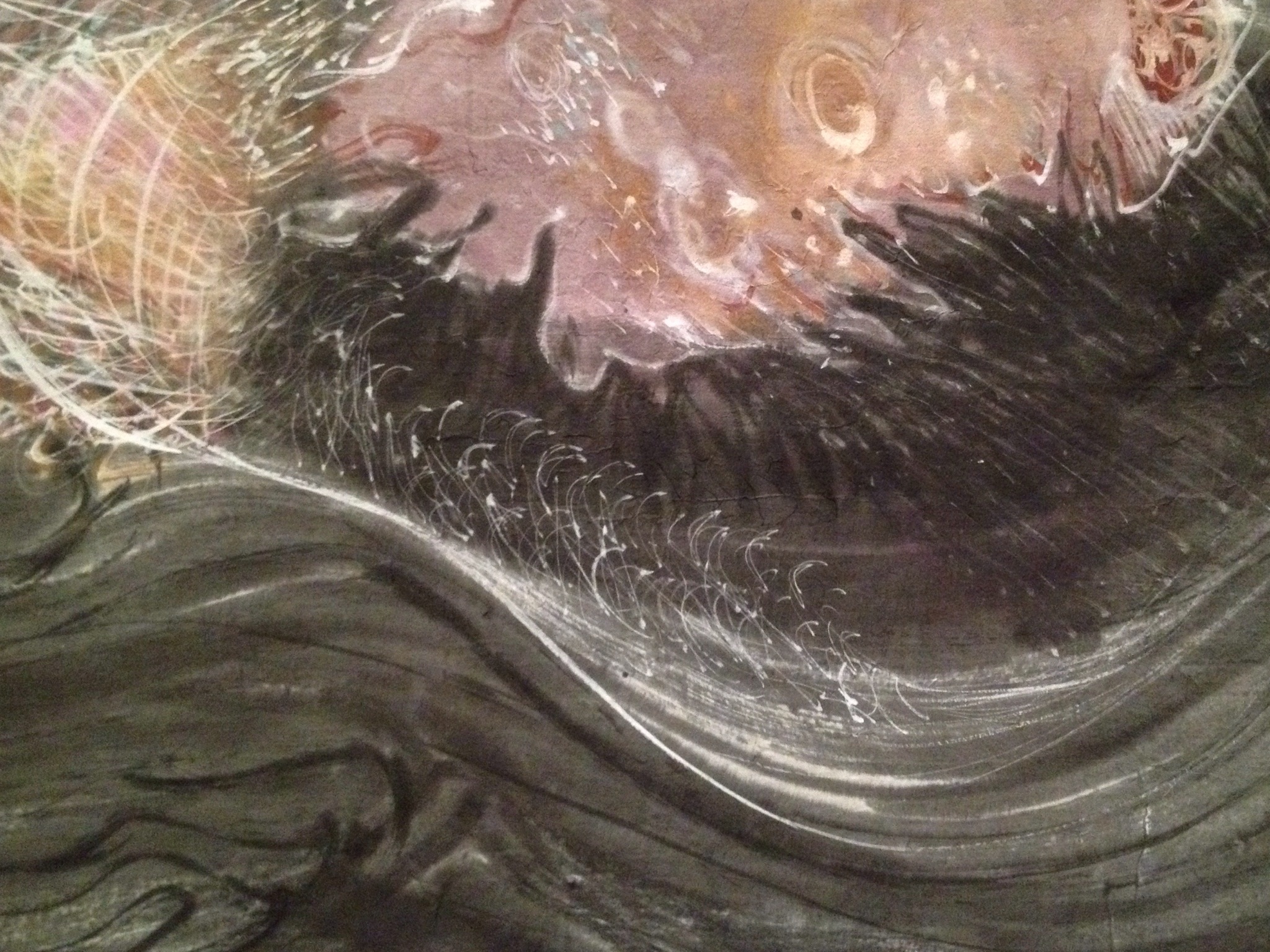
Morris Graves, The Genesis of Life Lay Deep and Anticipant under the Sky II (1944, detail)

Morris Graves, The Genesis of Life Lay Deep and Anticipant under the Sky II (1944, detail)

At the beginning of Moby Dick, Ishmael encounters a strange painting hanging in the entry of an old inn. Dimly lit and “thoroughly besmoked,” it was an indistinguishable mix of “shades and shadows” with a “long, limber, portentous black mass of something hovering in the center.” It seemed a picture of primal chaos, suffused with “a sort of indefinite, half-attained, unimaginable sublimity about it that fairly froze you to it,” prompting Ishmael to obsess about its meaning.

It’s the Black Sea in a midnight gale. – It’s the unnatural combat of the four primal elements. – It’s a blasted heath. – It’s a Hyperborean winter scene. – It’s the breaking up of the ice-bound stream of Time. – But at last all those fancies yielded to that one portentous something in the picture’s midst. That once found out, and all the rest were plain. But stop; does it not bear a faint resemblance to a gigantic fish? even the great Leviathan himself?

Ishmael might have been contemplating the inky monolith of a late Rothko, or one of Morris Graves’ dark wartime nocturnes of a restless and tormented life force. It was a classic experience of the Sublime, where the human and the known are overwhelmed by the transcendent and the unknowable. Whether you are Moses enveloped in Sinai’s stormy cloud or a tourist gawking at Niagara Falls, you feel a sense of shock and awe in the presence of a wild uncontrollable force. For a moment, at least, the stable coordinates of the humanly constructed world are blown away. The tourist may escape with merely a pleasant shudder, but the saint is swept into the divine abyss.

The Sublime is the annihilating negative which questions, disrupts, challenges a world too narrowly constructed in our own image. It is the vast unknowable desert that lies beyond our maps; the nameless voice that asks ‘Why?” and “Why not?”; the apocalypse that rejects the finality of empires. It is the dark night of the soul where language fails and silence speaks; the radically other, ungrasped by imagination; the formlessness prior to every making. It is the ending that births the beginning.

Artists have long attempted to convey the transcendent through sensuous means and materials, but only in the last century have some of them tried to do it without using recognizable images or narratives. Color, shape and texture in themselves would be sufficient to make visible the underlying essence of reality, according to pioneers of the abstract like Kandinsky. As Barnett Newman said in a 1948 manifesto, “We are freeing ourselves of the impediments of memory, association, nostalgia, legend, myth, or what have you, that have been the devices of Western European painting.” An abstract canvas could provide direct revelation through pure sensation, unmediated by stories or symbols or replications of the material world.

Whether the “abstract sublime” actually put the viewer in closer touch with the deepest reality, or was just another form of representation as “fictional” in form as a biblical scene or a landscape, has been widely debated. Can any image be identical to what it portrays? And is form only something that exists in the perceiving mind, and not a quality inherent to the universal flux? If deepest Reality, or God if you will, is unrepresentable, how can you make a picture of it? Can you stand before of the saturated hues of a Rothko and believe you are in the presence of the transcendent? Some have. I have.

Most artists today are reluctant to make overt claims for their work as spiritual events between viewer and the transcendent, as deep speaking to deep. In the postmodern play of signifiers, there is no divine Voice, no Reality trying to communicate with us from a realm beyond finite language. As atheist philosopher Richard Rorty reductively put it, “the world does not speak. Only we do.”

That is not my experience. Nature has spoken to me. Sacrament has spoken to me. Christ in my neighbor has spoken to me. And art, both figurative and abstract, has spoken to me, most recently in the paintings of Morris Graves in a revelatory exhibition at the Seattle Art Museum, Modernism in the Pacific Northwest: The Mythic and the Mystical.

The exhibition makes a case for Seattle as the birthplace of modernism in American art. Mark Tobey’s “white writing” paintings, where thin lines of white paint permeate scenes like an energy field binding all things together, have been credited with the invention of gestural painting, which Jackson Pollock would adapt and make famous. Both Tobey and Graves, imbued with the art and the spirituality of Asian and Northwest native cultures, approached their work with a mystical sensibility that impressed East coast critics and artists alike. Even when the New York School veered away from the spirituality of art into pure painting free of “meaning,” the Northwest painters continued to make substantial connections between art and spirit.

I was particularly moved by Graves’ World War II work. Jailed for refusing to fight, Graves was profoundly troubled by the madness and destruction of the conflict, what he called “the death of all reason.” When he was released in 1943, he began to paint feverish visions of a monochrome night world on the verge of ending, as darkness and deluge swirled all around. There were forms – a crow, a minnow, a waning moon – which resisted the devolution into utter chaos. These few were signs of resistance and grace. Graves wrote of the minnow:

Silvery minnow-moment of awareness flash-gleaming in the depths, now seen, now gone … when crisis occurs, the minnow voluntarily comes into view – to renew faith and give direction.

But Graves’ wartime paintings never showed more than brief glimmers of hope in a world of threat and horror. It was not until the war ended that Graves could fill a canvas with light, in his depiction of a brilliant lotus flower in bloom. This Buddhist symbol of meditation and enlightenment could be seen as a victory of light over darkness, but some have noted the bloom’s resemblance to a nuclear cloud. As with the August 6th coincidence of Hiroshima Day with the Feast of the Transfiguration, the struggle between life and death is far from done.

Graves believed that art has a profoundly meaningful task, and something Theodor Adorno said might well be applied to Graves’ own work:

Knowledge has no light but that shed on the world by redemption: all else is reconstruction, mere technique. Perspectives must be fashioned that displace and estrange the world, reveal it to be, with its rifts and crevices, as indigent and distorted as it will appear one day in the messianic light.

Art can reveal the poverties and distortions of the world.
Can it also enable us to stand in the “messianic light?”
Are there indeed showings of the divine in color, form and light?

On the day after the Feast of the Epiphany in 1956, Sylvia Plath wrote a postcard to her mother, describing her visit to the Matisse Chapel on the Riviera. The entrance was shut when she arrived. The chapel only opened twice a week, and on the other days not even rich tourists waving large sums of money could gain admittance. Plath was “desolate” at her bad timing. She wandered glumly around the walls enclosing the chapel, “feeling like Alice outside the garden.” Then she returned to the locked gate and stood quietly.

I began to cry. I knew it was so lovely inside, pure white with the sun through blue, yellow and green stained windows.
Then I heard a voice. ‘Ne pleurez plus, entrez,’ and the Mother Superior let me in, after denying all the wealthy people in cars.

I just knelt in the heart of the sun and the colors of sky, sea and sun, in the pure white heart of the chapel. ‘Vous êtes si gentille,’ I stammered. The nun smiled. ‘C’est la miséricorde de Dieu.’

It was.

Faith’s endangered habitat

Teton presider

American Christianity is in numerical decline – no news to the inhabitants of graying churches. According to a recent survey by the Pew Research Center, 20% of the population has no religious affiliation. Just five years ago, that number was 15%. Among adults under thirty, 32% are unaffiliated, with little prospect that they will become more religious as they grow older. According to the study, affiliation does not increase as a particular generation advances through the life cycle. The younger generations will remain less affiliated even as they age. If each succeeding generation continues the trend of rejecting institutional religion, will churchgoers become an endangered species?

The habitat for practicing believers has certainly been compromised. The inanities and hypocrisies of media evangelists, the ignorant ravings of fundamentalists, the hatred and violence of religious extremists have all marred and polluted the public landscape of religion. But that in itself need not be fatal. Christianity has a venerable history of toxic clean-up campaigns, with saints and prophets leading the way. A far more serious threat is the steady shrinkage of habitable environments for faith communities, as individualism, materialism and secularization encroach steadily upon the perceptions and behaviors that make religion sustainable. How can the community of God’s friends persist when God has become, for so many, not just unnecessary but virtually unthinkable?

Modernity has, over the last 500 years, gradually detached western culture from transcendent necessities. God is no longer assumed to be the creator and sustainer of every moment, the all-encompassing reality in whom we live and move and have our being. While individuals might retain a strong personal connection with God, the social world is seen as a self-governing reality, not requiring reference to anything “higher” or “beyond” in order to function or develop. Once the sacred dimension was expunged from the world, and “the last king had been strangled with the entrails of the last priest,” human life could achieve full independence from the constraints of any sacred order or transcendent reality beyond itself.

With God demoted from the ever-present sustainer of life to its original but now absent designer, it was not long before God seemed no longer necessary at all for the construction of meaning or purpose. As Charles Taylor writes in The Secular Age, “The modern social imaginary no longer sees the greater trans-local entities as grounded in something other, something higher, than common action in secular time.” In other words, the inherited modern culture in which we live and move and have our being has no apparent or practical need of God to explain things or provide the sources of human flourishing.

When Christians worship or pray or converse among themselves, they radically contradict such premises of modernity, but in the largely unconscious, ingrained, or automatic behaviors of everyday living, it is hard not to find ourselves reverting to the default position of the culture: simply acting without God in mind. Or in our bones. In the words of German theologian Eberhard Jüngel, “It would appear, then, that God has no place in our thought and thus has no place in our language. [God] does not occur, has no topos (place, position).”

This “placelessness” of God is what I mean by the erosion of sustainable habitat for communities of faith. If God has no place in the behavior or even the thought of so many people, why would religion make any sense at all to them, except as a provider of purely human benefits such as community or charity? No wonder the churches dwindle.

Then what do we make of these statistics: 68% of the unaffiliated say they believe in God, 58% feel a deep connection with nature and the earth, 37% call themselves “spiritual but not religious,” 30% have had religious or mystical experience, and 21% say they pray every day. Evidently many are still trying to retain a connection with something deeper than the everyday, with a necessary mystery beyond themselves. However, only 10% of them are interested in seeking religious community. Most would rather be spiritual but not religious.

I’m not sure that’s really possible. We might wish to declare independence from the limitations and messiness of human institutions and opt for the purity of personal practice, but “bowling alone” (to cite Robert Putnam’s famous term for the erosion of civic and communal engagement in America) misses the point of engaging our deeper selves.

Christians say we are made in the image of a Trinitarian (= social and interdependent) God, and we best praise and contemplate and grapple with that communally complex divine reality in the company of others: not only joining with the local worship assembly or even the wider Church on earth, but with the friends of God in every age who cry “Holy!” for all eternity, dancing with the Triune Love Who Loves Us. You can’t worship by yourself anymore than you can be in love by yourself. Worship needs a choir.

Even in private prayer, you use words and images supplied by tradition, and reinforce deep connections with others now absent from you. Even beholding the beauty of a sunset, you do it in company with the poets and painters and photographers who have given you an eye for the beauty of things.

The difference between solo spirituality and religious belonging is like the difference between a lion in the zoo and a lion on the savannah. You need a broad and healthy habitat to flourish. Can the habitat of faith and worship survive and be restored? Will things which were cast down be raised up, and things which have grown old be made new?

God only knows.

Where did Jesus go?

Ascension has always been a favorite feast for me. This is what I preached this morning at St. Thomas Episcopal Church in Medina, Washington.

Ascension for blog

In the 1960’s, the Italian journalist Oriana Fallaci interviewed
the American astronaut Wally Schirra:

“How does it feel to be up there?” she asked him.
“How does it feel to be floating weightlessly up there?”

He shook his head slowly. “Feeling weightless… I don’t know… You feel exquisitely comfortable, that’s the word for it, exquisitely… You feel comfortable and you feel you have so much energy, such an urge to do things, such ability to do things.  And you work well, yes, you think well, you move well, without sweat, without difficulty, as if the biblical curse, “in the sweat of thy face and in sorrow,” no longer exists. As if you’d been born again.”

“And when you come back to Earth, Mr. Schirra? …
how does it feel … to come back to Earth?  What’s it like?”

“For me it’s a great feeling of regret, a great sorrow. It starts when the retro rockets are about to fire and the time indicator shows how much time you still have left, and you’re no longer weightless, and the dropping needle takes away your joy and restores your weight, your biblical curse… Zero zero; three zero minutes and zero zero seconds… Zero zero; one zero minute and zero zero seconds… It’s robbing you of … your exquisite lightness, … and you can’t do anything about it, and while you are still thinking, you can’t do anything about it, there it’s nearly at an end, there it’s ending, there it’s ended.  While you’re thinking that, you’re back here on the Earth. No, returning isn’t a sigh of relief.  You can love the Earth with all the love in the world: Returning is regret, is sorrow.”

I have always loved this intriguing testimony someone who was able, for a time,
to escape the bonds of earth, to shed the weight of gravity
and experience the levity of the heavens.

Do you think the Ascension was like that?
Do you think it was a relief for Jesus to shed the weight of earthly existence,
to finally leave it all behind: the sweat and thirst, the labor and sorrow,
of embodied life?

Sometimes, when life gets hard, it is tempting to think so, and there is no lack of theological endorsements for a strict dualism between heaven and earth, between human and divine. But the whole point of the incarnation, the embedding of God into the human condition, is to affirm the union of heaven and earth, not their separation.

Christ did not come among us only to leave us behind in the end.
And the Resurrection, far from dismissing embodied life as a prison house,
something we need to escape from,
shows it to be worthy of eternal preservation and affirmation.

Then what is the meaning of this mysterious Ascension story, which is told only by Luke, by the way? None of the other gospel writers found it necessary to paint a literal picture of Jesus’ departure from the visible world. Since they did not go beyond the story of Jesus, they could conclude their account with him still around, not yet departed. Unlike Luke, they didn’t go on to tell the story of what happened next, when Jesus was no longer present in the way he had been in his earthly ministry, or in the resurrection appearances, which themselves also came to an end.

But once those unique experiences did cease to occur, the early Church had to adjust to the physical absence of Jesus. And in order to tell that story, Luke needed to remove Jesus from the stage. So he showed him ascending into a cloud. It is a lovely image, that expressive and resonant vertical metaphor for transcendence.

But in his Ascension story, Luke doesn’t provide the kind of detail expected of realistic narrative. He doesn’t try to make us believe Jesus went away just so. No special effects required. It’s simply “now you see him, now you don’t.”
We’ve all watched the sun go away on a cloudy day. Maybe it was like that.

Luke might have had Jesus disappear around a corner, or over a hill.
Or the disciples might have looked away for a moment, or blinked,
missing the exact moment of vanishing.
But the cloud is a nice touch. Artists have always loved it.
In any event, Jesus is suddenly gone.

The essential part of Luke’s story is not the means of Jesus’ departure,
but the meaning of his absence:
Where is he now, and will we ever see him again?

In a sense, Jesus is always going away.
Jesus never remains where we leave him.
Not in the tomb. Not in the sky. Not in the Bible.
Jesus comes to us out of the future, not the past.

It may take time to recognize the way his body will look the next time we see him.
It may look like a homeless man pushing his cart down the sidewalk,
the exhausted mother carrying her baby,
the victims of disaster and war on our televisions.
It may look like the face in the mirror,
or the ragtag band sharing bread and wine on a Sunday morning.
It may look like the whole wide world.

If the Incarnate One had clung to the body of a first century Jewish male,
God could have never become the rest of us.
Without that body to keep us fixated on past appearances,
we learn to see Christ everywhere.
The absence following the Ascension creates an emptiness
which God can fill with a new, expanded “body.”

British theologian Graham Ward celebrates the Ascension as an image of the “transcorporeal” nature of Christ’s body, which is always becoming something else, something larger, something more.

It can’t be comprehended, grasped, pinned down or exhausted.
Always pouring itself out, always being transfigured,
it does not remain a discreet, locatable object that is “here” or “not here,”
lost from sight behind a cloud or kicking back in some place called heaven
where we may venerate it from afar.

“The specificity of his body is unstable from the beginning,” writes Ward. “Jesus’ body is extendible, can expand to incorporate other bodies, make them extensions of his own.”

In other words, his body is not erased by the cross, the tomb or the ascension.
It is expanded.
We ourselves become part of it, as we discover that our own bodies,
instead of being the self-enclosure of solitary egos living in and for ourselves,
are part of a larger, permeable, interdependent existence.
Never complete in ourselves,
we are inseparable from what is outside us and beyond us.

Christ before us, Christ behind us, Christ under our feet,
Christ within us, Christ over us, let all around us be Christ.

If you want to see Jesus, don’t stand looking up into the heavens.
Just look around right where you are.

I read a story in The Christian Century magazine about a regional gathering of Lutherans that happened to fall on Ascension Day. The planning committee was trying to think of ideas for the liturgy, and someone suggested blowing out the Paschal Candle after the Ascension story was read.

The Paschal Candle is first lit at the Easter Vigil. A cantor sings, “The Light of Christ,” and everyone responds, “Thanks be to God!” This great candle then burns as a symbol of the risen Christ at every liturgy throughout the fifty days of Easter, ending with Pentecost Sunday. To blow it out at the Ascension would certainly be dramatic, but to make such a literal representation, as if the Easter presence were somehow being extinguished, would be not only be a little depressing but also very misleading.

Jesus did not vanish like smoke, never to return.
He came again in the fire of empowering Spirit.
And in the meantime, in the space between the Ascension and Pentecost,
in that time of absence and waiting which every believer knows all too well,
there is room to discover the new ways Christ is being manifested in our life together
as the community and communion of God’s friends..

W. H. Auden said that when a writer dies, he becomes his readers.
So we might say that when Jesus ascended, he became the Church.

And what about those Lutherans? What did they finally decide to do in that liturgy? The Paschal Candle was indeed extinguished after the reading of the Ascension gospel. But before this happened, just when the reader finished, a dancer entered, moving among the people with a collection of hand candles, lighting them one by one from the Paschal Candle, and offering them to each of the worshippers. Once everyone had a lighted candle, the dancer bowed before the Paschal Candle, and put it out. The smoke rose up and disappeared into the air. But the room remained full of light, as all those little flames flickered in the hands of the people.

The Light of Christ was not something they had watched disappear.
The Light of Christ was something they themselves had become.