The World’s End (An Advent Manifesto)

Standing Rock police assault Water Protectors with fire hoses.

Standing Rock police assault Water Protectors with fire hoses.

Advent is not just a season of quiet waiting.
It is also a time of protest and vision.

As the election consequences unfold, Advent seems less a ritual preparation for Christmas than a realistic description of where we find ourselves in a darkening world. Pitting hope against despair, Advent calls us to “cast away the works of darkness and put on the armor of light.” My last post proposed 7 Spiritual Practices for the Time of Trial. I want to follow that by revisiting a post from November 2014, an Advent manifesto which seems even more timely today. 

When I was 8 years old, I read in LIFE magazine that in so many millions of years, the sun would burn out and life on earth would cease. This worried me, so I asked my parents, “If the world is going to end, how come we say “world without end” when we pray?” And they told me what the Bible says, that heaven and earth may pass away, but God remains. That relieved some of my anxiety, but I still wasn’t sure I liked the idea of the world ending, even if God was in charge.

Of course the world ends all the time. When I moved from California to Puget Sound in the 1990’s, my first Northwest winter felt like a biblical apocalypse: the sun was darkened and the moon gave no light.

Who among us has not seen their world end? Adolescents exiled from childhood. Black teenagers robbed of their future. Elders deprived of their health. Unemployment …retirement …divorce … the death of a parent, a spouse, a child — in every one of these, a world comes to an end.

For anyone who has known serious loss, this is more than metaphor. The experience of grief can be so total and unrelenting that you can’t see anything beyond it. You can’t imagine the future. It feels like the end of the world.

The stars are not wanted now: put out every one;
Pack up the moon and dismantle the sun;
Pour away the ocean and sweep up the wood;
For nothing now can ever come to any good. [i]

W.H. Auden was invoking apocalyptic metaphors to express personal loss, but shared, public worlds also come to an end. As in 1789, or 1914. The Holocaust. Hiroshima. 9/11.My Lord, what a morning, when the stars begin to fall.

But why bring up such dreary stuff on this first day of the new Christian year? Shouldn’t we be breaking out the party hats, blowing horns and shouting “Happy New Year?” The wisdom of the Advent season is that it never begins with “A Holy Trinity Production,” or “The Creator of the World Presents.” No, it always opens with “The End.” Advent knows that every beginning involves some kind of ending. In this season’s Scripture, preaching and prayers, the present arrangements of collective and personal life are judged and found wanting. God’s imagination is far too rich and fertile to settle for our barren and diminished versions of human possibility.

Selfishness, greed, consumerism? Fear, racism and violence? Poverty, militarism, war, environmental degradation? That’s the best we can do? Really? God must be saying, “Come on, people. I made you a little lower than the angels, and this is what you came up with?”

George Eliot said “it is never too late to become what you might have been.” But to get to that “might have been” requires an Exodus into the wilderness beyond the way things are; an Exodus beyond even the best we can imagine for ourselves, into a place of unknowing, where only God possesses the language to speak our future into being.

So much of what we hear and pray and sing in Advent is profoundly disruptive. Bob Franke’s great Advent song, “Stir up your power,” gets right to it in the first line: This world may no longer stand. We are meant to be unsettled, to be driven beyond our narrow boundaries, our constricted realities, toward a beckoning horizon. The Christian life is a perpetual series of departures for a better place.

The world as it is – the world of racial hatred and toxic violence and economic injustice and perpetual war and addictive consumerism and pollution for profit and all the other evils which poison our common life – this world has no future in the emergent Kingdom of God.This world may no longer stand.

But the story doesn’t stop there. In my end is my beginning.[ii] Even when we have gone far astray, even when our story seems over, God remains deeply present in the processes of creation, tenderly leading and luring us into newness of life, making a way where there is no way, opening doors that none can shut.

Advent people do not just wring their hands or shake their heads over the latest news from Ferguson or the Middle East. We work and pray for something better. What we can do on our own is limited, but when we offer our priorities and energies to the larger purposes of God, Love will have its way with us.

As the Christian mystic Hadewijch put it in the thirteenth century:

Since I gave myself to Love’s service,
Whether I lose or win,
I am resolved:
I will always give her thanks,
Whether I lose or win;
I will stand in her power. [iii]

It is not always easy to stand in Love’s power and keep the faith. In some situations it is almost unimaginable. Forty years ago the African-American author James Baldwin wrote:

To be an Afro-American, or an American black, is to be in the situation, intolerably exaggerated, of all those who have ever found themselves part of a civilization which they could in no wise honorably defend – which they were compelled, indeed, endlessly to attack and condemn – and who yet spoke out of the most passionate love, hoping to make the kingdom new, to make it honorable and worthy of life. [iv]

This passionate mixture of protest and love sounds a lot like the Old Testament prophets who permeate our Advent lectionary, making their prophetic plea for history to be broken open by divine justice:

O that you would tear open the heavens and come down …
to make your name known to those who resist you,
so that the nations might tremble at your presence! [v]

Advent is not just a season of quiet waiting. It is also a time of protest and vision. Advent announces an insurgency against the way things are, a revolution to scatter the proud, cast down the mighty, raise the lowly, gather the lost, free the captive, and bind up the brokenhearted. Advent re-imagines the world as paradise restored, a new heaven and new earth suffused with the peace of God.

this is the day of broken sky
this is the space of conflagration-breath
speaking border-trespass
this is the feathered swoop of heaven
on the wing of now …
forking lightning into language …
breaking god into prison …
breaking the truth from jail! …

This is the fire-tongued fork of holy-ghost howl
making love on the tongue …
spitting flames of reconciliation
in the sky of war
making messiah-praise out of the air itself!

this is pentecost in your head
like becoming what you never dared
for the first time and forever

This ecstatic prophecy is from a poem by Jim Perkinson. [vi] He was talking about Pentecost, but his theme fits Advent as well:

“the day of broken sky”
the earth in conflagration
God breaking into the prisons
the truth being set loose at last
and “the fire-tongued fork of holy-ghost howl
making love on the tongue …
making messiah-praise out of the air itself!”

And each of us, all of us, becoming what we never dared.

When Jesus tells us to stay awake, he is warning us not to sleep through the day of God’s coming. Stay alert. Pay attention. Don’t miss it! Become what you never dared. Shake off the sleep of complacency, the sleep of complicity, the sleep of despair. Awake and greet the new dawn.

Jan Richardson describes this dawning reality in her beautiful poem, “Drawing Near.” [vii]

It is difficult to see it from here,
I know,
but trust me when I say
this blessing is inscribed
on the horizon.
Is written on
that far point
you can hardly see…

Richardson accurately expresses the sense of distant horizon that prevents the dominant reality of the moment from closing in on us and locking us in. That reality wants to be believed as fixed and final, permanent and stable. But the horizon calls every finality into question, disrupting its stability with the boundlessness of divine possibility. The horizon draws our attention from what is given to what may yet be. Keeping our eye on the horizon, feeling its pull, is the spiritual practice of Advent. Richardson’s poem expresses the deep longing produced by the distance between the already and the not-yet.

And then the poet discovers what every pilgrim knows: the goal of our long journey is something that has already been inscribed deep within us even before our journey began. Even before the day we were born, we were marked as God’s own forever.

And that is where Advent ultimately leaves us – finding that the thing we have been seeking so long has been with us all the time – within us, and all around us. While we have been walking our Camino to the Promised land, our feet have already been on holy ground, every step of the way. And the God of the far horizon turns out to be the path as well, keeping us company as we stride deeper and deeper into the world.

So when Advent people talk about the end of the world, we are speaking about end in the sense of purpose rather than termination. The word “apocalypse” means “unveiling,” and the apocalypse in our future will not be an annihilation, but a revealing of the world’s ultimate purpose and destiny.

Yes, all the inadequate, incomplete versions of world will come to an end (some of them kicking and screaming!), but creation as it was intended will be restored, not discarded. Like a poet who creates a new language out of old words, Love will remake the ruins and recover the lost. And the Holy One who is the mystery of the world will be its light and its life forever.

This Advent faith is expressed memorably in a short story by British writer Carol Lake, “The Day of Judgment.” On the Last Day of the world, God sails into England aboard a new Ark. But instead of bringing history to a close and pronouncing judgment on everyone, God leaves the Ark to enter the city of Derby. Heading for the run-down inner city neighborhood of Rosehill, he joins the crowd at a local pub, a multi-ethnic mix of the working poor and the unemployed. And there God gets so caught up in being with these people that he loses track of time, and the Ark sails away without him, heading off for the horizon of eternity. As the story describes it:

The Ark is on the edge of the horizon now, its destination the heartlessness of perfection. Most of the inmates already know what they are going to find – endless fruit, endless harmony, endless entropy, endless endless compassion, black and white in endless inane tableaux of equality. It sails off to a perfect world; the sky has turned into rich primary colors and in the distance the Ark bobs about on a bright blue sea.” [viii]

Meanwhile, God is still in that Rosehill pub, in the very heart of imperfection. If you had walked in there, you would have had a hard time picking him out. He blended right in. But if you were paying attention, you might notice that there was now something different about Rosehill. The old non-descript streets and dilapidated buildings had taken on a strange beauty. Maybe it was the warm slant of afternoon light, but people were beginning to see their neighborhood in a new way. And their own faces, too, seemed to glow with an inner radiance, as if they were carrying a wonderful secret, tacitly shared with everyone around them, as if they suddenly knew there was more to life than meets the eye.

They were still poor, the world was still a mess, but something new was in the air, a spirit of change was awakening. And from that day on, the people of Rosehill found themselves becoming what they’d never dared, for the first time and forever.


[i] W.H. Auden, “Twelve Songs (ix)”, Collected Poems, ed. Edward Mendelson (NY: Random House, 1976), 120

[ii] T.S. Eliot, “East Coker,” Collected Poems 1909-1962 (London: Faber and Faber Ltd, 1974), 191

[iii] Hadewijch: The Complete Works, trans. Mother Columba Hart, Classics of Western Spirituality (Mahwah, NJ: Paulist Press, 1980), 213

[iv] James Baldwin, No Name in the Street (NY: Dell, 1972), 194

[v] Isaiah 64:1-2

[vi] Jim Perkinson, “tongues-talk,” q. in Catherine Keller, On the Mystery: Discerning God in Process (Minneapolis: Fortress Press, 2008), 157-8

[vii] Jan Richardson, “Drawing Near” (http://adventdoor.com/2012/11/25/advent-1-drawing-near)

[viii] Carol Lake, Rosehill: Portraits from a Midlands City (London: Bloomsbury, 1989), 119

7 Spiritual Practices: A To-do List for the Time of Trial

Chi-Rho, ancient monogram for Christ (wall of Greek monastery in Meteora)

Chi-Rho, ancient monogram for Christ (wall of Greek monastery in Meteora)

And though this world, with devils filled,
should threaten to undo us;
we will not fear, for God hath willed
his truth to triumph through us;
the prince of darkness grim,
we tremble not for him;
his rage we can endure,
for lo! his doom is sure,
one little word shall fell him.

— Martin Luther

Save us from the time of trial . . .

— The Lord’s Prayer


Last week’s question was, What happened? This week, we are beginning to ask, What now? After the tears and the shock, the heartache and the nausea, how do we pull ourselves together and begin to resist the downward spiral of hate, fear, and planetary suicide?

As I was refilling the birdfeeders in our backyard on 11/9, choruses of chickadees and juncos signaled their pleasure. The beauty of the natural world provided welcome solace on a grim morning, and for a moment I imagined myself an insular neutral in a remote Swiss valley during World War II, or a cloistered monk during the Dark Ages, quietly tending my little Eden while chaos raged somewhere far away.

But retreat isn’t really an option. It’s not just love of country that makes me unwilling to concede our future to “the power of the dog” (Psalm 22:19). The fate of the entire world is at stake. This country has enormous influence and impact. If the American heart gets painted black, the suffering will be universal.

A friend in Virginia sent me a Mexican proverb after the election: “They thought they’d buried us, but they didn’t know we were seeds.” Exactly! We carry the power of springtime within us, to outlast the darkest winter and “restore earth’s own true loveliness once more.”[i]

Thinking about where to begin, I have reflected on seven verbs of spiritual practice. It’s a small offering to our ongoing collective conversation, and comments, arguments, and shares are welcome.

Pray

When evil threatens and courage fails, prayer remembers a greater power, the life-giving Source enabling us to endure and flourish. Both privately and in community, let us make daily intercession for our country, its leaders, and all who work to make it better. Let us also ask for the strength, patience, wisdom and courage to navigate the next four years. Our fiercest energies, anxieties, longings and passions are cries that will pierce the heavens. God support and save us!

But the prayerful life is not just a matter of words and devotional practices. It is a way of being, an all-consuming relationship of deep trust in the infinite and unconquerable Love who loves us. Even in times of suffering and doubt, the prayerful ones speak as if they are being heard. “Thy will be done,” cry the prisoners of hope. And, as Scripture promises, God provides.

If we are seeds, faith makes the best soil. We are not alone. It’s not entirely up to us. God will outwit our worst failings. Resurrection has the last word.

Fast

I have had to fast from the news since the election. The awfulness of the presidential appointments, the childish tweets, the widespread outbreaks of bigotry and bullying, the sneering of the haters and the fears of the vulnerable—it is all so ugly and maddening. Many of the discussions on social media are equally distressing. So many trolls, so much ignorance and bitterness. If I drink too much of the stuff, I’m soon spinning down the rabbit hole into a dystopian Wonderland. Curiouser and curiouser, to say the least.

But the peace of my soul is not the only reason for a news fast. Evil is like Medusa’s face. Gaze too long and you turn to stone, transfixed by horror. How do we hate hate without becoming hateful ourselves? The rage provoked by repugnant beliefs, bad behavior and delusional assertions can become addictive. It feels good to denounce the rascals and villains. It’s even entertaining to watch others do it. We think we are resisting evil, only to discover we are actually increasing its power as we succumb to its mesmerizing grammar.

Of course we need stay informed if we are to resist effectively. But bad news, whether fact or fiction, is like a plague. We should be mindful of its infectious toxicity. Remember to fast from evil and feast on goodness.

Repent

Every day ought to include honest self-examination: Where and how have I impeded or ignored the divine project of transforming lives and sanctifying the universe? How can I change my life to cooperate more fully with Love’s unfolding future?

Righteous indignation is natural right now, but it is also dangerous, because it may fail to “include itself in the problem against which it reacts. It judges in a divisive way, pitting ‘me’ against the rest . . .”[ii]

It is very tempting to point fingers and call people names, but that is not a constructive path to addressing the pain and anger festering in the American psyche. I’m not sure exactly how to pursue that path in a divided nation, but believe that the repentance of the “righteous” is an important step. Whatever injustices, slights, resentments or pathologies may underlie this election, we all have all played some part, even if only by passivity and default. However noble our intentions or wishes may be, we are all participants in a society where suffering is unequally distributed and great damage to people and planet is done every day in our name.

As Simon Tugwell writes in his book on the Beatitudes, even the “innocent” and the “good” are implicated in “the whole situation of wrongness, in which we and everybody else are caught up from the very moment of our birth.”

The saving image that comes to mind for me is the scene in The Brothers Karamazov when that dysfunctional K family is arguing and posturing in the monastic cell of Father Zossima. Their loud bickering, as bullying and shameless as a Trump rally, is especially shocking in the presence of such a holy and gentle man. The elder remains silent, making no attempt to intervene. Then, suddenly, he stands up, steps forward to one of the brothers—the one he intuits to be suffering the most—and kneels before him. Bowing his forehead to touch the ground, he says, “Forgive me! Forgive me, all of you!”[iii]

Prophesy

The practice of forgiveness and compassion does not mean we remain silent about what is wrong, unjust, or destructive in our common life. And we must never allow Trump’s behavior or crazy talk to be normalized. His promised actions, from mass deportations to torture to environmental destruction, are not the customary swing of the pendulum. And his proto-fascist attack on democracy has no precedent in our history. Such things are evil-minded folly, “leading us straight to tragedy.”[iv]

Like the biblical prophets and their American successors like Martin Luther King, Dorothy Day and the Berrigans, we must denounce evil, confront the powers, envision the good, and exhort the better angels of our nature. Over the next four years, the unemployment rate among prophets should reach an all-time low.

That a majority of white Christians voted for Trump does raise troubling questions about the efficacy of religious teaching. As Clarence Jordan said fifty years ago, the biggest lie told in America today is, “Jesus is Lord.” But God is surprisingly resourceful, and the Trump years may be a refiner’s fire, forging a more faithful witnessing Church out of the flames. In any case, Jesus’ friends do not have the luxury of an uninvolved, privatized religion. We are being called most urgently to raise our voices, practice our faith, and minister to the vulnerable in the public square, whatever the cost.

As Thomas Merton wrote when the national conscience was being seriously tested in the 1960s, Christians must either “face the anguish of being a true prophet” or “enjoy the carrion comfort of acceptance in the society of the deluded by becoming a false prophet and participating in their delusions.”[v]

Love

In times of great calamity or loss, the need to connect intensifies and conversations multiply. In recent days, many of us have engaged with friends and strangers over coffee, on social media, at worship and in the streets, seeking comfort, encouragement, shared concern and collective wisdom. As labor activist Joe Hill told his supporters just before he was murdered by the state of Utah, “Don’t mourn. Organize!”

But Love won’t let us stay huddled in circles of the like-minded. In a 1969 BBC production of the gospel story, many are bewildered when Jesus commands them to love their enemies. They start to grumble at such a hard teaching. “It is easy to love only those who love you,” Jesus tells them. “Would I come to tell you easy things? Do you want me to tell you easy things?”[vi]

How do I love my enemies even as I reject and resist the harm they inflict? As hard as it may be to cross the divide between ourselves and those who offend or outrage us, God will not let us do otherwise. There is no “us” and “them” in the Kingdom. Simon Tugwell puts this as well as any:

“It is theologically and philosophically disastrous to envisage heaven and hell sitting side by side forever, each bearing witness to the failure of the other . . . According to the classic Christian ascetic tradition, it is always futile to squander our anger on one another. That is a waste of anger. Anger is made to be directed against the demonic, not against our fellow men and women.”[vii]

Let it begin with our crazy relative at Thanksgiving dinner, but eventually, like it or not, we’ll have to work our way up to loving Steve Bannon and Abu Bakr al-Baghdadi as well. Unimaginable? Jesus never said it would be easy.

Serve

In the Book of Common Prayer, the newly baptized commit to a lifetime of service, to “persevere in resisting evil … to seek and serve Christ in all persons, loving your neighbor as yourself . . . to strive for justice and peace among all people, and respect the dignity of every human being.”[viii]

In all my post-election conversations, my friends have expressed a fresh resolve to be changemakers, to take on some new commitment that will make a difference. Episcopal priest Bill Teska, a friend in Minneapolis, offered a longtime activist’s suggestions on Facebook:

“It is time to get busy. Go to meetings. Go to demonstrations. Give whatever you can to organized non-violence resistance. I would say that qualifies as almsgiving, because the end is the defense of the poor and helpless.”

And another priest-friend, Gary Hall, posted this on his blog:

“We must, like the earliest Christians, be prepared to present ourselves as a counter-force and counter-culture to imperial values and norms… As alienated as we may now feel, we will find our antidote to depression in civic engagement on behalf of the gospel, confident that a new day is coming to be born.”[ix]

There are countless ways to light candles in this darkness. Find yours.

Hope

 Last weekend many of us were wondering how the first post-election Saturday Night Live would find anything funny in what America had just done. But instead of the expected opening comedy skit, the brilliant Kate McKinnon simply sang Leonard Cohen’s aching lament:

… And even though
It all went wrong
I’ll stand before the Lord of Song
With nothing on my tongue but Hallelujah

Thanks be to God, history’s outcome is not up to us. Whatever follies we commit in sin or ignorance, God’s kindnesses are never exhausted. Should heaven and earth pass away, the Love who loves us remains. Kill the Author of life and she will rise again. This is our radical, wild hope. It is why we sing Hallelujah even at the grave. Even in the deepest hell.

Practice this hope every day, every hour. And pass it on.


[i] From an Advent hymn, “On Jordan’s bank the Baptist’s cry”, words by Charles Coffin, tr. Charles Winfred Douglas after John Chandler. The Episcopal Hymnal 1982, #76

[ii] Simon Tugwell, The Beatitudes: Soundings in Christian Traditions (Springfield, IL: Templegate Publishers, 1985), 87

[iii] Fyodor Dostoevsky, The Brothers Karamazov, tr. Richard Pevear & Larissa Volokhonsky (New York: Vintage Classics, 1991), 74-5

[iv] Marty Kaplan,” Taking Our Country Back,” Moyers and Company website, Nov. 15, 2016: http://billmoyers.com/story/taking-country-back/

[v] Thomas Merton, Faith and Violence (68), q. in The Thomas Merton Encyclopedia (Maryknoll, NY: Orbis Books, 2001), 374

[vi] Son of Man (BBC Television, 1969) With an interesting script by Dennis Potter, this can be found on YouTube: https://www.youtube.com/watch?v=9atVsTh4C-0

[vii] Tugwell, 87-9

[viii] Rite of Holy Baptism, Episcopal Book of Common Prayer (New York: (Oxford University Press, 1979), 304-5

[ix] Gary Hall, “Responding to the Election” (Nov. 15, 2016): http://figbag.blogspot.com/2016/11/responding-to-election-paper-for-madres.html

Members of the Same Body? A Post-Election Homily

Thomas Cole, Expulsion from the Garden of Eden (1828)

Thomas Cole, Expulsion from the Garden of Eden (1828)

What just happened? Has half the country endorsed hate, fear, ignorance, racism, white nationalism, misogyny, sexual assault, xenophobia, environmental suicide, nuclear instability, and a war against the poor, the immigrant and the “other?” It has certainly given us the sickening prospect of unprecedented vulgarity, cheesiness, immaturity, dishonesty and self-dealing in the White House for the indefinite future.

Is this a case of “they know not what they do?” Those who proudly wear swastikas or Klan hoods, or wallow in the swamp of alt-right delusion, knew exactly what they were doing, but they are relatively small in number. A far larger faction has argued that while Trump might be a “scumbag” (to quote a Facebook friend who voted for him), his opponent, seen through the lens of misogynist fears and Republican fictions, was far worse.

Then there are the pragmatists and cynics who accept the Trumpian nightmare as unavoidable collateral damage in the war for political victory, ideological supremacy, “moral” and “religious” agendas, control of the Supreme Court, and economic privilege. They might cry a few tears for the victims, but somewhere deep down they “love the smell of napalm in the morning” because “it smells like victory.”[i]

And for the many who have swallowed Trump’s vague promises at face value, he is the strong man who will cure what ails them and make America great again. But the authoritarian dream is a con game, “a Kingdom of Hell whose ruler is not so much a Father of Lies as a Father of Wishes.”[ii]

Trump has great appeal for the dispossessed who burn with resentment and pain, the ones so long ignored, laughed at, or forgotten by a world which has left them behind. Trump’s very awfulness makes him the perfect weapon for striking back. “To those ignored, suffering people, Donald Trump is a brick chucked through the window of the elites.”[iii]

Of course, my own sense of bewilderment and shock at the outcome brands me as one of the arrogant and clueless elite. For the crime of writing my last post, Top Ten Reasons to Stop Trump Now, I have had to sweep up my share of broken glass. But where do we go from here? Are truth and reconciliation viable options in such a divided America? Can’t we all get along?

I addressed this very question in a homily following the presidential election in 2004. It was preached at the Episcopal cathedral in Philadelphia, where I had spent a week getting out the vote. The same lectionary readings will be read in the churches this coming Sunday. Portions of what I preached then remain relevant today, and I publish them here:

At the end of the eighteenth century, the President of the United States, supported by the religious right and a wealthy elite, began to round up dissidents and throw journalists in jail. And he garnered support for this assault upon civil liberties by stirring up fears about war and foreign enemies while dividing the country along the fault lines of self-interest and resentment.

The Vice President, deeply disturbed by this mockery of America’s founding ideals of liberty and the common good, tried to summon hope.

“A little patience,” he wrote, “and we shall see the reign of witches pass over, their spells dissolved, and the people recovering their true sight, restoring their government to its true principles. It is true, that in the meantime, we are suffering deeply in spirit, and incurring the horrors of a war, and long oppressions of enormous public debt. … If the game runs sometimes against us at home, we must have patience till luck turns, and then we shall have an opportunity of winning back the principles we have lost. For this is a game where principles are the stake.”

So wrote Thomas Jefferson in 1798.

Eighteen centuries earlier, Jesus surveyed the prospect of imminent public disaster, and how the game would run against his own followers:

Nation will rise against nation, and kingdom against kingdom.
There will be earthquakes, famines and plague.
And you will be hunted down, arrested, thrown in jail.
Some of you will be killed.
But don’t give in to fear.
Endure. Endure. Keep the faith and you will be saved.[iv]

Jesus’ prophetic vision mingled the political with the cosmic. Jefferson’s concerns were more specifically political, but he also sensed that larger issues were involved. “Principles were at stake.”

But if principles are at stake, is any common ground possible between opposing views? Compromise is the enemy of conviction. As the prophet Malachi wrote:

See, the day is coming, burning like an oven, when all the arrogant and all evildoers will be stubble. The day that comes shall burn them up, says the Lord of hosts…[v]

In the end, Malachi suggests an alternate possibility: The sun of righteousness shall rise, with healing in its wings.[vi] But is that only possible once the demonized “other” has been eliminated?

The dream of forging a new order with blood and fire has mesmerized much of human history, and the Bible sometimes veers in that direction, the direction of “sacred violence”—violence that intends a better world.

Sacred violence has its allure: the dream of remaking the world with force. It’s the dream of terrorists, it’s the dream of the Christian right, and if we ourselves are honest, it’s a dream each of us can understand. Who among us could not suggest a few “arrogant evildoers” as appropriate stubble for God’s cleansing fire? I’ve got my list.

But the Bible, unlike the terrorist, tends to take the point of view of the victim of violence, a perspective which destabilizes all notions of violence as sacred or good. The Son of God hanging on the cross makes all violence suspect.

When the last of the prophets, John the Baptist, considered the tree that fails to produce good fruit, he said, “Chop it down and burn it.” But if we did that, if we really did that, what would be left but a world of stumps and ashes?

When Jesus began his ministry, he renounced the Baptist’s axe, and let himself be nailed upon that barren tree. And by his act of powerless love, he awakened us from the mesmerizing dream of violence and vengeance and victory over our enemies, and made the earth fruitful at last with the feast of forgiveness, the banquet of reconciliation, the food and drink of new and unending life in God.

But how far we now seem from such reconciliation in our civil war between red and blue, rich and poor, rural and urban! If right-wing extremists hate the idea of being in communion with progressives in America, the feeling is certainly mutual. How do we live with these people? How do we dance with these people? Are we not in fact “two nations under God?”[vii]

O Jesus! O Jefferson! Where lies our hope in such a time? Can we endure, as Jesus counsels? Keep on keeping on. This too shall pass.

An imperial, bellicose, gluttonous America is unsustainable in the long run. Reality is simply against it. Whether it’s environmental disaster, economic collapse, civil strife, a Middle East quagmire, or the spiritual costs of building our politics on selfishness and lies, the bill will come due. Must it be the cleansing fire of apocalypse?

Or is there a way of national transformation not so costly to the earth and its people? Is it possible to forge together a political and economic life guided by the better angels of our nature?

In 1630 a little ship called the Arabella brought a group of immigrants to the shores of this country. Their leader, John Winthrop, preached to them before they disembarked: We shall be a city upon a hill. The eyes of all people are upon us.

His words would be taken out of context in the 1980s to celebrate a selfish and greedy America of unbridled private interest, where it was believed that the opposite of “wrong” was “poor.” But in fact, the heart of Winthrop’s sermon proposed a vision of the common good that remains unsurpassed in its description of public life as the space where we act out our essential connectedness:

…we must be knit together in this work as one… We must entertain each other in brotherly affection. We must be willing to abridge ourselves of our superfluities for the supply of others’ necessities. We must uphold a familiar commerce together in all meekness, gentleness, patience and liberality. We must delight in each other, make others’ conditions our own, rejoice together, labor and suffer together, always having before our eyes our commission and community in the work, our community as members of the same body.

Is this really possible? Can we truly delight in each other, make others’ conditions our own, rejoice together, labor and suffer together? In one of the darkest moments in American history, this is the work we have been given to do.

Jesus says, “Endure. Keep the faith and you will be saved.” [viii]
Paul says, “Never tire of doing good,”[ix]

Is anybody listening?

Related Posts

We Are the Singers of Life, Not of Death

Is the American Dream a Con Game?

[i] Robert Duvall utters this famous line during a battle in Francis Ford Coppola’s Apocalypse Now (1979)

[ii] Wikipedia reference: Barnard, Rita. “‘When You Wish Upon a Star’: Fantasy, Experience, and Mass Culture in Nathanael West,” American Literature, Vol. 66, No. 2 (June 1994), pgs. 325-51

[iii] David Wong, “How Half of America Lost Its F**king Mind”, Cracked, Oct. 12, 2016: http://www.cracked.com/blog/6-reasons-trumps-rise-that-no-one-talks-about/  Wong’s analysis is a must-read.

[iv] Luke 21:10-11, 16-18

[v] Malachi 4:1

[vi] Malachi 4:2a

[vii] Thomas Friedman, New York Times, Nov. 2004

[viii] Luke 21:19

[ix] II Thessalonians 3:13

Top Ten Reasons to Stop Trump Now

bosch-hell-cub

Whatever happens on Election Day, the fact that close to half of American voters are willing to embrace the most dangerous and disgusting presidential candidate in American history makes me tremble for my country. With just three days until we choose our fate, here’s my top ten of the catastrophic nightmares currently slouching toward Washington.

1) Climate change       Environmental policies rooted in denial, ignorance, and greed would do irreparable damage to this planet. Time is literally running out. Four years of suicidal idiocy could be irreversible. For this alone, a vote for Trump is both senseless and unforgivable.

2) Nuclear threat      Giving control of the world’s most powerful military, not to mention the nuclear codes, to an emotional toddler is clearly insane.

3) Fascism       Believe me. I alone can make America great. Everyone else is stupid. Trump is part of a worldwide erosion of democracy by a resurgent authoritarianism. Fear and hate have made many sell their souls to naked power. When fascism spread in 1930’s Europe, Americans were confident that “it can’t happen here.” Now we aren’t so sure.

4) Hatred     Racism, bigotry, misogyny, bullying, scapegoating and political violence have been making a shocking comeback, with Trump as their enthusiastic cheerleader. He has endorsed and normalized the most vile sins of the American shadow. God help us should he and his alt-right thugs and cronies ever come to power.

5) Supreme Court    Imagine a Trump majority for the next 25 years.

6) From Russia with love     Trump’s crush on Putin, combined with his own stupendous ignorance, would make him Russia’s perfect fool. Throw in Trump’s extensive financial ties to Russia, and the downside risk to global stability is considerable.

7) Republicans strike back      If the right gets its way, millions will lose their health care, the rich will get richer, the earth will be plundered, minorities will be oppressed, the debt will explode, and the lucky few will escape to Canada.

8) Cultural debasement      Under Trump, the Puritans’ shining city on a hill would become a putrid swamp of vulgarity, sleaze, bigotry and selfishness. I don’t really understand why so many Christians love this guy. To quote Holden Caulfield, “Jesus would puke” at the shameless vanity of Trumpworld.

9) Corruption     Trump’s businesses, already suspect for their history of exploited workers, unpaid contractors, cheated investors, and shady international ties, would not go into a blind trust, but be carried on by his children. That should go well.

10) Stupidity     When I was laughing off the Trump candidacy in a London pub a year ago, a British woman gave me a sobering warning. “Watch out,” she said. “When Boris Johnson ran for mayor of London, he made the whole political process dumber. Trump could do the same thing to you.” And as we have witnessed, the bar has been lowered beyond belief. We are in danger of electing a man of unfathomable ignorance and stupifying shallowness, who has neither capacity nor desire to learn or grow.

That’s my list and I’m sticking to it. God save our country from such a fate. I have recently read about conservative pastors warning their congregations that voting Democratic would condemn them to hell. I myself would never presume to foretell the afterlife of any voter. But I am pretty sure of one thing. No one need go to hell if Trump is elected. Hell will already have come to us.


Related posts

Can This Be Happening? Donald Trump and the Rise of Authoritarianism

How Far Can We Sink? – Donald Trump and the Vortex of Rage

Dreading and Hoping All: Thoughts about Halloween

img_2957

Nor dread nor hope attend
A dying animal;
A man awaits his end
Dreading and hoping all.

— William Butler Yeats[i]

The Lord is my light and my rescue.
Whom then should I fear?

— Psalm 27:1


When children assume alternative identities to roam the streets on All Hallows Eve (Halloween), they are performing an ancient ritual of interaction between the realms of the seen and the unseen, the living and the dead. The proliferation of characters from pop culture may have diluted the otherworldly explicitness of the more traditional ghosts, monsters and witches, but the strangeness remains. Whatever the costumes may be, for one night an entire generation disappears into a procession of fantastic and otherworldly beings, disturbing the settled normality of our neighborhoods.

The American Halloween traces its origins to Samhain (“summer’s end”), the Celtic New Year marking the end of harvest and the onset of winter. As the zero point between an exhausted past and time’s renewal, Samhain (pronounced SAH-win) was considered a critical moment for both nature and humanity. Life itself hung in the balance (would Spring ever return?), and the boundary between the visible world and whatever lay beyond it grew thin and porous. Spirits, fairies, and even the human dead were thought to be abroad at such a time, because everything was at stake and everyone wanted a vote in whatever happened.

The ancient Celts were ambivalent about the disruptive presence of so many immigrants from the Other Side. They lit fires and carried jack-o-lanterns to guide and warm the spirits in the autumnal night, but also to ward them off. They set out food and drink not just for hospitality but also for appeasement. They wore masks and costumes to imitate and honor the uncanny beings, but also to scare them away, or prevent them from recognizing and harming the vulnerable humans behind the masks.

In their uneasy relationship with the mysteries of death and transcendence, were the Celts so unlike ourselves? We sense in otherness both threat and gift. It stirs both dread and hope.

I know that some Christians, both past and present, have fretted about the “paganism” of seasonal rituals, as though deep attention to the rhythms and patterns of cosmos and psyche will deform rather than enrich our collective wisdom. But I think we would do well to consider the gifts of ancestral experience in the matter of living harmoniously with time and nature. How might we use pre-Christian dimensions of All Hallows Eve, for example, to take us deeper into an authentic spiritual practice of embodied, earthly existence?

Many years ago, as liturgical artist-in-residence at St. John’s Episcopal Church in Los Angeles, I designed an All Hallows Eve ritual incorporating the Halloween themes of mortality, anxiety and the otherworldly into a eucharistic celebration for All Saints’ Day. The luminosity of saintly lives would shine even brighter, I thought, against the deepest black of our mortal uncertainty and fear.

Our publicity described the event as “an autumnal ritual to mark the season of darkening with ancient customs, wherein life and light are reaffirmed. We will conclude with a festival eucharist for All Saints’ Day.”

Many participants came dressed as their favorite saint (broadly defined to include such non-canonical moderns as John Muir, Emily Dickinson, Mark Rothko, Martin Luther King and Dorothy Day). Those without costumes were provided with a symbol to carry, such as a lantern (truth-seeker), book (theologian or writer), musical instrument (musician), or protest sign (activist). Everyone wore a mask to help us disappear for the moment into an anonymous collectivity.

Some 200 strong, with drums, kazoos and other noisemakers, we processed outside, around the block, behind a large papier-maché sun, which would soon enact for us the season’s decline into winter. When we finally made our way into the church, our only light was the flickering glow of a few dozen jack-o-lanterns scattered around the interior.

Once everyone was inside, with the sun symbol lifted high at the head of the nave, the presider said:

As the sun departs from us, depriving us of light and warmth, call to mind the things which make you afraid or anxious, the things which darken your own lives and turn your hearts cold. Consider as well all the forces and follies which threaten the health of this planet and the well-being of God’s creatures.

And when the sun has gone, take off your mask, and face the darkness with all the trust and faith that is in you. We are not alone. The true Light of the world remains, hidden within the deepest night.

Audio of flowing electronic drones began the fill the vast Romanesque space as the sun made its slow way back down the nave and out the door. Once it had disappeared, the music faded out, and with thoughtful solemnity we all began to remove our masks. Our true faces revealed at last, we simply waited in the quiet darkness with prayerful attention.

Several minutes passed.
Then an unaccompanied singer, somewhere in the dark, broke the silence:

For all the saints,
who from their labors rest,
who thee, by faith, before the world confessed.
Thy name, O Jesus, be forever blessed.
Alleluia, alleluia.[ii]

This initiated a series of theatrical blackouts depicting the saints. A spotlight would come on to show a performer employing words, music or movement to represent a particular saint. When the spot switched off, another saint was illumined in a different part of the church. There were nine saints in all.

After the final blackout, all these saints, now robed in white and carrying candles, converged toward the altar as an unseen narrator read from Revelation 7:

After that I saw a huge number, impossible to count,
from every nation, tribe, people and language,
standing before the throne and before the Lamb . . .

The saints were all standing together at the altar when the reader concluded:

They will hunger no more, and thirst no more . . .
and God will wipe away every tear from their eyes.

Then the saints all raised their candles high and shouted with one voice: “Free at last! Free at last! Thank God Almighty, I’m free at last!” The organ began to play variations on Vaughan Williams’ great hymn for All Saints as our own hand candles were lit by the saints moving among us, until everyone was joined in a luminous refutation of eternal darkness.

The eucharistic feast of the redeemed had begun,

and God, as promised,
proves to be mercy clothed in light.[iii]


[i] “Death,” q. in Sandra M. Gilbert, Death’s Door: Modern Dying and the Ways We Grieve (New York: W. W. Norton & Company, 2006), 127

[ii] Text by William Walsham How (1823-1897), in The Hymnal 1982 (New York: The Church Hymnal Corporation), 287

[iii] Jane Kenyon, “Notes from the Other Side,” in Collected Poems (St. Paul, MN: Graywolf Press, 2005), 267

It Ain’t Me, Babe: Dylan Wins the Nobel Prize

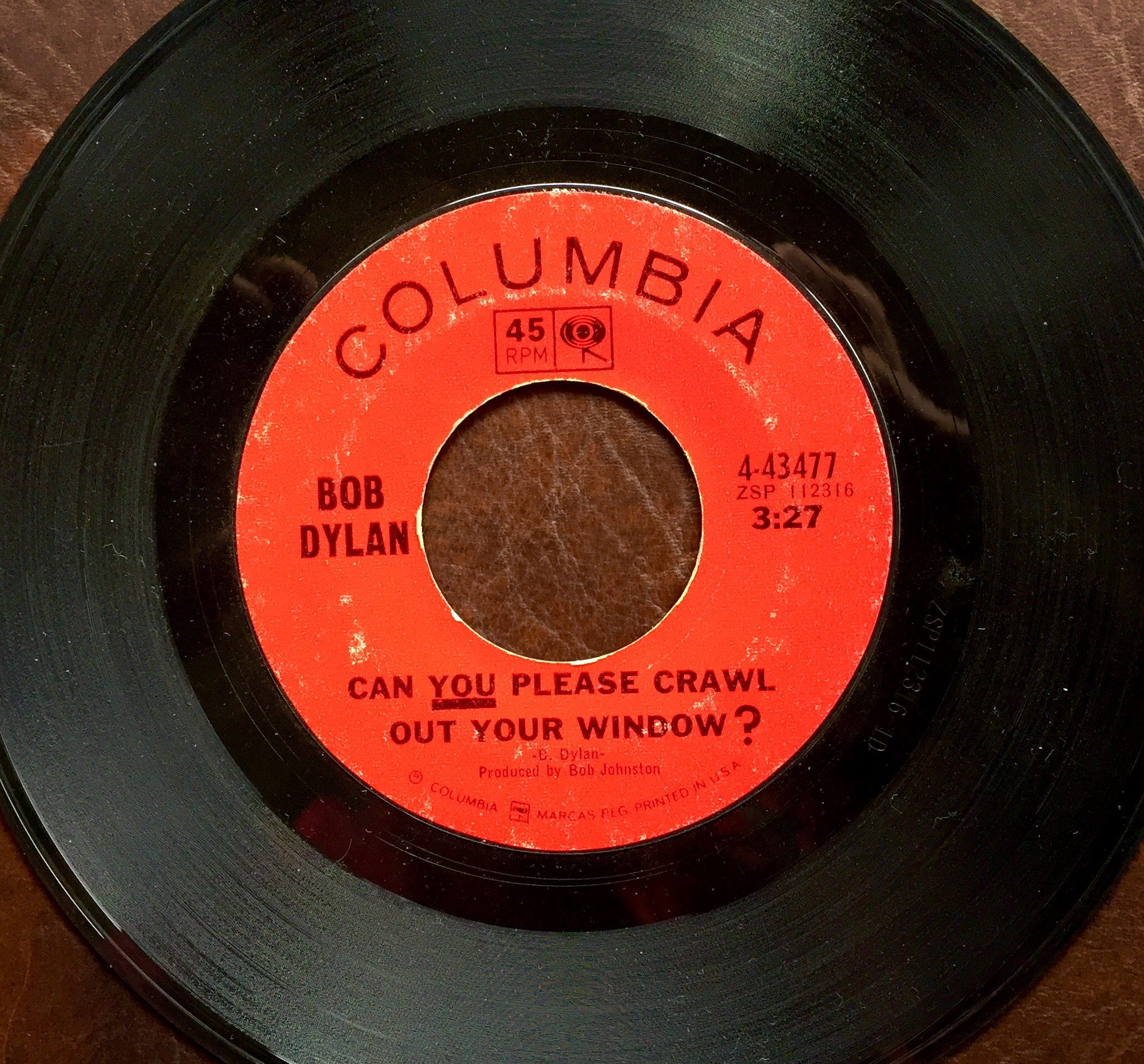
One of my prized 45s is this obscure single, released Dec. 21, 1965.

One of my prized 45s is this obscure single, released Dec. 21, 1965.

Well, I try my best
To be just like I am
But everybody wants you
To be just like them
They say sing while you slave and I just get bored
I ain’t gonna work on Maggie’s farm no more.[i]

All these people that you mention, yes, I know them, they’re quite lame
I had to rearrange their faces and give them all another name
Right now, I can’t read too good, don’t send me no more letters no
Not unless you mail them from Desolation Row [ii]

Little red wagon, little red bike
I ain’t no monkey but I know what I like [iii]

Whenever the Nobel Prize for literature is announced, the American response is often “Who?” In our cultural insularity, few of us know their work or even their names. Not this year. Everybody’s heard of Dylan, and many can recite his lyrics.

The surprise in 2016 stems from the bursting of old academic wineskins. What constitutes literature, anyway? Some of the literary establishment are unhappy that a songwriter tainted with lower-brow genres of popular culture (and currently performing in Las Vegas!) should steal the laurels from more “serious” candidates such as Syrian poet Adonis or Kenyan novelist Ngugi Wa Thiong’o. It’s “a joke,” fumed one French writer. A Scottish novelist dismissed the Nobel committee as “gibbering hippies.” [iv]

But if the linguistic arts trace their origins to the sung poetry of shared rituals, and Homer, the father of western literature, was a blind singer-songwriter who never put pen to paper, then Dylan can justly claim an ancient lineage, and stretching the definition of literature to include his work seems more restoration than innovation.

While Dylan’s jumping the queue ahead of American writers like Philip Roth, Joyce Carol Oates, and Don DeLillo might seem inappropriate to some, it is at least defensible. Oates herself calls the award “an inspired and original choice. His haunting music and lyrics have always seemed, in the best sense, ‘literary.’” [v]

Dylan has certainly had his down periods of uneven albums and terrible concerts. I myself have endured one too many evenings of mumbled words, mangled melodies, and an almost contemptuous stage presence. But to sustain such an influential and ever-evolving body of work over half a century, bridging the cultural divide between high and low, making the play of language a lever to move the world, is an astonishing achievement. His poetic and musical gifts have so often given voice to the collective longing of our “subterranean homesick blues.” They have also taken us inward, to the places of the heart where “we sit here stranded, though we’re all doing our best to deny it.” [vi]

As Bruce Springsteen has written, “Bob pointed true north and served as a beacon to assist you in making your way through the new wilderness America had become. He planted a flag, wrote the songs, sang the words that were essential to the times, to the emotional and spiritual survival of so many young Americans . . .” [vii]

Dylan was the soundtrack for my own coming of age. During my first year of college in 1963, a classmate thrust Dylan’s first album into my hands. “You’ve got to hear this,” he said. As soon as that growling, barbaric yawp started blasting out of the speakers, I was spellbound. Like so many others, I took up the guitar just so I could play his songs. “Blowin’ in the Wind” (from his second album), was my first attempt (key of D with its easy chords). By my senior year, dozens of Dylan songs were in my repertoire. I even learned the ten-minute “Desolation Row” by heart, once performing it on Rome’s Spanish Steps, by the house where Keats died, during a post-graduate summer of hitchhiking Europe with my guitar.

In Berkeley on March 28, 1965, I caught one of Dylan’s final all-acoustic concerts, just before the release of Bringing It All Back Home, the first album in his unmatched trilogy (Highway 61 Revisited and Blonde on Blonde would follow). Ken Kesey and Allen Ginsberg were sitting up front. Hippies and Hell’s Angels mixed with students and professors. The hall was charged with anticipation. From “Gates of Eden” to “It’s All Over Now, Baby Blue,” it was an amazing night.

It was the first time I ever heard “Mr. Tambourine Man.” Top 40 radio, or even Dylan’s previous work, had not really prepared me for the trippy ride “upon that magic swirling ship.” Behind its dazzling succession of vivid images, I recognized something primal and urgent, the call to leave everything and to follow, to look everywhere for the “windy beach, far from the twisted reach of crazy sorrow.”

As a poetic equivalent of the kingdom of God, the windy beach where the Spirit blows, the space of supreme aliveness, is too little found, and never possessed. And yet, now and then, I have danced beneath its diamond sky with one hand waving free, and hope to do so again as grace permits.

I was also in the crowd on September 3 of that same year, when Dylan played the Hollywood Bowl, backed by The Hawks (later The Band) along with Al Kooper on organ. There all the songs from Highway 61 Revisited were performed in public for only the second time (after a New York concert the previous week). Since the album had yet to hit the stores, it was my indelible first communion with the image world of Dylan’s surrealism. “There’s something happening here, but you don’t know what it is.”[viii]  Indeed.

The encore was “Like a Rolling Stone,” the one song we already knew from the radio. Before beginning, Dylan searched among his harmonicas in vain, then spoke into the microphone, “Anyone got a C harmonica?” As I remember it, 17,000 harmonicas came flying onto the stage, and soon we were all shouting with one voice, “HOW DOES IT FEEEEEEEL?”

When, in 1966, I crossed the country to study at the Episcopal Theological School in Cambridge, Massachusetts, my guitar and my Dylan records came with me. In a school play, I sang an adapted version of “With God On Our Side” to parody the horrific biblical conquest narratives. I wrote an article on the prophetic theology of Dylan’s lyrics in the seminary journal. And I incorporated fragments of his haunting religious poetry from John Wesley Harding into a multimedia senior sermon (you can hear the audio collage here).

In later years, Dylan’s preeminence in my life’s soundtrack receded, although his masterpiece of anguish and longing, Time Out of Mind, managed perfectly to coincide with my own midlife dark night of the soul. Lines like “It’s not dark yet, but it’s getting there” may not have been balm in Gilead, but they kept me company until the dawn.

These days I occasionally sing old favorites like “Ramona,” “She Belongs To Me,” “Chimes of Freedom” and “Buckets of Rain.” And I never tire of leading friends and retreat groups in heartfelt renderings of “Knockin’ on Heaven’s Door” and “I Shall Be Released.”

Everyone’s got their Dylan stories, but at their core is a mysterious absence. Dylan’s identity has always been veiled by a succession of fictions, evasions, conversions and withdrawals. He has given interviews full of absurd biographical narratives.[ix] Even before he was famous, he invented personae to protect himself from the prying projections of others. From fixtures and forces and friends your sorrow does stem, that hype you and type you, making you feel you gotta be just like them. [x]

Does it matter whether we ever know the real Dylan, or find him a relatable personality? Or are the songs enough? Is their mysterious power to speak to us and for us enough?

“It’s like a ghost writing a song like that,” Dylan said about “Like a Rolling Stone” 40 years after recording his greatest hit. “It gives you the song and then it goes away. It goes away.”[xi] The ghost, the geist, the spirit blows where it will. The artist prepares to receive it, and learns how to give it away.

Another Nobel Laureate, poet Czeslaw Milosz, concurs, insisting that the artist’s vocation is to be “a secretary of the invisible.” Deliver the message entrusted to your keeping, then get the hell out of the way. It ain’t me, babe. This has been the essential kenosis of both art and spirit since the beginning.

Take Caedmon, for example. An illiterate herdsman in seventh-century Britain, he was suddenly commanded in a dream to sing the story of creation. Without learning or training, he began to sing words unknown to him, gifts from the same ghost who visited Dylan. Thus was English poetry born.

Denise Levertov imagines Caedmon’s in-spiriting in a poem of her own. He is huddling for warmth at night with the beasts of the barn, when suddenly the air is filled with “feathers of flame, sparks upflying.” The cows remain oblivious and calm, not seeing what the poet sees as “that hand of fire / touched my lips and scorched my tongue / and pulled my voice / into the ring of the dance.” [xii]


[i] Bob Dylan, “Maggie’s Farm” (Bringing It All Back Home)

[ii] Bob Dylan, “Desolation Row” (Highway 61 Revisited)

[iii] Bob Dylan, “Buckets of Rain” (Blood on the Tracks)

[iv] “Writers divided on whether Dylan deserves Nobel prize”: https://www.yahoo.com/news/writers-divided-whether-dylan-deserves-nobel-prize-180943929.html

[v] ibid.

[vi] Bob Dylan, “Visions of Johanna” (Blonde on Blonde)

[vii] Bruce Springsteen autobiography, Born To Run, q. on Springsteen’s website: http://brucespringsteen.net/news/2016/bruce-springsteen-on-bob-dylan

[viii] Bob Dylan, “Ballad of a Thin Man” (Highway 61 Revisited)

[ix] To delve into the strange world of Dylan interviews: http://www.vulture.com/2007/10/the_ten_most_incomprehensible.html

[x] Bob Dylan, “Ramona” (Another Side of Bob Dylan)

[xi] Robert Hilburn, “Rock’s Enigmatic Poet Opens a Long-Private Door,” Los Angeles Times, April 4, 2004

[xii] Denise Levertov, “Caedmon”, q. in Edward Hirsch, Poet’s Choice (New York: Harcourt, Inc., 2006), 15

Leaves

October leaf, Newfane, Vermont (Photo by Jim Friedrich)

October leaf, Newfane, Vermont (Photo by Jim Friedrich)

Can all men, together, avenge
One of the leaves that have fallen in autumn?
But the wise man avenges by building his city in snow.

– Wallace Stevens

For the past week, I have been exploring the back roads of New England with my wife as we fill our eyes and hearts with October color. There have been cloudy days when the leaves have glowed like embers in the somber light, and days of utter brilliance when the sun made them shine like stained glass.

What Wallace Stevens called the “auroras of autumn” is one of the glories of the year. It is also, inevitably, a masque enacting the narrative of mortality in which we all play our part. As I wrote in “A Tender Doom,” a 2014 post, the “leaf falls, the year dies, the heart submits to processes beyond its control.”

This week I have watched leaves of gold and scarlet fall upon ravaged 18th century gravestones, and drop into ever-rolling streams which bear them away to God knows where. I have received news of a dear friend slipping out of this world as her husband of 71 years finished reading her the last rites from the Book of Common Prayer. I have also read the faithful witness of another friend, facing chemo, binding himself to the love that casts out fear in a time of anxious unknowns. He is a wise man who does not confuse the fight to live with a fight not to die, lest he turn living “into something less spiritually interesting.”

To paraphrase a line from poet William Stafford:

What the leaves say,
that is what I say.


Society for the Preservation of Amazement

I am always so grateful for the community of readers who linger here to read and ponder. In response to my recent post on the “priest/artist”, my friend David Fly was stirred to write a beautiful reflection, which he has graciously allowed me to publish here.

A professional clown before his ordination to the Episcopal priesthood in 1966, David has served in urban, rural, and campus ministries throughout the Midwest. Since his early retirement in 1998, he has been in demand as a preacher, teacher, and conference leader. In 2004, his memoir, Faces of Faith – Reflections in a Rearview Mirror, was published by Church Publishing Company. This summer marked his 50th anniversary of ordination to he priesthood. His own faithful artistry has long inspired my own priesthood.

In the foreword to David’s book, Bishop Hayes Rockwell wrote: “David Fly is fluent in the language of the lighthearted. He knows, as far too few in his calling know, that you can be serious without being solemn. He connects with us in a rich, entertaining and humorous way that points as well to joy, which lifts our hearts and spirits. David knows well, as Peter Berger said, about the “comic relief of redemption” and he is fluent in its vocabulary.”

img_6822

Artists and Priests: A guest post by the Rev. David Fly

When Jim Friedrich discusses the “priest/artist” connection, he says “Whether ordained or not, . . . artists perform a priestly function, inviting us to the mystery of the world, in which “things which were cast down are being raised up, and things which had grown old are being made new.” And he asks, “What I wonder, as an artist/priest myself, is whether those officially ordained by traditional Christian communities, such as my own Anglican tradition, fully understand the implications of this connection for our own work. Do we bring to our own priestly vocation the same degree of passion, creativity, imagination, curiosity and daring displayed in the work of the artist?”

After fifty years as an Anglican priest, I’ve had the opportunity to look back on my experience and as I do a couple of stories come to mind. They illustrate, for me, an answer the question Jim is asking.

My “training” for priesthood began very early. My grandmother and my great-aunt Susie were my teachers. They were the first who taught me a description of the world, that W. H. Auden describes as “a temporal one, where nothing is as it seems.” This was particularly true in summertime when my sister and I had lots of time to spend with them. Summer gave us a chance to see magic in the ordinariness of our lives, and Grandma and Great-Aunt Susie conspired to help us see it and celebrate it. They taught us that the future is like summertime. It’s always there, stretched out before us, a canvas empty and waiting. It calls us to explore and discover the wonder in commonplace things and to uncover the secrets of our lives. There will always be surprises to find and capture. They’re out there like lightning bugs on a dark summer night.

My family didn’t take vacations very often because we simply didn’t have the money. But, once in a while, we pooled our funds and rented a couple of cheap cabins in southern Missouri or northern Arkansas. One of my favorite places was a little town in northern Arkansas named Popover, which has now disappeared from the map.

Once, in the late ‘40s, when we stayed in Popover, I went walking along a riverbank with my grandmother. The bank was made up of large, flat river rocks. She held my hand to keep me steady as we moved next to the rushing water. The sound of the river almost drowned out her voice as she said to me, “What do you suppose is under those rocks?”

Already a rather cynical six-year-old, I replied, “Just more rocks!”

But she surprised me. She had me kneel with her and then began to gently turn over stones. I discovered under each of them a myriad of life forms: beautiful lichen, colonies of tiny ants, spiders, snails, and even an occasional snake! Beneath the stones life was teeming; you only had to look for it. And as we knelt there, my grandmother leaned close to me and whispered:

The angels keep their hidden faces
Turn but a stone and start a wing
‘Tis ye with your estranged faces
That miss the many-splendored thing

After their husbands died, Grandmother and Aunt Susie lived together in my grandmother’s house. Though their were getting along in years, they chose to continue sleeping in the upstairs bedrooms even though they would have to climb a very steep set of stairs every night. Being the proper ladies they were, they would never have considered pitching their camp in the living room. So, to avoid falls, they crawled up the stairs each night and down them every morning.

Once, long after I had moved from that town and my parents had moved away, I went to visit the two women who had meant so much to me as a child. While we were talking, my Aunt Susie said, “You know, David, I can’t get to church much anymore now that there’s no one to drive us. So my altar has become this flight of stairs. Each night, when I crawl up the stairs, I stop on the last three steps, say ‘Father, Son, and Holy Ghost,’ and then I say my prayers. When I come down each morning, I stop on the bottom three steps, say ‘Father, Son, and Holy Ghost,’ and say my morning prayers. And God meets me whether at the top of the stairs or at the bottom.”

After years of reverence for the altar at little St. Stephen’s church, Aunt Susie had found another altar and approached it with the same respect. And because of her reverence, she was open to finding God whether at the top of the stairs or at the bottom.

These women were the first to teach me the truth of Elizabeth Barrett Browning’s words:

Earth’s crammed with heaven,
And every common bush afire with God,
But only he who sees takes off his shoes.
The rest sit ’round it and pluck blackberries
And daub their faces unawares.

I don’t know when it happened for these women, but somewhere along the way, they stopped to see bushes burn and listen to the sounds of angels. Iris Murdoch says, “We should thank the gods for great artists who draw away the veil of anxiety and selfishness and show us, even for a moment, another world . . . and tell us a little bit of truth.” The artist/priest must do the same.

Many years later, after my ordination, when I was a college chaplain, I was given the gift of a wonderful definition of the Church. I went to the snack bar one afternoon for a cup of coffee. Because the place was so crowded, I ended up sitting with a young woman I had never met. She was reading a textbook. Suddenly, she slammed the book shut and said, “Statistics! That’s all they are. I’m taking a course in which people have been reduced to statistics. They’re not human beings anymore. All the mystery is gone, all the beauty. I’m being trained to treat people as if they were numbers on a page, and I’m afraid that when I leave this place, I’ll do just that.” As she rose to leave, her parting comment was, “You know, I think I’ll go someplace and start a Society for the Preservation of Amazement!”

She walked away before I could tell her that one already existed. My grandmother and great-aunt were charter members. Artists and priests are called to that Society, called to point beyond the present to a future filled with hope.

The Rich Man and Lazarus

Medieval illumination, The Rich Man and Lazarus

Medieval illumination, The Rich Man and Lazarus

For when we first believed in Christ we did not immediately acquire an exact understanding of what we should be doing, nor was it clear to us what we should stop doing and what we should continue doing.

— Diodore, Bishop of Tarsus (d. 394) [i]

You see, God who lives in heaven kept quiet about the rich man’s name, because he did not find it written in heaven. He spoke the poor man’s name, because he found it written there… [ii]

— St. Augustine

This Sunday’s gospel tells the parable of the nameless rich man, living the high life in his mansion, and Lazarus the poor man, who is starving just outside his gate. When they both die about the same time, their situations are reversed. The poor man, suffering the torments of Hades, gets a distant glimpse of Lazarus enjoying the blessings of heaven “in the bosom of Abraham.” (Luke 16:19-31)

Where do we find ourselves in this gospel parable? At the gate, or at the rich man’s table? When Jesus tells this story, he doesn’t seem to allow us the option of remaining a spectator, detached and uninvolved.

Jesus is calling us to make a decision.
What would you do in the circumstances of the story?

There’s a 19th century song based on this gospel. I learned to sing it 50 years ago from the legendary Ramblin’ Jack Elliott:

 Only a tramp was Lazarus’ sad fate
When he lay down by the rich man’s gate
To beg for some crumbs from the rich man to eat
But he left him to die like a tramp on the street…

 If Jesus should come and knock at your door
Would you let him come in and take from your store
Or would you turn him away with nothing to eat
Would you leave him to die like a tramp on the street?

What would you do?
In our world of extreme economic inequality, it’s not a hypothetical question.

That’s the thing about the lectionary. We come to church to be illumined, fed, inspired, and renewed; to praise our Maker and Redeemer in the company of God’s friends. But sometimes we’re slammed with a question that’s really hard to answer.

In this case, what’s hard isn’t mustering the good will to do the right thing. If you’re a friend of Jesus, you know what is right. What’s hard is figuring out exactly how to implement our good will in complicated long-term situations.

We could empty our wallets for the homeless on a walk through downtown, but homelessness would remain. We could vote for candidates who put the needs of the poor ahead of the billionaires. But we would still remain entwined in a system driven more by greed and consumption than by the nurture of human flourishing and the health of God’s creation.

So where do we start? Does the parable itself provide any clues? It’s not really a story, but more of a snapshot. On one side there is Lazarus the beggar lying outside the rich man’s gate, covered with sores, dreaming of the scraps of food that fall from the rich man’s table. On the other is the rich man, behind locked doors, dressed in purple and fine linen, eating to his heart’s content – with a clear conscience as far as we know.

And the story seems to imply that he is unaware of Lazarus’ very existence. He doesn’t send his servants out to drive the poor man away. He doesn’t callously pass him by, pretending not to see him.

In the story, the rich man remains inside, Lazarus remains outside, and the two worlds are completely sealed off from each other—until a catastrophe shakes the rich man out of his complacency, and opens his eyes to the suffering he has ignored for so long.

The catastrophe is his own death. This not only plunges him into the fires of Hades but also—even more painful!—it opens his eyes to his lifelong indifference to the suffering of Lazarus, a suffering he could have alleviated, had he been more aware.

So now he must gaze up at Lazarus, safe in the bosom of Abraham, tormented by the knowledge of things done and left undone. It turns out that his blindness to suffering was not the same thing as innocence. The words of the prophet Amos could have been addressed to him:

Woe to those who are at ease in Zion,
and for those who are complacent on the mount of Samaria…
Woe to those who lie on beds of ivory,
and sprawl on their couches,
stuffing themselves with lamb and veal,
singing idle songs and drinking wine by the bowlful,
who anoint themselves with the finest oils,
but are not grieved over the ruin of Joseph. (Amos 6: 1, 4-6)

It’s not that the rich man didn’t care about Lazarus. He didn’t even see him. Lazarus did not exist for him, until he was compelled to see reality through God’s eyes:

And what the rich man is shown by God in the end is this: Lazarus, rocking his soul in the bosom of Abraham, turns out to be very precious to God. But he (the rich man) is a prisoner of his own self-regard, the loveless and isolating condition otherwise known as hell.

And then this parable, as parables often do, turns to us expectantly. So, it wonders, is there anything you are not seeing in the places where you live and move and have your being?

Last week I attended a meeting of the Interfaith Economic Justice Coalition in Seattle. The subject was the situation of the workers at the airport, the ones who clean and load the passenger cabins, who push the wheelchairs and guide the planes to their gates, who prepare and serve the food in the facility’s many restaurants and coffee shops, who rent the cars and staff the parking lots.

When we pass through the airport as travelers, we are served by many of these workers. But how often do we really see them as people or understand their situation?

Are we aware that the Seattle airport, the third largest economic producer in the state, has been a notoriously low-wage pocket within the greater urban area? Other West Coast airports, such as LAX, are way ahead of our own in addressing wage and justice issues.

The employment structure at Sea-Tac Airport is complicated. A variety of corporate contractors apply to the Port Commission and the airlines for the right to provide specific services. Individual airlines can choose to work with their own preferred contractors, so there is a bewildering variety of arrangements in which individual workers may fall through the cracks, as their employers play musical chairs in the bidding and renewal process. Without a guarantee that you will keep your job regardless of which corporation wins the next contract for the service you provide, you could be out of a job with little warning.

The process of bidding and contract renewals has sometimes been used, by both airlines and the Port Commission, to shut out union workers and reduce the job security and benefits of airport employees in general.

When Seattle passed the nation’s first $15 minimum wage law in 2014, some contractors complied, some chose to fight the law in the courts, and some simply ignored the law and continued to pay only $9.45 an hour, until lawsuits forced them to comply.

Some of the contractors are still in court, but this month several of them agreed to pay retroactively the full minimum wage, which amounts to about $10,000 per worker for each of the two years in which they were underpaid. This will make a huge difference for those workers, their families, and the communities in which they live.

This ongoing struggle for a living wage is about the workers’ dignity and well-being as equal participants in an interdependent society. And, as people of faith would insist, it is about their inestimable value as the beloved children of God. But until my eyes were opened by what I learned at that meeting last week, they were almost as invisible to me as Lazarus at the gate.

And now that I see them a little more clearly, what shall I do? When I take a flight next Saturday, I will certainly be asking myself this question. I can pray for the workers, I can thank them for their service. This Tuesday I’ll be joining with workers and faith leaders at a Port Commission meeting to exert continuing pressure for economic justice. But what else?

I may not have a lot of answers yet, but the question is not going away as long as we keep replaying the unsustainable story of the rich man and Lazarus in our economics, our politics, and our social order. It will not go away, in fact, until that promised day when we will all sit together at one table, sharing our essential communion as grateful brothers and sisters in the feast of God.

Holy One, Lover of Justice, bring that day closer.


Related Post: Why Do We Work?


[i] q. in Thomas C. Oden, The Good Works Reader (Grand Rapids, MI: Eerdmann’s Publishing, 2007), 333

[ii] Sermon 33a.4, q. in Oden, 54

“The artist formerly known as priest”

Text:Robert Bresson; Calligraphy: Br. Roy Parker OHC

Text:Robert Bresson; Calligraphy: Br. Roy Parker OHC

We are all artists, we are all storytellers. We all have to live by art, it’s our daily bread… And we should thank the gods for great artists who draw away the veil of anxiety and selfishness and show us, even for a moment, another world…. and tell us a little bit of truth.”

— Iris Murdoch [i]

In the strict sense, of course,
We invent nothing, merely bearing witness
To what each morning brings again to light:
Gold crosses, cornices, astonishment
Of panes, the turbine-vent which natural law
Spins on the grill-end of the diner’s roof,
Then grass and grackles ….
All these things
Are there before us, there before we look
Or fail to look.

— Richard Wilbur, “Lying” [ii]

My friend and sometime colleague Mark Harris has been an Episcopal priest for half a century. Now in his seventies, with his days of institutional church employment behind him, he devotes much of his time to making art. One of his friends recently designated him as “the artist formerly known as priest.”[iii]

The Prince reference made me laugh, but I also resisted the concept. Priest and artist are not contradictory vocations. Both draw back the veil between seen and unseen; both bear witness to a depth, a meaning, a beauty, or a Presence which is ever before us whether we “look or fail to look.”

Of course the priest is committed to a particular story about the world, and is accountable to some form of ecclesiastical authority, while the artist has no such constraints. In fact, it has been a commonplace of modernity to depict religion as antithetical to artistic freedom.

After a “shameful and distressing” conversation about the subject with T.S. Eliot in 1928, Virginia Woolf wrote to her sister: “He has become an Anglo-Catholic, believes in God and immortality, and goes to church. I was really shocked. . . I mean, there’s something obscene in a living person sitting by the fire and believing in God.”[iv]

Similarly, a collective manifesto in 1948 declared art’s absolute independence from religion:

“We do not need the obsolete props of an outmoded and antiquated legend. We are creating images whose reality is self-evident and which are devoid of the props and crutches that evoke associations with outmoded images, both sublime and beautiful. We are freeing ourselves of the impediments of memory, association, nostalgia, legend, myth, or what have you. that have been the devices of Western European painting. Instead of making cathedrals out of Christ, man, or ‘life’, we are making them out of ourselves, our of our own feelings.”[v]

The modern narrative of art history, at least in western civilization, describes the messy divorce between art and religion. Art drifted away from sacred stories and theological themes to focus on the human being, the natural world, material objects and daily life. Then it stripped away all manner of content until its only subject was art itself, the pleasure of pure form and color unburdened by any external meaning.

In her persuasively argued book, The Spiritual Dynamic in Art, Charlene Spretnak refutes this narrative, documenting the deeply spiritual perspectives expressed by many of the iconic figures in modern art. For example, Van Gogh understood his revolutionary style as reinterpretation rather than rejection of a religious worldview: “I want to paint men and women with that something of the eternal which the halo used to symbolize, and which we seek to communicate by the actual radiance and vibration of our coloring.”[vi]

Writing “On the Meaning of Painting” in 1939, Joan Miró insisted that the artist’s vocation was to “endeavor to discover the religious essence, the magical significance of things,” rather than “merely add to the sources of stupefaction.” Recalling his first drawing class as a youth, he said, “That class was like a religious ceremony for me; I washed my hands carefully before touching the paper and pencils. The implements were like sacred objects, and I worked as though I were performing a religious rite.”[vii]

Spretnak cites many more such examples. But the rich and complicated relationship between art and religion is too vast for a single post, so for now let me return to my original argument. Priest and artist, for all their differences, share some essential common tasks:

To make visible what might otherwise not be seen.
To integrate life’s incompatible elements within a harmonizing vision.
To facilitate our encounter with a life-changing Presence.
To perform ritual interventions for the creation of community.

I am aware that many would define priesthood more narrowly, or art less religiously. Nevertheless, I am proud of the company I keep in this matter.

Seventeenth-century Anglican poet/priest George Herbert grounded his poems in a word or an image, morphing it into a multiplicity of resonant meanings. As one critic has put it, “he breaks the host of language” as the one becomes the many. This was more than clever wordplay. It was a worldview: one thing becomes another, like bread becoming God. Or a poet becoming a priest.

Contemporary Catholic poet Les Murray makes a similar connection between his verse and the Eucharist. Both involve “the absolute transformation of ordinary elements into the divine.”[viii]

The Orthodox composer John Tavener (d. 2013) described his music as “liquid metaphysics.” Acknowledging that his call was not to prove God’s existence but only to witness to his own experience of Presence, he said, “I cannot clearly demand belief in what I believe in, but I can ask for an openness, or certainly an acceptance that another level of reality exists beyond this commonplace one.”[ix]

Whether ordained or not, such artists perform a priestly function, inviting us to attend to the mystery of the world, in which “things which were cast down are being raised up, and things which had grown old are being made new.”[x] Or as I once heard arts innovator Peter Sellars put it, “The purpose of art is to wake people up who are sleepwalking, to grab them and say, ‘You cannot pass this by. This is your life!’”[xi]

Daniel A. Siedell, who has focused his critical attention on art and religion, makes an eloquent case for the priest/artist connection:

“There is a sacramental and liturgical presence in contemporary art, in which artists explore the potential of banal materials and gestures, in defined spaces, to embody and serve as a vehicle for profound meaning and experience. The liturgical dimension of contemporary artistic practice, which incorporates and re-performs the power of sacred space, ritualized gestures, and sacramental objects that testify to what philosopher William Desmond calls ‘the porosity of being,’ requires more expansive and richly-nuanced notions of both ‘art’ and ‘religion’ than those offered by modernist critics.”[xii]

Chiharu Shiota, "The Key in the Hand", Venice Biennale 2015 (photo by Jim Friedrich)

Chiharu Shiota, “The Key in the Hand”, Venice Biennale 2015 (photo by Jim Friedrich)

Chiharu Shiota is a Japanese artist living in Berlin. Her haunting installations are inspired by religious sites and rituals which evoke “strong emotional reactions. I think those reactions are sacred, but not necessarily the objects. It is similar with my art work. It’s the emotions that are sacred.”

For her work, “Key in the Hand,” she collected 180,000 old keys from all over the world, suspending them with 250 miles of red yarn over two old boats at the Venice Biennale in 2015. The keys represent the memories and treasures we lock away until we choose to entrust their custody to others. Shiota states that keys “protect important people and spaces in our lives. They also inspire us to open the door to unknown worlds.” [xiii] The yarn evokes blood and the interconnectedness of relationship. The boats, like an immense pair of hands, “catch” the rain of memories falling from above.[xiv]

Is Shiota’s work not sacramental, employing tangible objects to manifest hidden realities and touch our own deepest places? Does not its breathtaking beauty feel like a hint of the transcendent splendor toward which all being tends?

Chiharu Shiota, "The Key in the Hand", Venice Biennale 2015 (photo by Jim Friedrich)

Chiharu Shiota, “The Key in the Hand”, Venice Biennale 2015 (photo by Jim Friedrich)

Six years after Hurricane Katrina, the African-American artist William Pope.L invited residents of struggling New Orleans neighborhoods to donate photos in response to two questions:

When you dream of New Orleans, what do you dream of?
When you wake up in the morning, what do you see?

The collected photographs were to be projected onto a rear screen attached to the back of an old ice cream truck painted entirely in black. And one night in October, 2011, this 8-ton truck, with its engine shut off, was hauled through the city by a team of strong bodies from sundown to sunrise.

The artist imagined the black truck as the weight of our “collective darkness,” all those regrets and fears and demons we drag behind us. Countering the darkness, the back of the truck was illumined by projections from the inside of all the light collected from their lives and their dreams.

“I am asking people,” he said, “to show the fragility of their bodies as a collective and then go for a walk with others who are dragging the same old dreams down the same ole corridors and to take time out to wonder about that.”[xv]

Is this not priestly work? Using common materials and ritual actions, Pope.L. was the presider/curator for a “work of the people” which employed many of the elements of Christian liturgy: narrative (the photographs as “stories,” and the journey of the truck), symbol (darkness and light), time (a night passage framed by the setting and rising of the sun), and community (facilitating connections among the photographers, performers, and the neighborhoods through which they made ritual procession).

Pope.L acknowledges a “priestly” association: “Like the African shaman who chews his pepper seeds and spits seven times into the air, I believe art re-ritualizes the everyday to reveal something fresh about our lives. This revelation is a vitality and it is a power to change the world.”[xvi]

Critic and poet Donald Kuspit says that “being an artist is about being a certain kind of subject, not just about making certain kinds of objects,”[xvii] while Iranian/UK installation artist and sculptor Shirazeh Houshiary defines an artist as “someone who is capable of unveiling the invisible, not a producer of art objects.”[xviii] It seems that such artists as Shiota and Pope.L have brilliantly intuited this implicit artist/priest connection.

What I wonder, as an artist/priest myself, is whether those officially ordained by traditional Christian communities, such as my own Anglican tradition, fully understand the implications of this connection for our own work. Do we bring to our own priestly vocation the same degree of passion, creativity, imagination, curiosity and daring displayed in the work of the artist?

We may have much to learn.


Related Posts

Do Not Fear: Reflections on the Venice Colloquium

Sweet Miracle of Our Empty Hands

Heart Work and Heaven Work

Tending the Lamps of Holy Imagination

Note: The image at the top of this post was made for me by the wonderful calligrapher and Episcopal monk Br. Roy Parker OHC. For information on his work:  http://www.holycrossmonastery.com/calligraphy

[i] Iris Murdoch, Acastos: Two Platonic Dialogues, 1986, p. 62-3, q. in Theological Aesthetics after von Balthasar (Ed. by Oleg V. Bychkov & James Fodor, Burlington, VT: Ashgate Publishing Company, 2008), 162

[ii] Richard Wilbur: Collected Poems: 1943-2004 (New York: Harcourt, 2006), 83

[iii] Some of Mark’s work may be seen here: http://www.preludiumarts.net/ One of his poems is found in the Related Posts link to “Tending the Lamps of Holy Imagination”

[iv] London Review of Books, 10/23/14

[v] Originally published in Tiger’s Eye (Dec. 1948), q. in The Sublime, ed. Simon Morley, Documents of Contemporary Art (London: Whitechapel Gallery, 2010), 27

[vi] Charlene Spretnak, The Spiritual Dynamic in Art: Art History Reconsidered: 1800 to the Present (New York: Palgrave Macmillan, 2014), 40

[vii] ibid., 102, 100

[viii] Missy Daniel, “Poetry is Presence: An Interview with Les Murray”, Commonweal 119, no. 10, 1992, 10), q. in Between Human and Divine: The Catholic Vision in Contemporary Literature, ed. Mary C. Reichart (Washington, D.C.: The Catholic University of America Press, 2010), 217

[ix] John Tavener, ed. Brian Keeble, The Music of Silence: A Composer’s Testament (London: Faber and Faber, 1999), 163

[x] The Book of Common Prayer (New York: Oxford University Press, 1979), 291

[xi] From my personal notes on a “The Arts: A Catalyst for Change,” a forum at the Stanford University Centennial Weekend, October 1991

[xii] Re-Enchantment (James Elkins, David Morgan, eds., New York & London: Routledge, 2009), 234

[xiii] http://www.thisiscolossal.com/2015/05/the-key-in-the-hand/

[xiv] Interview with Shiota: http://2015.veneziabiennale-japanpavilion.jp/en/project/

[xv] Glenn Harper and Twylene Moyer, eds., Artists Reclaim the Commons: New Works/New Territories/New Publics (Ed., (Hamilton, NJ: isc Press, 2013), 247

[xvi] https://en.wikipedia.org/wiki/William_Pope.L

[xvii] Artforum (1984), q. in Daniel A. Siedell, God in the Gallery: A Christian Embrace of Modern Art (Grand Rapids, MI: Baker Academic, 2008), 124

[xviii] Interview with Stella Santacatterina (1994), q. in The Sublime, 93