The Woven Light: Reflections on the Transfiguration

James Turrell, Arrowhead (2009)

James Turrell, Arrowhead (2009)

We would have thrown our clothes away for lightness,
But that even they, though sour and travel stained,
Seemed, like our flesh, made of immortal substance.
And the soiled flax and wool lay light upon us.
Like friendly wonders, flower and flock entwined
As in a morning field. Was it a vision?
Or did we see that day the unseeable
One glory of the everlasting world
Perpetually at work, though never seen
Since Eden locked the gate that’s everywhere
And nowhere?…

– Edwin Muir, “The Transfiguration”

Martin Scorcese’s 1988 film, The Last Temptation of Christ,” was criticized by many for its eccentric portrayal of a Jesus deeply conflicted by the fierce struggle between his two natures. As one reviewer wondered, “Is he God or is he nuts?” Scorcese, who specializes in tormented, confused male characters full of nervous intensity, defended his approach as an attempt to explore Christ’s humanity without the blinding glow of divine self-assurance that made many movie Jesuses seem stiff, complacent and unreal.

“What we were taught in Catholic schools emphasized the divine side of Jesus,” said Scorcese, who had considered priesthood in his adolescence. “Jesus would walk into the room and you would know he was God. Maybe he glowed in the dark or something, I don’t know, but this is the impression they gave us as children.”

The Jesus of Matthew, Mark and Luke does not glow, except in that strange moment called the Transfiguration, celebrated on August 6th in the liturgical calendar. This feast day goes largely unnoticed now in the western churches, who have essentially transferred it to the last Sunday of Epiphany. This neglect of August 6 is in part a concession to the decline of weekday celebrations, but it may also reflect a discomfort with the story itself, which feels like myth or vision rather than actual history. Not even the risen Christ matched the glow of the Transfiguration. What are we being asked to believe here?

We can never know the phenomenon behind the reported perceptions by Peter, James and John. But the symbolic dimensions of the narrative are clear, linking the incident to the ancestral epiphanies of Moses and Elijah. There is a mountain, where earth below meets heaven above. There is a cloud of unknowing, veiling divine presence in hiddenness and mystery. And there is a voice, making contact with human sense, rupturing the boundary between holy and profane to affirm the unique filial status of Jesus as God’s Beloved “Son.”

But what about that “dazzling” glow? What did the disciples actually see in Jesus on that mountain? Was it an unrepeatable moment, a temporary endowment bestowed upon Jesus to make a point to doubting disciples, or was it something Jesus always possessed?

Gregory of Palamas, a 14th century Orthodox theologian, argued the latter. He based his influential meditation practice of Hesychasm on contemplation of the “uncreated light” first seen at the Transfiguration. This light, he taught, was not an ephemeral experience of the senses but the unmediated presence of God. Although this holy light could be seen through physical eyes, it was not a natural light. It was, in fact, the uncreated energies of the Godhead, the splendor of the age to come, a light shining from God’s future into the present moment.

Christ is transfigured, not by putting on some quality he did not possess previously, nor by changing into something he never was before, but by revealing to his disciples what he truly was, in opening their eyes and in giving sight to those who were blind. For while remaining identical to what he had been before, he appeared to the disciples in his splendor; he is indeed the true light, the radiance of glory.[i]

Whatever we make of Gregory’s metaphysical claims, which were disputed by many of his contemporaries, the spiritual resonance of light is undeniable and universal. It is always seems to be about something more than physics. It seems inevitably imbued with Spirit.

Annie Dillard describes “mornings, when light spreads over the pastures like wings, and fans a secret color into everything, and beats the trees senseless with beauty…Outside it is bright…It is the one glare of holiness; it is bare and unspeakable. There is no speech or language; there is nothing, no one thing, nor motion nor time. There is only this everything.”[ii]

Where does such light come from? Is it something that happens to our eyes but is not really in the world, or is it somehow there, in the heart of things, “born of the one light Eden saw play?” Is it not just a simulacrum of divinity, but a direct manifestation?

James Turrell, Breathing Light (2013)

James Turrell, Breathing Light (2013)

James Turrell, one of the most celebrated of the contemporary “Light and Space” artists nurtured under California skies, has been exploring light and its effects since the 1960s. His mesmerizing spaces invite participants to experience not objects made visible by light, but light itself in an astonishing repertoire of varying colors and brightness. If there are walls, they seem to dissolve into the immateriality of radiance. If there is a ceiling, it may have a large opening inviting us to contemplate the luminous canopy of sky. “Light,” says Turrell, “is not so much something that reveals as it is itself the revelation.”

We eat light, drink it in through our skins. With a little more exposure to light, you feel part of things physically. I like the power of light and space physically because then you can order it materially. Seeing is a very sensuous act – there’s a sweet deliciousness to feeling yourself see something.[iii]

For many of us fortunate to have savored the deliciousness of Turrell’s light spaces, feeling ourselves see something is not just an intellectual or psychological act. It is spiritual – the “glare of holiness … beating us senseless with beauty.”

Turrell’s own Quaker tradition says that prayerful attention is “going inside to greet the light.” But is the radiance of divine beauty just in our souls, or does it permeate the universe? Does it show itself to us here, there and everywhere, as it did to Peter, James and John?

David Bentley Hart, an Orthodox theologian, proposes creation as a manifestation of God’s infinite luminosity, what he calls “the agile radiance of the Spirit.”[iv] We see this radiance not by looking away from the world, but by looking more deeply into it. But when the light is in eclipse, what then? “Sometimes,” says Bruce Cockburn, “you have to kick the darkness till it bleeds daylight.” Even at the Transfiguration, according to an Anglican midrash by a seventeenth-century bishop, Moses and Elijah felt impelled to warn Jesus about the suffering and darkness awaiting him once he descended the mountain:

A strange opportunity … when his face shone like the sun, to tell him it must be blubbered and spat upon;… and whilst he was Transfigured on the Mount, to tell him how he must be Disfigured on the Cross![v]

The poet Kathleen Raine perfectly describes the utter bleakness when “the curtain is down, the veil drawn” over the world’s deep radiance. “Nothing means or is,” she says.[vi]

Yet I saw once
The woven light of which all these are made
Otherwise than this. To have seen
Is to know always.

[i] St. Gregory Palamas, The Triads, in Richard Harries, Art and the Beauty of God: A Christian Understanding (London: Mowbray, 1993), 85

[ii] Annie Dillard, Holy the Firm (New York: Harper Perennial, 1998), 67-8

[iii] q. in Michael Govan, “Inner Light: The Radical Reality of James Turrell”, James Turrell: A Retrospective (New York: DelMonico Books, 2014), 13

[iv] The Beauty of the Infinite: The Aesthetics of Christian Truth (David Bentley Hart, Eerdmans 2003), 292

[v] Joseph Hall, Contemplations upon the principal passages of the Old and New Testaments, 1612-28, found on Google Books, p. 383

[vi] Kathleen Raine, in Harries, 87

“Owl among the ruins” – What shall we do with empty churches?

Netherlands church converted to private residence.

Netherlands church converted to private residence.

Entering into a church is a metaphor for entering into a shared world of symbolic narratives and meanings, somewhat like entering into a story and discovering the richness and internal coherence of its structure.   – Richard Kieckhefer[i]

A space’s or a building’s ‘sacredness’ is, with rare exception, neither a permanent nor an absolute black-or-white condition. The sacrality of even the most natural or ‘found’ sanctuary is vulnerable to defilement, and thus desacralization.[ii]   – Lindsay Jones

Where once the spire of the cathedral or the steeple of the church gave the first glimpse of city or village, today it is the Sears and Hancock buildings.[iii]    – Nicholas Wolterstorff

Fifty years ago on Thanksgiving Day, a group of friends shared a festive meal in a former Episcopal church in Great Barrington, Massachusetts. First constructed in 1829 as St. James Chapel, then enlarged and renamed as Trinity Church in 1866, the white wooden structure, with pointed Gothic windows, steeply pitched roof and tall attached tower displays the Platonic ideal of a New England church, the transcendent anchor of so many Northeastern towns. But its congregation had dwindled over the years. In 1964 it was deconsecrated and sold to Alice and Ray Brock, who put a bedroom in the tower and made it their home.

As Arlo Guthrie tells it in his song, “Alice’s Restaurant,” the new owners had “a lot of room downstairs where the pews used to be. Havin’ all that room, seein’ as how they took out all the pews, they decided that they didn’t have to take out their garbage for a long time.” So after dinner, Arlo and friends offered to take all that garbage to the dump in their VW bus. But when they found the dump closed for Thanksgiving, they improvised, emptying their load onto an unofficial garbage pile spotted on a side road. Guthrie was arrested for littering, an offense which would eventually make him “unfit” for the draft. Absurd but true, and Guthrie’s 18-minute song about it became a uniquely comic anthem of the antiwar movement. Many of us would sing its joyful chorus as we marched on the Pentagon in November, 1967.

I thought about Alice and Arlo and old Trinity Church when I read an article by Inga Saffron about the fate of struggling churches in Philadelphia: “In the rush to build houses, churches are being discarded.” Her subject was St. Laurentius, an historic Gothic Revival church built in 1882 with the nickels and dimes of Polish immigrants. A prominent symbol of the city’s Polish heritage, but no longer a viable parish, it was slated for demolition by the Roman Catholic Archdiocese. The property would be sold to housing developers.

It’s a familiar problem. When neighborhoods change or religious affiliation declines, church buildings often lose their sustainability. In addition, significant changes in liturgical understanding and practice make many inherited structures unsatisfactory venues for the renewal of worship. Since historical preservation is not the primary mission of Christianity, religious institutions cannot be expected to hold onto every property in perpetuity.

But the decision to abandon a church building is not without impact on the surrounding community. What happens when a church’s physical and symbolic presence is erased from the landscape? As Saffron writes, “Certainly, Philadelphia’s archdiocese is stuck with far more buildings than it can use. But it’s dispiriting that it has taken to treating their disposition as purely a business problem, compounding the community trauma brought on by the closings of so many churches and schools . . . {T]he city can’t be just houses. It needs the punctuation of civic monuments – churches, schools, libraries, and even old factories. Without those larger structures to break up the relentless grid, our blocks would be run-on sentences, without meaning.”[iv]

It’s hard to imagine a Europe without its cathedrals, England without its country parishes, or a New England village green without its white church. And many residents of Philadelphia’s Fishtown neighborhood have protested the potential disappearance of St. Laurentius. “Can you imagine Fishtown being Fishtown without it?” Saffron asks.

At a city hearing on St. Laurentius, architect Susan Feenan argued for the preservation of historic structures. “I have no delusions about this building being a Catholic church again,” she said, “but a neighborhood without old buildings is like a child without grandparents.”[v]

However, if a building is no longer functions as shelter for a living congregation, or is no longer suitable as an enlivening worship space, is there an alternative to demolition, so that it may continue at least as an aesthetic presence and a repository of historical and cultural memory, without draining the Christian resources needed for mission and service?

One solution has been repurposing – the conversion of churches to primarily secular uses. In the last decade, 52 Philadelphia churches have found a new life without religion. Some of these conversions retain a community function, such as art gallery, bookstore, school, brew pub or restaurant. Some become offices or private residences. There are many examples of converted churches on the web. Their creative adaptation of challenging interiors is impressive, and they are all alluring. Who would not want to spend time in these lovely spaces?

I confess to some uneasiness here. I feel a certain melancholy in deconsecration. A sense of loss. Loss of community, loss of shared symbols, loss of faith, loss of God. Generations of prayers and hymns have thinned to fading echoes. Spatial or visual symbols, detached from their roots like cut flowers, seems sadly bereft and disregarded. The meaning of the space has been disconnected from the intentions of its builders. One couple who has taken up residence in an old Serbian Orthodox church “couldn’t live with all the wall paintings,” and they covered most of them up. The starry ceiling, happily free of explicit religious narratives, did please them, so it survived.

I’m not saying the Church should hold on to specific buildings when their day is done, no matter how many beloved memories they contain. Death and resurrection is the pattern we live by. Death is not the opposite of resurrection, but its necessary component. Sometimes we just need to let go so that the new may happen.

But the continuing physical presence of religious buildings provides a vital sign of a reality beyond our human projects and mirrored desires. Their importance is not only aesthetic and emotional. It is also spiritual, imploring all who pass by: Don’t forget!

Even a repurposed church retains a memory, a trace of the faith that built it. And that trace puts a question mark to the depthless horizontality of materialist culture. Can you dwell within or among such places without pausing to wonder?

Of all the options for church conversion, the residential privatization of sacred communal spaces seems the most troubling. Places once devoted to public welcome and communal prayer seem substantially trivialized when their function is reduced to the personal pleasure of the lucky few. But make old churches into places of public conviviality and conversation, of art and music, teaching and learning, or feeding and sheltering the poor, and Jesus will be there as surely as he was in the midst of the old worship community.

And whatever happened to the former church of “Alice’s Restaurant”? After being a private residence under several owners, it was bought by Arlo Guthrie in 1991, who turned it into the Guthrie Center at the Old Trinity Church. Reconsecrated as a home for all religions by his guru, Ma Jaya Sati Bhagavati, it provides social assistance, communal hospitality, educational events, concerts and lectures, and interfaith services. Sometimes a building just knows what it wants to be.

[i] Richard Kieckhefer, Theology in Stone: Church Architecture from Byzantium to Berkeley (Oxford: Oxford University Press, 2004), 135

[ii] Lindsay Jones, The Hermeneutics of Sacred Architecture: Experience, Integration, Comparison – Vol. Two, Hermeneutical Calisthentics: A Morphology of Ritual-Architectural Priorities (Cambridge, MA: Harvard University Press, 2000), 291

[iii] Nicholas Wolterstorff, Art in Action p. 23, quoted in T.J. Gorringe, A Theology of the Built Environment: Justice, Empowerment, Redemption (Cambridge: Cambridge University Press, 2002), 199

[iv] Inga Saffron, “In the rush to build houses, churches are being discarded”: http://articles.philly.com/2015-06-06/entertainment/63090297_1_historic-register-fishtown-based-st

[v] http://articles.philly.com/2015-07-11/news/64310933_1_fishtown-preservation-law-church-architect

Paying attention

Summer day, Deschutes River, eastern Oregon.

Summer day, Deschutes River, eastern Oregon.

Day creeps after day, each full of facts … And presently the aroused intellect finds … that a fact is an epiphany of God, that on every fact of his life he should rear a temple of wonder and joy.     – Ralph Waldo Emerson

One of today’s first facts was a blackberry that called to me as I ran by at dawn. Blackberries normally ripen in August, but here was one, dark and soft to the touch, ready for harvest in mid-July. Like Moses turning aside from his path to investigate a revelatory shrub, I interrupted my run to taste that precocious berry. How delicious! Sweet sacrament of summer.

This is the day I was born, long ago in another century, and I am celebrating by setting aside tasks and plans to slow down and take time, giving over the hours to what poet Mary Oliver calls “noticing and cherishing.” There are birds to watch, poetry to read, music to play, water to swim in, trails to explore. Or maybe, like Thoreau in his cabin’s sunny doorway, I will just sit among the trees, rapt in reverie, “in undisturbed solitude and stillness.”

After the blackberry, what else will offer itself to my attention?

Never in eternity the same sound –
a small stone falling on a red leaf.

So wrote Jane Kenyon in her poem, “Things,” which shares Emerson’s awareness of facts as epiphanies. But Kenyon, whose own time on earth was all too brief, was keenly aware that such joys are always on the verge of disappearance.

Things: simply lasting, then
failing to last: water, a blue heron’s
eye, and the light passing
between them: into light all things
must fall, glad at last to have fallen.

So much beauty, so many epiphanies. Do we have enough time? Robert Louis Stevenson said that “you have no idea, unless you have tried it, how endlessly long is a summer day.” So today I will try it. I will make an experiment in attentiveness and wonder, gratitude and joy. It is, I know, a luxurious waste of time. But it seems “meet and right so to do.” As photographer and writer Walker Evans reminds us, paying attention is what we were made for:

Stare. Educate the eye.
Die knowing something.
You are not here long.

July 4th and the Pursuit of Happiness

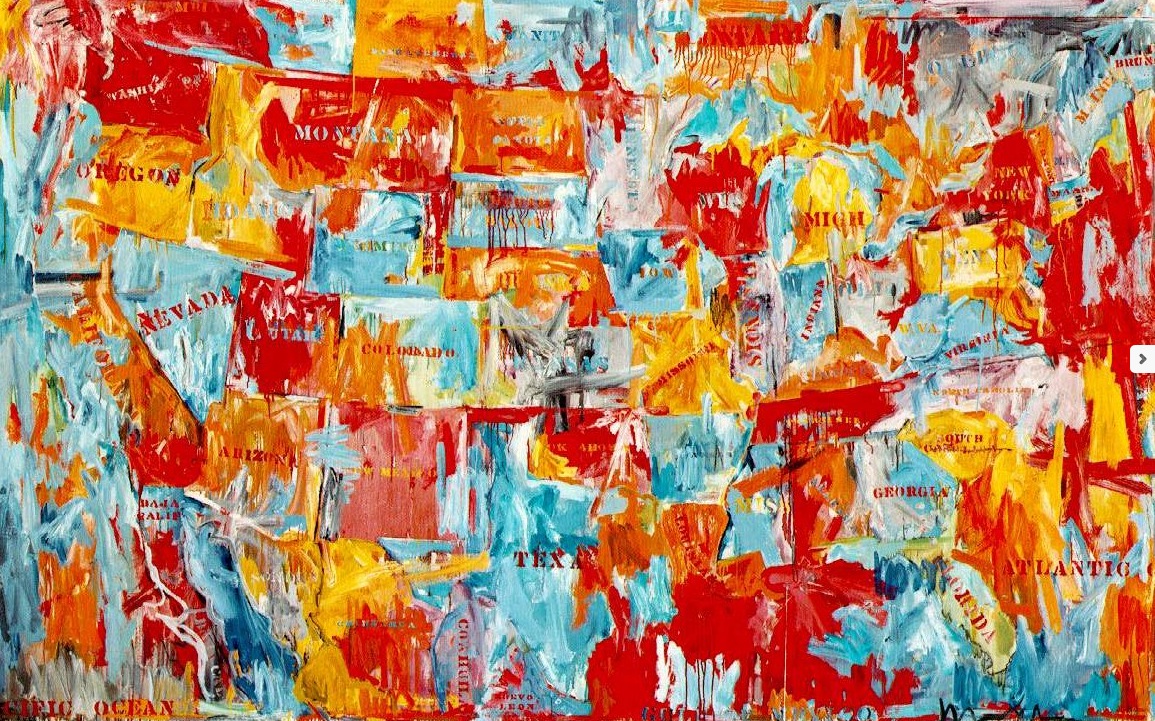
Map (Jasper Johns, 1961)

Map (Jasper Johns, 1961)

On July 4, 1776, Thomas Jefferson rose before dawn, recorded the temperature at 6 a.m. (68 degrees), had some tea and biscuits, and made his way to Independence Hall. Sixty-nine years later, Henry David Thoreau chose the day to begin his sojourn at Walden Pond. On July 4, 1863, Lee’s Confederate army began its decisive retreat from Gettysburg, and on the same date in 1895 Katherine Lee Bates published “America the Beautiful”. Nathaniel Hawthorne, Stephen Foster, Louis B. Mayer and Obama’s oldest daughter were all born on July 4, and both Jefferson and John Adams died on the 50thth anniversary of the Founders’ Declaration. So what do the rest of us have planned for Independence Day?

It was Adams who predicted that the Fourth would be “celebrated by succeeding generations as the great anniversary festival” and “solemnized with pomp and parade, with shows, games, sports, guns, bells, bonfires, and illuminations, from one end of this continent to the other, from this time forth for evermore.”[i] We have more or less fulfilled the externals of Adams’ vision, but the mindfulness with which we keep the feast is subject to question. In 1975, just before the American Bicentennial, a Gallup poll revealed that 28% of Americans were unable to identify what significant event happened in 1776.

What should we remember as a people? Do we create simplifying myths that unite us with some intoxicating blend of nostalgia and amnesia? Sanitizing and depoliticizing the past is a way to reduce conflict, as in the efforts to heal sectional division after the Civil war. But that can leave grievous social ills unaddressed and unhealed. The current debate about the Confederate battle flag shows how deeply embedded such sanitizing mythology can be. Preserving “heritage,” we discover, is a massive process of forgetting where, in Joan Didion’s memorable phrase, “no one is bloodied by history.”[ii]

Some governments try to supervise the formation of collective memory. The late Soviet Union is a notorious example, but there are also more benign forms of cultivating shared cultural identity (mais oui!). But in America, as Michael Kammen has noted, “people forget and remember largely on their own.”[iii] We have no ministry of culture, and national memory is contested without official referees.

But few of us will give much thought to either politics or culture tomorrow. As a radio talk show guy put it in his summary of America’s military mission: “Those guys are fighting so we can have barbecues and drink beer.”[iv] Pursuit of happiness indeed. But as Daniel Webster noted, it has always been so. “The tavern,” he said, “was the headquarters of the Revolution”[v] – a gathering place where ideas were exchanged and debated. In these latter days we have retained the conviviality of the tavern while dispensing with the ideas. The long-winded orations of old-time Fourths are long gone. There will be little thoughtful discussion of liberty and the common good around the barbecue. No radical challenges to tyranny and oppression will be issued. We’ll just enjoy a day off with our families, friends and neighbors as we pursue happiness together. And in a society fraught with so much division and disconnection, being together in peace and play and joy may be as good a way as any to keep the American feast.

One of the moments when I feel community most vividly is after the last fireworks fade to black above our local harbor. All of us who have watched from the beach begin to make our way along a forest path back to the road. It is too dark to see faces, or anything else that distinguishes one from another. We are an egalitarian procession of shadows, walking together. No longer pursuing happiness, we seem to have found it. Being there together in the night, for a few lovely minutes, is the most important fact about us.

The wonder I feel in the holiday’s concluding moment is beautifully expressed in Samuel Hynes’ memoir of his childhood in the 1930s. Although he grew up in a very different America, his description touches on something timeless:

The last rocket is always the best of all – burst after burst, the echoes rebounding, and then another burst just when you think it is all over. And then it is. The families rise slowly in the sudden silence and fold their blankets, and walk home through the dark, still streets, not talking much, purged by the high splendors they have seen, satisfied that another Fourth is over, another summer has been celebrated with a proper hullabaloo.[vi]

[i] Benson Bobrick, Angel in the Whirlwind: The Triumph of the American Revolution (New York: Penguin Books, 1998), 203

[ii] Michael Kammen, Mystic Chords of Memory: The Transformation of Tradition in American Culture (New York: Vintage Books, 1993), 667

[iii] ibid., 700

[iv] Overheard on a Montana roadtrip a few years ago.

[v] Angel in the Whirlwind, 494

[vi] Samuel Hynes, The Growing Seasons: An American Boyhood Before the War (New York: Penguin Books, 2003), 111

But now I see

Window in Hereford Cathedral for Anglican visionary Thomas Traherne (Tom Denny, 2007)

Window in Hereford Cathedral for Anglican visionary Thomas Traherne (Tom Denny, 2007)

President Obama began his eloquent and moving eulogy for the Rev. Clementa Pinckney with a New Testament reference: “The Bible calls us to hope. To persevere, and have faith in things not seen … We are here to remember a man of God who lived by faith. A man who believed in things not seen.”[i]

According to physicists, 95% of the known universe is hidden from human observation. In reviewing a recent book on the subject of invisibility, Kathryn Schulz writes that the “whole realm of the visible is governed by the invisible … we can see a fragment of the what of things, but nothing at all of the why. Gravity, electricity, magnetism, economic forces, the processes that sustain life as well as those that eventually end it – all this is invisible. We cannot even see the most important parts of our own selves: our thoughts, feelings, personalities, psyches, morals, minds, souls.” Her conclusion sounds a note of causality which Aquinas would have admired: “Our planet, our solar system, our galaxy, our universe: all of it, all of us, are pushed, pulled, spun, shifted, set in motion, and held together by what we cannot see.”[ii]

Most of that invisibility is an inherent property of the unseen, but to that imperceptibility we human beings contribute our own forms of blindness. Some of that blindness is benign and adaptive, as we protect ourselves from sensory overload by only seeing what is necessary or unusual. But we also suffer moral blindness, closing our eyes to things we would rather not see, many of which the President boldly named in his oration.

“For too long,” he said, “we’ve been blind to the way past injustices continue to shape the present.” Blind about poverty, blind about racism, blind about our criminal justice system, blind about the unconscious impulse “to call Johnny back for a job interview but not Jamal.” As the congregation took up the cry – for too long! – he added, “For too long, we’ve been blind to the unique mayhem that gun violence inflicts upon this nation. Sporadically, our eyes are open: When eight of our brothers and sisters are cut down in a church basement, 12 in a movie theater, 26 in an elementary school. But I hope we also see the 30 precious lives cut short by gun violence in this country every single day; the countless more whose lives are forever changed — the survivors crippled, the children traumatized and fearful every day as they walk to school, the husband who will never feel his wife’s warm touch, the entire communities whose grief overflows every time they have to watch what happened to them happen to some other place.”

But it wasn’t just evil which became visible in Charleston. We also saw an answering goodness. As the philosopher Alfred North Whitehead insisted, “The kingdom of heaven is not the isolation of good from evil. It is the overcoming of evil by good.” When evil occurs, it is “met with a novel consequent as to issue in the restoration of goodness.”[iii] This novel consequent has taken many forms in recent days, most dramatically in the costly expressions of forgiveness by those so cruelly bereaved. It was not what the world expected to see.

“Oh, but God works in mysterious ways,” the President reminded us. “God has different ideas … Blinded by hatred, the alleged killer could not see the grace surrounding Reverend Pinckney and that Bible study group — the light of love that shone as they opened the church doors and invited a stranger to join in their prayer circle. The alleged killer could have never anticipated the way the families of the fallen would respond when they saw him in court — in the midst of unspeakable grief, with words of forgiveness. He couldn’t imagine that.”[iv]

Inspiring words, received by an inspired congregation. If we ever wonder whether church is worth the bother, do we need more evidence than Charleston? The radical forgiveness and faith we have witnessed there are not accidental. They have been uniquely forged and nurtured over time within a community of biblical witness, shared practice and common language. Church is where God’s friends do the collective work, generation after generation, to preserve and evolve the repertoire of faith in our stories, our praises and our actions.

Without church, we wouldn’t know how to name – or sing – “amazing grace.” We would lack the eyes – and the language – for “things unseen.” Without church, the President could never deploy Scripture with such resonance, or begin to sing a beloved hymn in the assurance that he would not have to finish it alone.

[i] Hebrews 11:1

[ii] Kathryn Schulz, “Sight Unseen: The Hows and Whys of Invisibility,” The New Yorker, April 13, 2015, 75-79

[iii] Alfred North Whitehead, Religion in the Making (New York: Fordham Press, 1996), 155

[iv] The full text of President Obama’s eulogy for the Rev. Clementa Pinckney on June 26, 2015, is widely available on the Internet.

Now welcome, Summer!

Dawn, Summer Solstice morning on Bainbridge Island, Washington.

Dawn, Summer Solstice morning on Bainbridge Island, Washington.

Now welcome, Summer, with thy sunne soft …
That hast this winter’s weather overshake 
And driven away the longe nightes black.

A few minutes ago, eight of us stood in the middle of a labyrinth outside an Episcopal church to sing these lines from Chaucer at the moment of Summer Solstice, 9:39 Pacific Daylight Time. It was not part of the Sunday liturgy, just one of my personal rituals to welcome my favorite season, and I found a few willing recruits to join in. Another of my Solstice rituals is to read Wallace Steven’s “Credences of Summer,” an eloquent tribute to the longest day when “spring’s infuriations are over,” summer mind enjoys a refuge from time’s flow and “the roses are heavy with a weight / Of fragrance and the mind lays by its trouble.”

With Charleston, climate change and endless war, not to mention the relentless pressures of a 24/7 culture, how do we lay by our troubles for a season, a day or even a moment? Adam Gopnik, in an old New Yorker essay, dismissed the idyllic summer images of unhurried pleasure as a national mythology. “We make up in symbolism what we lack in spare time. Summer in America is another place, to be dreamed of rather than remembered … Summer is about longing for summer.”

So is summer – or even the idea of summer – under threat of extinction? Or can we preserve and nurture a summer mind, a summer practice in ways both large and small? Can we take time to savor the gifts of the moment, kissing the joy as it flies? Can we give all our attention, now and then, to the “eternal foliage” of being?

It’s like prayer and meditation. Make time for it, and the quality of everything else is transformed. And what Rabbi Abraham Heschel said of the Sabbath applies equally to summer:

To set apart one day a week for freedom, a day on which we would not use the instruments which have been so easily turned into weapons of destruction, a day for being with ourselves, a day of detachment from the vulgar, of independence from external obligations, a day on which we stop worshipping the idols of technical civilization, a day of armistice in the economic struggle with our fellow human beings and the forces of nature – is there any institution that holds out a greater hope for human progress than the Sabbath?

On the shore of Minnesota’s Lake Pepin, where my father enjoyed many mythological summers in his youth, the Friedrichs who live there now fly a flag from May to September. Its motto reads: “Doing nothing is always an option.” Can I hear an ‘Amen?’

May your summer days, your summer moments, your summer places be many. May you and your people sustain a golden habitat for this glorious season.

Sunrise over Puget Sound on the longest day.

Sunrise over Puget Sound on the longest day.

And in these first hours of summer, what better invocation than James Wright’s poem, “Lying in a Hammock at William Duffy’s Farm in Pine Island, Minnesota”:

Over my head, I see the bronze butterfly,
Asleep on the black trunk,
Blowing like a leaf in green shadow.
Down the ravine behind the empty house,
The cowbells follow one another
Into the distances of the afternoon.
To my right,
In a field of sunlight between two pines,
The droppings of last year’s horses
Blaze up into golden stones.
I lean back, as the evening darkens and comes on.
A chicken hawk floats over, looking for home.
I have wasted my life.

God is a dance we do

Elaine Friedrich and friends, c. 1933

Elaine Friedrich and friends, c. 1933

At the end of last Sunday’s eucharist, we sang “You shall go out with joy,” a contemporary hymn with the infectious rhythm of Mediterranean dance.[i] The words, the tune, and the smiling worshippers all seemed to say the same thing: the Spirit really wanted to move in that place. So before we went our separate ways, I invited the congregation to repeat the song, while all who wished stepped into the open space before the altar for an impromptu circle dance. With joined hands, we circled round, spiraled inward, wove in and out of the arches and tunnels of upraised arms, manifesting with our bodies the divine fullness attributed to the Holy Trinity: an “interdependence of equally present but diverse energies … in a state of circumvolving multiplicity.”[ii] Or as St. Athanasius said more simply of the triune God, we were participating in the divine reality of “reciprocal delight.”

Communal dance is an early Christian image for the divine reality, due in part to a pun on the Greek word, perechoresis. This term (from peri = “around,” and chorein = “make room for,” “contain”) was appropriated in the fourth century to express the Trinitarian unity-in-diversity. Perechoresis implies a shared existence, a being-in-one-another where each Person, while remaining uniquely distinct, penetrates the others as each and all become the subject, not the object, of one another.

The Trinity is not a simple, static substance but an event of relationships. It is why we can say that God is love. “To be” has no ontological reality apart from “to be in relationship.” In the words of Anglican priest John Mbiti of Kenya, expressing the strongly communal mindset of African theology, “I am because we are, and since we are, therefore I am.”[iii]

Each Person contains the others and is contained by them in a shared communion of self-offering and self-surrender. But that continuous self-offering is never a one-way transaction, either one of self-emptying or one of being filled. It is always both at once – giving and receiving – as we ourselves know from our own mutual experience of love at its best. As Jesus said, “losing” yourself and “finding” yourself are equivalent and simultaneous. In giving ourselves away, we receive ourselves back. This may be counterintuitive to the modernist mindset of autonomous individual self-possession, but it is the essence of communion: “a giving of oneself that can only come from the ongoing and endless reception of the other.”[iv] This “being in communion” is explored more fully in Part 1: God is relational.

Now here’s the Greek pun: perechoresis also can mean “to dance around,” and the ancient theologians quickly seized on that image as an accessibly concrete description of a complex process. Trinity is a dance, with Creator, Christ and Spirit in a continuous movement of giving and receiving, initiating and responding, weaving and mingling, going out and coming in. And while our attention may focus at times on a particular dancer, we must never lose sight of the larger choreography to which each dancer belongs: the eternal perichoresis of Three in One, One in Three.

“I am the dance and I still go on” (Dancers at Elaine Friedrich’s Requiem)

Wallace Stevens made a poem about the process of giving ourselves over to a larger whole, “the intensest rendezvous” where we find ourselves drawn out of isolation “into one thing.” He wasn’t writing about dance or the Trinity, but his words come as close as any to describing their essential motion:

Here, now, we forget each other and ourselves.
We feel the obscurity of an order, a whole,
A knowledge, that which arranged the rendezvous.[v]

My mother Elaine knew the joy of the “intensest rendezvous” of perechoresis. She started dancing as a little girl, and as a teenager in the 1920’s she taught dance to younger children for ten cents a lesson. While studying at Northwestern she took workshops in Chicago with some of the great pioneers of modern dance, Doris Humphrey and José Limón. Her teachers encouraged her to apply to Martha Graham’s company. But then she met my father, and a career in dance was set aside for a more domestic life. I owe my own existence to that sacrificial act. Still, she remained a dancer in her heart, and later in life became a great advocate of sacred dance. Whatever I learned from her about the divine dimensions of “dancing around,” of giving yourself over to the cosmic “Love that moves the sun and all the other stars,”[vi] remains a vital part of my theological education.

There are no spectators in the Trinitarian dance, which is always extending outward to draw us and all creation into its motions. As Jürgen Moltmann said, “to know God means to participate in the fullness of the divine life.”[vii] It’s not a matter of our trying to imitate the relational being of the loving, dancing God, as if we were inferior knock-offs of the real thing. God wants us to become ourselves the real thing. God wants to gather us into the divine perechoresis as full participants in the endless offering and receiving, pouring out and being filled, which is the dance of God and the life of heaven.

And while our dance with God has its mystical, mysterious, transcendent dimensions, it is also very concrete and specific to our historical life on this earth, in this present time. As Miroslav Volf has said, “The Trinity is our social program.”[viii] We are called to make God not just an inner experience but a public truth. When Love’s dance becomes our way of being in the world – as believers, as church – the Trinity is no longer just doctrine. It is a practice, begetting justice, peace, joy, kindness, compassion, reconciliation, holiness, humility, wisdom, healing and countless other gifts.

Liberation theologian Justo L. Gonzales puts it well: “If the Trinity is the doctrine of a God whose very life is a life of sharing, its clear consequence is that those who claim belief in such a God must live a similar life … for if God is love, life without love is life without God; and if this is a sharing love, such as we see in the Trinity, then life without sharing is life without God…”[ix] So, in the immortal words of Lewis Carroll’s Mock Turtle: Will you, won’t you, will you, won’t you, won’t you join the dance?[x]

My mother was still dancing in her nineties, mostly in the gentle motions of Tai Chi. A year before her death at 96, she was asked to lead a dance prayer in her retirement community’s chapel. It was no longer easy for her to stand, so she performed the prayer seated, while the elderly congregation echoed her gestures with their own frail bodies. The prayer was Daniel Schutte’s well-known anthem, “Here I am, Lord.”[xi] In this video you can only see Elaine, but I’m pretty sure she was dancing with the whole company of heaven.

[This is the final post of a 3-part series on the Trinity. Part 1 was “God is relational,” and Part 2, on the experiential foundations of Trinitarian belief, was “You can’t make this stuff up.”]

[i] Words by Steffi Geiser Rubin, music by Stuart Dauermann (© 1975 Lillenas Publishing Company)

[ii] David Bentley Hart, The Beauty of the Infinite: The Aesthetics of Christian Truth (Grand Rapids: Eerdmans 2003), 114

[iii] q. in Veli-Matti Kärkkäinen, The Trinity: Global Perspectives (Louisville: Westminster John Knox Press, 2007), 352

[iv] Graham Ward, “The Schizoid Christ,” in The Radical Orthodoxy Reader, ed. John Milbank and Simon Oliver (NY: Routledge, 2009), 241

[v] Wallace Stevens, “Final Soliloquy of the Interior Paramour,” Collected Poetry and Prose (NY: Library of America, 1997), 444

[vi] Dante, Paradiso xxxiii, 145, trans. Robert & Jean Hollander (NY: Doubleday, 2007), 827

[vii] Jürgen Moltmann, The Trinity and the Kingdom: The Doctrine of God, trans. Margaret Kohl (San Francisco: Harper & Row, 1981), 152

[viii] Miroslav Volf, “‘The Trinity is Our Social Program’: The Doctrine of the Trinity and the Shape of Social Engagement,” Modern Theology 14, no. 3 (July 1998)

[ix] The Trinity: Global Perspectives, 301

[x] From the Mock Turtle’s song in Alice in Wonderland by Anglican cleric Charles Dodgson (Lewis Carroll)

[xi] Daniel Schutte, © OCP Publications 1981

Three things you should know about the Trinity (Part 2)

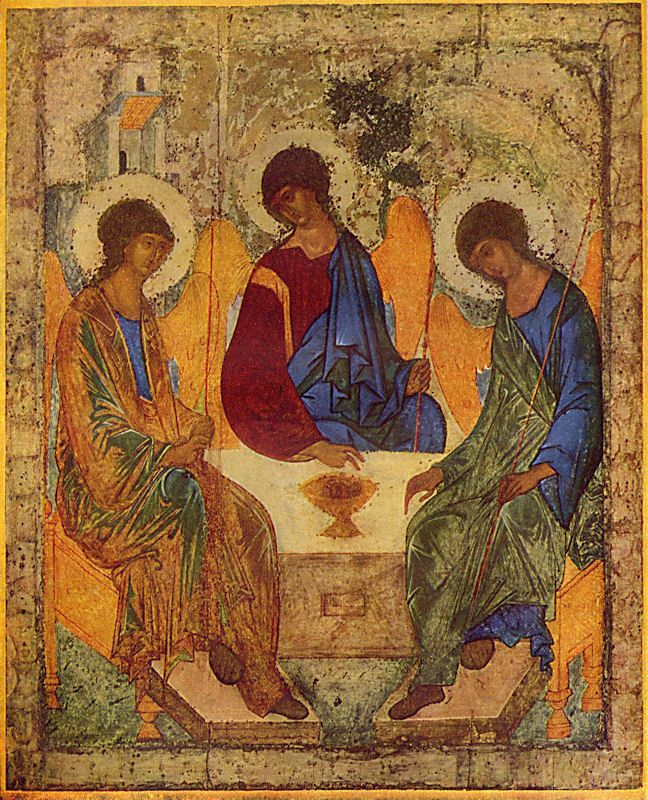
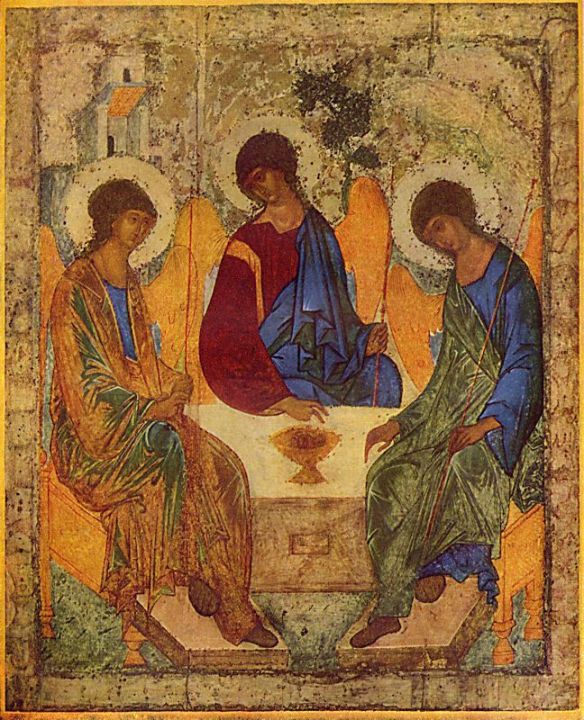
Andrei Rublev, The Holy Trinity (1425)

Andrei Rublev, The Holy Trinity (1425)

Trinitarian doctrine, like other key Christian doctrines, was hammered out, not in sterile study, but rather in the midst of lived spirituality, prayer, and the worship life of the church.[i]

                                                                        – Veli-Matti Kärkkäinen

The Trinity has to do with the lives of each of us, our daily experiences, our struggles to follow our conscience, our love and our joy, our bearing the sufferings of the world and the tragedies of human existence; it also has to do with the struggle against social injustice, with efforts at building a more human form of society, with the sacrifices and martyrdom that these endeavors so often bring. If we fail to include the Trinity in our personal and social odyssey, we shall have failed to show the saving mystery[ii]

– Leonardo Boff

Part 2: You can’t make this stuff up

Early in the twelfth century, a German monk named Rupert of Deutz went into a church where mass was being said by a white-haired bishop. At the offertory procession he experienced a vision of the Holy Trinity:

On the right at the edge of the altar stood three persons of such revered bearing and dignity that no tongue could describe them. Two were quite old, that is, with very white hair; the third was a beautiful youth of royal dignity …[iii]

A century later, Hadewijch of Antwerp, one of those remarkable women mystics who flourished in the late middle ages, also had a vision of the Trinity. But instead of three white males, what she saw was a dark whirlpool, which she described as “divine fruition in its hidden storms.” Hovering over this whirlpool was a spinning disc, on which sat a figure wearing the countenance of God – the face of God – on whose breast were written the words, “The Most Loved of All Beloveds.”

We may find Hadewijch’s vision more congenial: it is genderless, and less crudely specific than Rupert’s. And the tempestuous whirlpool, a flood of energy ceaselessly flowing through the universe, conveys a dynamic image of divinity that resembles the postmodern cosmologies of process theology and quantum physics. It’s probably easier for most of us to believe in a divine whirlpool than in three white guys.

But the crucial difference between Rupert and Hadewijch is not in the relative resonance of their imagery, but rather in what happens next. Rupert remains an observer, one who stands apart and sees God as an object. But Hadewijch does not remain separate from what she sees:

Then I saw myself received in union by the One who sat there in the whirlpool upon the circling disc, and there I became one with him in the certainty of union… In that depth I saw myself swallowed up. Then I received the certainty of being received, in this form, in my Beloved, and my Beloved also in me.

Rupert’s knowledge of God remained conceptual. Hadewijch’s knowledge of God became experiential. She was gathered into the circulating current of divinity. She became part of its flow, and that divine flow became part of her.

The language she uses for this experience is not mathematical or philosophical. Her language is the language of the heart. She describes being “swallowed up… in my Beloved, and my Beloved also in me.”[iv] Love, she discovered, is the way the soul knows. Love is the way the soul sees.

I begin this reflection with a mystic’s personal testimony because Trinitarian theology was not forged by inventive theorists, but by faithful Christians trying to make sense of the concrete, experiential data of salvation, beginning with the biblical narrative and continuing in the ongoing history of believing communities. Based on our collective and personal experience of being “saved” (or, if you prefer: healed, forgiven, reborn, renewed, resurrected, empowered), what can we say about the God who has done this? Trinitarian reflection began within an ancient community deeply grounded in the monotheism of Judaism, which had, over the centuries, found ultimate reality to be not a plurality of disconnected or contradictory energies but a coherent unity. But once the early Christians began to attribute divinity to both Jesus and the Holy Spirit, a simple self-contained oneness was no longer sufficient to describe the Reality.

Without losing the unity of God, how could they account for the divine diversity revealed in the saving activities of Christ and the Spirit? Once they began to call Jesus “Lord” (Kyrios), which happened very early in their worship and their storytelling, traditional monotheism was radically destabilized. The growing perception of the Holy Spirit as a guiding and empowering presence of deity in their communities only compounded the problem.

There were various attempts to solve the problem by downgrading Jesus and Spirit to subordinate, derivative, or semi-divine realities, by no means equal to the eternal and uncreated God. Such “heresies” were popular with those who wanted to keep God simple. But “orthodoxy” was unwilling to deny the fullness of divinity to either Christ or the Spirit. Only God can save us. Christ and Spirit, in the biblical revelation and Christian experience, are integral and essential to salvation. Therefore, they must be equally integral to the Holy One who is the Creator and Redeemer of all things.

The question wasn’t only metaphysical (What is the relation between the one and the many or the finite and the infinite?) or logical (How can One be Three and Three be One?). Trinitarian reflection was also a deep engagement with the question of suffering. If God incarnate in Christ chose to share the human condition, to live and die as one of us, does that mean that vulnerability and suffering have become part of God’s own history? And if these human elements have been added to the divine life through specific temporal events, has time itself disturbed the perfect calm of eternity? If God has been affected and changed by events in time and history, what can we then say about the consistency and transcendence of the divine nature? How can God be decisively linked to the history of the world without losing freedom or transcendence? Can a changeless God weep? Can we be saved by a God without weapons?

In his comprehensive survey of contemporary Trinitarian thought, Veli-Matti Kärkkäinen argues that “the assumption of humanity by God, the Son, means that human capacity to suffer is not foreign to the being of God. How else could one speak of God as love? … It is more biblical to think of God as passionate love, the Father who chooses to engage the suffering of the world, than as a Transcendent One whose separation from the world’s suffering guards his freedom.”[v] Robert Jenson, a foremost North American authority on the Trinity, rejects the notion of divine detachment from creation in dramatically succinct terms: “God … is what happens with Jesus… God is what will come of Jesus and us, together.”[vi]

The problems and paradoxes that arise from such far-reaching assertions have been debated and puzzled over throughout Christian history, and the recent profusion of Trinitarian theology has become an incredibly rich conversation. There is, of course, no final version of God awaiting discovery, no definitive outcome to all this reflection, only an endless attentiveness to the Mystery which may consent to dance with language, but always outruns it in the end.

So why presume to talk about the Trinity at all? Why can’t we simply say and think and pray to “God” and leave it at that? We can’t do that because Christians don’t belong to a theoretical God, a reasonable and logical divine construct worked up by professional philosophers. We belong to the self-revealing but complicated God of the Bible who has, in the form and activity of Christ and the Holy Spirit, rescued us from our own folly and gathered us into the communion that is the very life of God. And no matter what diverse strategies of insight and understanding we may employ, what we can actually say about the Trinity is always grounded in experience, both the experience of our ancestors encoded in Scripture and tradition and the contemporary revelations of communal and personal life.

Trinitarian thought isn’t made out of thin air or abstract speculation. It is produced and nourished by the concrete, tangible history of Christian experience. However each day manifests for us “the means of grace” and “the hope of glory,” whatever the myriad ways by which we love and serve and witness, we need the threefold name to account for the diversity of God’s relations with us. Anything less would impoverish our prayer and considerably reduce the scope of our attention.

For most theologians, our experience of God as threefold also reflects a Trinitarian life within God’s own self. Since God’s inner life is beyond our sight, this can only be an assumption. But it is a crucial one. If God is trustworthy and self-revealing, it must be that when we meet God as Trinity, we get the real thing. God isn’t just pretending to be Three for us; God’s own inner life is constituted by relationality and communion.

Finally, how shall we address or invoke this Mystery, which a Japanese theologian intriguingly calls “Three Betweennesses in One Concord?”[vii] The traditional “Father, Son, and Holy Spirit,” despite its authoritative pedigree, is distractingly masculine for many, and various substitutes have arisen, each with their own impediments. “Creator, Redeemer, Sanctifier,” for example, is a bit impersonal, and risks reducing the three Persons to job descriptions. Likewise, “Source, Word, Spirit,” “Creator, Liberator, Comforter,” “Parent, Child, Paraclete,” “Mother, Daughter, Spirit,” and “Mother, Lover, Friend” all have their particular assets and liabilities. My own current preference, since I suspect that God is more verb than noun, is “Love who loves us[viii], Word who saves us, Spirit who revives us.”

I leave the last word to 16th century reformer Philip Melanchthon, who said, “We adore the mysteries of the Godhead. That is better than to investigate them.”[ix]

[This is the second of three reflections on the Trinity. The first, on the essential relationality of God, may be found here.]

[i] Veli-Matti Kärkkäinen, The Trinity: Global Perspectives (Louisville: Westminster John Knox Press, 2007), 35

[ii] ibid., xv-xvi

[iii] Bernard McGinn, The Growth of Mysticism: Gregory the Great Through the 12th Century (New York: The Crossroad Publishing Company, 1994), 330

[iv] ibid., The Flowering of Mysticism (New York: The Crossroad Publishing Company, 1998), 212-16

[v] Veli-Matti Kärkkäinen, 99

[vi] Robert W. Jenson, The Triune Identity: God According to the Gospel (Philadelphia: Fortress Press, 1982), 22-3

[vii] Nozumu Miyahira, in Kärkkäinen, 314

[viii] I take this resonant phrase from Terrence Malick’s transcendent film, To the Wonder.

[ix] Kärkkäinen, xvi
Three things you should know about the Trinity (Part 1)

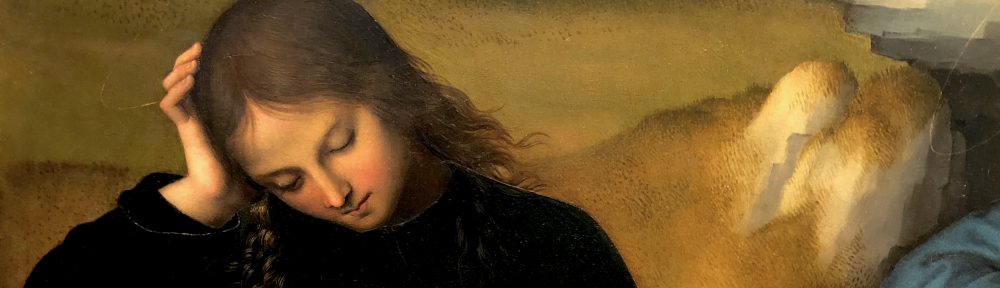
The Trinity is hard to visualize, as this late Gothic painting from the Louvre demonstrates.

The Trinity is hard to visualize, as this late Gothic painting from the Louvre demonstrates.

I’ve heard a lot of clergy say they hate to preach on Trinity Sunday. It seems too abstract, too complex, too heady a topic for a Sunday congregation, especially in a culture where thinking theologically is not a widely practiced art. It’s like trying to explain quantum physics to non-scientists. It took centuries for the ancient church to shape the doctrine of the Trinity. How can anyone explain it in 15 minutes? Besides, people look to the preacher for inspiration, not explanation. They want a sermon to make sense of things, not to make their heads explode.

Even Gregory of Nyssa, who thought a lot about the Trinity in the 4th century, found it a daunting subject:

You tell me first what is the unbegottenness of the Father, and I will then explain to you the physiology of the generation of the Son, and the procession of the Spirit, and we shall both of us be stricken with madness for prying into the mystery of God.[i]

I actually enjoy preaching the Trinity. I like it so well I even preached when Trinity Sunday fell on the day between my wedding and my honeymoon. It’s an inexhaustible subject – the Christian theory of everything – but over my next three posts, let me (humbly) suggest three things which I believe to be foundational for trinitarian faith.

Part 1: God is relational

We tend to think of a person as defined by his or her separateness. I’m me and you’re you! We may interact and even form deep connections, but my identity does not depend upon you. I am a self-contained unit. You can’t live in my skin and I can’t live in yours. That’s the cultural assumption, which goes back at least as far as Descartes in the seventeenth century, and continues today in such debased forms as rampant consumerism, where my needs and my desires take precedence over any wider sense of interdependence, community, or ecology.

But what we say about the Persons of the Trinity is quite different. Each Person is not an individual, separate subject who perceives the other Persons as objects. The Trinitarian persons experience one another not from the outside, but from the inside. They indwell each other in a mutual interiority.

John Lennon expressed the Trinitarian spirit when he sang, “I am he as you are she as you are me and we are all together.” And a French mystic put it this way: “it’s a case of un ‘je’ sans moi” (an “I” without a me).

But if the divine Persons are all inside each other, commingled, “of one being,” as the Creed says, what makes each Person distinct? To put it succinctly: the Persons are distinct because they are in relation with one another.

As Martin Buber observed, we are persons because we can say “Thou” to someone else. To be a person is to experience the difference – and the connection – that forms the space between two separate subjects. My consciousness is not alone in the universe. There are other centers of consciousness: Thou, I… Thou, I… The fact that you are not I is what creates self-consciousness, the awareness of my own difference from what is outside myself.

If we apply this to the Trinity, we say that there are Three Persons because there is relation within God, relation between the Source who begets, the Word who is begotten, and the Spirit who binds the two together and moves them outward in ever widening circles.

These relations are not occasional or accidental. They are eternal. There is an eternal sending within God, an eternal self-giving within God, an eternal exchange by which God is both Giver and Receiver simultaneously.

Trinitarian faith describes a God who is not solitary and alone, a God who is not an object which we can stand apart from and observe. The Trinity is an event of relationships: not three separate entities in isolation and independence from one another, but a union of subjects who are eternally interweaving and interpenetrating.

The early Church had a word for this: perechoresis. It means that each Person penetrates the others, each contains the other, and is contained by them. Each fills the space of the other, each is the subject, not the object of each other. As Jesus says in the Fourth Gospel: I am in the Father and the Father is in me.

This divine relationality is not something which an originally solitary God decided to take up at some point. God is eternally relational. Before there was an external creation to relate to, God’s own essential self was and is an event of perpetual relation. There was never simply being, but always being-with, being-for, being-in. To be and to be in relation are eternally identical.

When the Bible says, “God is love” (I John 4:16), it means that love is not just something God has or God does; love is what God is. As Orthodox theologian John D. Zizoulas says in his influential text, Being as Communion, “Love as God’s mode of existence … constitutes [divine] being.”[ii] Feminist theologian Elizabeth Johnson echoes this in her book, She Who Is: “There is no divine nature as a fourth thing that grounds divine unity in difference apart from relationality. Rather, being in communion constitutes God’s very essence.”[iii]

In other words, God is Love giving itself away – self-emptying, self-diffusing, self-surrendering – and in so doing finds itself, receives itself, becomes itself.

For those of us made in God’s image, who God is matters deeply, both for our own self-understanding and for our engagement with the world. The Trinity isn’t just a doctrine or an idea. It’s a practice, a way of life, the shape of every story.

To be continued … 

[i] Sermons of Gregory of Nyssa, Orat. xxxi, 8

[ii] John D. Zizoulas, Being as Communion: Studies in Personhood and the Church (Crestwood, NY: St. Vladimir’s Seminary Press, 1993), 46

[iii] Elizabeth Johnson, She Who Is: The Mystery of God in Feminist Theological Discourse (NY: Crossroad, 1993), 227

Cave of the Apocalypse

Katholikon of the Holy Monastery of St. John the Theologian

Katholikon of the Holy Monastery of St. John the Theologian


I, John … was on the island called Patmos because of the word of God and the testimony of Jesus. I was in the spirit on the Lord’s day, and I heard behind me a loud voice saying, ‘Write in a book what you see …’    (Rev. 1:9-11)

Patmos is one of the smaller Dodecanese Islands, a grueling 8-hour middle-of-the-night ferry ride east of Athens. It has gorgeous bays and quiet beaches, superb mountain views, charming villages and, at least not in summer’s high season, a tranquil predominance of locals over tourists. The outsiders I have met are themselves “regulars,” returning again and again because they love it. Yesterday a man from the Netherlands told me this was his 23rd straight year of month-long visits.

Patmos is also a place of pilgrimage, where St. John the Theologian (or “the Divine,” as we say in the western church), fell into a swoon and saw things which have intrigued, puzzled, disturbed and inspired readers ever since. The Book of Revelation has, regretfully, provided horrific weapons of mass destruction for hellfire preachers, but it is also the source for many sublime hymns and prayers in my own Anglican tradition.

Most scholars think that the book’s author is not the same person who wrote the Fourth Gospel. Language, style and themes are too different in the two works. But “tradition” has always preferred to link the Galilean fisherman “whom Jesus loved” with both the mystical composer of the Fourth Gospel and the visionary exiled to Patmos. It exemplifies the arc of discipleship as potentially a long, strange trip. As we sang in a hymn at my own ordination years ago, “the peace of God, it is no peace … Young John, who trimmed the flapping sail, homeless in Patmos died; Peter, who hauled the teeming net, headdown was crucified.”

So the Christian can’t come to Patmos and simply lie on the beach or relax in the taverna. The Holy Monastery of St. John the Theologian beckons from the high ridge above the  port. Its dark-hued fortress of lion-colored stone makes somber contrast with the whitewashed village around it, as if to say that the ascent of this hill is serious business.

The monastery rises above the village of Chora.

The monastery rises above the village of Chora.

If you rise early, you can experience the awesome richness of the monastery’s Katholikon (main church) in solitude. The brilliant wall paintings, recently cleaned, immerse you in holy images. Along with the intricately carved iconostasis, hanging oil lamps, and numerous icons, they effect a ceaseless engagement of the eye. Some might find this distracting for prayer, but for me the sense that there is always more than I can take in – the visual inexhaustibility of Orthodox interiors – can lead to a kind of surrender, overwhelming and transcending the subjectivity of my own thoughts and perceptions. Here is Mystery. Give over to it. Lose yourself in it.

The monastery museum holds an eclectic assortment of treasures, including a 6th century gospel book, a 1499 Venetian collection of Aristophanes’ comedies, a 6th century BC bust of Dionysus (god of wine and ecstasy), the largest Orthodox collection of 5th-6th century Coptic textiles, preserved by the dryness of Egyptian tombs, and a police blotter in Arabic from the late 15th century, when Byzantine territories had fallen under Muslim control (“The Cadi [Judge] of the Palace is ordered to find three Patmians who were kidnapped by pirates.”).

Below the monastery, halfway up the hill from the sea, is the Cave of the Apocalypse. Here, according to tradition, John lay on the stone floor for several days while the vision unfolded. The cave is not large, but the insertion of a wooden iconostasis into its contours, along with icons and hanging lamps, has made it a compelling place for worship, prayer and veneration. John’s private ecstasy has been reimagined through specific features of the cave. Here is the cleft from which the Voice spoke. Here is the corner when he laid his head to rest between revelations. Here are the fissures where the Trinitarian God divided the rock into three parts with an earthquake.

Literal belief in the details of the cave’s legends is not required to make the site holy. It is holy because centuries of believers have given a particular kind of attention here to a Reality which yearns to make itself known in the innermost heart, for which a sheltering, enclosing cave is a tangible, sensory analogy.

Another mystical theologian, St. Bonaventure, said, “When you pray, gather up your whole self, enter with your Beloved into the chamber of your heart, and there remain alone with your Beloved, forgetting all exterior concerns.” The Cave, for the attentive, can mirror the chamber of the heart.

I entered it three times during my week here. The first time was the Sunday liturgy, full of incense and chanting voices. It was beautiful, but I had no revelations, or even deep feelings. God was present, but I was a bit absent. I was tired from a long, sleepless ferry ride. And I knew that whatever the Cave offered was not a tourist experience you can just walk in and collect.

So I went back a few days later. The voices I heard then were those of tour guides. Most just reeled off the legends uncritically as if they were prosaic facts. Here this and that happened, blah blah blah, now let’s go back to the bus. But one guide, a Greek woman speaking both in English and German, really got into it.

“People think that the Book of Revelation is about judgment and punishment. That is there, of course, but by the time you get to Chapter 21, you find what it is really about: a new world, a new heaven, a new earth, where we will be with God, and God with us.

“John’s message is trying to wake us up, to make us see that we are all one because God is with us and in us. Our original condition of oneness will be restored in the end. We lost that unity in the beginning because we had free will, and we chose to have our own experience, and forgot our connection with one another.

“If a bomb falls on someone in Syria, we think, ‘Thank God that didn’t happen to me.’ But what happens to others happens to all of us. John is trying to wake us up to this. And when he talks about the destruction of the earth, we have to think about how much closer we ourselves are to bringing that about today, unless we remember what we were made for and what we are a part of.”

When I thanked her afterward for her ‘preaching,’ she said, “I want to tell people what they don’t know, what they don’t hear in the schools, what the priests won’t tell you.” She was pretty sour on the institutional church. “I was baptized Greek Orthodox. I believe in Christ and the power of the sacraments, but I don’t belong to any church. I’m kind of a revolutionary.” I asked her name. “Vera,” she said. “Like veritas– the truth.”

This morning, my last on Patmos, I returned to the Cave for a third time. Two cantors and a priest were chanting the Divine Liturgy. I was the only other person present. This time, the spirit of prayer came easily, like a morning breeze. I received no visions, heard no voices except the beautiful earthly ones I stood among. But it was more than enough. When the priest handed out the holy bread at the end, I was aware of my outsider status as non-Orthodox. But the priest, who had the face of a Baroque Apostle, turned to me with a slight nod. And so I ate the bread of heaven, and departed well satisfied.