Living by the Sword: Putin and the Perils of Messianic Politics

Vladimir Putin and the icon of the Savior “not made by hands,” (Attibution: AP Photo/RIA Novosti, Alexei Nikolsky, Pool)

“The hour is late. The world is choked with weapons, and dreadful is the mistrust peering from all men’s eyes. The trumpets of war may blow tomorrow. Who knows if we shall see each other in another year? What are we waiting for? Peace must be dared. Peace is the great venture.”

— Dietrich Bonhoeffer (August 1934)

At a pro-war rally in Moscow last month, Vladimir Putin praised his troops for their embodiment of Christian love. “And this is where the words from the Scriptures come to mind,” he said. “‘There is no greater love than if someone gives up his soul for his friends.’ The heart of the message is that this is a universal value for all the people and all the confessions of Russia …. Shoulder to shoulder they are helping and supporting each other and when it’s necessary they cover as if it was their own brother, they cover each other from the bullets. We haven’t had such unity in a long time.”[i]

The crowd loved the speech. “Forward Russia!” they chanted. Jesus! Love! Unity! Was this a political rally, or a religious revival? Some of each, I would think. For a thousand years of Russian history, politics and religion have been closely entwined. In 988, after the Christian conversion of Prince Vladimir of Kievan Rus’—the original Russian state—his subjects waded into the Dnieper River to be baptized en masse.

The fact that this birth narrative of Slavic Orthodoxy took place in Kyiv helps explain the lingering Russian attachment to the Ukrainian capital. It’s their Jerusalem. Even though the Ukrainian Orthodox Church was granted independence from its Russian counterpart in 2018, one third of the Orthodox churches still loyal to the Moscow Patriarchate are situated in the Ukraine, and Putin has argued that his army is coming to their defense. 

The mythology of Holy Rus’, a divinely ordered “kingdom” of Slavic believers—a “Third Rome” inheriting the world-transforming mission of its failed predecessors in Europe and Constantinople—became a staple of Russian identity. In contrast to the perceived decadence, individualism, and secularism of the West, Holy Rus’ was thought to preserve communal spiritual values for the sake of all humankind. In a famous speech given in 1880, Dostoevsky said:

“[T]o be a true Russian does indeed mean to aspire finally to reconcile the contradictions of Europe, to show the end of European yearning in our Russian soul, omni-human and all-uniting, to include within our soul by brotherly love all our brethren, and at last, it may be, to pronounce the final Word of the great general harmony, of the final brotherly communion of all nations in accordance with the law of the gospel of Christ!”[ii]

When Russia seized Crimea in 2014, such Third Rome mythology seemed alive and well when Foreign Minister Sergei Lavrov dismissed the protests of the “godless West, hostile to the Russians because we [remain] Christian traditionalists.”[iii] Many observers think the invasion of Ukraine is fueled by the same mythology. If so, Putin’s nostalgia for the old Russian Empire would be more than the product of personal and political ambition. It would amount, in that case, to a crusade to recover the lost lands of Holy Rus’ and restore the Third Rome to its proper glory. To let Ukraine drift away into western decadence would betray the myth.

Historian Anna Geifman dismisses any speculation about Putin’s mental stability:

“He’s not crazy — he’s messianic,” she says. “What Putin says is logical, and consistent with his entire policy since 2008 … To sustain his legitimacy, the regime chose to delineate a more national-patriotic and anti-Western direction, grounding its appeal on a strong conservative, Orthodox [Christian] foundation …  He may not use that term [the Third Rome], but he talks about the corruption of the West, with its ‘everything goes’ lifestyle that no longer differentiates between good and evil … Disregarding historical evidence to the contrary, Putin views Ukraine as part of the Russian family. Their independence is a slap in the face to his ideology.”[iv]

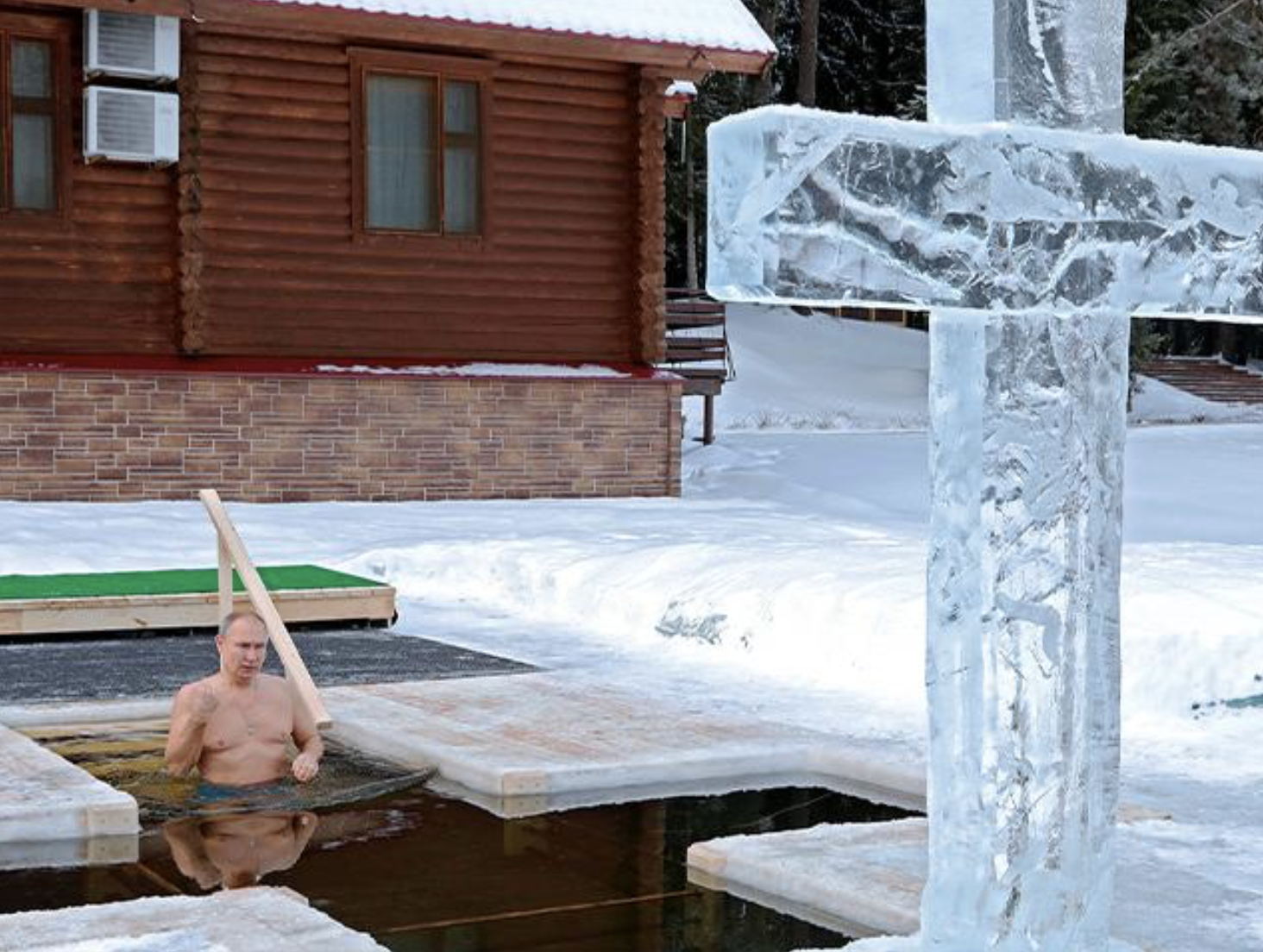
Vladimir Putin observers an Orthodox Epiphany ritual imitating the baptismal immersion of Christ.(Attribution: Mikhail Klimentyev, Sputnik, Kremlin Pool Photo)

Putin is coy about his personal beliefs, though he wears a cross around his neck and makes a public display of his Orthodox rituals. Is his employment of Holy Rus’ rhetoric just a cynical ploy to move the masses, or is he a religious crusader at heart? And which would be worse? Either way, the resulting atrocities have been horrifically evil. The Russian messiah is a war criminal.

Empty strollers in Lviv represent the children killed in the war’s first 3 weeks.

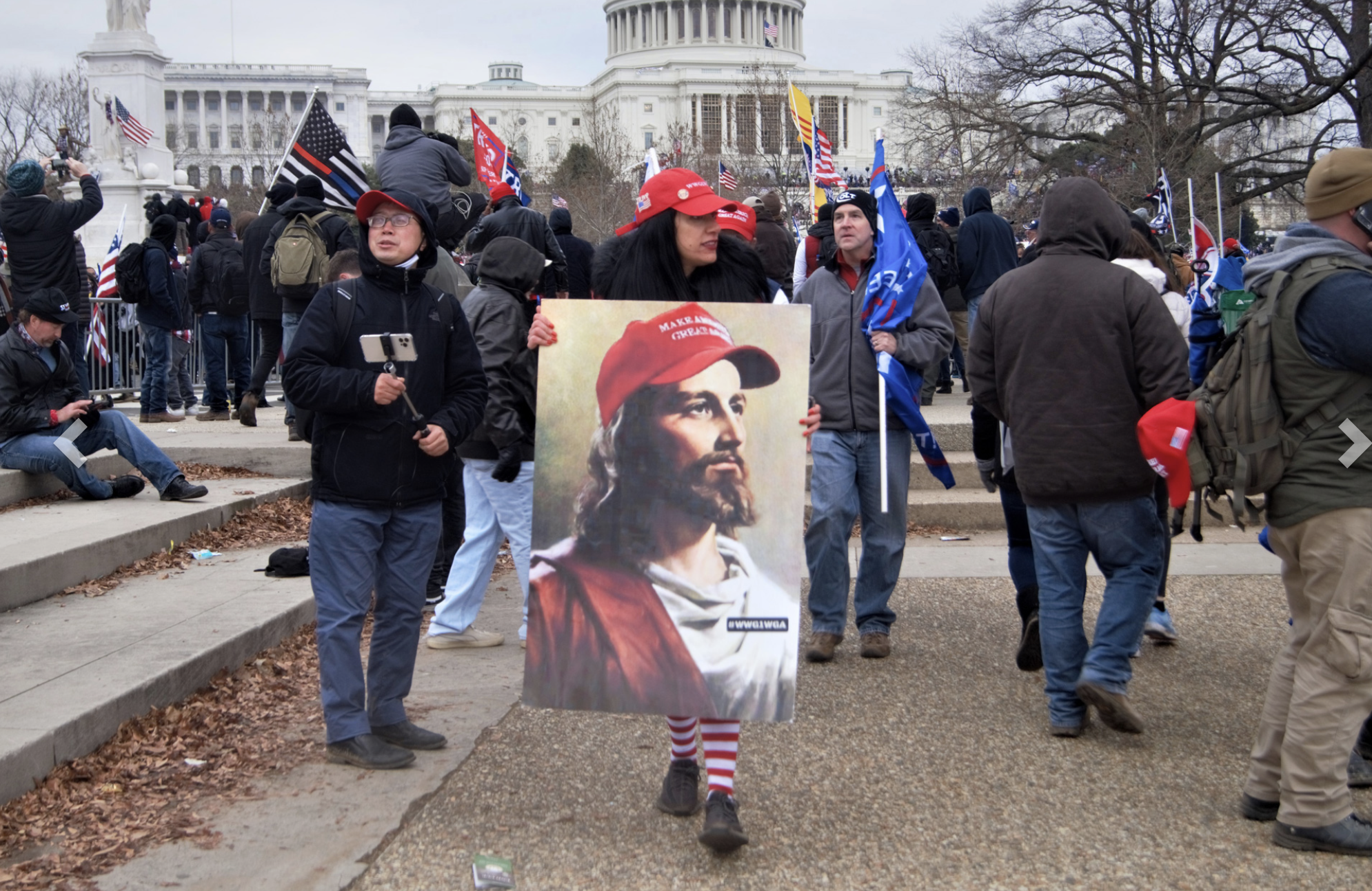
The unholy matrimony of religion and violence is always toxic, poisoning both church and world. We have seen too much of that right here in the United States. Many of the violent seditionists who stormed the Capitol on January 6, 2021, thought they were enacting God’s will. They blew shofars to make “the walls of corruption crumble.” They waved Jesus banners and Bibles, dragged large crosses into the fray, erected a gallows for their enemies. Their madness was driven by a core belief: “God, guns, and guts made America.”[v]

MAGA Jesus at the January 6 insurrection.

It wasn’t just the confused angers of the mob at work. The madness was deployed by the highest levels of government. As Capitol police were being beaten and killed and politicians were running for their lives, the President’s Chief of Staff sent an email from the White House to the sedition-enabling wife of a Supreme Court justice: 

“This is a fight of good and evil … Evil always looks like the victor until the King of Kings triumphs. Do not grow weary in well doing. The fight continues …”[vi]

For the seditionists, and a majority of white Evangelicals overall, Trump was a messianic figure, seeming to offer deliverance and rebirth to a desperate and despised people. “Donald Trump is in the Bible,” a rioter told a journalist. “Get yourself ready.”[vii]

The moral and theological collapse of right-wing Christianity in America echoes the capitulation of the Protestant German Church to the Third Reich. In the 1930s, most German clergy and theologians joined the Nazi party. Some were just playing it safe, but others were swept up in the nationalistic fervor. It became customary to conclude the baptismal rite by praying “that this child may grow up to be like Adolf Hitler.” And the head of the government Ministry of Church Affairs declared in 1935 that the Führer was “the bearer of a new revelation … Germany’s Jesus Christ.”[viii]

In the face of such absurd and blasphemous perversions of Christianity as we have seen in Russia, Germany, and the United States, what are God’s friends to do? Some would have us abandon religion altogether. Recent American studies have shown that many of the “nones” cite bad politics as their primary reason for rejecting Christianity, while many churches are themselves retreating from public life to avoid the contaminating risks of political action.[ix]

Dietrich Bonhoeffer

Dietrich Bonhoeffer was a German theologian and pastor who came of age during the rise of the Nazis. During a fellowship year at Union Theological Seminary in New York, he absorbed Professor Reinhold Niebuhr’s Christian realism. If you avoid history’s messy struggles to preserve your purity, Niebuhr warned, the vacuum you leave will be filled by the demonic. 

Attending an activist black church in Harlem also had an enormous impact on young Bonhoeffer. As his superb biographer Charles Marsh has written, “No longer would he speak of grace as a transcendent idea but as a divine verdict requiring obedience and action. The American social theology … had remade him into a theologian of the concrete.”[x] When, a decade later, he joined a conspiracy to assassinate Hitler, “he would abandon any hope of innocence, incurring the guilt of responsible action. Of the two evils, it was the one he could abide.”[xi] The failed plot would cost him his life. He died in a concentration camp two weeks before it was liberated by the Allies. His body was never found. 

Bonhoeffer had assented to a selective use of violence in order to interrupt mass murder. The unspeakable suffering of the many outweighed his own need for innocence. But he did not do it lightly, and the political captivity of the German Church made him keenly aware of how religion’s engagement with culture can easily go off the rails. He thought deeply about the ambiguities involved in repairing a broken world, but he knew that we cannot just think our way out of the human condition. We need something more, something divine. And words he wrote during the dark days of World War II still point the way:

“Who stands firm amidst the tumult and cataclysms? … The huge masquerade of evil has thrown all ethical concepts into confusion … The failure of ‘the reasonable ones’—those who think, with the best of intentions and in their naïve misreading of reality, that with a bit of reason they can patch up a structure that has come out of joint—is apparent. With their ability to see impaired, they want to do justice on every side, only to be crushed by the colliding forces without having accomplished anything at all. Disappointed that the world is so unreasonable, they see themselves condemned to unproductiveness; they withdraw in resignation or helplessly fall victim to the stronger … Who stands firm? Only the one whose ultimate standard is not their reason, their principles, conscience, freedom, or virtue; only the one who is prepared to sacrifice all of these when, in faith and relationship to God alone, they are called to obedient and responsible action. Such a person is the responsible one, whose life is to be nothing but a response to God’s question and call.”[xii]


[i] https://www.thenationalnews.com/world/europe/2022/03/18/putin-rallies-stadium-crowds-and-lauds-troops-fighting-in-ukraine/ The quotation is a paraphrase of Jesus’ words in John 15:13, just after he says, “Love one another as I have loved you.” Putin used the Russian word for soul (душу (dushu) instead of the biblical “life.”

[ii] Dostoevsky’s speech, given in honor of Russian poet Aleksandr Pushkin (1799-1837), can be found here: http://web.archive.org/web/20050207093332/http://www.dwightwebber.com/pushkinspeech.html

[iii] Quoted in Binyamin Rose, “Russia’s Deep-Seated Messianic Complex,” Mishpacha: Jewish Family Weekly (Mar. 15, 2022) https://mishpacha.com/russias-deep-seated-messianic-complex/

[iv] Ibid.

[v] Emma Green, “A Christian Insurrection” (The Atlantic, Jan. 8, 2021).

[vi] David French, “The Worst Ginni Thomas Text Wasn’t from Ginni Thomas (The Atlantic, March 25, 2022).

[vii] Jeffrey Goldberg, “Mass Delusion in America” (The Atlantic, Jan. 6, 2021).

[viii] Charles Marsh, Strange Glory: A Life of Dietrich Bonhoeffer (New York: Vintage Books, 2014), 283, 271.

[ix] Ruth Braunstein, “The Backlash against rightwing evangelicals is reshaping American politics and faith” (The Guardian, Jan. 25, 2022).

[x] Marsh, 135.

[xi] Ibid., 346.

[xii] Ibid., 341.

“We must love one another or die”—What Does the Iliad Tell Us about the Invasion of Ukraine?

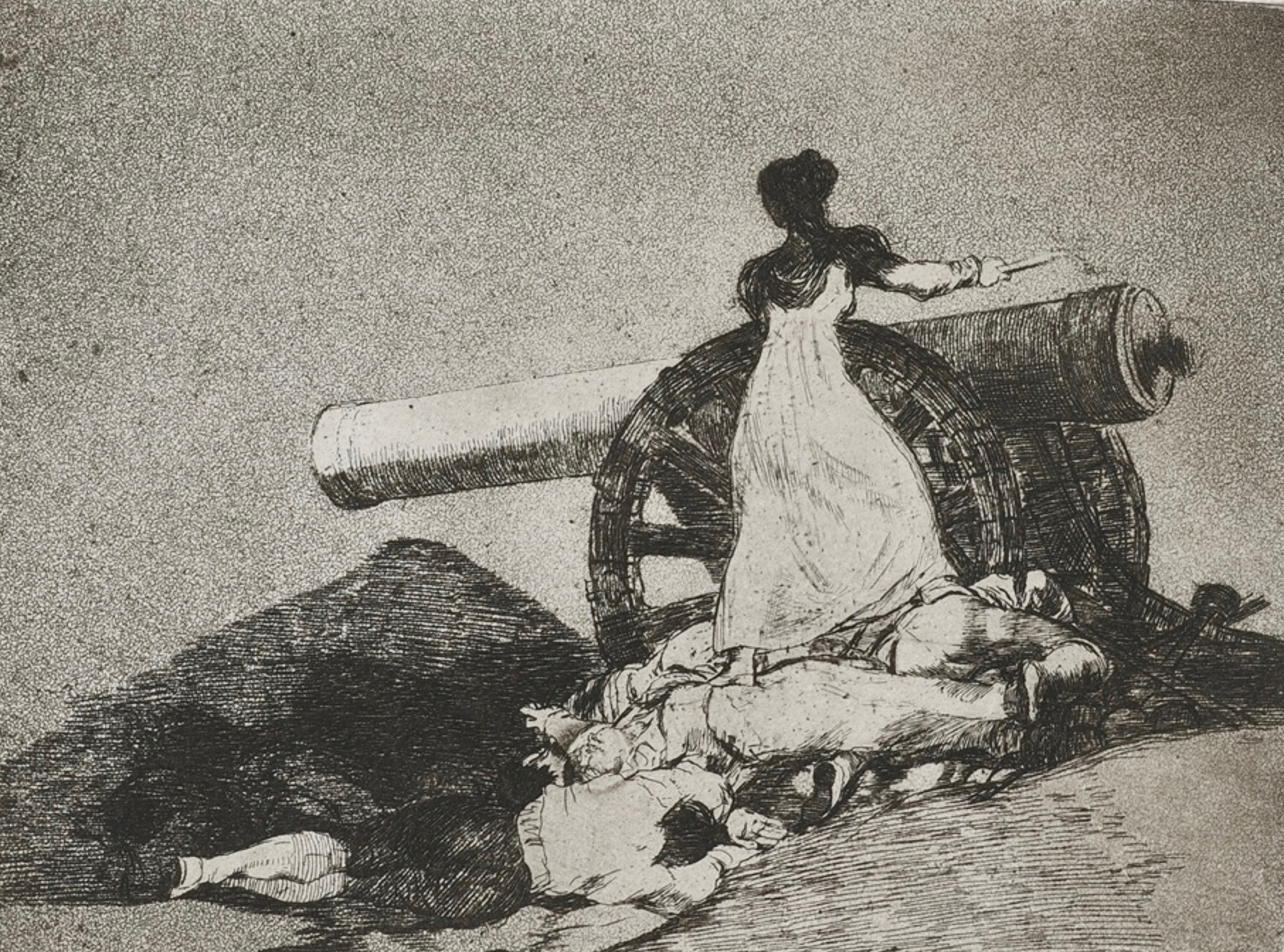
Francisco de Goya, “Ya no hay tiempo” (There isn’t time now), from The Disasters of War (1810-1820).

It is true that our weakness could prevent us from defeating the force that threatens to overwhelm us. But this does not prevent us from understanding it. Nothing in the world can stop us from being lucid.

— Simone Weil

Humility before the real, before untamable existence, is what we learn from the grief and supplications of the tragic poets and the exhortations and lamentations of the prophets.

— Rachel Bespaloff

In the summer of 1939, two women visited an exhibition of Goya’s The Disasters of War at the Geneva Museum of Art and History.[i] Goya’s 82 etchings, graphic depictions of the human cost of war, impressed each of them deeply, especially in the shadow of looming European conflict. The day after the exhibition closed, Hitler’s troops invaded Poland.

Rachel Bespaloff.
Simone Weil.

Rachel Bespaloff and Simone Weil did not know each other. They saw the Goyas in Geneva on different days. But they had many things in common. Both were of Jewish descent, and both were French, although Bespaloff had been born in Ukraine. Both were philosophers, consumed by the questions of affliction and human suffering. Both would die too soon—Weil at 34 from malnutrition and heart failure in 1943, and Bespaloff at 53 by suicide in 1949. And both responded to the outbreak of World War II with influential essays on the Iliad

Homer’s tragic epic, the founding work of European literature, bears impartial witness to the creative and destructive forces at work in the finite historical world. The poet sings of war, but his underlying theme is the complexity of human nature and human experience. There is rage in the Iliad, and cruelty, but wisdom and compassion as well. 

With the Russian invasion of Ukraine, the reflections of Weil and Bespaloff on this ancient epic provide a timely lucidity. For example, Weil’s analysis of wrathful Achilles pinpoints the ultimate futility of force. In the Iliad, the harder Achilles tries to enforce his will, the more resistance he generates. Weil could have been describing Vladimir Putin: 

“Homer shows us the limits of force in the very apotheosis of the force-hero. Through cruelty force confesses its powerlessness to achieve omnipotence. When Achilles falls upon Lycaon, shouting ‘death to all,’ and makes fun of the child who is pleading with him, he lays bare the eternal resentment felt by the will to power when something gets in the way of its indefinite expansion. We see weakness dawning at the very height of force. Unable to admit that total destruction is impossible, the conqueror can only reply to the mute defiance of his defenseless adversary with an ever-growing violence. Achilles will never get the best of the thing he kills: Lycaon’s youth will rise again, and Priam’s wisdom and Ilion’s beauty.” [ii]   

Weil argued that the Iliad’s true subject was not any one figure, but the fateful dynamics of force to which both Greeks and Trojans were subject: “Force employed by man, force that enslaves man, force before which man’s flesh shrinks away. In this work, at all times, the human spirit is shown as modified by its relations with force, as swept away, blinded, by the very force it imagined it could handle, as deformed by the weight of the force it submits to.” [iii]

In her opening paragraph of her essay, Weil sees both the victors and the vanquished as dehumanized and uncreated by powers not of their own making. The victors are “swept away” when force goes its own way, generating consequences they can’t control. The vanquished are turned into “things,” stripped of the capacity to think, or act, or hope. Even if a victim’s life is spared, he or she is as good as dead. Force “makes a corpse out of [them]. Somebody was here, and the next minute there is nobody here at all.” [iv]

Francisco de Goya, “Que Valor!” from The Disasters of War (1810-1820).

Goya’s war images convey this truth. They grant no wider picture of strategy or purpose, but only offer snapshots of an ambient violence, which seems to exist independently of the anonymous actors caught up in war’s depersonalizing horror. “What courage!” reads the artist’s caption, “Que Valor!” Was Goya being ironic? One might interpret this etching as an image of resistance—a brave woman standing on the bodies of her fallen comrades to reach the cannon’s fuse and repel the oppressors. But I can’t help seeing a pile of indistinguishable corpses, and a faceless figure whose own subjection to the laws of force has but one future. 

As Weil put it, “for those whose spirits have bent under the yoke of war, the relation between death and the future is different than for other men. For other men death appears as a limit set in advance on the future; for the soldier death is the future, the future his profession assigns him.” [v] In his classic novel of the American Civil War, Stephen Crane said the same thing even more chillingly: War is “like the grinding of an immense and terrible machine.” Its “grim processes” are designed to “produce corpses.” [vi]

This pair of photos posted last week by a young Ukrainian couple on social media feels both stirring and sad. Scheduled to be married in May, they realized they might not live that long. So they rushed the wedding. As sirens sounded the Russian attack on Kyiv, they made their vows of lifelong fidelity. Then they took up arms to defend their city. Their courage is inspiring, like the man before the tank in Tiananmen Square. But their vulnerability is heartbreaking. May God protect them.

Weil describes the immutable laws of force, which has no regard for such “perishable joys.” [vii] “To the same degree,” Weil says, “though in different fashions, those who use it and those who endure it are turned to stone.” In battle, thought and choice and hope are swept away. “Herein lies the last secret of war,” Weil says, “a secret revealed by the Iliad in its similes, which liken the warriors either to fire, flood, wind, wild beasts, or God knows what blind cause of disaster, or else to frightened animals, trees, water, sand, to anything in nature that is set into motion by the violence of external forces.” [viii]

In other words, everyone involved is a victim of war. That is why neither Homer nor Goya seem to take sides. The unflinching visual witness of The Disasters of War may have been undertaken in protest against the brutality of Napoleon’s army in Spain, but as the series evolved it became harder to distinguish the nationality of perpetrators and victims in the images. We only see human beings equally deformed by the workings of force. There is no great cause in these pictures, only suffering. 

Attribution: Nexta TV

For me, one of the most disturbing images of the war’s first week was this video of a Russian soldier taking evident pleasure in the firing of missiles into Ukraine. As a Christian, I am obligated to see Christ in his arrogant face, but it is not easy. He is smiling at the death of his fellow beings. The patch on his uniform reads: “They will die and we will go to heaven.” Nevertheless, understanding this man to be himself a victim of force plants a seed of compassion in me. He has lost his humanity to the machinery of war. I must pray for him as well. 

In writing about the Iliad, Weil was repeating Goya’s message that “violence obliterates anybody who feels its touch. It comes to seem just as external to its employer as to its victim. And from this springs the idea of a destiny before which executioner and victim stand equally innocent, before which conquered and conqueror are brothers in the same distress. The conquered brings misfortune to the conqueror, and vice versa.[ix]

Francisco de Goya, “Las mujeres dan valor” (The women are courageous) from The Disasters of War (1810-1820).

Rachel Bespaloff, writing during the Nazi invasion of France, attributes the Iliad’s impartiality to the seeming impartiality of life itself: 

“With Homer there is no marveling or blaming, and no answer is expected. Who is good in the Iliad? Who is bad? Such distinctions do not exist; there are only men suffering, warriors fighting, some winning, some losing. The passion for justice emerges only in mourning for justice, in the dumb avowal of silence. To condemn force, or absolve it, would be to condemn, or absolve, life itself. And life in the Iliad (as in the Bible or in War and Peace) is essentially the thing that does not permit itself to be assessed, or measured, or condemned, or justified, at least not by the living. Any estimate of life must be confined to an awareness of its inexpressibility.” [x]

The impartiality of Homer and Goya is echoed in one of the most remarkable battle scenes in the history of cinema. In Terence Malick’s The Thin Red Line, U.S. marines are trying to take a Japanese position on a Pacific island in World War II. But instead of encouraging the viewer to take sides, the director presents both the Americans and the Japanese as common victims of force, as if we were seeing war through God’s eyes. On the soundtrack the gunfire and explosions remain faint, barely there, while a slow elegiac score, like the music of weeping angels, allows us to reflect on the tragedy of violence instead of stirring our partisan emotions. One of the soldiers, a kind of Christ figure, speaks in voice-over: 

This great evil, where does it come from? How does it still enter the world? What seed, what root did it grow from? Who’s doing this, who’s killing us, robbing us of life and light, mocking us with the sight of what we might have known? Does our ruin benefit the earth? Is this darkness in you too? [xi]

Impartiality is not the same as indifference. Although she favored pacifism, Weil wrote her essay after joining the fight against fascism in Spain (the near-sighted and clumsy intellectual had to be sent home after accidentally stepping into a pot of boiling oil). She spoke out in favor of struggles for independence in the French colonies, and worked for the French Resistance. Similarly, Bespaloff renounced her own pacifist sympathies when Hitler seized France. Both women felt their ideals constrained by the “yoke of necessity.” [xii] Sometimes force simply won’t let you abstain. Bespaloff would later lament that history had forced her entire generation “to live in a climate of violent death,” amid “the smoke of crematories.” [xiii]

To see everyone as a victim is to realize the limits of force and begin to discover the power of compassion. “Those who live by the sword die by the sword,” said Jesus. And Weil, who got to know Jesus pretty well in her final years, urged us to “learn that there is no refuge from fate, learn not to admire force, not to hate the enemy, nor to scorn the unfortunate.” [xiv]  

This is not a prescription for passivity in the face of naked aggression. Along with most of the world, including many of Russia’s own people, I support the Ukrainian resistance, but it’s not enough just to take sides in the ancient game of force. Even as we are swept up in the necessities of conflict, we must strive to imagine a better way and a better world. 

In late 1942, when Weil was working in the London office of the French Resistance, she proposed a plan to parachute hundreds of white-uniformed nurses onto battlefields, not only to tend to the wounded but also to provide an image of self-sacrificial goodness in the midst of cruelty and violence. She herself wanted to be in the first wave of this non-violent invasion. In submitting her plan to the Free French authorities, she made a visionary argument:

“There could be no better symbol of our inspiration than the corps of women suggested here. The mere persistence of a few humane services in the very center of the battle, the climax of inhumanity, would be a signal defiance of the inhumanity which the enemy has chosen for himself and which he compels us also to practice … A small group of women exerting day after day a courage of this kind would be a spectacle so new, so significant, and charged with such obvious meaning, that it would strike the imagination more than any of Hitler’s conceptions have done.” [xv]

Charles de Gaulle thought her quite mad, and her plan of course went nowhere. But I always find myself inspired by “impossible” visions which refuse the seductions and delusions of force. When Hitler invaded Poland, W. H. Auden wrote a poem, “September 1, 1939,” calling upon the lovers of justice to “show an affirming flame” in the night of “negation and despair.” As we now weigh our best measures against the worst possibilities, Auden’s key line is more urgent than ever:

“We must love one another or die.” 

Käthe Kollwitz,”The Mothers,” from Seven Woodcuts on the War (1924)

[i] After Madrid was bombed in the Spanish Civil War, the Prado’s art treasures were moved to the League of Nations in Geneva in early 1939. The museum exhibition with the Goya etchings ended on August 31 of that year. The invasion of Poland began on September 1, 1939.

[ii] Simone Weil, in Simone Weil & Rachel Bespaloff, War and the Iliad (New York: New York Review of Books, 2005), 54. Thanks to NYRB for publishing these essays together for the first time.

[iii] Ibid., 3.

[iv] Ibid., 3.

[v] Ibid., 21-22.

[vi] Stephen Crane, The Red Badge of Courage, ch. 8, quoted in War and the Iliad, p. xi.

[vii] The term is Bespaloff’s, referring to Hector’s recitation of everything the war is about to take from him: his city, his family, his comrades, his very life (War and the Iliad, 43).

[viii] War and the Iliad, 26.

[ix] Ibid., 20.

[x] Ibid., 50.

[xi] The Thin Red Line (1998), written and directed by Terence Malick, based on the novel by James Jones (1962). Released by Twentieth Century Fox. A beautiful blu-ray edition is available from The Criterion Collection. Jim Caviezel, whose other-worldliness rose above the warring world to intimations of the Transcendent, spoke the voice-over. He would eventually play the role of Jesus in Mel Gibson’s Passion of the Christ (2004).

[xii] War and the Iliad, 21. The phrase is Weil’s.

[xiii] Ibid., 23.

[xiv] Ibid., 37.

[xv] Simone Weil, quoted in Robert Zaretsky, The Subversive Simone Weil: A Life in Five Ideas (Chicago: University of Chicago Press, 2021), 155.

“Don’t Look Up”: Laughing Till It Hurts

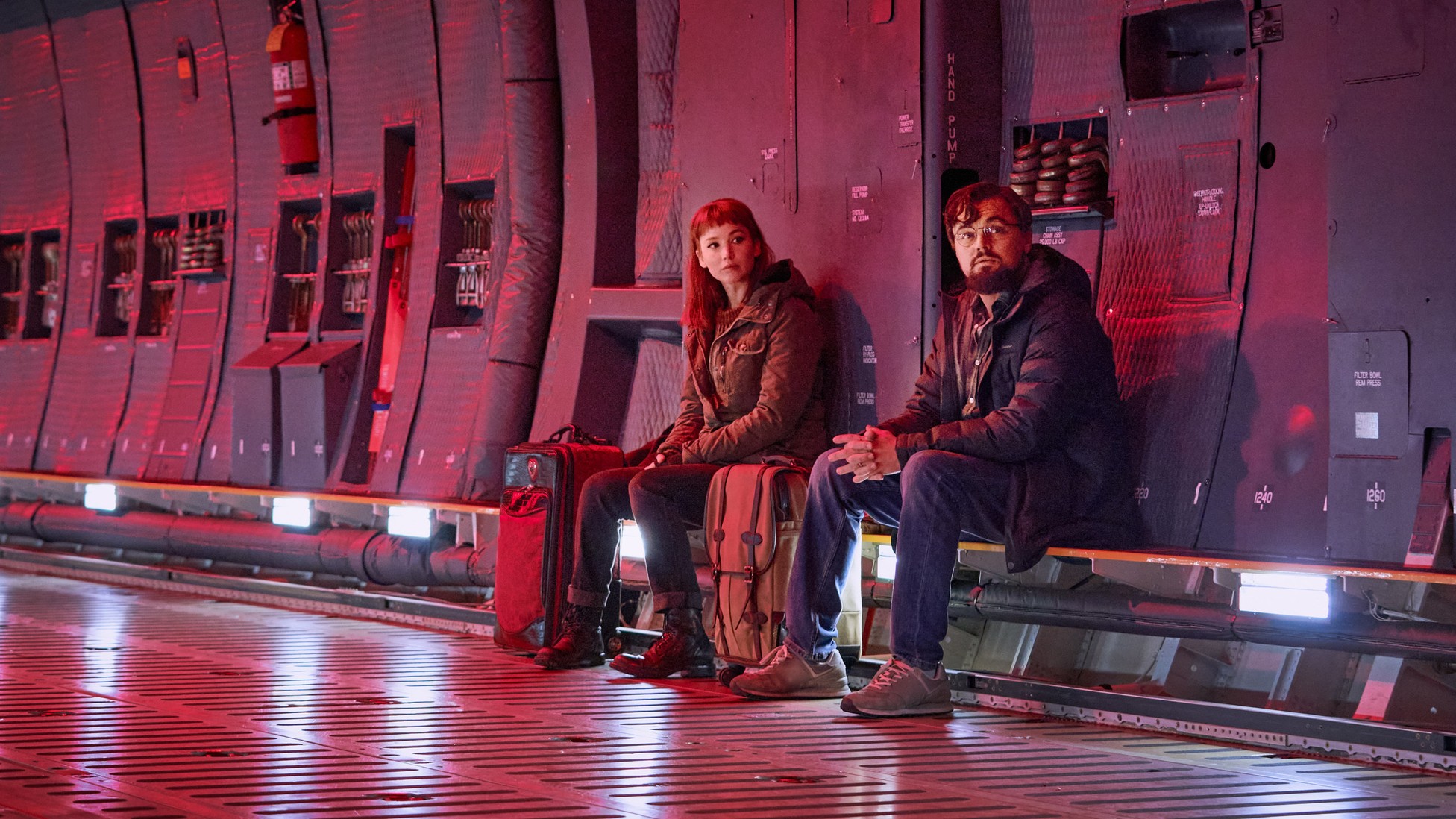
Kate Dibiasky (Jennifer Lawrence) and Dr. Randall Mindy (Leonardo DeCaprio) discover a comet in Don’t Look Up. (Niko Tavernise/Netflix)

Human narcissism and all that it has wrought, including the destruction of nature, will finally be our downfall. In the end, McKay isn’t doing much more in this movie than yelling at us, but then, we do deserve it.

— Manohla Dargis, “Tick, Tick, Kablooey!”[i]

God is our refuge and our strength,
a very present help in trouble.
Therefore we will not fear, 
though the earth be moved,
and though the mountains be toppled 
Into the depths of the sea.

— Psalm 46:1-2

Spoiler alert: If you want to see Don’t Look Up with innocent eyes, watch the movie before reading this. It is currently streaming on Netflix.

Kierkegaard once told a parable about the human capacity for denial. A fire broke out backstage in a crowded theater before the performance. With the curtains still drawn, the audience was unaware of the danger, so one of the actors stepped out to warn them. But he was dressed as a clown, and the people thought his cries of alarm must be some kind of joke. The louder he shouted “YOU’RE ALL GOING TO DIE!”, the more they laughed and cheered. By the time they realized the peril for themselves, it was too late. 

“I think,” said the Danish philosopher, “that’s just how the world will end—to general applause.” [ii]

One of the most popular current films, Don’t Look Up, is a farce about the extinction of life on our planet. It dresses its message of disaster and death in a comic premise: most of humanity is either too witless, deluded, or self-absorbed to acknowledge the threat. The more ridiculously the characters behave, the more we laugh—at least until the (literally) bitter end.

Like Kierkegaard’s clown, director and co-writer Adam McKay has serious intentions. “I’ve been really terrified about the climate, the collapse of the livable atmosphere,” he told an interviewer. “It seems to be getting faster and faster. Yet for some reason, it’s not penetrating our culture.”[iii] Since climate change is a gradual process stretching far beyond our attention span, McKay has substituted a more instantaneous disaster for our consideration. In the movie, an immense comet is headed straight for planet Earth. In six months, all living things will be destroyed. 

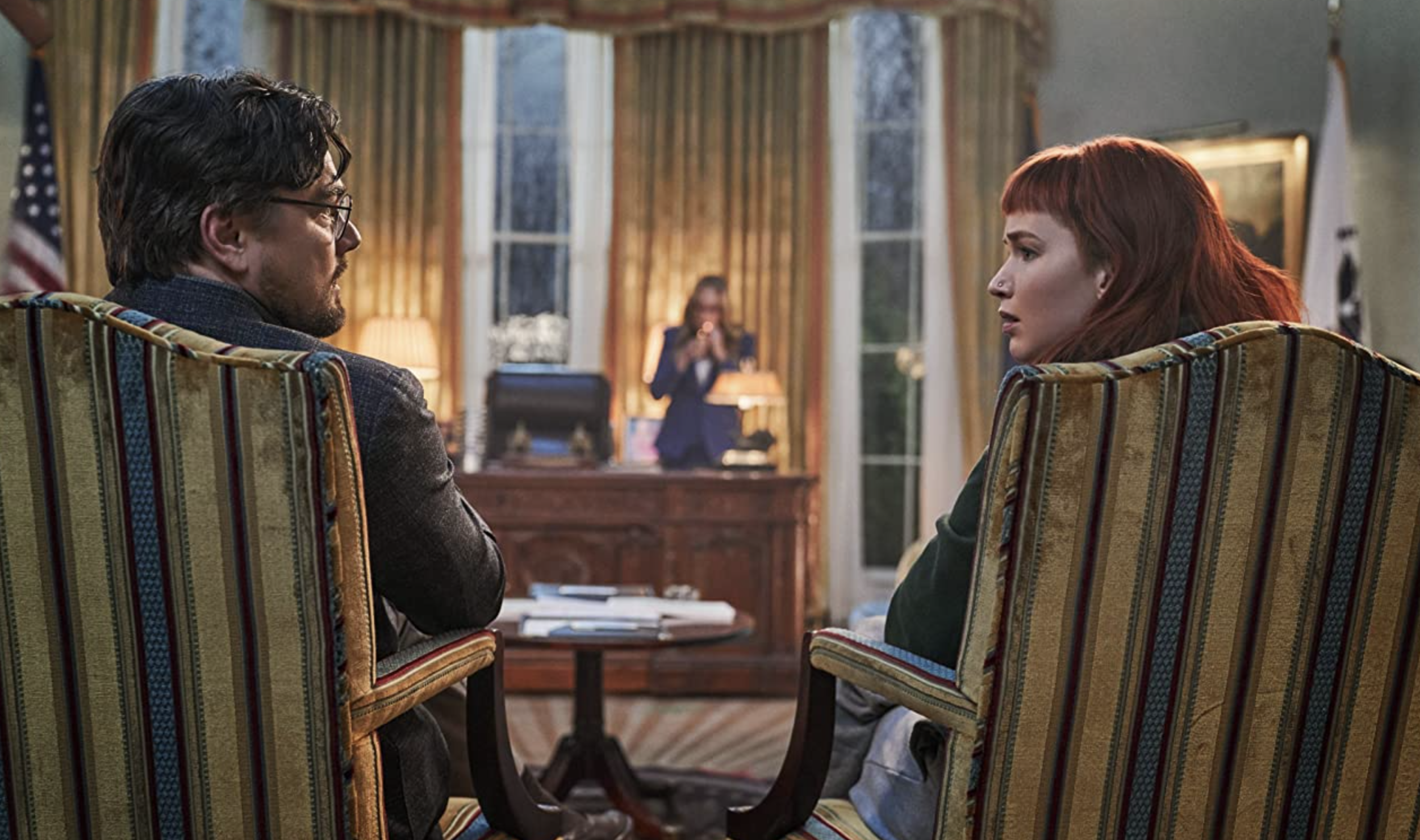
An astronomy professor at Michigan State, Dr. Randall Mindy (Leonardo DiCaprio), and his protégé, Kate Dibiasky (Jennifer Lawrence), discover the comet and try to warn the White House and the world. But their pleas for action go largely unheeded, and things go merrily downhill from there. As Manohla Dargis writes, Don’t Look Up is “a very angry, deeply anguished comedy freakout about how we are blowing it, hurtling toward oblivion. He’s sweetened the bummer setup with plenty of yuks — good, bad, indifferent — but if you weep, it may not be from laughing.” [iv]

In the Oval Office, Randall and Kate try to get the attention of a distracted President, played by Meryl Streep. (Niko Tavernise/Netflix)

During preproduction, the world was struck by a different disaster—the pandemic. The mismanaged Trumpian response, followed by the deadly denialism of the anti-vaxxers, added fuel to the satirical fire. McKay’s parable became as much about COVID as it is about climate change. It was hard to keep the fictional script ahead of the times. McKay said they had to make the film “20% crazier, because reality had played out crazier than the script.” [v]

In most disaster movies, human ingenuity and determination win out in the end, and the world manages to survive. But Don’t Look Up is not so forgiving. Human folly and sin guarantee global extinction. And no matter how much we have been entertained by the stellar cast and amusing scenarios, we are meant to come away unsettled. Complacency is not an option. The theater of Nature is on fire. This is not a drill.

The film has been embraced by the viewing public as well as activists, but many critics have been not only dismissive but contemptuous: “… it’s one joke, told over and over and over again”[vi] … “the attempts at mockery are broad, puerile, and obvious, unintentionally trivializing the issues it seeks to highlight”[vii] … “drowns in its own smugness”[viii] … “its simplistic anger-stoking and pathos-wringing mask the movie’s fundamental position of getting itself talked about while utterly eliding any real sense of politics or political confrontation.”[ix]

David Fear of Rolling Stone is particularly brutal: “… a righteous two-hour lecture masquerading as a satire .…  So caught up in its own hysterical shrieking that it drowns out any laughs, or sense of poignancy, or points it might be trying to make … it’s never able to find a way to crawl out of the tarpit of its own bone-deep despair … it doesn’t mean that one man’s wake-up-sheeple howl into the abyss is funny, or insightful, or even watchable. It’s a disaster movie in more ways than one. Should you indeed look up, you may be surprised to find one A-list bomb of a movie, all inchoate rage and flailing limbs, falling right on top of you.”[x]

There have been more measured critiques. Some find Don’t Look Up heavy-handed and misanthropic. Most of the characters, they say, are too cartoonishly stupid or corrupt to make us care deeply about their fate. Some think the filmmaker is too cynical about our collective capacity to counteract moral blindness and systemic evil, leaving us discouraged rather than empowered. Others, weighing the effectiveness of the relentlessly over-the-top caricatures, ponder “the question of whether our culture has become too depressing, too absurd, too lamentable to satirize.” [xi]

In a lengthy and sober analysis, Eric Levitz judges the comet scenario to be a misleading metaphor for climate change:

“In the film’s populist, polemical account of the ecological crisis, there is … no need for Americans to tolerate significant disruptions to their existing way of life, no vexing question of global redistribution, no compelling benefits from ongoing carbon-intensive growth, and thus no rational or uncorrupted opponent of timely climate action. Don’t Look Up casts the conflict between minimizing climate risk and maximizing near-term economic growth as one pitting the interests of billionaires against those of everyone else.” [xii]

What I find missing in all this criticism is a sense of genre. The lack of political nuance, psychological depth, or aesthetic rigor is beside the point. This film embraces the method of the Italian Commedia dell’Arte, where stock characters “make sport of human foibles and universal complaints while burlesquing the most socially or politically prominent members of a given community.” [xiii]

In the early 20th century, the Commedia model was adapted by Russian “agitprop” theater, “noted for its cardboard characters of perfect virtue and complete evil, and its coarse ridicule.”[xiv]  Agitprop’s aim was not to create great art, but to inspire collective action. In the American 1960s, groups like the San Francisco Mime Troupe practiced a similar “guerilla theater,” whose purpose, as stated in a 1967 manifesto by R. G. Davis, was to criticize “prevailing conditions … expressing what you (as a community) all know but no one is saying … truth that may be shocking and honesty that is vulgar to the aesthete … There is a vision in this theater, and … it is to continue … presenting moral plays and to confront hypocrisy in the society.” [xv]

It’s a playful form of politics, using laughter to dethrone the powers of this world by undermining their pretensions to ultimacy. As the Psalmist says, “God is laughing at them; the Lord has them in derision” (Psalm 2:4). Prophetic mockery is the genesis of revolution. It’s liberating and cathartic. But if it remains merely a way to blow off steam, or a refreshing but temporary lightening of spirit, that is not enough. Action must follow. We must become the change we seek. 

Kate and Randall on a mission to warn the world. (Niko Tavernise/Netflix)

Millions of people have seen Don’t Look Up. Its content and aims are being widely and passionately discussed. Is it a good movie? How accurate is its central metaphor? Which actors stand out? Is it funny? Given the film’s vast global reach and the urgency of the crisis, these become secondary questions. What I want to know is: Does it make a difference? Can it provoke repentance? Will it produce change?

Every preacher and every liturgist wonders the same things. How do our sermons, images, rituals and stories contribute to the transformational mix? In a podcast conversation about the film, Atlantic writer Spencer Kornhaber addresses this issue:

“I think this quest for movies to deliver a message that changes people’s minds is maybe quixotic. There aren’t a ton of works in history like that. But what they do do is give you a set of images and characters and metaphors and clichés that, when they work, become absorbed into our language. They help us talk about the world in ways that are hopefully progressing our discourse and society.” [xvi]

Of course, a film about global annihilation is a hard sell (and released at Christmas, no less!). The prospect of unimaginable loss opens the door to nihilism and despair. Why bother? Why go on? The director himself describes his film as a place where “absurdist, ridiculous comedy lives right next to sadness … so the trickiest part of the movie was to ramp down that tone in the last 20 minutes.” During a script conference before shooting started, one of the producers asked McKay, “Where’s faith in this movie?” And the director, whose mother was a born-again evangelical, exclaimed, “Oh, you’re right. You’re right!” [xvii]  

The last supper in Michigan. (Niko Tavernise/Netflix)

As the comet nears its collision with earth, we see people facing extinction in various ways. Some are praying, some are partying, some are weeping, some are just staring at the sky in disbelief, fear, or hopeless resignation. But in a dining room in East Lansing, Michigan, a small group of friends and family have gathered around a table for a communal last supper. Among them are Randall and Kate. For six months they had tried and failed to awaken humanity to effective action. Now they are back home, choosing neither anger nor despair for their final moments on earth, but gratitude and communion. 

As the food is shared, each of them names something they are grateful for. Then Randall says, “Well, we’re not the most religious here in the Mindy household, but, um, maybe we should say ‘amen?’ Should we do that?”

Most of them are unpracticed in prayer, so this suggestion creates an awkward pause. But Yule, a young Christian skateboarder (Timothée Chalamet), speaks up. “I’ve got this,” he says. Everyone joins hands around the table, and Yule begins to pray:

“Dearest Father, Almighty Creator, we ask for your grace tonight, despite our pride; your forgiveness, despite our doubt. Most of all, Lord, we ask for your love, to soothe us through these dark times. May we face whatever is to come in your divine will with courage and open hearts of acceptance. Amen.” 

Somewhere across the globe, the comet strikes, and an immense tsunami begins to swallow planetary life like the biblical flood. Yes, there is a parodic ark, reserved for the billionaires, bearing them to a justly ironic fate in a galaxy far, far away. But the true ark of the righteous remnant is that Michigan dining room.

In their final minute on earth, the men and women around the table discuss small, ordinary blessings like the store-bought apple pie and the delicious home-brewed coffee. In an inspired ad-lib that had occurred to DiCaprio between takes, Dr. Mindy speaks his last words: 

“Thing of it is, we really did have everything, didn’t we? 
I mean, when you think about it.” 

The simple human beauty of this last supper, more than the script’s many earnest pleadings, makes the film’s best case for preserving the world. It seems no accident that the one who sets the spiritual tone is named Yule, an old word for Christmas. Even at history’s last moment, Love is being made flesh.

Then, as the walls around them begin to disintegrate, the screen goes suddenly dark. The circle of human love has vanished into the Divine Mystery. 

After watching Don’t Look Up, I came across a poem by John Hollander which articulates for me the feeling of this moving finale. “At the New Year” is about the new beginnings that emerge from all the endings—those moments when we feel “every door in the world shutting at once.” Then the poet prays, “let it come at a time like this, not at winter’s / Night,” but “at a golden / Moment just on the edge of harvesting, ‘Yes. Now.’ / … as we go / Quietly on with what we shall be doing, and sing / Thanks for being enabled, again, to begin this instant.” [xviii]

So the apocalypse ends not with a bang, but with a softly spoken thanks for everything. Even when the worst arrives, the answering word is Yes, and the circle of love goes “quietly on with what we shall be doing,” and singing our thanks. Every moment, even the last one, is a gift to be savored. May our own precious moments on this earth be hallowed with gratitude, acceptance, and trust, now and at the hour of our death.


[i] Manohla Dargis, New York Times review of Don’t Look Up (12/23/21): https://www.nytimes.com/2021/12/23/movies/dont-look-up-review.html

[ii] Søren Kierkegaard, Either/Or, Part 1 (1843).

[iii] Adam McKay, quoted in Frederic and Mary Brussat, film review of Don’t Look Up in Spirituality and Practice (Dec. 21, 2021): https://www.spiritualityandpractice.com/films/reviews/view/29113/dont-look-up

[iv] Dargis, “Tick, Tick, Kablooey!” New York Times review (12/23/21).

[v] McKay, q. in David Sims, “Don’t Look Up is a Primal Scream of a Film,” The Atlantic (12/23/21): https://www.theatlantic.com/culture/archive/2021/12/dont-look-up-adam-mckay-netflix-movie/621104/

[vi] Max Weiss, Baltimore Magazine (12/27/21): https://www.baltimoremagazine.com/section/artsentertainment/movie-review-dont-look-up/

[vii] James Berardinelli, Reel Reviews (12/23/21): https://www.reelviews.net/reelviews/don-t-look-up

[viii] Sameen Amer, The News International, Pakistan (1/16/22): https://www.thenews.com.pk/tns/detail/925421-in-the-picture

[ix] Richard Brody, “The Crude Demagogy of Don’t Look Up,” The New Yorker (1/6/22): https://www.newyorker.com/culture/the-front-row/the-crude-demagogy-of-dont-look-up

[x] David Fear, “‘Don’t Look Up…or You Might See One Bomb of a Movie Hurtling Right Toward You,” Rolling Stone (12/24/21): https://www.rollingstone.com/movies/movie-reviews/dont-look-up-review-leonardo-dicaprio-jennifer-lawrence-1268779/

[xi] “Why Are People So Mad About Don’t Look Up?,” The Atlantic podcast (1/14/22): https://www.theatlantic.com/podcasts/archive/2022/01/dont-look-up-satire/621256/

[xii] Eric Levitz, “Don’t Look Up Doesn’t Get the Climate Crisis,” New York Magazine (1/5/22):https://nymag.com/intelligencer/2022/01/dont-look-up-climate-metaphor-review.html

[xiii] Michael William Doyle, “Staging the Revolution: Guerilla Theater as a Countercultural Practice, 1965-1968”: https://www.diggers.org/guerrilla_theater.htm

[xiv] Richard Pipes, Russia Under the Bolshevik Regime, 303, cited in “Agitprop” (Wikipedia).

[xv] Doyle, “Staging the Revolution …”

[xvi] Spencer Kornhaber, “”Why Are People So Mad …?”

[xvii] Adam McKay, interview in Variety, “Adam McKay on the Ending(s) of Don’t Look Up” (Dec. 2021): https://variety.com/2021/film/news/adam-mckay-dont-look-up-ending-spoilers-1235142363/

[xviii] John Hollander (1929-2013), “At the New Year,” in American Religious Poems: An Anthology by Harold Bloom, eds. Harold Bloom & Jesse Zuba (New York: Library of America, 2006), 442-443.

Tending Hope’s Flame on an Anxious New Year’s Eve

Little Nemo dreams about the New Year (Winsor McCay, Dec. 27, 1908).

My times are in your hand; deliver me.

— Psalm 31:15

Time is our choice of how to love and why.

— W. H. Auden

The turning of the year is the only ritual observance shared universally by humankind. Each religion has its own sacred days scattered across the months, but tonight everyone on earth will join in one great procession, time zone by time zone, into the New Year. We pause a moment to look back, with a mixture of gratitude and regret; then we turn our faces toward the unwritten future. We usually do this with gleeful clamor and warm embraces, welcoming the New with our brightest hopes. The arrival of 2022 may strike a more tentative note. 

In my seven years of blogging, I have written a reflection every New Year’s Eve. Most of those posts have been about hope. On the eve of 2017, with my country “teetering on the brink of insanity and ruin,” I hoped that we would “not to be mesmerized by the abyss,” but rather be on the watch for the divine ingenuity “already and always at work amid the blind sufferings of history.” 

Three years later, with the flag of hope tattered and torn by endless battles, I drew inspiration from Thoreau, who continued his quiet work of studying the natural world even as the Civil War ravaged the American consciousness. We must, he argued, refuse the hypnotic spell of the chaos which seeks to seduce our gaze. The refusal to take our eye from the transcendent goodness and beauty at the heart of things is “the only fatal weapon you can direct against evil.”

At the end of 2021, such spiritual poise feels elusive, if not unimaginable. This was supposed to be the year we returned to normal. With COVID now raging like the fires and storms of climate change, and our body politic critically ill with malice and madness, normal is no longer on the itinerary. 

Didier Maleuvre, a specialist in the study of Western culture, describes hope as an inherently perilous task: “So long as one hopes, one puts oneself at the mercy of the future.” Isn’t that where we find ourselves on the eve of 2022—at the mercy of the future? It is an unnerving time for sure, and few of us will be stepping so bravely into the New Year tonight. 

Yet we must, now more than ever, light our candles in this dark and declare our fidelity to the dawn, whenever and however it may come. God desires a better world. However our follies may frustrate and obstruct divine hope, God is wiser than despair. “Behold,” says the Holy One, “I make all things new.”[i] May we all heed the summons to embody that great redemptive labor in our own stories, whether it be in small acts of kindness or collective works of social and spiritual transformation.

The world as we know it is passing away. But death is never the final meaning, only the portal to new birth. Can we embrace this moment in time as an invitation to radical transformation? The Indian writer Arundhati Roy expresses such a hope:  

“What is this thing that has happened to us? It’s a virus, yes. In and of itself it holds no moral brief. But it is definitely more than a virus … It has made the mighty kneel and brought the world to a halt like nothing else could. Our minds are still racing back and forth, longing for a return to ‘normality,’ trying to stitch our future to our past and refusing to acknowledge the rupture. But the rupture exists. And in the midst of this terrible despair, it offers us a chance to rethink the doomsday machine we have built for ourselves. Nothing could be worse than a return to normality. Historically, pandemics have forced humans to break with the past and imagine their world anew. This one is no different. It is a portal, a gateway between one world and the next. We can choose to walk through it, dragging the carcasses of our prejudice and hatred, our avarice, our data banks and dead ideas, our dead rivers and smoky skies behind us. Or we can walk through lightly, with little luggage, ready to imagine another world. And ready to fight for it.”[ii]

Imagine a better world and walk toward it.

Dear reader, I believe that our faith and our love, as well as our hope, will be severely tested in the coming year. When the demons of weariness and discouragement do their worst, remember the Paschal Mystery: The way down is the way up

When Dante’s descent into the abyss of Hell reached its deepest point, his downward trajectory ceased. Once the poet passed through the nadir—the center of the earth—his motion became, without a change in direction, an ascent back toward the surface. His journey taught him that even the “lightless way,” if you take it far enough, is bound for glory.  

… we climbed the dark until we reached the point
where a round opening brought in sight the blest

and beauteous shining of the Heavenly cars.
And we walked out once more beneath the Stars. [iii]

Virgil leads Dante out of Hell (14c MS).

Dear readers, thank you for engaging with my posts over the last year. I am especially grateful when your own thinking is stirred or your soul is fed by what you find here. My work is to pass on whatever comes to me in reading, experience and the occasional inspiration, planting what seeds I can in the community garden. It is a labor of love. To all who take the time to write a comment or share a post with others, thank you for valuing and extending the conversation. 

I wish for you both courage and joy in the New Year. Keep tending the fires of hope!

For summaries and links for previous New Year’s Eve posts, click here.


[i] Revelation 21:5.

[ii] Arundhati Roy, “The Pandemic is a Portal,” in Freedom. Fascism. Fiction, (New York: Penguin, 2020). This quote has been widely posted on the Internet, and you can see her read the full text on YouTube: https://youtu.be/7hgQFaeaeo0

[iii] Dante Alighieri, Inferno xxxiv.140-143. John Ciardi translation.

On the Morning After the Nativity

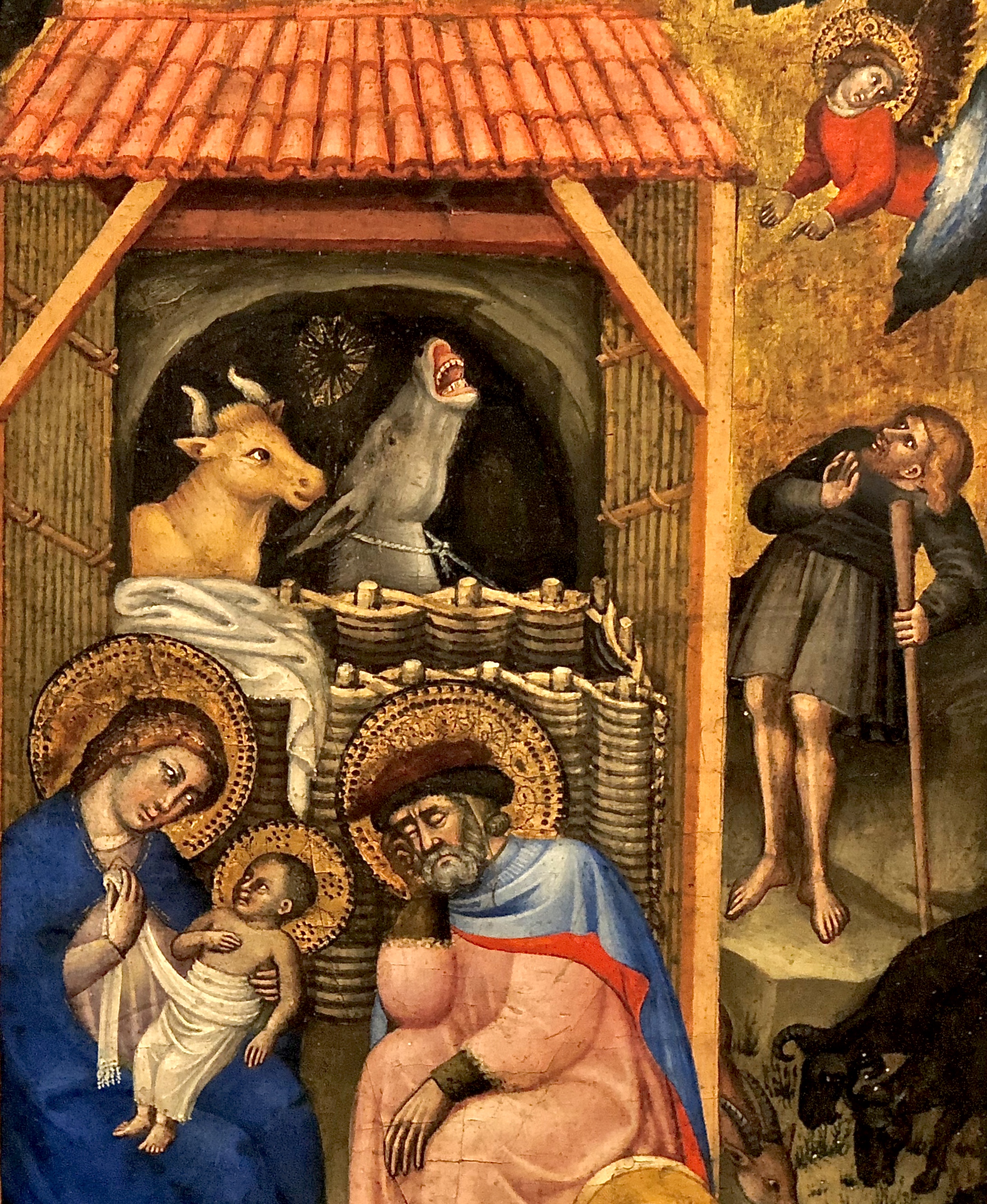
Simone di Filippi, Nativity (c. 1380, Uffizi Gallery, Florence).

That glorious Form, that Light unsufferable, 
And that far-beaming blaze of Majesty, 
Wherewith he wont at Heav’n’s high council-table, 
To sit the midst of Trinal Unity, 
He laid aside, and here with us to be, 
Forsook the courts of everlasting day, 
And chose with us a darksome house of mortal clay. 

— John Milton, “Ode on the Morning of Christ’s Nativity”

What on earth happened last night—at that little stable on the edge of town? It was all so strange, so unbelievable. Some of us are still sleeping it off. Some of us didn’t get any sleep at all, or maybe we were asleep the whole time and it was all just a dream. 

There was a really bright star, and then the sky started singing: Gloria in excelsis Deo! It was angels, someone said. I don’t know about that, but it was so beautiful, as if music were being invented for the very first time. 

And suddenly, we all started running, don’t ask me why, until we came to this cave––it was a stable with a cow and a couple of donkeys––and in the back there was a woman lying down on some hay, and a man kneeling beside her. And between them there was a little baby, just a few hours old, I’d say. What a place to begin your life! They must have been pretty desperate to end up there. Maybe they were refugees. Or undocumented. I don’t know. But they didn’t look scared or out of place. They seemed to belong there. And you know, I had the feeling that I belonged there too. We all did. 

I can’t really explain it, but I got this feeling that everything in my life before that had just been waiting around for this moment, as if after a long and pointless journey I had finally come home. 

And I know it sounds weird, but I swear that little baby looked right at me, as if he knew who I was––or who I was going to be, because when I left that stable I knew––I knew!––that my life was never going to be the same. Pretty crazy, right? Part of me hopes it was just a dream, because if it’s not, I have no idea what happens next. But I have to admit I’m a little nervous about where all this is going to take me.[i]

That’s how I imagine the “morning after” speech of a Bethlehem shepherd. After such a vision, he’s intoxicated by wonder, struggling to make sense of it, and feeling both curious and anxious about what happens now, after this wondrous birth. What will happen now—to me, to you, to the whole wide world? A change gonna come, yes it will.[ii] Yes it will, because what happens in Bethlehem doesn’t stay in Bethlehem. It goes home with us, it gets in our blood, it becomes part of our story. Nothing in the world will ever be the same again. Nothing in our lives will ever be the same again. 

And that is why, on the morning after, we listen to St. John’s grand prologue to the Fourth Gospel. Its cosmic perspective on the birth of Christ reminds us how vast and consequential was that humble birth in a lowly stable. 

In the beginning was the Word, and the Word was with God, and the Word was God. He was in the beginning with God. All things came into being through him, and without him not one thing came into being. . . And this divine Word became flesh and lived among us (John 1:1-14).

In other words, God was not content to remain purely within the confines of the divine self. God desired to go beyond the inner life of the divine, to enter the confines of time and space and history, to become incarnate as the mortal subject of a human life and experience the human condition from the inside. The Word was made flesh and dwelt among us.

What a fantastic thought: God wants to be with us—not just love us at a distance but to be intimate with us. Joy to the world, the Lord is come … let every heart prepare him room. But perhaps we have some doubts about our capacity to receive such a guest. 

I’ve been reading a couple of 17th-century poets who expressed their own doubts our capacity to host divinity. Matthew Hale (1609-1676) in a poem titled “Christmas Day” (1659), said:

                                    I have a room
‘Tis poor, but ‘tis my best, if thou wilt come
Within so small a cell, where I would fain [willingly]
Mine and the world’s Redeemer entertain … 

Here he’s speaking about his heart as the place he would entertain the Redeemer. He goes on to describe sweeping up the dust and cleaning up the mess, just as we would if we expected an important houseguest. The poet even attempts to wash this “room”—with his own penitent tears.

And when ‘tis swept and washed, I then will go,
And with Thy leave, I’ll fetch some flowers that grow
In Thine own garden [i.e., the flowers of faith and love];
With those I’ll dress it up …
yet when my best
Is done, the room’s [still] not fit for such a Guest. 

Well, if we can’t make our hearts fit dwellings to house the divine, who can?
Only God can make us so:

            Thy presence, Lord, alone
Will make a stall a court, a cratch [manger] a throne.  

The poet/priest George Herbert, in his own “Christmas” poem (1633), expresses the same need for divine assistance:

O thou, whose glorious, yet contracted light,            
Wrapt in nights mantle, stole into a manger;
Since my dark soul and brutish is thy right,    
To Man of all beasts be not thou a stranger:             

Herbert’s poetry is always resonant with Scriptural references. “Beasts” recalls Psalm 49:12—prideful humans are like “the beasts that perish”—while “a stranger” evokes Ephesians 2:12—without Christ, we remain “strangers to the covenants of promise.”

Then Herbert, like Hale, calls upon God as the only one who can complete his moral and spiritual remodeling project: 

Furnish & deck my soul, that thou mayst have         
A better lodging, than a rack, or grave. 

“Rack” is another word for a manger, but it can also mean an instrument of torture, suggesting the cross. In other words, the first time Christ came, humanity provided him the cross and the grave. The poet prays that next time Christ comes to us, we may give him better lodging—a newly furnished soul, adorned with God’s grace. 

Both of these poets were saying: Let every heart prepare him room. But they were also confessing that such preparation is more than we can do by ourselves. However, with God’s help, we may yet become fit lodging for divine presence. 

In the 20th century, whose atrocities left our confidence in human potential badly shaken, the Catholic contemplative Thomas Merton could still claim that we “exist solely for this, to be the place God has chosen for the divine Presence. The real value of our own self is the sign of God in our being, the signature of God upon our being.” 

Merton wrote this after a life-changing experience at the corner of Fourth and Walnut in downtown Louisville. As he was studying all the faces of the milling crowd, he suddenly felt an overwhelming love for all of them, even though they were all strangers to him. It was like what the shepherds experienced in the Bethlehem stable, where, as W. H. Auden said in his own Christmas poem, “everything became a You and nothing was an It.” [iii]  Merton would later put his street-corner epiphany at into words.

“It is a glorious destiny to be a member of the human race, though it is a race dedicated to many absurdities and one which makes many mistakes: yet, with all that, [God’s own self] glorified in becoming a member of the human race. 

“I have the immense joy of being [a human person], a member of a race in which [God’s own self] became incarnate. As if the sorrows and stupidities of the human condition could overwhelm me, now I realize what we all are. And if only everybody could realize this! But it cannot be explained. There is no way of telling people that they are all walking around shining like the sun.” [iv]

Just so, on that wondrous Christmas night in Bethlehem, our human nature was lifted up as the place where God chooses to dwell. We are still works in progress no doubt, but we are bound for glory. St. Paul believed this when he said that “all of us, with our unveiled faces like mirrors reflecting the glory of the Lord, are being transformed into the image that we reflect in brighter and brighter glory” (II Cor. 3:18).

A thousand years later, St. Symeon the New Theologian echoed Paul’s luminous text: “As they who behold the light are within the light and partake of its brightness, so they who behold God are within God, partaking of God’s brightness.”

They who behold the light are within the light and partake of its brightness. Our pale mirrors are made to contain the most impossible brilliance. And even when we turn away from the Light, the Light comes looking for us. No matter how shadowy the path we have taken, the Light will find us, and fill us with divine radiance. That is our destiny, says the Child in the manger. 

What happens in Bethlehem does not stay in Bethlehem.

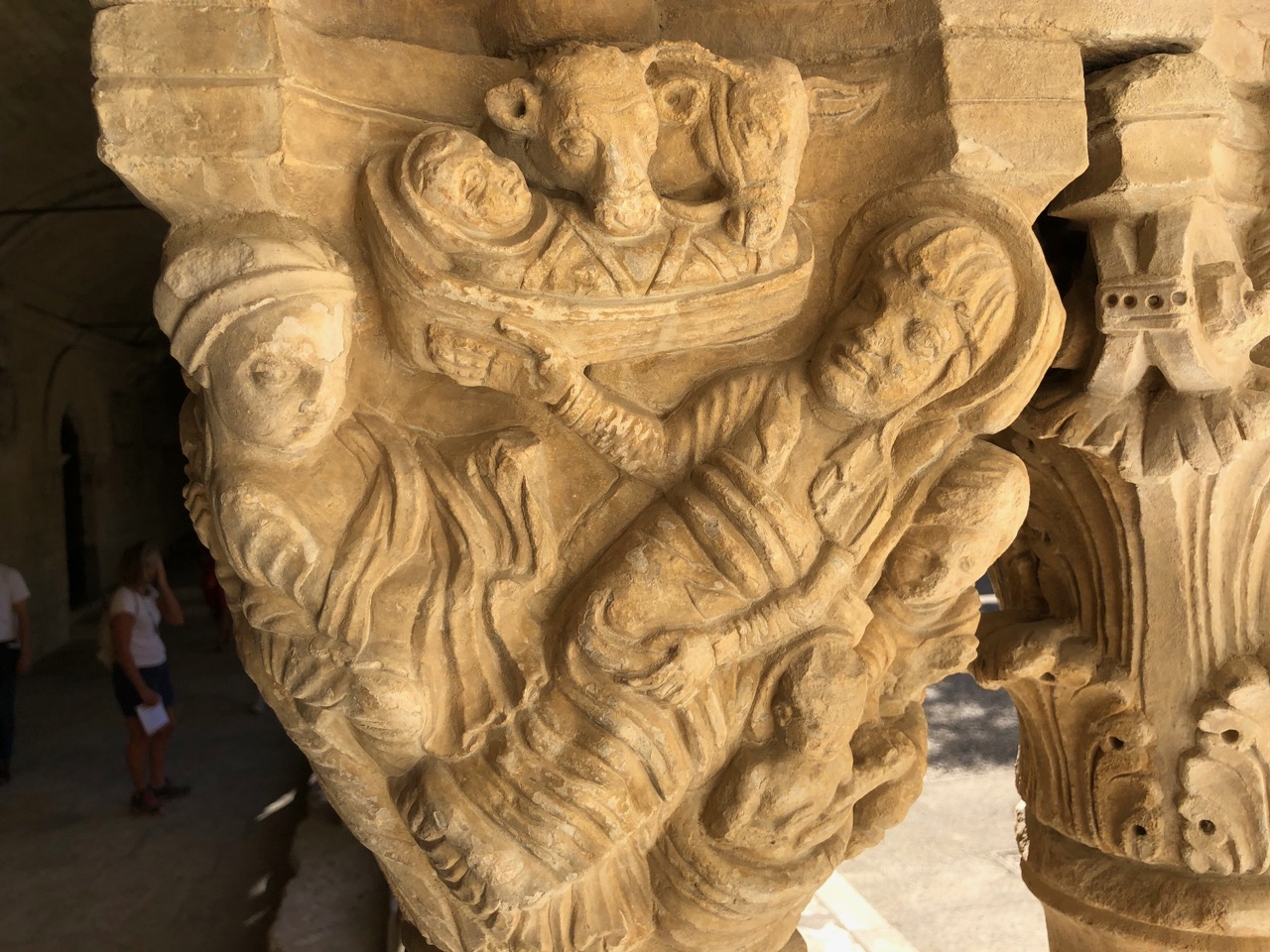
Nativity (12th century), Cloister of St. Trophime, Arles, France. 

Bethlehem is not a dream fading away into the past. It is the human future. And Christmas Day is not the morning after. It is the first day of the rest of our journey deeper and deeper into God. And whether we know it or not, as we walk that pilgrim road, we are all shining like the sun.

As we used to say back in the day, “Can you dig it?” Can you embrace the wonder of the holy birth: the immensity of heaven cloistered in one small room, be it the Virgin’s womb, the Bethlehem stable, the human heart, or whatever place you’re in right now? Can you embrace the wonder? Will you?

The world wants you to believe far less. 
But why would you want to do so?  

In a novel by the Anglican writer Charles Williams, a young woman goes to church with her aunt on Christmas morning. She is a seeker, not quite a believer, but she finds herself touched by a carol they are singing:

Christians, awake, salute the happy morn
Whereon the Savior of the world was born;
Rise to adore the mystery of love, 
Which hosts of angels chanted from above. 

The young woman leans over and whispers to her aunt, “Is it true?” Her aunt, one of those quiet saints who has spent her life submitting to divine love, turns to her niece with a smile and says simply, “Try it, darling.”[v]


[i] It’s a risky thing to follow Jesus. At the end of the Fourth Gospel, Jesus tells Peter that “someone else will put a belt around you and take you where you would rather not go” (John 21:18).

[ii] Sam Cooke’s prophetic cry for social transformation was influenced by Martin Luther King’s “I have a dream” speech and Bob Dylan’s “Blowin’ in the Wind.” Cooke said the song came to it in a dream. Listen to it and imagine a shepherd singing it after the Nativity: https://youtu.be/fPr3yvkHYsE

[iii] W. H. Auden, For the Time Being: A Christmas Oratorio. The line is from the Narrator’s concluding speech. Auden’s marvelous poetic dramatization of the Nativity, written during the dark days of World War II, is imbued with hope. Alan Jacobs’ helpful annotated edition is highly recommended (Princeton University Press, 2015).

[iv] Thomas Merton, Conjectures of a Guilty Bystander (1966).

[v] Charles Williams’ Christmas novel is The Greater Trumps (1932).

Say Yes: A Homily for Advent 4

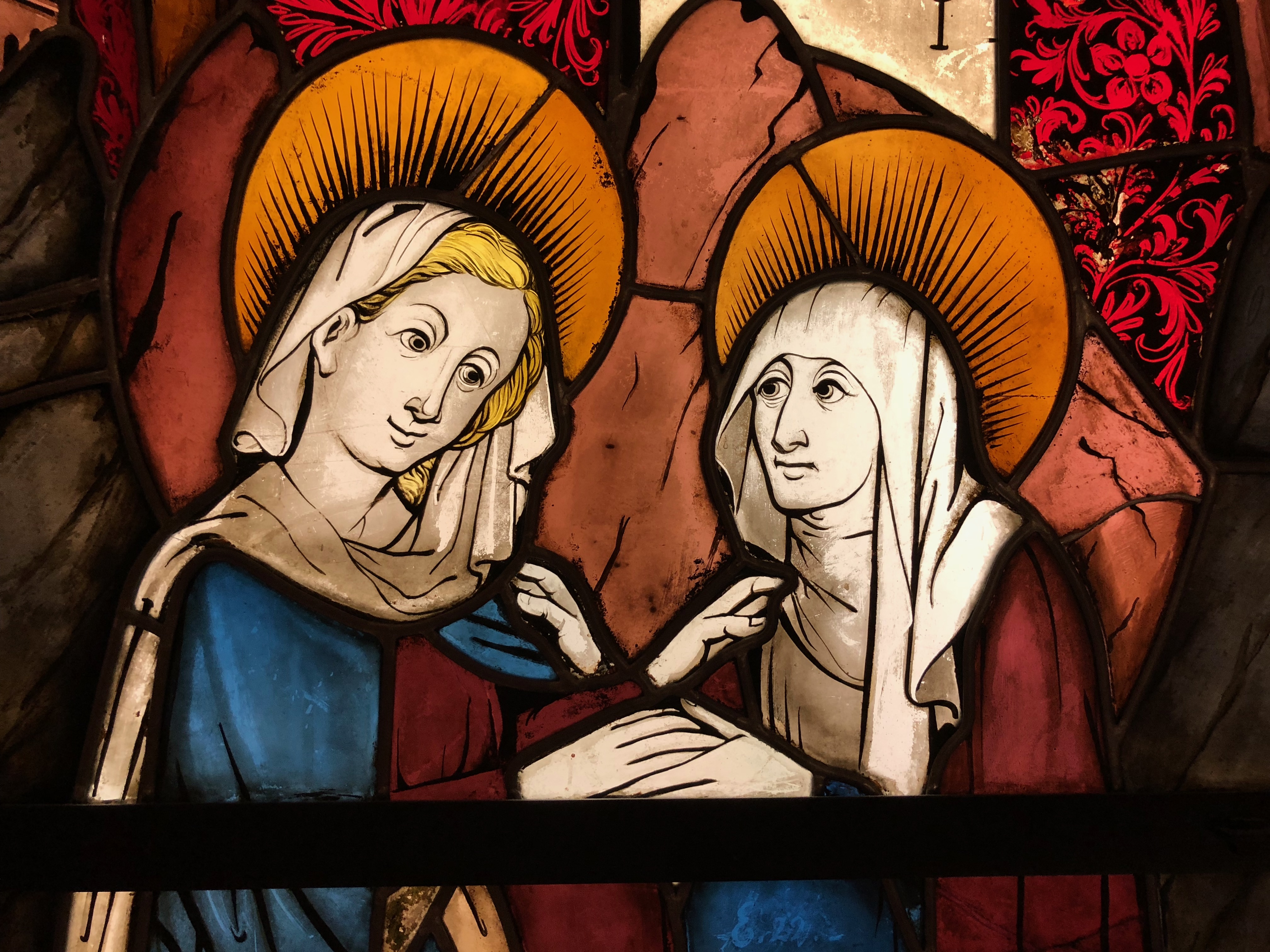
The Visitation, German c. 1444.

In calling me, the call does not leave me intact; it surges only by opening a space in me to be heard, and therefore by shattering something of what I was before I felt myself to be called.

— Jean-Louis Chrétien

In Mahler’s Third Symphony, the first movement is an eruption of massive orchestral sounds: horns, drums, fanfares and marches, a shaking of the foundations to make way for a new world to appear. And for the next four movements, the music rarely takes a breath. The adagio, the slow, contemplative movement which usually comes in the middle of a symphony, is delayed until the very end. And what an ending it is—23 minutes long!—taking us with unhurried solemnity ever deeper into the mystery of the world. Mahler called it “the higher form in which everything is resolved into quiet being. I could almost call the Third’s finale ‘What God tells me,’” he added, “in the sense that God can only be understood as love.” [i]

Advent is like that symphony, it seems to me. Over the first three Sundays, the prophets roar, the heavens shake, the voices cry. Repent! Make way! Stay awake! Cast away the works of darkness! Put on the armor of light! But on the Fourth Sunday, it’s suddenly quiet. No more cosmic thunder. No more urgent warnings. The Baptist’s big crowds have drifted on home. Advent’s adagio finale is a miniature: two pregnant women in a humble courtyard, having an intimate conversation. 

But what a conversation it is! “Blessed are you among women, and blessed is the fruit of your womb!” says Elizabeth. “My soul magnifies the Lord, and my spirit rejoices in God my Savior.” replies her cousin Mary. Their ecstatic words have been on our lips in worship ever since.[ii]

The cousins had a lot to process. One was carrying the last of the Old Testament prophets, John the Baptist. The other was carrying the founder and pioneer of a transformed humanity. They held creation’s future within them, ever since they had each said “Yes” to a story that was no longer their own. They now belonged to God, come what may. I imagine they both did a lot of laughing and crying that day.

The Rev. Mark Harris, a dear friend I first met in seminary a half-century ago, began last year’s challenging Advent by writing a poem about Mary’s consent. It’s called “Implications of Yes.”

The neighbors talked about it for a while,
How the young girl who was beginning to show 
Came back from meeting her cousin
And seemed kind of quiet,

How she was seen leaving her house 
Early one morning with a small sapling 
Bundled in rough cloth in one hand, 
And a shovel in the other.

Later she was seen coming back,
No sapling, the shovel over her shoulder, 
Her hands and dress smeared with dirt, 
Her eyes red and swollen.

Later, sitting with the others, she spoke 
Of her longing for a lost simplicity
And her preparations for realities 
that follow from her quiet Yes .

Years from now, she said, 
There will be need for this tree grown,
Just as there is need now 
for this Child that grows in me. 

The tree will bear the body of the Man, 
As I bear the Child.
We will each be ready in our turn
To do as the Holy One requires.

We will, with the Holy One we bear, 
Be broken by the bearing, 
And will give our lives
For the healing of the nations. [iii]

The poet gives us a stunning image here. Mary, pregnant with Jesus, plants the tree that will become his cross! Both mother and tree will, like Jesus, offer all that they have and all that they are for the healing of the nations, the repair of the world. That’s how the story goes in a fallen, broken world, and if you say ”Yes” to this story, it will cost no less than everything. 

When Mary said “Yes” to the angel of the Annunciation, it was neither the first nor the last time she would do so. Her whole life up to that point had been a series of consents that would prepare her to receive the Holy One into herself. And in the years that followed, she never renounced her acceptance of the story that would one day take her weeping to the foot of the cross. It is no light thing to say Yes to such a story.

We will each be ready in our turn
To do as the Holy One requires.

Mary was ready in her turn. But now it’s our turn. 

The Incarnation of the Divine Word was a singular event. Only Jesus could be who he was and do what he did as the unique conjunction of human and divine—God in the flesh. But in another sense, the Incarnation is a continuing event to the degree that we ourselves become open and receptive to the divine that wants to be born in us.

The Russian Saint Seraphim of Sarov (1759-1833) put it this way: The purpose of human life is the acquisition of the Holy Spirit. In other words, our human destiny is to be filled with Divinity, to dwell in God and let God dwell in us. What did we ask in today’s collect-prayer? May our own souls and bodies become “a mansion prepared for Godself.”[iv] We weren’t kidding around. It’s our most serious Advent prayer, committing ourselves to becoming God-bearers. 

The first Christians made some strikingly bold claims for humanity’s potential for “divinization” (becoming like God). The Second Letter of Peter (1:4) says: “God has given you such precious and majestic promises, that you may become partakers of the divine nature.” The First Letter of John (3:2) says, “We know that when God appears, we shall be like God, because we shall see God as God is.” And St. Paul, in Second Corinthians 3:18, insists that “all of us, with faces unveiled, mirroring the Lord’s glory, are being transformed into the same image from one degree of glory to another.” 

The two most famous summations of divinization as corollary to incarnation were made by Irenaeus in the second century and Athanasius in the fourth. “In God’s immense love,” said Irenaeus, “God became what we are, that he might make us what he is.” Athanasius was even more explicit: “The Divine Word became human that humans might become God.”

Now many have argued against this whole idea of divinization. There’s too great a gulf between Creator and creature, some say. Who can hope to cross that infinite abyss? Others say that humanity is simply not up to it. Just look at world history over the past century, or the last few years in America. On the Feast of the Epiphany, January 6, 2021, for example, did anyone see Christ’s glory being reflected from those tormented faces at our nation’s Capitol? [v]

But if we believe that the Divine Word was truly made flesh, and that Jesus was both fully human and fully divine, then we must acknowledge the existence of an innate human capacity to receive and embody God. Absent that capacity, Mary could never have conceived our Lord and Savior. There is an integral part of our human makeup which is designed to answer when God calls. In other words, our humanity always contains a mansion prepared for Godself. That receptive capacity to say Yes to God may be buried beneath multiple layers of ego and sin, but it cannot be destroyed. It’s a feature, not a bug.

One of the greatest Orthodox theologians of the last century, Sergius Bulgakov, insisted on the indispensable role of humanity in the Incarnation: 

Christ did not bring His human nature down from heaven, and He did not create it anew from the earth; rather, He took it from “the most pure flesh and blood of the Virgin Mary”… [T]he Incarnation of Christ is realized not in one Person but in two: in Christ and in the Virgin Mary. The icon of the Mother of God with Infant is therefore the true icon of the Incarnation.[vi]

To become fully human, the only-begotten of God did not destroy human nature, making it something it was not. Rather, Christ fulfilled human nature, manifesting our human potential to dance with God. But we need help to realize our full humanity. It’s not just that our wills are impaired by sin. The fact is that we are not made to function as autonomous beings at all. We are choral beings at heart. We need the full choir, the whole company of heaven and earth, in order to be our truest selves and exist not in isolation but in holy communion.  

So let us admit that Mary was capable of divinization. She could contain and give birth to the holy in our midst. But what about the rest of us? Are we capable of embodying divinity? Many Christians have said yes, absolutely! The great hymn writer Charles Wesley put it this way:

Heavenly Adam, life divine, 
Change my nature into Thine;
Move and spread throughout my soul,
Actuate and fill the whole;
Be it I no longer now
Living in the flesh, but Thou.[vii]

That’s a high bar for sure. But it happens. The saints prove that every day. And we ourselves are here because we are engaged in the same transformational project.

Be it I no longer now
Living in the flesh, but Thou.

Less me, more God.

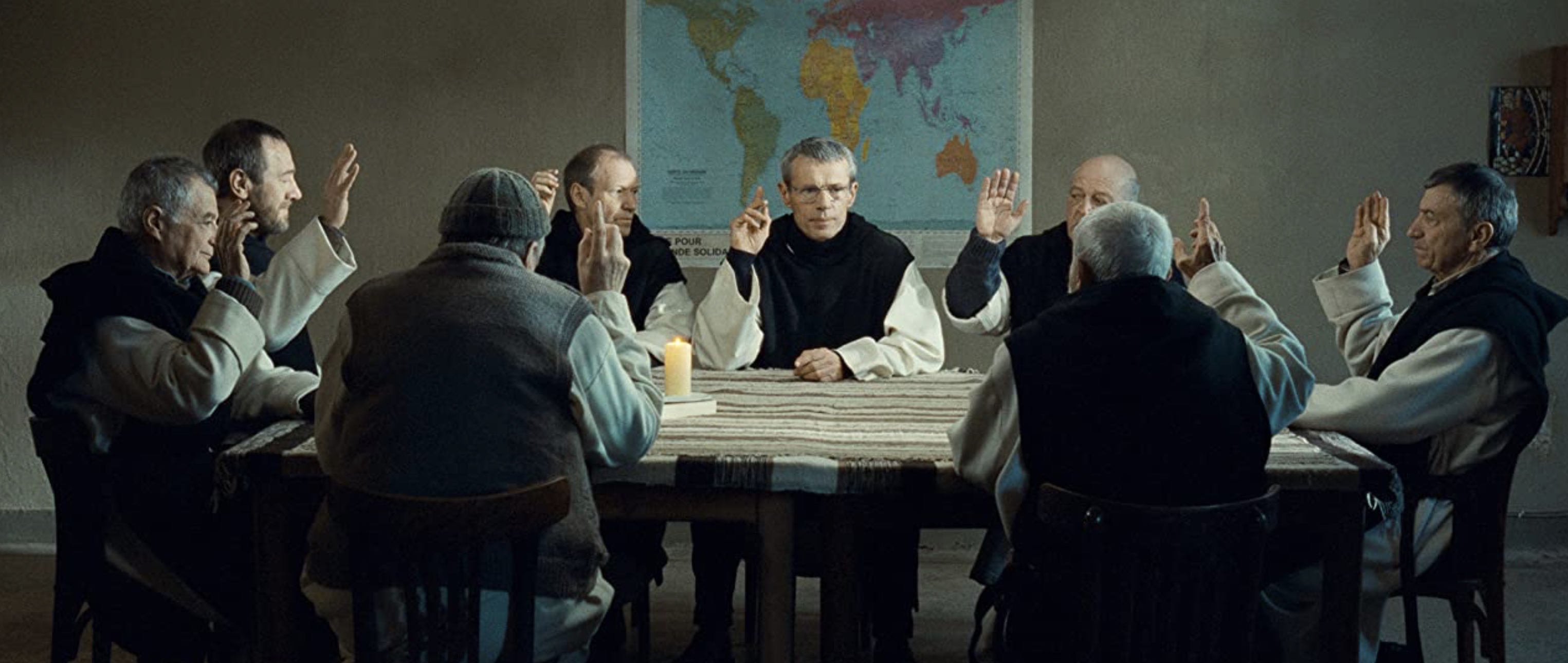
Our parish hosted a film series this Advent, and last week’s feature, Of Gods and Men (2010), told the true story of French Trappist monks who served an impoverished Muslim village in Algeria. Their monastery, Our Lady of Atlas, had been there since 1938, but in the decades after the end of French colonial rule in 1962, their community was threatened by civil unrest and a lingering suspicion of Europeans. In the 1990s, returning to France was clearly the safest choice, but the village leaders begged them to stay. They depended on the monks, not only for medical care, but for their stabilizing and loving presence.

On Christmas Eve, 1993, terrorists broke into the monastery and held the monks at gunpoint, making it clear that they were now in mortal danger. The terrorists eventually departed without incident (even apologizing for disturbing the holy feast of Jesus’ birth), and the monks celebrated Midnight Mass with special intensity. But the threat remained.

Two years later (March 1996), that Christmas Eve of both fear and deliverance was still reverberating in their hearts. Dom Christian, the prior, told the brothers in a Lenten reflection: 

… through that experience we felt invited to be born again. The life of a man goes forth from birth to birth … In our life there is always a child to be born; the child of God who each of us is … We have to be witnesses of the Emmanuel, that is, of “God with us.” There is a presence of “God among us” which we ourselves must assume.[viii]

A few weeks after Dom Christian wrote these lines about giving birth to God, the monks were taken hostage just before Holy Week. They would be martyred during Eastertide. If they had fled the country when they had the chance, they could have preserved their lives. But the brothers would not abandon the people they served. And their writings and their actions made it clear that they had already surrendered their lives long before, in both their baptismal vows and their monastic vows. They were people who knew what it meant to say yes when Jesus calls, come what may. 

Of Gods and Men (2010). The monks say yes to remaining in harm’s way.

If any of you still have doubts about the human capacity to embody divinity, listen to what Dom Christian wrote after that pivotal Christmas Eve, imagining what he would say to his future killer at the hour of his death: 

And also you, my friend of the last moment,
who will not have known what you are doing:
Yes, I want this thank you and this “a-dieu
to be for you, too,
because in God’s face I see yours.
May we meet again as happy thieves 
in Paradise, if it please God, the Father of us both. 
Amen! In h’allah! [ix]

Who could write such a thing had God not filled him to the brim! Another monk, Fr. Christopher, wrote in his journal during that same Christmastide: “We are in a state of epiclesis.”[x] Epiclesis is a Greek term denoting the invocation of the Holy Spirit in the eucharistic prayer, asking for the sanctification of our lives as well as the holy gifts on the altar. 

We are all in a state of epiclesis—the acquisition of Spirit. And indeed, it is God’s desire to give us more spirit, more grace, more love, more humanity and more divinity. All we need to do is say Yes


[i] Gustav Mahler, letter to Bruno Walter in 1896, the year he composed the Third Symphony.

[ii] Elizabeth’s words are part of the “Hail Mary” prayer used in the Rosary; Mary’s Magnificat (“Song of Mary”) is one of the oldest Christian hymns, and draws upon the Song of Hannah (I Samuel 2:1-10) and other Old Testament texts. This scene of the two cousins only appears in Luke 1:39-55.

[iii] Mark Harris is an Episcopal priest, poet and artist living in Lewes, Delaware. The poem, written December 1, 2020, is used by permission. 

[iv] The Collect for Advent 4 in the Book of Common Prayer reads: Purify our conscience, Almighty God, by your daily visitation, that your Son Jesus Christ, at his coming, may find in us a mansion prepared for himself; who lives and reigns with you, in the unity of the Holy Spirit, one God, now and for ever. Amen.

[v] January 6, the Feast of the Epiphany, celebrates the manifestation of Christ to the world. It is a bitter irony that that date has now been corrupted by the violence, hate and delusion of the insurrection. A similar irony taints the Feast of the Transfiguration, when the brilliant light of Christ’s divinity must share August 6 with the incinerating explosion of the atomic bomb at Hiroshima. 

[vi] Sergius Bulgakov, The Lamb of God (Grand Rapids, MI: Eerdmans, 2008), 200, 202.

[vii] Charles Wesley (1707-1788), Since the Son Hath Made Me Free.

[viii] Dom Christian de Chergé, Reflections for Lent (March 8, 1996), in Bernardo Olivera, How Far to Follow: The Martyrs of Atlas (Petersham, MA: St. Bede’s Publications, 1997), 103, 99. 

[ix] Testament of Dom Christian, dated Dec. 1, 1993 & Jan. 1, 1994, opened, after his death, on Pentecost Sunday, May 26, 1996, in Olivera, 127.

[x] Fr. Christopher Lebreton (January, 1994), in Olivera 111.

“Don’t mess with our myths!” — Thoughts on Thanksgiving Eve

Ron Cobb’s troubling cartoon in the Los Angeles Free Press has been in my Thanksgiving file for 50 years.

This new Israel the Lord brought by a mighty hand and an outstretched arm over a greater than the Red Sea, and gave them these ends of the earth for their habitation. In a day, with a wonderful alteration such as was never heard of in the world, the remote, rocky, bushy, wild-woody wilderness became for fertileness the wonder of the world, a second Eden, rejoicing and blossoming as a Rose, Beautiful as Tizrah, Comely as Jerusalem.   

— A New England sermon, 17th century

Adam saw it in a brighter sunshine, but never knew the shade of pensive beauty which Eden won from his expulsion. 

— Nathanael Hawthorne, The Marble Faun

Forty years ago, traveling in an old school bus with four other humans and two dogs, I visited New England communes to engage in dialogue about the nature of community. The project, funded by the Episcopal Church, was conceived by the Rev. Bill Teska, a fellow priest who thought the Church had something to learn from grassroots experiments in the nurturing of a common life. 

It was November. Snow was beginning to blanket the land. Whenever we had to sleep in our chilly bus, I regretted that we were one animal short of a three-dog night. New England freezes will test the soul. At a newly-formed commune in Maine, we wondered how their experiment was going. “Ask us in the spring,” they told us. “We haven’t gone through our first winter yet. A commune hasn’t proved it can survive until it’s been through a winter.”

The United States of America has survived some pretty severe winters of discontent, but the storms brewing now have us all on edge in a way that feels unprecedented. We have begun to doubt our survival. 

In reading Colm Toíbín’s The Magician, a novel about the life of Thomas Mann, I was struck by a couple of paragraphs describing Germany in 1934. With a few word changes, they could have been ripped from the headlines of America today:

“Each morning, as they read the newspapers over breakfast, one of them would share an item, a fresh outrage committed by the Nazis, an arrest or confiscation of property, a threat to the peace of Europe, an outlandish claim against the Jewish population or against writers and artists or against Communists, and they would sigh or grow silent. On some days, while reading out an item of news, Katia would say that this was the worst, only to be corrected by Erika, who would have found something even more outrageous.” 

“The Nazis … were street fighters who had taken power without losing their sway over the streets. They managed to be both government and opposition. They thrived on the idea of enemies, including enemies within. They did not fear bad publicity—rather, they actually wanted the worst of their actions to become widely known, all the better to make everyone, even those loyal to them, afraid.” [i]

Sound familiar? What decent soul has not been worn down by the relentless succession of lies, madness, and evil acts over the past five years?  And who does not now tremble at the increasingly overt embrace of violence, fear and hatred as acceptable political tools by a major political party? 

I was born 6 weeks after D-Day. Although I have lived through some troubled times in America, I have never doubted my country’s ability to survive its sins—until this year. Suddenly the American experiment seems shockingly fragile and strangely impermanent. While the majority of Americans may still desire the greater good, the proliferation of bad actors, along with their enablers and dupes, has metastasized into the tens of millions. Our democracy managed to survive January 6th, but not by what anyone could call a comfortable margin. The party that enabled and even fomented insurrection not only refuses to show a shred of shame or remorse, it is actively working to undermine whatever defenses—like voting rights, or an impartial judiciary—remain against future coup attempts.

There is not yet a majority in Congress willing to overturn an election. Nor is a military takeover currently in the cards. But such scenarios are no longer utterly inconceivable. The smell of burning books is already in the air. Where do we go from here?

When the demons run wild in our common life, we cry, “This is not who we are!” The myth of American innocence has been a prevalent theme since the first colonists arrived in the “New World.” Freed of the dead weight of the past, armed with a sense of limitless possibility and buoyant resilience, we (i.e., white Americans) have preferred to think of ourselves as forever young. 

The American, according to the myth, is the new Adam (or Eve) in the new Eden, a “radically new personality, the hero of the new adventure: an individual emancipated from history, happily bereft of ancestry, untouched and undefiled by the usual inheritances of family and race; an individual standing alone, self-reliant and self-propelling, ready to confront whatever awaited him with the aid of his own unique and inherent resources.” [ii]   

However, the preservation of this myth requires an immense labor of forgetting. Slavery, racism, the Native American genocide, xenophobia, mob violence, misogyny, environmental destruction and countless other sins do not fit the narrative of innocence. If myth’s stabilizing power lies in both conscious and unconscious agreement about our collective memory (“This is who we are!”), stirring up the troubling ghosts of historical evidence poses a threat to our sense of cohesion and identity. Tradition loses its binding force if it is allowed to be put into question. 

“Don’t mess with our myths!” is the rallying cry of the far right, who have shown their willingness to destroy America in order to save their version of it. But the rest of us should not feel too secure within our own fictions of innocence. We have yet to resolve our legacy of racism. We seem incapable of addressing our propensity for violence. And our lifelong assumptions about American democracy have been plunged into doubt. When fascism infected Europe in the 1930s, Americans said, “It can’t happen here.” In these latter days, we know better. It can. 

Okay, this all seems a little grim for Thanksgiving Eve. But if our current crisis forces us to reexamine and reform the foundations of our common life, perhaps we can be thankful for that. For people of faith, the survival of life as we know it is never the highest good. As we reminded ourselves last Sunday on the Feast of Christ the King, we are not in charge of history, and don’t have to be in love with particular outcomes of transitory events. Empires rise, empires fall. The Kingdom of God—the reign of self-diffusive love—is the only thing that endures, because it knows the secret of dying and rising. Therefore, even at the grave we make our song: Alleluia, alleluia, alleluia! [iii]

Even as the mountains tumble into the sea, the holy Mystery whispers “Rise! Rise!” into every moment, even the most forlorn. For that, I give thanks.

God is our refuge and strength,
a very present help in trouble.
Therefore we will not fear, though the earth be moved, 
or the mountains tumble into the sea; 
though the waters of chaos rage and foam, 
though the mountains tremble at its tumult,
the Lord of hosts is with us; the God of Jacob is our stronghold. 

— Psalm 46: 1-4

Mount Rainier dawn (March 4, 2015)

Previous Thanksgiving posts:

Utopian Dreams and Cold Realities: A Thanksgiving Homily

Trying to Get Home for Thanksgiving


[i] Colm Toíbín, The Magician (New York: Scribner, 2021), 229 & 231.

[ii] R. W. B. Lewis, The American Adam: Innocence, Tragedy, and Tradition in the Nineteenth Century (Chicago: University of Chicago Press, 1955), 5.

[iii] The Burial Office, Episcopal Book of Common Prayer, 499.

“I mean to be one too”: A Homily for All Saints

Procession of the Faithful from Baptism to Eucharist, Bamberg Commentaries, c. 1000.

There is only one sadness; it is the sadness of not being saints. 

— Leon Bloy [i]

In a 1998 New York Times interview, Gregory Peck reflected on the challenge of playing Ahab in Moby Dick. “I think I should have been more ferocious in pursuit of the whale, more cruel to the crew,” he said, “and I think I’d have a better grasp now of what Melville was talking about. Ahab focused all his energies on avenging himself against the whale, but he was trying to penetrate the mystery of why we are here at all, why there is anything. I wasn’t mad enough, not crazy enough, not obsessive enough. I should have done more.” He paused, took a long breath, and added: “At the time, I didn’t have more in me.” [ii]

When you hear the stories of the saints, do you say, “I mean to be one too!”—or do you feel you’re not quite ready for the part? Maybe you’re not crazy enough, not obsessive enough, not pure enough, not loving enough. You may think, “I don’t have it in me.” 

Well, you’re right. You don’t. But that’s the point. The saints don’t have it in them either. Saintliness comes from a source deeper than their own solitary selves. The true hero or heroine of a saint’s life is not the individual person, but the divine intention taking flesh in his or her story. As St. Paul said of his own life’s protagonist, “Not I, but Christ in me” (Gal. 2:20).

As Wendy Wright has written, saints “are people who have had the imagination and audacity to allow themselves to be remade slowly in the image of the living God, people who have so opened their hearts to God that God’s own story is in them once again … retold.” [iii] Every saint’s life is a unique retelling, shaped by the particulars of heredity, personality and environment, but down deep it’s always the same story, over and over again: the story of “love’s endeavor, love’s expense,”[iv] perpetually pouring itself out for the life of the world. 

When I graduated from high school, my parents gave me a gilt-edged copy of one the great classics of Christian devotion, Of the Imitation of Christ, written by Thomas à Kempis in the early 15th century. My father wrote in the front, “We hope that this book will bring you closer to the knowledge and love of God, and of his Son, Jesus Christ our Lord. Love, Mom & Dad.”

Although not all of Thomas’ late medieval spirituality resonates today, much of it still hits home.

Blessed are the ears that catch the pulse of the Divine whisper, and give no heed to the whisperings of this world … Blessed are they that prepare themselves more and more, by daily exercises, for the receiving of heavenly secrets. Blessed are they who are glad to have time to spare for God.[v]

O my friend, lose not thy confidence of making progress toward the things of the Spirit; still thou hast time, the hour is not yet past. Why wilt thou defer thy good purpose from day to day? Arise, and in this very instant begin, and say, Now is the time to be doing, now is the time to be striving, now is the fit time to be amending myself.[vi]

(Mom, Dad, I’m still working on it!)

Every saint’s life is an imitation of Christ. The very structure of Christian sacred biographies reflects this theological point. In the Book of Acts, the martyrdom of Stephen—the first biography of a Christian saint—deliberately mirrors the Passion of Christ. Like Jesus, Stephen is an innocent killed by a world which refuses his message. Like Jesus, Stephen uses his final breaths to forgive his enemies and surrender his spirit to the divine. “Lord Jesus, receive my spirit,” he prays at the end. Perhaps it’s not enough to say that Stephen was imitating Christ in his martyrdom. He was, in truth, repeating Christ, in the Pauline sense of “Christ in me.” We suggest the same sense of return and presence in the Words of Institution at every eucharist: Whenever you perform these actions, I am with you once again.

Eleven centuries after the death of Stephen, St. Aelred, abbot of Rievaulx in the north of England, lay on his deathbed, eyes closed. His friend and fellow monk, Walter Daniel, leaned over to whisper in his ear, “Look on the cross; let your eye be where your heart is.” Aelred opened his eyes for just a moment, and spoke his last words: “In manus tuas commendo spiritum meum” (“Into your hands I commend my spirit.”) Once again, the surrender of spirit by a dying saint echoes the last words of Jesus from the cross in Luke 23:46. 

In fact, unlike Stephen’s paraphrase, it was a direct quote. Did Walter, Aelred’s biographer, insert the verse from Luke into his abbot’s mouth as a pious fiction, or had Aelred in fact repeated Christ’s words verbatim? In the genre of sacred biography, we don’t need to know the factual answer. Holy stories are always about more than what a camera or microphone can record. As narratives straddling the mysterious boundary between the human and the divine, their language dives beneath the empirical surface to explore the hidden depths. Hyperbole, metaphor, miracle—these are all rhetorical tools to convey the inherently mysterious nature of religious experience. 

As Thomas J. Heffernan points out in his seminal study of sacred biographies, “Walter would argue, and his monastic audience would agree, that Aelred’s death has become more memorable because it is now able to arouse in us the memory of another death, the death of Christ, which is the paradigm for the manner in which all Christian martyrs are meant to surrender to God.” [vii]

When it comes to saints, it is not in the historical particulars of their stories, however interesting, edifying, or inspiring, that the central meaning of their lives is to be found, but rather in the way their stories imitate, or repeat, the Christ event, as divine love takes place anew in the flesh of our human existence. As hymn writer Isaac Watts summarized this process:

“The image of Christ is transcribed upon our natures, we go from one degree of it to another, we are changed from glory into glory, from one degree of glorious holiness to another: thereby the gospel appears to have a fairer, brighter, and a stronger evidence.” [viii] We, having Christ in us, become the evidence for the truth of Christian faith.

In other words, saints are living icons, radiant with the light of heaven—even if they sometimes have messy and complicated lives.  Take, for example, Elizaveta Pilenko. Born to a wealthy Russian family in 1891, she was caught up in the revolutionary movement during her late teens. She briefly flirted with a plot to assassinate Trotsky (Russian politics were deadly even then). But at the same time, her Orthodox faith was beginning to deepen. She fled the Stalinist regime for Paris in the 1920s, by which time her second marriage, like her first, had failed, and a daughter had died of influenza. 

In her new home, she began a ministry to the poor, and her bishop encouraged her to take vows as a nun. She did so, receiving her religious name, Maria Skobtsova. She was permitted to continue to live and work among the people, and her rented Parisian house had an open door for refugees and lost souls. Her bishop called her faux monastery “the desert of human hearts.” 

She wasn’t exactly easy for her sister nuns. She wore odd clothes, and hung out in cafes and bars late into the night, counseling people on the brink of despair. She also missed many liturgies while off scrounging food for her soup kitchens in the markets of Las Halles. She’s been called the Orthodox Dorothy Day.

St. Mary of Paris (Maria Skobtsova).

When France fell to the Nazis in 1940, Mother Maria sheltered many Jews, supplying them with baptismal certificates and assisting their escape. Eventually arrested by the Gestapo, she died in the gas chamber at Ravensbrück on Holy Saturday, 1945. She was canonized as St. Mary of Paris in 2004.

Mother Maria was also a writer of poetry and theology. Listen to what she said about the Christian life as a continual self-emptying:  

“Renunciation teaches us not only that we not greedily seek advantages for our soul but that we not be stingy, that we always be extravagant in our love, that we achieve a spiritual nakedness, that our soul hold nothing back, that we not hold back anything sacred and valuable which we would not be ready to give up in Christ’s name to those who need it …That which was given away returns. The love which was expended never diminishes the source of that love, because the source of love in our hearts is Love itself, Christ… Here we are speaking about a genuine emptying out, in a partial imitation of how Christ emptied himself by becoming incarnate in humanity. We must likewise empty ourselves out completely, becoming, so to speak, incarnate in another human soul, offering it to the full measure of God’s image which is contained in ourselves.” [ix]  

Now when we hear a prescription like that, we may worry, as Gregory Peck did over Melville’s Ahab, about our capacity to perform such a demanding role. What we need to remember is this: the subject of our life is not our individual, autonomous self, but the transcendent, empowering Christ who dwells within us. In a recent podcast, Mark Harris, one of my most eloquent priestly friends, made this point perfectly. “When I look at the heroes I have in terms of justice ministries,” he said, “they are people who live into this to the point of self-emptying. They get out of the way finally. It’s not about their being good; it’s about good being done. So it’s God’s justice that’s done, not them doing justice.” [x]

Heavenly Adam, Life divine
Change my nature into Thine;
Move and spread throughout my soul;
Activate and fill the whole;
Be it I no longer now
Living in the flesh, but Thou. 

— Charles Wesley

Our own holiness practice may not entail the rigors or reach the heights of the greatest saints. Most of us are called to what Thérèse of Lisieux described as “the Little Way.” As a dreamy teenager, Thérèse thought it would be simply thrilling to be a saint:

“I would be a Martyr … I would be a Missionary. I would be flayed like St. Bartholomew, plunged into boiling oil like St. John, or, like St. Ignatius of Antioch, I would be ground by the teeth of wild beasts into bread worthy of God. With St. Agnes and St. Cecilia I would offer my neck to the sword of the executioner, and like St. Joan of Arc I would murmur the name of Jesus at the stake.” [xi]

Thérèse of Lisieux.

However, such heroic drama would be denied her. After a brief and uneventful life hidden within a Carmelite cloister, she died from tuberculosis at 24. But her autobiography, detailing her efforts to respond to the smallest, most ordinary moments with a loving, patient and generous heart, would inspire countless faithful around the world.  “I am only a very little soul,” she said, “who can only offer very little things to the Lord.”

Fr. Alban Butler, who in the 18th century compiled the most extensive compendium of saintly lives in the English language, also made the point that sanctity can be a practical, everyday kind of holiness: 

“Perfection consists not in raptures and lofty contemplation; nor in austerities, or any extraordinary actions: for thus, it would have been above the reach of many. But God has placed it in what is easy, and in every one’s power. The rich and poor, the learned and unlearned may equally aim at perfection: for it requires only that we perform our daily actions in a spirit of true Christian virtue … we must be holy not by fits, but by habit … it is then our ordinary actions performed in a true spirit of virtue … which must sanctify our lives.” [xii]

We must be holy not by fits, but by habit, 
performing our ordinary actions in a true spirit of virtue.

Blessed are those who rise and shine.
Blessed are those who lend a hand. 
Blessed are those who listen.
Blessed are those who take the time.
Blessed are those who speak kindly.
Blessed are those who smile at strangers.
Blessed are those who plant.
Blessed are those who raise children.
Blessed are those who teach.
Blessed are those who provide our meals.
Blessed are those who do the hard things.
Blessed are those who look with compassion.
Blessed are those who do justice. 
Blessed are those who wonder.
Blessed are those who welcome.
Blessed are those who nurture.
Blessed are those who care. 
Blessed are those who struggle with failing bodies. 
Blessed are those who suffer.
Blessed are the broken.
Blessed are those who know loss. 
Blessed are those who persist.
Blessed are those who surrender.
Blessed are those who remember hope.
Blessed are those who practice resurrection. 

“To be a saint,” says Frederick Buechner, “is to live not with hands clenched to grasp, to strike, to hold tight to a life that is always slipping away the more tightly we hold it; but it is to live with the hands stretched out both to give and receive with gladness.” [xiii]  You see, it’s very simple to be a saint. Just open your hands, and your heart.

Claude Laydu, Diary of a Country Priest (Robert Bresson, 1951).

The greatest cinematic depiction of sainthood is Robert Bresson’s Diary of a Country Priest, based on George Bernanos’ novel of the same name. The unnamed priest is rejected by many in his village, but it is clear to a few—and to the viewer—that Christ is truly in him. The priest experiences what he calls “the miracle of our empty hands!—that we may give what we do not possess!” Claude Laydu, the non-professional who played the part, threw himself into the role, living with working-class priests, adopting an austere diet, studying the novel throughout the shoot, and submitting without question to Bresson’s strict direction. As critic Tony Pipolo writes, “The very qualities this behavior manifests—obedience, obsessive concentration, a combination of fire and composure, and genuine dedication—were exactly those Bresson sought for his curé.”[xiv] But only after viewing the finished film would Laydu recognize the true nature of his role. “I didn’t know I was playing a saint,” he confessed. I think all the saints would say pretty much the same thing. 

I’ll give the last word to Buechner, who writes about saints as well as any. In a novel about Brendan of Ireland, his protagonist sums it up beautifully: 

“[God] wants each one of us to have a loving heart …
When all’s said and done, perhaps that’s the length and breadth of it.” [xv]


[i] Cited in Tony Pipolo, Robert Bresson: A Passion for Film (Oxford/New York: Oxford University Press, 2010), 71.

[ii] Gregory Peck New York Times interview in 1988, quoted in William Grimes’ New York Times obituary for Mr. Peck, June 13, 2003. 

[iii] Wendy Wright, “For all the saints,” in Weavings: A Journal of the Christian Spiritual Life (Vol. III, No. 5, Sept.-Oct. 1988), 17-18.

[iv] From W. H. Vanstone’s hymn, “Morning glory, starlit sky” (Episcopal Hymnal 1982, #585). The endeavor and expense are spelled out in verse 3: “Love that gives, gives evermore, / gives with zeal, with eager hands, / spares not, keeps not, all outpours, / ventures all, its all expends.”

[v] On the Imitation of Christ, Book 3, ch. I.

[vi] Ibid., Book 1, ch. XXII.

[vii] Thomas J. Heffernan, Sacred Biography: Saints and Their Biographers in the Middle Ages (Oxford/New York): Oxford University Press, 1988), 79.

[viii] Isaac Watts (1674-1748), cited in Gordon Mursell, English Spirituality: From 1700 to the Present Day (London, SPCK, 2008), 69.

[ix] Maria Skobtsova, in Michael Plekon, Living Icons: Persons of Faith in the Eastern Church (Notre Dame 2002), 76.

[x] The Rev. Mark Harris, speaking about the Beatitudes on the video podcast, Circuosity .21https://youtu.be/6V6zGsX9yqA

[xi] Thérèse of Lisieux (1873-1897), cited in Jill Haak Adels, The Wisdom of the Saints: An Anthology (Oxford/New York: Oxford University Press, 1987), 7.

[xii] Alban Butler (1710-1773), Meditations and Discourses, cited in Mursell, 36.

[xiii] Frederick Buechner, The Magnificent Defeat (New York: Seabury Press, 1966), 119.

[xiv] Pipolo, op. cit., 71.

[xv] Buechner, Brendan (New York: Atheneum, 1987), 216.

All Souls Day: Will the Circle Be Unbroken?

Gravestone, Peacham, Vermont.

Our experience shows us that death does not break our kinship bond. We turn to one another for help and support regardless of which side of death our relatives are on.

— Martin Brokenleg [i]

We pray for the dead, believing that, as they are drawn nearer to God, they are enabled to grow in the knowledge and understanding of God, in the service of God, and in the joy and fulfillment of God’s renewing love. We do not pray for the dead as those without hope, but trusting that the faithfulness of God will bring them to the completion and bliss for which every human soul was created. 

— Jon Hart Olson [ii]     


On All Souls Day (November 2), we call the dead to mind with stories, mementos, photographs, and rituals. In some ways, the dead never leave us. We still use the language they invented, live in the houses they built, learn from their wisdom, pay for their sins. And we carry their DNA inside our bodies. Bill Holm, a Minnesota poet, has noted the strong resemblances between his own living and dead:

When Jona at sixty traveled 
to her father’s farm in Iceland, 
the relatives looked down
at bony knuckles, veins
popping up, said: “See!
She has the Josephson hands
even after a hundred years…”

Now, when I bellow at parties, 
or look down at my own hands;
knuckles growing, veins
rising as I age, I think:
I’ll be living with all 
these dead people inside me.
How will I ever feed them?
They taught me, dragging carcasses
a thousand winters across
the tundra inside their own bodies. [iii]

“How will I ever feed them?” We certainly contain and nurture the legacy of the dead in our culture, in our very bodies, but is there any form of continuing relation with the dead as discrete entities who remain other than ourselves? Do the dead still exist somewhere, and can we still be in relation with them? In both the Odyssey and the Aeneid, the hero descends to the underworld to speak with the dead and get their advice. However eerie, it was a sensible quest. The dead have “been there, done that.” They possess the voice of experience. Robert Pogue Harrison explains what Homer and Virgil were up to when they put words in the mouths of the shades in Hades: “We lend voice to the dead so that they may speak to us from their underworld—address us, instruct us, reprove us, bless us, enlighten us, and in general alleviate the historical terror and loneliness of being in the world.” [iv]

As a person of faith, I believe this continuing presence to be more than the lingering effects of the departed on our bodies and our psyches. The communion of the living and the dead possesses an ontological dimension. The afterlife has an existence, a reality, outside our imagination. And it is not only in the past. It is part of our present, and our future. Whether we live or die, we all belong to a larger divine wholeness—“all the company of heaven”— from which we can never be separated. This wholeness, for which there are many names, is the Love that binds us all together. This interconnection, this “communion of saints,” cannot be broken, even by death.

Such radical sense of interdependence, where we all, as John Donne put it, “lie open to one another,” may not come naturally to people who value privacy and individuality and have the means to live without others. Among the world’s poor, however, survival depends on mutuality. People pool and share their resources, with no illusions that they can make it on their own. Community and family are absolutely necessary, and this solidarity is not broken by death. 

In her study of Mexico’s Días de los muertos, Juanita Garciagodoy writes that the poor do not regard the self as “atomistic, independent of the social body that constitutes its extended family and community. The physical body is not the private property of its owner with the array of rights to privacy and individualism and the independence from relations, friends, and neighbors the body of the typical “first worlder” claims. People are felt to be connected radically.” This connectedness includes the departed, as the Days of the Dead make clear. “Those people’s spirits are still part of the unit of the living. There is no question about their desert to be humored, fed, entertained, and regaled on dates of remembrance. Those who live with this understanding know that no one is an island.” [v]  

Dead or alive, we’re all in this together. The Mexican calaveras, cartoonish depictions of skeletons performing the activities of the living, make this point with comedic verve. I once saw a woodcut of three skeletons in festive dress, arms around each other, smiling and waving as they looked me in the eye. Below them, like a postcard greeting, were the words, Wish you were here!  

Gravestone, St. Peter’s churchyard, Lewes, Delaware.

My father died when I was 21. One of my best friends died when we were 30. But for the most part, death kept its distance in my younger days. Lately, however, the losses have begun to mount. The pandemic, tragically, has taken vast multitudes—“a huge number, impossible to count.”[vi] And on a personal level, the vanishing of loved ones grows way too frequent now that I’ve reached a certain age. In the past few years, I’ve addressed personal loss in my writing, and in honor of All Souls, my Day of the Dead “altar” will be a brief florilegium—flowers for the dead, if you will— from four of my requiem posts. 

When two of my most beloved elders, Joe and Phyllis Golowka, died within weeks of each other, I wrote (and preached) “You say goodbye, I say hello”: A Requiem Sermon

This is the story that God’s friends stake their lives on:
God has loved us into existence.
God sustains us every step of our life’s journey.
And even after our bodies give out,
God loves us too much to let us go.

Bill Fisher, born five days earlier than I, was a close friend for 59 years. In his final days, after he slipped into unconsciousness, I gave him last rites, and his earthly companions sang him to rest. In Paradisum: On the Death of a Friend, describes what happened next.

I entered his room alone to sing him one more song, “Waterloo Sunset.” We had both loved the quirky music of Ray Davies, and the song’s image of crossing over the river “to feel safe and sound” seemed so fitting.

And I won’t feel afraid
As long as I gaze on Waterloo Sunset
I am in paradise 

Another friend was taken suddenly early this year. In “When I begin the long work of rising”—A Tribute to David Fetcho, I quote one of his songs:

I want to go with you
to the other side of the light
where we’ll see
what the shadow reveals
will be such a relief …
time in its disguises 
won’t fool us anymore …

Days tumble on with minds of their own
they breathe in our lives, and make them their own
and time, time disappears
like the wind from a sail …
and every good day will be 
just another good day
of eternal life. [vii]

Anise Stevens, my sister’s child, left us far too soon at age 49. She died in the first minute of dawn on New Year’s Day, 2019. Through my tears, I preached “Trailing clouds of glory” at her requiem.

In her last weeks, Anise wondered about what lay ahead. That is the question. My sister Martha said to me before the funeral that her daughter is “on her way.” Then she recited Wordsworth’s evocative image of the next life as our native home to which we shall one day return:

Our birth is but a sleep and a forgetting; 
The Soul that rises with us, our life’s Star, 
Hath had elsewhere its setting 
And cometh from afar;
Not in entire forgetfulness, 
And not in utter nakedness, 
But trailing clouds of glory do we come 
From God, who is our home. [viii]

The author lays California wildflowers on the grave of William Wordsworth in St. Oswald’s churchyard, Grasmere, England (July 16, 1994).

I have always found Wordsworth’s hopeful and exuberant spirit an inspiration, so much so that I marked my fiftieth birthday with a pilgrimage to the poet’s grave. After nine miles of rambling through the Arcadian charms of English countryside, I arrived at dusk. I had brought along my copy of The Prelude, with two wildflowers from home, an orange California poppy and a pink Farewell-to-Spring, pressed within its pages. As a quarter moon set over the darkening hills beyond St. Oswald’s churchyard, I took out the flowers and laid them on the grassy grave. Then, in the fading light of a summer evening, I spoke the lines which epitomize my own trust in the providence and grace of the human journey:

The earth is all before me. With a heart
Joyous, nor scared at its own liberty,
I look about; and should the chosen guide 
Be nothing better than a wandering cloud,
I cannot miss my way. I breathe again! [ix]


[i] Martin Brokenleg, “Mitakuya owasin: You are all my relatives,” in The Witness, Vol. 76, No. 11 (Nov. 1993), p. 8. Brokenleg is an Episcopal priest and a member of the Rosebud Sioux tribe.

[ii] Jon Hart Olson, newsletter of Christ Church, OntarIo, CA (Nov. 1994). Jon was an Episcopal priest, colleague, mentor and friend.

[iii] Bill Holm, “Genealogy,” in The Dead Get By with Everything (Minneapolis: Milkweed Editions, 1991) 14.

[iv] Robert Pogue Harrison, The Dominion of the Dead (Chicago: University of Chicago Press, 2005) 150-1.

[v] Juanita Garciagodoy, Digging the Days of the Dead (Boulder, CO: University Press of Colorado, 2000), 269.

[vi] Revelation 7:9, from the liturgical readings for All Saints Day.

[vii] David Fetcho, “Just Another Good Day.” You can listen to the song here: https://soundcloud.com/ds_feco/just-another-good-day

[viii] William Wordsworth, “Ode on Intimations of Immortality from Recollections of Early Chiidhood.”

[ix] William Wordsworth, The Prelude, I.14-18. Wordsworth’s image is a happy reversal of Milton’s melancholy account of the Expulsion from Paradise, where the first humans’ outward journey has dimmer prospects: “The World was all before them, where to choose / Their place of rest, and Providence their guide: / They hand in hand with wandering steps and slow, / Through Eden took their solitary way” (Paradise Lost, 646-649).

Human Vision Corrected by Divine Love — A Homily on Jesus and Bartimaeus

The Healing of Bartimaeus ( Master of the Gathering of the Manna, c. 1465).

Jesus was walking out of Jericho, surrounded by a big crowd. Like all such crowds, it was a mix of the curious and the adoring. Jesus was at the height of his popularity. He stirred people’s imaginations and raised their hopes. The excitement was palpable. But amid all the festive clamor, a single shout brought this parade to a sudden halt:

“Jesus, Son of David, have mercy on me!”
It was a blind beggar, sitting by the roadside. His name was Bartimaeus.
“Shush,” people said. “Don’t make a scene.”
But he cried all the louder: “Son of David, have mercy on me!”

And Jesus stood still, 
just the way the sun had stood still in the sky for Joshua 
in that same city of Jericho.

“Call him here,” Jesus said. And so they did. 
“Take heart!” they told him. “Get up. He is calling you.”

Immediately, Bartimaeus threw off his cloak, sprang to his feet, and came to Jesus. Then Jesus asked him a question that went straight to the point: “What do you want me to do for you?”

“My teacher,” he said, “Let me see again.”
And what Bartimaeus asked, Jesus granted.

— Mark 10: 46-52

In Mark’s gospel, this is the last miracle performed by Jesus before he goes to his death in Jerusalem. It marks the fatal turning point between his ministry and his Passion. It is our Lord’s last act, his last word, before beginning the Way of the Cross. To the world, that looked like the path to oblivion. But to those who have been given the eyes of faith, the Way of the Cross, as we pray every Holy Week, is “none other than the way of life and peace.”

And thus the healing of Bartimaeus is not just the story of one man’s good fortune. It is an invitation to each of us to perceive and receive the vision of salvation which is about to unfold. Mark is telling us that if you want to understand the Paschal Mystery of Passion and Resurrection, you need to open your eyes. And it is crucial to note that the climactic words of this story are not “he regained his sight,” but rather, “he followed him on the way.” Once you see what God is doing through Jesus, then it’s your turn to take up your own cross and follow. 

Let there be light!” says the God of Genesis. 
“I am the light of the world,” says the God incarnate. 

And yet, in the story leading up to this moment, even Jesus’ closest friends have suffered their own blindness. “Are your minds closed?” he chides them. “Have you eyes and do not see?” But they go on missing the point again and again. To their credit, they continue to follow Jesus. They are drawn to him, they know something is happening here—but they don’t know what it is. “Do you not yet understand?” Jesus sighs. I’m sure he said this more than once.

And then, after repeated examples of the disciples’ blindness throughout Mark’s gospel, suddenly we hear a plaintive voice cry out from the crowd: “Jesus! Have mercy on me. Remove this grievous blindness.”

That’s our prayer too, isn’t it? Lord, take away our blindness. Help us to see.
And Jesus replies, “I thought you’d never ask!”

St. Gregory of Nyssa, in the fourth century, was one of many theologians who have shared Mark’s diagnosis of the human condition as one of persistent blindness:

“Humanity was created for this end, that it might see ‘good,’ which is God; but because humanity would not stand in the light, [in fleeing from the light] it lost its eyes… We subjected ourselves to blindness, that we should not see the interior light.”

St. Augustine described the interior eye, our capacity to see the things of God, as “bruised and wounded” by the transgression of Adam and Eve, who, he says, “began to dread the Divine light [and] fled back into darkness, anxious for the shade.”

Refusing to stand in the light… subjecting ourselves to blindness. 
Is this what we do? Are we truly so “anxious for the shade?”

Arthur Zajonc is a quantum physicist who became fascinated with the literal dimensions of this question, examining case histories of blind people who recovered their sight. In his book, Catching the Light: The Entwined History of Light and Mind, he tells of an 8-year-old boy, blind at birth from cataracts, who underwent surgery in the year 1910. When the time came to remove his bandages, the doctor was very hopeful. He waved his hand in front of the boy’s eyes, which were now physically perfect. 

“What do you see?” asked the doctor.
“I don’t know,” the boy replied.
“Can’t you see my hand moving?” said the doctor.
“I don’t know,” said the boy.

The boy’s eyes did not follow the doctor’s slowly moving hand, but stared straight ahead. He only saw a varying brightness before him. Then the doctor asked him to touch his hand as it moved, and the boy cried out in a voice of triumph, “It’s moving!” He could feel it move, and even, as he said, could “hear it move,” but it would take laborious effort to learn to see it move.

As that first light passed through the child’s newly clear black pupils, it called forth no echoing image from within. His sight, Zajonc tells us, began as a hollow, silent, dark and frightening kind of seeing. The light of day beckoned, but no light of mind replied within the boy’s anxious, open eyes.

“The sober truth” says Zajonc, “remains that vision requires far more than a functioning physical organ. Without an inner light, without a formative visual imagination, we are blind.”

This echoes Augustine’s description of our “bruised and wounded” inner eye. What is it that makes us so unable to process what is before us, to see what is being offered to our open eyes?

The mystical Anglican poet Thomas Traherne framed an answer in the ornately vivid language of the seventeenth century:

“As my body without my soul is a carcass, so is my Soul without Thy Spirit, a chaos, a dark obscure heap of empty faculties ignorant of itself, unsensible of Thy goodness, blind to Thy glory.” 

And what are the causes of this abysmal state? he asks. They are several. 

“[The Light within us is eclipsed] by the customs and manners of [others], which like contrary winds blew it out: by an innumerable company of other objects, rude, vulgar and worthless things, that like so many loads of earth and dung did overwhelm and bury it: by the impetuous torrent of wrong desires in all others whom I saw and knew that carried me away … from it: by a whole sea of other matters and concernments that covered and drowned it…” 

“Contrary winds” blowing out the Light within us… being overwhelmed by “an innumerable company… of rude, vulgar and worthless things”… “the impetuous torrent of wrong desires” – does any of that sound familiar? Who among us has not had days like that, or even years like that? Is that not the world we live in today?

Not long after Traherne wrote those words, another English writer, John Bunyan, told the story of two pilgrims, named Christian and Faithful, who came upon Vanity Fair, a kind of shopping mall where all the transitory pleasures of this world were on seductive display.

“What will ye buy?” cried one of the merchants.
And Christian and Faithful replied, “We buy the truth!”

This was clearly the wrong answer, for the two pilgrims were immediately set upon, beaten, smeared with mud, thrown in a cage, and finally put on trial. The jury was rigged, led by Mr. Blind Man and Mr. Hate-Light. “Guilty,” they cried, and Faithful was put to death. But Christian managed to escape, and his journey into God continued. 

Bunyan’s allegorical constructs seem quaintly archaic today, but Vanity Fair is still with us, with its endless commodification of unsatisfiable desires. And Mr. Hate-Light is still at work, generating the ceaseless illusions that blind us to the beauty of holiness. 

Now once Christian had escaped Vanity Fair, he still had to pass through the Valley of the Shadow of Death, where the light was so scarce, and the path so narrow, that he was in constant danger of stumbling into the ditch on his right or the quagmire on his left. 

But Christian was not without hope in that dark valley. 
As Isaiah says, the God of light travels with us:

I shall lead the blind by a road they do not know… 
I shall turn the darkness into light before them, 
and the quagmire into solid ground. (Isa 42:16)

All of us, deep down, want the light. All of us need the light. But sometimes we resist the light, or run away from it, or shut our eyes to it. There are things we’d rather not see, in the world or in ourselves. Illuminating our dark places can feel like a judgment, as if the light were accusing our shadows.

Light of the world, rescue us from darkness!

In Franco Zefferelli’s film, Jesus of Nazareth, we meet another blind man at the pool of Bethsaida in Jerusalem, but unlike Bartimaeus, he is deathly afraid of being healed. “Leave my eyes alone!” he shouts. “Stop touching my eyes!”

After analyzing sixty-six cases of blind people who had recovered their sight, Arthur Zajonc would concur with Zeffirelli’s portrayal of our resistance to an enlarged perception of the world:

“The project of learning to see,” he writes, “inevitably leads to a psychological crisis in the life of the patients, who may wind up rejecting sight. New impressions threaten the security of a world previously built upon the sensations of touch and hearing. Some decided it is better to be blind in their own world than sighted in an alien one… The prospect of growth is as much a prospect of loss, and threat to security, as a bounty.”

In other words, opening our eyes to a more truthful clarity can be scary—no more fictions or illusions about the state of the world or the state of our souls. If we say we have no sin, we deceive ourselves, and the truth is not in us (I John 1:8). Seeing—clearly and accurately—the fallenness of our broken world—and our wounded selves—is a painful revelation. Once we face facts, transformation is the only way forward. We must change our life. A new way of seeing demands a new way of being. We can either fight that divine summons, like the man in the Zeffirelli film (Don’t touch my eyes!), or we can jump up and embrace it, like Bartimaeus.

But it’s not just the wrongness of things which is hidden by our blindness. The truth is, there is also so much blessing and beauty in this world, eagerly waiting to be discerned and embraced. And whatever our doubts and fears about losing our protective blindness, the beauty revealed will be worth the price. It’s the beauty of God’s future—what Jesus called the Kingdom. We often think of the Kingdom as impossibly distant, but it is possible to glimpse it even now, in this present age. We only need the eyes to see. 

This healing of our inner eye, this recovery of the divine Light within us, is perfectly expressed in a passage from Willa Cather’s novel, Death Comes for the Archbishop. Her protagonist, Jean-Marie Latour, a nineteenth-century missionary bishop to the territory of New Mexico, is discussing visions and miracles with his Vicar. 

“Where there is great love,” he says, “there are always miracles. One might almost say that an apparition is human vision corrected by divine love .… The Miracles of the Church seem to me to rest not so much upon faces or voices or healing power coming suddenly near us from afar off, but upon our perceptions being made finer, so that for a moment our eyes can see and our ears can hear what is about us always.”

Human vision corrected by divine love. 
How blessed are they who receive such a miracle! 

Let us close by hearing the gospel story one more time, succinctly told by John Newton, the author of “Amazing Grace,” in an old American shape note hymn called “Villulia.”

“Mercy, O thou Son of David, 
thus poor blind Bartimaeus prayed.
“Others by thy grace are saved,
now afford to me thine aid.”

Money was not what he wanted,
though by begging used to live;
but he asked, and Jesus granted
alms which none but he could give.

“Lord, remove this grievous blindness,
let mine eyes behold the day.”
Straight he saw, and, won by kindness,
followed Jesus in the way.