Stories That Save Us: Performing Scripture as an Act of Resistance

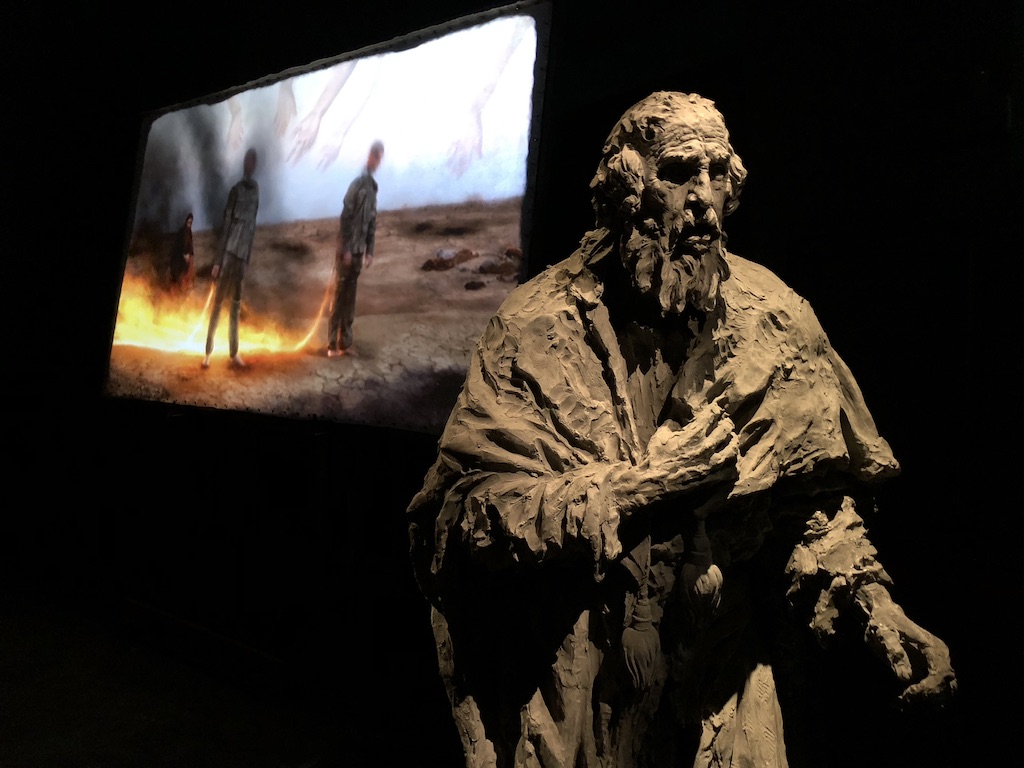
Biblical stories can be retold in many ways with a variety of media. This is part of The Prodigal Son parable in an elaborate and moving installation by Alexander Sokurov at the Venice Biennale in 2019. (Photo by the author)

This is the third in a series of posts responding to the alarming events in Minneapolis. It may be the most arcane, of interest only to worship planners and storytellers. I usually try to write posts of more general interest, but my long experience as a liturgical creative and biblical storyteller impels me to set this down, for what it’s worth, as a small personal contribution to the ongoing efforts of the faithful to resist public malice and hold fast to the good with all the means at our disposal.

In evil times such as these, how can churches be faithful to the Baptismal Covenant to “persevere in resisting evil … seek and serve Christ in all persons … strive for justice and peace among all people, and respect the dignity of every human being”? In recent weeks, we have seen many clergy and laity adding their voices and bodies to the resistance against tyranny and cruelty in Minneapolis, and to the increasingly dangerous work of loving our neighbor and protecting the vulnerable.

As a longtime liturgist, I find myself wondering how—and to what degree—our worship gatherings, in addition to our witness in the public square, might themselves be responsive to what is happening around us—and inside us—during America’s current authoritarian nightmare. Prayer and preaching are two vital ways, and I have given some striking examples in my two previous posts, White House Brutality (prayer as a “refusal to consent to an unredeemed world … It breaks the silence, awakens the passive, and cultivates action, both human and divine.”) and Murder in Minneapolis (featuring one priest’s prophetic sermon, forged in the crucible of tyranny and protest).

Singing is also a powerful weapon against evil and its sad progeny—discouragement, fear and despair. It’s been said that the Civil Rights movement succeeded in part because it had a great soundtrack. Its stirring adaptations of black spirituals, sung not only in the marches but also in the jails, kept voices high and spirits strong. As they say, the people united will never be defeated. And nothing unites like communal singing. The resistance to American fascism is taking this to heart as collective song becomes once again a vital part of public protests.

Prayer, preaching and singing are all powerful ways to say yes to God and no to evil. And to that list I would add the telling of our sacred stories. Creative engagement with Scripture deserves equal attention as a means to lift up our hearts and shine the light of hope against the darkness.  Week after week, year after year, Christians tell formative stories of sin and redemption, strife and reconciliation, despair and hope, losing and finding, oppression and liberation, death and resurrection. Then the preacher strives to connect those biblical stories with our own lives and times. But what if we were to make those connections not just in our homiletic reflections following the stories, but in the storytelling act itself?

As a young priest in Los Angeles during the Vietnam War, I staged a dramatized version of Jesus’ parable of the Unforgiving Debtor for an experimental eucharist. The man whose debt was very small was a draft resister, thrown into prison by an angry creditor dressed as Uncle Sam. That creditor was then reminded of the immensity of his own debt, illustrated by projected images of the atrocious violence in Southeast Asia.

Such a pointed retelling of Scripture might be too edgy for typical Sunday worship, but there are times when biblical stories really want to be heard in fresh and compelling ways. Holy Week 2026 can be a great opportunity to do that. How might worship planners think creatively about the Paschal journey from death to life in the context of our current experience of state-sponsored hate and violence?

The next No Kings march is scheduled for March 28, the day before Palm Sunday. How will it feel to reenact Jesus’ provocative entry into Jerusalem after millions of us will have shouted our own hopeful hosannas in the streets of America? What will be in our hearts on Maundy Thursday when our beautiful feast of loving one another concludes with the arrest our Lord by armed thugs? And when we come to the foot of the cross, will we see the God who not only shares our present suffering but also transforms it, making a Way where there is no way?

I love the traditional Scriptural texts for the Holy Week rites which take us on the Paschal journey from death into life. As containers for all the thoughts and feelings we bring to that journey, especially in times of immense public distress, they need no inventive retelling. They will be heard in fresh ways simply by virtue of what is in our minds and in our hearts throughout Holy Week 2026.

But when the sun goes down on Holy Saturday, and the Great Vigil of Easter begins to transport us from the world of sin and death into the realm of light and life, the world of the past is gone, and it is time to let imagination flourish, that we may find our own struggles and hopes vividly enacted in the performance of biblical narratives.

At the Easter Vigil, which I take to be the molten core of Christian worship, it is critical to experience those stories as if they are happening to us. We need to feel ourselves delivered from the flood of chaos and liberated from bondage to the powers-that-be. The dry bones of our damaged hopes need to rise again and inhale the breath of the Spirit. As the ancient Exultet chant declares at the outset of the liturgy,

How holy is this night, when wickedness is put to flight, and sin is washed away. It restores innocence to the fallen, and joy to those who mourn. It casts out pride and hatred, and brings peace and concord.

What does it take to do the Vigil stories justice? Well, it takes time and effort, a creative team, prayerful engagement with the stories, and openness to the Holy Spirit. Before offering a few tips for your own Vigil storytelling, let me give some examples from a Vigil I curated last year, as described in my April 2025 blog post, “For God so loved our stories”—Tales from the Easter Vigil:
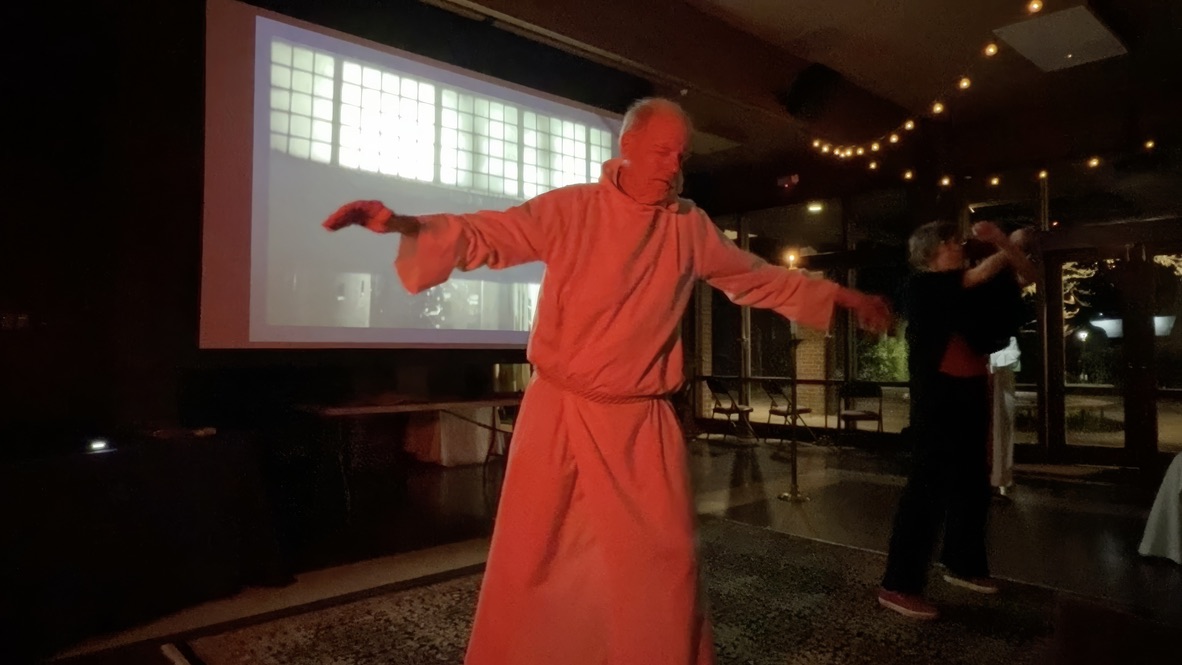
The author as one of the dancers in the Red Sea story at the Easter Vigil 2025.

The Red Sea: Noirish projected images (from Bela Tarr’s bleak film, Werckmeister Harmonies) show anonymous figures shuffling through an imprisoning corridor, while dancers on the stage express the experience of oppression with their bodies. An offstage narrator explains:

Three thousand years ago, in the land of Egypt,
there were people who had no name.
They were the faceless many,
exploited by the powerful,
forgotten by the privileged: slaves, immigrants, the poor,
the homeless, the vulnerable, the invisible, the outcast.

Then dismissive terms for the oppressed appear on the screen in stark animated graphics: Not like us … worthless … horrible people … trash … less than human. More images of “the faceless many” are shown as the dancers continue, until an offstage choir sings a verse of “Go down, Moses.”

Suddenly, the divine breaks into this dark world: the screen flashes red, and we see the words from Psalm 68 that are always used in Orthodox Paschal liturgies:

Let God arise!
Let the foes of Love be scattered!
Let the friends of justice be joyful!

Then a song from the Civil Rights movement fills the room: “They say that freedom is a constant struggle … Oh Lord, we’ve struggled so long, we must be free.” The dancers’ bodies shift from oppression to liberation, while the screen shows powerful footage of crowds on the march for justice. As we hear a dub track with a repeated phrase by Martin Luther King, Jr.(“We cannot walk alone!”), the dancers begin their own march across the stage to the “Red Sea,” where they halt while the narrator declares:

This too is a creation story:
On this day, God brought a new people into existence.
On this day, God became known as the One who delivers the oppressed,
the One who remembers the forgotten and saves the lost ,
the One who opens the Way through the Sea of Impossibility,
leading us beyond the chaos and the darkness into the Light.
When the world says No, the power of God is YES!

As the dancers, joined by a small crowd of others, begin to cross the Sea, the choir (offstage) sings Pepper Choplin’s moving anthem, “We are not alone, God is with us …” After the song, a bidding to prayer begins:

Pray now for the conscience and courage
to renounce our own complicity
in the workings of violence, privilege and oppression.
Pray in solidarity with all who are despised, rejected,
exploited, abused, and oppressed.
Pray for the day of liberation and salvation.

The Fiery Furnace: This story from the Book of Daniel is borrowed from the Orthodox lectionary for the Paschal Vigil, and its humor (yes, the Bible can be funny) provides some comic relief after the Red Sea. The story’s mischievous mockery of a vain and cruel king, outwitted in the end by divine intention, feels quite timely. The idol shown on the screen is a golden iPhone, which will be destroyed by a cartoon explosion from Looney Tunes. The humorously tedious repetition of the instruments signaling everyone to bow is performed with the following (admittedly unbiblical) instruments: bodhran, bicycle horn, slide whistle, chimes, train whistle, and Chinese wind gong. The Song of the three “young men” in the furnace is recited by three women in an abbreviated rap version. At the end, the cast of twelve exit happily, singing the old Shape Note chorus, “Babylon is fallen, to rise no more!”

Then we give thanks “for the saints who refuse to bow down to the illusions and idolatries of this world” and pray for “the grace and courage to follow their example, resisting every evil, and entrusting our lives wholeheartedly to the Love who loves us.”

Valley of Dry Bones: Unlike the embellished retellings of the other stories, this one sticks closely to the biblical text, but is delivered in a storytelling mode by a single teller (me) in a spooky atmosphere of dim blue light. The voice of God is a college student on a high ladder. The sound of the bones joining together is made by an Indonesian unklung (8 bamboo rattles tuned to different pitches). When the story describes the breath coming into the lifeless figures sprawled across the valley, I get everyone in the assembly to inhale and exhale audibly a few times so that we can feel and hear the spirit-breath entering all of us. Then I move among them, bidding one after another to rise until everyone is standing, completing the story with their own bodies: the risen assembly itself becomes a visible sign of hope reborn.
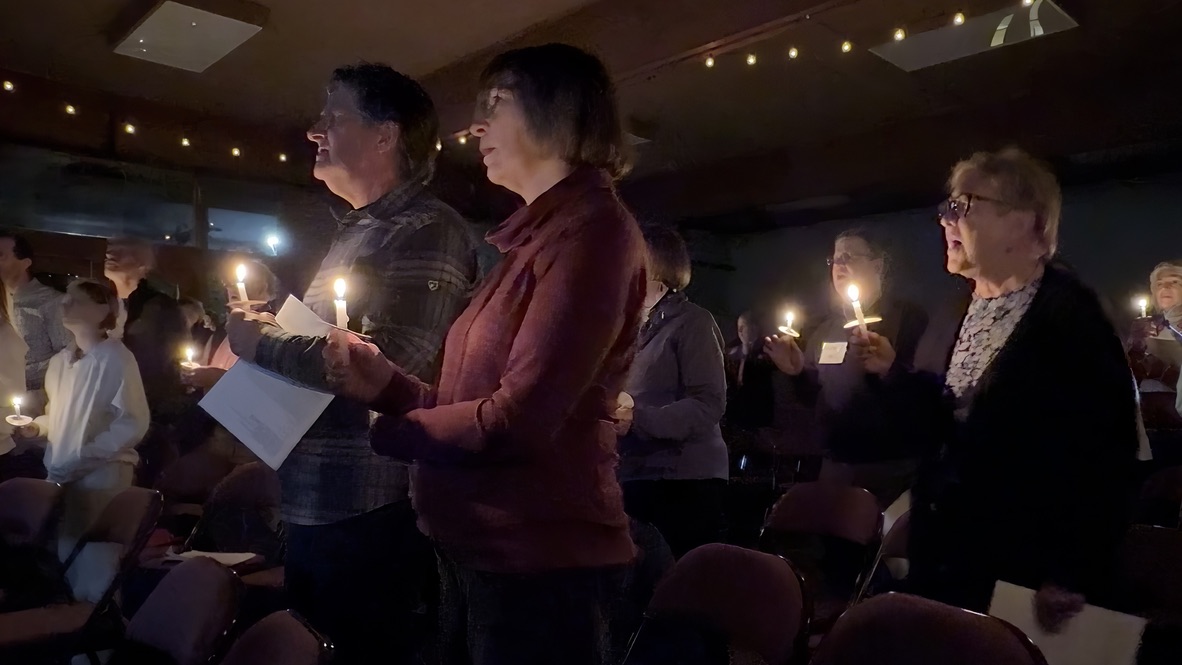
Easter Vigil 2025 at St. Barnabas, Bainbridge Island, Washington.

Many churches don’t do the Easter Vigil, and of those that do, all too few give it proper attention as the richest and most luminous liturgy of the entire year. It requires a lot of preparation, effort and energy at the end of a very labor-intensive week. It also involves a long-term project of educating a congregation to understand the Vigil as the preeminent Easter rite.

You can celebrate the Resurrection gloriously on Sunday morning, but if you want to experience Resurrection in a kind of Christian dreamtime, come to the Vigil as well. And if you are in a community which already knows the unique power of the Vigil experience, I encourage you to explore the potential of its stories to empower our bodies and restore our souls in this dark and dangerous age.

If you are not part of a community that does the Easter Vigil, I thank you for reading this far anyway. But if you are in a position to shape a creative Vigil, here are some suggestions to get you started.

You may want to begin with just one or two stories. Find the creatives in your community and form a team to study the texts and discern what they are trying to say now. And think about the connections they make with our lives and our society. For example, footage from the Minneapolis protests could be part of the Red Sea saga, or the king’s ruffians throwing their victims into the fiery furnace could be dressed like ICE agents.

Decide for each story whether to use simple storytelling (one or more voices, scripted or retelling freely) or more theatrical means (scripts, actors, visual design, visual media, singing, musical score, sound effects, etc.). Think about ways to involve children (e.g., animals on the ark, or part of the Red Sea march to freedom) and even the whole assembly, through singing or collective reading, like a Greek chorus, of projected words on a screen. Involving as many people as possible in creating and performing the stories bolsters both attendance and enthusiasm. Play with ideas, images and words until the stories take shape. Then provide sufficient time for learning lines and rehearsals.

Ideally, the Story Space will be separate from the worship space. A parish hall is usually more flexible than a church interior in terms of seating and a stage area. If there is a screen or a large white wall, large images can be projected. Strings of party lights on a dimmer and LED spotlights with variable colors are easy ways to restrict light to the stage area and establish the mood for each story. The other advantage of a separate Story Space is that a liturgy conducted in a sequence of spatial locations underscores the Vigil as a journey—from the New Fire outside to the Story Space to the font to the altar and finally back into the world.

And let each story be followed by an appropriate song (I use both folk music and contemporary songwriters to fit the relaxed spirit of “tales around the sacred campfire,” in contrast to the chant and hymnody in the church portion of the liturgy). Then comes a bidding to prayer, summarizing the themes of the particular story.

Let me close with the bidding I wrote to follow The Valley of Dry Bones. It expresses everything I want to say about the liberating power of our stories to resist evil, proclaim hope, and lift up our hearts:

Dear People of God: There are those who tell our story as a history of defeats and diminishments, a narrative of dashed hopes and inconsolable griefs. But tonight we tell a different story, a story that inhales God’s own breath and sings alleluia even at the grave. By your baptism, you have been entrusted with this story, to live out its great YES against every cry of defeat.
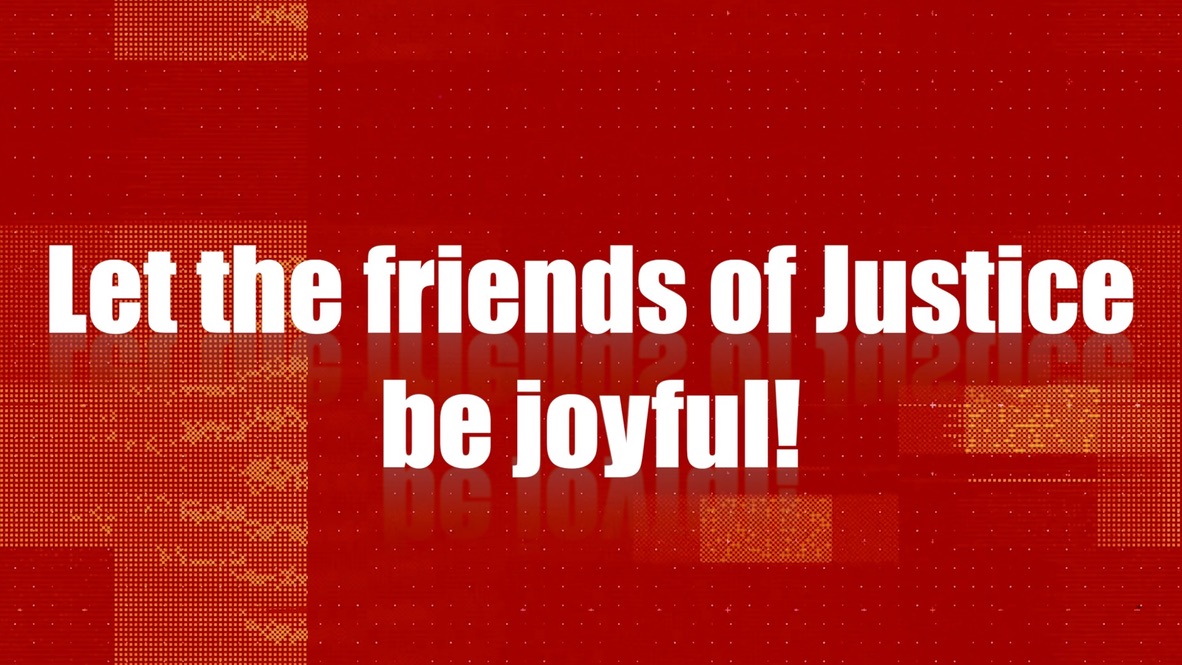
Psalm 68:3, one of the texts projected in the background of the Red Sea story.


“For God so loved our stories” — Tales from the Easter Vigil

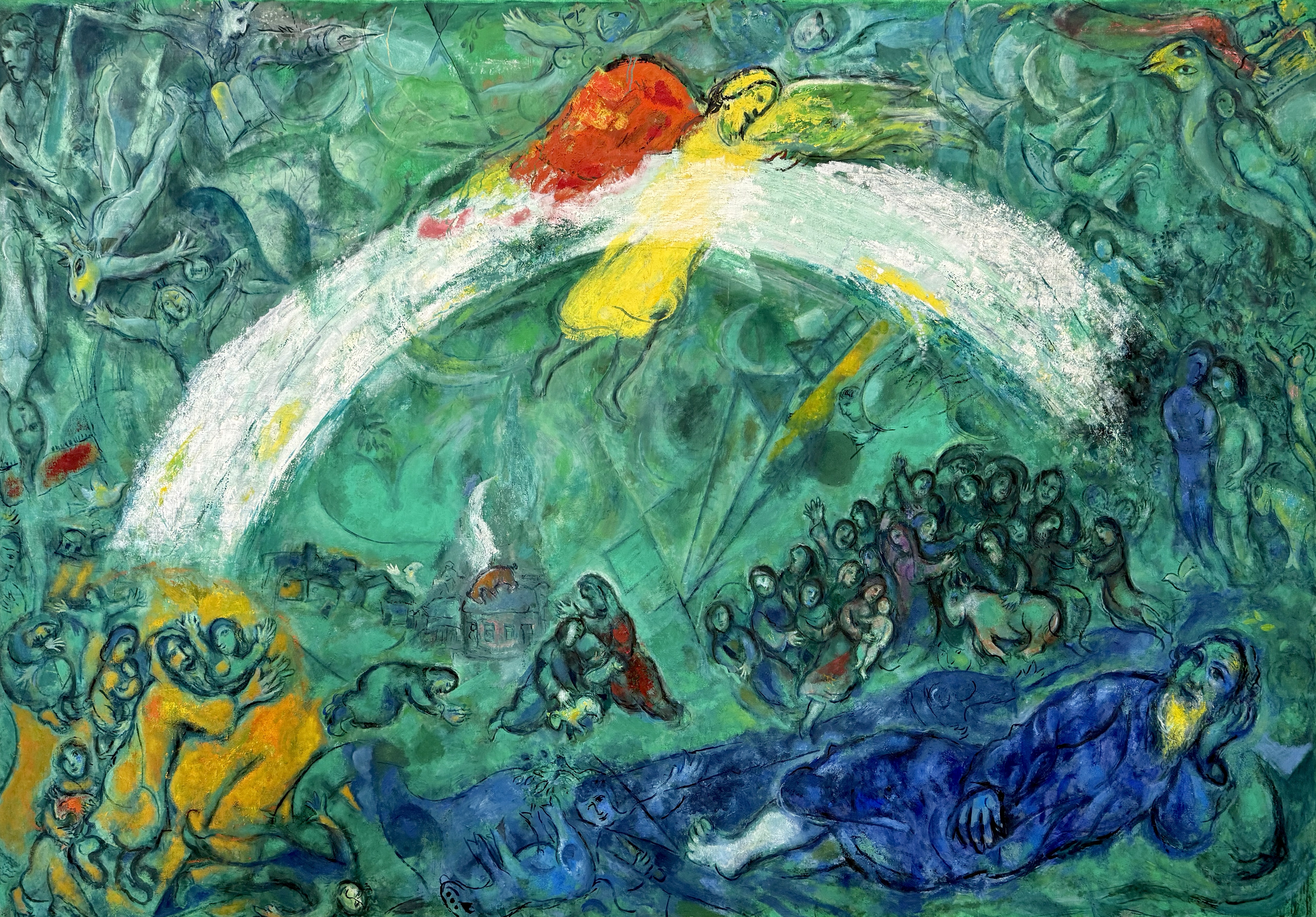
Marc Chagall, Noah and the Rainbow (1961-66)

How blessed is this night, when earth and heaven are joined …

— The Exultet [i]

The Easter Vigil is the molten core of Christian worship: a multisensory passage from darkness to light, death to life. With fire and water, stories and prayers, hymns and chants, candles and incense, bread and wine, it is the most luminous and wondrous of liturgies. The morning rites of Easter Sunday celebrate Resurrection, but the Easter Vigil on the night before feels almost like Resurrection itself. When it’s over, you come away a little dazed, wondering “oh what is that beautiful thing that just happened?” [ii]

After the New Fire is lit at sunset on Holy Saturday, one of the first things that happens at the Easter Vigil is the recitation of narratives and prophetic texts [iii] from the Hebrew Scriptures, beginning with the Creation story (Genesis 1:1—2:4a). In most churches, the texts are read from a lectern, but for nearly four decades, in a dozen different West Coast churches, I have curated the performance of the Vigil lectionary using drama, storytellers, music and projected media.

There’s nothing wrong with a well-read passage of canonical text—I’m quite fond of a good reading by a practiced and thoughtful voice—but sometimes a telling or dramatization can reach places which a reading cannot. Instead of a reader as a passive, transparent window for a sacred text to pass through without inflection or distortion, a teller embodies the text in breath, intonation, gesture and movement, making it alive and present and urgent in the moment of its speaking. And a dramatization can make a familiar story be freshly encountered. A story told or performed rather than read has a unique kind of authority, coming from the heart instead of a book.

The Easter Vigil is the Christian dreamtime, and we try to engage its lectionary accordingly. Biblical stories aren’t just memories about the past. They are living words meant to guide and shape our own responses to the present. As we become steeped in the stories, they begin to dwell in us, and we in them.

When we hear of the world drowning in its own evil, while a faithful remnant tries to navigate the sea of chaos, we recognize ourselves aboard the ark. When we hear of an evil regime trying to crush the ones who are “not like us,” the deliverance of the oppressed at the Red Sea encourages our own struggle to break free of the dark. When we hear of dry bones resurrected by divine breath, our own dead hopes begin to breathe again.  

In the darkest days of the Second World War, W. H. Auden wrote a “Christmas Oratorio” [iv] which had no illusions about the world into which God was made flesh:

The evil and the armed draw near;
The weather smells of their hate
And the houses smell of our fear …

Such days are upon us again, and we truly need our sacred stories—the ones that remember divine intention and a habitable future—more than ever. At our Episcopal parish of St. Barnabas on Bainbridge Island, Washington, where my wife is the rector, I’ve been developing fresh versions of the stories, listening carefully for whatever they want to say to us in the year of our Lord 2025.

We will begin with a pair of texts projected on a screen after the ancient Exultet is chanted. The first says, For God so loved our stories. This is of course a blend of Elie Wiesel’s “God made man because he loves stories” and John 3:16’s “For God so loved the world …” The theology of Incarnation says that God’s own self entered fully into the human story. And the theology of salvation says that we in turn are meant to participate in the divine story. Both meanings are implied in the preface to our Vigil story time, grounding the performed narratives in the conviction that we can meet God in them.

The second text is a verse from Jeremiah (29:11): For surely I know the purpose I have for you, says the Holy One: plans for peace and not for evil, to give you a future and a hope. At a time when our future is in question and hope is stretched thin, God invites us to sit around the Paschal fire and let the stories of promise speak to our hearts once more.

Here is how the telling will go at this year’s Paschal fire:

The Creation: After the voice of e.e. cummings says, “When God decided to invent everything, he took one breath bigger than a circus tent, and everything began,” a big screen lights up with spectacular footage of the natural world, taking us through the first seven days in seven minutes. In response, the congregation is urged “to pray fervently for all the people of the earth, and for ourselves, that we may repent of our careless and arrogant abuse of creation, and find our proper and constructive place within its fragile and balanced harmonies.”

The Flood: Four people at a table engage in Bible study. Some of them resist the story (“Why do we even tell this story? No one wants to believe in an angry God” … “In the beginning, God says everything’s so great. Then suddenly he wants to call the whole thing off?”). Others see a kind of learning going on—God learning to live with an imperfect creation. Then somebody argues that the story is not really about God’s choices or God’s emotional life. It’s about the ark.

“The people who first told this story were just like us. They were adrift in a sea of chaos. Everything they had hoped and believed was underwater, washed away in the blink of an eye, and they wanted to know if they still had a future.”

As the discussion winds down, someone says, “Well, I’d better go feed the animals.” Wild waves appear on the screen behind them. It turns out that they have been on their own ark the whole time. The story they were discussing was happening to them. That’s often true of Bible stories.

The exhortations to prayer that follow each story reiterate the themes of the narrative. After The Flood, the Presider reminds the assembly that “God remains deeply committed to our story … God will not forget us, though we be sinking in a sea of chaos.” And the Deacon bids us pray for victims of natural disasters, all whose lives are beset by chaos, those drowning in the dark waters of doubt and fear, and those who cling to the precious ark of faith.

The Red Sea:

Noirish images of anonymous figures (from a bleak Hungarian film) shuffle through an imprisoning corridor on the screen, while three dancers on the stage express the experience of oppression with their bodies. A narrator explains:

Three thousand years ago, in the land of Egypt,
there were people who had no name.
They were the faceless many,
exploited by the powerful,
forgotten by the privileged: slaves, immigrants, the poor,
the homeless, the vulnerable, the invisible, the outcast.

Then dismissive terms for the oppressed appear on the screen in stark animated graphics: Not like us … worthless … horrible people … trash … less than human. More images of “the faceless many” are shown as the dancers writhe in despair and an offstage choir sings a verse of “Go down, Moses.”

Suddenly, the divine breaks into this dark world: the screen flashes red, and we see the words from Psalm 68 that are always used in Orthodox Paschal liturgies:

Let God arise!
Let the foes of Love be scattered!
Let the friends of justice be joyful!

Then we hear a verse of a Civil Rights song: “They say that freedom is a constant struggle … Oh Lord, we’ve struggled so long, we must be free.” The dancers’ bodies shift from oppression to liberation, while the screen shows powerful footage of crowds on the march for justice. As we hear a repeating loop of Martin Luther King saying “We cannot walk alone,” the dancers begin their own march across the stage to the “Red Sea,” where they halt while the narrator declares:

This too is a creation story:
On this day, God brought a new people into existence.
On this day, God became known as the One who delivers the oppressed,
the One who remembers the forgotten and saves the lost ,
the One who opens the Way through the Sea of Impossibility,
leading us beyond the chaos and the darkness into the Light.
When the world says No, the power of God is YES!

As the dancers begin to cross the Sea, the choir sings, “We are not alone, God is with us …”
After the song, the bidding to prayer begins:

Pray now for the conscience and courage
to renounce our own complicity
in the workings of violence, privilege and oppression.
Pray in solidarity with all who are despised, rejected,
exploited, abused, and oppressed.
Pray for the day of liberation and salvation.

The Fiery Furnace: This story from the Book of Daniel is borrowed from the Orthodox lectionary for the Paschal Vigil, and its humor (yes, the Bible can be funny) provides some comic relief after the Red Sea. The story’s mischievous mockery of a vain and cruel king, outwitted in the end by divine intention, feels quite timely. The idol shown on the screen is a golden iPhone, which will be destroyed by a cartoon explosion from Looney Tunes. The humorously tedious repetition of the instruments signaling everyone to bow is performed with the following (admittedly unbiblical) instruments: bodhran, bicycle horn, slide whistle, chimes, train whistle, and Chinese wind gong. The Song of the three “young men” in the furnace is recited by three women in an abbreviated rap version. At the end, the cast of twelve exit happily, singing the old Shape Note chorus, “Babylon is fallen, to rise no more!”

The Fall of Babylon, Tapestry of the Apocalypse, Angers, France (1377-1382).

Then we give thanks “for the saints who refuse to bow down to the illusions and idolatries of this world” and pray for “the grace and courage to follow their example, resisting every evil, and entrusting our lives wholeheartedly to the Love who loves us.”

Valley of Dry Bones: Unlike the embellished retellings of the other stories, this one sticks closely to the biblical text, but is delivered in a storytelling mode by a single teller (me) in a spooky atmosphere of dim blue light. The voice of God is a college student on a high ladder. The sound of the bones joining together is made by an Indonesian unklung (8 bamboo rattles tuned to different pitches). When the story describes the breath coming into the lifeless figures sprawled across the valley, I get everyone in the assembly to inhale and exhale audibly a few times so that we can hear the spirit-breath entering our own bodies. Then I move among them, bidding one after another to rise until everyone is standing, completing the story with their own bodies: the risen assembly itself becomes a visible sign of hope reborn.

Then the Presider says,

Dear People of God: There are those who tell our story as a history of defeats and diminishments, a narrative of dashed hopes and inconsolable griefs. But tonight we tell a different story, a story that inhales God’s own breath and sings alleluia even at the grave. By your baptism, you have been entrusted with this story, to live out its great YES against every cry of defeat.

And then, with our sacred stories of faith and hope freshly written on our hearts, we will process from the Story Space to the church for the Renewal of Baptismal vows, followed by the festive first eucharist of Easter, replete with Alleluias. And God willing, by the time it’s all done, none of us will be the same.

May all of you who make the Paschal journey this weekend come to “see and know that things which were cast down are being raised up, and things which had grown old are being made new, and that all things are being brought to their perfection by the One through whom all things were made, our Savior Jesus Christ.” [v]

Resurrection of Christ, Brittany (c. 1425-1430).


All liturgical texts, unless otherwise cited, are by the author.
The Easter Vigil at St. Barnabas Episcopal Church (Bainbridge Island, WA) is on April 19, 2025.

[i] The Exultet (“rejoice”) is a chanted praise sung before the Paschal Candle at the Easter Vigil. Dating back to the 7th or 8th century, it is one of the most beautiful chants in the western rite, and its text is packed with striking images and metaphors of Christ’s passage through death to resurrection, and its implications for our own salvation. Singing it at the Vigil has been one of my greatest priestly joys over the years.

[ii] The line is taken from Mary Oliver’s poem, “At Blackwater Pond.”

[iii] The Vigil lectionary is not all stories. Beautiful texts from Isaiah, Baruch, Ezekiel, and Zephaniah are options as well. During the “Story Time” of the Vigil, we stick to the narratives. The non-narrative texts are then recited by readers along the way between the Story Space and the church, so that the people process through a corridor of continuous audible texts on their way to the font of rebirth.  

[iv] W. H. Auden began writing For the Time Being: A Christmas Oratorio in the autumn of 1941. It was published in September, 1944). Dark times indeed.

[v] Quoted from the collect (prayer) that concludes the Old Testament readings in the Episcopal Book of Common Prayer.

“Let’s do it for the story”: A Farewell to Angela Lloyd

Storyteller Angela Lloyd

Once upon a time, a brilliant storyteller came into the world to touch countless hearts with tales of wisdom and wonder, losing and finding, tears and laughter. She scattered her life-giving stories far and wide, and encouraged others to do the same. She knew the power of stories to bind us together, ground us in communal wisdom, and help us imagine better futures. Hers was a serious vocation in a world so forgetful of the stories we need, the stories that nourish, the stories that save. But she always lived out her calling with levity and lightness. Everyone who has known her remembers her laughter, her joy, her delight in daily blessings, her generous and irrepressible spirit. As she liked to put it, she was “subject to bursts of enthusiasm.”

Desert dawn at Angela’s house (December 17, 2024): Looking west, looking east.

A week before Christmas, master storyteller Angela Lloyd was up at dawn, photographing the beauty of the California desert sky. She posted two photos with a greeting to her friends: “Good morning. The view from here: looking west, looking east.” She loved sharing the beauty of her desert home. But sometime after that glorious morning she was taken ill, and not long after, on the twelfth day of Christmas, Angela departed this life. When I got the news today, the world felt suddenly washed with grey, bereft of her bright presence.

I came to know Angela nearly 40 years ago, when we worked together on creative retellings of Old Testament stories for the Easter Vigils at Christ Church, an Episcopal parish in Ontario, California. We both believed that God is not known through ink so much as through breath. Without the breath of a spirited teller, our sacred stories may lie dormant and listless.

After a few years we made a film of the stories, The Electronic Campfire: New Storytelling from Scripture. Angela took some of the parts (including that of God), while I took the rest. We shot the scenes in various southern California locations.

When I heard that Angela had died, I wanted to celebrate her giftedness by sharing her work in this film. While throughout her life she told many different kinds of stories from a variety of sources and traditions, our biblical collaborations do convey, I believe, a lively sense of the engaging spirit she brought to everything she did. I offer these clips in her memory.

On the third day of Creation, God creates plants and trees.

The first is the Creation story from the first chapter of Genesis. Instead of speaking the divine words for each of the seven days (“Let there be light,” etc.), God performs an action, since in the Bible God’s word is not just description of an action, but the action itself. For God, to say is the same as to do.

The Creation Story from The Electronic Campfire

Angela’s other stories in the film were the Red Sea and the Valley of the Dry Bones. In the first story, I play the Israelites, so you’ll see a bit of that as a lead-in to Angela’s performance of both Yahweh (God) and Miriam (Moses’ sister). The Dry Bones story is all Angela, including some of her riffs on the washboard. She improvised a line the Exodus tale which, in retrospect, sums up her life: “Let’s do it for the story.”

Red Sea & Dry Bones from The Electronic Campfire

At the Easter Vigil, there is a bidding to prayer after each story. Here are the words which follow the story of the Divine Breath that ceaselessly enlivens our “dry bones”—in this world and the next:

Dear People of God:
There are those who tell our story
as a history of defeats and diminishments,
a narrative of dashed hopes and inconsolable griefs.
But tonight we tell a different story,
a story that inhales God’s own breath
and sings alleluia even at the grave …

The sixth day: “Let us make humankind in our image.”

We did a number of Easter Vigils together, and Angela would always surprise me with a new variation. One time, playing an Israelite in the Exodus, she pulled out a postcard. “I was planning to mail this when we got to the Promised Land,” she said, “but something tells me I should mail it now. It may be a while before we get there. Besides, I’m starting to think that maybe anywhere can be the Promised Land, that even in this wilderness I am standing on holy ground.”

Thank you, dear Angela, for your marvelous stories, your enthusiasm, your joy, and so much more. There’s an old song by Jane Voss that salutes absent friends, and what the song says, that is what I say:

Wherever you may be tonight,
I hope this finds your burdens light,
Your purpose high, your spirit strong,
I hope that you have got along—
My song was lost and gone, if not for you.  

The Paschal Wisdom of Holy Week

In the Garden, an icon by the hand of the artist, Angelica Sotiriou, 2009.

I’m writing this on Maundy Thursday, the night of Jesus’ tender farewell supper with his friends—and the night he was handed over to malevolent powers. The beautiful icon from the hand of California sacred artist Angelica Soteriou [i] captures the wrenching moment between the solidarity of his loving community and the fatal desolation of his Passion. He is alone. Neither friends nor enemies share his existential space. He’s kneeling in prayer, arms stretched out, beseeching his Father for whatever is needed to make it through the night. But his hands remain open, receptive to a will not his own. Not my will, but thine. And though an annihilating blackness surrounds him, his body is held safely within the warm color of the mountain of God. Even when we feel alone, even abandoned, we are still enfolded within divine love and mercy. Our divine milieu is not an exemption from trouble, but an assurance against trouble’s finality.

On this holy Thursday, many churches, including mine, do the eucharist in the context of an actual shared meal. It is is our custom to eat in silence, which monastics know is a profound way to be together. Our silence is punctuated by a series of meditative readings from the Farewell Discourses, the words of encouragement, comfort and challenge which, in John’s gospel, Jesus speaks to his friends on the night before his execution. It’s not a reenactment of a past event. Those words are spoken directly to us, in our own fraught time.  

Tonight, however, we added a word from one of Jesus’ more recent friends, the theologian Dietrich Bonhoeffer, who was facing his own Gethsemane in a German prison. At Christmastide, 1944, a few months before he would be executed by the Nazis, he wrote a poem which was smuggled out of prison in a letter to his mother. Its expression of confidence and hope in the midst of an evil time not only echoes the spirit of Jesus’ Farewell Discourses, but it speaks strongly to our own latter days, when so many things are in peril.

Here is the versified translation of Bonhoeffer’s poem by the British hymn writer Fred Pratt Green:

By gracious powers so wonderfully sheltered,
and confidently waiting come what may,
we know that God is with us night and morning,
and never fails to greet us each new day.

Yet is this heart by its old foe tormented;
still evil days bring burdens hard to bear;
O give our frightened souls the sure salvation
for which, O Lord, you taught us to prepare.

And when this cup you give is filled to brimming
with bitter suffering, hard to understand,
we take it thankfully and without trembling,
out of so good and so beloved a hand.

Yet when again in this same world you give us
the joy we had, the brightness of your Sun,
we shall remember all the days we lived through,
and our whole life shall then be yours alone.[ii]

Yes, we too are living through “evil days” which weigh down “our frightened souls” with “burdens hard to bear.” But our brother Dietrich, like our brother Jesus, reminds us that there is an alternative to fear and despair, if we can find the courage to live into God’s future, come what may, and the Paschal wisdom to walk the Way of the Cross “thankfully and without trembling,” because we know that death doesn’t get the last word.

Now, as we move into Good Friday, listen to what Rowan Williams, former Archbishop of Canterbury, says about the cross:

Jesus crucified is God crucified; so we believe. Jesus is the total and final embodiment in history of God’s loving mercy; and so this cross is a unique, terrible, extreme act of violence—a summary of all sin. It represents the human rejection of love. And not even that can destroy God; with the wounds of the cross still disfiguring his body, he returns out of hell to his disciples and wishes them peace. There is our hope—the infinite resource of God’s love, the relationship with God’s creatures that no sin can finally unmake. God cares what we do because God suffers what we do. God is forever wounded, but forever loving. The possibilities of our relationship to God are indeed ‘new every morning.’” [iii]

In other words, says Williams, “we have a future because of God’s grace.” Bonhoeffer said the same thing, and he said it from death row. That’s what the Paschal Mystery of dying and rising is trying to tell us—not only in the rituals and narratives of Holy Week, but in the kind of lives we live when we fully embody the archetypal pattern of surrender and transformation. The way down is the way up. Lose your life to find it. Let go and let God.

There’s always more to say about this, of course, but it’s almost midnight, and tomorrow is the rigorous journey to the foot of the cross. And beyond that, there’s the Easter Vigil, a night of wonders when heaven and earth are joined and liturgical curators are left exhausted yet exultant in its wake. If you want to read more about the cross, try What Will the Cross Make of Us?, written in 2022 by my less tired self. For more on the Easter Vigil, try Just a Dream?—Reflections on the Easter Vigil.

I’m going to bed now, but let me leave you with a 3-minute trailer for the Triduum, pushing the point that the Triduum is not a la carte, but a 3-part connected sequence that wants to be experienced in full. The three-day Paschal passage from Passion to Resurrection isn’t just bingeing on liturgy. It’s a profound way of knowing that delivers you to a different place. As we say at my church every Holy Week, “The journey is how we know.”


[i] For more of Angelica Sotiriou’s compelling work, see her website: https://angelicasotiriou.com

[ii] Fred Pratt Green’s hymn adaptation of Dietrich Bonhoeffer’s poem appears in many hymnals and is available from Hope Publishing, Carol Stream, IL. For more on the poem’s creation and reception: https://www.umcdiscipleship.org/resources/history-of-hymns-by-gracious-powers

[iii] Rowan Williams, from a sermon excerpted in A Time to Turn: Anglican Readings for Lent and Easter Week (Harrisburg, PA: Morehouse Publishing, 2004), 99.

Fireworks and Stories: Creativity Aboard the Easter Vigil

Noah’s Ark: Fresco, Abbey Church of Saint-Savin-sur-Gartempe, France (c. 1100).

My sister Martha Stevens is a marvelous storyteller. It was her profession for a long time, as she traveled far and wide to hold listeners spellbound with tales from many centuries and cultures. In the late 1980s, inspired by her work, I began to foster retellings of biblical narratives at the Easter Vigil—Creation, Flood, the Binding of Isaac, the Red Sea and the Valley of Dry Bones. Over the years, these Vigil retellings expanded to include theater and multimedia as well as individual storytellers. 

Although I have curated creative Easter Vigils with story teams in a wide variety of parishes over the years, I began with an 8-year stretch at Christ Church, an Anglo-Catholic parish in Ontario, California. When I introduced the storytelling component in 1988, the church already had a famously distinctive practice for welcoming resurrection. 

While a joyful noise is customary in most churches after the first shouts of “Christ is risen,” this usually means the ringing of bells and the organ’s roar. But to these were added not only dozens of wind chimes placed within the reach of every worshipper, but the boom and blaze of fireworks. After his first experience of the Christ Church Vigil in 1989, visitor David Trowbridge wrote down his impressions. His description of the fireworks reflects the assembly’s collective astonishment in that moment:

“Well, at this point, everybody for at least three miles in every direction who wasn’t awake woke up and knew that it was Easter again at Christ Church. There was a shattering explosion from the courtyard [visible through the nave’s glass wall] as the first of at least 10,000 LARGE firecrackers went off. Then the pinwheels, then the Roman candles, and then the 10-foot high cross in red fireworks with blue fireworks (representing the water of baptism) underneath. Everybody started laughing and exclaiming and jumping up and down, but nobody could hear anything. 

“The contrast between the mystical beauty of the Kyrie just before and the almost orgiastic release of the fireworks was exactly right—nothing I have ever experienced has so truly expressed the joy and release that Christians should feel in celebrating the mystery of the empty tomb. We tend to take the story for granted, but at Christ Church, the noise and the excitement made it all new again, and we all felt, for a few minutes, a little of the unbelieving excitement that the disciples must have felt that first Easter Day, when they found that He, first of all [human beings], had conquered death.”[i]

The previous year, I had approached the church’s longtime rector, Jon Hart Olson,[ii] about adding storytelling to the Easter Vigil. Jon, a brilliant theologian, exquisite liturgist, and a generous encourager of my own priestly imagination, welcomed the chance to offer fresh versions of the old stories. The people of Christ Church embraced the idea as well, and it became part of their annual tradition. When I had a chance to revisit their Vigil 20 years after leaving the parish, I was delighted to see the creativity continuing, as Dry Bones came to life in the form of two break dancers in skeleton suits. As they gyrated beneath a blacklight, all we could see in the dark was their dancing bones.[iii]

In his account of the 1989 Vigil, Trowbridge found the storytelling as compelling as the fireworks: 

“The priest who told the story of Noah and the Ark was especially entertaining. At one point, describing the animals boarding the ark two-by-two, he named about 100 animals in alphabetical order … He described how cranky and bored everyone got on the Ark, and how Noah organized singalongs for the animals. At this point he got everyone making their favorite animal noises all together. Pandemonium! I was screaming like a chimpanzee, which seemed to provoke the rector, who was sitting nearby, into a fit of laughter. At the end of the reading, the [storytelling] priest unfurled a long cloth rainbow across the room …

“After the [fireworks], the Eucharist proceeded as usual, or so we thought, but there was one more surprise in store for us. At festal Eucharists, it is customary to read the Gospel lesson with much ceremony. The Bible is carried from the altar, the deacon who is to read it is blessed by the priest, it’s carried out into the midst of the congregation with candles and incense … and so it was here. Then, as is customary, the deacon lifted up the Bible and intoned, ‘The Holy Gospel of our Lord Jesus Christ, according to Luke,’ and we all responded, ‘Glory to You, Lord Christ.’

“And the back door of the church swung open with a loud crash, and a disheveled woman in a purple sweater and black pants rushed in! She shouted, ‘Sit down, all of you,’ and pushed her way to the front, rudely shouldering aside the deacon with the Bible. ‘Sit down! I’ve got something important to say.’

“At this point, I’m sure many people (I know I was) were thinking that one of Ontario’s street people had crashed the service. After a long moment of embarrassment and that ‘what should I do? … should I do anything?’ feeling, the woman identified herself. It was Mary Magdalene, who told us, in the vernacular, instead of in the elevated style of the Bible, what happened when she went to the tomb that morning to prepare Jesus’ body for burial. What a way to hear the Gospel! It was like hearing it for the first time.”

I do wish there were more storytelling in church. There’s nothing wrong with a well-read passage of canonical text—I’m quite fond of a good reading by a practiced and thoughtful voice—but sometimes a telling can reach places which a reading cannot. Instead of a reader as a passive, transparent window for a sacred text to pass through without inflection or distortion, a teller embodies the text in breath, intonation, gesture and movement, making it alive and present and urgent in the moment of its speaking. A story told rather than read has a unique kind of authority, coming from the heart instead of a book. God is not ink. God is breath. 

Not everyone is prepared for the energy—and occasional lack of decorum—of good storytelling in church. But many find it engaging, even revelatory. Dennis Dewey,[iv] a brilliant storyteller, is careful to deflect the inevitable praise evoked by his creative delivery of Bible stories: “You make the Bible come alive!” people tell him. “No,” he says. “The Bible already is alive. I just try not to kill it.” 

At this year’s Easter Vigil, pandemic protocols were still in place, so we were streaming the liturgy. For the Flood story, I solicited participation by asking parishioners to send me videos of themselves entering the ark (their front door) and staring out the ark’s portholes (their front window). Since we have all been on our separate arks for the past year, I wanted to acknowledge the challenge of our collective pandemic experience, while affirming our enduring faith in the rainbow promise. We’re in the story, and the story is in us.

I added voice-over to the submitted clips, and inserted a segment from a video of my Vigil stories, The Electronic Campfire: New Storytelling from Scripture (1991), made in collaboration with the amazing storyteller Angela Lloyd.[v] I hope you enjoy this short video, “The Flood and the Ark.” Even more, I hope you will be inspired to explore storytelling—and storylistening—within your own faith community. 


[i] David Trowbridge, unpublished manuscript (April 1989). David’s wife Nancy sent me this writeup at the time, encouraging me to share it “here and there if you wish.” It only took me 32 years to do so. My memories from several decades of creative Easter Vigils tend to conflate and become less true as memory simplifies and smooths out the details, so I am happy to possess this vivid firsthand impression from an attentive observer having the Christ Church Vigil experience for the first time. 

[ii] The Rev. Jon Olson preached at my ordinations to the Diaconate and the Priesthood, and taught me so much about liturgy and spirituality. He was the kind of friend who kept you up well past midnight with luminous (and hilarious) conversations. I cast him as Lazarus in my 1970s film The Investigation, which explores the Jesus story in a modern setting. I will always be grateful that Jon gave this itinerant priest an abiding place of welcome in the unique community he served at Christ Church. 

[iii] The break dancers were young men, part of the parish family, who danced professionally at Disneyland. They raced to the church after work to perform Dry Bones (those Vigils started at 9 p.m. and went past midnight). The teller of the story spoke, unseen, from the balcony at the back of the church, while the skeletons danced before the altar. 

[iv] I had the pleasure of taking a workshop in biblical storytelling from Dennis Dewey. Find his website here: https://sacredstoryjourneys.wordpress.com

[v] The Electronic Campfire, not currently available on disc, may be seen here: https://youtu.be/sDDdSKFSWoE   Angela Lloyd is not in the Flood story, but is featured in most of the others. Angela took part in most of my Christ Church Vigils. She is not to be missed (“a combination of Maria von Trapp, Mary Poppins, and Tinkerbell”—Donald Davis). For her website: https://www.angelalloyd.com

Lost at Sea: Retelling the Flood Story in a Pandemic

Row on, row on, another day
May shine with brighter light.
Ply, ply the oars, and pull away,
There’s dawn beyond the night.

–– Traditional sea shanty


At the Easter Vigil, we light a fire in the dark and tell our sacred stories. One of them is the saga of the Flood from the Book of Genesis. Tonight, as we stream the Vigil liturgy from our living room for our local parish, this is how it wants to be told. 

When we wonder about things, we tell stories.  One of our oldest stories describes a great flood that sweeps away everything in the world until there is nothing left but an endless sea. Some people say it’s a story about God getting fed up with the world’s violence and greed and wanting to start over. Others say the story is about everything being thrown out of balance by human sin––the harmonies break down, and God’s beautiful creation is swallowed up by chaos.

But tonight, when a new kind of flood is sweeping across the earth, washing away the world we know, maybe the story needs to be about the ark. We’re all in this boat together, hoping and praying we can survive the raging sea until the storms are over and we can anchor in some safe and peaceful harbor.

That’s where we are now, in the middle of the story––cooped up in this ark with a bad case of cabin fever, wondering if the flood is ever going to subside so things can get back to normal. It’s not easy, being stuck in this boat. It’s strange and stressful for us. Meanwhile, the sea gets rougher, the storms wilder.

It’s like that Psalm we say in Holy Week:

Save me, O God! The waters have risen up to my neck.
I am sinking in a deep mire. The waves wash over me.
Do not let the flood swallow me up! (Psalm 69)

That’s how it feels, here in the middle of the story, in the middle of the flood. We have our fears. We have our doubts. We have our losses. And frankly, some of us are getting sick and tired of this stupid ark. Been in the storm so long, Lord! How long? Too long.

But this isn’t where the story ends, with us lost at sea, sinking into oblivion. The One who made us will not forget us. The One who loves us will not forsake us. Already, God is imagining a future for us. Maybe it will be something better.

God never said we won’t be afflicted.
God never said we won’t be disquieted.
God did say we shall not be overcome.

When through the deep waters I call thee to go,
The rivers of sorrow shall not thee overflow,
For I will be with thee, thy troubles to bless,
And sanctify to thee thy deepest distress.

Ultreia!

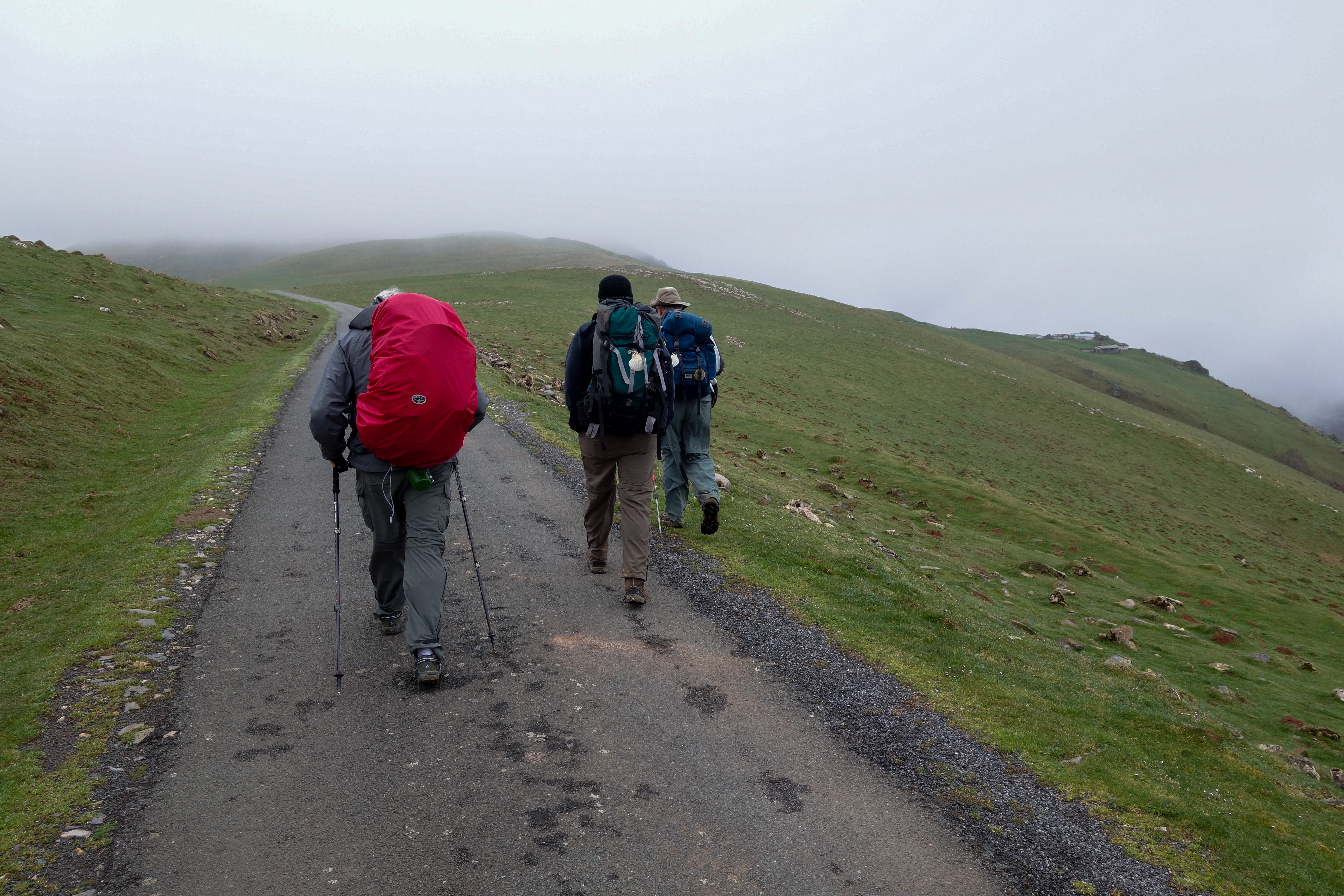
Camino de Santiago, west of Pamplona.


The Religious Imagineer is five years old this week. It began during my 500-mile pilgrimage on the Camino de Santiago in the spring of 2014, with dispatches on miles I walked, things I saw, people I met, thoughts I had.

No great views today, but the summit where France turns to Spain was a brooding cloud of unknowing where we walked by faith not sight. (April 8, the first day)


Crossing the Pyrenees on the first day.


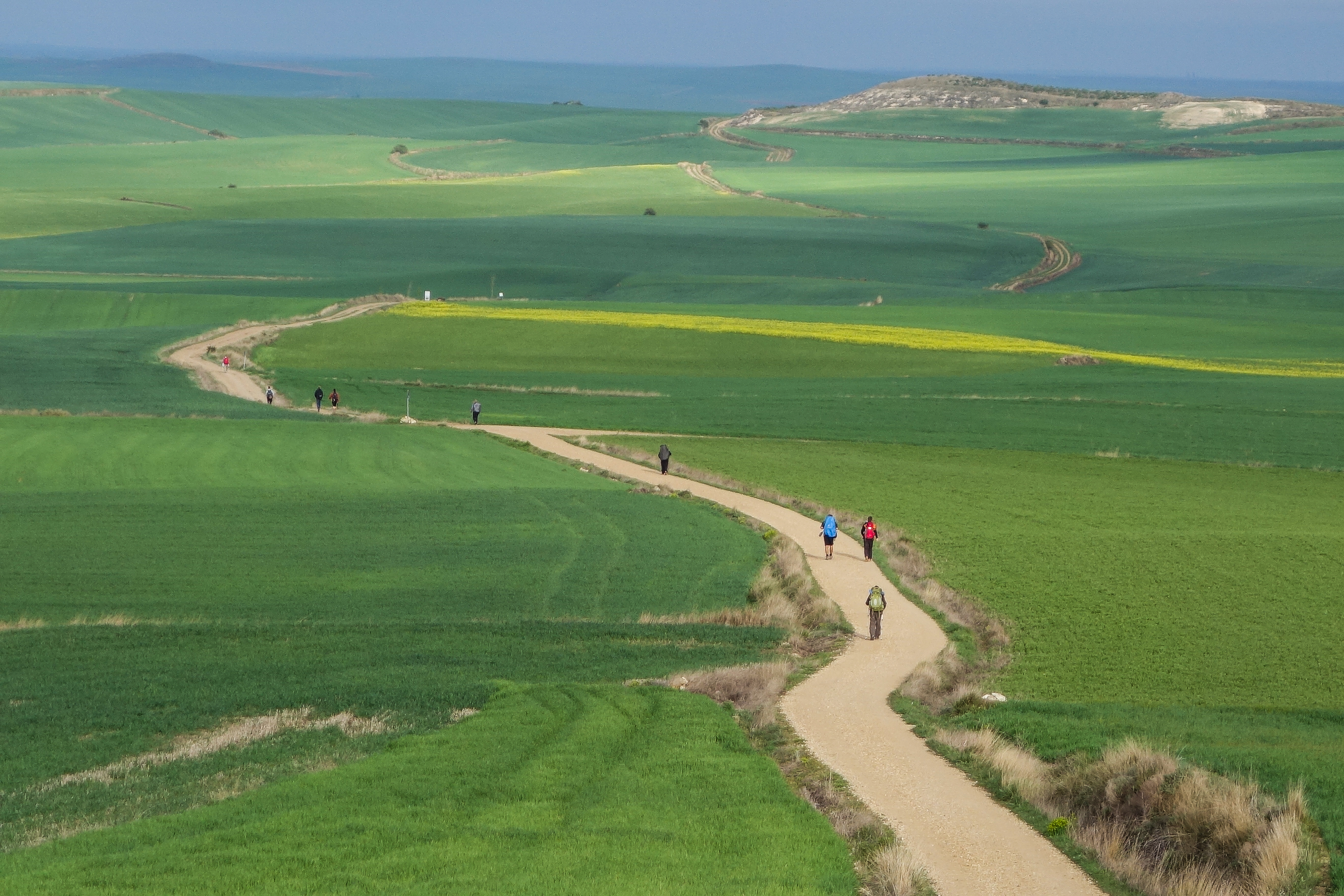
The land through which we pilgrims passed today was painted with a few strong colors: dark green wheat, yellow mustard, blue sky, white clouds. Those four colors filled the eye in every direction, with no lesser hues to dilute the effect. To wander through such a scene was a glorious thing. Whatever else the Camino brings, I will have had this day. As a German woman said as she passed me by, “Cherish every step! Cherish every step!” (April 11)


Pilgrims moving westward from Castrojeriz.


[A 30-second video of my shadow moving along the Camino]: If you want to experience the length of my walk in real time, replay this video 27,000 times. (April 25)


Few trees, big sky, only occasional villages, and long stretches where the only human presence was the long procession of pilgrims migrating westward. The lack of distractions and variations tends to make the very act of walking to be the mind’s principal occupation. As Robert Macfarlane puts it in The Old Ways: A Journey on Foot, walking becomes “sensational” – it isn’t just conducive to thought, it becomes the form thought takes. I walk, therefore I am. Perhaps it is similar to the way that cinema thinks through the movement of the camera. It isn’t forming propositional thought, but is simply absorbing through its attentive motion the shape of the world, the textures of existence. (April 29)


Fellow pilgrim Edward “Monty” Montgomery enters San Juan de Ortega on Good Friday.


There are many along this road who began it as a form of athletic challenge or youthful adventure or unusual vacation. And many will finish it that way. But in talking with those who profess no religious intention, or who are dismissive of Christianity as something they outgrew, I still hear the spiritual language of pilgrimage breaking through the verities of secularism. One has lost a job and is trying to discern a meaningful alternative. Another is trying to listen to her life from a place of unknowing. Another has no answer to the question of why he is walking, but still presses on to Santiago. To borrow a phrase from the great Spanish mystic, John of the Cross, every pilgrim is trying to arrive at a place we know not by following a way which we know not. (May 1)


Halfway to Santiago, a Camino friend was feeling some pain and discouragement on a particularly demanding stretch. But then he saw a handwritten sign: “Don’t give up before the miracle.” (May 7)


But can I, having now trod 478 miles in 31 days, really claim any kind of illumination or transformation as a result? I still get annoyed by the loud and incessant talkers who mar the tranquility, I still get angry when a speeding truck comes close to knocking me into a ditch. I have yet to perfect the pilgrim equanimity urged by my guidebook, which sees every irritation as the sand that produces the pearl. But at least I try to make these things part of my walking prayer. As the monks say of life in the monastery, “We fall down and get up, fall down and get up …” (May 9)


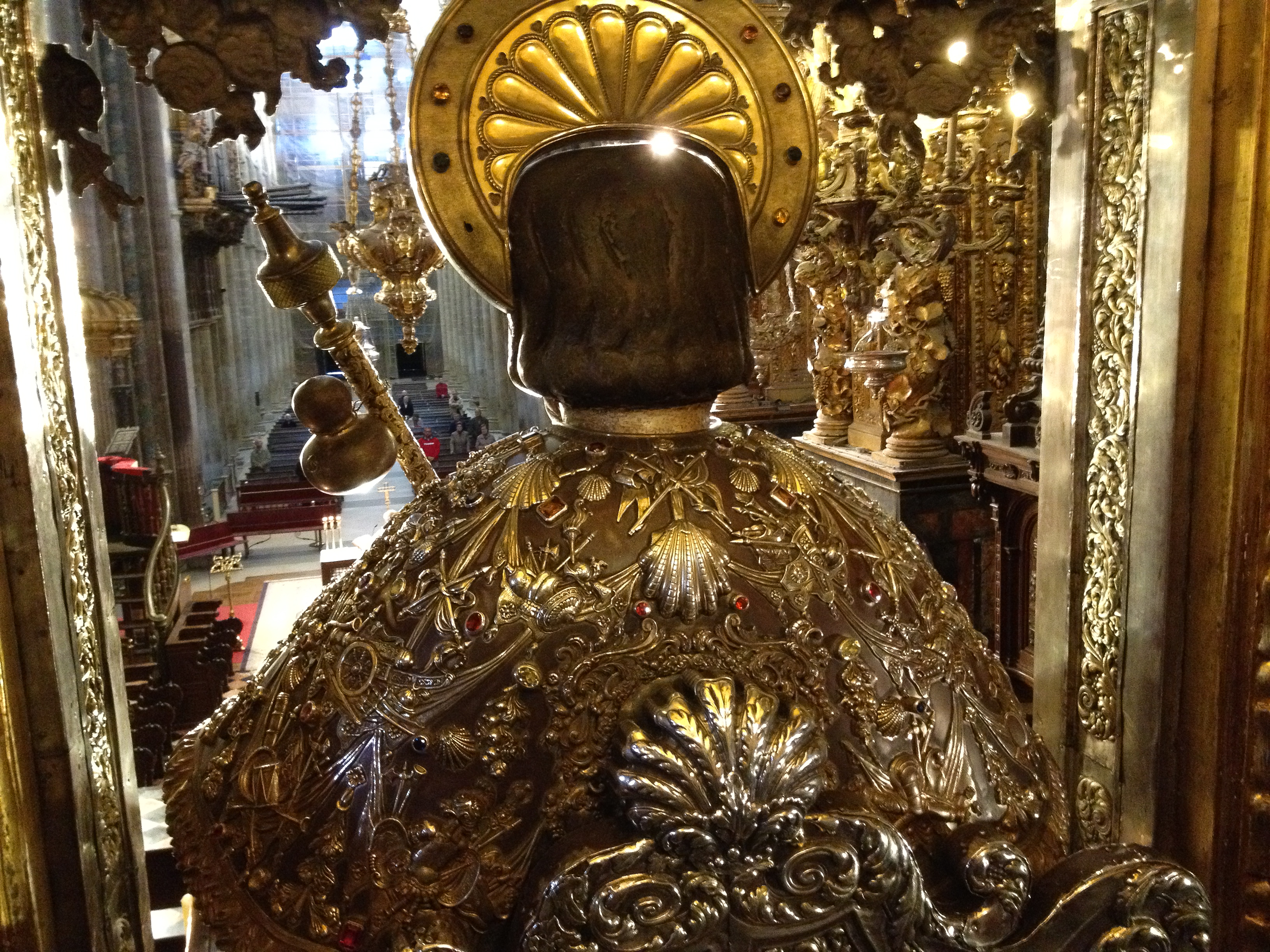
This morning I performed the final Camino ritual: climbing the stairs behind the altar to hug the gleaming metal effigy of Santiago. Despite the cool hardness of the sculpture, it was strangely comforting. I whispered in the saint’s ear: “Thank you for the beautiful voyage.” (May 12)


Statue of St. James behind the high altar, Cathedral of Santiago.

After I reached Camino’s ultimate end in Muxia, on the western shore of northern Spain, my blog just kept on going, continuing its own pilgrimage to God knows where, reporting as it goes. I have written about theology, spirituality, liturgy, poetry, the arts, cinema, music, politics, culture, nature, seasons, time, death and resurrection. My topics––and my influences––may be eclectic, but I trust my Christian faith and Anglican temperament to lend some coherence to these verbal wanderings.

In that spirit, I borrowed my blog’s subtitle from T. S. Eliot’s Four Quartets: “Where the fire and the rose are one.” This union of contraries––passion and tenderness, danger and beauty, wild instability and serene form––draws upon Dante’s imagery in the Commedia. Fire is purgation, divine light and the flame of love. The rose, perhaps inspired by the rose window of an Italian cathedral, images the heavenly city, containing a multitude of saints within its harmonizing circle. Dante unites flame and flower in his image of the Virgin, whose “womb relit the flame of love––/ its heat has made this blossom seed / and flower in eternal peace” (Par. xxxiii.7-9). In the unfolding future of God’s not-yet, the fire and the rose will indeed be one.

Gustave Dore, The Celestial Rose in Dante’s Paradise (1868)

In The Religious Imagineer’s first five years, there have been 237 posts, 61,913 visitors and 92,870 views. My ten most viewed posts so far have been:

1) The ten best Jesus movies (Jan. 6, 2015)–– I have taught Jesus movies for years, and find cinematic gospels, despite (or because of?) their flaws, to be fascinating case studies for questions of biblical representation and interpretation, as well as Christology.

2) Members of the same body? A post-election homily (Nov. 10, 2016) –– “Can we truly delight in each other, make others’ conditions our own, rejoice together, labor and suffer together? In one of the darkest moments in American history, this is the work we have been given to do.”

3) Ten ways to keep a holy Advent (Dec. 6, 2014) –– Interrupting, Silencing, Waiting, Listening, Watching, Praying, Reflecting, Loving, Giving, Receiving.

4) A deep but dazzling darkness (Aug. 25, 2017) –– My account of the 2017 eclipse, seen through the lens of mystical theology, continues to find readers almost every day. It has been viewed on more total days than any other post.

5) You can never go fast enough (Sept. 9, 2014) –– This mix of classic cars, road trips, nostalgia and eschatology got a huge amount of traffic when it became a WordPress editors’ pick.

6) 7 spiritual practices: a to-do list for the time of trial (Nov. 18, 2016) –– This brief guide to engaging the powers of darkness without losing our own souls remains all too relevant.

7) Dreaming the church that wants to be (Oct. 7, 2015) –– Eleven Christian artists gathered for 10 days in Venice to imagine a rebirth of wonder among God’s friends. This prologue, and the several posts that followed it, emerged from that quest.

8) The ten best religious films (Oct. 8, 2014) –– “Most of these films refuse the usual manipulations and excitements of mass cinema, and demand a contemplative mind. Transcendental style can be as rigorous as prayer.”

9) The spirituality of running (Aug. 4, 2016) –– A subject dear to my runner’s heart. “What we do with our bodies manifests and expresses inner states, the sacred ground of our being. But bodily practices can also induceinner states. How we move, how we sit, how we breathe, can all make a difference in our spiritual life. Inner and outer are intertwined and interactive. We pray in, with, through our bodies.”

10) Hospital for the soul (April 24, 2014) –– One of my earliest posts concerns a house of hospitality where pilgrims find momentary respite from the Camino’s onward rush. “Everyone is welcome here,” I was told, “but it’s not for everyone. Many people hurry along the Camino who show little interest in the work of the soul.”

Of the top ten, three are on spiritual practice, three are about movies, three are about widely shared experiences (the Camino, the eclipse, and our current political “time of trial”). And three include a number in the title, always a hit with the search engines!

If you want to explore further in these writings, enter a subject in the Search box, such as “Cinema,” “Nature,” “Liturgy and worship,” or “Imagination,” and you will find a range of selections. Or as we enter Holy Week, you might try “What Shall We Preach on Easter Sunday?” (currently featured in the April 10 issue of The Christian Century) or “Just a dream?­­––Reflections on the Easter Vigil.”

I am grateful to you, dear readers, for joining me in this journey of words and thoughts over the past five years. I deeply appreciate your attentive reading and supportive comments. And if you would like to help me expand the reach of this writing ministry by sharing your favorite posts now and then (share buttons are at the bottom of individual posts), that would be an awesome anniversary gift!

And now, as we say on the Camino, “Ultreia!” (“Let’s go further!”). In the days to come, I will always strive to be worthy of your time.

The author at Camino’s end in Muxia.

All photographs by Jim Friedrich

Consumed by Love: The Flames of Candlemas

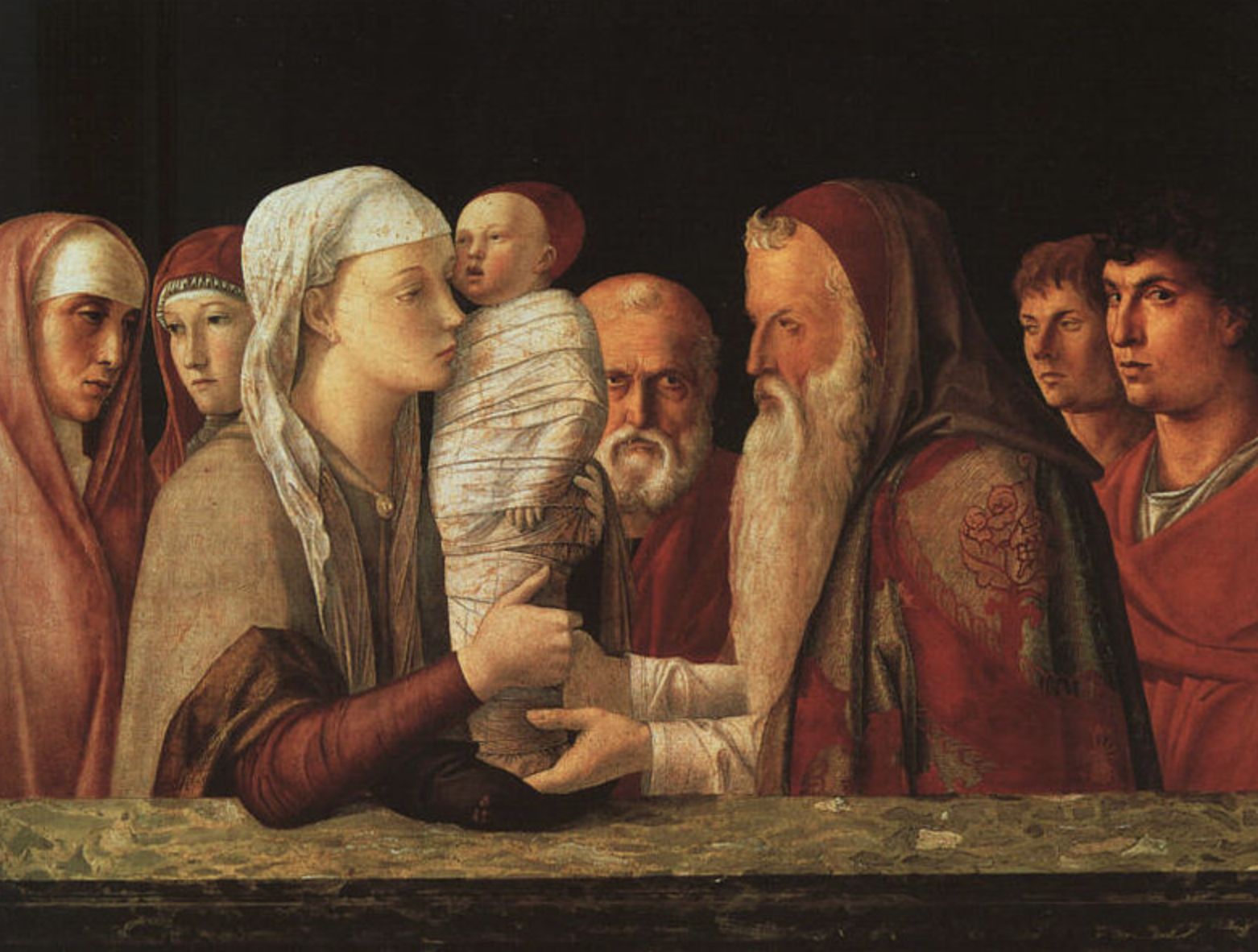
Giovanni Bellini, The Presentation in the Temple (1459)

Today is Candlemas, the 40thday after the Nativity. Its liturgical origins are obscure, but its blazing processions of candles in the winter dark not only made a glorious end to the extended Christmas celebrations of less hurried times, it also provided a brilliant preview of the resurrection fires of the Easter Vigil. Although it still may allow, for a few liturgically-minded procrastinators, a generous extension of the deadline for boxing up our holiday decorations, Candlemas is rarely observed in American homes and churches. Our minds are fixed on groundhogs and football, not the Presentation of our Lord in the Temple.

Still, I would gladly join a candlelight procession to a holy place on this night, to beseech the Light of the World “to pour into the hearts of your faithful people the brilliance of your eternal splendor, that we, who by these kindling flames light up this temple to your glory, may have the darkness of our souls dispelled.”

In the Eastern churches, Candlemas is called “The Meeting,” highlighting the moment when two old souls, Simeon and Anna, met the One for whom they had waited all their lives. Simeon had been told “by the Holy Spirit” that he would not see death before the coming of the Messiah. Every time he went to the Temple, he wondered, “Could this be the Promised Day?” Whatever he may have imagined––the House of God filled with smoke and shining angels, a mighty king arriving in noisy triumph––the long-expected day arrived like any other, without the slightest fanfare.

Simeon liked to go to the Temple early, when it was still blissfully quiet and uncrowded. He began his prayers as usual, but his attention wandered when the entrance of a young couple and their baby caught his eye. He could tell they were country people, the way they looked with such amazement at the vast interior. As they passed by him, he smiled kindly, then closed his eyes to resume his prayers.

But everything within him shouted, “Look! This is the time. Don’t miss it.” As soon as he opened his eyes again, he knew. He didn’t know how, but he knew. That child, cradled in the arms of a peasant girl, was the One!

“Please,” he said. “Please wait!” The couple stopped and turned to face him. Simeon held out his arms, and the girl, as though they had both rehearsed it a hundred times, handed him the baby without the least hesitation. And gazing into those infant eyes, seeing there the future of God’s hopes for all the world, Simeon began to murmur the prayer which the faithful have sung ever since at close of day:

Lord, now at last you release your servant
to depart in peace,
for my eyes have seen the Savior,
just as you have promised.

Then Anna, the old prophetess who had camped out in the Temple for many years, stepped out of the shadows to add her own confirming praises. Joy to the world, the Lord is come!

The Nunc Dimittis of these two old saints, near the end of their lives, being granted the grace of completion on that Temple morning, is beautifully echoed in a passage from Wendell Berry’s novel, Jayber Crow:

I am an old man now and oftentimes I whisper to myself. I have heard myself whispering things that I didn’t know I had ever thought. “Forty years” or “Fifty years” or “Sixty years,” I hear myself whispering. My life lengthens. History grows shorter…

I whisper over to myself the way of loss, the names of the dead. One by one, we lose our loved ones, our friends, our powers of work and pleasure, our landmarks, the days of our allotted time. One by one, the way we lose them, they return to us and are treasured up in our hearts. Grief affirms them, preserves them, sets the cost. Finally a man stands up alone, scoured and charred like a burnt tree, having lost everything and (at the cost only of its loss) found everything, and is ready to go. Now I am ready.

It is a custom at Candlemas to bless the candles for the rest of the year. In 2003, I happened to be in London’s Cathedral of St. Paul for a similar rite, when members of the Wax Chandlers Livery Company, in a practice dating back to the fifteenth century, brought long candles to be blessed for their service on the high altar.

The preacher on that occasion, Canon Martin Warner, took comfort in the fact that when his own brief candle should come to an end, another candle, the Paschal Candle of Easter, would burn over his coffin, declaring by its resurrection light that each of us is but wax “being consumed by the incredible flame of love that is God’s own self, melted not into oblivion but into the freedom of attaining our perfection and deepest longings.”

A candle is a temporal thing, fulfilling its function of radiance and warmth at the cost of its own vanishing. Even so, the fire that consumes it bears Love’s name, and does Love’s work. Whatever is offered up shall receive its true being. Whatever is lost shall be found anew.

Fire of heaven, make us ready.

March For Our Lives: When Hope and History Rhyme


Seattle March for Our Lives (Photo by Jim Friedrich)

History says, Don’t hope
On this side of the grave.
But then, once in a lifetime
The longed-for tidal wave
Of justice can rise up,
And hope and history rhyme.

–– Seamus Heaney, “Doubletake”


Heaney’s powerful words seem the perfect epigraph for this amazing day, when hundreds of thousands of people In over 800 communities took to the streets to say “enough is enough.” Enough shootings!  Enough victims! It’s time to heal our national gun-sickness. It’s time to choose life.

Have we finally reached a turning point? We’ve seen countless turning points come to naught. We have become well accustomed not to “hope on this side of the grave.” But this new movement, led by highly committed young people not yet practiced in the art of resignation, does feel different. Could this in fact be one of those rare moments, like the end of apartheid or the fall of the Berlin wall, when “hope and history rhyme”?

Seattle March for Our Lives (Photo by Jim Friedrich)

In “Summoning the Sanity to Scream,” posted in the wake of Orlando, I wrote:

Gun worship seems the most powerful religion in America. From presidents to schoolchildren, the blood of countless victims stains its altars. And however much we rage and moan we feel powerless to stay the hand of sacrifice.

 After the joy of marching with thousands of beautiful fellow citizens in the streets of Seattle, and later viewing media excerpts of the utterly compelling young voices at the demonstration in Washington, D.C., I felt myself being awakened from the deadly illusion of inevitability. I began to let myself hope again. The kids are leading the way out of the Slough of Despond. How can we not follow?

Seattle March for Our Lives (Photo by Jim Friedrich)

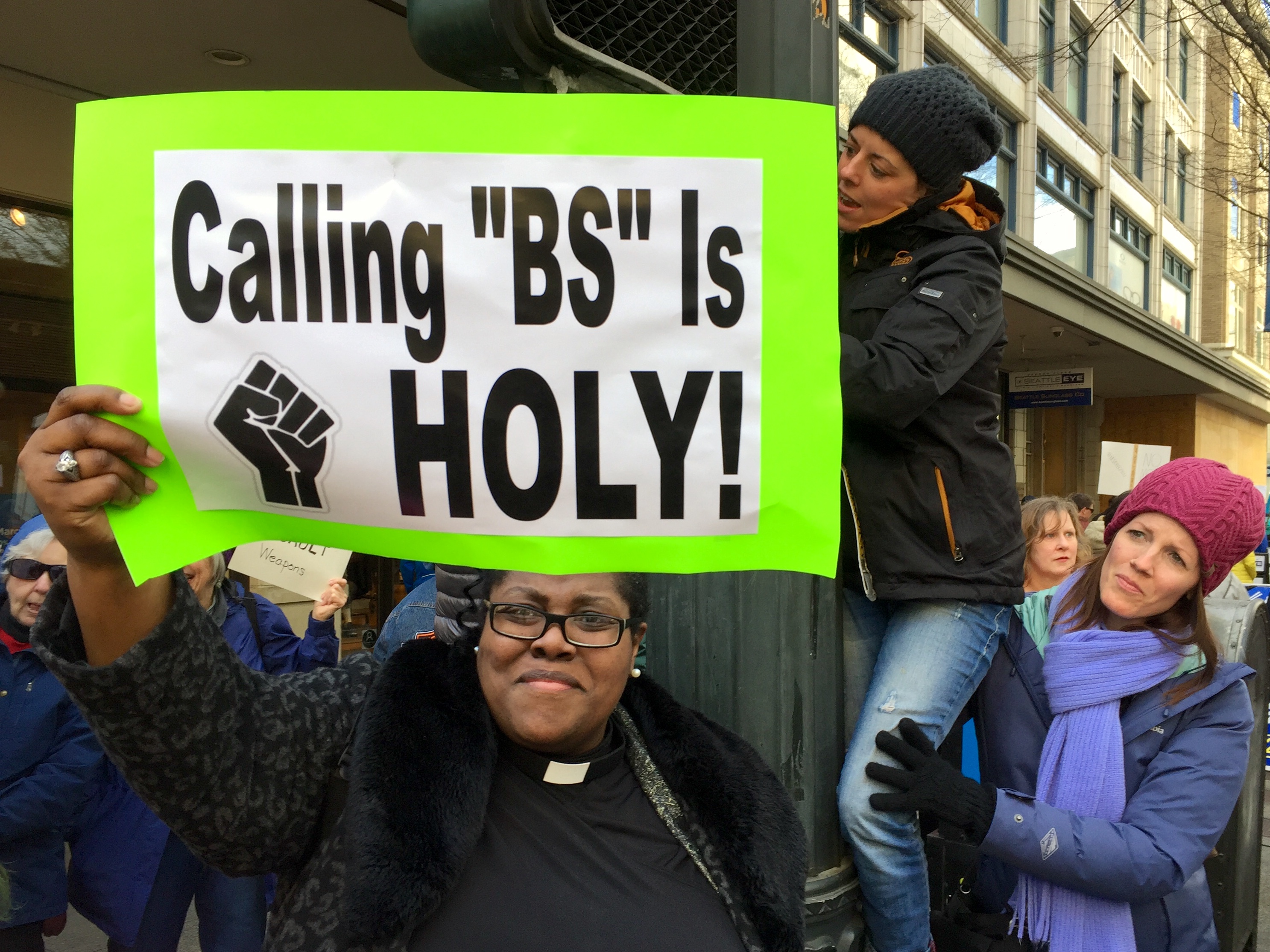
I was especially moved by Emma Gonzalez, a senior at Parkland’s Marjory Stoneman Douglas High School. Already well known for her prophetic cry against the NRA and its political puppets (“We call BS!”), she began with a brief, heartbreaking roll call of her seventeen dead friends. Then, remaining at the podium, she stood in solemn silence for a very long six minutes––ritually enacting the excruciating duration of the mass shooting.

Ms. Gonzalez had not explained her silence in advance, nor had she invited the crowd to observe it with her. Many in the crowd of 800,000 were undoubtedly bewildered by such an exercise, periodically filling the uncomfortable silence with shouts of “We love you, Emma,” or chants of “Never again.” But the camera also showed many faces mute and tearful. It was a risky liturgical move to immerse that vast multitude in such a long silence (almost unendurable for talkative Americans!) without any advance consensus on its intention or meaning. Those weren’t a million Trappists out there. As far as I could tell from the video, she more or less pulled it off, never quite losing them. I suspect that many will be haunted by the experience for a long time to come. You can watch it here.

Seattle March for Our Lives (Photo by Jim Friedrich)

It is late, I am tired from a lot of walking, and I hesitate to reduce what happened today into a few concluding paragraphs. Something great happened out there, and let’s leave it at that for now. But I am prompted  to make a brief digression before signing off.

As a priest on the eve of Holy Week, I could not help making connections between today’s events and what Christians will be doing over the next eight days. How could I not carry echoes of today’s joyful urban processions into tomorrow’s commemoration of Jesus’ entry into Jerusalem? Both processions involved cheering crowds envisioning a better world; both posited fundamental challenges to the established powers. As for the fate of today’s crowds compared to the one in first-century Jerusalem, I suspect there are crucial differences as well. While every human dream must endure repeated crucibles of resistance and setback, I suspect that the kids on the streets today will not replicate the failures of the Palm Sunday crowd. In that sense, they may prove to be more like Jesus––enduring faithfully with their eyes on the prize––than like the fickle crowd whose “hosannas” turned so quickly to “crucify.”

The other connection I’m thinking about tonight is Emma Gonzalez’s six-minute silence. Founded on an original experience of unimaginable pain and loss, it created a space where suffering might be both remembered and transcended. Like the rites of Holy Week, it engaged the past as something never to be forgotten, something that is intrinsic to the story, but in the context of a future which can contain and redeem whatever has been lost. We all dwell in the provisional space between memory and hope, where we neither forget nor give up. There is always more to our story than we can ever know. Even in the darkest night, God continues to imagine the dawn.

Seattle March for Our Lives (Photo by Jim Friedrich)

At the Easter Vigil next Saturday night, one of the stories we will tell is the deliverance of the biblical Israelites from the powers that enslave them. Instead of an adult reading the story from the Bible, children will act out the Exodus from Egypt. When they reach the Red Sea (adults blocking their way with waves of blue fabric), the congregation will shout “No way! No way!”–– like Congress telling the kids to give up and go home. But Moses will raise his staff, a way will open through the sea, and the Israelites will cross over. One will be carrying a “Never again” sign; another will wear a “March for our lives” T-shirt.

Once they are safely across the sea, Miriam, Moses’ sister, will reflect on what has happened, concluding with a declaration of faith:

“The world says NO.
The power of God is YES!”


Related posts

The Murderous Hypocrisy of Thoughts and Prayers

Summoning the Sanity to Scream

God Isn’t Fixing This


Just a dream? – Reflections on the Easter Vigil

Byz Res mosaic

On Holy Saturday in Jerusalem, an hour past sunset 26 years ago, I greeted the Resurrection with the Ethiopian community in their courtyard on the roof above the Church of the Holy Sepulchre. Processing around a small cupola representing the empty tomb, they sang and danced with torches and umbrellas. Their graceful, white-robed bodies and joyful faces were vivid icons of the risen life, producing in me a state of dreamlike wonder. As I later made my way through the deserted stone passages of the old city in search of the midnight liturgy at the Russian church, I fell into an apocryphal reverie.

I imagined the risen Jesus quietly reversing the steps of his Via Dolorosa, away from the cross, away from the mindless crowd now sleeping off its orgiastic fury, away from the city of betrayals and farewells, away from the awful time of trial. Going home. To Galilee.

Of course we don’t know how the Resurrection actually happened, nor do we grasp the concept of passing out of existence only to return the same yet different. Perhaps the closest we come is our daily rising from sleep, when it may take a moment before we remember who we are and reconnect with the continuity of personal identity that somehow survives the abyss of unconsciousness. Even so, there sometimes remains a strange sense that we have crossed over into a new space and time full of unimagined possibilities. We are not quite the same person who closed his or her eyes the night before. Behold, says Jesus, I make all things new.

The sublime intensity of Holy Week, culminating in the Triduum, or Great Three Days of Maundy Thursday, Good Friday and the Easter Vigil, can produce a similar effect on the faithful who make the long journey from the Last Supper to the first Alleluia. We not only learn something along the Way of the Cross to the place of Resurrection, we become something as well. When it’s over, we are somebody else. Forgiven. Set free. Made new.

As I said in the Vigil homily on Saturday night, “we have made an exodus from our tired old stories of death and loss into God’s new story of possibility and promise.” Any Vigil worth its salt will enable us to dwell for a few hours in the light of that new story, the light that penetrates our shadows with the bright splendor of God’s future. And when it’s over, we may wonder: What just happened? Was it only a dream?

One of the striking things about the Easter Vigil is that there is no single representation of the Resurrection. The gospel reading might describe dazzling messengers announcing it after the fact, but the event itself is never described in the text. The closest the liturgy gets to a specific resurrection moment is when the Presider launches the eucharist with a shout of Christ is risen, and a holy tumult is made with chimes, bells and drums while all the lights switch on to banish the darkness. But the victory of Life and Love is actually manifested repeatedly throughout the liturgy in symbol, word and sacrament, as well as in the faces and gestures of the assembly. The liturgy as a whole is an experiential analog of the Paschal Mystery.

Here are a few of this year’s many resonant manifestations for me:

  • The New Fire: It is always moving, after we have all been scattered from the bare and mournful church interior of Good Friday, to see how many return the next night to gather outside around the New Fire with expectant faces. Death has done its worst, and we have come to make our reply: Love wins anyway. I especially rejoiced to see the children, already dressed for the Ark story in their animal costumes, standing right up front with their floppy ears and shaggy coats. As St. Paul said, not just humanity, but the whole creation, eagerly awaits the day of renewal.
  • The Creation: “Once upon a time, human beings had no story. Only the gods did things worth telling.” So began the Prologue to our sacred stories, concluding with the discovery, by an ancient “tribe of nobodies” that their own lives were, in fact, part of something much, much larger. “Human beings had become a story told by God.” Then out of the darkness a voice said, “Let there be light!” Projected on a 15’ screen, we saw the first light of the creation, from Terence Malick’s film, Tree of Life, continuing with spectacular cinematic images of earth’s evolution up through the arrival of the birds. Then the film switched off and a monkey and frog entered to cavort among the assembly, until a flute sounded, and the musical “breath of God” turned them into the first humans. They straightened up, removed their wooden Indonesian masks, and became suddenly conscious of their own humanity. “Adam and Eve” were played by pre-teens, but when they cautiously crossed the gap between them to touch hands and connect with the strange and unknown “other,” they gave us a transcendent image far beyond their years.
  • The Red Sea: This central metaphor for the Paschal Mystery of “crossing over” from death to life was a complex interplay of live actors, projected images (documentary-looking Exodus images from DeMille’s 1927 silent, The Ten Commandments, plus Civil Rights footage from the Selma to Birmingham march of 1965), soundscapes (6 separate cues to mark different stages of the story), and dramatic theatrical lighting. After the Red Sea had been crossed, the narrator concluded by saying, “When the world says no, the power of God is …”. The Israelites, all played by children, completed the sentence by shouting, “YES!” The brave sound of those young voices will long stay with me.
  • “Hallelujah”: After each story, we sang a song and said a prayer to reflect the story’s themes. The last story, The Valley of Dry Bones, was followed by Leonard Cohen’s “Hallelujah,” with powerful Easter lyrics by Scott Lawrence. Our hand candles were relit as we sang: “no darkness can conceal the light within you … hallelujah, hallelujah…” All those candlelit faces, all those beautiful voices raised in song, said Resurrection as powerfully as anything else we did that night.
  • The Dance: At the end, following communion, we invited people to come out of their seats to gather in a great circle to dance. I had been warned to expect only a half-hearted response. Episcopalians are reserved, I was told. Dancing in church might be outside some people’s comfort level. But as we sang a couple of choruses of “I will raise them up” from the Bread of Life hymn, everyone did in fact rise up and come out of their pews. We joined hands, and off we went, circling and spiraling as we sang the Easter Troparion (“Christ is risen from the dead, trampling down death by death”) and “Jesus Christ is risen today.” Resurrection wasn’t just something we heard about or thought about, it was something we embodied, something we danced. As Christ shows us every Easter, “I am the Dance and I still go on.” Amen to that! We proved it with our bodies.

When the Vigil was over, we each went our separate ways. The Vigil “set” was struck, like a circus tent, leaving behind little trace of what had taken place. Had it all – not just the Vigil but the entire Triduum – been just a dream, soon to fade in the glare of everyday life and ordinary time? Or had our extraordinary journey together, soaked in Paschal images, revealed something essential, enduring and profoundly transformative?

Whether in this year’s Triduum, in my Jerusalem Holy Week long ago, or in many other memorable traverses of the Paschal Mystery, I do believe I have encountered, embodied, and imbibed the core of our faith: Christ lives. Love wins. We shall be changed.

The resonant images and experiences of the Triduum have been planted deep within me, year by year. They may still have to struggle in my poor soil or compete with the choking thorns of my world, but as the collect-prayer for Thursday of Easter Week asks, “Grant that all who have been reborn into the fellowship of Christ’s Body may show forth in their lives what they profess by their faith.”

God, bring that day closer!