Unknown's avatar

About jimfriedrich

I am an Episcopal priest, liturgical creative, filmmaker, writer, musician, teacher and retreat leader. My itinerant ministry is devoted to religious imagination and holy wonder. My blog is a space where diverse ideas and perspectives - theology and culture, liturgy and spirituality, arts and religion - can meet and converse with one another.

Everything Changed, Nothing Changed (Summer of Love, Part 3)

Victor Moscoso poster (1967)

The riptide of The Revolution went out with the same force it had surged in with, the ferocious undertow proportionate to the onetime hopes.

– Todd Gitlin[i]

Everything changed; the world turned holy;
and nothing changed:
There being nothing to change or needing
change; and everything
Still to change and be changed….

– Thomas McGrath[ii]

In The Limey (1999), a Steven Soderbergh film set in contemporary Los Angeles, Peter Fonda plays Terry Valentine, an aging pop music producer, now cynical and corrupt, for whom the idealism of the Sixties is a very distant memory. His young girlfriend asks him what it was really like back then. “Mmm,” she murmurs. “It must have been a time, huh. A golden moment.”

Lem Dobbs’ fine script gives Valentine a wistful reply. “Have you ever dreamed about a place you never really recalled being to before? A place that maybe only really exists in your imagination? Some place far away, half-remembered when you wake up. When you were there, though, you knew the language. You knew the way around. That was the Sixties.” He pauses, frowning slightly as his disillusion kicks in. “No. It wasn’t that either. It was just ’66––and early ’67. That’s all it was.”

When did “the Sixties” end? Kent State (1970)? The Summer of Love (1967)? Or in the helter skelter of Charles Manson (1969), when we “looked into Manson’s eyes and saw in those dark caves what we most feared within ourselves, the paranoia of what might happen if you go too far.”[iii]

Zebra Man (1966), Stanley Mouse & Alton Kelley.

On New Year’s Eve, 1969, I fled an uninspired party and drove to the beach. I wanted to give the last hours of the Sixties my undivided attention. I parked in one of those big empty lots in Santa Monica, in a pool of lamplight where the asphalt meets the sand. I propped my journal against the steering wheel and began to write whatever I could remember about my own Sixties. Out in the darkness, a hundred yards away, the tide was going out, wave by wave.

Just before midnight, a police car pulled up next to me. The officer got out, walked over to my window, and aimed a flashlight at my face. In those days, the Zodiac Killer was on the loose, and a single young man parked all alone at the beach on New Year’s Eve was a definite person of interest.

– What are you doing out here?
– Writing in my journal.
– Mind if I take a look?
– Sure. Why not?

Even then, I was eager for readers. He flipped the pages, reading a few lines out loud. He smiled faintly and shook his head. Lucky for me, it wasn’t the sort of thing a serial killer would write. He handed back my journal and wished me a Happy New Year. By then it was 1970.

Whenever the Sixties did end, and the high tide of cultural upheaval, political activism, youthful idealism and millennial hope began to run out, many were left to wonder what it had all meant. Was it a dead end, or a door opening into something larger and more lasting? Did it change the world? Did it change our lives?

Alice Jaundice (1968), David Warren

Writing about the utopian social experiments of Haight-Ashbury, Charles Perry asked, “How did you deal with the fact that the million visions of the possibilities of life you saw were humiliatingly tied to the perversely unchanging self you brought into the experience?”[iv] And in soliciting the reflections of Sixties people 20 years after the Summer of Love, Annie Gottlieb tried to address her own questions about the decade’s long-term effects on their lives: “Where are the millions of comrades in each other’s arms, the warm bodies that packed every rock concert, college campus, and demonstration, the tattered and colorful armies of love? Forever dispersed into castles of bourgeois comfort and pockets of principled despair?”[v] 8

But as many of us have learned, resignation and despair are not the only options. We may have lost our innocence about the world––and about the traces of darkness in our own hearts––but we are still prisoners of hope. Our formative glimpses of a new heaven and a new earth may have come and gone, but their influence still lingers. However chastened or weary we may be, a sense of expectation remains. What Jesus called the Kingdom of God is a future of human flourishing and divine blessing that still pulls on us with gravitational force. Its current absence doesn’t dim our faith. It only intensifies our longing.

  • Part of the message board at the Psychedelic Shop, Haight-Ashbury (1967)
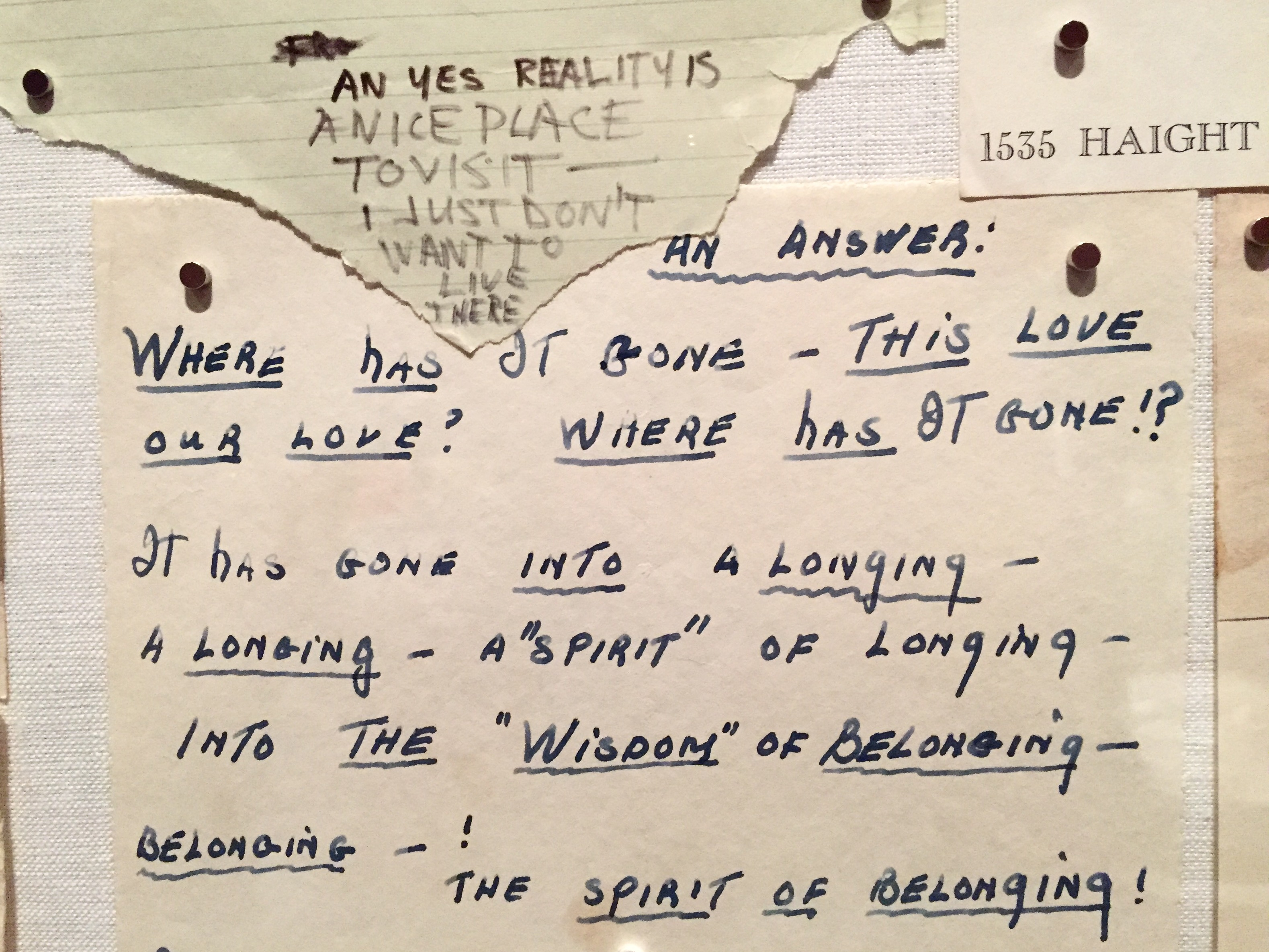
So when I consider the transformative dimension of the Sixties, and the ache of its disappearing, I call to mind a late summer morning in 1969, when I was awakened at dawn by a pounding on my door. It was the Rev. Craig Hammond, one of my colleagues in campus ministry at the University of Michigan. “The circus is in town!” he said. “If we help them raise the tent this morning, they’ll give us free tickets for tonight’s show.” I threw on some clothes and hurried to join my friends at the circus grounds. And so it was that I was admitted that night––absolutely free––to a world of wonders and impossibilities.
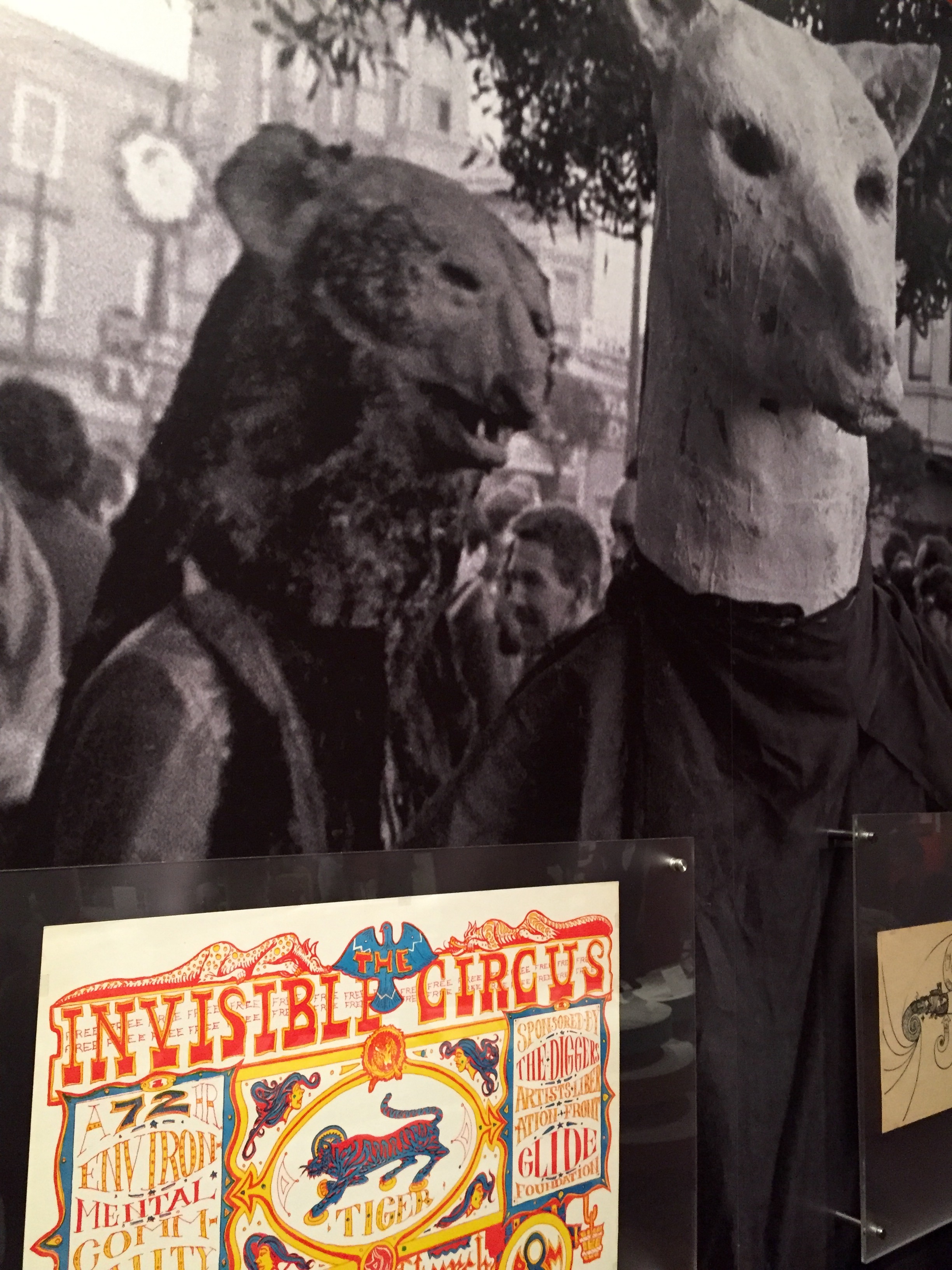
Display at the “Summer of Love Experience” exhibition (2017), De Young Museum, San Francisco

One of the things I remember most is my sense of letdown the next day, after the circus moved on. Where I had seen trapeze artists defy physical law and visual probability, and witnessed clowns die and rise again, there was now but an empty field. Like the Kingdom of God, the circus comes and goes. Its appearance is sudden and brief. And you can’t hold on to it. You can only look for its coming again.

At our campus worship service the following Sunday, I reflected on this analogous relationship:

It’s nearly useless to talk about it now. In a matter of days, it has faded like a dream. The powers set free within its tents seem but idle fancies. The attempt to talk now about the CIRCUS, so soon after its vanishing, comes with a price––acknowledgement of my separation from it.

And yet, it touched us as it passed, its mad motions opened a space between the calm routines and resignations of our everyday lives, allowing us the briefest glimpse of the darkness and the dance of divinity.

But the kingdom is not yet, and we are condemned for the moment to remain audience only. The circus priests of pain an laughter stand on the other side of an unbridgeable divide, though for a day and a night they seemed so very near. When the next morning found no trace of them, we tried to forget as best we could.

But we didn’t forget. Not really. In fact, when our worship team was invited soon afterward to curate a liturgy for a special “General Convention” of the Episcopal Church in South Bend, Indiana, we were inspired to employ circus imagery and metaphors in the construction of the ritual.

In the ordinary round of Episcopal business, a national gathering of clergy and lay representatives happens every three years, but this Convention was summoned in an off-year to address critical issues and questions posed to the Church by the struggles and tensions of the Sixties. The discussions would focus particularly on race, women, and war. A certain amount of disagreement and polarization was anticipated, and we had been given the mission of making ritual to move people from a place of difference into an experience of shared celebration.

We were scheduled to follow an evening concert in a coffeehouse setting, where about 400 people were seated around large tables. There were no obvious signs that a liturgy was about to happen––no procession forming at the back of the hall, no clergy vested in bright robes, no worship booklets distributed. Some began to wonder whether the liturgy, publicized only by mimes handing out flyers at lunchtime, was just an unfounded rumor.

Then the lights went down. A spotlight shone on the stage, where a lone figure came from behind the curtain to give the Ringmaster’s pitch: Step right up, ladies and gentlemen! See the eschaton under the big top! Three rings of grace! Come one, come all, everybody welcome! It seemed meet and right that this Ringmaster, a priest from Washington, D.C., happened to be P.T. Barnum’s great-grandson.

The spotlight switched off, and in the darkness an anonymous voice (in fact the Presiding Bishop, John Hines), read the gathering prayer: God of the Circus, Lord of the Dance, open our eyes to see your show when it comes to town. Amen.

The sermon featured a projection of photographs I had taken at the circus mixed with images of the human condition in the great circus of history, set to the music of Bob Dylan’s “Desolation Row.” At communion, the reception of bread and wine was followed by an anointing of each communicant with white clown makeup. Finally, after singing “I Shall Be Released,” we made a joyous communal dance.

Afterward, I wrote in my journal:

Now all of us had become the circus­­––we ourselves were the elephants, the high wire artists, the clowns––the circus in us, the circus through us. I saw monks weeping and bishops dancing, and for one bright moment there were a great many things which no longer mattered very much in the light of this One Big Thing.


The Summer of Love Experience, De Young Museum, San Francisco

All the photographs were taken July 20th at “The Summer of Love Experience: Art, Fashion and Rock & Roll,” featuring a wealth of artifacts on the 50th anniversary of the Summmer of Love. It continues at San Francisco’s De Young Museum, close to Haight-Ashbury, through August 20th. Pilgrims will be richly rewarded.

Related posts:

“I wanted heaven now” (Summer of Love Part 1)

Something’s Happening Here: Summer of Love (Part 2)


[i] Todd Gitlin, The Sixties: Years of Hope, Days of Rage (New York: Bantam Books, 1987), 420.

[ii] Thomas McGrath, Letter to an Imaginary Friend (Chicago: Swallow, 1970, p. 95), q. in Gitlin, p. 420.

[iii] David R. Williams, Searching for God in the Sixties (Newark: University of Delaware Press, 2010), 215.

[iv] Charles Perry, The Haight-Ashbury: A History (New York: Wenner Books, 2005), 263-4

[v] Annie Gottlieb, Do You Believe in Magic? The Second Coming of the Sixties Generation (New York: Times Books, 1987), 8.

 

Something’s Happening Here: Summer of Love (Part 2)

Still from Cancel My Subscription, a film by Jim Friedrich (1967)

I am the Messiah. I’ve come down to preach love to the world. We’re going to walk through the streets and teach people to stop hating.

– Allen Ginsberg, after dropping acid at Timothy Leary’s house[i]

Can you picture what will be
So limitless and free
Desperately in need of some stranger’s hand
In a desperate land –
Lost in a Roman wilderness of pain
And all the children are insane
All the children are insane
Waiting for the summer rain

– Jim Morrison, “The End”

I spent the Summer of Love in a mental hospital ten miles from Disneyland. On my first day, I walked into the glass-walled staff booth overlooking the ward room to introduce myself. A stern-faced nurse moved quickly to block my way. “This is for staff only,” she said. “Please go back out to the ward.”

I gave her my best smile. “Um, actually, I’m going to be your chaplain intern for the summer.” Her expression froze while she took this in. Only her eyes moved, slowly scanning me from head to toe. My appearance clearly said “mental patient”––long hair, suede cowboy jacket, Beatles boots, no tie. A chaplain? The cognitive dissonance was frying her circuits. “I’ll get the doctor,” she said curtly.

The ward psychiatrist seemed amused. He told me I didn’t have to cut my hair. “Just put on a tie, and people will know you’re not a patient.” Was the boundary between sane and insane really so slight––just ­­a narrow strip of colored silk?

In the Sixties, boundaries were no longer what they used to be. It was a time to tear down the walls, break on through to the other side, explore the wildness beyond the prison house of the social imaginary. It’s a mythic quest as old as the biblical exodus from slavery to the Promised Land, and its American lineage goes back to the Puritans, Utopians and Transcendentalists.

“Let us….work and wedge our feet downward,” urged Thoreau, “through the mud and slush of opinion, and prejudice, and tradition, and delusion, and appearance….till we come to a hard bottom and rocks in place which we can call reality.”[ii] The Sixties at their best fostered this kind of aspirational, transformative work.

And I opened my heart to the whole universe
And I found it was loving
And I saw the great blunder my teachers had made:
Scientific delirium madness

– The Byrds, “Fifth Dimension”

In reading Charles Perry’s fascinating history of the Haight-Ashbury phenomenon (published 17 years after the Summer of Love), I was struck by the degree to which even the chaotic extremes of play and pleasure were grounded in serious intent. The sobermindedness of New Left activists was easy to see: Let’s get to work, fight the oppressors, and change the world, no matter how long it takes. But the seriousness of the “psychedelic community” of Haight-Ashbury, cloaked in levity and joy, was harder for outsiders to fathom: Let’s be a new kind of world here and now, they declared––tolerant, communal, liberated from money and convention, celebratory, blissful, loving, peaceful, whimsical, turned on and tuned in to the infinite harmony of Being.

As Perry writes, many of the ideas and practices of the Haight “held out the promise that this world is an illusion as conceived––the real world is here and now, but it is as different from what appears to be the real world as being stoned is from being straight, and it’s just around some mysterious corner. Creating a grand synthesis often revolved around finding a verbal formula that would unite everything, if only verbally; the word ‘together,’ which could suggest being organized and effective in one’s personal life as well as united with other people spiritually or politically, or even united with God, came in for heavy use.”[iii]

One resident of the Haight described “a super-curiosity on the street in ‘66. We thought there was going to be a breakthrough, and that it was imminent. I thought, There might be some room in this neighborhood where they’ve found a tunnel out. So I got into as many scenes as I could.”[iv]

Those scenes really started in 1965, when I was a junior at Stanford, 45 minutes down the Peninsula from San Francisco. I’d go up to the City to hear Jefferson Airplane at the Matrix, or the Grateful Dead at the Fillmore. I didn’t do drugs––I was wary of their downside, and didn’t really believe in their necessity––but my capacity for attentive wonder and ecstatic play caused some to think I must be on something. I did attend one of Ken Kesey’s “Acid Tests,” where I joined people beating a resonant metal sculpture with sticks for an hour or so. I didn’t know they were all on LSD. I thought they were performing an experiment in noise music.

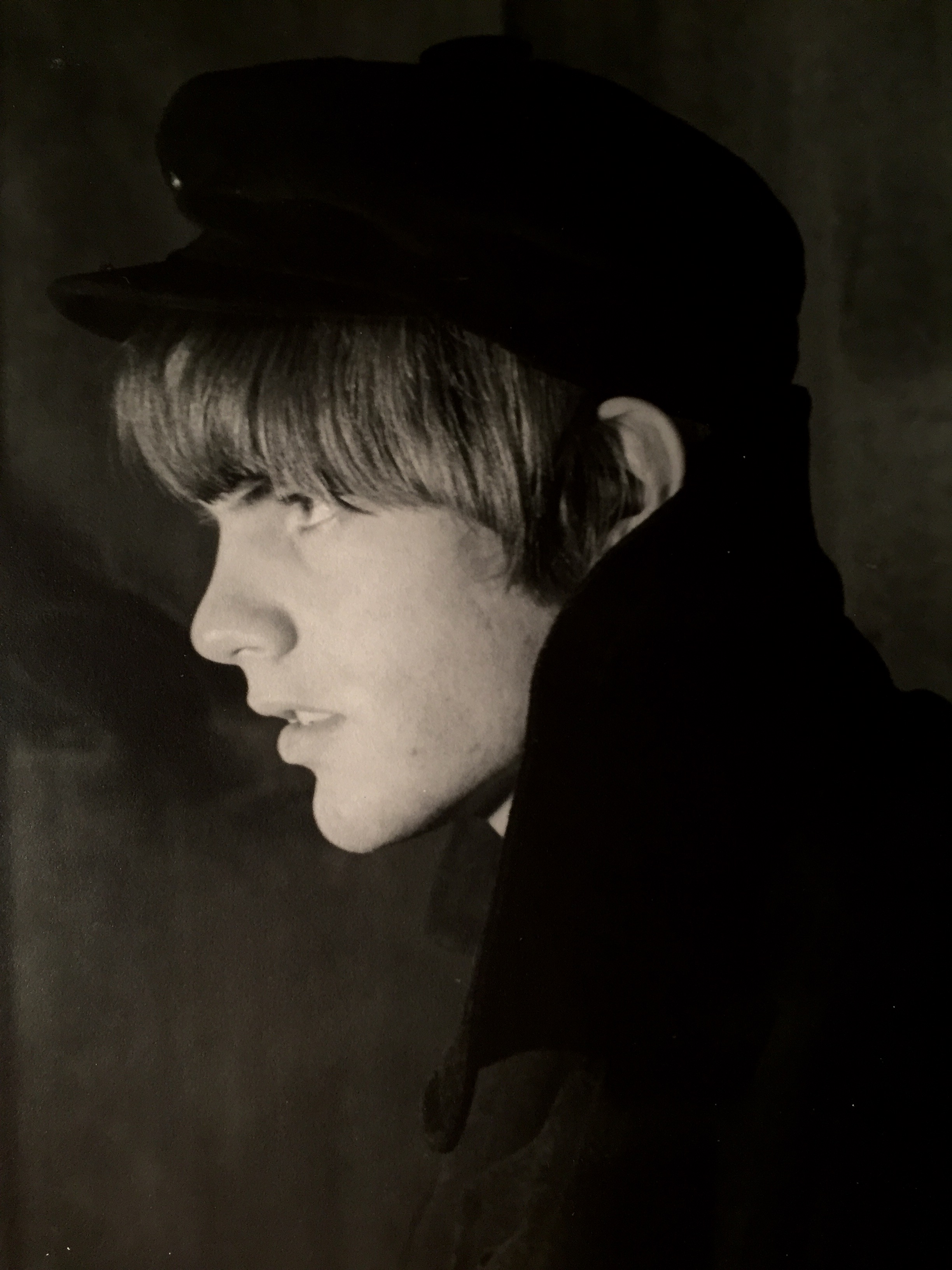
The author in 1966.

By the time the San Francisco scene really heated up in late ’66, I was in Cambridge, Massachusetts, studying theology and working as a youth minister in a local parish. When a friend at Harvard organized a West-Coast style be-in the next spring, I took my youth group to share the experience. In the theatrical spirit of the times, it seemed just the thing to wear costumes from the church Christmas pageant. So it was that Mary and Joseph, shepherds and Wise Men danced hand in hand with hippies and flower children on the banks of the Charles River. Afterward, I took the teenagers, still in costume, to hear a lecture at Harvard by the controversial Episcopal bishop, James Pike. Our biblical couture made quite an impression when we entered the packed hall.

By June of ‘67 I was back home in southern California, doing the mental hospital gig and, in my free time, experiencing L.A.’s own Summer of Love. I danced to the Byrds, the Doors, and Love, wore flowers in my hair at be-ins, saw young girls coming to the canyons, and made a trippy experimental film. Meanwhile, a seminary friend was helping to feed and house 150 young people per night at a West Hollywood church. Like the 75,000 pilgrims to San Francisco, they had come in search of the Land of Peace and Love. My 80-year-old grandmother organized the ladies of her retirement home to make them sandwiches.

I managed to get up to the Haight once that summer. A friend gave me his brother’s imaginative depiction of the Jefferson Airplane as characters in Alice in Wonderland. “If you run into [their manager] Bill Graham,” I was instructed, “show it to him and ask if he’d consider it for their next album cover.” And when I arrived at the corner of Haight and Ashbury, there was Graham, and with him the Airplane’s lead singer Marty Balin. They politely declined the drawing. A year after the Sixties ended, the artist would die of a heroin overdose.

In 1967, the ubiquitous music, crowded dance floors, playful be-ins, alternative newspapers and distinctive dress were the most public evidence that “something’s happening here,” but in the Haight you could pick up the communal vibe by just walking the streets, sharing a free meal with the Diggers, hanging out in the art-shaped environments of the local stores and eateries, or grooving on “Hippie Hill.” As Perry summarizes, “it seemed that all this energy had to lead to something amazing.”[v]

And did it? Or was it a doomed vision with no lasting effect? We’ll wonder about that in my next post. Meanwhile, I’ll leave you with an inspirational word from Chief Bromden in One Flew Over the Cuckoo’s Nest. It’s an experience I wish I could have given my charges at the hospital, an emergence into clarity to which we all might aspire:

And when the fog was finally swept from my head, it seemed like I’d just come up after a long, deep dive, breaking the surface after being under water a hundred years.[vi]


Related post:“I Wanted Heaven Now”- Remembering the Summer of Love in America’s Time of Trial


[i] David R. Williams, Searching for God in the Sixties (Newark: University of Delaware Press, 2010), 109.

[ii] Henry David Thoreau, Walden: One Hundred Fiftieth Anniversary Edition (Boston: Shambhala Publications, 2004), 82-3

[iii] Charles Perry, The Haight-Ashbury: A History (New York: Wenner Books, 2005), 257.

[iv] Greg Riesner, quoted in Perry, 257.

[v] Perry, 264.

[vi] Ken Kesey, One Flew Over the Cuckoo’s Nest, in Williams, 40.

“I wanted heaven now” – Remembering the Summer of Love in America’s Time of Trial

How do we celebrate our national origins at one of the lowest points in American history? The cruel and rapacious ruling party betrays the Founders daily, while America’s worst impulses––racism, militarism, nativism, greed and know-nothingness––are not just tolerated by the White House. They are encouraged and inflamed. The shining city on a hill is mudsliding downward into a nightmarish abyss.

Thank God for the many resisters who incarnate the better angels of our nature in the continuing struggle for justice, equality and the common good. They are, in the words of an 1850 Fourth of July oration, “the only visible source of light and heat and repose to the dark and discordant and troubled world.”

Tomorrow I will refresh my own love of country by silencing the news to spend a morning with American writers like Thoreau, Dickinson, Whitman, Muir, and Didion. And maybe it’s a good time to reread Nathaniel Hawthorne’s apocalyptic parable, “Earth’s Holocaust.” A vast crowd gathers on a broad western prairie to build a huge bonfire, into which they begin to throw all the “outworn trumpery” of the Old World. The heraldry of ancient aristocratic families feed the flames, followed by the robes and scepters of royalty. Scaffolds and other symbols of government oppression are tossed in as well. And finally, as the flames rise ever higher, the total body of European literature and philosophy is consumed. “Now,” said the chief celebrant, “we shall get rid of the dead weight of men’s thoughts.”

There are times when the idea of a radical makeover in politics and culture strikes a chord of repressed desire among the children of Adam and Eve––refugees as we are from a lost Eden. Such youthful optimism, such buoyant faith in the new, permeates the political rhetoric of our republic’s first century. “The American Revolution is the wonder and the blessing of the world,” said Daniel Webster. “Its inherent unconquerable force will heave both the ocean and the land, and flame up to heaven…In our day there has been as it were a new creation… The last hopes of mankind…rest with us.”

Fifty years ago, Hawthorne’s bonfire burned anew in the Summer of Love. In the largest mass migration of young people in American history, tens of thousands made their way to San Francisco in search of a new way of being. Some were just running away from home, some were just looking for a party. But many felt a deeper longing.

In a 2007 PBS documentary on the Summer of Love, Claudia King Yunker reflects on her reasons for joining the 1967 westward pilgrimage. As a 23-year-old civil rights worker in Chicago, she had been frustrated by the slow pace of social change. Rumors of a utopia happening now felt like a summons. “I was young,” she says. “I wanted heaven now.” So off she went to seek it in Haight-Ashbury.

Whatever was beautiful, true and good about the dreams of the “Love Generation” did not find an abiding home on this earth. It didn’t even last the summer. But as Yunker remembers fondly forty years later, things like racism, war, and greed “were not acceptable for a few minutes. [This lasted] for just a little short time. But it was really like something that shimmered.”[i]

During the months leading up to the Summer of Love, the mayor of San Francisco, the local police, and Governor Ronald Reagan did their best to put out the shimmer. In October of 1966, Allen Cohen and Michael Bowen, editors of the Oracle newspaper, organized a people’s response to official repression: not a confrontational protest against the powers-that-be, but a celebration manifesting an alternative social vision. The “Love-Pageant Rally,” they said, would “affirm our identity, community and innocence from influence of the fear addiction of the general public.”

Promotional leaflets for the rally featured a “Prophecy of a Declaration of Independence,” and on the eve of Independence Day, 2017, fifty years after the Summer of Love, it makes interesting reading:

When in the flow of human events it becomes necessary for the people to cease to recognize the obsolete social patterns which had isolated man from his consciousness and to create with the youthful energies of the world revolutionary communities to which the two-billion-year-old life process entitles them, a decent respect to the opinions of mankind should declare the causes which impel them to this creation.

We hold these experiences to be self-evident, that all is equal, that the creation endows us with certain inalienable rights, that among these are: the freedom of the body, the pursuit of joy, and the expansion of consciousness, and that to secure those rights, we the citizens of the earth declare our love and compassion for all conflicting hate-carrying men and women of the world.[ii]

Related post: July 4th and the Pursuit of Happiness


[i] Summer of Love (PBS American Experience DVD: 2007), written, produced and directed by Gail Dolgin and Vicente Franco.

[ii] In Charles Perry, The Haight-Ashbury (New York: Wenner Books, 2005), 92-3.

I Must Decrease (And Why That’s Good News)

Seattle Midsummer twilight (10:05 p.m., June 22, 2017)

The 24th of June is, in the Christian calendar, the Feast of the Nativity of John the Baptist. In Europe, it’s also known as Midsummer Day, marking the critical moment when the longest days begin the six-month journey toward the longest nights. Even though we still have months before us of warm weather and brilliant sunshine, the light is now (imperceptibly at first) beginning to slip away minute by minute. Thus in the old days, on the night before Midsummer––called Midsummer Eve or Midsummer Night––bonfires were lit to encourage the waning sun, and people were on their guard against any supernatural mischief. As we know from Shakespeare’s Midsummer Night’s Dream, it’s a good night just to stay home. Whatever you do, don’t go into that magic forest!

The ancient traditions may seem obsolete, but are we free of the anxiety they represent? This turning point in the sun’s journey is a metaphor for our own mortality. We are temporal beings––creatures of time. For us, nothing lasts forever. The very moment that we reach the peak of the Summer Solstice, savoring what the poet Wallace Stevens called “arrested peace, / Joy of such permanence, right ignorance / Of change…”, the sense of having all the time in the world starts to seep away––imperceptibly at first, as we enjoy our fun in the sun and the long unhurried twilights. As Stevens goes on to say in his great Solstice poem, “Credences of Summer”: “This is the barrenness / Of the fertile thing that can attain no more.” After the perfect moment, then what?

In a Calvin and Hobbes cartoon, Calvin is running around in a frenzy, shouting, “It’s July already! Oh no! Oh no! What happened to June? Summer vacation is slipping through our fingers like grains of sand! It’s going too fast! We’ve got to hoard our freedom and have more fun! Time rushes on! Help! Help!”

Meanwhile, his friend Hobbes the tiger is watching Calvin’s panic with studious detachment. Then he says to himself, “I don’t think I want to be here at the end of August.”

My Minnesota relatives still have the summer house my grandfather built on a bluff above Lake Pepin, a scenic stretch of the Mississippi River that becomes a lake two miles wide and thirty miles long. About fifteen years ago, in late June, I walked down to the beach from the house, passing through a grove of maple trees and birdsong. When I emerged from the woods onto the sandy lakeshore, I saw one of the great spectacles of Midwest summer: a storm of mayflies.

Thick black clouds of insects with transparent wings whirled in the air above me. Millions more covered the willows and cottonwoods, darkening the summer greenery with their densely packed masses. It was an explosion of pure fecundity: “The feast and fairy dance of life,” as one naturalist has described it.

But this dance is oh so brief. After incubating for two long years in the mud of the lake bottom, the mayflies grow wings, float up to the surface and rise into the air to mate. Within 24 hours of this eruption into ecstasy, they fall lifeless back to earth. Roads and bridges covered with their greasy remains are too slick for driving, and must be closed until a cleanup crew arrives.

Is this not a sped-up version of the human condition––here today, gone tomorrow? As they sang in medieval England, “Merry it is while summer lasts; but now draws near the wind’s cold blast.” The Bible was equally frank about our radically transient status: “All flesh is grass . . . The grass withers, the flower fades.”

Contemporary poet Mary Oliver delivers the same message, lightened by a dose of whimsey:

For years and years I struggled
just to love my life. And then

the butterfly
rose, weightless, in the wind.
“Don’t love your life
too much,” it said,

and vanished
into the world.[i]

For me, this mortal life is like the fireworks on the Fourth of July. So glorious and wondrous––and so quickly over. Every year my wife and I walk a mile down to the local harbor to watch the display, and when it’s done, as we make our way home in the darkness, I always feel the melancholy of endings. The pyrotechnics of July 4––the American version of Midsummer Night––have come and gone. Only two weeks old, summer is already beginning to slip through our fingers! This is the barrenness of the fertile thing that can attain no more.

John the Baptist knew how the story goes. He knew that his given moment on the stage was coming to an end. Remember what he said about Jesus? He must increase, I must decrease. My time is passing, but Jesus’ time is coming. Thus at the Nativity of John the Baptist the days start to decrease, while at the Nativity of Jesus the days start to increase.

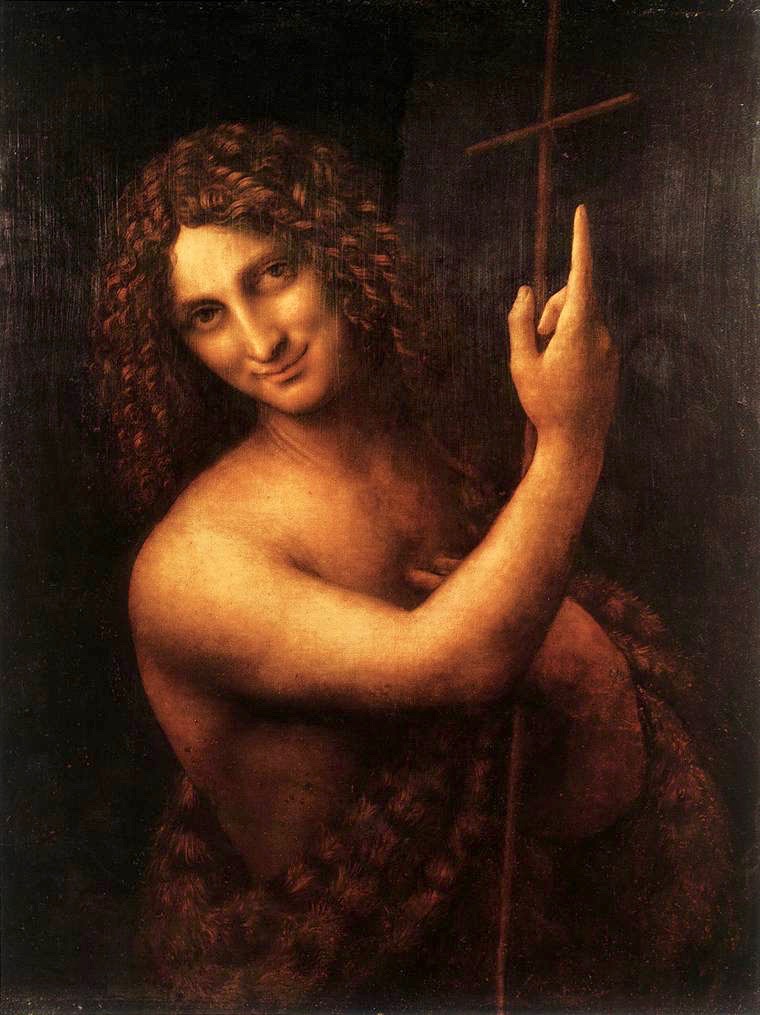
John the Baptist is rightly remembered as the voice in the wilderness, announcing that the Lord is come (let every heart prepare him room!) As his father Zechariah foretold when John was only eight days old, the Baptist was born to be “the prophet of the Most High…. to give knowledge of salvation to [God’s] people by the forgiveness of their sins.” In paintings, John is often seen pointing away from himself, toward Jesus, the “dawn from on high” who gives “light to those who sit in darkness and in the shadow of death.”

Leonardo da Vinci, John the Baptist (1513-16)

John gave us expectant hearts. But he offered us another great gift as well. He taught us the art of letting go. Jesus must increase, I must decrease. That’s what he said, and what he did. It’s what we all do. As the old shape note hymn says with such brutal honesy, “Passing away, we are passing away.”

All flesh is grass––a melancholy thought at the dawn of summer. But wait; there’s more, and it’s good news. Though the grass withers and the flower fades, Isaiah tells us, the word of God will stand forever (Isaiah 40:8). And what is this “word?” Jesus is the word, the speaking of divine reality in human be-ing. And that divine reality, which we are made to mirror, is all about self-diffusive, self-forgetting love. God is a Trinity of persons, giving themselves over to one another in an eternal circulation of gifts offered and gifts received.

So the great secret at the heart of existence, the word that stands forever, is that it’s all about letting go instead of holding on. Jesus made that perfectly clear in his death and resurrection. And John the Baptist, who was martyred before he could see that first Easter Day, intuited this truth even before it was fully revealed.

He must increase, I must decrease. Less of me, more of Christ. More of God. And the Christian life is all about making that truth our daily practice, as individuals and as communities of faith. We learn to let go of things which are passing away––and of the stories which are no longer true for us––and to remain open and grateful for the new gifts we are about to receive. Welcome every gift, but hold on to nothing but God, who is not only the Giver of every gift, but is also the only gift worth having.

God is not a thing, an object, a commodity to be possessed. God is a dance we do. We become most truly ourselves only to the degree by which we participate in, and surrender to, the choreography of that dance: the eternal giving and receiving of self-diffusive love. Letting go, not holding on, is what completes us.

As Mary Oliver reminds us,

To live in this world

you must be able
to do three things:
to love what is mortal;
to hold it

against your bones knowing
your own life depends on it;
and, when the time comes to let it go,
to let it go.[ii]


Related post:

Sacraments of Summer


[i] Mary Oliver, “One or Two Things,” New and Collected Poems (Boston: Beacon Press, 1992), 122.

[ii] ibid., 178

A Land of Crippling Nonsense

Thomas Cole, The Voyage of Life: Manhood, 1842 (National Gallery)

A mob cannot be a permanency:
everybody’s interest requires that it should not exist,
and only justice satisfies all.

––– Ralph Waldo Emerson, “Politics”


In my last post I suggested that the Christian understanding of God as Trinity––the self-diffusive love of interdependent communion––is incompatible with the manifestly unloving actions of America’s ruling party: “Pretty much everything the White House and the Congressional majorities are trying to do now is a grievous offense against the Divine Trinity whose very being is communion. Attacking immigrants, inflaming racism and violence, abusing women, starving the elderly, sentencing tens of thousands to early death by taking away their health care so the rich can get richer, poisoning the wells of public life, telling the planet to go to hell––the list of injuries to God’s desire grows daily.”

Some readers––not, I suspect, regular visitors to my site––did not find this a self-evident statement, and posted their bitter complaints on The Religious Imagineer Facebook page:

This sounds so anti-American. You people need to stop that crap. Get this in your head, climate change is a hoax, global warming was a hoax. Affordable Care Act was a hoax. Your site is a hoax.

You guys sound like communist [sic]. No thanks.

You people are sick. President Trump and the First Lady and families are Christians. Love the USA and want to protect it. How can you spew filth and lies and look at yourself in the mirror? God is watching you and you will have to answer to him. It will not go well for you! The Democrats lie and cheat and do not care because they do not believe in God.

President Trump and his voters are Christians who just want to save America from Islam so their children and grandchildren will be able to practice their religion freely.

Romans 13. All authority is appointed by God at the appointed time. Unfortunately, because of our Falling Away, God appointed Obama to weaken and divide America because God knew Obama would play his part. The truth is the US’s role is defined in Rev 12: to prepare and secure Israel’s place in Jerusalem and on the Temple Mount. Trump moving our embassy to Jerusalem will be a good start. I’ve often wondered how Europe, the Holy Roman Empire, the iron mixed with clay, would turn against Israel. Now we know. The Marxist Pope has fallen away and is preaching ecumenism aka interfaithism. He has fallen for the world’s message of Coexist. But if he truly understood Prophecy he would know that the lies of political correctness, tolerance, and diversity are Satan’s agenda to amalgamate the world to destroy Israel. We must resist Satan’s agenda, not Trump’s agenda of Nationalism and Capitalism so we can fulfill our God Given Destiny. Go Trump!!

Your site is a tool of Satan. God is not “a dance we do.” He is THE WAY, THE TRUTH, AND THE LIFE.

You’re a liar.

Your [sic] nuts.

Although I did write in that same post, “we should be dismayed but not surprised by those who want to make America hate again,” I have to admit I was pretty surprised. In my accustomed insularity from the dark side of the American id, living as I do on a blue island in a blue state, and belonging to a church which both favors the biblical justice tradition and encourages critical thought­­, I rarely venture into the dark swamps of inchoate political rage. Reading these comments, I felt like Dante crossing the Styx in Delacroix’s painting, where tormented souls gnaw on the poet’s frail craft. It’s a pretty unnerving ride.

Eugène Delacroix, Dante and Virgil in Hell, 1822 (Louvre)

A recent poll gave Trump a disapproval rating of 60%––a record for a new president––but it also showed that 36% continue to approve his presidency. That’s still a lot of Americans giving a thumbs up to what I term “injuries to God’s desire.” So I have to wonder: How many of this 36% are cynics and hypocrites who tolerate Trump’s dark side in order to achieve a conservative agenda? How many are using a man whose defects they may detest as a club to bash a system which has left them behind? How many are simply unaware of the degree to which they have voted against their own self-interest, like the Trump voters who may soon lose their health care? And how many do, in fact––without any shame––embrace authoritarianism, racism, xenophobia, misogyny, and planetary suicide as justifiable within their eccentrically constructed worldview?

Some of my angry correspondents merely lashed out like the childish bully they adore. Some asserted ‘alternative facts,’ because it is always easier to dismiss accurate information than surrender an entire worldview. But a couple of people did offer a kind of argument. One took the clash-of-civilizations approach favored by ISIS, making Trump the chief Crusader against an invading Islam. The other glorified “Nationalism and Capitalism” with a strange brew of Romans 13 (a favorite authoritarian text), Revelation apocalyptic, anti-papist tropes, and a little anti-modern nostalgia for the good old days when tolerance and diversity were not the norm. The Holy Roman Empire even made a cameo appearance! This kind of thing, once all the rage in mid-twentieth century Europe, belongs in the trash heap of history.

I deleted most of the angry comments from this blog’s Facebook page. Their ill-mannered tone didn’t seem to merit any permanence on my site. But they did make me wonder about the degree to which Christian teaching and formation have failed to counter the entrenched biases and practices of human sinfulness. Donald Trump is certainly not the first moral degenerate to be proclaimed a defender of the faith. And Christian history provides sadly numerous examples of WWJD (What would Jesus do?) receiving wildly incorrect answers.

We like to think that the baptized have made some progress in the historical quest to live a godly life. However, while Christians may no longer burn witches or practice slavery, there are still a lot of pious people whose politics are just as monstrous and cruel, even if well disguised as tax and health “reform,” rollbacks of environmental protection in the name of “freedom,” a system heavily rigged against the most vulnerable, and a profit-driven militarism making perpetual fear and violence good for business.

When someone votes or makes a policy decision, he or she may be acting in good faith, based on serious reflection and high principles. But the cumulative result of multiple decisions, however well reasoned, may turn out to be something unintended and undesirable. Sometimes we need to step back and say: Look where our choices have landed us. Is this where we actually want to be? Is this what God has in mind for human flourishing?

Civil War historian Bruce Catton once described this potentially ruinous process in his vivid account of the battle for Charleston’s Morris Island, which in 1863 became “the deadliest sandpit on earth. It was dug up by spades and high explosive, almost sunk by sheer weight of metal and human misery, fought for with a maximum of courage and technical capacity and a minimum of strategic understanding; a place of no real consequence, lying at the end of one of those insane chains of war-time logic in which men step from one undeniable truth to another and come at last to a land of crippling nonsense.”[i]

Sound familiar? We too are shocked to find ourselves in a land of crippling nonsense. A narcissistic, unstable ignoramus holds the most powerful office on earth. Economic inequality has reached insane proportions. Political norms and standards of truth are undermined with impunity. Discourse has devolved into rancorous discord. Racist and fascist tribalisms are on the rise. Even nuclear war is back on the table. And prominent in the insane chain of choices leading us to this moment are the votes of countless Christians who thought Donald Trump to be God’s chosen instrument for a divine agenda.

Can we argue those folks back into a more biblically faithful worldview with some serious Bible study or powerful preaching? The evidence so far is not promising. One Facebook respondent to my last post thought preaching on the difference between the ruling agenda and the Trinitarian imperatives of love would only be “alienating to a lot of people,” since his parish was “about 50/50 Trump Clinton.” He’s probably right, at least about his local situation. So then what? Should we say and do nothing, in order keep the peace? In a family, that’s called dysfunctional.

“Your nuts” is certainly a fatal opening for dialogue. But within faithful Christian communities, is it not possible to appeal to biblical norms of love and justice in a spirit of humility, mutual listening and prayer? However, merely pointing out the contradiction, say, in receiving the Bread of Heaven on Sunday and voting against Meals on Wheels on Monday, will only get us so far. Being called to account often produces more resistance than penitence.

It is insufficient––and often alienating––to teach or argue generalities and cherished ideas in the abstract. We need to tell the stories which enable us to grasp each other’s realities with compassion and respect. I don’t mean an open forum for crazy worldviews or hateful attitudes, but rather an attentive hearing for the authentic narratives of the “other.” If we truly desire a viable future for our common life, we must make space for the concrete specifics of storytelling and storylistening, in order to walk in each others’ shoes and see through each others’ eyes before we presume to advance our own perspectives. A mob cannot be a permanency. Only communion has a future.

Listen to the stories of those who are afraid or angry or deprived. Listen to the stories of the poor, the immigrants, the marginalized and stigmatized. Listen to the stories of believers from other faiths, and listen to those for whom belief is hard. Listen to the witness of the saints among us who labor in the hot zones as peacemakers and justicemakers. Listen to your neighbor. Listen to the stranger. Listen without interruption or judgment. And within all these stories––and in the prayers and silences that surround them––listen for the Holy Spirit. Churches are uniquely positioned to nurture such transformative story spaces, and I pray that more and more of them will take the initiative to do so.

And a little child shall lead them. My favorite American vision of a redeemed common life comes from Natalie, an 8-year-old Hopi girl, who described her recurring daydream to Robert Coles for his remarkable book, The Spiritual Life of Children:

All the people are sitting in a circle, and they are brothers and sisters, everyone! That’s when all the spirits will dance and dance, and the stars will dance, and the sun and moon will dance and the birds will swoop down and they’ll dance, and all the people, everywhere, will stand up and dance, and then they’ll sit down again in a big circle, so huge you can’t see where it goes, or how far, if you’re standing on the mesa and looking into the horizon, and everyone is happy. No more fights. Fights are a sign that we have gotten lost, and forgotten our ancestors, and are in the worst trouble. When the day comes that we’re all holding hands in the big circle – no, not just us Hopis, everyone – then that’s what the word ‘good’ means…and the whole world will be good when we’re all in our big, big circle. We’re going around and around until we all get to be there![ii]


Related post: Donald Trump and the Rise of Authoritarianism


[i] Bruce Catton, Never Call Retreat (New York: Doubleday, 1965)

[ii] Robert Coles, The Spiritual Life of Children (New York: Houghton Mifflin, 1990)

The Holy Trinity and American Politics

Masaccio, The Holy Trinity, Santa Maria Novella, Florence (1425-27)

When you are praying, do not fancy the Divinity like some image formed within yourself. Avoid also allowing your spirit to be impressed with the seal of some particular shape.

– Evagrius[i]

The Trinity reminded Christians not to think about God as a simple personality and that what we call “God” was inaccessible to rational analysis.

– Karen Armstrong[ii]


Trinity Sunday (June 11 this year) originated in the 10th century as a kind of epilogue to the Christian year’s Incarnation narrative from Advent to Pentecost. The coming of Christ, his life among us, his death and resurrection, and the sending of the Holy Spirit all spring from a single Source: the God whose triune nature became manifest in the interwoven processes of creation, redemption and sanctification. Trinity Sunday is a doxology to the Trinitarian template shaping salvation history since time began.

Some preachers dread the Trinity sermon as a doomed exercise in higher mathematics or abstract philosophy or a futile attempt to cram some theology into the minds of the congregation before they take off for summer vacation. But recent decades have seen a tremendous revival of Trinitarian thought as foundational for Christian faith and practice. Two years ago I wrote three posts about the Trinitarian mystery. Here are the links if you want to have a look:

Three Things You Should Know about the Trinity

Part 1: God is relational

Part 2: You can’t make this stuff up

Part 3: God is a dance we do

This year I have been thinking about the Trinity in relation to American politics. In a commencement speech at a Christian college last month, popular-vote-loser Trump said, “In American we do not worship government; we worship God.” Since “God” is a generic term which may apply to any object of worship, Trump is certainly free to apply it to whatever conjured projection of his own monstrous attributes he pleases. But no one should mistake it for the God whose essence is not the narcissistic solitude of monarchical power but the self-diffusive relationality of loving communion.

Trump’s dis-ease in relation to the underlying reality of divine communion is but an extremely grotesque example of modernity’s critical error about the nature of human be-ing. As I said in my “God is relational” post:

“We tend to think of a person as defined by his or her separateness. I’m me and you’re you! We may interact and even form deep connections, but my identity does not depend upon you. I am a self-contained unit. You can’t live in my skin and I can’t live in yours. That’s the cultural assumption, which goes back at least as far as Descartes in the seventeenth century, and continues today in such debased forms as rampant consumerism, where my needs and my desires take precedence over any wider sense of interdependence, community, or ecology.”

Pretty much everything the White House and the Congressional majorities are trying to do now is a grievous offense against the Divine Trinity whose very being is communion. Attacking immigrants, inflaming racism and violence, abusing women, starving the elderly, sentencing tens of thousands to early death by taking away their health care so the rich can get richer, poisoning the wells of public life, telling the planet to go to hell––the list of injuries to God’s desire grows daily.

I get it. Evil has been prowling around like a ravenous lion ever since the Fall. America is no exception in this regard, and we should be dismayed but not surprised by those who want to make America hate again. But I wish they would at least purge “God” from their rhetoric. I know it’s a generic, non-descriptive term when severed from liturgical or theological context. They’re not talking about any God I know. Still, their implicit claim of reference to the biblical God is blasphemous and tiresome.

How does God’s love abide in anyone rich in worldly goods who sees the needs of his brothers and sisters and acts heartlessly toward them? (I John 3:17)

Whoever fails to love does not know God, because God is love. (I John 4:8)

I couldn’t help noting that on the Thursday closest to Trinity Sunday, 2017, James Comey and Sen. Angus King, in a Congressional hearing watched by millions, both cited the medieval martyrdom of Thomas Becket at the altar in Canterbury Cathedral. Becket, who spoke truth to power in the name of the Trinitarian God, was consecrated on the Feast of the Holy Trinity, 1162.

KING: “[W]hen a president of the United States in the Oval Office says something like, ‘I hope’ or ‘I suggest’ or ‘would you’, do you take that as a directive?”

 COMEY: “Yes. It rings in my ears as, well, ‘will no one rid me of this meddlesome priest?’”

 KING: “I was just going to quote that, in 1179, December 27th, Henry II said, ‘Who will rid me of the meddlesome priest?’ and the next day, [Becket] was killed. Exactly the same situation.”[iii]

At that moment, church history nerds across America sprang from their couches to applaud the survival of learned discourse. And I suspect that God, who holds evil tyrants “in derision” (Psalm 2:4), found the Trinity coincidence amusing.


[i] Evagrius Ponticus, The Praktikos & Chapters on Prayer, trans. John Eudes Bamberger OCSO (Kalamazoo, MI: Cistercian Publications, 1981), 66

[ii] Karen Armstrong, The Case for God (New York: Alfred A. Knopf, 2009), 115

[iii] Transcript of James Comey testimony before United States Senate Intelligence Committee (June 8, 2017):  http://www.politico.com/story/2017/06/08/full-text-james-comey-trump-russia-testimony-239295

Fight Like Hell, Love Like Heaven

Alphonse Mucha, Design for June cover (1899)

Springtime glories round us teeming,
Fill our hearts with joyous cheer,
Sunshine brightly o’er us beaming,
Makes all nature glad appear;
Lovely season bright and vernal.
Ever welcome to our clime,
Emblem of a growth eternal,
And of destinies sublime.

–– Shaker hymn


The First of June. This morning’s cloudy sky and cool air cannot refute the calendar. The sun gains strength daily, and the blooming riot of spring yields to a more tranquil verdancy. Summer is i-cumen in.

Half a century ago, Hal Borland reported the news from the natural world for the New York Times. His descriptions were local to the northeastern United States, but not so singular as to prevent translation into our own habitats. His June dispatches are a canticle of praises sung at summer’s dawn:

June is really a time of relative quiet, serenity after the rush of sprouting and leafing and before the fierce heat that drives toward maturity and seed. June’s very air can be as sweet as the wild strawberries that grace its middle weeks, sweet as clover, sweet as honeysuckle.

The rasping that is July, the scraping of cicadas and all their kin, is yet in abeyance. June doesn’t assault your ears. It flatters them, then softens the sound of frog and whippoorwill, and is a joy.

These things we know each June. We learn them all over again in the first week, and we wonder how we ever could have forgotten them. For June is peonies as well as roses. June is the first kitchen-garden produce as well as flower beds. June is a happy memory rediscovered and lived again.

June is cornflower blue and day-lily gold and white lace of daisies in the field. June is bridal wreath and mock orange and the scent of sweet peas on the garden fence.

June is strawberries, red and juiceful and tantalizing …. June is peas in the garden, late June, for the favored gardener. June is first lettuce and baby beets, and string beans in blossom and susceptible to both beetle and blight. June is corn, both sweet and field varieties, pushing green bayonets toward the sun. June is scallions.

 Now come some of the pleasantest nights of our year, nights when you can almost hear the grass growing and the rosebuds straining at their seams…The world has a green, growing fragrance, a hundred odors mingled into one. A late Spring rushes into full leaf and opening bud, and June comes over the hills in the moonlight.[i]

Our hawthorn tree – one of my friends to love and protect.

This is the news we absolutely need to hear. This is the day which the Lord has made. Let’s go outside and see what’s happening in the garderns, fields and woods of our own neighborhoods. It’s time to pay more attention.

In Borland’s entry for June 1st, he delivers a homily on the meaning of the season:

June and Summer bring the undeniable truth of growth and continuity. Each Summer since time first achieved a green leaf has been another link in the chain of verity that is there for understanding. Every field, every meadow, every roadside is not rich with the proof of sustaining abundance, evidence that the earth is essentially a hospitable place no matter what follies [humanity] may commit. June invites [us] to know these things, to know sun and rain and grass and trees and growing fields. It is a season for repairing the perspective, for admitting, however privately, that there are forces and rhythms that transcend man’s particular and transient plans.[ii]

I want to believe that. I really do. But we live in the shadow of apocalypse. Does nature still have the capacity to transcend human folly? Will the earth remain a hospitable place?

After writing that last sentence, I checked HuffPost to see whether the White House had issued its expected decision on the Paris Climate Agreement. This is what I saw:

HuffPost headline (June 1, 2017)


What is all this juice and all this joy?
A strain in the earth’s sweet being in the beginning
In Eden garden.––Have, get, before it cloy,
Before it cloud, Christ, lord, and sour with sinning . . .[iii]

Is Eden doomed, soured by sin? Must we begin to lament its inevitable destruction?

Withdrawing from the Paris Agreement makes little economic or political sense. The rest of the world understands the stakes, and a clear majority of American voters know we need to get serious about climate change. Even oil companies are against abandoning the agreement. So why does Trump refuse to give in to the growing consensus––and life or death urgency––on this planetary crisis? Is it simply his inability to admit any error? That is no doubt part of it. But the scale of his suicidal ignorance is so vast that I have to wonder: are we witnessing a performance of pure, unadulterated evil?

In Milton’s Paradise Lost, Satan is enraged to find that he is not the One to whom every knee on heaven and earth should bow. Rather than live in a created order where he is not the center of attention and worship, he chooses to be the lord of hell and chaos––no mere servant in heaven–– and dedicates himself to “study of revenge, immortal hate, / And courage never to submit or yield” (1.7-8).

If Satan can’t rule creation, he will destroy it to satisfy his infantile rage against everything good, true and beautiful. If he can’t have victory, he’ll settle for revenge.

And now
Through all restraint broke loose he wings his way….
Directly toward the new created World,
And Man there plac’t, with purpose to assay
If him by force he can destroy or worse,
By some false guild pervert; and ashall pervert
For man will hark’n to his glozing lyes [flattering lies]. (3.86-93)

Sour with sinning, indeed. Let every American feel the shame and horror of what the Faither of Lies has done this day. Let us weep and wail as we must. Let our anger and disbelief erupt in fierce and unrelenting action.

But do not forget the other news––the news right outside your door. Do not forget to cherish the beauty of this day, this June, this “wild and precious life.” Always remember why this God-given world matters so much. Whatever responses and actions we commit ourselves to on this Day of Infamy, let them come not from hate or fear, but from love.

Obsessing over evil will only suck us into the dark vacancy of its chaos. Everything we do to protect and preserve Creation must be grounded in the divine Love without which nothing at all would exist. Fight like hell, but love like heaven.


[i] Hal Borland, Sundial of the Seasons: A Selection of Outdoor Editorials from the New York Times (Philadelphia & New York: J. B. Lippincott Company, 1964), 78-83.

[ii] Ibid., 78.

[iii] Gerard Manley Hopkins, “Spring”


Ascension Day “Charade”? – The Puzzling Exit of Jesus

Ascension Day at the Episcopal Theological School, May 4, 1967 (Photo by Jim Friedrich)

I first fell in love with Ascension Day in the seventh grade, when my Episcopal school in Los Angeles kept the day holy by giving us the afternoon off. When solemn high mass ended at noon, 350 boys raced out of chapel to make the most of a sunny spring day. I may not have had a keen grasp of the Ascension’s theological significance, but if it meant a half-day vacation, I was all for it. So how did I spend that free time? I went to see the Crucifixion.

My father, James K. Friedrich, priest and film producer, was shooting the last episode of a 6-hour miniseries on the life of Christ. I met my friend Ricky McGarry, whose Catholic school also observed a half-day, and we took a bus to Hollywood’s Goldwyn Studio to visit the set. The irony of going to “Golgotha” on Ascension Day escaped me at the time. Although it could be said that the Fourth Gospel sees as much glorification on Mt. Calvary as Luke sees on the Mount of Olives, this was not an argument a seventh-grader was prepared to make.

The Rev. James K. Friedrich on the set of “Crucifixion and Resurrection” (1956)

My most memorable––and notorious––Ascension Day came a decade later, reported under the title “Ascension Day Charade “ in The Christian Century magazine.

On Ascension Day, May 4, approximately 40 men and a few women and children gathered at a conspicuous place at noon and conducted a premeditated, burlesque celebration of the day of Christ’s “Glorification.” To one end of a long cord they had fastened several gas-filled balloons; to the other, a crude effigy of the Christ made of tissue paper and cardboard. As high noon approached, the crowd began a hilarious countdown beginning at 100. The volume of the shouting and the air of boisterous jollity heightened until with a mighty shout of “Zero” and “Blast-off” from the crowd the cord holding the balloons and the effigy was released. A naïve bystander did not realize what the raucous crowd was mocking until, as the balloons ascended dragging behind them the paper Christ, he heard one of the men quote Scripture: “Men of Galilee, why do you stand looking up into heaven? This Jesus, who was taken up from you into heaven, will come in the same way as you saw him go into heaven.”

Who were these people? Were they Russian atheists or members of the Chinese Red Guard taunting Christians with their gibes? Were they “hippies” taking a trip on LSD or Black Muslims reviling Christianity? Where did this parody of the Ascension occur? It occurred on the campus of a highly respected seminary, and the men who contrived and conducted it were seminarians, studying for the office of pastor, prophet and priest in the high calling of Jesus Christ.

The unsigned editorial went on to shake its finger at such “profanations,” expressing “revulsion and pity,” and “a heavy sense of abiding sadness” over the “absurd and despicable” actions of those naughty seminarians.

On the day designated by the church and by generations of Christian people as a reminder of the exaltation of Christ, these people debased the Christ… What will they try next for thrills? The Black Mass?[i]

But another mainline publication, the Methodist Christian Advocate, jumped into the fray on the students’ behalf. It couldn’t resist needling the low church Century for fussing over a liturgical calendar item to which their liberal mainline constituency in fact paid scant attention. And it worried that the establishment’s “disturbing defensiveness about surface material” may signal that its symbols are already on the decline. In contrast, said the Advocate,

the seminarians who are able to deal so lightly with symbols of a previous day… are indicating a certain freedom toward their faith. Be reminded that they are seminary students, who presumably have some desire to serve their world through their church. Their lightness toward tradition may well reflect a desire to shake loose from dead forms in order to better serve the God who has called them.[ii]

Dear reader, it may not surprise you to learn that this controversial liturgical observance was cooked up in my seminary dorm room. A youthful Religious Imagineer, joined by two other first-year students at the Episcopal Theological School in Cambridge, Massachusetts, was seeking a dramatic finish to a series of spontaneous “art actions” during a four-day gathering of major church leaders. The conference agenda was certainly serious and daunting––the reunification of ten American denominations. But the addition of news media and right-wing Christian protestors to the mix was too tempting to resist. It seemed a good time for some religious guerilla theater.

Our helium-powered ascension was not mockery but play, with precedents going back to the medieval practice of tying a rope to an effigy of Christ and pulling it up through a hole in the church ceiling on the Feast of the Ascension. But in the late twentieth century, the explicitness of a material ‘figure’ rising into an empty sky prompted some discomfort among the Christian modernists in the crowd. How much were they being asked to believe about the Ascension? What was really at stake in our ‘Ascension Day Charade?’

The four gospels describe the earthly life of Jesus, his death, and various appearances to his followers after the resurrection. But only Luke describes the moment the appearances ended. Matthew provides a farewell scene on a mountain, but we never see Jesus actually leave. Instead, he promises to be with us always, to the end of time. Mark concludes his account with three women being told by a mysterious figure that the risen Christ is “not here.” But if they go back to Galilee, they will see him there. It’s like the teaser in a season finale: To be continued. John, who devotes several chapters to a long and moving farewell speech at the Last Supper, ends his gospel with a another conversation over food––a picnic breakfast at the beach––but now the talk seems less urgent, as though Jesus and his friends have all the time in the world together.

Only Luke delivers the emotional image of seeing the Incarnate One go for good, like Shane riding off into the sunset. As I wrote in my 2014 post on the Ascension, “Where Did Jesus Go?”:

Luke might have had Jesus disappear around a corner, or over a hill.
Or the disciples might have looked away for a moment, or blinked,
missing the exact moment of vanishing.
But the cloud is a nice touch. Artists have always loved it.
In any event, Jesus is suddenly gone.

Christians ever since have been left with a number of questions? Where did he go? Is he still locatable in space and time, or is he only in a transcendent, placeless realm? What form did he take in order to be in a ‘place’ beyond embodied existence? What does it mean to say Christ is still present and in relationship with us? Does the Ascension tell us anything about our own future?

If Jesus exchanged the spatially locatable body of a first century Jew for the omnipresence we attribute to the divine, can we still say he is fully human, or did the Word “unbecome” flesh in the Ascension? Did it somehow reverse or cancel the Incarnation?

Martin Luther, insisting that the ascended Christ was not “a stork in a nest in a treetop,”[iii] argued for his ubiquitious presence in the here and now, but that still leaves the particularity of Jesus in question. As one contemporaray theologian has framed the dilemma, “Christ everywhere really means Jesus of Nazareth nowhere.”[iv]

One ancient solution was to understand the Church as the continuation in space-time of Christ’s incarnate presence. Jesus’ individual body was succeeded by the community of the faithful, the visible ‘Body of Christ’ in the world. As Ephesians says, “The Church is Christ’s body, the completion of him who himself completes all things everywhere” (Eph.1:23). But where is the church which has truly fulfilled this high calling, except in momentary flashes of grace? We may be Christ’s hands and feet in the world, but we are still not all that good at it, despite centuries of practice. The perfection of Christ is not contained within the ecclesia, though we may hope to meet it there.

It was easier to take Luke’s ascension imagery seriously when the cosmos was vertically arranged into earth below, heaven above. The heavenly realm might be invisible, yet it could seem nonetheless near enough to shed its influence on the world below. Indeed, many paintings of the Ascension show heaven to be, as the Celts say, only about a foot and a half above our heads.

Pietro Perugino, The Ascension of Christ (1495-98)

Recent centuries have abandoned such a dualistic cosmos. Heaven as a separate place in the old sense has receded into infinity––and beyond!––distant and remote, unengaged with the mechanisms, causalities and presences of this world. But a God who has nowhere to ‘be’ in space-time is a God without ‘existence.’ In modernity’s cosmology, it isn’t just Jesus who has ascended out of sight, but the entire Godhead. The question became not just ‘where is Jesus?’ but ‘where is God?’

Theologians have puzzled over the seeming ‘unthinkability’ or absence of God within the social imaginary of modernity. I won’t go too far into the weeds to catalog the rich variety of their responses here, but they include thinking of God not as a noun (an object among others) but as a verb (known through actions, situations or relations), or expanding the notion of transcendence to mean not only ‘beyond’ but ‘within’––the hidden inner source of every possibility which Gerard Manley Hopkins called ‘the dearest freshness deep down things.’ But whatever the approach to the mystery of divine presence and absence, language fumbles when it reaches beyond the senses. In the matter of the divine who, what, where, when and how, words fail.

The true God is the unknown mystery of the world whose holiness is violated as soon as God acquires a name. God is beyond being and nonbeing, belief and unbelief, theism and atheism. God is hidden, holy, mysterious, the ineffable source of revelation and grace.[v]

The Ascension epitomizes the dilemma of locating and describing ‘the unknown mystery of the world.’ We may catch a glimpse the disappearing feet, but if Jesus has indeed returned to God, where exactly is that? And how do we ourselves get there?

The Ascension of Christ, Limoges (Late 16th century)

A nineteenth-century Danish theologian proposed a temporal approach to the question of ‘where.’ Instead of looking for the ascended Christ in space, might we discern him within the unfolding of time, replenishing and perfecting the world ‘with the energies of the future’?

The presence of Christ in the universe must be looked upon, not so much as actual being, but rather as an essential becoming; it must be treated as a progressive advent, a continual coming, in virtue of which, by the growing development of his fullness, he makes himself the center of the whole creation; and the creation itself is thus being prepared and created anew as a living, organic, and growing temple of Christ.[vi]

To contemplate the mystery of the ascended Christ as a process, shaping the interrelated destiny of everything that is, may prove a way to collapse the infinite distance between earth and heaven into a nearness, a presence, which can be known and experienced even if not understood. Wherever Christ went, it was to prepare a ‘place’––or situation––where we all may become our truest selves, completed at last in Christ’s glorified and expanded body. Like Dante at the end of Purgatorio, through the mystery of ascent we become ‘rifatto … puro e disposto a salire a le stelle’ (‘remade . . . pure and ready for the stars’).[vii]

So the ultimate question for Ascension Day may not be ‘where is Jesus?’, but ‘where are we?’ And where do we need to go from here to be with Christ and in Christ? An old shape note hymn says it perfectly:

Then he arose, ascended high
To show our feet the way…


Related post: Where Did Jesus Go?


[i] “Ascension Day Charade” (unsigned editorial), The Christian Century, vol. LXXXIV, No. 21 (May 24, 1967), 675-76.

[ii] “Jesus in the Clouds,” Christian Advocate, vol. XI, No. 12 (June 15, 1967)

[iii] Douglas Farrow, Ascension and Ecclesia: On the Significance of the Doctrine of the Ascension for Ecclesiology and Christian Cosmology (Edinburgh, Grand Rapids: T & T Clark, 1999), 269.

[iv] Ibid., 12.

[v] Gary Dorrien, The Word as True Myth: Interpreting Modern Theology (Louisville: Westminster John Knox Press, 1997), 238

[vi] Hans Martensen, in Farrow, 192.

[vii] Purgatorio xxxiii.141-143.

End photo by Marilyn Robertson.

To Plough and Harrow the Soul: The Shared Work of Art and Faith

Sandro Botticelli, Madonna and Child with Singing Angels (1477), Gemaeldegalerie, Berlin

[Art] makes us see in new and different ways, below the surface and beyond the obvious. Art opens up the truth hidden and within the ordinary; it provides a new entrance into reality and pushes us through that entrance. It leads us to what is really there and really going on. Far from subjective, it pierces the opaque subjectivity, the not seeing, of conventional life, of conventional viewing, and discloses reality.[i]

– Langdon Gilkey

The allotted function of art is not, as is often assumed, to put across ideas,
to propagate thoughts, to serve as example. The aim of art is to prepare a person
for death, to plough and harrow his soul, rendering it capable of turning to the good.[ii]

– Andrei Tarkovsky


In the blood-soaked trenches of World War I, a young German chaplain found respite from horror and death by looking at reproductions of great art in tattered magazines. Even in black and white, faintly viewed by candlelight, the images revealed to him “the existence of beauty.” As soon as the war ended, he went straight to the art museum in Berlin to see, for the first time, one of the paintings which had comforted him in battle: Botticelli’s Madonna and Child with Singing Angels.

Gazing up at it, I felt a state approaching ecstasy. . . As I stood there, bathed in the beauty its painter had envisioned so long ago, something of the divine source of all things came through to me. I turned away shaken … I believe there is an analogy between revelation and the way I felt … the experience goes beyond the way we encounter reality in our daily lives. It opens up depths experienced in no other way.[iii]

Ten years later, in 1927, a middle-aged Canadian painter saw an exhibition of modernist landscapes by the celebrated “Group of Seven.” That night she wrote in her journal:

Oh, God, what have I seen? Where have I been? Something has spoken to the very soul of me, wonderful, mighty, not of this world. Chords way down in my being have been touched. . . Something has called out of somewhere. Something in me is trying to answer.[iv]

The young German, Paul Tillich, would become one of the greatest theologians of the twentieth century, while Emily Carr, at age 56, would begin her most productive period as a painter, exploring the unique spirituality of Canadian landscapes.

Tillich and Carr each had a powerful, life-changing experience in the presence of paintings. Were they describing a religious experience or an aesthetic one? Whatever distinctions might be made between the religious and aesthetic dimensions of each encounter, what they had in common was the fundamental dynamic of revelation: call and response.

 Something has called out of somewhere.
Something in me is trying to answer.


Lawren Harris, North Shore, Lake Superior (1926)

Art, like religion, addresses us, hoping for a response. Art, like religion, wants to take us “deeper and deeper into the world.”[v] Art and Christianity have sometimes acted like rivals, but they really share a common task––to rescue us from what David Foster Wallace called “our tiny skull-sized kingdoms,”[vi] and awaken us to larger realities.

Gary Indiana, in his appreciation of the transcendental cinema of Robert Bresson, put it this way:

You go to a work of art and hope to be transformed. Quietly, secretly, to be roused from a waking sleep, agitated at some resonant depth in your psyche, shown something you couldn’t have shown yourself. Bresson shocks you into reconsidering your whole existence.[vii]

Not everyone welcomes this kind of engagement in art – or in religion, for that matter. Many would prefer art to remain a harmless commodity, a decoration, an amusement. The average time a museum visitor spends in front of a painting is about fifteen seconds. As for religion, how many churchgoers want a worship service to shock them into reconsidering their whole existence?

Once upon a time in the West, there was no such thing as religious art.[viii] There were simply religious beliefs and practices involving images, words, music, singing, architecture, drama and movement. But with the waning of the Middle Ages, art began to lose its preoccupation with sacred stories and theological themes. Artists turned their attention to the human being, the natural world, material objects and daily life, even as churches of the Reformation, wary of idolatry, began to strip images and ornaments from their places of worship.

Thus the typical modern narrative of art history shows religious concerns and perspectives being left in the dust with the rise of secular culture. The modern artist was expected to ignore religion or to mock it. Christian subjects and symbols, no longer a living language for many, began to lose their hold on the imaginative life of the West. Museums replaced churches as sites of popular devotion. And conventional wisdom concluded that good artists were not religious and religious artists were not good.

Barnett Newman’s fierce manifesto in 1948 declared art’s absolute independence from religious tradition:

We do not need the obsolete props of an outmoded and antiquated legend. We are creating images whose reality is self-evident and which are devoid of the props and crutches that evoke associations with outmoded images, both sublime and beautiful. We are freeing ourselves of the impediments of memory, association, nostalgia, legend, myth, or what have you, that have been the devices of Western European painting. Instead of making cathedrals out of Christ, man, or ‘life’, we are making them out of ourselves, out of our own feelings.[ix]

Some of that same antipathy lingers today. When a symposium on art and religion was held a few years ago, two prominent art critics refused to attend. They said it would be too “painful” to sit at a table where people talk about religion and art at the same time.[x]

Christians have made their own contribution to the divide. They have not always been comfortable with the questioning spirit and expressive freedom of artists. And many churches are simply out of touch with contemporary art, failing to regard engagement with the arts as a significant spiritual practice. Nor do they foster dialogue––or collaboration––with local artists, closing the door to the possibilities of mutual exchange.

But contemporary Christianity’s greatest failing with respect to the arts may be a lack of imagination––in our worship, our formation practices, and our theological conversations. Gerhard Richter, one of the world’s most celebrated living artists, thinks “the church is no longer adequate as a means of affording experience of the transcendental and of making religion real—and so art has been transformed from a means into the sole provider of religion.”[xi] It is a troubling indictment, and I hope we can prove him wrong with a rebirth of vision and wonder in our common life.

Meanwhile, the whole tired narrative of art leaving religion behind is being reexamined. A close look at the writings and conversations of modern and contemporary artists reveals a continuing interest in the transcendent, the numinous, and the sacramental. A lot of artists may have stopped going to church or painting traditional religious subjects, but few have ever abandoned the search for meaning or depth of presence in their work.[xii]

Many iconic figures of modern art openly recognized the spirituality of their work. “I want to paint men and women,” wrote Vincent van Gogh, “with that something of the eternal which the halo used to symbolize, and which we seek to communicate by the actual radiance and vibration of our coloring.”[xiii] Jean Miró hoped painting could “discover the religious essence, the magical significance of things.”[xiv] Mark Rothko believed that both the making and the viewing of his intensely colored canvases had a sacred dimension: “The people who weep before my pictures are having the same religious experience I had when I painted them.”[xv]

Roger Wagner, Menorah (1993)

There are an increasing number of well-respected Christian visual artists, such as Roger Wagner, Makoto Fujimura, and Terrence Malick, who are exploring Christian subjects, stories and symbols with fresh eyes and astonishing means. Many others, though not active in faith communities, still find in Christianity a deep language for the big questions of identity, purpose, and suffering.

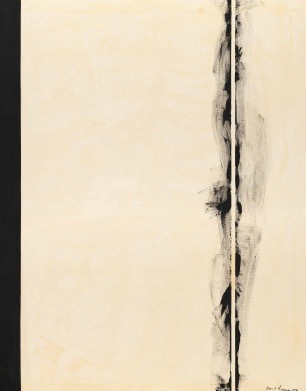
The persistence of Christian subjects and images, despite the immense erosion of the Church’s cultural presence, is exemplified in the case of Barnett Newman. Only ten years after his manifesto against the “outmoded images” of western art and religion (quoted above), he began to paint one of the sacred masterpieces of modern art: Stations of the Cross (1958-1966). In fourteen large abstract canvases of minimal content, he explored Christ’s anguished scream from the cross: My God, my God, why have you forsaken me? Newman called it “the unanswerable cry,” and in each of those paintings, often with only a thin black line in tension with––even overwhelmed by––the empty space around it, he questions our place in the larger whole. What does it mean to exist, to suffer, to desire? Are we alone, ignored, or loved?

Barnett Newman, Stations of the Cross, First Station (Jesus is Condemned)

Ultimately, it is not just the intentions or beliefs of the artists, nor their chosen subjects and styles, which make their art religious, for “any art that helps us penetrate the surface of things is religious, regardless of content or creator.”[xvi]  And whether art is a mirror of the human condition, a window into beauty both immanent and transcendent, or a hammer to shatter our complacencies, it shares many of the tasks and effects of religion.

Art and faith are, each in their own way:

  • Transformative: opening us up to the otherness of worlds beyond our isolated egos.
  • Revelatory: showing us what might otherwise remain invisible (suffering and injustice as well as more sublime realities).
  • Sacramental: making present to our senses the depth and beauty of a world “charged with the grandeur of God.”
  • Relational: connecting us with “Something” that not only desires to be known, but wants to address us.
  • Prophetic: making it impossible to avert our eyes from pain, suffering and injustice.
  • Formative: teaching us how to be receptive and pay the deepest attention.

Art and faith, then, are fundamentally allies, though they may not always act like it. Deepening the connections between them is, I believe, part of the Spirit’s dance. Or as Cirque du Soleil’s Michel Laprise puts the question:

A bridge to a new dimension? A magnetic portal to an invisible world? Yes! Why not? The Valley of Possible Impossibles, where dreams are on standby … waiting to be ushered into the now Abandoned dreams, collective dreams, mad, mad, mad utopian dreams … the unconscious into the conscious. Duality! Oneness!

Let the journey begin… [xvii]


Cirque du Soleil, Kurios (photo by Jim Friedrich)


Related posts

Do Not Fear: Reflections on the Venice Colloquium

“The artist formerly known as priest”


[i] Langdon Gilkey, “Can Art Fill the Vacuum?” in Art, Creativity, and the Sacred: An Anthology in Religion and Art, ed. Diane Apostolos-Cappadona (New York: Crossroad, 1984), 189-90.

[ii] Andrei Tarkovsky, Sculpting in Time: Reflections on the Cinema (Austin: University of Texas Press, 1986, 1987), 43.

[iii] Paul Tillich, q. in On Art and Architecture, ed. John Dillenberger and Jane Dillenberger (New York: Crossroad, 1987), 234-5.

[iv] Emily Carr, Hundreds and Thousands: The Journals of an Artist (Toronto: Irwin Publishing, 1966), 6.

[v] Mary Oliver, “The Journey,” in New and Selected Poems (Boston: Beacon Press, 1982), 114-5.

[vi] David Foster Wallace, This is Water: Some Thoughts, Delivered on a Significant Occasion, about Living a Compassionate Life (New York: Little, Brown and Company, 2009), 117.

[vii] Gary Indiana, “Movie Rites,” Artforum (April 2000, v38 i8).

[viii] See Hans Belting, Likeness and Presence: A History of the Image before the Era of Art (Chicago: University of Chicago Press, 1997)

[ix] Barnett Newman, “The Sublime is Now,” Tiger’s Eye (Dec. 1948), reprinted in The Sublime (Ed. Simon Morley, Documents of Contemporary Art, London: Whitechapel Gallery, 2010), 27.

[x] Re-Enchantment, ed. James Elkins & David Morgan (New York & London: Routledge, 2009), 110

[xi] Gerhard Richter: Text, Writing, Interviews and Letters, 1961-2007 (London: Thames & Hudson, 2009), 34.

[xii] Charlene Spretnak’s extensive documentation in The Spiritual Dynamic in Modern Art (New York: Palgrave Macmillan, 2014) makes the case persuasively.

[xiii] Spretnak, 40.

[xiv] Ibid., 102.

[xv] Ibid., 129.

[xvi] Daniel A. Siedell, God in the Gallery: A Christian Embrace of Modern Art (Grand Rapids, MI: Baker Academic, 2008), 164.

[xvii] Michel Laprise, Workbook for Cirque du Soleil’s Kurios: Cabinet of Curiosities (2014)

Temporary Resurrection Zones

Then I saw a new heaven and a new earth.

– Revelation 21:1

We can’t create a world we haven’t yet imagined. Better if we’ve already tasted it.

– Beautiful Trouble[i]

At the Last Supper, with less than 24 hours to live, Jesus took the time to go around the room and wash the feet of every disciple. Then he asked all of them to do the same when he was gone. “You must wash each other’s feet,” he said. “I have given you an example so that you may copy what I have done to you” (John 13:14-15). He could have been speaking metaphorically. Maybe “wash each other’s feet” simply meant that they should always serve one another in loving humility.

But I suspect Jesus wanted them to repeat the footwashing not just as a reminder of his message, but because there is something you can only learn when you kneel at the foot of another, take their foot in your hands, and pour water over it. And there is something you can only know when you let someone kneel before you and minister to you as a living icon of Christ, who emptied himself and took the form of a slave.

Thankfully, the Church has preserved footwashing in its Holy Week rituals, and every year this archaic act, with its egalitarian model of mutual love, posits its quiet but tangible challenge to the social order. In our own time, Pope Francis has used the rite to embrace the marginalized, including prisoners, immigrants and Muslims. Church history abounds with similar examples.

In medieval England, some of the poor were invited into the Canterbury cloister every Maundy Thursday afternoon. Then the monks would make an entrance, each standing face to face with one of their impoverished guests. An eleventh-century text describes the remarkable scene:

Then the prior shall strike the board thrice at the abbot’s command,
and genuflecting and bowing down they shall adore Christ in the poor.

Once each monk had washed and dried the feet of the person before him, he bent to kiss each foot with extraordinary reverence. As C.S. Lewis once put it: Next to the Blessed Sacrament itself, your neighbor is the holiest object presented to your senses…for in him Christ is truly hidden.

One of my favorite footwashing stories took place in Madrid’s Royal Chapel in the mid-nineteenth century. The king and queen entered dressed in all their finery. Seated on two separate platforms were twelve poor men and twelve poor women, all of them old, dressed in fresh clothing provided by the monarchs. The king knelt to wash the men’s feet while the queen, adorned with white mantilla and diamond diadem, did the same for the women. And while the queen was washing one woman’s feet, her diamond bracelet slipped off her wrist into the basin of water. The poor woman reached down to retrieve it, and held it out to the queen. But the queen told her, “Keep it, hija mija; it is your luck.”[ii]

I don’t know what was in the queen’s heart at that moment, nor is there any record of the poor woman’s thoughts. The incident was only the briefest ripple on the placid surface of the status quo. The social order quickly resumed its accustomed injustice, and the queen probably had plenty of spare diamonds in her chamber. Her generous act may have been little more than a display of superior power and wealth.

Still, it was a tiny crack in the accustomed order, offering a glimpse of a better world beyond the consensus reality. Jesus knew what he was doing when he told us to keep washing each other’s feet. Rinse, repeat. Maybe someday the ritual’s radical implications will dawn on us and we’ll work to change the way we live together.

Activists have a term for what Jesus did in the footwashing: prefigurative Intervention. It is an action which dissents from the dominant order by showing a different way of being and relating. Beautiful Trouble, a handbook for creative activism (reviewed in my last post), describes it this way: “The goal of a prefigurative intervention is twofold: to offer a compelling glimpse of a possible, and better, future, and also––slyly or baldly––to point up the poverty of imagination of the world we actually do live in.”[iii]

Instead of a direct assault on the existing order, create an alternative experience attractive enough to lure people toward something better. This is the premise underlying the Eucharist, where an alternative world of welcome, inclusion, abundance and communion is proposed at least once a week around the world.

Hakim Bey, a Sufi poet, scholar, and “anarcho-immediatist,” has called for the creation of “temporary autonomous zones”–– “an eruption of free culture” where alternative futures may be experienced, if only briefly. Instead of simply waiting for large-scale historical change to arrive, why not create ephemeral spaces and moments where something different can be experienced? “Are we who live in the present doomed never to experience autonomy, never to stand for one moment on a bit of land ruled only by freedom?”[iv]

A simple example would be PARK(ing) Day, when people in American cities put enough coins in parking meters to buy curbside spaces for a day, turning them into a mini-park with a tiny pool, a little jazz lounge, or some other variation where people can discover a different way of inhabiting public space in a temporary respite from automobiles and bureaucratic planning. More elaborate and challenging “prefigurative interventions” were the famous encampments in Wall Street and Tahrir Square, enabling large numbers of people to imagine that another reality might be achievable.

As the writers of Beautiful Trouble make clear, the “idea is not to paint a pretty picture full of rainbows and unicorns, but to put forward a fragment of something visionary, desirable, and just beyond the realm of the possible––and in such a way that your action calls out the vested interests making it impossible.”[v]

One of my favorite examples is a series of intervention called “small gifts.”  The one described in Beautiful Trouble––“take what you need, give what you can”–– created a space for “conversation and generosity” in a busy shopping area. The three British artists who curated this action sought answers to the following questions:

What would our world look like if we exchanged gifts rather than money?
What is the value in speaking to strangers?
What if we focused on giving as much as we can rather than as little?

They set up a dining table and chairs in a busy shopping area, and made one hundred tiny envelopes containing a one-pound coin, a written question, and an invitation to use the coin to make, find or buy something to bring back to the table. Then the artists began to offer the envelopes to passersby. Anyone who accepted an envelope became part of the conversation. And if they then used their coin to bring something back to the table, they were asked to share the question in their envelope to prompt conversation with those already there. And all were welcome to share in whatever was on the table at the moment.

“Give what you can, take what you need” gift envelope with pound note (Photo by Rani Shah)

This improvised sharing of food, conversation and gift-giving not only created community in a place of alienation and anonymity, it stimulated rich exchanges about “generosity, value and ownership” while avoiding the divisiveness of overt political discourse.[vi] It was also, I would suggest, an enacted parable of the heavenly banquet.

The Church is always wondering how to do its work in the world. It’s not enough to stay within our walls and hope the world drops by from time to time. We need to take our gifts into the wider community, to make prefigurative interventions in intentional and creative ways. Some churches do “Ashes To Go,” anointing busy urbanites on street corners and transit stations on Ash Wednesday. Others offer to wash the feet of strangers on Maundy Thursday, or celebrate the eucharist in parks with the homeless. Some join forces with community leaders and organizers to serve the poor, alleviate hunger and homelessness, and advocate for political change and economic justice.

These are all really great ministries, but I hope we will also be inspired to go beyond what we already know and do, to invent a whole multitude of imaginative and alluring ways to interrupt the blind sufferings of history with temporary resurrection zones and divine interventions. We need both to learn from and collaborate with the artists and creatives who are already out there ahead of us, announcing in their own diverse idioms that God’s future is not only on its way, it might already be available in the here and now.

Related posts 

Unsilent Night: An Advent Revelation

“Delightful! Wonderful! Incomparable!” – Thoughts about Holy Spaces

[i] Beautiful Trouble: A Toolbox for Revolution, “Assembled” by Andrew Boyd with Dave Oswald Mitchell (New York/London: OR Books, 2016), 84

[ii] James Monti, The Week of Salvation: History and Traditions of Holy Week (Huntington, IN: Our Sunday Visitor, Inc., 1993)

[iii] Beautiful Trouble, 82

[iv] ibid., 270

[v] ibid., 83

[vi] ibid., 360-63