For the latest No Kings March to occur on the eve of Palm Sunday seemed to me a resonant conjunction. Both yesterday’s march and the “triumphal entry” of Jesus into Jerusalem stirred the deepest hopes of people suffering under oppressive regimes. Of course not all hopes are equal, and sometimes they turn out to be, as T. S. Eliot noted, “hope for the wrong thing.” Even if the folks shouting Hosanna in Jerusalem were mistaken about what God was up to that week, I imagine Jesus still being touched by their longing, that crazy feeling that the world might just get better. The capacity for hope is one of humanity’s finest qualities.
There is some irony, of course, in linking No Kings to a biblical event suffused in royal imagery. I’ve been singing the Palm Sunday processional, “All glory, laud, and honor to thee, Redeemer, King!” ever since I was a child. But God is no stranger to irony—manifesting divinity as a helpless child, “ruling” as a servant, and dying to give life. And a line by the late great songwriter Bob Franke neatly resolves, for me at least, any tension between democracy and religious language inherited from monarchists.
Well you kneel to the Lord and you will bless yourself; Ain’t no need to kneel to no one else.
In a week when people of my tradition walk the Way of the Cross in ritual, song and story, we know that hope is no stranger to struggle and suffering. It’s a long and winding road to Easter, passing through Gethsemane and Golgotha. Yet it remains, as the Book of Common Prayer assures us, “none other than the way of life and peace.”
On yesterday’s march in Seattle, I shot video of what I saw, and in putting it together I was struck all over again by the recurrent note of joy. Not everyone would put it this way, of course, but for one gloriously sunny day, we were, as the South Africans sing, “marching in the light of God,” and the divine future of human flourishing made a significant incursion into the present moment. As the crowd chants in the opening of my video:
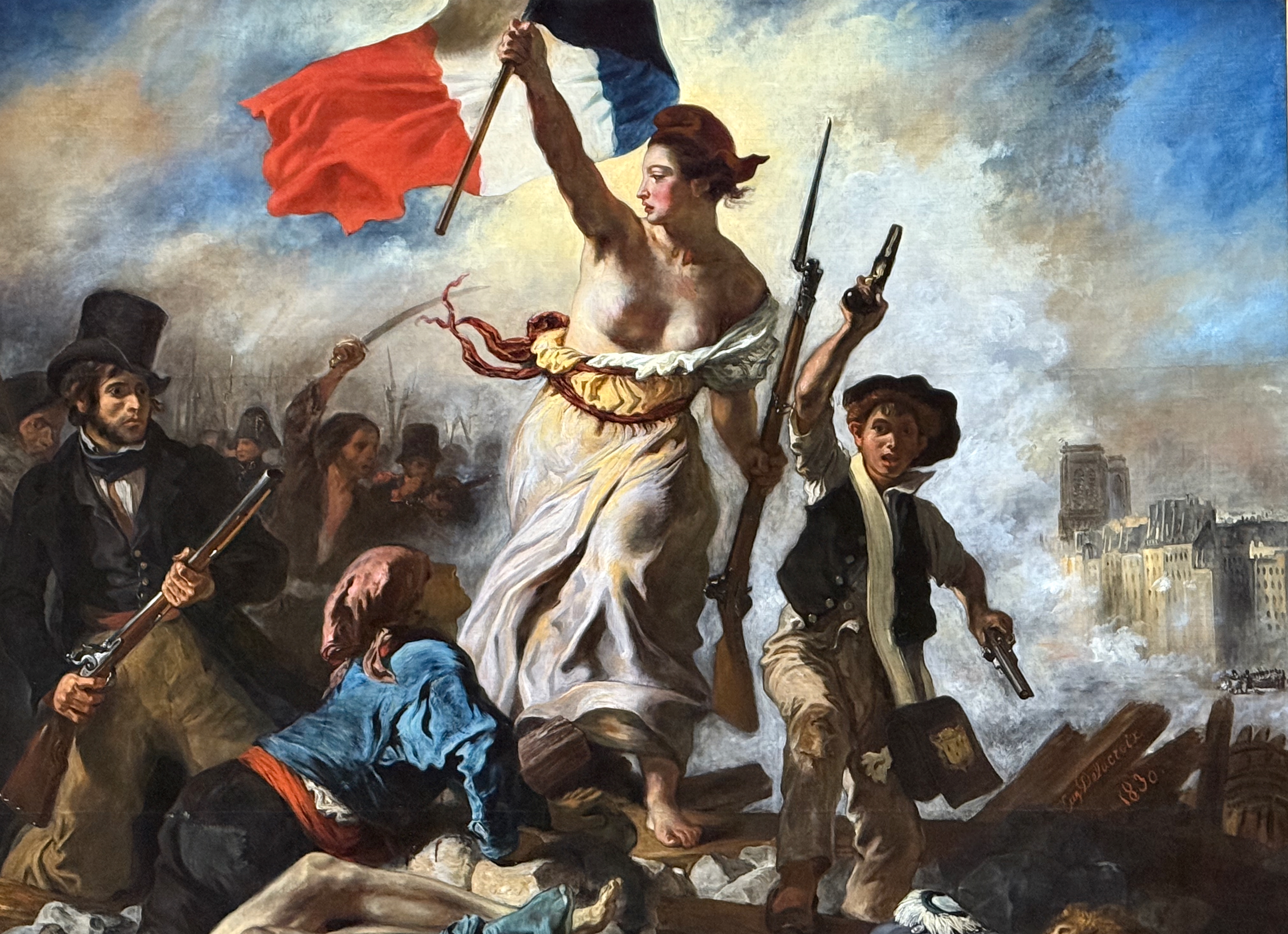
Eugène Delacroix, LIberty Leading the People (1830).
“Nothing collapses more quickly than civilization during crises like this one [the French Revolution of June 1848]; lost in three weeks is the accomplishment of centuries. Civilization, life itself, is something learned and invented … After several years of peace men forget it all too easily. They come to believe that culture is innate, that it is identical with nature. But savagery is always lurking two steps away, and it regains a foothold as soon as one stumbles.”
When an inflamed crowd of Parisian citizens stormed the Bastille on July 14, 1789, the obsolete medieval fortress had long outlived its usefulness as an instrument of royal tyranny. It was destined for demolition, and a mere seven prisoners inhabited its dungeons when the crowd broke through the gates. A year later, Lafayette presented the key for the Bastille to President George Washington, honoring the quest for liberty by both countries. The key still resides at Washington’s Mount Vernon home.
Historians have suggested that the king’s capitulation to the political power of commoners (the ‘Third Estate’) on July 9 marks the true beginning of the French Revolution, but the bloody drama of Bastille Day proved a more potent symbol than the parliamentary negotiations being conducted at the king’s palace of Versailles. In any case, the once unthinkable destruction of the Ancien Régime had been decades in the making.
In The Revolutionary Temper: Paris, 1748-1789, American historian Robert Darnton traces the growth of revolutionary sentiment as it was expressed in the Paris street: café conversations (often transcribed by police spies), underground gazettes and pamphlets, street songs, sidewalk speeches, public demonstrations and processions, and personal diaries. Eighteenth-century Paris had its own version of an information society, where “the ebb and flow of information among ordinary Parisians” was shared widely in cafés, marketplaces, wineshops, street corners and salons. [ii]
When the 72-year reign of Louis XIV ended in 1715, it was hard to imagine an alternative to absolute monarchy. His successor, Louis XV, would still be claiming dictatorial authority as late as 1766:
“In my person alone resides the sovereign power: from me alone my courts derive their existence and their authority, without any dependence and any division.” [iii]
In 1781, Louis XVI would tell his judiciary, “It is legal because I want it.” [iv] That’s the authoritarian creed. But by then, the game was up, and he was just whistling in the dark. A record of financial mismanagement, economic hardship, abuse of power, political corruption, and the ravages of poverty and hunger had by then called into question not only the effectiveness of the king and his government, but the legitimacy of the monarchy itself. Murmures (vocal grumbling about the regime) became part of daily life in Paris, and fed the printed complaints of the pamphleteers.
“Although the words were printed on paper, the messages of pamphlets flew through the air and mixed in the cacophony known as bruits publics [‘public rumors’]. Pamphlets were bruited about. They were read aloud, performed, applauded, rebutted, and assimilated in the talk that filled lieux publics [“public places”]. Readers also pondered tracts in the quiet of their studies, but when they went outside they encountered other Parisians, in marketplaces, along the quais, in the courtyard of the Louvre, on benches in the gardens of the Palais-Royal, the Tuileries, and the Luxembourg palace. Like smoke from thousands of chimneys gathering over the city, a climate of opinion gradually took shape.” [v]
It took half of the eighteenth-century to produce such a climate of opinion in France, a ”revolutionary temper” which was perfected, like tempered steel, through repeated heating and cooling. People would complain about this tax or that scandal, this outrage or that cruelty, but the tectonic shift from specific complaints to general discontent and clamor for change was a process of decades. Only when the climate of opinion attained sufficient density was it possible to imagine the impossible. Once revolution became conceivable, the leaps from absolute monarchy to constitutional monarchy to no monarchy at all were breathtakingly swift.
Revolution doesn’t necessarily require the refinements of political theory. By 1788, the high cost of bread by itself (like our egg or gas prices) was enough to elicit calls for radical change. One angry woman in a boulangerie was heard to say, “They should march on Versailles and burn the place down.” [vi] She was not alone, and by then the people of Paris were beginning to conceive of themselves as part of a movement, and act accordingly.
“Whether or not they followed the arguments of the theoreticians, Parisians were swept up in the conviction of becoming a nation, a sovereign body that would defy privileged orders and take charge of its own destiny. This way of constructing reality—the drawing of lines, the identification of a common enemy, the creation of a collective self-awareness—can be understood as a process of radical simplification. Although it had origins that went far back in the past, it came together with unprecedented force in 1788 and underlay a revolutionary view of the world: us against them, the people against the grands, the nation against the aristocracy.” [vii]
I could not read Darnton’s illuminating account without thinking of my own deeply troubled country. Although there are of course countless dissimilarities between 18th-century France and 21st-century America, some parallels got me thinking.
First of all, I found the accounts of a Paris alive with ardent conversations about public life to be inspirational. There was an urgency and a passion which feels lacking in America’s current collective consciousness. “Everyone writes, everyone reads,” said one of those pre-revolutionary Parisians. “Even the coachman reads the latest work on his perch,” said another. “Every person down to domestic servants and water carriers is involved in the debating.” [viii] But in America, 2025, while we may consume volumes of news in private, most of us carry on as if life is pretty much normal, even as our would-be dictator dispatches masked thugs to terrorize our communities, trains the military to act as his personal army, and builds concentration camps to torture and disappear his “enemies.”
Like 18th-century Paris, we need to converse with one another in earnest, employing a reliable flow of factual information and strategic thought to shape a collective consciousness for the common good. The forces of tyranny and greed have worked for decades to create its opposite, a seductive web of lies and rage to poison and incapacitate the consciences of millions of Americans. Those who care about the common good are still, I believe, in the majority, but that means nothing if we lack the means and the will to be connected with one another in public truth-telling, mutual encouragement, and collective action. As long as we feel isolated, alone and discouraged, tyranny will flourish.
I was also struck by the importance of imagining alternatives to consensus reality in our public life. A sense of inevitability is the mother of inaction. In France under Louis XIV, the monarchy seemed inevitable—until it didn’t. In America, at least until Trump, democracy and the rule of law were assumed to be inevitable. And while many of us have come to realize how fragile and conditional our democracy actually is, the press, along with many Democratic politicians, continue to play the game of “Let’s Pretend.”
Let’s pretend that everyone is playing by the same rules. Let’s pretend the president is not fascist, childish, ignorant, cruel, and increasingly incoherent and nonsensical. Let’s pretend that normal protocols are the best way to engage with him. Let’s pretend we don’t have an American gestapo, or a White House dominated by racists, white nationalists and shameless liars. Let’s pretend our government isn’t supporting genocide in Gaza, or robbing millions of their health care. Let’s pretend that climate change is nothing to worry about. Let’s pretend it’s all just politics as usual and both sides do the same thing, so there’s no cause for alarm.
Finally, I was intrigued by the theatricality of what the French called emotions populaires [mass protests]. Straw effigies of unpopular or disgraced officials were mocked, paraded through the streets, and forced to kneel before statues of honored officials and beg divine pardon. On one occasion, the crowd seized a passing priest, demanding that he hear the dummy’s confession. Eyed with suspicion as a symbol of the Ancien Régime, the priest was careful not to anger the crowd by refusing to play. He put his ear to the effigy’s mouth for a few moments, then declared to all that it had so many sins to confess that it would take all night! The people laughed, applauded the priest’s wit, and let him go. As for the dummy official, he “was pitched into a giant feu de foie [‘fire of joy’].” [ix]
I suspect that setting fire to effigies of our American tyrants would not be a safe practice these days, and I am aware that the emotions populaires in revolutionary Paris often led to serious violence. But I wonder if there might be, in our own acts of resistance and witness, creative theatrical ways to engage with flanks of armed soldiers or gangs of ICE agents using guerilla theater, humor, song, ritual, and even clowning and mime—anything to subvert, disarm, or transcend the deadly Punch and Judy face-off of venomous gazes. Is there any way to make the other laugh, or wonder, or think, if only for a moment? Send in the clowns! Could you still want to shoot someone who made you laugh—or cry?
You may say that I’m a dreamer, but I’m not (I hope) the only one.
[i] Charles Augustin Sainte-Beuve (1804-1869), a French literary critic, is quoted by George Eliot in Impressions of Theophrastus Such; cited in Frederick Brown, The Embrace of Unreason: France, 1914-1940 (New York: Anchor Books, 2014), 3.
[ii] Robert Darnton, The Revolutionary Temper: Paris, 1748-1789 (New York: W. W. Norton & Company, 2024), xix.
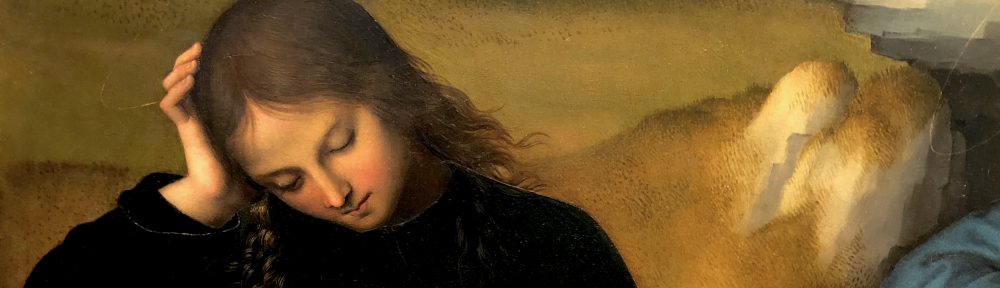
Anonymous, The Descent from the Cross (detail), German c. 1500.
The evil and the armed draw near; The weather smells of their hate And the houses smell of our fear.
— W. H. Auden, For the Time Being
“ … because all you of Earth are idiots!”
— Plan 9 from Outer Space (Ed Wood, 1957)
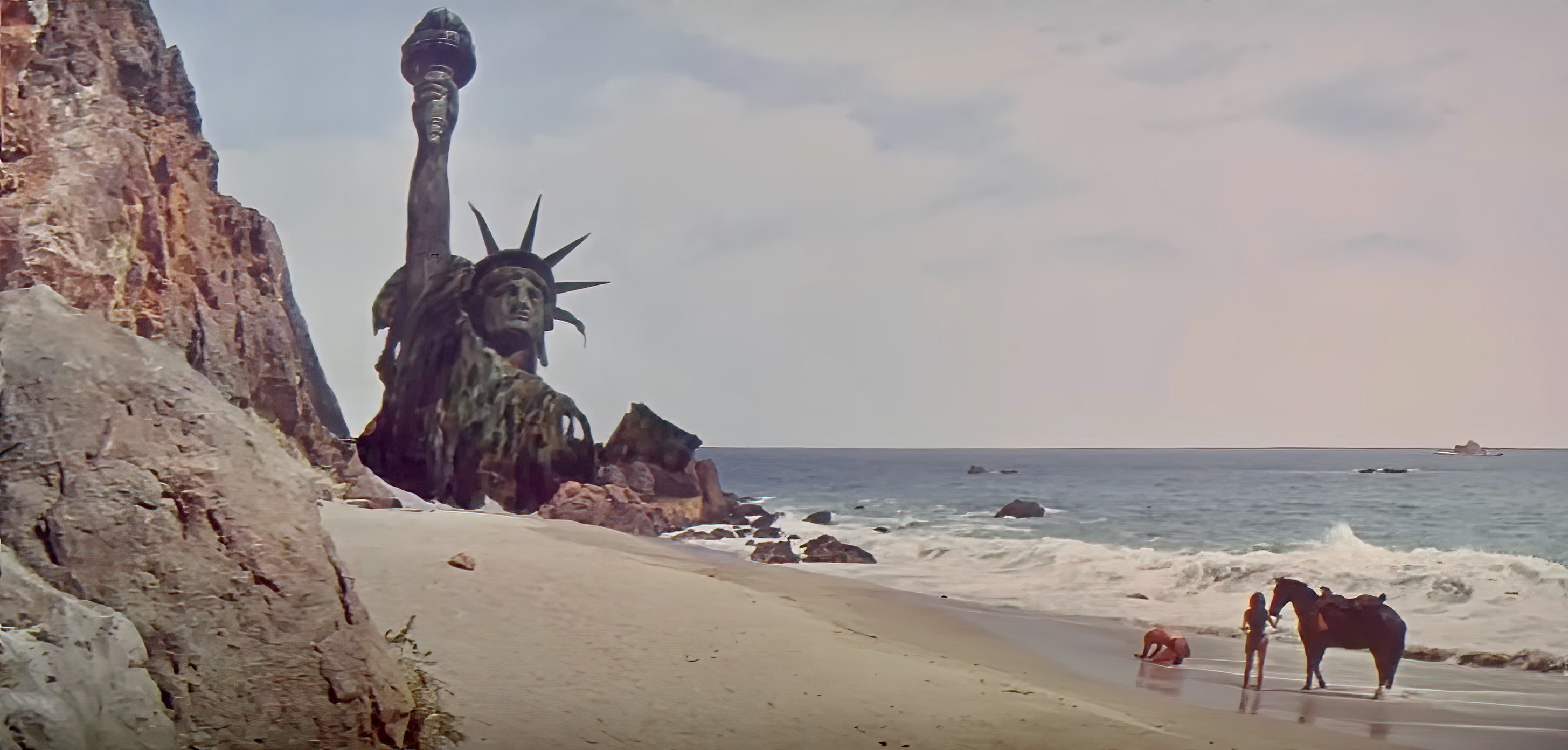
How bad is it, anyway? In the first hours of the new Amerika last Tuesday, the original Planet of the Apes (1968) came to mind. Finding a half-buried Statue of Liberty on a deserted beach, space-and-time traveler Charlton Heston realizes he has not landed on some distant planet, but on his own earthly home, where humanity has evidently committed nuclear suicide. Literally pounding the sand, he cries out to his long-vanished fellow mortals, “You really, finally, did it! You maniacs! You blew it up! Damn you! God damn you all to hell!”
A ruined earh: The final image of Planet of the Apes (1968).
In the Year of our Lord 2024, a decisive majority of Americans have chosen to blow up democracy, the rule of law, the common good, civil liberty, women’s rights, health care, international stability, public sanity, and our last hopes of staving off climate apocalypse. Did they know what they were doing? I confess to zero interest in their motivation at this point. Their decision, measured by its inevitable consequences, was neither rational nor moral. The harm it will do is immeasurable. Even if they thought they were trying to make a point about their personal economic pain, the mad embrace of a fascistic, unstable sociopath and the MAGA dream of demolishing the American experiment—not to mention the livability of our planet—will impose a price none of us can afford.
The American minority, meanwhile, has spent the past week trying to cope with the shock and the horror of the Antichrist’s second coming (I use that name not in a mythical sense, but in a moral one, describing the Trump who in every respect is against the way of Jesus).
Some have engaged in second-guessing the Democratic campaign, as if putting the argument differently could have penetrated the thick shields of delusion and hate erected by right-wing propagandists and their carefully crafted algorithms. Some have sought comfort in the long view, looking toward the distant horizon where hope and history will someday rhyme. Some see the moment as a sobering diagnosis of our national maladies, putting an end to further denial. There’s no use pretending we’re still healthy. Some are tuning out, or contemplating flight to saner climes. Some, sadder and wiser, are vowing to carry on the fight for the common good. God help them.
Marc Chagall, Adam and Eve Expelled from Paradise (detail), 1961.
Many people have been passing poems around on social media, lighting candles of gentleness and peace for one another in this dark night. I have taken comfort in these tender gestures, offered like balm in Gilead for the sin-sick soul. But I also have found myself browsing post-WWII poems that register the shock of brutal conflict. “The Last War” by Kingsley Amis (1948) touched a chord in me with its opening line: “The first country to die was normal in the evening.” By morning it was disfigured and dead
The poem narrates a kind of Agatha Christie murder story in a country house. No one, in the end, survives the weekend. When the sun (the light of Reason? the eye of God?) shows up to survey the damage and “tidy up,” he is unable to separate “the assassins from the victims.” Sickened by the folly and horror of human self-destruction, the sun goes back to bed. The last two stanzas begin with the sound of gunfire and end with a deathly quiet:
Homicide, pacifist, crusader, tyrant, adventurer, boor Staggered about moaning, shooting into the dark. Next day, to tidy up as usual, the sun came in When they and their ammunition were all finished, And found himself alone.
Upset, he looked them over, to separate, if he could, The assassins from the victims, but every face Had taken on the flat anonymity of pain; And soon they’ll all smell alike, he thought, and felt sick, And went to bed at noon.
The sense of recognition I felt in reading the poem oddly eased my post-election malaise. Though I dwell in the valley of the shadow, I’m not alone. Like Dante in hell, I’ve got a good poet for company.
Virgil and Dante in the 8th Circle of Hell The Roman poet would guide Dante through the infernal regions until they found the way out.
Well, what now? If there were ever a time demanding religious imagination—the ability to see resurrection light even on Good Friday—this is it. Such envisioning will be one of the ongoing tasks of The Religious Imagineer. But we can’t just leap into Easter. We must first do our time at the foot of the cross, living in solidarity—and risk?—with the victims and the vulnerable, tuning our hearts to the bells that toll for every human tear:
Tolling for the luckless, the abandoned and forsaked, Tolling for the outcast, burning constantly at stake … Tolling for the aching ones whose wounds cannot be nursed, For the countless confused, accused, misused, strung-out ones and worse, And for every hung-up person in the whole wide universe. [1]
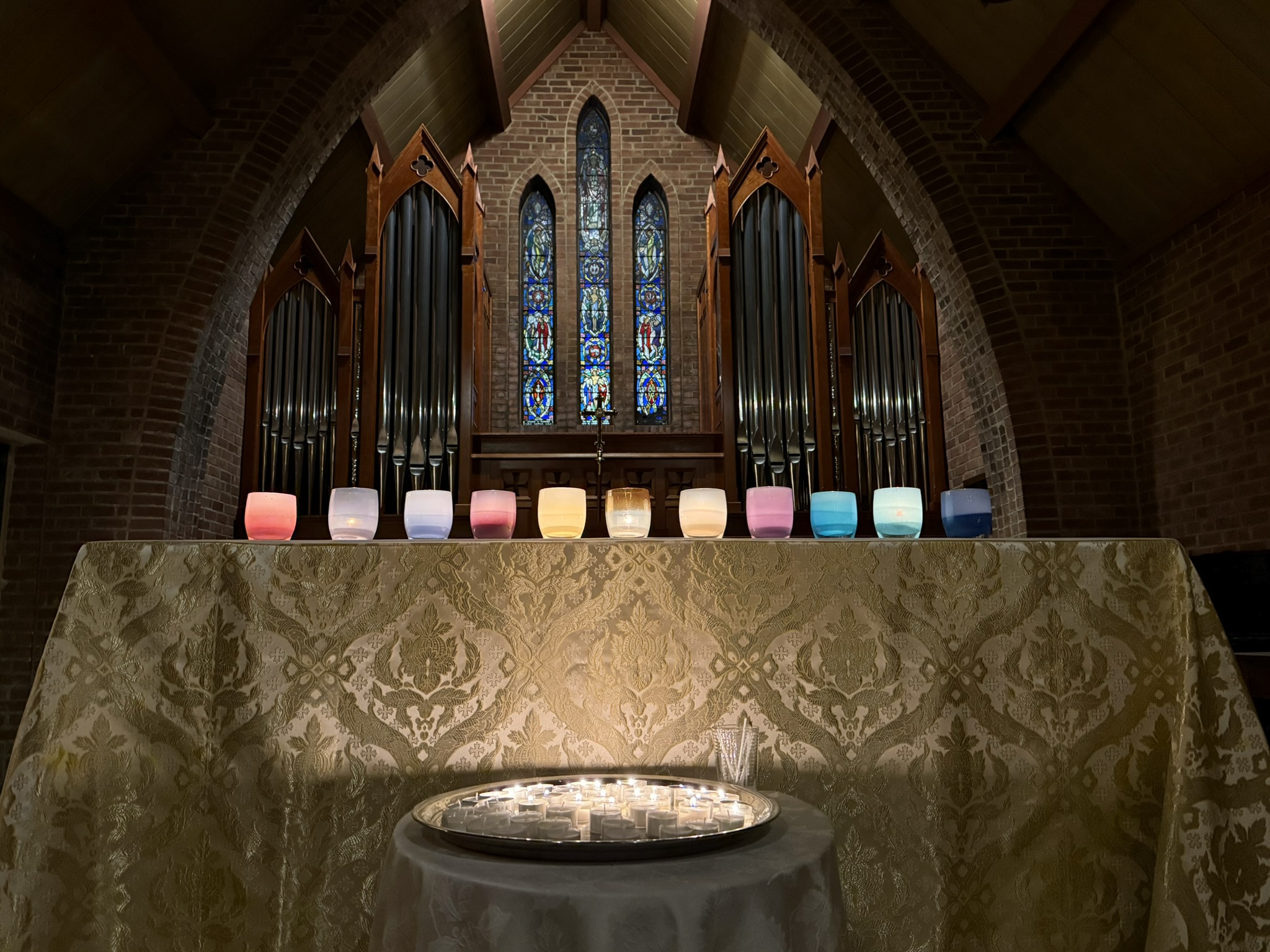
St. Barnabas Episcopal Church, Bainbridge Island, Washington. Prayers silent and aloud were offered here the night before and the night after the election.
I feel blessed to be in Christian community during this time of trial. It is better to hold hands than clench fists. It restores the soul to share our griefs and voice our hopes in sacred discourse and common prayer. Preachers are encouraging our renewed commitment to the Baptismal Covenant: to persevere in resisting evil; seek and serve Christ in all persons; strive for justice and peace among all people; and respect the dignity of every human being.[2] Pastors, meanwhile, are reminding us to love those who voted against most of those things.
(I confess to my own struggle with the Christly precept of loving the haters. Yes, we all fall short, but the so-called Christians cheering the triumph of our basest impulses are, IMHO, falling short with unseemly enthusiasm. As Henry James noted, “when you hate you want to triumph.”) [3]
Tom Tomorrow always nails it: MAGA House of Horror (October 28, 2024).
Many of us, like the desert monks of Late Antiquity, are feeling the need to go on retreat from the public square, to hush the noise and attend the still small voice of holy wisdom. Our spiritual practices seem more necessary than ever.
For me over the past week, that has taken the form of Daily Offices, running, watching the birds in the garden, reading Henry James, a Monteverdi concert, and a splendid evening of Balanchine works by the Pacific Northwest Ballet. I have also been fasting from political news, limiting myself to a small amount of reflective commentary from trusted sources. Such self-care through withdrawal from the fray is “meet and right so to do.” But unless we are contemplatives whose job is to provide for the rest of us what Jesuit activist Dan Berrigan called “large reserves of available sanity,” we can’t stay in the desert forever.
Old Testament scholar Walter Brueggemann has responded to the election with a fine reflection on Elijah’s flight from the danger and exhaustion of public justice-making to the solitude and safety of the holy mountain. After a while, God tracks him down to ask, “What are you doing here, Elijah?”
“Go back to your proper place; you can linger here in self-pity only so long and then you must remember your call and perform your responsibility.” So Elijah is freshly dispatched back to his dangerous work. He is dispatched by the one who has lordly authority for him. The only assurance he is offered is that there are others—7000—who stand alongside in solidarity.[4]
We are not alone. God is with us. The night after the election, some of our local parish church gathered for Evening Prayer, with generous pauses for quiet resting in the Divine Presence. When words fail, let silence speak. Afterward, we had a deep and earnest conversation about the effect of the election on our hearts, minds, and bodies. The empowering richness of that exchange, a gift of the Holy Spirit, raised us from the depths to remember our vocation as God’s friends: to plant the seeds of resurrection amid the blind sufferings of history.
Henri Matisse, The Rosary Chapel in Vence, French Riviera.
Let me close with an encouraging story from the desert monks.
The disciple of a great old man was once attacked by the demons within him. The old man, seeing it in his prayer, said to him, ‘Do you want me to ask God to relieve you of this battle?’ The other said, ‘Abba, I see that I am afflicted, but I also see that this affliction is producing fruit in me; therefore ask God to give me endurance to bear it.’ And his Abba said to him, ‘Today I know you surpass me in perfection.’” [5]
Throughout this time of trial and affliction, God grant each of us, and our communities, the endurance to bear what we must bear, and do what we must do, that our lives may prove both faithful and fruitful in due season.
[1] Bob Dylan, “Chimes of Freedom,” from Another Side of Bob Dylan (Columbia Records, 1964).
[2] From the Baptismal Covenant, Episcopal Book of Common Prayer (1979).
[3] Henry James, The Ambassadors (New York: Modern Library, 2011), 427.
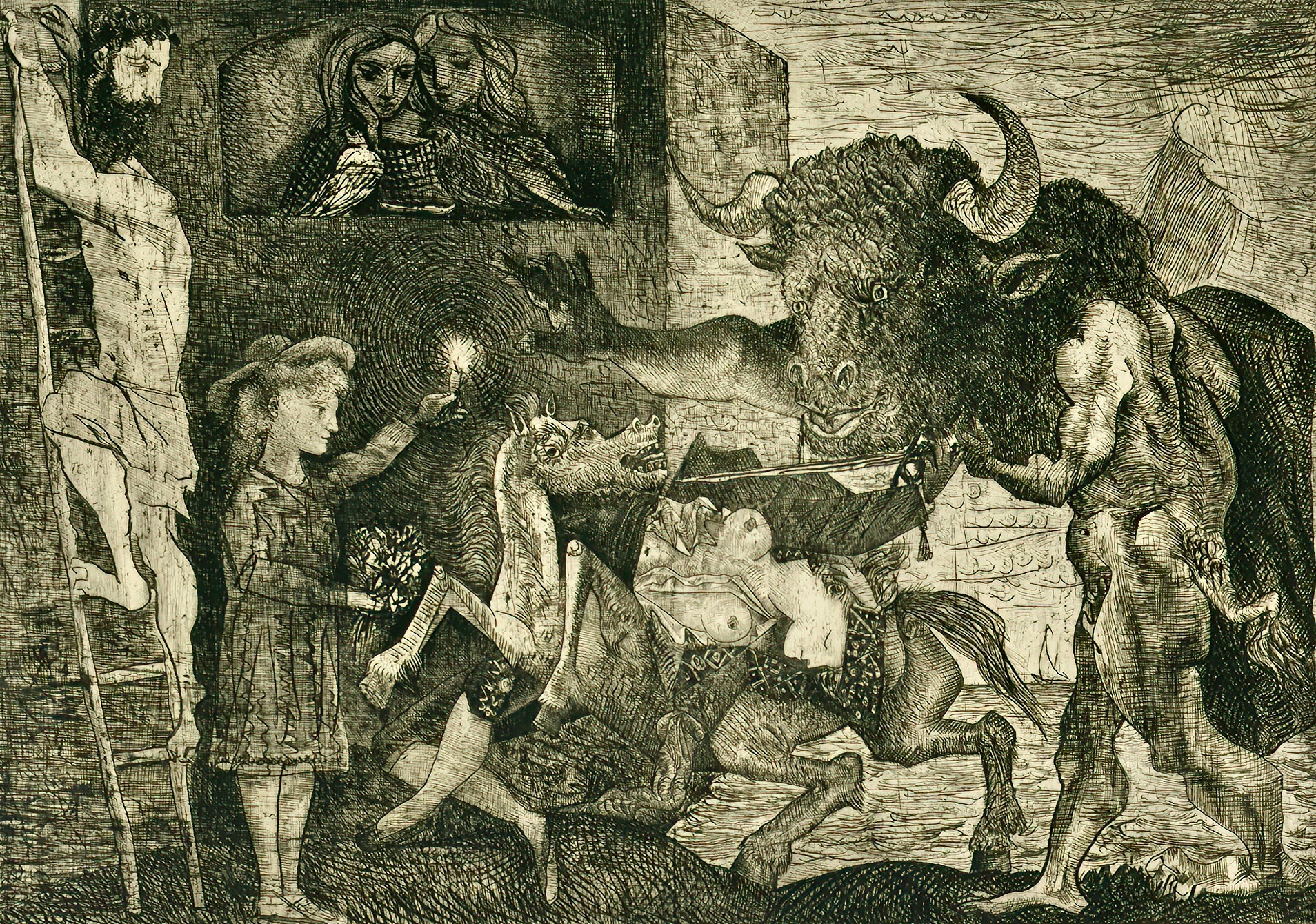
Picasso’s turbulent etching from the eve of the Spanish Civil War seems a timely image of my own country in this harrowing election season. The monstrous beast towers over his victim—the wounded female matador lying unconscious on the back of her tormented horse. From a high window, two other women, with doves of peace, witness the predator’s violence with both anger and sorrow. The cowardly male fleeing up the ladder takes no side, offers no resistance. Only the brave young girl, with her candle and flowers, stands firm against the Minotaur, whose hand tries to block the light of truth. Her calm and steady presence is unperturbed by the monster’s agressive rage. She knows something he will never understand. Even in the darkest hour, there is a light which refuses to be extinguished.
Here’s to the truth-tellers, activists, organizers, public servants, door-knockers, and phone-bankers whose candles shine so brightly in these challenging days. And for my own candle on Election Eve, let me offer the words of Abraham Lincoln, who summoned our better angels in his 1862 address to a divided nation:
“Can we do better?” The dogmas of the quiet past are inadequate to the stormy present. The occasion is piled high with difficulty, and we must rise with the occasion. As our case is new, so we must think anew and act anew. We must disenthrall ourselves, and then we shall save our country.
Fellow-citizens, we can not escape history. We of this Congress and this Administration will be remembered in spite of ourselves. No personal significance or insignificance can spare one or another of us. The fiery trial through which we pass will light us down in honor or dishonor to the latest generation … We shall nobly save or meanly lose the last best hope of earth.
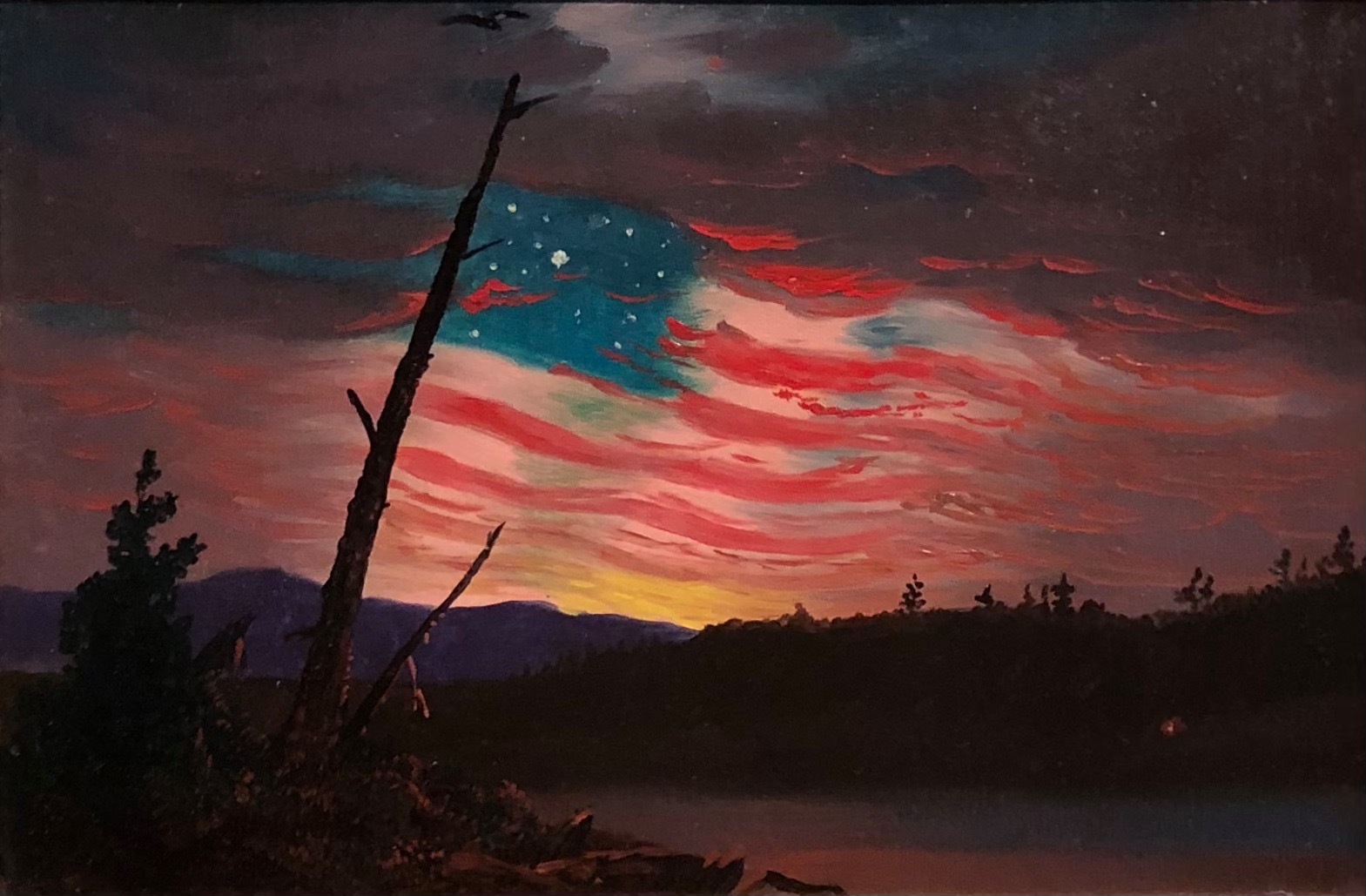
Frederic Edwin Church, Our Banner in the Sky (1861), painted at the outbreak of the American Civil War.
On November 5th, Guy Fawkes Day, the citizens of Great Britain will celebrate the defeat of a conspiracy to overthrow the political order in 1605. Thirty-six barrels of gunpowder hidden beneath the House of Lords were discovered before they could blow King and Parliament to kingdom come, and the plotters were brought to justice.
Also on November 5th, the citizens of the United States will vote whether to thwart or assist the overthrow of their own political order. Democracy itself is on the ballot, and the party of insurrection is determined to blow it up. If the latest polls are accurate, they have a fair chance of success.
Seventeenth-century England and twenty-first century America are dissimilar in countless ways, but the Gunpowder Plot of 1605 and the Presidential election of 2024 have one crucial thing in common: the toxic social effect of equivocation.
When the seventeenth century began, “equivocation” was a neutral, rarely used term for statements deemed ambiguous. But in the aftermath of the Gunpowder Plot, it became a widespread byword for deceitful speech. The term’s sudden prominence was triggered by the discovery of the plotters’ handbook, A Treatise of Equivocation, which detailed various ways for persecuted Roman Catholics to lie under oath without endangering their conscience.
When Catholic worship and practice were being suppressed after the English Reformation, the Roman faithful needed to conceal from the authorities the presence of priests and the saying of masses in their private homes. If asked, they could equivocate: give ambiguous or incomplete answers, or practice “mental reservation”—speaking aloud partial truths, while retaining in their minds any bits which might get them into trouble. As long as you speak the whole truth in your mind, where God can hear it, leaving your inquisitor in the dark is not a sin. In other words, the Treatise argued, it is possible to lie without guilt.
In a time when Roman priests were being hunted down and threatened with prison or the gallows, such equivocation was understandable. We do not fault the Dutch family who lied about Anne Frank hiding in their secret annex. But as the Gunpowder Plot made clear, social stability was not a given in the early days of King James’s reign. However, neither factions, plots, religious difference or the clash of ideas seemed the greatest threat to common life in Britain. The greatest threat was thought to be equivocation, the solvent of bad faith which dissolves communal trust. As an English court put it a few years after the insurrection was foiled:
“The commonwealth cannot possibly stand if this wicked doctrine be not beaten down and suppressed, for if it once take root in the hearts of people, in a short time there will be no faith, no truth, no trust … and all civil societies will break and be dissolved.” [2]
The Earl of Salisbury, responding to A Treatise of Equivocation with a book of his own, An Answer to Certain Scandalous Papers, warned against “that most strange and gross doctrine of equivocation,” which would “tear in sunder all the bonds of human conversation.” [3]
A similar anathema was issued from a London pulpit:
“He that lyeth doth deprive himself of all credit among men (for they will also suspect him to be a liar), so that he that once deceiveth his neighbor by equivocation, shall always be suspected to equivocate … If deceit by equivocation be used, then all covenants and contracts between man and man must cease, and have an end, because all men will be suspicious of one another … So, no commonwealth can stand, no civil society can be maintained.” [4]
The nightmarish world of Shakespeare’s Macbeth, written just after the Gunpowder Plot, dramatizes the dread of social disintegration, as even the more admirable characters find themselves “unspeaking” truth. “Fair is foul and foul is fair,” cry the weird sisters at their cauldron of deconstruction. Once language begins to mean anything and nothing, civil discourse is mortally wounded, and it is not just Macbeth who begins “to doubt th’ equivocation of the fiend / That lies like truth.” [5]
Shakespearean scholar James Shapiro notes that the moral chaos of the play is draining not just for the characters but for the audience as well:
“Equivocation makes following Macbeth’s dialogue a mentally exhausting experience, for playgoers—much like those conversing with equivocators—must decide whether a claim should be accepted at face value, and, if not, must struggle to construct what may be suppressed through mental reservation. But with equivocators, one never knows what, if anything, is left unspoken.” [6]
In the American election of 2024, we are well acquainted with the fiend that lies like truth. “Fair is foul, and foul is fair,” cry the weird brothers Trump and Vance, poisoning our national speech and our common life like there’s no tomorrow. The lying is in their natures—it’s who they are: hollow men without principles, shapeless hulks of impulse and ambition. But their lying, a weapon as destructive as gunpowder, is also an instrument of power. If truth and trust can be blown to bits, the weird brothers will be free to soar beyond accountability into a realm of naked, unfettered tyranny.
It will not go well for them. As Dante assures us, the lowest place in Hell is reserved for the fraudulent, because fraud is the polar opposite of love. Love nurtures community. Fraud disintegrates it. Dorothy Sayers’ eloquent notes on Dante’s Inferno describe the bleak endgame for the ones who are only in it for themselves:
“Beneath the clamor, beneath the monotonous circlings, beneath the fires of Hell, here at the center of the lost soul and the lost city, lie the silence and the rigidity and the eternal frozen cold. It is perhaps the greatest image in the whole Inferno … A cold and cruel egotism, gradually striking inward till even the lingering passion of hatred and destruction are frozen into immobility—that is the final state of sin.” [7]
Gustave Doré, Dis frozen in the lake of ice (1861). Immobilized in the pit of hell, the prince of lies is trapped in wordless solitude, dis-connected from every form of relation.
The evils of Trumpworld have multiplied ceaselessly over the years: tens of thousands of unnecessary Covid deaths, families torn apart at the border, political violence, the abuse of immigrants and women, the corruption of the Supreme Court, the stoking of anger, racism and hate, the relentless erosion of social bonds, the corrosive degradation of the rule of law, et cetera, et cetera. And so much lying. J. D. Vance’s gleeful admission that he invented the terrible stories about immigrants eating pets is just the latest example of a shamelessly destructive addiction to untruth. These people don’t care how many people they hurt.
It’s exhausting. That too is part of the Trump/Vance strategy. We’re supposed to grow weary and discouraged in the face of their unrelenting and senseless chaos. I find an apt metaphor for this moment of American politics in Washington Irving’s account of a transatlantic voyage in the early nineteenth century. Traveling by land, he said, keeps us connected with a sense of where we are and where we’ve come from.
“But a wide sea voyage severs us at once. It makes us conscious of being cast loose from the secure anchorage of settled life, and sent adrift upon a doubtful world. It interposes a gulf not entirely imaginary, but real, between us and our homes—a gulf subjected to tempest and fear and uncertainty, rendering distance palpable, and return precarious.” [8]
Winslow Homer, The Gulf Stream (1899/1906).
Irving’s harrowing journey took about as many weeks as we have left until the election. Sail on, friends, sail on. It is my hope that come November 5th, we will anchor once again in safe harbor, put the chaos behind us, and begin to mend the torn fabric of our common life.
In the meantime, citizens, we all have some serious work to do.
[1] Dante Alighieri, Inferno xxxi, 55-57, translated by Mary Jo Bang. Dante is explaining why the Creator made large creatures like elephants and whales, but abandoned the making of giants. Intelligence, granted too much size and power, could do great damage if corrupted.
[2] James Shapiro, The Year of Lear: Shakespeare in 1606 (New York: Simon & Schuster, 2015), 158.
[7] Dorothy Sayers, commentary on her translation of Inferno, quoted in Helen Luke, Dark Wood to White Rose: Journey and Transformation in Dante’s Divine Comedy (New York, Parabola Books, 1989), 41.
[8] Washington Irving, The Sketch Book of Geoffrey Crayon (1819-1820), quoted in David McCullough, The Greater Journey: Americans in Paris (New York: Simon & Schuster, 2011), 12.
It’s a scary time. Vote as if your life depends on it.
“Noncooperation with evil is as much a moral obligation as is cooperation with the good.”
— Martin Luther King, Jr.
At the end of World War II, there were 8 million Nazis in Germany, about 10 percent of the population. Millions more, whether from fear, ignorance, or true belief, had also given their consent to the evils of the Third Reich. Of those who had chosen noncooperation, most were either dead or gone, and the occupying Allied authorities believed that a program of “denazification” was necessary to awaken Germany from Hitler’s bad dream.
One of the Allied strategies was to make people attend documentary films before they could receive their food ration cards. The hope was to reshape indoctrinated minds with the facts. Years later, a German writer recalled the experience of sitting through death camp footage in a Frankfurt cinema:
“In the half-light of the projector, I could see that most people turned their faces away after the beginning of the film and stayed that way until the film was over. Today I think that that turned-away face was indeed the attitude of many millions; … The unfortunate people to which I belonged was … not interested in being shaken by events, in any ‘know thyself.’” [i]
That postwar Frankfurt screening could be a sad parable for my own country, where tens of millions continue to turn their faces away from reality. Forty percent of Americans still approve of Donald Trump. Sixty percent of Republicans believe his “big lie” that the 2020 election was stolen. And 345 Republican candidates for federal or statewide office continue to push the big lie despite zero evidence. At least 58% of them are expected to win.[ii]
In his absolutely indispensable handbook, On Tyranny, Timothy Snyder notes that many of the democracies founded in the wake of two world wars collapsed when authoritarians (mis)used the electoral system to seize power and eliminate opposition. The relatively long history of American democracy suggests stability, but the future of our democracy suddenly seems terribly uncertain. As Snyder observes:
“Some of the Germans who voted for the Nazi Party in 1932 no doubt understood that this might be the last meaningful free election for some time, but most did not.… No doubt the Russians who voted in 1990 did not think that this would be the last free and fair election in their country’s history, which (thus far) it has been. Any election can be the last, or at least the last in the lifetime of the person casting the vote.” [iii]
Democracy is on the ballot next week, they say. But since it is hard for most Americans to conceive an absence before it happens, or grasp the immensity of the threat, I would state the emergency in more urgent terms: Tyranny is on the ballot! The barbarians are at our gates! Democracy is burning! The end is near.
If we act as if this were a normal election, where we choose between ordinary political parties based on habit, tribal preference, or the issue of the moment, then I tremble for my country. The GOP is no longer a mainstream party. It has become the vehicle of choice for racists, white supremacists, liars, thugs and criminals. It is trying to dismantle democracy by any means necessary.
Many traditional Republicans who have not yet left the party are surely uncomfortable with where the far-right has taken them, but the voices of conscience and truth remain disappointingly silent. Adam Kinzinger, one of the few Congressional Republicans to speak out, says it’s simply his duty to put country over party:
“By the way,” he said recently, “Liz [Cheney] and I are not courageous. There’s no strength in this. We’re just surrounded by cowards.”
I know we must be careful about throwing the word “Nazi” around. Although American neo-Nazis have a love affair with Trump, and some 50 current Republican candidates have been advertising on a website frequented by Nazi sympathizers, it would be inaccurate, unhistorical, and inflammatory to apply the term directly to Republicans.[iv] However, I do find some chilling affinities, which in a sane world would disqualify the GOP, in its current state, from any voter’s serious consideration. Let me offer a florilegium of various sources to make my point.
Charismatic leader
For those who wonder why people surrender their wills to charismatic leaders, Stephen Jaeger describes the “mindset of the followers that enables them to dream the master’s dreams, to create or acknowledge a higher world in which he lives, to be deaf to criticism, resist with aggression any attempt to undermine the idol, and long to live in that world themselves. It is a condition in which the mind is under a spell and in the grip of an uncritical awe that extends to selfless devotion and beyond, to self-sacrifice.”
We may be puzzled by the ardent devotion that attaches itself to demagogues and tyrants—even the repulsive ones—but Jaeger says the rewards seem worth it to their uncritical followers:
“Through him the troubles of the world will end; he will redeem from its dreariness a world threatened by disenchantment. He embodies renewal. He awakens extravagant hopes in the devotee, visions of happiness, heroism, divinity, the restoration of the spirit, and the realization of fantasies. The charismatic and the followers create and share a world in which the boundaries of reality become unclear. Dreams and impossible or unlikely enterprises appear realizable, the deepest hopes and desires appear attainable.” [v]
The Big Lie
Trump and his enablers have shown the effectiveness of the shameless lie told over and over. Say it enough times, and people will come to believe it. Hitler provided the cynical playbook for all his successors:
“All propaganda must be popular and its intellectual level must be adjusted to the most limited intelligence among those it is addressed to. Consequently, the greater the mass it is intended to reach, the lower its purely intellectual level will have to be.… The receptivity of the great masses is very limited, their intelligence is small, but their power of forgetting is enormous. In consequence of these facts, all effective propaganda must be limited to a very few points and must harp on those in slogans until the last member of the public understands what you want him to understand by your slogan.” (Mein Kampf, 1925) [vi]
“Above all one must get rid of the idea that ideological concepts can satisfy the crowd. For the masses, knowledge is an unstable basis. What is stable is feeling, hatred.… What the masses need to feel is triumph in their own vigor.” (1926 speech) [vii]
Imagine what Hitler could have done with Twitter.
Contempt for Democracy
Once the Nazis were in power, Minister of Propaganda Joseph Goebbels explained how easy it was to use “the stupidity of democracy” for undemocratic ends. “It will always remain one of democracy’s best jokes,” he said, “that it provided its deadly enemies with the means by which it was destroyed.” [viii]
Republicans hope to seize total control of the voting process across the United States, through gerrymandering, limited eligibility and access for voters, partisan supervision of vote counts, and the empowering of state legislatures to override unfavorable results. The Republican candidate for governor in Wisconsin said it out loud last week: “Republicans will never lose another election in Wisconsin after I’m elected governor.” [ix]
Political Violence
Authoritarian movements need to amputate dissenters from the body. This can be done through rhetorical dehumanization of opponents, physical intimidation of critics, imprisonment, or even murder. Right-wing violence in America is nowhere near its heyday under the Nazis, but it is real and it is growing. Threats against political office-holders and anyone “not like us” has increased alarmingly since Trump took control of the Republican party. Timothy Snyder says that this is a matter of cause and effect:
“What was novel in 2016 was a candidate who ordered a private security detail to clear opponents from rallies and encouraged the audience itself to remove people who expressed different opinions. A protestor would first be greeted with boos, then with frenetic cries of ‘USA,’ and then be forced to leave the rally. At one campaign rally the candidate said, ‘There’s a remnant left over. Maybe get the remnant out. Get the remnant out.’ The crowd, taking its cue, then tried to root out other people who might be dissenters, all the while crying ‘USA.’ The candidate interjected, ‘Isn’t this more fun than a regular boring rally? To me, it’s fun.’ This kind of mob violence was meant to transform the political atmosphere, and it did.” [x]
In January, 1933, a German girl named Melita Maschmann was taken by her parents to watch a Nazi torchlight parade. Suddenly one of the marchers attacked a bystander, who apparently had shouted a criticism of the Nazis. The man fell to the ground, where his bloody face turned the snow red. Maschmann later recalled her excited reaction:
“The horror it inspired in me was almost imperceptibly spiced with an intoxicating joy. ‘We want to die for the flag,’ the torch-bearers had sung.… I was overcome with a burning desire to belong to these people for whom it was a matter of death and life.… I wanted to escape from my childish, narrow life and I wanted to attach myself to something that was great and fundamental.” [xi]
In 1933, the Nazi leaders were still making some effort to appear respectable, stoking political violence with their rhetoric while distancing themselves from the consequences. They needed to consolidate their power before showing their darkest colors. We have seen that in America as well, most recently in the brutal attack on Paul Pelosi, husband of Nancy Pelosi, the third person in line for the Presidency. After years of dehumanizing and sometimes violent rhetoric against Speaker Pelosi, most Republicans have indignantly denied any responsibility for the consequences of their words. A deplorable few found the violence to be humorous.
Kari Lake, Republican candidate for governor of Arizona, joked about the attack in a campaign appearance while 82-year-old Paul Pelosi was lying in the hospital with a skull fractured by his assailant’s hammer. Lake’s audience burst into laughter, and she did nothing to stop them in the name of human decency. When criticized for her tasteless insensitivity (I’m being kind here), she doubled down, claiming that her remark was taken out of context by “creative editing” which ignored her other remarks about security blah blah blah. “I never made light of the attack,” she insisted.
Well, you can judge for yourself. The following clip isolates her remark and the laughter it provoked. Whatever was said before and after cannot disguise the callousness of what she said, or the inhuman, howling amusement of her crowd. And yes, I did some “creative editing,” repeating, and finally slowing, the clip, giving us sufficient time, as the political mask slips for an instant, to contemplate the true face of democracy’s destroyers.
[i] Tony Judt, Postwar: A History of Europe Since 1945 (New York: Penguin Books, 2006), 57.
[iii] Timothy Snyder, On Tyranny: Twenty Lessons from the Twentieth Century (New York: Crown, 2017), 28-29. This little book is a must-read for our times!
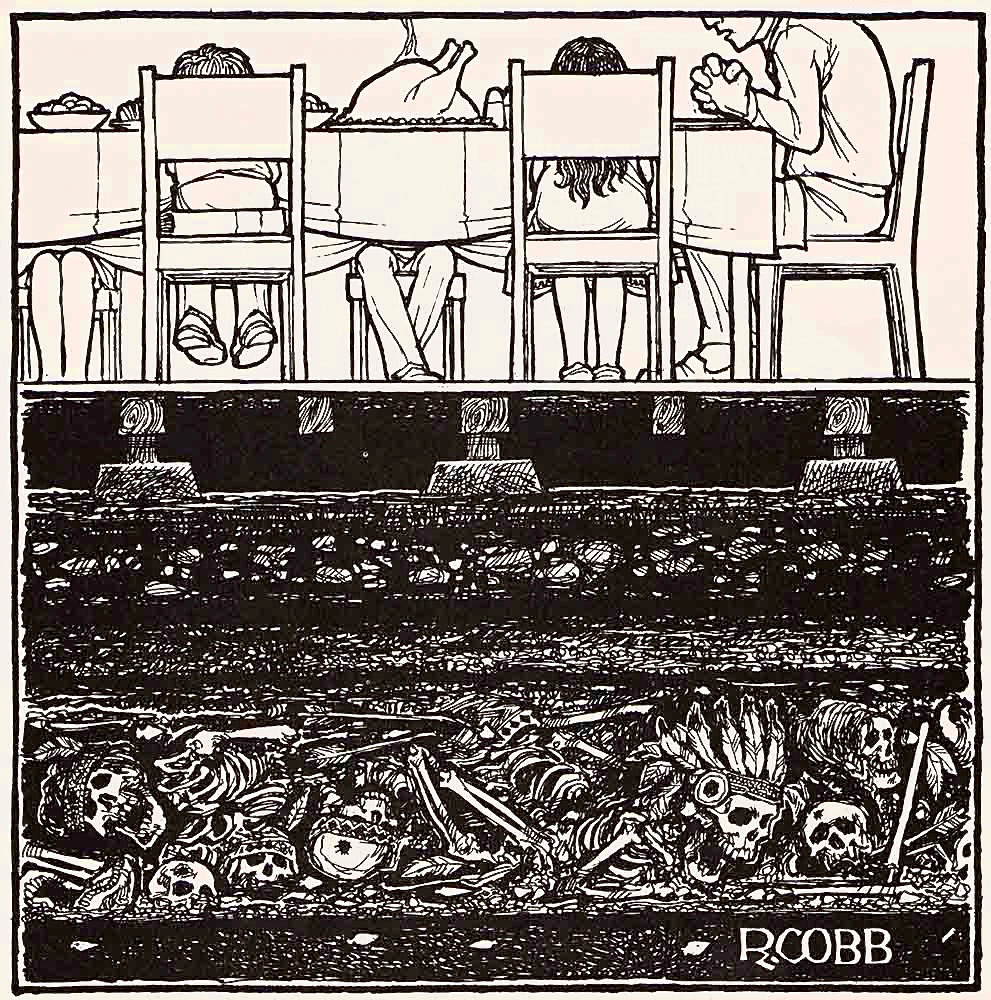
Ron Cobb’s troubling cartoon in the Los Angeles Free Press has been in my Thanksgiving file for 50 years.
This new Israel the Lord brought by a mighty hand and an outstretched arm over a greater than the Red Sea, and gave them these ends of the earth for their habitation. In a day, with a wonderful alteration such as was never heard of in the world, the remote, rocky, bushy, wild-woody wilderness became for fertileness the wonder of the world, a second Eden, rejoicing and blossoming as a Rose, Beautiful as Tizrah, Comely as Jerusalem.
— A New England sermon, 17th century
Adam saw it in a brighter sunshine, but never knew the shade of pensive beauty which Eden won from his expulsion.
— Nathanael Hawthorne, The Marble Faun
Forty years ago, traveling in an old school bus with four other humans and two dogs, I visited New England communes to engage in dialogue about the nature of community. The project, funded by the Episcopal Church, was conceived by the Rev. Bill Teska, a fellow priest who thought the Church had something to learn from grassroots experiments in the nurturing of a common life.
It was November. Snow was beginning to blanket the land. Whenever we had to sleep in our chilly bus, I regretted that we were one animal short of a three-dog night. New England freezes will test the soul. At a newly-formed commune in Maine, we wondered how their experiment was going. “Ask us in the spring,” they told us. “We haven’t gone through our first winter yet. A commune hasn’t proved it can survive until it’s been through a winter.”
The United States of America has survived some pretty severe winters of discontent, but the storms brewing now have us all on edge in a way that feels unprecedented. We have begun to doubt our survival.
In reading Colm Toíbín’s The Magician, a novel about the life of Thomas Mann, I was struck by a couple of paragraphs describing Germany in 1934. With a few word changes, they could have been ripped from the headlines of America today:
“Each morning, as they read the newspapers over breakfast, one of them would share an item, a fresh outrage committed by the Nazis, an arrest or confiscation of property, a threat to the peace of Europe, an outlandish claim against the Jewish population or against writers and artists or against Communists, and they would sigh or grow silent. On some days, while reading out an item of news, Katia would say that this was the worst, only to be corrected by Erika, who would have found something even more outrageous.”
“The Nazis … were street fighters who had taken power without losing their sway over the streets. They managed to be both government and opposition. They thrived on the idea of enemies, including enemies within. They did not fear bad publicity—rather, they actually wanted the worst of their actions to become widely known, all the better to make everyone, even those loyal to them, afraid.” [i]
Sound familiar? What decent soul has not been worn down by the relentless succession of lies, madness, and evil acts over the past five years? And who does not now tremble at the increasingly overt embrace of violence, fear and hatred as acceptable political tools by a major political party?
I was born 6 weeks after D-Day. Although I have lived through some troubled times in America, I have never doubted my country’s ability to survive its sins—until this year. Suddenly the American experiment seems shockingly fragile and strangely impermanent. While the majority of Americans may still desire the greater good, the proliferation of bad actors, along with their enablers and dupes, has metastasized into the tens of millions. Our democracy managed to survive January 6th, but not by what anyone could call a comfortable margin. The party that enabled and even fomented insurrection not only refuses to show a shred of shame or remorse, it is actively working to undermine whatever defenses—like voting rights, or an impartial judiciary—remain against future coup attempts.
There is not yet a majority in Congress willing to overturn an election. Nor is a military takeover currently in the cards. But such scenarios are no longer utterly inconceivable. The smell of burning books is already in the air. Where do we go from here?
When the demons run wild in our common life, we cry, “This is not who we are!” The myth of American innocence has been a prevalent theme since the first colonists arrived in the “New World.” Freed of the dead weight of the past, armed with a sense of limitless possibility and buoyant resilience, we (i.e., white Americans) have preferred to think of ourselves as forever young.
The American, according to the myth, is the new Adam (or Eve) in the new Eden, a “radically new personality, the hero of the new adventure: an individual emancipated from history, happily bereft of ancestry, untouched and undefiled by the usual inheritances of family and race; an individual standing alone, self-reliant and self-propelling, ready to confront whatever awaited him with the aid of his own unique and inherent resources.” [ii]
However, the preservation of this myth requires an immense labor of forgetting. Slavery, racism, the Native American genocide, xenophobia, mob violence, misogyny, environmental destruction and countless other sins do not fit the narrative of innocence. If myth’s stabilizing power lies in both conscious and unconscious agreement about our collective memory (“This is who we are!”), stirring up the troubling ghosts of historical evidence poses a threat to our sense of cohesion and identity. Tradition loses its binding force if it is allowed to be put into question.
“Don’t mess with our myths!” is the rallying cry of the far right, who have shown their willingness to destroy America in order to save their version of it. But the rest of us should not feel too secure within our own fictions of innocence. We have yet to resolve our legacy of racism. We seem incapable of addressing our propensity for violence. And our lifelong assumptions about American democracy have been plunged into doubt. When fascism infected Europe in the 1930s, Americans said, “It can’t happen here.” In these latter days, we know better. It can.
Okay, this all seems a little grim for Thanksgiving Eve. But if our current crisis forces us to reexamine and reform the foundations of our common life, perhaps we can be thankful for that. For people of faith, the survival of life as we know it is never the highest good. As we reminded ourselves last Sunday on the Feast of Christ the King, we are not in charge of history, and don’t have to be in love with particular outcomes of transitory events. Empires rise, empires fall. The Kingdom of God—the reign of self-diffusive love—is the only thing that endures, because it knows the secret of dying and rising. Therefore, even at the grave we make our song: Alleluia, alleluia, alleluia! [iii]
Even as the mountains tumble into the sea, the holy Mystery whispers “Rise! Rise!” into every moment, even the most forlorn. For that, I give thanks.
God is our refuge and strength, a very present help in trouble. Therefore we will not fear, though the earth be moved, or the mountains tumble into the sea; though the waters of chaos rage and foam, though the mountains tremble at its tumult, the Lord of hosts is with us; the God of Jacob is our stronghold.
Robert S. Duncanson, Landscape with Rainbow (1859).
One of the loveliest Inauguration rituals is the presentation of a painting to the new President, borrowed from the Smithsonian collection to set a tone for a fresh administration. Today’s selection was made by First Lady Jill Biden, who chose Landscape with Rainbow by Robert S. Duncanson, the most celebrated African-American artist of the mid-nineteenth century. Born in New York and based in Cincinnati, Duncanson was active in the struggle against slavery. As a black man navigating a culture of white dominance, he was familiar with the divisive tensions of American society. Yet in his paintings he depicted his country as a peaceful and harmonious paradise. By painting a more perfect Eden, he nourished a vision of hope.
In Landscape with Rainbow, the storm is over. In the clearing sky, a rainbow offers the biblical promise of a redemptive future. Painted in 1859, on the eve of the Civil War, Duncanson’s landscape sees a light beyond the present darkness. Explaining the reason for choosing this work, Dr. Biden said, “I like the rainbow—good things to follow.”
A year after Duncanson’s Arcadian picture of joyful calm, Frederic Edwin Church painted a very different atmosphere, Twilight in the Wilderness (1860). His agitated, bloody sky, applying vivid new cadmium pigments, seemed to augur the apocalyptic battles to come. It was twilight in America—dark things followed.
Frederic Edwin Church, Twilight in the Wilderness (1860).
When I saw Duncanson’s landscape unveiled today in the Capitol rotunda, its peaceful luminosity reflected the sense of relief and hope most of us are feeling today after 4 years of dispiriting storms. We pray the darkness which swirled in that same rotunda a fortnight ago can be dispelled. Still, I couldn’t help thinking about Church’s Twilight.
I have always loved Church’s painting. It’s an exuberant celebration of American wilderness, and scholars resist literalizing it into a prophecy of war. But for me, on a purely sensory and emotional level, the contrast between Duncanson’s rainbow and Church’s dying day captures the essence of this pivotal American moment. Asked to choose between rainbow and twilight, we chose the brighter thing.
President-Elect Joe Biden and Vice President-Elect Kamala Harris
Democracy won today. The United States of America has stepped away from the edge of the authoritarian abyss, and countless hearts—and the planet itself—are sighing with relief. Yes, so much damage to repair, and immense challenges ahead, and the work will not be easy. But let us embrace and enjoy this day’s levity of spirit, and breathe in the winds of joy.
I was born between D-Day and the liberation of Paris, and for the first time in my life, the Fourth of July will not be a celebration. Even when our country had gone astray in Vietnam or Iraq, even in the shameful eras of segregation or government-sanctioned torture, it still seemed possible to make ritual remembrance of America’s ideals and renew our collective hope in the better angels of our nature. Not this year.
For 1260 miserable days, we have endured a relentless assault on Constitutional principles and democratic norms by an authoritarian president, with a Congress and political structure either too paralyzed or too corrupt to resist. An unending stream of atrocities has made us so numb that even Trump’s despicable (and treasonous?) betrayal of American soldiers in Afghanistan is not sufficient to force his resignation. But as it turns out, the erosion (and potential demise) of our democracy will be of no concern for hundreds of thousands—perhaps millions—of U. S. citizens. By the next Fourth of July, they will be dead.
It’s not entirely Trump’s fault. Our healthcare delivery system is not well-suited to the conditions of pandemic. Neither is an economy which forces many workers into close proximity. And then there are those lockdown rebels, defiant to the end: “Give me liberty AND give me death.”
But there’s no denying the conclusion that Trump’s well-documented incompetence, unpreparedness, and criminal neglect have already caused, by some estimates, 60% of the U.S. deaths from COVID-19. As of today, we count 78,000 Americans whose lives were lost because the White House was incapable of a timely and well-managed response.[ii] And it is only getting worse. As we surpassed 50,000 new cases per day on July 1, Trump was still preaching magical thinking: Pretend there’s no problem and it will soon go away.
“How long can we live with this President?” is no longer a figure of speech. For the most vulnerable among us, it has become existential. Is it hyperbole to call Trump a mass murderer? Do the math. Sixteen 9/11s in a single day. According to Dr. Anthony Fauci, that could soon double. Thank you, Mr. President.
In a sobering Atlantic article, “The 3 Weeks That Changed Everything,” James Fallows compares the United States to an airplane being flown into a mountain. “At least in an airplane cockpit, the first officer can grab the controls from a captain who is steering the aircraft toward doom.” But our politics don’t work that way. A veteran intelligence official quoted in the article sums up the problem exactly: “Our system has a single point-of-failure: an irrational president.” [iii]
In his classic study, The American Adam [iv], R. W. B. Lewis examines fresh starts and new possibilities as the dominant tropes of American myth-making: a new Eden, the land of the free. This has required the repression of certain facts. North America was not an uninhabited space for the taking. “All men are created equal” was written by a slaveholder. The degree to which these tragic ironies have been balanced by substantial instances of liberation, justice and human flourishing continues to be contested.
But in any case, America identity—e pluribus unum—is a construction of fact and myth, (selective) memory and metaphor, aspiration and ideal. As one scholar puts it, “America has to be thought in order to be lived, but for both to happen, it had to be written.… America was invented, not discovered.”[v] We trace our nation’s birth to a rhetorical scripture, “for the truth of which,” as Thomas Jefferson put it, “we pledge a faith as yet unsullied by falsehood.” [vi]
Independence Day celebrates a radical break from the past, a casting off of the old order for the new. In “Earth’s Holocaust,” Nathaniel Hawthorne’s fable of revolution written in 1844, a great crowd gathers on a vast prairie to make a bonfire of everything humanity needs to renounce: the trappings and symbols of repressive institutions and economic inequality—all the “outworn trumpery” (!) of the world. The unprecedented scale and duration of the Black Lives Matter protests is a vivid enactment of this trope, evoking America’s most radical premise: We are not bound to our past; we can reinvent the social order.
Meanwhile, the COVID-19 pandemic is forcing institutions, communities, and individuals to reimagine how we live and move and have our being. When the pandemic passes, will we resume the old ways, or insist on something better? In another of his stories, Hawthorne proposed a state of perpetual renewal:
I doubt whether even our public edifices—our capitols, statehouses, courthouses, city-halls and churches—ought to be built of such permanent materials as stone or brick. It were better that they should crumble to ruin once every twenty years or thereabouts, as a hint to people to examine and reform the institutions which they symbolize.[vii]
Whether collective and personal transformation will come through purifying fire or the gentler urgings of wisdom and spirit, it will unmask our illusions and disturb our slumber. As David R. Williams reminds us, the sin of “profound unknowing” cannot endure:
We imagine we are awake and aware of what we are doing, but in fact we are walking in our sleep. We live in a constructed illusion of sounds we call words, and ideas we think we believe, and sights that at least seem to have reality. Most of the time, the illusion holds. But, as Puritan theologian Jonathan Edwards warned …, “we walk over the pit of hell as on a rotten covering, and there are places in that covering so rotten that they will not bear our weight, and these places are unseen.” [viii]
So no, not a normal Fourth of July this year. In the worst case scenario, it could be our last, if our democracy continues to implode. As a member of what Emerson called the Party of Hope [ix], I do not foresee that happening. But I do worry that my country is ill-prepared—emotionally or spiritually—for apocalypse of any kind. Even should the sun go out and the moon turn to blood, some will still be shouting, “Fake news!”
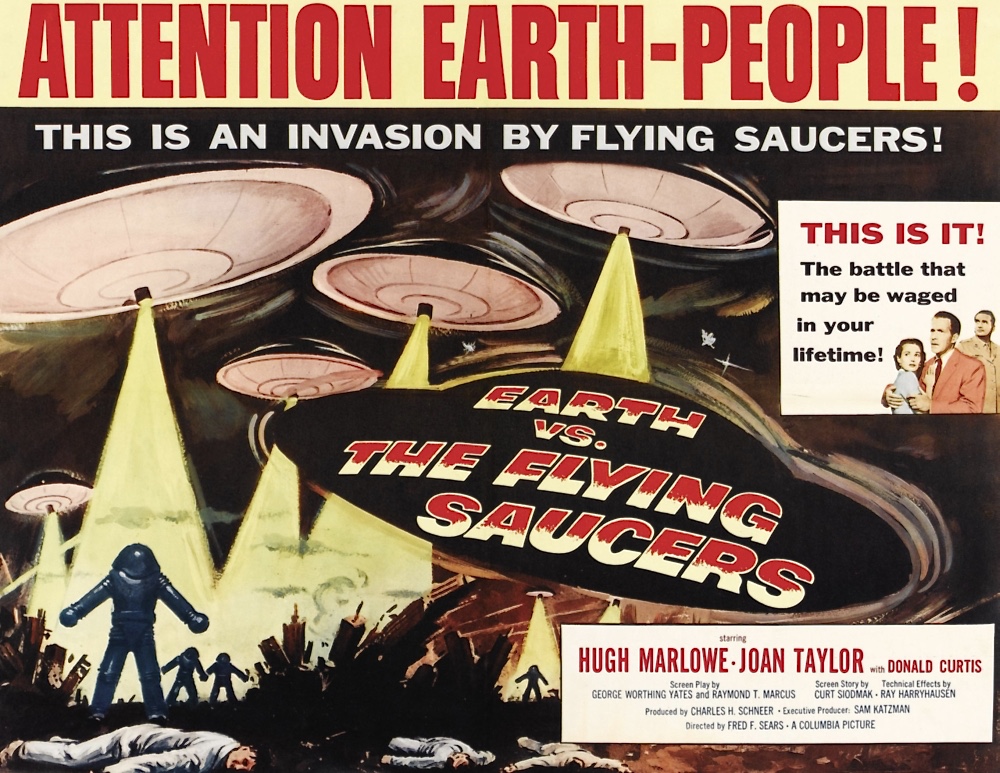
In 1957, a ten-year-old Stephen King was watching a movie matinee of Earth vs. the Flying Saucers, a sci-fi film about alien invaders from outer space.
“[J]ust when it was reaching the good part, with Washington in flames and the final, cataclysmic interstellar battle about to be joined—the screen suddenly went dead. Well, kids started to clap and hoot, thinking the projectionist made a mistake or the reel had broken, but then, all of a sudden, the theater lights went on at full strength … then the theater manager came striding down the center aisle, looking pale, and he mounted the stage and said, in a trembling voice, ‘I want to tell you that the Russians have put a space satellite into orbit around Earth. They call it Sputnik. … ’ There was a long hushed pause as this crowd of fifties kids in cuffed jeans, with crewcuts or ducktails or ponytails, struggled to absorb all that; and then, suddenly, one voice, near tears but also charged with terrible anger, shrilled through the stunned silence: ‘Oh, go show the movie, you liar!” [x]
[iv] R. W. B. Lewis, The American Adam: Innocence, Tragedy, and Tradition in the Nineteenth Century (Chicago: University of Chicago Press, 1955)
[v] Geoff Ward, The Writing of America: Literature and Cultural Identity from the Puritans to the Present (Cambridge, MA: Polity Press, 2002), 17.
[vi] This line from Jefferson’s original draft of the Declaration of Independence would be deleted by committee, but it expresses the document’s Edenic spirit (“as yet unsullied by falsehood”). Cited in Ward, 28.
[vii] Nathaniel Hawthorne, The House of the Seven Gables (1850), cited in Lewis, 19.
[viii] David R. Williams, Searching for God in the Sixties (Newark, DE: University of Delaware Press, 2010), 204.
[ix] Ralph Waldo Emerson described a duality in American culture as a schism between the Party of Memory (tradition, or reverence for a “sacred” past or origin) and the Party of Hope (dedicated to rebirth and new possibilities). These are not, of course, to be confused with specific political parties, and most of us belong to both (except, perhaps, for members of a third party, the Party of Irony). See the discussion in Lewis, 7.
[x] Tim Underwood and Chuck Miller (eds), Bare Bones: Conversations on Terror with Stephen King (New York: New English Library, 1990), p. 22, cited in Ward, 119.













 The religious imagineer