March For Our Lives: When Hope and History Rhyme


Seattle March for Our Lives (Photo by Jim Friedrich)

History says, Don’t hope
On this side of the grave.
But then, once in a lifetime
The longed-for tidal wave
Of justice can rise up,
And hope and history rhyme.

–– Seamus Heaney, “Doubletake”


Heaney’s powerful words seem the perfect epigraph for this amazing day, when hundreds of thousands of people In over 800 communities took to the streets to say “enough is enough.” Enough shootings!  Enough victims! It’s time to heal our national gun-sickness. It’s time to choose life.

Have we finally reached a turning point? We’ve seen countless turning points come to naught. We have become well accustomed not to “hope on this side of the grave.” But this new movement, led by highly committed young people not yet practiced in the art of resignation, does feel different. Could this in fact be one of those rare moments, like the end of apartheid or the fall of the Berlin wall, when “hope and history rhyme”?

Seattle March for Our Lives (Photo by Jim Friedrich)

In “Summoning the Sanity to Scream,” posted in the wake of Orlando, I wrote:

Gun worship seems the most powerful religion in America. From presidents to schoolchildren, the blood of countless victims stains its altars. And however much we rage and moan we feel powerless to stay the hand of sacrifice.

 After the joy of marching with thousands of beautiful fellow citizens in the streets of Seattle, and later viewing media excerpts of the utterly compelling young voices at the demonstration in Washington, D.C., I felt myself being awakened from the deadly illusion of inevitability. I began to let myself hope again. The kids are leading the way out of the Slough of Despond. How can we not follow?
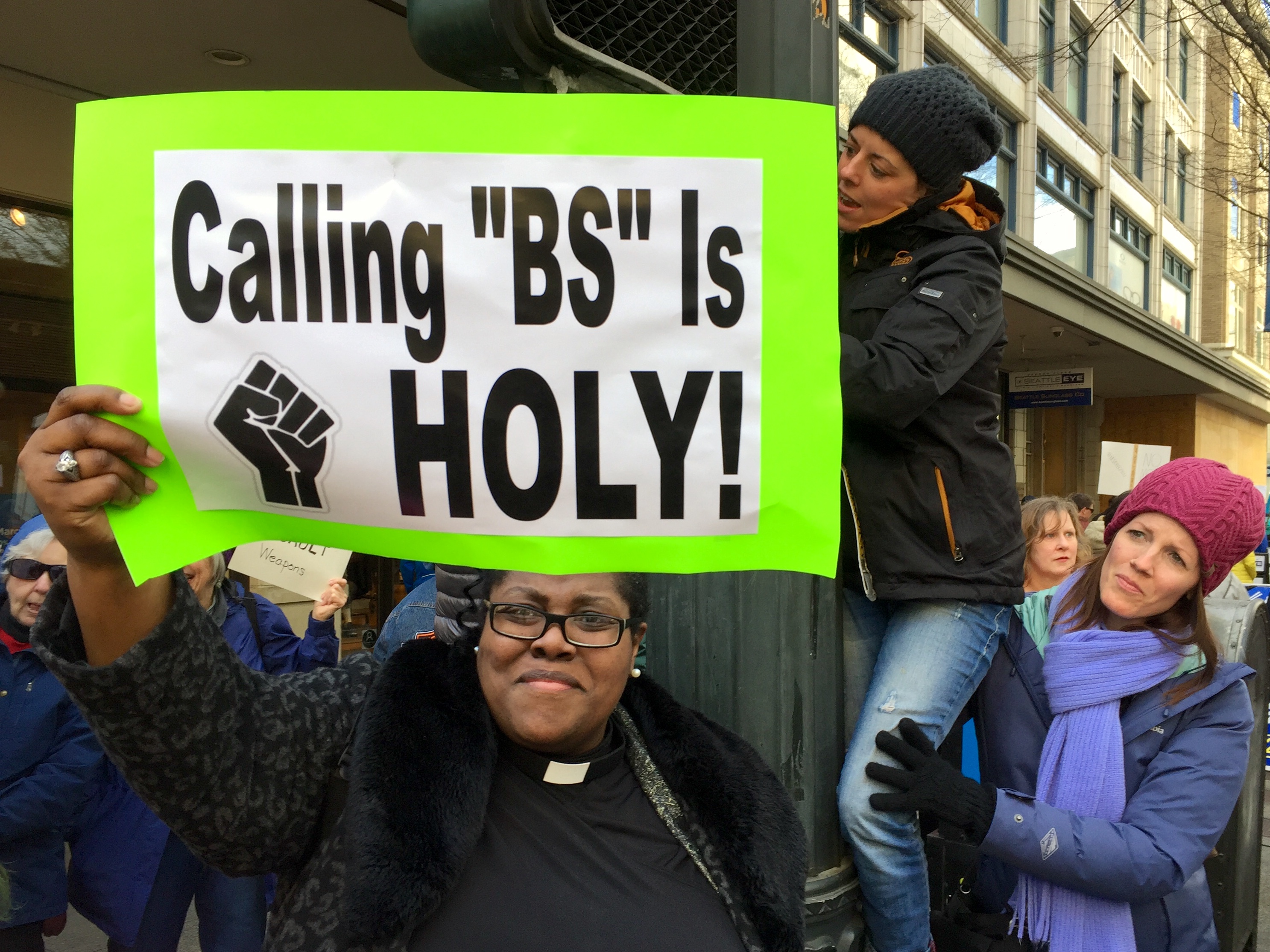
Seattle March for Our Lives (Photo by Jim Friedrich)

I was especially moved by Emma Gonzalez, a senior at Parkland’s Marjory Stoneman Douglas High School. Already well known for her prophetic cry against the NRA and its political puppets (“We call BS!”), she began with a brief, heartbreaking roll call of her seventeen dead friends. Then, remaining at the podium, she stood in solemn silence for a very long six minutes––ritually enacting the excruciating duration of the mass shooting.

Ms. Gonzalez had not explained her silence in advance, nor had she invited the crowd to observe it with her. Many in the crowd of 800,000 were undoubtedly bewildered by such an exercise, periodically filling the uncomfortable silence with shouts of “We love you, Emma,” or chants of “Never again.” But the camera also showed many faces mute and tearful. It was a risky liturgical move to immerse that vast multitude in such a long silence (almost unendurable for talkative Americans!) without any advance consensus on its intention or meaning. Those weren’t a million Trappists out there. As far as I could tell from the video, she more or less pulled it off, never quite losing them. I suspect that many will be haunted by the experience for a long time to come. You can watch it here.

Seattle March for Our Lives (Photo by Jim Friedrich)

It is late, I am tired from a lot of walking, and I hesitate to reduce what happened today into a few concluding paragraphs. Something great happened out there, and let’s leave it at that for now. But I am prompted  to make a brief digression before signing off.

As a priest on the eve of Holy Week, I could not help making connections between today’s events and what Christians will be doing over the next eight days. How could I not carry echoes of today’s joyful urban processions into tomorrow’s commemoration of Jesus’ entry into Jerusalem? Both processions involved cheering crowds envisioning a better world; both posited fundamental challenges to the established powers. As for the fate of today’s crowds compared to the one in first-century Jerusalem, I suspect there are crucial differences as well. While every human dream must endure repeated crucibles of resistance and setback, I suspect that the kids on the streets today will not replicate the failures of the Palm Sunday crowd. In that sense, they may prove to be more like Jesus––enduring faithfully with their eyes on the prize––than like the fickle crowd whose “hosannas” turned so quickly to “crucify.”

The other connection I’m thinking about tonight is Emma Gonzalez’s six-minute silence. Founded on an original experience of unimaginable pain and loss, it created a space where suffering might be both remembered and transcended. Like the rites of Holy Week, it engaged the past as something never to be forgotten, something that is intrinsic to the story, but in the context of a future which can contain and redeem whatever has been lost. We all dwell in the provisional space between memory and hope, where we neither forget nor give up. There is always more to our story than we can ever know. Even in the darkest night, God continues to imagine the dawn.

Seattle March for Our Lives (Photo by Jim Friedrich)

At the Easter Vigil next Saturday night, one of the stories we will tell is the deliverance of the biblical Israelites from the powers that enslave them. Instead of an adult reading the story from the Bible, children will act out the Exodus from Egypt. When they reach the Red Sea (adults blocking their way with waves of blue fabric), the congregation will shout “No way! No way!”–– like Congress telling the kids to give up and go home. But Moses will raise his staff, a way will open through the sea, and the Israelites will cross over. One will be carrying a “Never again” sign; another will wear a “March for our lives” T-shirt.

Once they are safely across the sea, Miriam, Moses’ sister, will reflect on what has happened, concluding with a declaration of faith:

“The world says NO.
The power of God is YES!”


Related posts

The Murderous Hypocrisy of Thoughts and Prayers

Summoning the Sanity to Scream
God Isn’t Fixing This


Forty Years of Chewing Sand

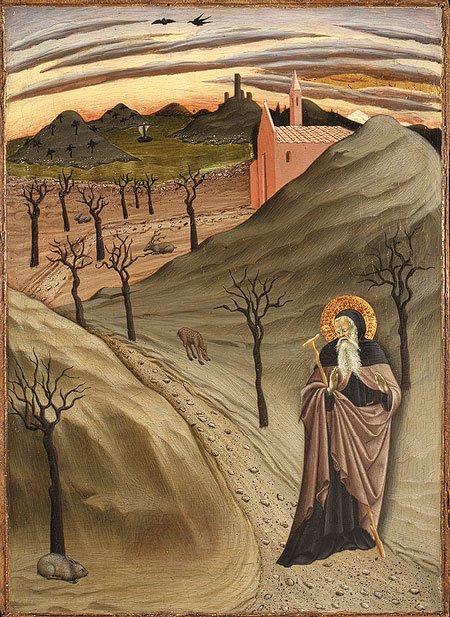
St. Anthony the Abbot in the Wilderness (Osservanza Master, Siena, c. 1435)

The desert can be tomb and cradle, wasteland and garden, death and resurrection, hell and heaven. Thus in the desert you will find that God is simultaneously present and absent, proximate and remote, visible and invisible, manifest and hidden. He can receive you with great tenderness and then abandon you on the cross of loneliness. He consoles you and torments you at the same time. He heals you only to wound you again. He may speak to you today and ignore you tomorrow.

–– Alessandro Pronzato [i]


In American Nomads, my recent reviiew of Jessica Bruder’s Nomadland, I applied the term “ascetics” to the motorized wanderers who have left behind the oppressive futility of a dysfunctional society to seek a freedom and authenticity seemingly unattainable within the rigged game of economic inequality. Although most of those contemporary nomads might take issue with the religious connotations of the word, I believe that any intentional exodus “away from here” is inevitably a quest for the redemptive space of a Promised Land. Its refusals and renunciations are the necessary first steps toward new being.

In popular usage, asceticism conjures images of bodily self-mortification, like sleeping on a bed of nails, for the sake of a purely spiritual goal. Such a limiting caricature reflects an unfortunate dualism of body and soul. But the term comes from the Greek word for athletic training, and is best understood as a wholistic practice in which everything which comprises the human person—body and soul, heart and mind, inner psyche and outer world—is fully engaged in a committed discipline of patterned living.

Asceticism is not solely a matter of giving old things up; it also involves taking on things that are new. Lenten discipline, for example, involves the addition of deeper spiritual practices and loving actions, and not merely the common subtractions of culinary pleasures and worldly amusements. More prayer and more justice, not just less chocolate.

But even the embrace of positive actions or behaviors involves the renunciation of obstacles, distractions and hindrances which impede or resist the ascetic’s goal. And since we are social beings, both formed and deformed by the worlds we inhabit, it is not always enough to work on ourselves within the confines of the given world. To borrow a phrase from Wallace Stevens, we sometimes need to “exit the whole Shebang.”

And from the biblical Exodus to the “vandwelling” nomads fleeing the enslaving fleshpots of America, the exit always leads to the desert: the no-where beyond the reach of the social imaginary, the silence beyond the captivity of language, the trackless waste where all our constructions turn to dust. As I wrote in Via Negativa:

The desert is the emptiness where there’s no place to hide. In the desert, you come face to face with yourself, your demons, and your God. Nothing is defined there, nothing known in advance. Your scripts are no good in the desert. Your evasions are futile. Whatever makes you want to turn around and run back to the safety of your old illusions is the very thing that is trying to kill you.

We could all use some time in the desert, whether it’s Jesus’ 40 days or the Israelites’ 40 years. But whenever we step outside the noise of our social and personal fictions, the silence is going to wound us with questions. Who am I really, when my familiar props, costumes and stories are stripped away, leaving me naked and alone on an empty stage? Do I have what Salinger’s Franny Glass called “the courage to be an absolute nobody?”

Even the great desert saints of Late Antiquity trembled on the brink of so much nothingness. As Belden C. Lane writes in his indispensable guide to wilderness spirituality, The Solace of Fierce Landscapes:

“What they fled with greatest fear was not the external world, but the world they carried inside themselves: an ego-centeredness needing constant approval, driven by compulsive behavior, frantic in its effort to attend to a self-image that always required mending.” [ii]

The desert way is threatening and fierce, but it is also a place of transformative clarity, as mystics and artists continue to remind us. Indifferent to the old scripts of alienation and inauthenticity, it can be the birthplace of a new way of being human. Video artist Bill Viola describes the lure of the desert issuing from the spiritual desire for true and undistorted existence:

“I want to go to a place that seems like it’s at the end of the world. A vantage point from which one can stand and peer out into the void – the world beyond… There is nothing to lean on. No references… You finally realize that the void is yourself. It is like some huge mirror for your mind. Clear and uncluttered, it is the opposite of our urban distractive spaces. Out here, the unbound mind can run free. Imagination reigns. Space becomes a projection screen. Inside becomes outside. You can see what you are.” [iii]

Of course, the desert can be anywhere. Alassandro Pronzato, one of my favorite desert teachers, describes it as an essentially inward condition:

“You can find your desert in a corner of your house, on a motorway, in a square, in a crowded street. But you must first renounce the slavery of illusions, refuse the blackmail of pressure, resist the glitter of appearances, repudiate the domination of activity, reject the dictatorship of hypocrisy. Then the desert becomes a place where you do not go out to see the sand blowing in the wind but the Spirit waiting to make his dwelling within you.” [iv]

The desert is no place for the casual tourist. It is a pilgrimage of arduous passage, demanding time, patience, endurance and persistence. “You do not settle there, you pass through. One then ventures on to these tracks because one is driven by the Spirit towards the Promised Land. But it is only promised to those who are able to chew sand for forty years without doubting their invitation to the feast in the end.” [v]

Chewing sand for forty years—not the best sales pitch for the pilgrimage to God. But all the easy roads just lead back to Egypt. Endure the trials, bless the oases. Persist. Never turn back.

Do not doubt the feast.


Related posts:

Via Negativa: A Lenten Worship Installation

Solitude (Part 1)

Solitude (Part 2)


[i] Alessandro Pronzato, Meditations on the Sand (1982), q. in John Moses, The Desert: An Anthology for Lent (Norwich, UK: The Canterbury Press, 1997, 30-31.

[ii] Belden C. Lane, The Solace of Fierce Landscapes: Exploring Desert and Mountain Spirituality (New York: Oxford University Press, 1998), 166.

[iii] Bill Viola, Reasons for Knocking at an Empty House: Writings 1973-1994 (London: Thames & Hudson, 1995) 54.

[iv] Moses, 31.

[v] Ibid., 26.

I took the photograph in California’s Alabama Hills, where I have run among wildflowers and slept beneath the stars. The mountain peak on the right is Mt. Whitney, the highest point in the lower 48 states. I climbed it in 1998.

Ash Wednesday Isn’t for Heroes

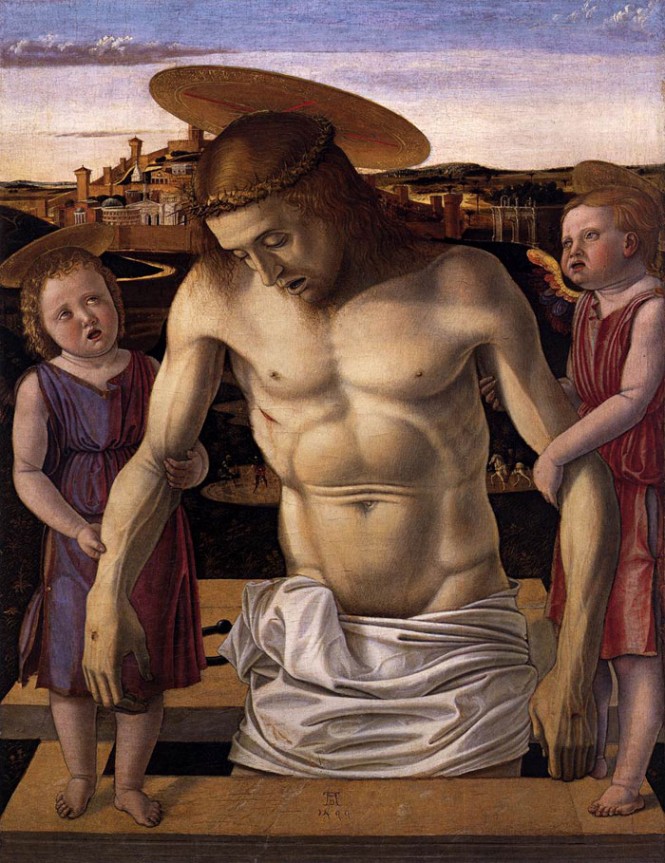
Giovanni Bellini, Dead Christ Supported by Two Angels (1460)

Yesterday’s come-from-behind Olympic victory by Shaun White in the snowboarding halfpipe was both thrilling drama and breathtaking athleticism. Following a failure to medal in the last Olympics and a serious injury in competition just four months ago, his triumph fit the classic pattern of the hero’s journey: an arduous path “through many dangers, toils and snares” until the prize is won. But the hero’s journey, however inspiring, is not our Lenten theme. We walk a different way, practicing self-compassion in the dust and ashes of our own defeats.

Every Ash Wednesday, my favorite Winter Olympics story comes to mind. Readers may recall it from a 2016 post, but I offer it again here, prefaced by Mary Oliver’s Lenten antiphon:

You do not have to be good.
You do not have to walk on your knees
for a hundred miles through the desert, repenting.
You only have to let the soft animal of your body love what it loves.[i]

In the 1988 Winter Olympics, American speed skater Dan Jansen, the best in the world, was the consensus pick to win the 500 and 1000 meter events. On the morning of the 500 final, he learned his sister had just died from leukemia. His focus clearly elsewhere, he fell on the first turn of his race and never finished. He would also fall and fail in the 1000 meters. At the 1992 Olympics, he again failed to win the medals expected of him. The 1994 Olympics offered him one last chance, and he came to the line of the 500 meter race as the clear favorite, the only skater ever to break 36 seconds, which he had done four times. But after one slight slip on the ice, he finished out of the medals yet again.

Ash Wednesday came just after that race, and during the liturgy I reflected on Jansen’s story in my homily. Although Jansen would finally win a gold medal a few days later (in the one race where he was an underdog), it was his “failures” that resonated with people. After the liturgy, a therapist in the congregation told me that many of her clients that week had talked with her about Jansen’s story, and how much it moved them. If the world’s greatest skater could fall, then maybe it was all right for them to fall as well. You don’t have to be a hero, only your own flawed and unfinished self, letting the soft animal of your body love what it loves.

In his youth, the poet David Whyte was hiking in the Himalayas when he came to a deep chasm. The only way across was a rickety old rope bridge with many missing slats. Although he was a confident, experienced mountaineer, he suddenly froze at the prospect of traversing the abyss on so treacherous a path. He sat down on the ground and stared at the bridge for hours, unable to proceed. “There are times when the hero has to sit down,” he said later. “At some bridges in life the part of you that always gets it done has to sit down.” Then an old Tibetan woman came along, gathering yak dung for fuel. She walked with a limp. “Namaste,” she said with a smile. Then she turned and limped across the bridge. Immediately, without thinking, he rose up and followed. Sometimes, he realized, it is “the old interior angel,” the unheroic, limping, unequipped part of ourselves, that gets us to the other side.[ii]

Remember that you are dust, and no hero. Whether your Lent will be a time of giving up, going deep, or reaching out, may it always be done with a generous measure of self-compassion.


[i] Mary Oliver, “Wild Geese,” in Devotions (New York: Penguin Press, 2017), 347.

[ii] Remembered from a David Whyte talk in the 1990s.

What Will You Wish You Had Said?

Listening to voices from the end of life at Spoken/Unspoken.(Photo by Jim Friedrich)

At the end of your life, what will you wish you had said?

 This question is the premise for “Spoken / Unspoken: Stories of Living and Dying,” a moving audio installation at California’s Santa Cruz Museum of Art and History. In a room of warm and cheerful colors, the visitor hears a succession of voices responding to the question. Each speaker is a person near the end of his or her life, recorded at Hospice of Santa Cruz County. Their words are also supplied in written form.

“I wanna say it’s not the destination, it’s the journey. . . I want to say everything. Everything I feel. Everything I experienced. . . I’m finding answers all the time and I’m finding more questions too. . . I’m letting it happen, I’m not running after it. If it comes I’ll latch onto it.”

 “I wish I could say I’m sorry to the people who I have offended in my life in different ways.”

 “I don’t understand myself. One of these days I’ll find out what’s going on.”

 “I cannot believe the speed of light that takes place toward your end days. What happened from 50 on was unbelievable. Time goes by so quickly. It’s just unimaginable. You can’t do anything about it.”

 “I’ve often been afraid [to get closer to people]. I don’t know why I’m afraid. There’s times that I think I’ve had answers to a problem a person has told me about and I haven’t shared what I thought the answer was, and I feel like I missed the point. I missed the time of being God’s handyman. They are not so much words of wisdom, but they are feelings that I have. I didn’t tell them that I loved them enough. I didn’t show that love enough.”

“I want to say, may this be a good day for you and that you’re enjoying . . . thinking of the creative things in you that God has given you to do––and go do one of them someday.”

Every voice is accompanied by its own unique musical score, created by composer and sound artist Lanier Sammons. The peaceful ambient music reflects not only the emotional content of the various interviews but also the particular tone, tempo and manner of each individual speaker. The result is a quality of presence which is more than whatever is being said.

I was especially taken by the man who broke into a rendition of “Some Enchanted Evening.” His singing was melodious and full of warmth. You may see a stranger across a crowded room. And somehow you know. It’s all about desire. As the theologians and novelists tell us, every story begins with a lack, and longing is at the heart of who we are.

We all know that words can suggest but never exhaust the complexity of our stories or the mystery of our being. But what is unique about the voices in this installation is their location––at life’s most critical boundary. Whether we think of it as “the end” or understand it to be the door between worlds, death invites retrospective reckonings. What has been the meaning of my story? Did I make a difference? Is there something I wish I had done, or said?

Spoken / Unspoken works at many levels. The attentive acts of listening by the hospice staff, the sound artist, and the museum curators have honored the beauty and value of dying elders, who are too often marginalized by a society uncomfortable with aging and death. The various voices convey both the uniqueness of every individual and the universality of our shared human condition. And it creates a sacred space where we can experience community not only with the specific people who share something of themselves in the recordings, but with every soul on pilgrimage into life’s unknown futures.

The installation also prompts visitors to perform a couple of actions.  Stationery and pencils are provided so we can communicate by letter something that needs to be said to a friend or loved one. A text encourages us: “Don’t wait, say it now.” There is also an adjacent recording booth, where you can make your own response to the question, “What do you wish you had said?” Sammons will then take your story, weave it together with other voices, and set it all to music. A week later you can hear the result on headphones as part of the installation.

What have I myself left unsaid after so many years on this earth? I’ve been wondering about that ever since experiencing the Santa Cruz installation a couple of weeks ago. I’m also dreaming about the adaptation of this sound installation concept for religious communities. I have led church retreats where we practice storytelling and storylistening––beginning with our communal sacred stories and moving into the treasuries of our personal stories. And people are usually surprised to discover how much there is to know about the life stories and spiritual experiences of their companions in faith. Even in communities where we profess the sacredness of every person as God’s beloved, so much is left unsaid between us.

So here’s an idea. What if communities of faith spent some time recording members’ responses to the big questions––about God, humanity, faith, hope, love, transformation, etc.––or provided a sound booth (a technological confessional?), where people can walk in and record what matters most to them? Then let some music and sound artists create an audio mix from the gathered material, and play it back in a church space where drop-ins can linger and listen to a living “cloud of witnesses.”

If any of this sparks your own creativity or exploration, I’d love to hear about it.

“Be known to us in the music we make”

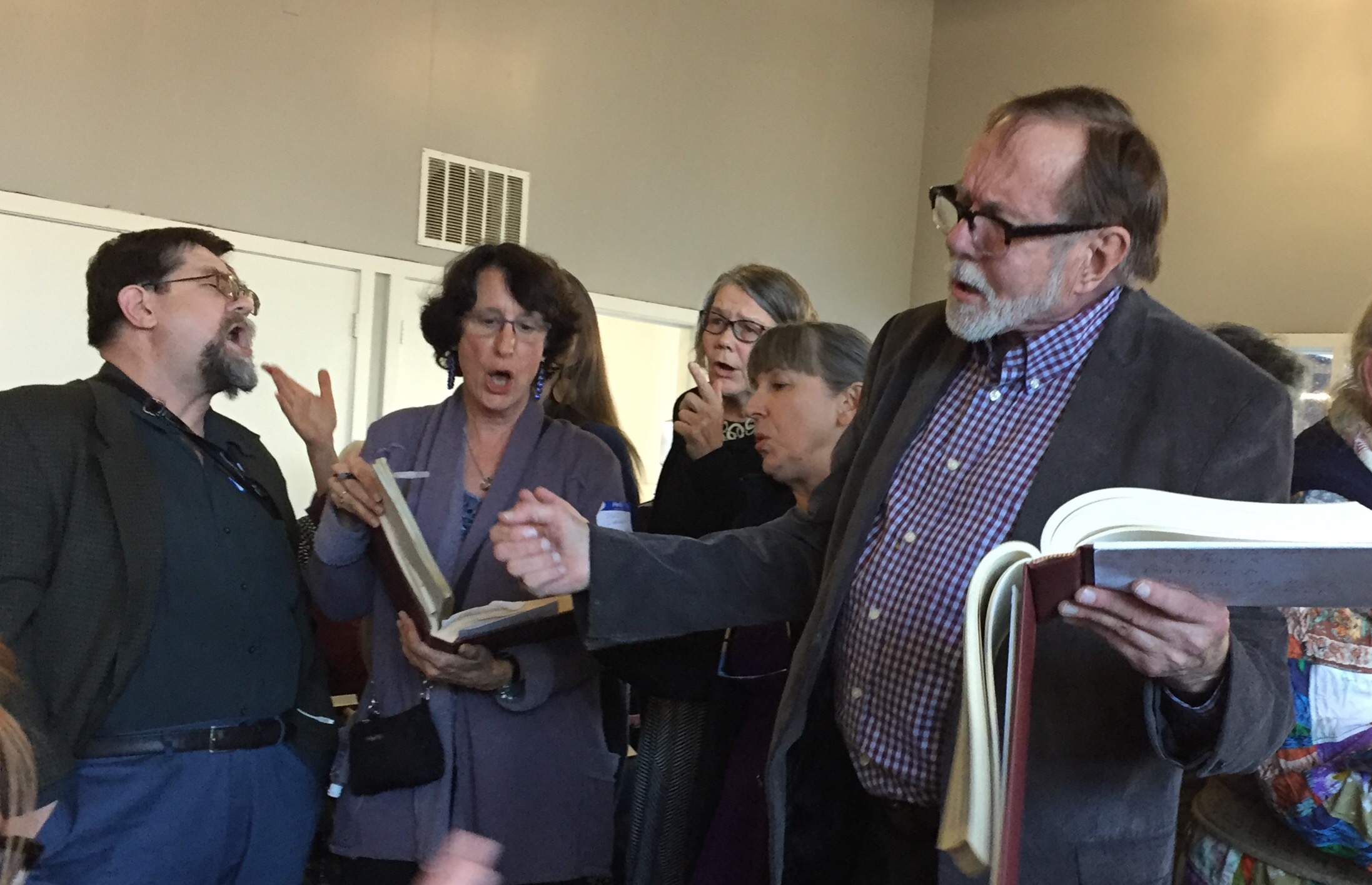
Ted Mercer leads a song at the California Sacred Harp Convention.

I am the chaplain this weekend for the 30th Annual All-California Sacred Harp Convention, where over a hundred singers have gathered from a dozen states (along with a few enthusiasts from Europe) to sing about 190 shape note songs over the course of two days. It’s an intense immersion in a uniquely American repertoire––loud, raw, and deeply expressive. You can read about it in my post, A Musical Tsunami.

While the song texts mostly reflect images and themes from 18th and 19th century Christianity, a shape note gathering is not a community of religious consensus. Non-Christian people of faith and no faith are in the mix, and there is no discussion of verbal meanings. It’s all about the singing. And yet, there is a sense of “church” about these gatherings. We tap into a power beyond the self, form bonds of communion with one another, and are transported by a shared experience that can verge on the ecstatic.

By long tradition, each day of a singing convention opens and closes with prayer, composed or selected at the discretion of the chaplain. The following prayers are mostly my own. While seeking to honor and express the sacred dimension of a shape note singing, I tried to be inclusive, avoiding explicit sectarian language. But you may notice some Anglican phrasing––and theology––seeping through.

Saturday (Jan. 20)

Opening prayer

O divine Beloved, Maker of all things and Lover of souls, we are gathered here by your grace to sing the life that conquers death, the joy that dries all tears, the peace that passes understanding, the love that resists every evil.

Be known to us in the music we make and the songs we share.
To spend one day with Thee on earth exceeds a thousand days of mirth.

We are truly thankful for the generations of composers and singers who have entrusted us with the Sacred Harp, and we pray that our singing in this place will gladden the whole company of heaven with an awesome and holy sound.

Draw us together with the cords of friendship.
Let no one be a stranger here.
Lift up our hearts and make us one.

Now sanctify this hollow and hallowed square, that it may be for us not just a refuge from the storms of the world, but a tangible experience of our truest humanity, reflecting your glory in the harmonious beauty of our shared communion.

We ask this in your holy Name. Amen.


Grace for the mid-day meal

Blessed are you, O God, giver of breath and bread,
from whom all blessings flow.
We give you thanks for the abundance of this hour,
for the food and drink prepared from your bounty by human labor
and spread before us by generous hands.
Give us such an awareness of the sacredness of every feast,
that the sharing of this meal may manifest the connections between us,
and deepen our gratitude for life.
Blessed be your Name forever. Amen.


Closing prayer (by Brian Wren*)

May the Sending One sing in us,
may the Seeking One walk with us,
may the Greeting One stand by us,
in our gladness and in our grieving.

May the Gifted One relieve us,
may the Given One retrieve us,
may the Giving One receive us,
in our falling and our restoring.

May the Binding One unite us,
may the One Beloved invite us,
may the Loving One delight us,
in bliss both human and divine.

Now let us go forth in peace,
rejoicing in the power of the Spirit. Amen.

* Brian Wren is an Anglican hymn writer in the UK.
The “in bliss” line is my own, while the final lines are
a eucharistic dismissal from the Book of Common Prayer.


Sunday (Jan. 21)

Opening prayer

Grace of melody be upon us
Grace of harmony be upon us
Grace of shapes be upon us
This day and evermore.

Grace of lyric be upon us
Grace of meter be upon us
Grace of fugues be upon us
This day and evermore.

Grace of praise be upon us
Grace of union be upon us
Grace of joy be upon us
This day and evermore. Amen.


Grace at the mid-day meal*

Holy God, giver of breath and bread,
it is with gratitude and joy that we receive the gift of this meal.
Into ourselves we take these changing forms of matter and light
through which we shall be changed:
other bodies becoming our bodies,
other lives becoming our life.

That there is but one body,
one life shared by all,
we vow to remember.

Now bless this food to our use, and us to your service,
and make us ever mindful of the needs and rights of others.
Let all the people say: Amen.

* Adapted from various sources. The first line is from Gerard Manley Hopkins, the last lines are at traditional grace, and the middle part I learned from a priest at a campfire on a kayaking retreat for clergy. I don’t know the source.


Closing prayer

Holy and gracious God, you are a mystery beyond all telling,
yet have we not heard your voice sounding in our midst this day?
You are beyond all seeing,
yet did we not glimpse your glory in the faces of one another?
You are beyond all knowing,
yet has not each of us heard a word spoken today––
a word of love or consolation,
a word of encouragement or mercy?

It has been such a blessing to join our voices with one another,
in union with the countless singers who have gone before us.
Our hearts are full, and we are deeply grateful.
Now send us forth in peace, guide us safely home,
and help us to carry the grace of these precious hours
into the rest of our lives,
that the world may resound
with the melody of compassion
and the harmony of justice,
and your blessing be known
through every land by every tongue.

Glory to you for ever and ever. Amen.

Related post: A Musical Tsunami

Epiphanies in the Temples of Wonder

Grand Teton National Park, Winter 1979 (Photo by Jim Friedrich)

We have seen the Creator as Light and the Spirit as Light,
guiding with light the whole creation.

–– Byzantine matins, Feast of the Transfiguration

One senses something more than the natural…What these paintings seem to depict is not so much discrete things – trees, fields, figures, buildings – shown in particular configurations – but something that subsumes or, in potentiality, contains them.

 ––Museum label for a George Inness survey at the San Diego Museum of Art (2004)


I took my photograph of wintry pines forty years ago while cross-country skiing in Grand Teton National Park. I had stopped to contemplate the grove with its sense of mysterious depth, all those vertical lines receding into an infinity my eye could not penetrate. I felt the pull of whatever lies behind the components of the visible: the “something that subsumes or contains them.” It seemed an intimation of whatever lies beyond the self and its constructions.

The photograph became my Christmas card that year, with these words written on the back:

Shhh!
it comes
it goes
put yourself in its path
and wait

In this season of Epiphany (“manifestation”), we are invited to consider the possibility that the Transcendent desires to be seen. And when we are receptively attentive––and unhurriedly patient––we may discover the world to be a theater of divine showings and human awakenings.

Even in a world of “dull” and “prosaic” facts, said Emerson in an 1838 lecture, “the aroused intellect finds gold and gems in one of these scorned facts, then finds that the day of facts is a rock of diamonds, that a fact is an epiphany of God, that on every fact of his life he should rear a temple of wonder and joy.”[i]

Every year, every day, every hour of our lives offers its epiphanies. Leafing through old journals for some memorable examples of my own, I came across some passages from a European grand tour in the 1970s, a few years before I photographed the snowy Teton pines. My older self might want to tame some of the exuberant excess in the writing, but I still recognize, and do not regret, the intensity of that young man’s wonder.

An epiphany has been called “a moment when . .. consciousness finds itself flooded, or breathed into, or simply filled by a force . . . that comes from outside the self and is incorporated into the soul of the recipient.”[ii] My first direct encounter with the collection of J. M. W. Turner paintings in London’s Tate Gallery felt like that. This is how I wrote it down at the time:

Having seen most Turners only in reproduction, or in the vivid descriptions of [19th century critic] John Ruskin, I was not fully prepared for the ecstasy, the overwhelming somatic experience, of viewing the actual paintings. The three large Turner galleries were a temple of light, each framed canvas a window into a universe of radiant splendor. The early paintings showed his classical lineage, the formal narratives, but it was not long before his clear shapes began to waver and blur in the universal solvent of a liquid light. It was not a failure of drawing but the birth of new vision.

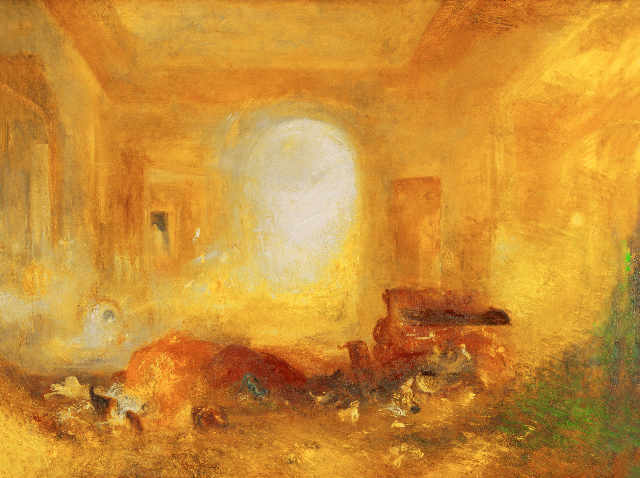
 Some of his sunsets and storms engulf recognizable forms, almost to the point of abstraction, yet they remain anchored in real perception, aspects of the created world which registered in the artist’s here and now. In “Interior at Petworth,” golden light, turbulent and thick, pours through the windows like water from a burst dam, tearing through the staid Victorian inner space to submerge everything in its radiance. How did Turner come to see a world so alive with animating energies? Was this light within his mind, leaving the room essentially untouched, or did he see something inherent in the physical world, a subversive brilliance operating outside the range of mortal sight?[iii]

J.M.W. Turner, “Interior at Petworth” (1837)

A week later, I walked through the doors of la belle cathédrale de Chartres into another epiphany:

The moment of entrance flooded me with intense emotion. I knew it would be beautiful, but I was unprepared for the way the soaring interior would catch me up in a such a physical way, and ravish my virgin eyes with the vivid, fantastic hues of medieval glass, floating islands of magic color in a sea of smoky shadows.

My eyes filled with tears. Never before had a building made me weep. It was that sense of perfection I have found more often in nature, the homecoming when one arrives at the perfect moment, the perfect place, where the lack that drives our stories is satisfied, every desire met.

I drifted around the cathedral as in a dream. There were no lights on at first, and the upward-thrusting shafts and vaults disappeared, like prayer, into a realm beyond our sight. The eloquent profusion of Gothic lines, the underlying mind that held vast forces in balance, subduing the play of gravity and architecture into a state of arrested serenity, was everywhere implied, but the complexity outran the mind’s descriptive grasp. Chartres invites not analysis, but worship. In every direction, the space receded into vague twilights. The effect was neither disorienting nor alarming, but enfolding, a mothering womb rather than annihilating tomb. Theotokos, the Divine Mother, was not only at the heart of the north rose window. She was the very space in which we moved.

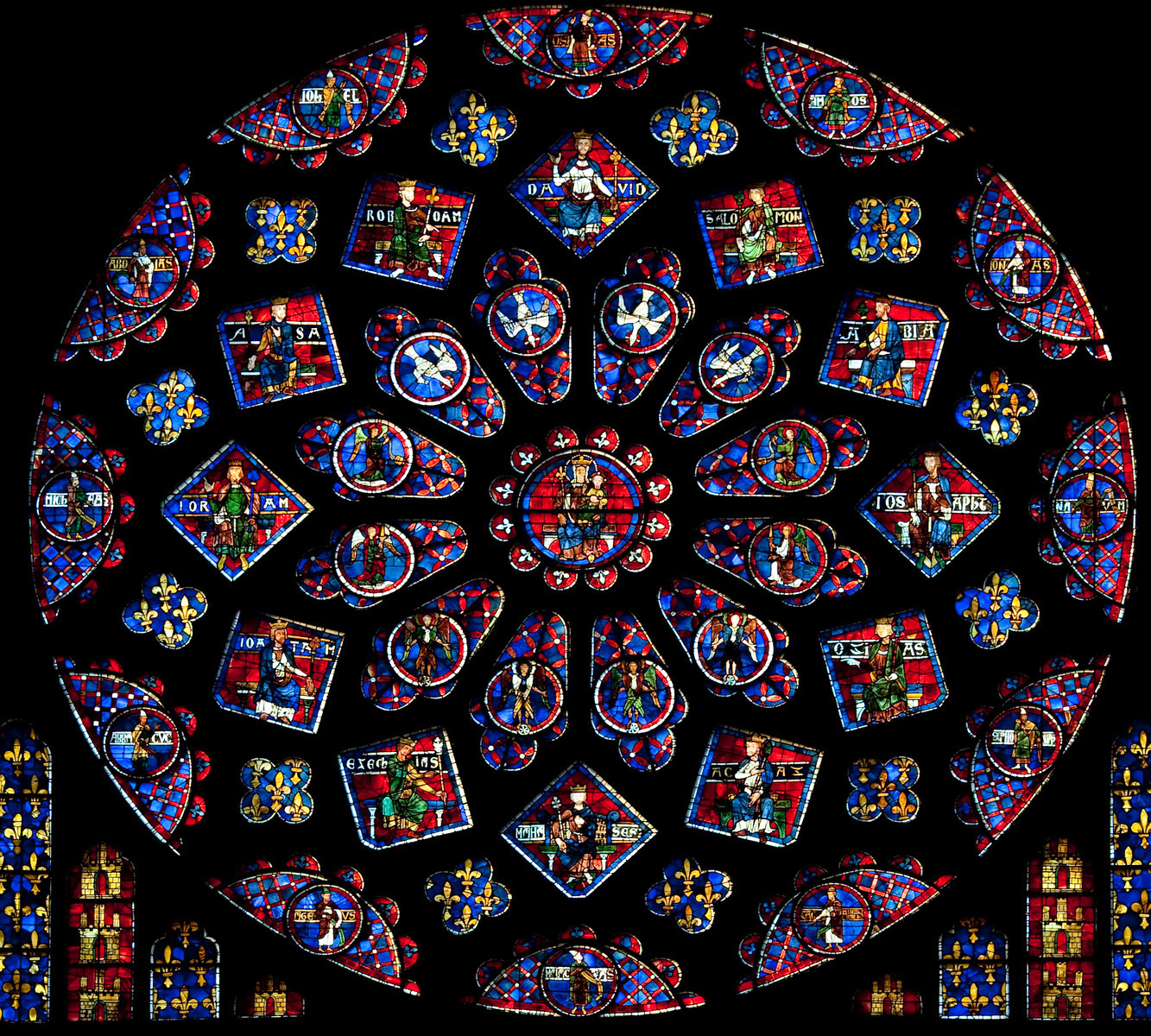
The kaleidescopic windows seemed suspended, weightless, free floating in the darkness, jeweled messengers uttering angelic phrases directly to the soul, unclothed by human words. The north rose window, like Dante’s vision of the heavenly dance, held me rapt for the longest time. What kind of imagination had spread such rich fare before us? And if we feasted on such visions, how would we be changed?[iv]

North rose window, Chartres cathedral


[i] From “School,” a lecture given by Ralph Waldo Emerson in Boston on Dec. 19, 1838.

[ii] Ashton Nichols, The Poetics of Epiphany: Nineteenth Century Origins of the Modern Literary Movement (Tuscaloosa, AL: University of Alabama Press, 1987), 14.

[iii] Personal journal (April 29, 1976).

[iv] Ibid. (May 4, 1976)

At the Mercy of the Future

Greek funerary sculpture, 4th-3rd century B.C. (National Archaeological Museum, Athens)

So long as one hopes, one puts oneself at the mercy of the future.

––Didier Maleuvre


When we say goodbye to the Old Year tonight, it will be with considerable relief. Whatever our private griefs and losses may have been (I lost 5 beloved elders as well as my best friend), the long-term public damage to people and planet is almost beyond measure. Will the New Year be any better? We can only hope, and that leaves us, as Maleuvre says, at the mercy of the future.

Maleuvre’s resonant phrase comes from his analysis of the human face in ancient sculpture:

“The head that tops Egyptian statuary is really a death mask. Expectation, longing, hope… are absent from the Egyptian physiognomy. What they carved in rock is the hard stare of compulsive serenity, of a mind set in foregone conclusions. Longing tends to stretch the boundaries of reality; it opens up prospects, possibilities, contingencies. So long as one hopes, one puts oneself at the mercy of the future… But this expecting mode is absent in Egyptian statuary, the faces and forms of which feature none of the muscular readiness of Greek figures. The latter wade in the stream of time, on the watch for the unforeseen, ready to contend. Whereas the Egyptian statue expects nothing from the world: its blank equanimity is not even the quiescence of stoic wisdom, but of a mind dead set against wonder.”[i]

If any of us were really capable of the “compulsive serenity” or “blank equanimity” of an existence without surprise, possibility or risk, would we really choose it––“a mind dead set against wonder,” expecting nothing, hoping for nothing?

It is not in our nature to do so. We are creatures of longing and hope, and it is our fate to wade into the stream of time, come what may. But as the biblical God tells us at the beginning of every quest, “Do not be afraid. I will go with you.”

So let us go bravely into the New Year, to do the work and be the change.
And twelve months hence, may all our songs be glad.

+

Dear reader –– Thank you for honoring this writer with your attentive reading and thoughtful feedback in 2017. I am also very grateful for those times you have shared a post with your own friends and communities. It is encouraging to know that these reflections mean something to you, and that you find them meaningful for others as well. So I thank you for your support of my writing ministry. I will do my best never to waste your time. Happy New Year!

+

Some of my favorite posts from 2017:

The arts

And whether art is a mirror of the human condition, a window into beauty both immanent and transcendent, or a hammer to shatter our complacencies, it shares many of the tasks and effects of religion.

To Plough and Harrow the Soul: The Shared Work of Art and Faith

Kieslowski’s Decalogue: A Masterpiece of Religious Cinema

Temporary Resurrection Zones

Culture

We may have lost our innocence about the world––and about the traces of darkness in our own hearts––but we are still prisoners of hope. Our formative glimpses of a new heaven and a new earth may have come and gone, but their influence still lingers. However chastened or weary we may be, a sense of expectation remains. What Jesus called the Kingdom of Godis a future of human flourishing and divine blessing that still pulls on us with gravitational force. Its current absence doesn’t dim our faith. It only intensifies our longing.

Everything Changed, Nothing Changed (Summer of Love, Part 3)

Mortality

None of us will be shouting “Hey, look, it’s me!” in heaven.
We won’t even be shouting “Hallelujah!”
We will have become Hallelujah!

“You say goodbye, I say hello”: A Requiem Sermon

In Paradisum: On the Death of a Friend

Falling Leaves and the Fate of Mortals

Wonder

When [the eclipse] was over, what lingered was the overwhelming sense that I had experienced both immanence and transcendence in a single image, its roundness like a sacramental Host lifted above the altar of the world. In retrospect, it doesn’t seem too much to claim that within the visionary interval of totality my deepest longing was met by an answering Presence.

A Deep but Dazzling Darkness


[i] Didier Maleuvre, The Horizon: A History of Our Infinite Longing (, Berkeley: UC Press, 2011), 16.


What Happens in Bethlehem Doesn’t Stay in Bethlehem

Giovanni Bellini, The Madonna of the Small Trees (1487)

If you want, the Virgin will come walking down the road, pregnant with the holy, and say,
“I need shelter for the night, please take me inside your heart.
My time is so close.”

 Then, under the roof of your soul,
you will witness the sublime intimacy,
the divine, the Christ,
taking birth forever.

 –– St. John of the Cross


The story we celebrate on Christmas Eve isn’t just about a long-ago wonder. It describes something that is still going on, as the divine “takes birth forever” in mortal flesh and human stories. The infinite God, the Creator of time and space and matter, the Source and Sustainer of all existence, yearns to be born in us, to express the life-giving Word in the vocabulary of human flesh. Your life, my life, our common life as the body of Christ––these are God’s Bethlehem tonight.

In other words, the Nativity isn’t just something we remember. It’s something we do, something we become.  As St. Paul said, “all of us . . . are being transformed into the image that we reflect in brighter and brighter glory.” In other words, we are destined to become God-like.

But what does that mean––“God-like?” It doesn’t mean having superpowers or being invulnerable. Look at Jesus. His life tells you what God-like means. He was born in poverty and weakness, in a stable not a palace, and he lived a life of utter self-emptying and self-offering, giving himself away for the life of the world.

To let the divine be born in us, then, means simply this: to let our humanity achieve its true fullness by allowing divine Love to have its way with us. A 13th-century mystic, Mechtild of Magdeberg, put it like this:

“When are we like God? I will tell you.
Insofar as we love compassion and practice it steadfastly,
to that extent do we resemble the heavenly Creator
who practices these things ceaselessly.”

O come, let us adore Christ. But not only that. O come, let us imitate Christ. Let God’s life be born in us. And when the divine is born in us, when the divine takes place in us, we will not be the only ones changed by it. Everyone we meet will be changed. And perhaps one day, the whole world will be changed––into “brighter and brighter glory.”

I think it all comes down to this: What happens in Bethlehem doesn’t stay in Bethlehem.
It goes out into all the world, to all people, all places, now and forever.
And nothing will ever be the same again.

+


Dear reader, thank you for taking the time to consider these posts. You are a writer’s best gift. I wish you a most happy and luminous Christmastide. May your own encounter with the embodied God––whatever form it may take––bless and empower you in the days to come.

Dancing with Time: An Advent Prelude

Time is our choice of How to love and Why.

–– W. H. Auden[i]


Every December, as we approach the border between the years, I think a lot about time. Where did the last twelve months go? How will this year be remembered? What will the New Year bring? How will I ever find time––or make time––to breathe during the holiday rush?

Then there are the big questions. What am I meant to do with the gift of time? How much of it is left? Does time have any purpose or meaning? Is it going anywhere?

The season of Advent, beginning this Sunday, is all about time.

  • We recall the past, pondering the Scriptural history of humanity’s deepest longing and desire, and celebrate the coming of the One in whom “the hopes and fears of all the years” converge at last.
  • We look to the future, when Creation will one day correspond to the purposes of God: the broken mended, wounds made whole, tears wiped from every eye––and everyone gathered into Love’s eternal dance.
  • And we attend to the present, alert for the signs of God’s self-revealing in every moment. The world is saturated with divine appearance, and the practice of Advent is to keep watch and stay awake.

But time is tricky, elusive and complex. It takes many forms. In The Myths of Time, London priest Hugh Rayment-Pickard posits four distinct modes of time.

CATASTROPHIC TIME is devoid of redemption or meaning. It is going nowhere fast. The world feels dark, empty, terrifying. There is neither purpose nor hope nor beauty. It’s a state of utter depression: time has no goal, and everything is sinking into the abyss of nonbeing.

Catastrophic time extinguishes every impulse to rise up and live anew. It is hell’s “darkling plain,” where there is “neither joy, nor love, nor light, / Nor certitude, nor peace, nor help for pain.”[ii] Most of us have experienced this temporal condition––even Christ in his cry of abandonment––but it’s not a place you can stay for long.

APOCALYPTIC TIME shares with the catastrophic a deep disillusionment with the projects of human history. The apocalyptic view knows the mess we’re in: “genocide, ravenous capitalism, grotesque inequalities, world-destroying technologies and competing fundamentalisms.”[iii]

And it looks to God alone for deliverance, as in this lyric by Leonard Cohen:

If it be your will, let your mercy spill
on all these burning hearts in hell,
if it be your will to make us well…
and end this night,
if it be your will.[iv]  

Yes, the world is broken and wounded in ways that seem beyond human remedy. Still, we hope: God is coming to save us. We don’t know how, we don’t know when, we don’t even know what. But we believe, trust and hope that in the end God will “end this night” and “make us well.”

PROPHETIC TIME shares the apocalyptic sense of crisis and judgment, but it doesn’t leave all the work to an outside, transcendent agency. We ourselves are invited and encouraged to become the hands and feet of God, the visible embodiment of divine intention. The prophets don’t just wait for God’s future to arrive like a package from Amazon Prime (expedited shipping available!). They point to the Now as the place where “every heart prepares him room,” where we all can join the work of repairing the world as well as our own broken and unfinished selves.

The prophetic sense, like the apocalyptic, longs for a better world; but it insists on our own participation in the process of revolutionary transformation. We don’t just sit still until the Kingdom comes; we go out to meet it.

The source of so much positive social change, the prophetic understanding of historical time as an unfolding of divine purpose may at times overestimate human potential and underestimate human sin. It can leave us disillusioned when our efforts go awry or the world fails to improve in a timely manner.

KAIRIC TIME differs sharply from both the apocalyptic and the prophetic. Instead of looking to the future end of time and the completion of salvation history, it devotes all its attention to the profound depths of the present moment, to what the Greeks called kairos: the epiphanic Now, charged with meaning in its own right, whatever its connection to a larger ongoing story.

Kairic time is the domain of the poet, the artist and the mystic, who know how to find what T. S. Eliot called “a lifetime burning in every moment.” But in fact it is available to us all. We only need the discipline to wait until it shows itself, and the attentiveness to be fully present and receptive when it comes.

As the 14th century author of The Cloud of Unknowing recommends:

“Be attentive to time and how you spend it. Nothing is more precious. This is evident when you recall that in one tiny moment heaven may be gained or lost. God, the master of time, never gives the future. God gives only the present, moment by moment.”[v]

The Incarnation is in one sense a validation of kairos, because it shifts the crucial moment of history from the end of time to the middle: God comes into the midst of world and time, giving the divine presence fully, holding nothing back. Therefore we can find “God-with-us” in every moment, if we pay attention and stay awake.

But kairic time, like the other modes, has its liabilities and limitations. We can be so swept away by the beauty of the moment that we become insensible of the suffering all around us. We may grow so enamored of our own experience that the demands and tasks of a shared public life fade into insignificance––the world out there is “not our problem.” Living in the moment can be enlightenment. It can also be escape.

Does any single mode take precedence over the others?
Or do they all have gifts for us?
The fact is, we live and move and have our being
in all the temporal modes––sometimes simultaneously.
And each of them calls us to respond in a particular way:[vi]

Apocalyptic: Renounce and resist the things that bind us to the ways of violence, greed and death, and wait upon the surprises of God with faith and hope.

Prophetic: Prepare ourselves to make room for God’s coming, offering our energies and our choices as visible signs of the dawning Kingdom.

 Kairic:  Stay awake for the revelation in every moment.

“My times are in your hand,” says the Psalmist.[vii]
What would happen if we could realize this in every moment?
This Advent, may your own dance with time be full of grace.


Related posts:

Ten Ways to Keep a Holy Advent

The World’s End (An Advent Manifesto)


[i] W. H. Auden, “For the Time Being: A Christmas Oratorio,” Collected Poems (New York: Random House, 1976), 297.

[ii] Matthew Arnold, “Dover Beach.”

[iii] Hugh Rayment-Pickard, The Myths of Time: From St. Augustine to American Beauty (London: Darton, Longman and Todd Ltd, 2004), 99.

[iv] Leonard Cohen, “If It Be Your Will,” on Various Positions (1984)

[v] The Cloud of Unknowing, q. in Hugh Rayment-Pickard, 92.

[vi] Even catastrophic time may contain a gift. Good Friday is the prelude to Resurrection.

[vii] Psalm 31:15