Consumed by Love: The Flames of Candlemas

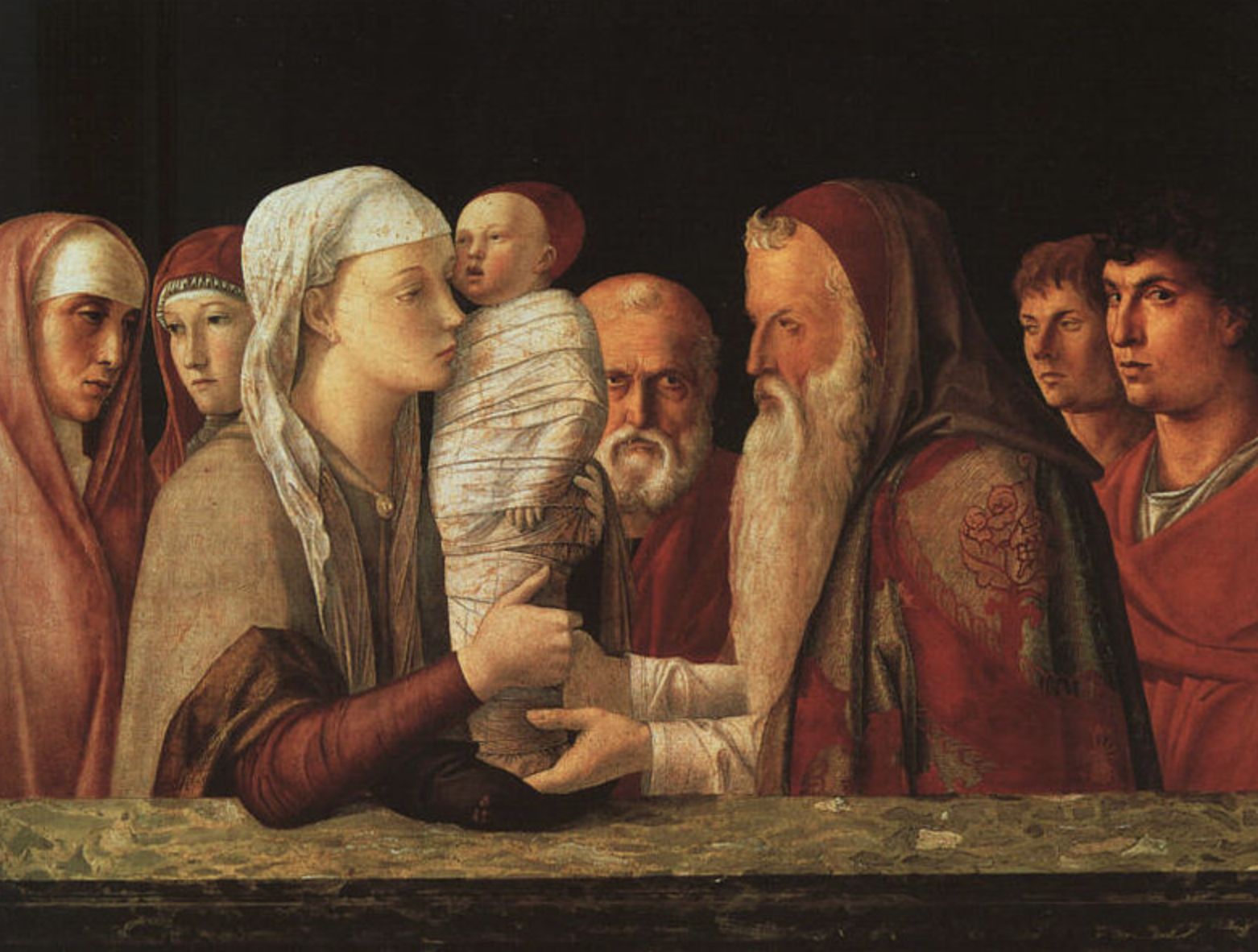
Giovanni Bellini, The Presentation in the Temple (1459)

Today is Candlemas, the 40thday after the Nativity. Its liturgical origins are obscure, but its blazing processions of candles in the winter dark not only made a glorious end to the extended Christmas celebrations of less hurried times, it also provided a brilliant preview of the resurrection fires of the Easter Vigil. Although it still may allow, for a few liturgically-minded procrastinators, a generous extension of the deadline for boxing up our holiday decorations, Candlemas is rarely observed in American homes and churches. Our minds are fixed on groundhogs and football, not the Presentation of our Lord in the Temple.

Still, I would gladly join a candlelight procession to a holy place on this night, to beseech the Light of the World “to pour into the hearts of your faithful people the brilliance of your eternal splendor, that we, who by these kindling flames light up this temple to your glory, may have the darkness of our souls dispelled.”

In the Eastern churches, Candlemas is called “The Meeting,” highlighting the moment when two old souls, Simeon and Anna, met the One for whom they had waited all their lives. Simeon had been told “by the Holy Spirit” that he would not see death before the coming of the Messiah. Every time he went to the Temple, he wondered, “Could this be the Promised Day?” Whatever he may have imagined––the House of God filled with smoke and shining angels, a mighty king arriving in noisy triumph––the long-expected day arrived like any other, without the slightest fanfare.

Simeon liked to go to the Temple early, when it was still blissfully quiet and uncrowded. He began his prayers as usual, but his attention wandered when the entrance of a young couple and their baby caught his eye. He could tell they were country people, the way they looked with such amazement at the vast interior. As they passed by him, he smiled kindly, then closed his eyes to resume his prayers.

But everything within him shouted, “Look! This is the time. Don’t miss it.” As soon as he opened his eyes again, he knew. He didn’t know how, but he knew. That child, cradled in the arms of a peasant girl, was the One!

“Please,” he said. “Please wait!” The couple stopped and turned to face him. Simeon held out his arms, and the girl, as though they had both rehearsed it a hundred times, handed him the baby without the least hesitation. And gazing into those infant eyes, seeing there the future of God’s hopes for all the world, Simeon began to murmur the prayer which the faithful have sung ever since at close of day:

Lord, now at last you release your servant
to depart in peace,
for my eyes have seen the Savior,
just as you have promised.

Then Anna, the old prophetess who had camped out in the Temple for many years, stepped out of the shadows to add her own confirming praises. Joy to the world, the Lord is come!

The Nunc Dimittis of these two old saints, near the end of their lives, being granted the grace of completion on that Temple morning, is beautifully echoed in a passage from Wendell Berry’s novel, Jayber Crow:

I am an old man now and oftentimes I whisper to myself. I have heard myself whispering things that I didn’t know I had ever thought. “Forty years” or “Fifty years” or “Sixty years,” I hear myself whispering. My life lengthens. History grows shorter…

I whisper over to myself the way of loss, the names of the dead. One by one, we lose our loved ones, our friends, our powers of work and pleasure, our landmarks, the days of our allotted time. One by one, the way we lose them, they return to us and are treasured up in our hearts. Grief affirms them, preserves them, sets the cost. Finally a man stands up alone, scoured and charred like a burnt tree, having lost everything and (at the cost only of its loss) found everything, and is ready to go. Now I am ready.

It is a custom at Candlemas to bless the candles for the rest of the year. In 2003, I happened to be in London’s Cathedral of St. Paul for a similar rite, when members of the Wax Chandlers Livery Company, in a practice dating back to the fifteenth century, brought long candles to be blessed for their service on the high altar.

The preacher on that occasion, Canon Martin Warner, took comfort in the fact that when his own brief candle should come to an end, another candle, the Paschal Candle of Easter, would burn over his coffin, declaring by its resurrection light that each of us is but wax “being consumed by the incredible flame of love that is God’s own self, melted not into oblivion but into the freedom of attaining our perfection and deepest longings.”

A candle is a temporal thing, fulfilling its function of radiance and warmth at the cost of its own vanishing. Even so, the fire that consumes it bears Love’s name, and does Love’s work. Whatever is offered up shall receive its true being. Whatever is lost shall be found anew.

Fire of heaven, make us ready.

Prayers for the Advent Season

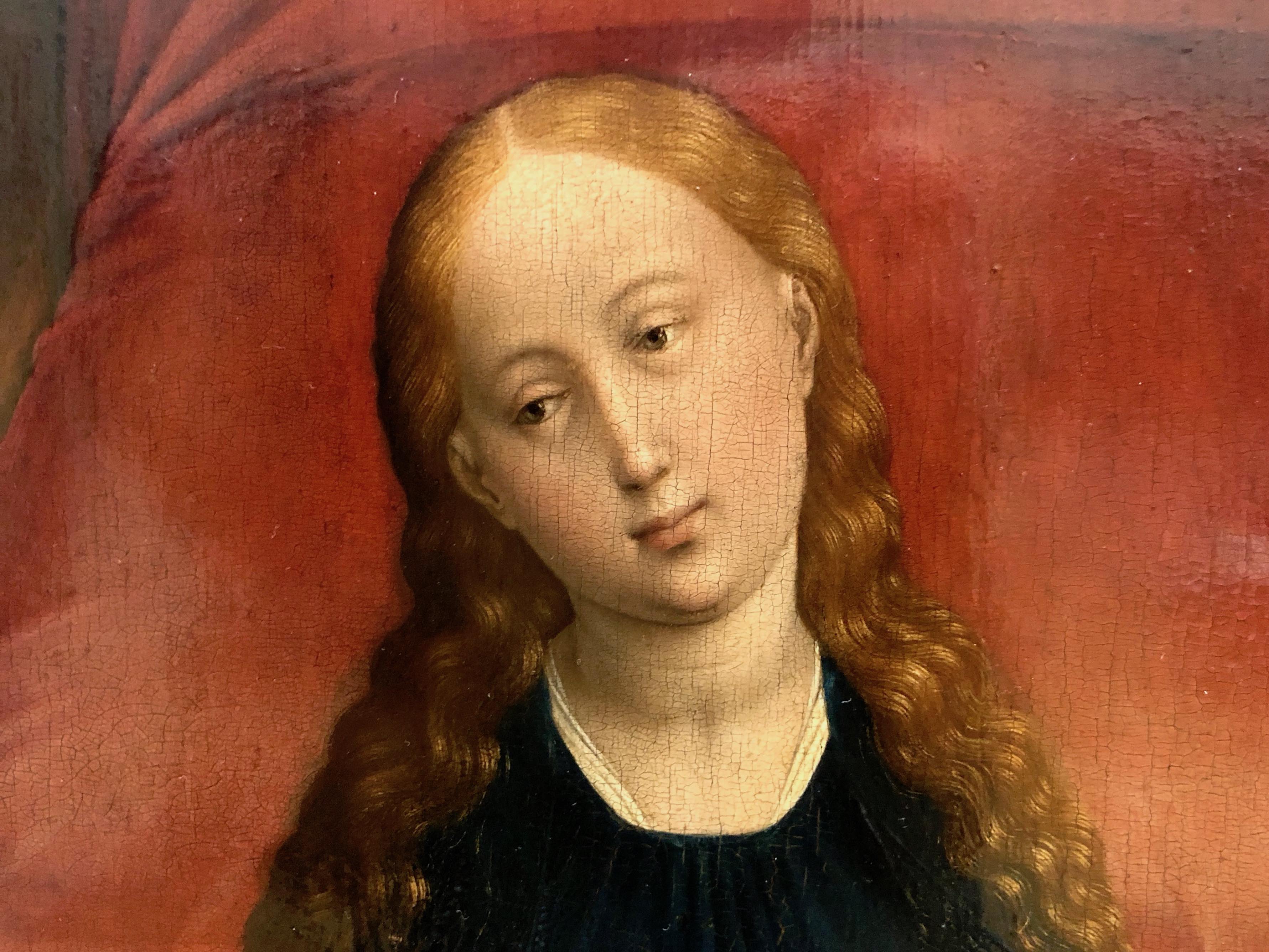
Annunciation (detail), Workshop of Rogier van der Weyden, c. 1440.

I’ve written more about Advent than any other season of the Christian year. It’s like a Mahler symphony, densely packed with vivid contrasts, complex themes, cosmic grandeur, dark abysses and sublime radiance. It begins with the cymbal crash of an exploding world, and concludes with the tender adagio of a baby’s first breaths. Advent haunts our complacency, stirs our longing, and lights a brave candle in the dark.

My ten previous Advent posts, divided into the categories of theology, worship and practice, can be linked directly from last year’s summary compilation, “How long? Not long!––The Advent Collection.”  Whether you love the season as I do, or are wondering what it’s all about, I hope you will find in those ten posts some words to connect with your own journey toward the dawn.

Meanwhile, here is something new: a set of intercessions I composed for this year’s Advent liturgies at St. Barnabas Episcopal Church on Bainbridge Island, the local parish where my wife Karen Haig is the rector. You may recognize specific borrowings from tradition, such as the ancient O Antiphons or the Book of Common Prayer, but it all comes from a lifetime of Advents, soaking up the language and embracing the themes of this transformative season.

I offer these prayers for both liturgical and private use. And if they prompt you to explore your own devotional language of longing and hope, so much the better.

Intercessory Prayers for Advent:

God of many names, God beyond all names; the beginning and the end of every story, the meaning of every life; infinite Mystery both hidden and revealed:

Hear us when we pray to You.

Blessed are You who join us together in the communion of Christ’s Body. Renew and energize your holy Church, in this parish and throughout the world, that we may be a resurrection people, manifesting your steadfast love in our common life of praise and service.

Hear us when we pray to You.

O perfect Wisdom, direct and rule the hearts of the leaders and shapers of society, raise up prophets of justice and peace, and empower your people for the holy vocation of repairing the world. May we entrust all our labors to the work of Providence.

Hear us when we pray to You.

O Deliverer, You unlock every door and make a way where there is no way. Set free all who are afflicted or distressed in body, mind or spirit. Resurrect their hope, grant them peace and refreshment, and restore their joy.

Hear us when we pray to You.

O compassionate One, hold us in your mercy: heal the sick, mend the broken, protect the vulnerable, shelter the refugee, strengthen the weary, rescue the lost, and give courage to all who struggle.

Hear us when we pray to You.

O Morning Star, bright splendor of the light eternal, illumining all things with your radiance: Come, enlighten all who sit in darkness, and those who dwell in the shadow of violence and death. Grant us your peace, and teach us to live in the dawn of your unfailing promise.

Hear us when we pray to you.

O Lover of souls, when we wander far away, lead us back to You; when we refuse your embrace, do not give up on us; when we forget You, do not forget us.

Hear us when we pray to You.

O Desire of every heart, the answer to every longing: You are the strong force that draws us into the mystery of love divine. Forgive us those things which distract and delay us, and lead us ever deeper into the Way, the Truth and the Life.

Hear us when we pray to You.

God who has come, God who does come, God who is yet to come: Make us an Advent people, ready and alert to welcome and receive You in the stranger’s face, the loving act, the moment of grace, the presence of healing, the birth of possibility, the gift of wonder. Let every heart prepare You room.

Hear us when we pray to You.

O Emmanuel, God-with-us, You show us the face of divinity and reveal the fullness of our humanity. Come: renew your creation, restore us all in Christ, and enable us to become who we are, your faithful and loving people. We pray in the name of Jesus. Amen.


August’s Feasts of Light

Perseid meteor shower, 2013. (Photo by Jim Friedrich)

Instead of writing a new post this week, I am off to the wilderness in search of solitude and    nature’s blessings. So let me simply offer links to a couple of posts about annual events which make early August such a special part of summer.

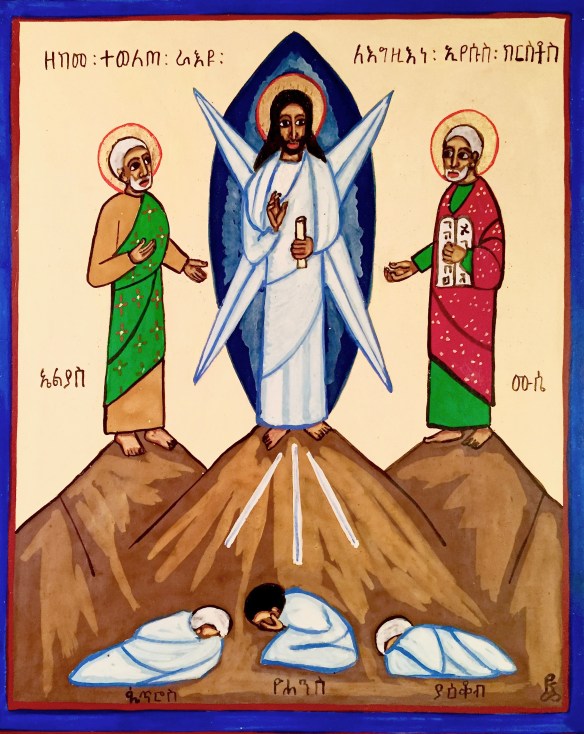
The first is a post for the Feast of the Transfiguration (August 6): The Woven Light.

The second, One Vast Miracle, is about the Perseid meteor shower, for which you should definitely find a dark place next weekend (best after midnight). No moon this year, so it should be a great show.

I’ll get back to writing when I return. Meanwhile, may your summer blessings abound.


Ascension Day: Parting is Such Sweet Sorrow

Giotto, The Ascension (c. 1305, Scrovegni Chapel, Padua)

Hail the day that sees him rise,
glorious to his native skies;
Christ, awhile to mortals giv’n,
enters now the highest heaven.

–– Charles Wesley (18th century)

At once the disciples wept and, groaning deeply,
said to the teacher,
“Are you leaving us, O Compassionate?
Parting from those who love you?”

–– Romanos, Kontakion for the Ascension (6th century)

O envious cloud,
do you grudge even our brief delight?
Where do you fly in such haste?
Your departure, so splendid and bright!
But how poor and blind you leave us!

–– Fray Luis de Leon ((16th century)


This is the fortieth day of Easter, Ascension Thursday, commemorating the cessation of resurrection appearances and the exaltation of Christ into a state of divine glory and universal presence. The liturgical texts and hymns are festive and celebratory: the divine fullness, hidden and humbled in the life of a first-century mortal, is lifted high once again, but without discarding the humanity assumed and hallowed in the Incarnation. By ascending, Christ does not abandon us to “earth’s broken Eden,”[i] but rather makes the way for us to follow, deeper and deeper into God. Our humanity, made glorious in Christ, is joined to divinity forever.

O strong Ramme, which hast batter’d heaven for mee,
Mild lambe, which with thy blood, hast mark’d the path;
Bright torch, which shin’st, that I the way may see . . . [ii]

Still, the day has always felt bittersweet to me. Amid all the festive imagery of a glorified Christ taking up his rightful crown as “cherubic legions shout him welcome to the skies,”[iii] and despite the promise that we now have a Mediator who, as one dear priest put it to me long ago, “whispers our prayers into the ear of the Father for all eternity,” a sense of ending and departure is there as well. The companion who once graced his disciples with the intimacy of daily presence, even after his death––where is he now?

Those once blessed,
now sad, afflicted,
those nourished at your breast
and now by you dispossessed,
where will they turn their faces? [iv]

Divine absence is a common theme in our time. In the secular imaginary, where heaven is but empty space, the Ascension is a flight to nowhere. It’s not just a matter of declining interest in the labor of belief as other matters compete for our attention. For many, “God” is simply no longer even thinkable. Divinity seems a term referring to nothing in contemporary experience. The vocabulary and grammar necessary to speak God into being have become, for many, a dead language.

Climbing high into the mountains fifty years ago, on the lookout for divine presence, Czeslaw Milosz saw only absence––“the mighty power of counter-fulfillment; the penalty of a promise lost forever.”

No eagle-creator circled in the air from which the thunderbolt of its glory had been cast out.

Protective spirits hid themselves in subterranean beds of bubbling ore . . .

God the Father didn’t walk about any longer tending the new shoots of a cedar, no longer did man hear his rushing spirit.

His son did not know his sonship and turned his eyes away when passing by a neon cross flat as a movie screen showing a striptease. . .

And those who longed for the Kingdom took refuge like me in the mountains to become the last heirs of a dishonored myth. [v]

The Ascension does not only signify absence, however. It also promises a new form of presence, which I have written about in “Ascension Day ‘Charade’: The Puzzling Exit of Jesus.” But absence is as fundamental to faith as presence, and deserves to be treated by Christian communities with equal respect and attention.

Since most churches, unable to get good attendance at weekday liturgies, now celebrate the joyful glories of the Ascension on the Seventh Sunday of Easter, perhaps we should consider devoting Ascension Thursday to the honest contemplation of its shadow side. What if God’s friends were to gather annually in an “upper room” for an Ascension potluck or pub night to share their stories and their wonderings about the experience and meaning of divine absence?

Might we then, like those first disciples left behind on the Mount of Olives, find the sincerity of our questions and the depth of our longing answered by the winds of heaven and the fire of unquenchable Love?

So now, be joyful and radiant,
be glad, and sing a new song.
For everything that may happen, happens for your sake.
It was for you I came down and went through all . . .
It is for you again that I ascend into heaven,
to prepare the place
where I must be with you. [vi]


[i] Denise Levertov, “Ascension,” in Divine Inspiration: The Life of Jesus in World Poetry, eds. Robert Atwan, George Dardess, Peggy Rosenthal (New York: Oxford University Press, 1998), 567.

[ii] John Donne, “Ascension,” in John Donne: The Complete English Poems (London: Everyman’s Library, 1985), 433-34.

[iii] Isaac Watts, “Morning,” in The Sacred Harp (Bremen, GA: The Sacred Harp Publishing Company, 1991), #163t.

[iv] Fray Luis de Leon, “The Ascension,” in Divine Inspiration, 566.

[v] Czeslaw Milosz, “How It Was,” in Czeslaw Milosz: New and Collected Poems, 1931-2001 (New York: Ecco, 2003), 232-33.

[vi] Romanos, “Kontakion on the Ascension,” in On the Life of Christ: Kontakia, trans. Archimandrite Ephrem Lash (New York: Harper Collins, 1995).

What Shall We Preach on Easter Sunday?

Harrowing of Hell, Barberini Exultet Scroll (Italy, c. 1087)

The original disciples were shocked into bliss by the Resurrection––
and they never recovered.

–– Dom Sebastian Moore O.S.B.


At the entrance to the Jerusalem’s Church of All Nations, next to the Garden of Gethsemane, there is a sign warning every visitor:

NO EXPLANATIONS INSIDE THE CHURCH

This was intended to discourage talkative tour guides from disturbing the church’s prayerful ambience with shouted lectures, but it has always struck me as very good advice for preachers on Easter Sunday. Confronted by a room full of people who spend most of their time in the secular social imaginary where the dead stay dead and God––if there is one––does not intervene in the natural order, preachers are tempted to mount a defense of the Resurrection within the plausibility structures of the modern mindset. In doing so, they not only tame a dangerous mystery into a manageable––and rather harmless––assumption, but they also waste a valuable opportunity to bring the assembly into confrontation with the transformative presence of the living Christ.

There is nothing wrong with addressing people’s doubts, or wondering what facts might lie behind the “painfully untidy stories”[i] of the Easter narratives. But that is work for another day. Easter Sunday is for proclamation, not explanation. It is a time to meet the One who changes everything.

The central question of Easter is not, “What happened to Jesus way back then?” but rather, “Where is Jesus now––for us?” Or even more strikingly, “When is Jesus­­? When is Jesus for us?”[ii] So Easter becomes not a matter of our questioning the Resurrection, but of allowing the Resurrection to question us. Who are we now, and what must we become, in the light of the risen Christ?

If I were preaching on Easter Sunday, I wouldn’t want to convince so much as to invite–– to invite the mixed crowd of believers, seekers and doubters to embrace the Easter experience and consent to its transformative effects. In order to connect the risenness of Jesus with the risenness of us and all creation, I would pursue two fundamental themes: Easter is now! And, Resurrection has consequences!

Easter is now!

Since it only occurs once a year, Easter Sunday is sometimes mistaken for a commemorative anniversary of a past event. In fact, the earliest churches treated the Paschal mystery of Christ’s death and resurrection as the timeless (or time-full) subject of every eucharistic liturgy. The establishment of an annual observance of “Easter Day” was a later development.

The Resurrection, although breaking into history on a specific temporal occasion, is not the property of the past. As God’s future showing itself in our present, it belongs to all times and seasons. Jesus is alive, still showing up as a transfiguring presence in a world fraught with absences. Jesus is not over, and his story is not over. It will only be completed in the divinization of the cosmos, when God is in all and all are in God.

Easter isn’t something we remember. It’s something we live and breathe.

Resurrection has consequences

The Resurrection is more than an idea we talk about or believe propositionally. It’s something we become, something we “prove” in the living of our stories. Rowan Williams describes it this way:

“[T]he believer’s life is a testimony to the risen-ness of Jesus: he or she demonstrates that Jesus is not dead by living a life in which Jesus is the never-failing source of affirmation, challenge, enrichment and enlargement––a pattern, a dance, intelligible as a pattern only when its pivot and heart become manifest. The believer shows Jesus as the center of his or her life.”[iii]

In the Orthodox icon of the Resurrection, Jesus is never by himself. He is always depicted taking the dead by the hand and pulling them out of their own tombs. Christ’s hand snatching us from death is a vivid image (as in the Exultet scroll above), and George Herbert, the seventeenth-century poet-priest, employs it artfully in ‘Easter’:

Sing his praise
Without delayes,
Who takes thee by the hand,
that thou likewise
With him mayst rise . . .

But the things that are killing us exert a powerful gravity. We sag under the weight of our despair, we resist the hand that pulls us upward. Nevertheless, Christ persists. “Arise, sad heart,” says Herbert in ‘The Dawning’:

if thou dost not withstand,
Christ’s resurrection thine may be;
Do not by hanging down break from the hand
Which, as it riseth, raiseth thee.

Do not by hanging down break from Christ’s hand. Christ came to save us from our least selves. That’s the gift––and the challenge––of the Resurrection, and it applies to our common life as well as to our private selves. The first disciples, so scattered and shamed by the events of the Passion, made this perfectly clear when their broken and bewildered community was restored to life. And so it is for all of us who follow.

Resurrection is about the healing and restoration of wounded and severed relationships: relationships between God and humanity, between human persons and, ultimately, among all the elements of creation. An Orthodox theologian puts the case in the widest possible terms: “The Resurrection is not the resuscitation of a body; it is the beginning of the transfiguration of the world.”[iv]

That’s what I would preach on Sunday. Of course we don’t control what people take away from the Easter celebration. But we can hope that the faithful will be inspired and empowered, and that “outsiders” may be intrigued–– and even fed–– by spending time with a resurrection community alive with the Spirit.

The primary task of preachers and evangelists on Easter Sunday is not to recite or argue the evidence for the Resurrection, but to help their communities become that evidence. May the whole world one day see and know a church which has been shocked into bliss––and has never recovered!

+


Holy Week posts

Dear reader, as we enter the Triduum, the Great Three Days of Holy Week, I pray that your own experience of dying and rising, whether ritually embodied in the traditional rites or undergone in the particularity of your own spiritual path, may bring you to the place of new life and true peace. Easter graces be upon you.

I have written a number of posts about aspects of Holy Week, and I link them below as seeds for your own reflection. As always, I am blessed by your reading.

The Journey is How We Know (The Triduum)

Temporary Resurrection Zones (Maundy Thursday)

We Are Not Alone (Good Friday)

Good Friday

My Body Shall Rest in Hope – A Holy Saturday Reflection

Just a Dream? – Reflections on the Easter Vigil

Are We Too Late for the Resurrection?


[i] Rowan Williams, Resurrection: Interpreting the Easter Gospel (Cleveland, OH: The Pilgrim Press, 1982 & 2002), 100.

[ii] Gareth Jones, “The Resurrection in Contemporary Systematic Theology,” in Resurrection Reconsidered, ed. Gavin D’Costa (Oxford: Oneworld Publications, 1996), 42.

[iii] Williams, 55-56.

[iv] Patriarch Athenagoras, q. in Michel Quenot, Resurrection and the Icon, trans. Michael Breck (Crestwood, NY: St. Vladimir’s Seminary Press, 1997), 232.

Dancing with Time: An Advent Prelude

Time is our choice of How to love and Why.

–– W. H. Auden[i]


Every December, as we approach the border between the years, I think a lot about time. Where did the last twelve months go? How will this year be remembered? What will the New Year bring? How will I ever find time––or make time––to breathe during the holiday rush?

Then there are the big questions. What am I meant to do with the gift of time? How much of it is left? Does time have any purpose or meaning? Is it going anywhere?

The season of Advent, beginning this Sunday, is all about time.

  • We recall the past, pondering the Scriptural history of humanity’s deepest longing and desire, and celebrate the coming of the One in whom “the hopes and fears of all the years” converge at last.
  • We look to the future, when Creation will one day correspond to the purposes of God: the broken mended, wounds made whole, tears wiped from every eye––and everyone gathered into Love’s eternal dance.
  • And we attend to the present, alert for the signs of God’s self-revealing in every moment. The world is saturated with divine appearance, and the practice of Advent is to keep watch and stay awake.

But time is tricky, elusive and complex. It takes many forms. In The Myths of Time, London priest Hugh Rayment-Pickard posits four distinct modes of time.

CATASTROPHIC TIME is devoid of redemption or meaning. It is going nowhere fast. The world feels dark, empty, terrifying. There is neither purpose nor hope nor beauty. It’s a state of utter depression: time has no goal, and everything is sinking into the abyss of nonbeing.

Catastrophic time extinguishes every impulse to rise up and live anew. It is hell’s “darkling plain,” where there is “neither joy, nor love, nor light, / Nor certitude, nor peace, nor help for pain.”[ii] Most of us have experienced this temporal condition––even Christ in his cry of abandonment––but it’s not a place you can stay for long.

APOCALYPTIC TIME shares with the catastrophic a deep disillusionment with the projects of human history. The apocalyptic view knows the mess we’re in: “genocide, ravenous capitalism, grotesque inequalities, world-destroying technologies and competing fundamentalisms.”[iii]

And it looks to God alone for deliverance, as in this lyric by Leonard Cohen:

If it be your will, let your mercy spill
on all these burning hearts in hell,
if it be your will to make us well…
and end this night,
if it be your will.[iv]  

Yes, the world is broken and wounded in ways that seem beyond human remedy. Still, we hope: God is coming to save us. We don’t know how, we don’t know when, we don’t even know what. But we believe, trust and hope that in the end God will “end this night” and “make us well.”

PROPHETIC TIME shares the apocalyptic sense of crisis and judgment, but it doesn’t leave all the work to an outside, transcendent agency. We ourselves are invited and encouraged to become the hands and feet of God, the visible embodiment of divine intention. The prophets don’t just wait for God’s future to arrive like a package from Amazon Prime (expedited shipping available!). They point to the Now as the place where “every heart prepares him room,” where we all can join the work of repairing the world as well as our own broken and unfinished selves.

The prophetic sense, like the apocalyptic, longs for a better world; but it insists on our own participation in the process of revolutionary transformation. We don’t just sit still until the Kingdom comes; we go out to meet it.

The source of so much positive social change, the prophetic understanding of historical time as an unfolding of divine purpose may at times overestimate human potential and underestimate human sin. It can leave us disillusioned when our efforts go awry or the world fails to improve in a timely manner.

KAIRIC TIME differs sharply from both the apocalyptic and the prophetic. Instead of looking to the future end of time and the completion of salvation history, it devotes all its attention to the profound depths of the present moment, to what the Greeks called kairos: the epiphanic Now, charged with meaning in its own right, whatever its connection to a larger ongoing story.

Kairic time is the domain of the poet, the artist and the mystic, who know how to find what T. S. Eliot called “a lifetime burning in every moment.” But in fact it is available to us all. We only need the discipline to wait until it shows itself, and the attentiveness to be fully present and receptive when it comes.

As the 14th century author of The Cloud of Unknowing recommends:

“Be attentive to time and how you spend it. Nothing is more precious. This is evident when you recall that in one tiny moment heaven may be gained or lost. God, the master of time, never gives the future. God gives only the present, moment by moment.”[v]

The Incarnation is in one sense a validation of kairos, because it shifts the crucial moment of history from the end of time to the middle: God comes into the midst of world and time, giving the divine presence fully, holding nothing back. Therefore we can find “God-with-us” in every moment, if we pay attention and stay awake.

But kairic time, like the other modes, has its liabilities and limitations. We can be so swept away by the beauty of the moment that we become insensible of the suffering all around us. We may grow so enamored of our own experience that the demands and tasks of a shared public life fade into insignificance––the world out there is “not our problem.” Living in the moment can be enlightenment. It can also be escape.

Does any single mode take precedence over the others?
Or do they all have gifts for us?
The fact is, we live and move and have our being
in all the temporal modes––sometimes simultaneously.
And each of them calls us to respond in a particular way:[vi]

Apocalyptic: Renounce and resist the things that bind us to the ways of violence, greed and death, and wait upon the surprises of God with faith and hope.

Prophetic: Prepare ourselves to make room for God’s coming, offering our energies and our choices as visible signs of the dawning Kingdom.

 Kairic:  Stay awake for the revelation in every moment.

“My times are in your hand,” says the Psalmist.[vii]
What would happen if we could realize this in every moment?
This Advent, may your own dance with time be full of grace.


Related posts:

Ten Ways to Keep a Holy Advent

The World’s End (An Advent Manifesto)


[i] W. H. Auden, “For the Time Being: A Christmas Oratorio,” Collected Poems (New York: Random House, 1976), 297.

[ii] Matthew Arnold, “Dover Beach.”

[iii] Hugh Rayment-Pickard, The Myths of Time: From St. Augustine to American Beauty (London: Darton, Longman and Todd Ltd, 2004), 99.

[iv] Leonard Cohen, “If It Be Your Will,” on Various Positions (1984)

[v] The Cloud of Unknowing, q. in Hugh Rayment-Pickard, 92.

[vi] Even catastrophic time may contain a gift. Good Friday is the prelude to Resurrection.

[vii] Psalm 31:15

Applauding the Saints

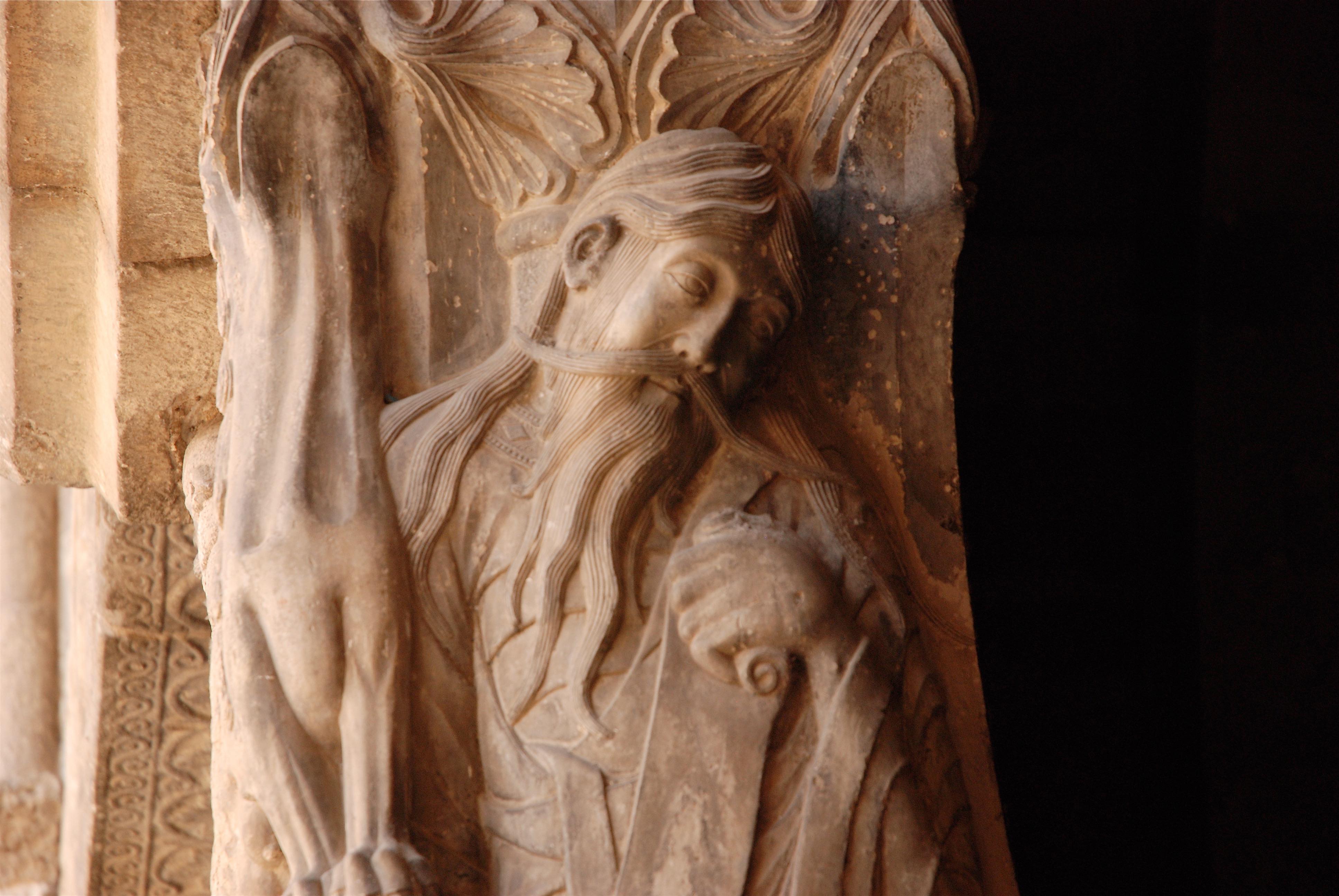
Jeremiah, portal of Moissac abbey on the Le Chemin de St. Jacques (Photo by Jim Friedrich)

At least once in our lives we have dreamed of becoming saints… Stumbling under the weight of the contradictions of our lives, for a fleeting moment we glimpsed the possibility of building within ourselves a place of simplicity and light.

–– Carlo Caretto[i]

Did I offer peace today? Did I bring a smile to someone’s face? Did I say words of healing? Did I let go of my anger and resentments? Did I forgive? Did I love?

–– Henri Nouwen[ii]


On the Feast of Pentecost in 2001, I attended the papal mass in the densely packed outdoor plaza of St. Peter’s Basilica. As the grand procession made its way toward the altar, the assembly began to applaud. While the sound of one hand clapping may induce a spiritual state, the sound of many hands can be jarring in a worship setting, at least for contemplatives. Pope Benedict XVI, never a happy-clappy man, called it “a sure sign that the essence of the liturgy has totally disappeared and been replaced by a kind of religious entertainment.”[iii]

But Rome has a long tradition of applauding the pope as he enters for mass, and this day was no exception. However, this papal entrance was unique, for there were not one but two popes coming up the aisle––the reigning pontiff, John Paul II, but also the mortal remains of the beloved John XXIII as well. On the anniversary of his death (June 3), John’s body was being transferred from an underground crypt to a more public location under the altar of St. Jerome in the basilca’s central nave. But for the duration of the mass, it rested by the outdoor altar in full view of the assembly.

John XXIII died in 1963. When his original coffin was opened after 38 years, his body was found to be remarkably intact. It was dressed in red and white pontifical robes and placed in a glass coffin designed to block UV rays from the Roman sun. His face was protected by a wax mask, displaying the smile which had once dissolved the gloomy severity of a fortress church.

The living pope got his share of the applause, but the most affectionate attention was directed toward the “Good Pope John,” who would be canonized as a saint by Pope Francis in 2014. John’s humility, humor, and love of the poor were striking qualities in a pontiff, but he was best known for initiating the landmark reforms of Vatican II.

John XXIII famously said he wanted to “open the windows” of the Church so that fresh air could blow through its stuffy rooms. So it seemed to me a clear act of divine whimsy when a sudden gust of wind swept through St. Peter’s Square at that Pentecost mass, blowing the caps off the heads of cardinals as we chanted the Creed.

Ironically, John himself discouraged the custom of applauding him or any other pope in church. In templum Dei, he said, the focus should be on God, not ourselves. While we may want to celebrate the saintliness of exemplary persons, the true saint always deflects such praise. Not I, but Christ in me, they tell us.

This deflection is not an act of false humility. Saints are too busy chasing God or serving others to check their spiritual Fitbit. Saints never know that they are saints. They only know that something absolutely essential is calling them, and their life becomes the record of their response.

The first officially recognized Christian saints were the ancient martyrs, who took Christ’s “lose your life to find it” in the most literal sense. As Thomas Becket says in T. S. Eliot’s Murder in the Cathedral, the martyr is one “who has become the instrument of God, who has lost his will in the will of God––not lost it, but found it. . . . The martry no longer desires anything for himself, not even the glory of martyrdom.”[iv]

Although physical martyrdom is still a widespread occurrence around the world, self-sacrifice need not be lethal. Most people engage in some sacrificial practices for God or neighbor, but few of us take it as far as the asceticism so vividly imagined in Don DeLillo’s novel, The Names:

“Go naked in a scatter of ashes, stand in the burning sun. If there is a God, how could we fail to submit completely? Existence would be decrease, going clean. And adding beauty to the world, Kathryn might say. To her the spectacle had merit even if the source was obscure. They would be beautiful to see, leaning on staffs, mind-scorched, empty-eyed, men in the dust of India, moving to the endless name of God.”[v]

The late medieval mysticism of Marguerite of Porete was steeped in this kind of radical self-emptying. What she called the “annihilated soul” (âme aniente) has “neither what nor why”–– it wills nothing, knows nothing, possesses nothing. Such utter evacuation of ego makes space for the Divine to dwell. The Soul, she said, “was created for nothing other than to have within the being of pure charity without end.”[vi] This was a forbidding, perhaps impossible spirituality.

Ecclesiastical authorities repeatedly warned Marguerite to stop circulating her troublesome ideas and writings. Nevertheless, she persisted. Certainly the outspokennes of a free-spirited woman was enough in itself to disconcert the male hierarchy. But the radical nature of her mystical spirituality seemed a very real threat to the stability of Christian community. Imagine a congregation of annihilated souls trying to manage the mundane duties of parish life. What happens when the church needs a new roof? What do they teach in Sunday School? Would a visitor feel welcome––or terror––at the liturgy?

Marguerite was burned at the stake in Paris on June 1, 1310, “the earliest recorded death sentence for mystical heresy in Western Christianity.”[vii] While we abhor such an outcome, we may share the underlying concern about a spirituality of utter self-negation. Few of us are called to “go naked in a scatter of ashes.” If this life is a gift and not a prison, shouldn’t our spiritual practice affirm and embrace the blessings and epiphanies of embodied existence?

“Your Enjoyment of the World is never right,” wrote 17th-century Anglican Thomas Traherne, “till evry Morning you awake in Heaven: see your self in your fathers Palace: and look upon the Skies and the Earth and the Air, as Celestial Joys.”[viii] Traherne is miles from Marguerite of Porete, yet they both share the one thing common to all the saints. They turn their faces Godward.

“I ought therefore evermore . . . . to remember God, and aim at His Glory as my Supreme End. When I forget Him I walk in Darkness, when I aim at myself it is in vain Glory.”[ix]

Tomorrow is All Saints Day. We will remember and celebrate the great company of our ancestors and mentors in the blessing way. We will praise their godly qualities, be inspired by their examples, and take heart from the fact that they were and are “just folk like me”[x]––forgiven sinners, “stumbling under the weight of their contradictions” yet keeping their eyes on the prize.

Yes, we applaud their sanctity, but listen! Our applause is being drowned out by a mightier sound. The company of heaven returns the compliment. While we make our own stumbling way deeper and deeper into the Mystery, the saints are now applauding us.


Related post: For All the Saints


[i] Robert Ellsberg, The Saints’ Guide to Happiness: Practical Lessons in the Life of the Spirit (New York: Doubleday, 2003), 29.

[ii] Ibid., 146-7.

[iii] Joseph Ratziner, The Spirit of the Liturgy (San Francisco: Ignatius Press, 2000), 198.

[iv] Quoted in Martyrs: Contemporary Martyrs on Modern Lives of Faith (San Francisco: Harper San Francisco, 1996), 4-5.

[v] Don DeLillo, The Names (New York: Vintage, 1989), 92.

[vi] Joanne Maguire Robinson, Nobility and Annihilation in Marguerite Porete’s Mirror of Simple Souls (Albany, NY: State University of New York Press, 2001), 78, 83.

[vii] Ibid., 27.

[viii] Thomas Traherne, Centuries of Meditations I.28-29, q. in Denise Inge, ed., Happiness and Holiness: Thomas Traherne and His Writings (Norwich, UK: Canterbury Press, 2008), 125.

[ix] Ibid., Select Meditations III.75, in Inge, 262.

[x] Lesbia Scott, “I Sing a Song of the Saints of God.”

I Must Decrease (And Why That’s Good News)

Seattle Midsummer twilight (10:05 p.m., June 22, 2017)

The 24th of June is, in the Christian calendar, the Feast of the Nativity of John the Baptist. In Europe, it’s also known as Midsummer Day, marking the critical moment when the longest days begin the six-month journey toward the longest nights. Even though we still have months before us of warm weather and brilliant sunshine, the light is now (imperceptibly at first) beginning to slip away minute by minute. Thus in the old days, on the night before Midsummer––called Midsummer Eve or Midsummer Night––bonfires were lit to encourage the waning sun, and people were on their guard against any supernatural mischief. As we know from Shakespeare’s Midsummer Night’s Dream, it’s a good night just to stay home. Whatever you do, don’t go into that magic forest!

The ancient traditions may seem obsolete, but are we free of the anxiety they represent? This turning point in the sun’s journey is a metaphor for our own mortality. We are temporal beings––creatures of time. For us, nothing lasts forever. The very moment that we reach the peak of the Summer Solstice, savoring what the poet Wallace Stevens called “arrested peace, / Joy of such permanence, right ignorance / Of change…”, the sense of having all the time in the world starts to seep away––imperceptibly at first, as we enjoy our fun in the sun and the long unhurried twilights. As Stevens goes on to say in his great Solstice poem, “Credences of Summer”: “This is the barrenness / Of the fertile thing that can attain no more.” After the perfect moment, then what?

In a Calvin and Hobbes cartoon, Calvin is running around in a frenzy, shouting, “It’s July already! Oh no! Oh no! What happened to June? Summer vacation is slipping through our fingers like grains of sand! It’s going too fast! We’ve got to hoard our freedom and have more fun! Time rushes on! Help! Help!”

Meanwhile, his friend Hobbes the tiger is watching Calvin’s panic with studious detachment. Then he says to himself, “I don’t think I want to be here at the end of August.”

My Minnesota relatives still have the summer house my grandfather built on a bluff above Lake Pepin, a scenic stretch of the Mississippi River that becomes a lake two miles wide and thirty miles long. About fifteen years ago, in late June, I walked down to the beach from the house, passing through a grove of maple trees and birdsong. When I emerged from the woods onto the sandy lakeshore, I saw one of the great spectacles of Midwest summer: a storm of mayflies.

Thick black clouds of insects with transparent wings whirled in the air above me. Millions more covered the willows and cottonwoods, darkening the summer greenery with their densely packed masses. It was an explosion of pure fecundity: “The feast and fairy dance of life,” as one naturalist has described it.

But this dance is oh so brief. After incubating for two long years in the mud of the lake bottom, the mayflies grow wings, float up to the surface and rise into the air to mate. Within 24 hours of this eruption into ecstasy, they fall lifeless back to earth. Roads and bridges covered with their greasy remains are too slick for driving, and must be closed until a cleanup crew arrives.

Is this not a sped-up version of the human condition––here today, gone tomorrow? As they sang in medieval England, “Merry it is while summer lasts; but now draws near the wind’s cold blast.” The Bible was equally frank about our radically transient status: “All flesh is grass . . . The grass withers, the flower fades.”

Contemporary poet Mary Oliver delivers the same message, lightened by a dose of whimsey:

For years and years I struggled
just to love my life. And then

the butterfly
rose, weightless, in the wind.
“Don’t love your life
too much,” it said,

and vanished
into the world.[i]

For me, this mortal life is like the fireworks on the Fourth of July. So glorious and wondrous––and so quickly over. Every year my wife and I walk a mile down to the local harbor to watch the display, and when it’s done, as we make our way home in the darkness, I always feel the melancholy of endings. The pyrotechnics of July 4––the American version of Midsummer Night––have come and gone. Only two weeks old, summer is already beginning to slip through our fingers! This is the barrenness of the fertile thing that can attain no more.

John the Baptist knew how the story goes. He knew that his given moment on the stage was coming to an end. Remember what he said about Jesus? He must increase, I must decrease. My time is passing, but Jesus’ time is coming. Thus at the Nativity of John the Baptist the days start to decrease, while at the Nativity of Jesus the days start to increase.

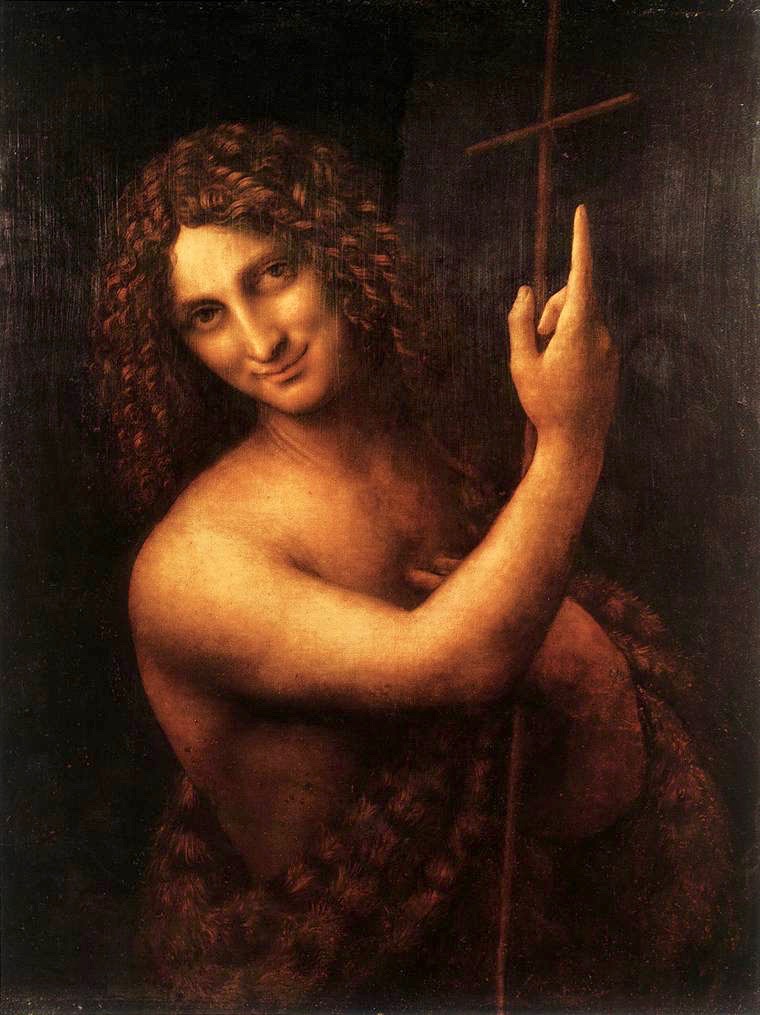
John the Baptist is rightly remembered as the voice in the wilderness, announcing that the Lord is come (let every heart prepare him room!) As his father Zechariah foretold when John was only eight days old, the Baptist was born to be “the prophet of the Most High…. to give knowledge of salvation to [God’s] people by the forgiveness of their sins.” In paintings, John is often seen pointing away from himself, toward Jesus, the “dawn from on high” who gives “light to those who sit in darkness and in the shadow of death.”

Leonardo da Vinci, John the Baptist (1513-16)

John gave us expectant hearts. But he offered us another great gift as well. He taught us the art of letting go. Jesus must increase, I must decrease. That’s what he said, and what he did. It’s what we all do. As the old shape note hymn says with such brutal honesy, “Passing away, we are passing away.”

All flesh is grass––a melancholy thought at the dawn of summer. But wait; there’s more, and it’s good news. Though the grass withers and the flower fades, Isaiah tells us, the word of God will stand forever (Isaiah 40:8). And what is this “word?” Jesus is the word, the speaking of divine reality in human be-ing. And that divine reality, which we are made to mirror, is all about self-diffusive, self-forgetting love. God is a Trinity of persons, giving themselves over to one another in an eternal circulation of gifts offered and gifts received.

So the great secret at the heart of existence, the word that stands forever, is that it’s all about letting go instead of holding on. Jesus made that perfectly clear in his death and resurrection. And John the Baptist, who was martyred before he could see that first Easter Day, intuited this truth even before it was fully revealed.

He must increase, I must decrease. Less of me, more of Christ. More of God. And the Christian life is all about making that truth our daily practice, as individuals and as communities of faith. We learn to let go of things which are passing away––and of the stories which are no longer true for us––and to remain open and grateful for the new gifts we are about to receive. Welcome every gift, but hold on to nothing but God, who is not only the Giver of every gift, but is also the only gift worth having.

God is not a thing, an object, a commodity to be possessed. God is a dance we do. We become most truly ourselves only to the degree by which we participate in, and surrender to, the choreography of that dance: the eternal giving and receiving of self-diffusive love. Letting go, not holding on, is what completes us.

As Mary Oliver reminds us,

To live in this world

you must be able
to do three things:
to love what is mortal;
to hold it

against your bones knowing
your own life depends on it;
and, when the time comes to let it go,
to let it go.[ii]


Related post:

Sacraments of Summer


[i] Mary Oliver, “One or Two Things,” New and Collected Poems (Boston: Beacon Press, 1992), 122.

[ii] ibid., 178

The Holy Trinity and American Politics

Masaccio, The Holy Trinity, Santa Maria Novella, Florence (1425-27)

When you are praying, do not fancy the Divinity like some image formed within yourself. Avoid also allowing your spirit to be impressed with the seal of some particular shape.

– Evagrius[i]

The Trinity reminded Christians not to think about God as a simple personality and that what we call “God” was inaccessible to rational analysis.

– Karen Armstrong[ii]


Trinity Sunday (June 11 this year) originated in the 10th century as a kind of epilogue to the Christian year’s Incarnation narrative from Advent to Pentecost. The coming of Christ, his life among us, his death and resurrection, and the sending of the Holy Spirit all spring from a single Source: the God whose triune nature became manifest in the interwoven processes of creation, redemption and sanctification. Trinity Sunday is a doxology to the Trinitarian template shaping salvation history since time began.

Some preachers dread the Trinity sermon as a doomed exercise in higher mathematics or abstract philosophy or a futile attempt to cram some theology into the minds of the congregation before they take off for summer vacation. But recent decades have seen a tremendous revival of Trinitarian thought as foundational for Christian faith and practice. Two years ago I wrote three posts about the Trinitarian mystery. Here are the links if you want to have a look:

Three Things You Should Know about the Trinity

Part 1: God is relational

Part 2: You can’t make this stuff up

Part 3: God is a dance we do

This year I have been thinking about the Trinity in relation to American politics. In a commencement speech at a Christian college last month, popular-vote-loser Trump said, “In American we do not worship government; we worship God.” Since “God” is a generic term which may apply to any object of worship, Trump is certainly free to apply it to whatever conjured projection of his own monstrous attributes he pleases. But no one should mistake it for the God whose essence is not the narcissistic solitude of monarchical power but the self-diffusive relationality of loving communion.

Trump’s dis-ease in relation to the underlying reality of divine communion is but an extremely grotesque example of modernity’s critical error about the nature of human be-ing. As I said in my “God is relational” post:

“We tend to think of a person as defined by his or her separateness. I’m me and you’re you! We may interact and even form deep connections, but my identity does not depend upon you. I am a self-contained unit. You can’t live in my skin and I can’t live in yours. That’s the cultural assumption, which goes back at least as far as Descartes in the seventeenth century, and continues today in such debased forms as rampant consumerism, where my needs and my desires take precedence over any wider sense of interdependence, community, or ecology.”

Pretty much everything the White House and the Congressional majorities are trying to do now is a grievous offense against the Divine Trinity whose very being is communion. Attacking immigrants, inflaming racism and violence, abusing women, starving the elderly, sentencing tens of thousands to early death by taking away their health care so the rich can get richer, poisoning the wells of public life, telling the planet to go to hell––the list of injuries to God’s desire grows daily.

I get it. Evil has been prowling around like a ravenous lion ever since the Fall. America is no exception in this regard, and we should be dismayed but not surprised by those who want to make America hate again. But I wish they would at least purge “God” from their rhetoric. I know it’s a generic, non-descriptive term when severed from liturgical or theological context. They’re not talking about any God I know. Still, their implicit claim of reference to the biblical God is blasphemous and tiresome.

How does God’s love abide in anyone rich in worldly goods who sees the needs of his brothers and sisters and acts heartlessly toward them? (I John 3:17)

Whoever fails to love does not know God, because God is love. (I John 4:8)

I couldn’t help noting that on the Thursday closest to Trinity Sunday, 2017, James Comey and Sen. Angus King, in a Congressional hearing watched by millions, both cited the medieval martyrdom of Thomas Becket at the altar in Canterbury Cathedral. Becket, who spoke truth to power in the name of the Trinitarian God, was consecrated on the Feast of the Holy Trinity, 1162.

KING: “[W]hen a president of the United States in the Oval Office says something like, ‘I hope’ or ‘I suggest’ or ‘would you’, do you take that as a directive?”

 COMEY: “Yes. It rings in my ears as, well, ‘will no one rid me of this meddlesome priest?’”

 KING: “I was just going to quote that, in 1179, December 27th, Henry II said, ‘Who will rid me of the meddlesome priest?’ and the next day, [Becket] was killed. Exactly the same situation.”[iii]

At that moment, church history nerds across America sprang from their couches to applaud the survival of learned discourse. And I suspect that God, who holds evil tyrants “in derision” (Psalm 2:4), found the Trinity coincidence amusing.


[i] Evagrius Ponticus, The Praktikos & Chapters on Prayer, trans. John Eudes Bamberger OCSO (Kalamazoo, MI: Cistercian Publications, 1981), 66

[ii] Karen Armstrong, The Case for God (New York: Alfred A. Knopf, 2009), 115

[iii] Transcript of James Comey testimony before United States Senate Intelligence Committee (June 8, 2017):  http://www.politico.com/story/2017/06/08/full-text-james-comey-trump-russia-testimony-239295