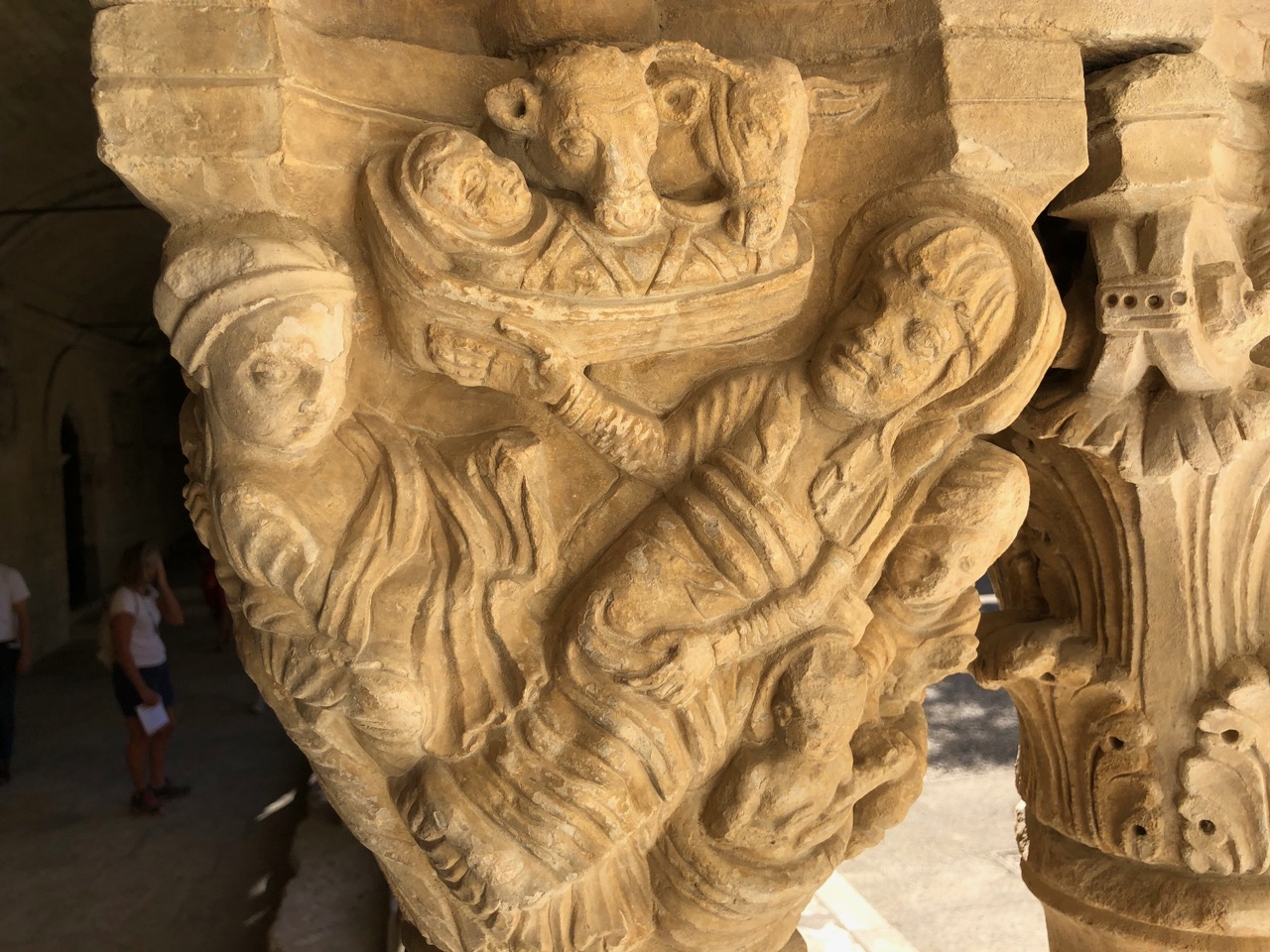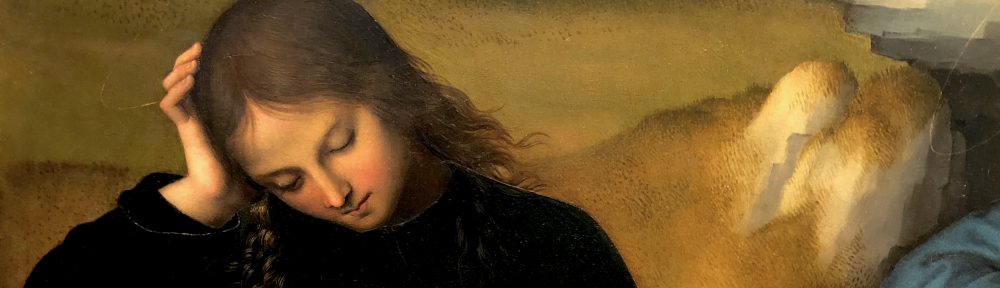
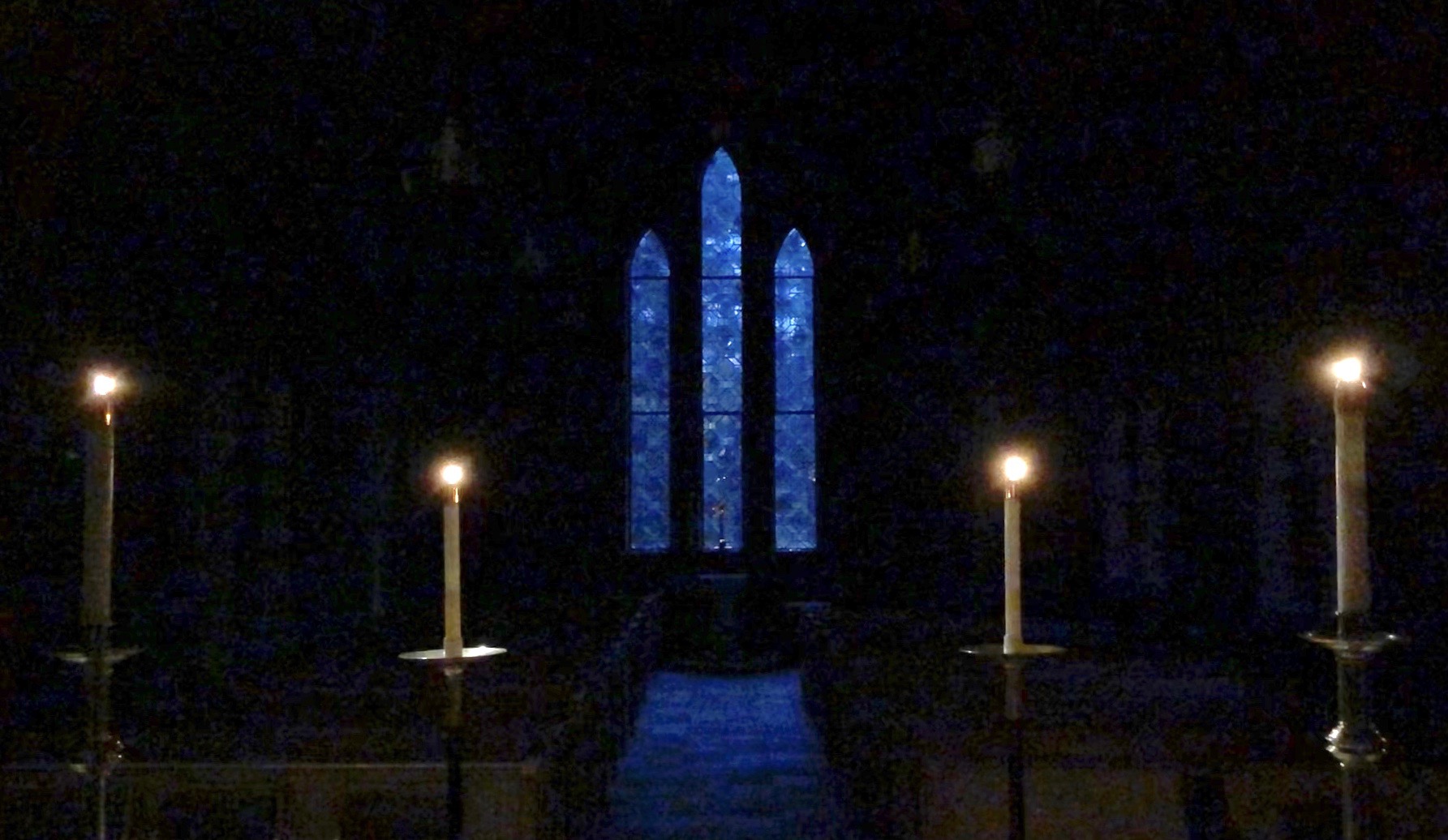
Our parish service of Advent Lessons and Carols is virtual this year, using music recorded in 2019, and readers recorded in 2020. I added visuals inspired by the texts. The choir of St. Barnabas Episcopal Church on Bainbridge Island, Washington, is under the direction of Paul Roy, who also plays the organ. Priscilla Jones plays cello, and Rick Baty is on trumpet. The Rev. Karen Haig, rector of St. Barnabas, is the Officiant.
I share it here with my wish that your own Advent, dear reader, may be a season of hope and peace as the friends of God watch for the dawn.
The service music and notes on the images:
Veni Emmanuel (arr. Raymond H. Haan): The empty church at nightfall, like all of us scattered in our pandemic isolation, longs for the dawning of the day when God’s friends will once more fill this sacred space with thanks and praise.
Savior of the nations, come (Martin Luther’s variation on Ambrose of Milan, translated by William M. Reynolds and James Waring McCrady, with a powerful 16th century tune): Text and images celebrate the “wondrous birth.”
Adam lay ybounden (15th century text, setting by Boris Ord, 1897-1961): Had there been no apple and no Fall, the carol says, there would be no Queen of heaven and no Incarnate Word (some theologians dispute this—God wants to be with us under any circumstances—but the “felix culpa” is here charmingly argued). The last image here contrasts Eve picking an apple with Mary picking the sacramental Host to feed the people.
There is no rose of such virtue (15th century text, setting by Stephen Carraciolo): This lovely text compares Mary to a rose, and so do the images.
When the King shall come again (text by Christopher Idle, b. 1938): The images illustrate the hymn’s vision of a redeemed Creation: earth’s loveliness restored …rivers spring up … ransomed people march on God’s highway toward “the Lord with glory crowned.”
See, amid the winter’s snow (text by Edward Caswall, 1858; tune by John Goss, 1800-1880)): The text hails “redemption’s happy dawn” and gives us the key Nativity images, but the first line dictated the imagery, which I shot at home in winters past. The relaxing footage induces a contemplative mind receptive to the Mystery.
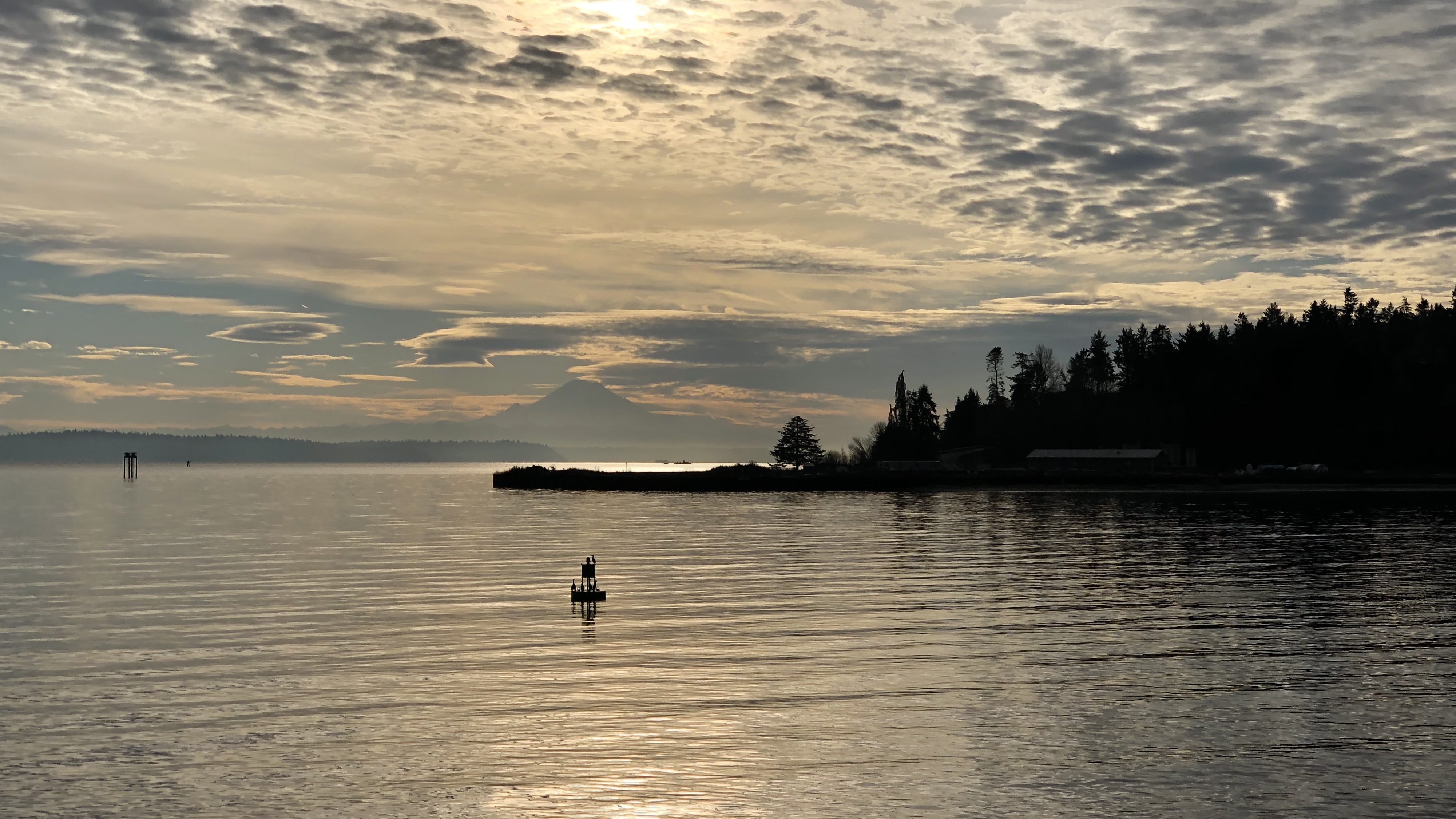
People, look east (words & music by Eleanor Farjeon, 1881-1965; arr. James E. Clemens): This lively carol prompts a variety of images— looking east at dawn (Mt. Rainier, Seattle from a ferry), home and hospitality (St. Barnabas in the snow), birds (pine siskins, goldfinches), stars, and angels (from Annunciation paintings). The final line, “Love, the Lord, is on the way,” inspired the linking of Mary’s pregnancy to the eucharist Host being adored by the angelic host.
Magnificat (setting by Thomas Attwood Walmisley): Mary’s great hymn of reversal is accompanied by diverse images of the Mother of God.
Lo, he comes with clouds descending: Charles Wesley’s great hymn of the Second Coming, with its stirring tune by Augustine Arne (1710-1788), calls for clouds and—unusual for the season—Passion imagery.
Sleepers, wake! A voice astounds us (arr. J.S. Bach): The words for this great Advent hymn call us to watch for the imminent dawn of salvation. Thus the images of the nocturnal moon (light in the darkness) conclude with sunrise light. The long night is over at last.
This is the sixth in a series on the canonical hours, the ancient Christian practice for living a mindful day. The first, “Reclaiming My Time,” gives a general introduction, with a list of helpful resources for your own practice of prayer and meditation. This reflection considers Vespers, the transition between day and night.
Vesper Light, Island of Paros, Greece (Jim Friedrich, 2015).
Now the day is over, Night is drawing nigh, Shadows of the evening Steal across the sky.
This familiar 19th-century Vespers[ii] hymn was dropped from the Episcopal hymnal in the proposed revision of 1982. A selection committee had deemed the text too sentimental and the tune too simple (5 of its 8 bars are on the same note, a kind of Anglican “om!”). But when the new hymnal came to a vote at the church’s General Convention 38 years ago, a motion was made from the floor to restore this old favorite. I was present for that debate, when one delegate after another stepped to a microphone to declare how much that hymn had meant to them, how formative the singing of it had been for their sense of belonging to a spiritual community with a fondness for dusk. The motion passed easily, and the hymn was rescued from the ecclesiastical dumpster.
Unlike its Vespers companions in the hymnal, its opening verse makes no mention of Christ or the Creator. It offers no theology of the day as divine gift, sings no praise to the Source of eternal brightness. It simply devotes quiet attention to the sensory data of the twilight hour: shadows lengthen, light fades. As temporal creatures, we have an inborn sensitivity to the vanishing of time. The Vesper drama, the most poignant of all the hours, is performed daily: sun goes … light fades … night falls. Failing to attend would impoverish both consciousness and spirit.
“Absolutely unmixed attention” (Simone Weil’s definition of prayer) is how to keep Vespers as a sacred hour, a time to engage with the sense of an ending and acknowledge our own temporality. Days must end, lives must end, and both passages deserve our profoundest attention.
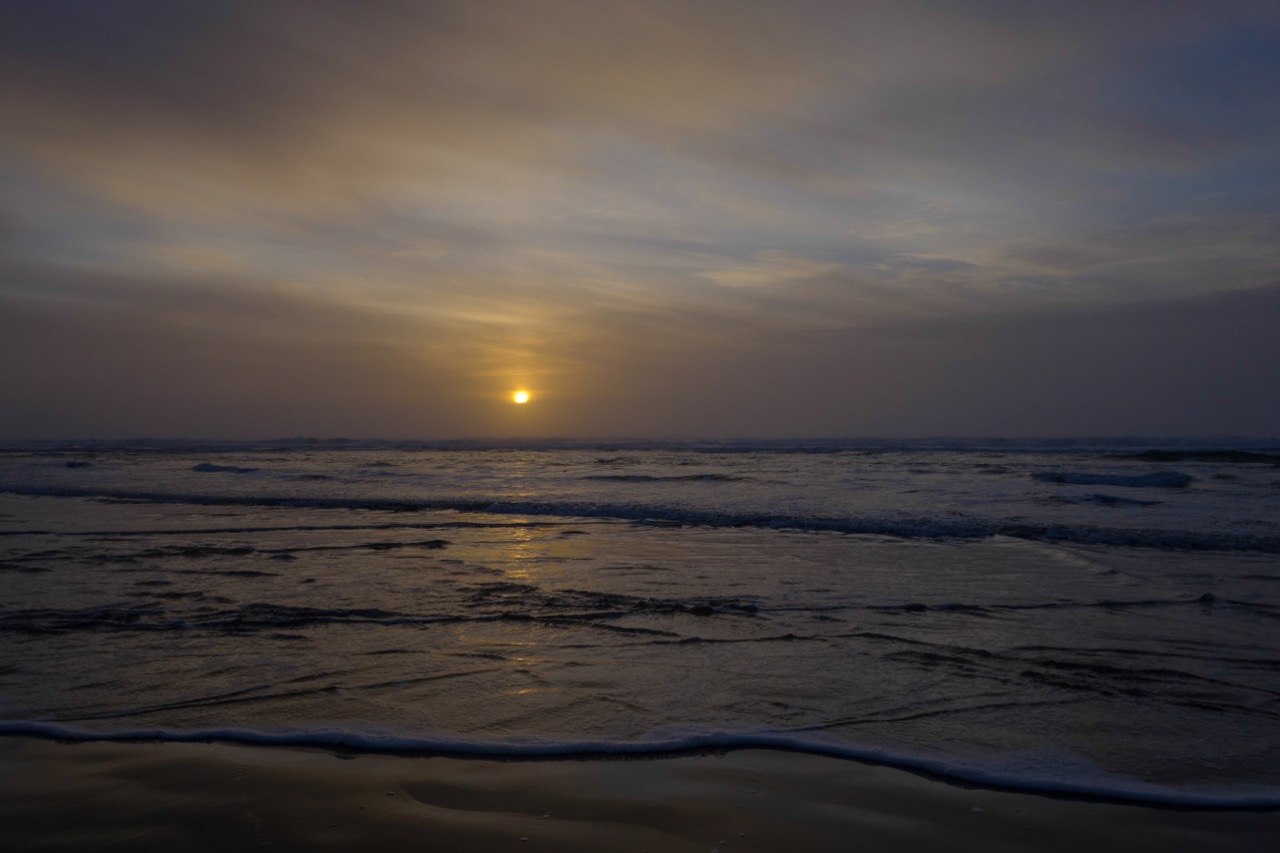
Winter sunset, Washington coast (Jim Friedrich, 2016).
Fairer through Fading—as the Day Into the Darkness dips away— Half Her Complexion of the Sun— Hindering—Haunting—Perishing—
How many Vespers have we missed, shut inside with the lights on or distracted by our screens? And when we do honor the hour with our attention, it is rarely in community. I suspect we could trace the affection for “Now the day is over” to the effect of ritualizing the inevitability of ending in the company of others. Such shared, collective awareness is a powerful thing. When I try now to recall memories of singing that hymn, I don’t see individual faces, but only a group, deeply united in song. It is always dusk, whether at a campfire or in a candlelit church as the windows grow dark. The strength of our voices feels surprising, surpassing their usual reticence, as if a greater power has possessed us in the form of sound.
For those of us not adept at goodbyes, bidding farewell to the day can produce a certain melancholy, but this is more than compensated by the beauty of the vesper light—the saturated sunset tints, the subtle tonalities of twilight.
Vespers also prompts what Jesuits call the Examen: a prayerful review of the day. “In the evening we shall be examined on love,” warned St. John of the Cross, comparing day’s end to the Last Judgment. And, adds poet Thomas Centolella, “it won’t be multiple choice … No cheating, / we’ll be told … no more / daily evasions.” [iv]
From the perspective of the end, we can look back on the story of the day as a whole: How did it go, for good or ill? … Where did God meet us—and did we notice? … When did we remember—or forget—to be our truest selves? … And, most importantly, did we say yes to Love?
Few days go perfectly, and neither do we. But the spirit of evening’s Examen is not self-criticism but self-compassion. Whatever the day has brought, let it end not with regret but with gratitude. Vespers calls us home, after all, to the place where we are always welcome just as we are.
Lord of all kindliness, Lord of all grace, Your hands swift to welcome, your arms to embrace, Be there at our homing, and give us, we pray, Your love in our hearts, Lord, at the end of the day.[v]
Kathleen Norris learned “the true purpose of vespers” from her sojourns in monastic community. It is, she writes, “to let my body tell me, at the end of a workday, just how tired I am.” Vespers invites us to “let the day suffice, with all its joys and failings, its little triumphs and defeats.” [vi]
While I love daybreak, so full of possibility and potential energy, I think Vespers is my favorite hour—“sweeter than Matins,” said Emily Dickinson, who herself preferred the mature and mellow ripeness of the completed day to the freshly planted seeds of morning. It is an haven of peace. We put down our work and retire from the fray. We go homeward—and inward—to restore our bodies and nourish our souls.
St. Anselm’s pastoral counsel from the Middle Ages seems even more necessary today:
“Flee for a while from your tasks, hide yourself for a little space from the turmoil of your thoughts. Come, cast aside your burdensome cares, and put aside your laborious pursuits.… Give your time to God, and rest in him for a little while. Enter into the inner chamber of your mind, shut out all things save God … and having barred the door of your chamber, seek him.” [vii]
Watch the sunset. Savor the fading light. Look for the evening star. Light a candle. Love the silence. Let your heart speak. Give thanks.
Vesper moon and evening star at my grandfather’s summer place, Wacouta, MN (Jim Friedrich, 2018).
“Let evening come,” says Jane Kenyon in her lovely Vesper poem. “Let it come, as it will, and don’t / be afraid. God does not leave us / comfortless …” [viii] Yes, let it all come: darkness, ending, even death itself. Don’t be afraid.
In the meantime, hallow the loveliness of Vespers’ daily gift, so perfectly described by Breton poet Anjela Duval:[ix]
The day is now over, The hour’s come I was waiting for. After labor so material, How sweet a spiritual hour.
I’m bathed here in tranquility. I hear no sound around me. But the sound of the pendulum, Counting out drops of time.
The hour of prayer, hour of study, Hour of dreaming, of fantasy, Hour divine, full of ecstasy.
In this hour there’s so much happiness! Only one thing’s missing to perfect it: — In the hearth the singing of a cricket!
[i] Sabine Baring-Gould (1834-1924) published “Now the day is over” in 1865. It is in the Episcopal church’s The Hymnal 1982, #42. Baring-Gould was an Anglican priest, writer, and folk-song collector. His other best-known hymn, “Onward Christian Soldiers,” did not survive its deletion from the 1982 hymnal.
[ii] “Vespers” derives its name from Hesperus, the Evening Star (usually the planet Venus, sometimes Mercury) which appears in the West after sunset. Where I live, sunset is at 4:20 p.m. on the Winter Solstice and at 9:11 p.m. on the Summer Solstice, so Vespers can be a very moveable feast.
[iii] Emily Dickinson’s “Fairer through Fading — as the Day” (938) compares the doomed beauty of twilight with the phenomenon of a dying friend seeming to look better just before dying.
[iv] Thomas Centolella, “In the Evening We Shall Be Examined on Love,” in Lights and Mysteries (Port Townsend, WA: Copper Canyon Press, 1995).
[v] Jan Struther (1901-1953), “Lord of all hopefulness,” The Hymnal 1982, #482. This “hours” hymn, with verses for waking, midday, evening and sleeping, is set to Slane, a lovely Irish tune. As a boy, I used to sing it walking home at dusk, after basketball or track practice. I‘ve always loved the way, in just 4 verses, it embeds us prayerfully in the daily round.
[vi] Kathleen Norris, The Cloister Walk (New York: Riverhead Books, 1996), 237-238.
[vii] St. Anselm, Archbishop of Canterbury (1093-1109), was the most brilliant Western theologian between Augustine and Aquinas. Cited in Elizabeth Yates, A Book of Hours (Norton, CT: Vineyard Books, 1976), 42.
I’ve blogged about Advent—my favorite season—many times on “The Religious Imagineer” website. Click here for the updated list and links for all 15 Advent posts (2014-2020), covering theology, prayer practices, and innovative worship. I hope these words may be useful for your own Advent journey.
Coming next week: Praying the Hours (6): Vespers and Compline
Dawn at the church in Rabanal on the Camino de Santiago (May 2, 2014).
This is a sermon I preached for the First Sunday of Advent, 2020, in the streamed liturgy at St. Barnabas Episcopal Church on Bainbridge Island, Washington. Below the video recording you will find the text with footnotes. Two corrections to the recording: Wordsworth’s account of crossing the Alps is in Book VI of The Prelude, and his celebrated line is: “Bliss was it in that dawn to be alive.” That’s exactly how I felt when I took the top photograph on my pilgrimage walk to Santiago, so I doubly regret the error in the recording!
The liturgical year is like a great story with many chapters, and every Advent we go back to the beginning and tell it all over again. But it’s an unusual story. It doesn’t begin with “Once upon a time …” No, it begins with “The End.” Whether the gospel for the First Sunday in Advent is from Matthew, Mark, or Luke, we always get the apocalyptic Jesus announcing the end of the world. The sun and moon will go dark, the stars will fall from the sky, reality itself will tremble and shake.
It’s the ultimate disaster movie, and we usually absorb it as such. The apocalyptic images of destruction and chaos engage our fears while they’re up on the screen (or on the lips of the gospel reader), but when the lights come up and we head for the exit, we expect to find the same old safe and reliable world waiting for us outside the theater or the church. But in 2020, not so much!
The ending of worlds is far too real this year. COVID-19 has made us acutely conscious of our own impermanence, not only as individuals but as a species. Millions have seen their jobs disappear, education is in crisis, social gatherings are nearly extinct, and so many ordinary things, from restaurants to haircuts, not to mention liturgical assemblies, have vanished from daily experience. We’ve been shocked this year to discover how easily the stability of our democratic institutions can be assaulted and eroded, and we’ve been disheartened and unsettled by the fragility of our social bonds in the face of so much hatred, bigotry, demagoguery and violence. Truth itself has become an endangered species. And if all that isn’t enough, the climate apocalypse is well underway.
“Signs of ending all around us,” says one of our Advent hymns. Then it wonders:
Can it be that from our endings, new beginnings you create? Life from death, and from our rendings, realms of wholeness generate?[i]
How will the world end? Let me count the ways, says the apocalyptic Jesus. But Jesus isn’t trying to depress us. Jesus doesn’t want to paralyze us with despair. But he does want us to be clear about where our treasure is, where our hope lies. Put your faith in the things that endure, he says. “Heaven and earth will pass away, but my words will not pass away.”[ii]
I think what he’s getting at here is that our idolatries, our invented securities, will come to nothing in the long run. Only God endures. Only God’s Kingdom—the world of God—is built to last. So learn how to discern what lasts and what doesn’t, and how to remain faithful to the vision without getting discouraged by the obstacles and failures along the way.
A common misconception about the apocalypse is that it only comes once, at the end of history, when the broken will be made whole, all discords harmonized, all divisions reconciled. Christian faith indeed affirms that great vision of a perfected humanity and a restored creation. But our faith also calls us to make that future present wherever and whenever we can, and to notice how it’s already happening around us. At the same time, we need to recognize the ambiguities of historical existence. God and not-God are like the wheat and the weeds—hard to tell apart until the final harvest. Stay awake, Jesus says. Pay attention. Sometimes the Kingdom is where you least expect it. Sometimes it doesn’t look like anything you expected. And often it will come and go in the blink of an eye. Keep your eyes open!
Why must there be apocalypse? Why must so many things come to an end? In order for God’s future to take place now, some of what is present needs to get out of the way to make room for the new thing God wants to happen. That’s why we should speak about the end of the world not as a single, far-off event, but as the ending of worlds plural: the ending of all those things which need to pass away so we can get right with God.
An economy where millions lose their jobs and millions go hungry while the assets of 600 billionaires increase by 1 trillion dollars during the pandemic—that’s got to go. The killing of people because they’re black—that’s got to go. The destruction of nature by greed and stupidity—that’s got to go. You get the idea. God wants a better world, and God asks us not only to pray for that world but to work for it, and, by God’s grace, to embody it and manifest it whenever and however we can.
But for reasons we are not given to understand as finite beings, the inbreaking of the Kingdom isn’t a story of steady and relentless progress. We are indeed visionary creatures, full of desire for better selves and better worlds, but we are also finite and fallible, complicated mixtures of mud and spirit. We have our limits. We don’t always know the right thing, or when we think we know, we don’t do it, or can’t do it. Or by the time we do, maybe it’s no longer the right thing.
Good motives tend to produce mixed outcomes. And as for bad things, Scripture tells us that a creative God can make a silk purse from a sow’s ear. Historical existence is complicated. It’s messy. A lot of the time we’re just guessing. We have to learn not to fall in love with outcomes, or get too attached to our ideas of the best future. Our God is a God of surprises, and most of our maps to the Promised Land turn out to be illusions, or at least out of date.
In the late 18th century, the French Revolution stirred the imagination of Europe with a sense of immense possibility. Looking back on 1789 twenty-five years later, French observer Thomas Noon Talfourd described the incredible excitement in the air:
“Every faculty of the mind was awakened,” he said, “every feeling raised to an intenseness of interest, every principle and passion called into superhuman exertions. At one moment, all was hope and joy and rapture; the corruption and iniquity of ages seemed to vanish like a dream; the unclouded heavens seemed once more to ring with the exulting chorus of peace on earth and good-will to men … The most brilliant hopes were cherished … and fresh prospects were daily opening which … filled us with painful delight and with giddy rapture.”[iii]
G.W.F. Hegel, the great German idealist, was 19 years old when that revolution happened. “It was a glorious dawn,” he recalled later. “All thinking beings shared in the jubilation of the epoch. A sublime emotion ruled that age, and enthusiasm of the spirit thrilled through the world, as though the time were now come of the actual reconciliation of God with the world.”[iv]
When the English poet William Wordsworth was a young man, he went to France to begin a walking tour in the summer of 1790, when revolutionary spirits were still high. “Bliss was it in that dawn to be alive,” he wrote, “France standing on the top of golden hours, / And human nature seeming born again.”[v]
Those among us who came of age in the 1960s may remember the same exhilaration of being young and idealistic in a time of great upheaval and daring dreams. We had our “brilliant hopes” and “sublime emotion,” our visions of a new world emerging from the ruins of the old.
But we would soon discover that a reborn humanity, reconciled to the purposes of God, was not so easily achieved. So too did the young Wordsworth grow disenchanted with the French Revolution’s dark side. The Kingdom of God may work through the movements of history, but it is not identical with them. To confuse God and history is idolatry. Misplaced hope is worship of the wrong thing.
Fifteen years after his tour of revolutionary France, Wordsworth wrote his epic poem, The Prelude, a spiritual biography of his generation of Romantics and idealists. In Book VI of The Prelude, he explored his personal struggle with hope and disillusionment through the narrative of his excursion through France to the Alps. Making his way south, he feasted and danced with happy revolutionaries, tasting the bliss of their new world. As he put it, he “found benevolence and blessedness / Spread like a fragrance everywhere, like Spring.”[vi]
But when he reached the Alps, he saw a troop of French soldiers plunder a peaceful mountain convent in the name of revolution and freedom from the oppression of religion. Actually, this desecration occurred two years later. But Wordsworth inserts it into his poem to dramatize with this single illustration his more gradual internal process of disappointment with the Revolution’s betrayal of his generation’s hopes.
In the poem, Wordsworth is shocked to witness the soldiers’ destruction of the convent and the expulsion of its “blameless inmates.” The revolutionary sword wields no justice in this act, only negation. The convent, a precious habitation of calm and spirit, set apart to remember eternity, perishes in a world gone mad.
As a disillusioned Wordsworth climbed higher in the Alps, he struggled with despair. He felt “inwardly oppress’d” by an “utter loss of hope itself, / And things to hope for.”[vii] (A loss of “things to hope for.” That is so 2020!) With the Revolution descending into the maelstrom of violence and naked power, where could he look for the true apocalypse that would break the power of the fallen world, renovate humanity, and restore the earthly paradise?
The climb itself began to form an answer in his heart and mind. “For still,” he tells us, “[he] had hopes that pointed to the clouds.”[viii] He was a Romantic, after all, fluent in the language of Nature. The soaring peak of Mont Blanc, rising into the sky above, was an icon of Transcendent power far greater than revolutions or armies—or the countless dejections of history.
We can imagine the music swelling here, as the poet approaches the summit to receive the grace of divine vision, reconciling in a flash all the contradictions of human existence. What actually happened was, Wordsworth got lost in the mist. Eventually, he ran into a peasant who told him that he’d already crested the pass and was in fact now going down other side. Though the poet’s hopes may have still pointed to the clouds, his body was on its way back to the complications of the world below.
Wordsworth would find in this experience a metaphor for the life of faith. We don’t get the decisive apocalypse, the ultimate finale, in this life. God is too inventive to settle for our flawed approximations of a better world. There’s always going to be a mixture of good and ill, darkness and light, in our historical projects, as well as in the circuitous journey of every soul. Still, God has planted hope and desire deep in our hearts, and amid all the complications and setbacks of the human journey, we keep reaching for the clouds, and that in itself is something glorious. As Wordsworth put it:
And now, recovering, to my soul I say ‘I recognize thy glory.’ … Our destiny, our nature, and our home Is with infinitude, and only there; With hope it is, hope that can never die, Effort, and expectation, and desire, And something evermore about to be.[ix]
150 years after Wordsworth crossed the Alps, another poet, W. H. Auden, articulated his own understanding of the dance between disappointment and hope. As a political idealist in the 1930s, he would face his own disillusionment at the end of that decade. Revolutionary hopes for a better world had withered, and humanity, as far from the earthly paradise as it had ever been, was plunging into the inferno of the Second World War.
We hoped, we waited for the day The State would wither clean away, Expecting the Millennium That theory promised us would come, It didn’t.
Like Wordsworth—and all of us at the end of 2020—Auden was forced to accept the limits of historical existence, and to discern, as he put it, “what / Is possible and what is not, / To what conditions we must bow / In building the Just City now.”
And like Wordsworth, Auden finds himself on a mountain: Dante’s Mount Purgatory, where the Earthly Paradise at the top is a distant goal, for which there are no shortcuts.
The purgatorial hill we climb, Where any skyline we attain Reveals a higher ridge again. Yet since, however much we grumble, However painfully we stumble, Such mountaineering all the same Is, it would seem, the only game …
We have no cause to look dejected When, wakened from a dream of glory, We find ourselves in Purgatory, Back on the same old mountain side With only guessing for a guide …
O once again let us set out, Our faith well balanced by our doubt, Admitting that every step we take Will certainly be a mistake, But still believing we can climb A little higher every time …[x]
We’re all on that mountain with the poet, still climbing, sheltering our hope like a candle in the winds of doubt, stumbling our way onward. Sometimes we lose the path, and go astray. And if we do attain a summit, a higher one still looms before us.
And all those apocalypses along the way, all those endings great and small, the vanishings of good things and bad things alike, turn out not to be last judgments or final judgments, bringing our story to a close. They are more like doors, where we pass from a tired world into a new reality.
As long as we are creatures of time and history, that reality will never be fixed or final. And with a God who is utterly free and endlessly inventive, who can describe what is to come? But if I may switch metaphors and poets, let me give you one of my favorite Advent images.
In her poem, “Rowing,” Anne Sexton imagines herself rowing toward an island called God.
I am rowing, I am rowing, though the wind pushes me back and I know that that island will not be perfect, it will have the flaws of life, the absurdities of the dinner table, but there will be a door and I will open it and I will get rid of the rat inside me, the gnawing pestilential rat. God will take it with his two hands and embrace it.
Sexton knows she’s not there yet, she is still in the Advent space of waiting and hoping. And, like Auden, she is aware of what is possible and what is not, and to what conditions she must bow as a flawed and finite being in search of Grace.
“This story,” she says, “ends with me still rowing.”[xi]
This, dear people of God, is where we begin the Advent journey. On the sea of faith, still rowing. Or maybe back on the same old mountain side, with only guessing for a guide. But always holding fast to hope that can never die, as we wait and watch for “something evermore about to be.”
“This story ends with me still rowing.”
[i] Dean W. Nelson,“Signs of endings all around us,” # 721 in Wonder, Love, and Praise: A Supplement to The Hymnal 1982 (New York: The Church Pension Fund).
[ii] The Gospel for Advent 1 (Year B) is Mark 13:24-37.
[iii] Thomas Noon Talfourd, The Poetical Talent of the Present Age, 1815), cited in M. H. Abrams, Natural Supernaturalism: Tradition and Revolution in Romantic Literature (New York: W. W. Norton & Company, 1971), 329-330.
[v] William Wordsworth, The Prelude: 1799, 1805, 1850, eds. Jonathsn Wordsworth, M. H. Abrams, Stephen Gill (New York: W. W. Norton & Company, 1979), X, 692 (1805), VI, 353-4 (1805). All citations from The Prelude are from this Norton Critical Edition.
[x] W. H. Auden, “New Year Letter (January 1, 1940),” Collected Poems, ed. Edward Mendelson (New York: Random House, 1976). We hoped (175); what is possible (190); the purgatorial hill (178-179).
[xi] Anne Sexton, “Rowing,” in The Awful Rowing Toward God (New York: Houghton Mifflin, 1975). This is the first poem in the book. In the last, “The Rowing Endeth,” she finally reaches the island. God invites her to play poker. They both win, because that’s how it goes with God. The text of “Rowing is here: https://www.poemhunter.com/poem/rowing/ … “The Rowing Endeth” is here: https://opreach.org/2013/02/26/the-rowing-endeth/
This is the fifth in a series on the canonical hours, the ancient Christian practice for living a mindful day. The first, “Reclaiming My Time,” gives a general introduction, with a list of helpful resources for your own practice of prayer and meditation. This reflection considers Sext and None, the hours of midday and mid-afternoon.
Midday sun near the Summer Solstice (Eugene, Oregon: June 25, 2011)
Bumper to bumper, the days stream past the day-old baked goods store though sometimes a Sunday morning pulls in, driven by some old man who stops in the present for a moment to buy a little bag of yesterdays. But mostly the days, by the dozens, dry out and get thrown to the birds, sparrows and starlings to whom each hour is as tasty as the last.
— Ted Kooser, The Wheeling Year
What are days for? Days are where we live. They come, they wake us Time and time over. They are to be happy in: Where can we live but days?
— Philip Larkin, “The Whitsun Weddings”
Sext
The “sixth hour” after Prime is the midpoint of the solar day. At the highest point of its arc, the sun concludes its ascent by crossing the meridian, passing over from the sky’s eastern half (ante meridian) into its western half (post meridian). From there until sunset, it’s all downhill.
As the summit of the solar journey, when all shadows shrink toward nothingness, noon shares the refulgence of the summer solstice: the sky’s luminosity is at the full, and time pauses to linger. “Here the sun, / Sleepless, inhales his proper air, and rests,” said Wallace Stevens, celebrating the annual moment of “arrested peace, / Joy of such permanence, right ignorance / Of change still possible.”[i] An earlier American poet, Emily Dickinson, celebrated noon as a daily symbol of fullness and ripeness. It was a momentary taste of eternity, a glorious timeout from the temporal flow.
The soul has moments of Escape— When bursting all the doors— She dances like a Bomb, abroad, And swings upon the Hours,
As do the Bee—delirious borne— Long Dungeoned from his Rose— Touch Liberty—then know no more, But Noon, and Paradise— [ii]
The whimsical Douglas Adams (The Hitchhiker’s Guide to the Galaxy) recommends proper enjoyment of the midday pause. “Just as lunch was at the center of man’s temporal day, and man’s temporal day could be seen as an analogy for his spiritual life, so lunch should (a) be seen as the center of man’s spiritual life, and (b) be held in jolly nice restaurants.”[iii]
But midday can be more than a pleasant break in the action. However busy the day, monastic communities take time out to give thanks for the morning, reflect on its challenges and its gifts, and invite grace and wisdom for the afternoon. And so too may we uncloistered believers, immersed in the secular world, profitably recollect, reorient, and recommit in the middle of the day’s story. What is time for? What is this day for? What is it trying to tell me? What is it asking of me? “We harvest what the morning sowed,” says a noonday hymn. “Now grant us undiminished strength / to stand and do what still remains.”[iv]
For the mystic, the noonday surplus of earthly light both images and ignites an inner fire. “Be ablaze with enthusiasm,” said Hildegard of Bingen. “Let us be an alive burning offering before the altar of God.”[v] And it was beneath the midday sun that St. Paul was brought to his knees by “a bright light from heaven” (Acts 22:6). To borrow another line from Emily Dickinson, I imagine Paul’s transformative glimpse of divinity to have been “As much of Noon as I could take / Between my finite eyes.”[vi]
But even in the brightest noon, there lurks the shadow of crisis, “the barrenness / Of the fertile thing that can attain no more.”[vii] Just as the sun’s zenith is the beginning of its descent into night, the soul at noon must reckon with its own temporality. Our escape into the “arrested peace” of Paradise is but a moment. Like the sun, we too must decline toward the Night. And the sense of an ending, the pressure of time running out, afflicts the present moment with doubt. Have I done my best with this day so far? Will I have time to complete the work I have been given to do? Does it matter?
In their meditations on the Canonical Hours, David Steindl-Rast and Sharon Lebell point out the spiritual duality of the noonday hour:
“Sext comes right in the middle of the day, in the middle of everything. It is the middle of our life each day, the time of opportunity and the time of crisis … At this turning point in time we decide the fate of our day, and cumulatively the fate of our lives. Do we renew our fervor and commitment, or do we let the forces of entropy drain our resolve?”[viii]
The Latin word for noon (meridiem) and its European derivatives (mezzogiorno, mediodia, le midi) are simply descriptive: “the middle of the day.” But the English term, confusingly derived from None, the canonical hour for mid-afternoon (3 p.m.), holds negativity in its heart. As a palindrome, it reads “no” from either direction. This double no evokes refusal, but is it the refusal of time—noon as a taste of timeless eternity—or something more dire: refusal of the temporal flow of life itself?
Fritz Lang’s Metropolis (1927).
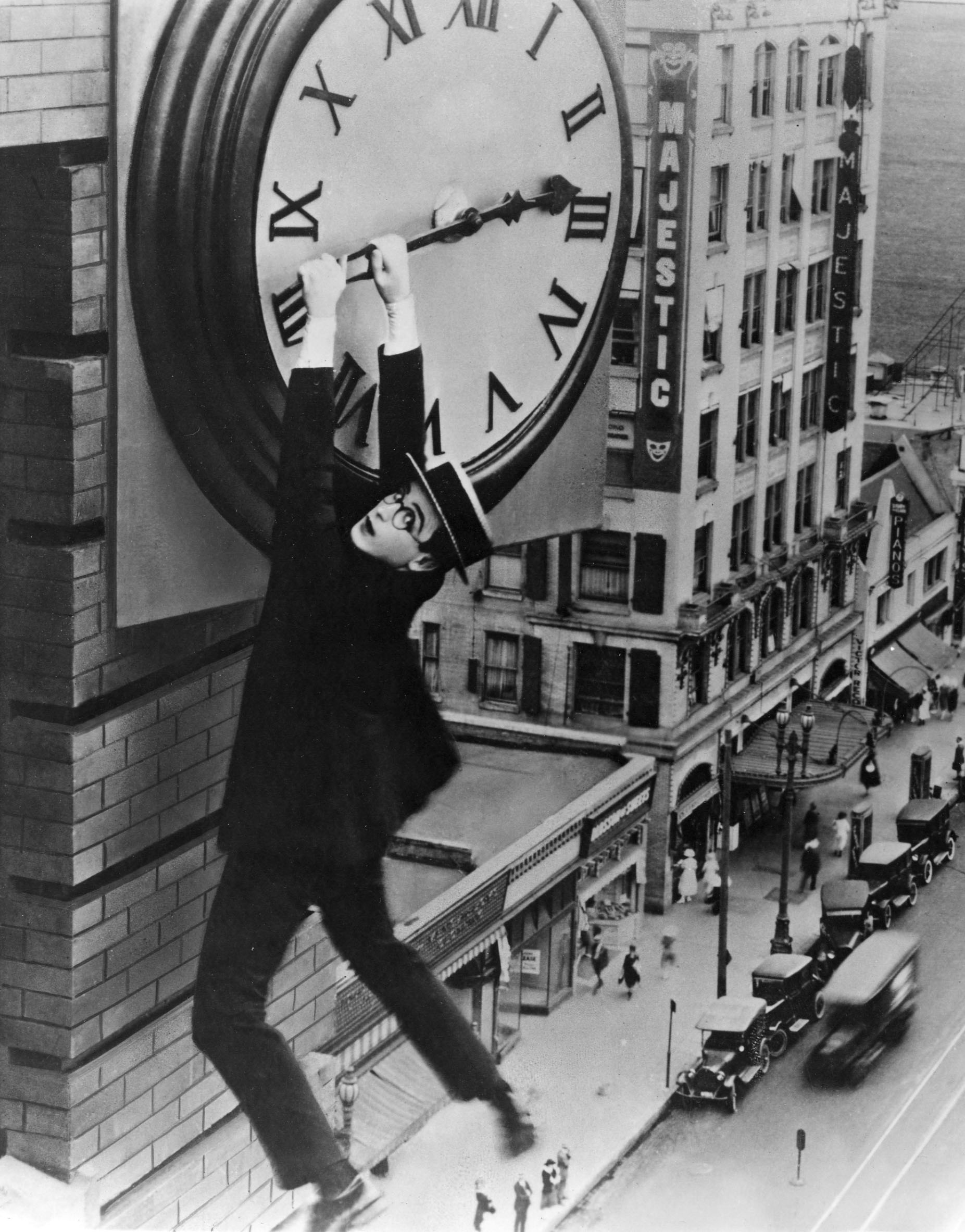
In her poem, “A Clock stopped,” Dickinson sees a death image in the cessation of a ticking clock at exactly 12 p.m.—called “Degreeless noon” by the poet because the overlapping of hour and second hands, both pointing to XII, leaves no intervening angle between them. Their stilled hands no longer circle the hours. Their “dial life” is at an end. Does that signify eternity or oblivion? This question haunts many of Dickinson’s writings. The word “no” permeates this poem, not only in “noon” but also in “not,” “snow,” “nods,” and, most chillingly, “concernless No”—conveying the indifference of death and nothingness to human fate.[ix]
A Clock stopped – Not the Mantel’s – Geneva’s farthest skill Can’t put the puppet bowing – That just now dangled still –
An awe came on the Trinket! The Figures hunched, with pain – Then quivered out of Decimals – Into Degreeless Noon –
It will not stir for Doctors – This Pendulum of snow – This Shopman importunes it – While cool – concernless No –
Nods from the Gilded pointers – Nods from the Seconds slim – Decades of Arrogance between The Dial life – And Him –
The word for midday occupies the exact middle of the poem: noon is the 38th word out of 75. And the poet makes it rhyme with pain. That’s a slant rhyme: the vowels disagree but the hard sound of the final consonants match. The pairing of noon and pain is unsettling, expressing the ambivalent nature of the hour—the solar zenith where the day begins its decline. Significantly, it was at this very moment that the Lord of life was nailed to the cross, as every noonday liturgy recalls.
Blessed Savior, at this hour you hung upon the cross, stretching out your loving arms: Grant that all the peoples of the earth may look to you and be saved; for your tender mercies’ sake. Amen. (Book of Common Prayer: Service for Noonday).[x]
Mortality is not noon’s only shadow. The Psalmist warns of “the sickness that lays waste at noonday” (Psalm 91:6). The Greek term for this malady is acēdia, variously translated as listlessness, restless boredom, discouragement, despondency. At its extreme is the suicidal ennui of Herman Melville’s “Bartleby the Scrivener,” who descends into total inaction with his perpetual refrain of refusal: “I prefer not to.” John Cassian (c. 350-435), whose 5th-century writings on desert spirituality would be a wellspring for later monastics, rendered acēdia in Latin as taedium cordis (“tedium of the heart”). The desert saints, who struggled with acēdia beneath the enervating Egyptian sun, gave it a more personal title: “the noonday demon.”
Desert Sext (Baja California, 12:05 p.m., October 1, 2005).
Cassian’s desert mentor, Evagrius Ponticus (c. 360-399), described acēdia as a chronic inability to be present:
“The eyes of the listless monk gaze out the window again and again, and his mind imagines visitors. A sound at the door, and he jumps up .… When he reads, the listless monk yawns plenty and easily falls asleep. He rubs his eyes and stretches his arms. His eyes wander from the book. He stares at the wall and then goes back to his reading for a little. He then wastes his time hanging on to the end of words, counts the pages, ascertains how the book is made, finds fault with the writing and the design. Finally he just shuts it and uses it as a pillow. Then he falls into a sleep not too deep, because hunger wakes his soul up and he begins to concern himself with that.”[xi]
I’ve met that noonday demon, and I suspect you have too. All the more needful, then, to transit the daily meridian with a prayer on our lips, and trust in our heart. “Today I place before you death and life,” says the Holy One. “Choose life!”[xii]
None
You sweep us away like a dream; we fade away suddenly like the grass. (Psalm 90:5)
By mid-afternoon, lengthening shadows measure the lateness. With each day’s passing, we think about endings and rehearse our own finality. The daily theater of impermanence may provoke in us wistfulness or melancholy. But it can also teach the art of letting go. This day has bestowed its gifts and it blessings. We have received them as best we could. We are grateful. But we don’t hold on. We don’t worry about the morrow. We entrust ourselves to the Giver, without clinging to the gift.
At None, the day’s labors are winding down. We might wish for more time, or more energy, to complete them gracefully, and we may not have the option to set them down unfinished. But if one has any choice in the matter, would it be better to honor the hour rather than the task? Late afternoon, the hour of None, calls us to work of a more inward kind. How can we make space for the questions, and the prayers which they prompt in us?
What has this day taught me? What could I do differently tomorrow? What requires mending before the sun sets? What burdens can I lay down? Who needs my forgiveness? What must I forgive in myself? What am I grateful for? What precious moments did I forget to sanctify with my deepest attention? Where did I remember God?
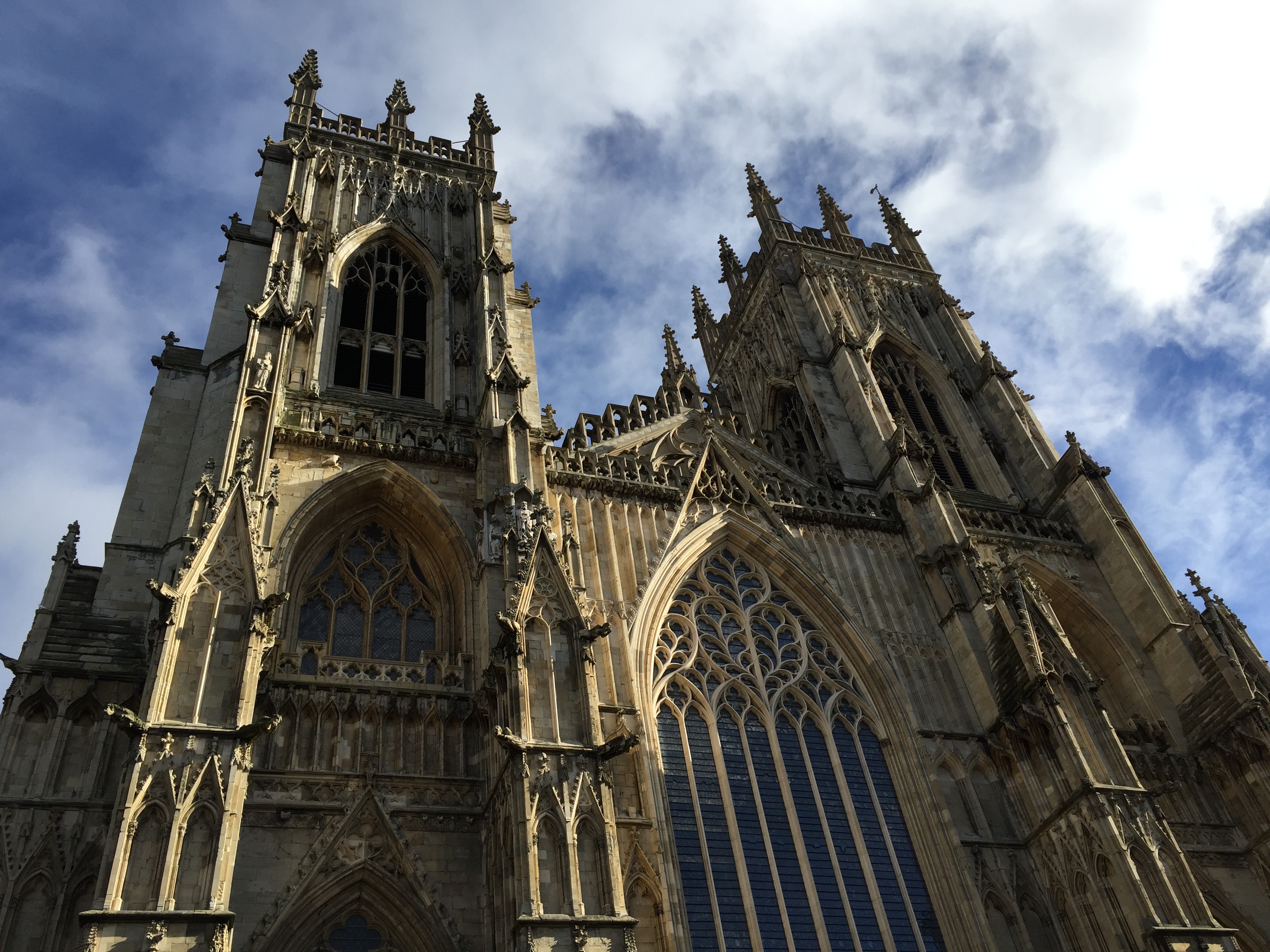
Shadows deepen at None (York Minster, UK: October 21, 2015).
The light of a waning afternoon is the sweetest kind. It is warmer and softer, purged of glare and harshness, suffused with fondness. It invites stillness, contemplation, tranquility, rest. It makes the world glow for weary eyes. It is honey for the soul. In these latter days, most of us lack tower bells to announce a pause for mindfulness, or muezzins in minarets calling us to prayer. But afternoon light remains omnipresent, inviting us all to sink into the mystery of the moment, wherever we may be.
W. H. Auden wrote a cycle of poems on the canonical hours: Horae Canonicae. As the poems take us through the diurnal passage from Prime to Compline, we soon realize the poet is talking about Good Friday. The poem for None—the hour when Christ died—imagines the waning of that most singular day.
It is barely three, Mid-afternoon, yet the blood Of our sacrifice is already Dry on the grass; we are not prepared For silence so sudden and so soon; The day is too hot, too bright, too still, Too ever, the dead remains too nothing. What shall we do until nightfall?
These lines register something of my own feelings over a lifetime of Good Fridays, when I exit the church at None into “silence so sudden and so soon.” How does one move on from the death of God? What shall we do until nightfall?
Soon cool tramontana will stir the leaves, The shops will re-open at four, The empty blue bus in the empty pink square Fill up and depart: we have time To misrepresent, excuse, deny, Mythify, use this event, While, under a hotel bed, in prison, Down wrong turnings, its meaning Waits for our lives …[xiii]
I think every disappearing afternoon shares something of this mood. Most days, the doings will be far less dramatic or significant, but there still remains a sense of aftermath, of carrying on under the influence of events now past, trying to make sense of them—or not—while somewhere up ahead, a fuller accounting “waits for our lives.” In any case, every day changes us, and discerning how is part of our prayer life.
But if the weight of Auden’s subject seems too much to carry with you into the average evening, let me leave you with a poem by William Stafford, a gem of self-compassion for the late afternoon:
Nobody cares if you stop here. You can look for hours, gaze out over the forest. And the sounds are yours too—take away how the wind either whispers or begins to get ambitious. If you let the silence of afternoon pool around you, that serenity may last a long time, and you can take it along. A slant sun, mornings or evenings, will deepen the canyons, and you can carry away that purple, how it gathers and fades for hours. This whole world is yours, you know. You can breathe it and think about it and dream it after this wherever you go. It’s all right. Nobody cares.[xiv]
[i] Wallace Stevens, “Credences of Summer,” Collected Poetry and Prose (New York: The Library of America, 1997), 323.
[ii] Emily Dickinson, “The Soul has Bandaged moments”— F360 (1862) 512.
[iii] Douglas Adams, Life, the Universe, and Everything (1980), cited in Mark Barrett, OSB, Crossing: Reclaiming the Landscape of Our Lives (Harrisburg, PA: Morehouse Publishing, 2008), 9.
[iv] Charles P. Price, “The fleeting day is nearly gone,” Episcopal Hymnal 1982, # 23.
[v] Hildegard of Bingen (1098-1179), cited in Macrina Wiederkehr, Seven Sacred Pauses: Living Mindfully Through the Hours of the Day (Notre Dame, IN: Sorin Books, 2008), 111.
[vi] Emily Dickinson, “Before I got my eye put out”— F 336 (1862) 327.
[viii] Brother David Steindl-Rast & Sharon Lebell, Music of Silence: A Sacred Journey Through the Hours of the Day (Brooklyn, NY: Ulysses Press, 2001).
[x] Episcopal Book of Common Prayer (New York: Oxford University Press, 1979), 107.
[xi] Evagrius Ponticus, On the Eight Spirits of Evil, cited in William Harmless, S.J., Desert Christians: An Introduction to the Literature of Early Monasticism (Oxford/New York: Oxford University Press, 204), 326.
This is the fourth in a series on the canonical hours, the ancient Christian practice for living a mindful day. The first, “Reclaiming My Time,” gives a general introduction, with a list of helpful resources for your own practice of prayer and meditation. This fourth reflection concerns Terce, the first of the “Little Hours.”
St. Isidore (kneeling at right) was a farmworker criticized by his boss for spending his mornings in church instead of doing his job. When an angel was seen to be filling in for Isidore in the field during mass, the boss relented. Although he is the patron saint of farmers, his legend speaks to all who seek to balance work and prayer. (Anonymous Bolognese painting, 17th century).
The design of Prayer . . . is not merely to make us devout while we are engaged in it, but that its odor may be diffused through all the intermediate spaces of the day, enter into all its occupations, duties, and tempers.
— Hannah More, Practical Piety (1812)
Grant to us, Lord, we pray, the spirit to think and do always those things that are right, that we, who cannot exist without you, may by you be enabled to live according to your will.
— The Book of Common Prayer
The “Little Hours”—Terce, Sext and None—are the most challenging for a personal prayer practice, because they span the middle portion of the day, the “9 to 5” when we are most occupied with our business in the world. Unless we are professional contemplatives, our days involve more doing than being. We are busy with whatever it is we do, with little chance for prayerful pauses. Even the monks who created the canonical hours kept their daytime devotions short, or “little,” to allow sufficient time for work and study.
During his two-year sojourn at Walden Pond, Henry David Thoreau managed to renounce working and doing for long stretches:
Sometimes, in a summer morning, having taken my accustomed bath, I sat in my sunny doorway from sunrise till noon, rapt in a revery, amidst the pines and hickories and sumacs, in undisturbed solitude and stillness, while the birds sang around. I grew in those seasons like corn in the night, and they were far better than any work of the hands would have been. They were not time subtracted from my life, but so much over and above my usual allowance.[i]
An entire morning given to reverie is an enviable use of time, but for most of us, including Thoreau, it is hardly sustainable as a daily practice. A viable spirituality for the Little Hours must come to terms with the demands and obligations of the day. As Benedictine abbot Cuthbert Butler (1858-1934) put it, “a contemplative life does not lie in the absence of activity, but in the presence of contemplation.”[ii]
How then do we nurture a contemplative awareness as we perform our daily work? How may we “remember God and eternity in the midst of [our] business” so that the fragrance of prayer “may be diffused through all the intermediate spaces of the day?”[iii] Let’s examine each of the Little Hours in turn, beginning with Terce.
Terce (“third”) is the 9 o’clock hour, when the working world is getting underway. Whether resuming ongoing projects or conceiving new ones, we launch into the morning with fresh energy and commitment. In the Book of Acts, Terce is the hour of Pentecost, when the Holy Spirit filled the disciples with the power of enthusiasm and possibility. This “third hour” invites us to engage each new day’s work—our own Book of Acts—in that same spirit.
Come, labor on! Who dares stand idle on the harvest plain, while all around us waves the golden grain? [iv]
Wendell Berry sets a high bar for our labor when he says it “defines us as we are; not too good to work with our bodies, but too good to work poorly or joylessly or selfishly or alone.” Even when our work is less than ideal, or only a means to an end, it may still be possible to honor our tasks with the mindfulness and care of a Brother Lawrence, who found joy in the humblest employment: “It is not necessary to have great things to do,” he said. “I turn my little omelet in the pan for the love of God.”[v]
Of course, not everyone’s day may feel like participation in the divine task of repairing the world, or the cultivation of human flourishing, or the fulfillment of personal vocation. There are some jobs which should not even exist, because they bring harm to the planet, society, or the worker. There are many people whose sense of purposeful time has been diminished by unemployment, retirement, or illness. And there are those who suffer days of perpetual affliction and sorrow. At such negative extremities of human experience, can prayerful awareness still flourish? Can we still cry to God “out of the depths?” Or is consciousness of transcendent presence and divine impulse only for the fortunate or the serene?
In 1849, Dostoevsky was arrested for political activities. After seven dismal months in prison, he was taken out to be executed by a firing squad, or so it seemed. It turned out to be a cruel charade—there was a last-minute reprieve. The rifles were lowered and the condemned prisoners were returned to their cells. But having looked death in the face, Dostoevsky realized the utter preciousness of life under any conditions. Back in his cell, he dashed off a letter to his brother.
“When I look back on my past,” he wrote, “and think how much time I wasted on nothing, how much time has been lost in futilities, errors, laziness, incapacity to live; how little I appreciated it, how many times I sinned against my heart and soul—then my heart bleeds. Life is a gift, life is happiness, every minute can be an eternity of happiness!”[vi]
Dostoevsky’s revelation from the depths of human suffering would sustain him through four years in a Siberian labor camp, and bear fruit in his visionary writings about the power of divine compassion to humanize a heartless world. Even in the abyss, we can be surprised by joy. Even at the grave, we make our song.[vii]Praise to the Giver! Praise to the gift!
Thankfully, most of our lives are less dramatic than Dostoevsky’s, but whether our story be sweet or not sweet, may we perform each day’s work mindful of time’s gift—the opportunity to make a difference, to add more goodness, truth and beauty to the world. Where there is hatred, let us sow love. Where there is injury, pardon. Where there is doubt, faith. Where there is despair, hope. Where there is injustice, action. Where there is darkness, light. Where there is sadness, joy.[viii]
The spirit of Terce is oblation: as our day begins to unfold, we offer it up as expression and embodiment of the divine impulse. An old eucharistic prayer puts it this way: “And here we offer and present unto thee, O Lord, our selves, our souls and bodies, to be a reasonable, holy, and living sacrifice unto thee.” Elizabeth Rooney’s devotional poem, “Oblation,”[ix] posits self-offering as a daily practice:
I hope each day To offer less to you, Each day By your great love to be Diminished Until at last I am So decreased by your hand And you so grown in me That my whole offering Is just an emptiness For you to fill Or not According to your will.
As we dive into the flow of the day, Terce reminds us to keep God in mind and heart and body. Our hours belong to God. Receive every moment, every labor, every encounter, every delight, every challenge as divine gift.
Prayer isn’t just a momentary act. It is a stance toward reality, a state of awareness. It may involve words, chant, ritual, or pure silence—an attentive pause to listen for whatever needs to be heard. And it always involves breathing. “By following your breath,” says Buddhist monk Thich Nhat Hanh, “and combining the Full Awareness of Breathing with your daily activities, you can cut across the stream of disturbing thoughts and light the lamp of awakening.”[x]
Pray at the door of morning … pray as you go … pray as you labor. Want what God wants. Be thankful. Do love’s work. Refuse despair.
In 1960 New Orleans, a six-year-old African-American named Ruby Bridges became the first black person to attend an all-white elementary school in the segregated South. On her first morning, she was met by a shouting mob of white people. At first she thought it must be some kind of celebration, like a Mardi Gras parade. But she soon realized the screams were directed at her. Federal marshals protected her from physical assault, but the hateful words and jeering faces were terrible enough. A few years later, Norman Rockwell painted that little girl’s courageous walk to school for a story in Look magazine.
Norman Rockwell, The Problem We All Live With (Look magazine, Jan. 14, 1964).
Ruby Bridges was met at the school door by Barbara Henry, the one teacher who was willing to teach a Black child. Years later, Bridges would write about that moment, “You cannot look at a person and tell whether they’re good or bad. Evil comes in all shades and colors. That is the lesson that I learned from the teacher that looked exactly like the people outside that threw things, spit, and yelled—she looked exactly like them, but she was different, and I knew that at six years old, because she showed me her heart.”
For a while, Ruby’s first-grade mornings—her Terce—always began with the taunting mob. One day, she paused before going inside. Her lips were moving, but the shouting drowned her out. Her teacher later asked her why she had stopped to talk to the crowd. “I wasn’t talking,” she said. “I was praying. I was praying for them.”[xi]
[i] Henry David Thoreau, Walden (1854), from the 2nd paragraph of “Sounds.”
[ii] Dom Cuthbert Butler, cited in Rowan Williams, The Way of St. Benedict (London: Bloomsbury Continuum, 2020), 112. Butler was a Benedictine abbot and patristic scholar.
[iii] “remember God”—John Gother (1654-1704), cited in Gordon Mursell, English Spirituality: From 1700 to the Present Day (London: SPCK 2008), 34; “may be diffused”—Hannah More (1745-1833), in Practical Piety; or, the influence of the religion of the heart on the conduct of life (1811), cited in Mursell, 118. Gother was a Catholic priest who catechised the London poor; More was an Anglican writer who stressed the inseparability of prayer and social action.
[iv] From “Come, labor on,” a hymn text by Jane Laurie Borthwick (1813-1897), #541 in The Episcopal Hymnal1982. This was often sung at chapel during my 6 years at an Episcopal school in Los Angeles, where self-motivation was strongly encouraged!
[v] Citations from Karen Speerstra, ed., Divine Sparks: Collected Wisdom of the Heart (Sandpoint, ID: Morning Light Press, 2005). Wendell Berry, p. 520; Brother Lawrence (from his 17th-century text, The Practice of the Presence of God), p. 521.
[vi] Cited in Joseph Frank, Dostoevsky: A Writer in His Time (Princeton, NJ: Princeton University Press, 2010), 181-182.
[vii] This beautiful statement of resurrection faith is from the Eastern Orthodox Memorial Service, sung as part of the Burial Kontakion in The Episcopal Hymnal1982, #355.
[viii] From the famous prayer attributed to St. Francis, although the earliest traceable source is from 1912. I added the injustice/action line.
[ix] Elizabeth Rooney (1924-1999) was an Episcopal poet and a member of the Society of the Companions of the Holy Cross.
[x] Thich Nhat Hanh, The Miracle of Mindfulness: A Manual on Meditation (1987), cited in Dennis Patrick Slattery, Grace in the Desert: Awakening to the Gifts of Monastic Life (San Francisco: Jossey-Bass, 2004), 40.
[xi] Ruby Bridges, cited in Marion Wright Edelman, “Lessons from Ruby Bridges” (Oct. 26, 1918).
President-Elect Joe Biden and Vice President-Elect Kamala Harris
Democracy won today. The United States of America has stepped away from the edge of the authoritarian abyss, and countless hearts—and the planet itself—are sighing with relief. Yes, so much damage to repair, and immense challenges ahead, and the work will not be easy. But let us embrace and enjoy this day’s levity of spirit, and breathe in the winds of joy.
Jan and Hubert van Eyck, Adoration of the Lamb (detail), Ghent Altarpiece (1432).
In this time of exile from gathered community, the All Saints images of countless saints singing “around the throne in sweet accord” fill me with longing for the day when we will join our hearts and voices in person once again. Meanwhile, memory and hope (and Zoom) will have to do.
The van Eyck image of saints in procession reminds me of a 1965 photograph of 600 activists, led by 25-year-old John Lewis, marching across the Pettus Bridge in Selma, Alabama.
John Lewis and friends march through the valley of the shadow toward the land of promise (Selma, Alabama, March 7, 1965).
They would be met on the other side by state troopers, whose violence was so shockingly brutal that the day is remembered as “Bloody Sunday.” Those troopers are gone, John Lewis is gone, but God’s friends continue the march toward a better day. And all those saints and martyrs who have gone before—the “great cloud of witnesses—now cheer us on from above.
In this perilous historical moment, may we too keep on keeping on, keep marching in the light of God, encouraged by the many saints who have shown us how.
This is the third in a series on the canonical hours, the ancient Christian practice for living a mindful day. The first, “Reclaiming My Time,” gives a general introduction, with a list of helpful resources for your own practice of prayer and meditation. This third reflection concerns Lauds and Prime, the hours when day begins.
“Your enjoyment of the world is never right, till every Morning you wake in heaven” (Thomas Traherne). January sunrise on Eagle Harbor, Bainbridge Island, Washington. (Photo by Jim Friedrich)
Lauds (Daybreak)
From dust I rise, And out of nothing now awake, These brighter Regions which salute mine Eys, A Gift from God I take. The Earth, the Seas, the Light, the Day, the Skies, The Sun and Stars are mine; if those I prize … Into this Eden, so divine and fair, So wide and bright, I come His Son and Heir.
Do you believe in miracles? There is at least one every day: God says, “Let there be light!” And behold, night and nothingness flee away; the visible world appears miraculously before our eyes. We may sleep through this miracle, forget to notice, or take it for granted. But every morning is like the first morning of the world—a divine gift to be honored with astonishment, delight, gratitude and praise.
The victory of light over darkness is one of the most ancient and natural religious tropes. For mortal beings, whose temporal span is a long day’s journey into night, the recurring dawn is a sign of unconquerable life. “The people who have walked in darkness have seen a great light,” says the prophet Isaiah, finding the narrative of salvation in dawn’s daily parable. The Song of Zechariah, whose son, John the Baptist, would herald the true Light of the world, elaborates this image at every Morning Prayer:
By the tender mercy of our God, the dawn from on high shall break upon us, to shine on those who dwell in darkness and the shadow of death, and to guide our feet into the way of peace. (Luke 1: 78-79)
August dawn on Eagle Harbor, Bainbridge Island, Washington. (Photo by Jim Friedrich)
It’s a shame that most of us see many more dusks than dawns in the course of our life. Might we be more joyful people if we devoted greater attention to the daybreak hour? Even early risers may succumb too quickly to their tasks, duties and worries to greet the dawn with attentive stillness.
“The breezes at dawn have secrets to tell you,” says Rumi. “Don’t go back to sleep.”[iii] The medieval Sufi mystic counsels us to cherish the liminal hush between night and day, sleep and waking, when the mind still drifts in tranquility. “Take the first moments when emerging from sleep to be still,” says Elizabeth Yates in her Book of Hours, “to let waking come gently, to cherish the thoughts that are hovering, to let the idea that may soon need to be acted upon gather fullness.”[iv]
Whatever your work may be, whatever your schedule demands, find a way to spend contemplative time with the dawn—if not daily, then weekly. The birth of the day is a great and mighty wonder, not to be missed. As Thomas Merton suggests, “the most wonderful moment of the day is that when creation in its innocence asks permission to ‘be’ once again, as it did on the first morning that ever was.”[v]
In the daybreak liturgy of Lauds—the term means “praises”—the opening sentence breaks the night’s Great Silence with an invocation: “O Lord, open my lips, and my mouth shall proclaim your praise” (Psalm 51:15). Begin your day not with coffee or screens, but with praise, and notice the difference! Some of us may be reluctant risers, but daybreak is no time for slumber. It’s too beautiful and holy to miss. “Rise and shine,” says the prophet, “for your light has come, and the glory of the Lord has dawned upon you (Isaiah 60:1). The Psalmist responds with gusto: “Wake up, my soul; awake, O instruments of joy; I myself will waken the dawn (Psalm 57:8). Sing the day into being!—it’s a lovely practice. Try it sometime on a mountain summit, lakeshore, or back porch.
A traditional Appalachian spiritual to welcome daybreak.
When I was a chaplain for teenage backpacking camps in California’s High Sierra, our venerable leader, Joe Golowka, was always the first one up. The rest of us, still snug in our bags, tried to postpone the shock of cold mountain air, but Joe would wander among us like a biblical watchman. “Don’t miss this beautiful dawn!” he’d say, echoing the Psalmist: This is the day which the Lord has made; let us rejoice and be glad in it (Psalm 118:24).
There are many beautiful hymns and prayers for the observance of Lauds, but a measure of wordless attention is also required. If we can simply listen without thought, the silent dawn will speak to us, as it did to Ralph Waldo Emerson:
“I see the spectacle of morning from the hilltop over against my house, from daybreak to sunrise, with emotions which an angel might share. The long slender bars of cloud float like fishes in the sea of crimson light. From the earth, as a shore, I look out into that silent sea. I seem to partake in its rapid transformations: the active enchantment reaches my dust, and I dilate and conspire with the morning wind.”[vi]
In Seven Sacred Pauses: Living Mindfully Through the Hours of the Day, Benedictine Macrina Wiederkehr praises the dawn as an hour of healing and renewal.
Moment before dawn quietest of all quiet moments, good medicine for the soul, make plans to be there.
Set the clock of your heart, breathe in the rays of dawn, raise high the chalice of your life, taste the joy of being awake. [vii]
Wiederkehr’s eucharistic image is apt. Taste and see. Dawn is indeed a sacramental hour. A hymn sung by Camaldolese monks imagines it as a baptism of light:
Dawn’s radiance washes over earth; refreshed and rested from the night the world is rinsed baptismally as all are bathed anew in light. [viii]
Caspar David Friedrich, Woman before the Rising Sun (1818).
Not only is the natural world “rinsed baptismally” each new day; so, to some degree, are we. “I dwell in possibility,” says Emily Dickinson, “spreading wide my narrow / Hands — / to gather Paradise.[ix]
However many past projects, burdens, and sorrows we drag with us into the present moment, the new morning is an invitation to set them down and “dwell in possibility,” receiving the gift of “now” as a fresh opportunity, an empty canvas, like Eden before the Fall. As John Muir learned from spending countless dawns in the roofless wild, we can breathe the air of Paradise in nature’s daily Lauds:
“I used to envy the father of our race, dwelling as he did in contact with the new-made fields and plants of Eden; but I do so no more, because I have discovered that I also live in ‘creation’s dawn.’ The morning stars still sing together, and the world, not yet half made, becomes more beautiful every day.” [x]
The new day not only reenacts the creation of everything. It is also a drama of resurrection: we rise from the “death” of sleep, startled by the return of our conscious self from the night’s oblivion. “Rise, heart; thy Lord is risen,” says the priestly poet George Herbert. For every day, when truly perceived and welcomed, is the day of resurrection:
Can there be any day but this, Though many sunnes to shine endeavour? We count three hundred, but we misse: There is but one, and that one ever. [xi]
However, rolling out of bed can become so habitual that we forget the wonder of it, forget the miraculous givenness of our existence. Sometimes a dramatic reminder may be necessary. Forty-nine years later, I still can feel the utter joy and relief of seeing one particular sunrise in the Smoky Mountains. Having just endured a terrifying night of lightning on an exposed summit, I felt delivered into newness of life. And who has not experienced equivalent inner dawns, when “the night of weeping shall be the morn of song.”[xii] One of Charles Wesley’s morning hymns employs the physical sensations of sunrise to convey the spiritual gifts we are offered with each new day:
Dark and cheerless is the morn unaccompanied by thee; joyless is the day’s return, till thy mercy’s beams I see, till they inward light impart, glad my eyes, and warm my heart.
Thomas Cole, The Voyage of Life: Childhood (1842).
In Thomas Cole’s The Voyage of Life, a quartet of allegorical paintings, “Childhood” is imbued with morning spirituality. The Adamic child, newborn and joyful, emerges from a dark cave into the roseate dawn of a happy world. A protective angel holds the tiller of the child’s golden boat as it drifts down the stream of time. As Cole reminds us in the quartet’s later paintings, troubled waters lie ahead in every voyage, but though Paradise be lost, it may yet be regained every time we greet a new day with thanks and praise. In the words of Kathryn Galloway’s morning hymn:
We receive God’s graceful moment While the day is fresh and still, Ours to choose how we will greet it, Ours to make it what we will. Here is given perfect freedom, Every hope in love to fill. [xiii]
The author welcomes a mountain sunrise near the North Wall in the Bob Marshall Wilderness, Montana (August 3, 2010).
Prime (after sunrise)
The trivial round, the common task, will furnish all we ought to ask; room to deny ourselves; a road to bring us daily nearer God.
Prime, the “first” portion of daylight following sunrise, is the period of transition from contemplation and praise into the onward flow of the day’s tasks and needs. In the monastic tradition, it is when work assignments are distributed, and the community asks a blessing upon their labors. Sounds begin to punctuate the silence: footsteps, voices, the opening of doors. Before things get too busy or muddled in my own working hours, can I pause for one minute—or twenty—to pray the day’s questions? What is this day for? What is being asked of me? What might I do better? Whom can I serve? How can I love? What can I change? Will I entertain angels unaware? Will I pause to notice a burning bush? Can I spend this day wholeheartedly receptive to the fullness of time?
The daily office for morning in the Book of Common Prayer expresses Prime’s focus on the day before us:
We humbly pray you so to guide and govern us by your Holy Spirit, that in all the cares and occupations of our life we may not forget you, but may remember that we are ever walking in your sight.
So clothe us in your Spirit that we, reaching forth our hands in love, may bring those who do not know you to the knowledge and love of you.
Drive far from us all wrong desires, incline our hearts to keep your law, and guide our feet into the way of peace; that, having done your will with cheerfulness during the day, we may, when night comes, rejoice to give you thanks.[xv]
This last prayer is my favorite, and I say it every day. It assumes that we are capable agents, that we can be shaped by divine intention, that this day holds immense potential for us. We may not make it to nightfall without lapses major and minor. The cheerfulness may fail us more than once. We know this. Perfection is a process, not a possession. But to begin each day by offering it to sacred purpose—the Divine acting in us and through us—this is the energizing spirit of Prime.
Lord, I my vows to thee renew; disperse my sins as morning dew; guard my first springs of thought and will, and with thyself my spirit fill. [xvi]
Easter morning, April 12, 2020. The cloth was a temporary backdrop for the streaming of the Great Vigil from our living room on Easter Eve. When the rising sun struck the window on resurrection morning, it made the empty cross.
The video of “Bright morning stars are rising,” a traditional Appalachian spiritual first recorded in the field by Alan and Elizabeth Lomax, is sung by the author, accompanied by his photographs: Mt.Rainier seen from an airplane in a late-winter dawn (2015); Holy Saturday dawn on the Camino de Santiago east of Burgos (2014); Summer Solstice sunrise in Puget Sound, Washington (5:26 a.m., June 21, 2015); October sunrise in 2011 from the former site of Mt. Calvary Retreat House in Santa Barbara, an Episcopal monastery tragically destroyed by fire three years earlier; sunrise on the Dordogne River in France, a few days after the Autumn Equinox in 2018.
[i] Graham Dowell, Enjoying the World: The Rediscovery of Thomas Traherne (Harrisburg, PA: Morehouse Publishing, 1990), 92. Traherne, a 17th-century Anglican poet, priest and theologian, was truly a morning person, naturally disposed to “enjoy” the world with wonder, love and praise.
[ii] John Keble (1792-1866), “New every morning is the love,” Episcopal Hymnal (1982) #10. Keble, one of the founders of the Oxford Movement, was a poet-priest. Many of the poems in his popular collection, The Christian Year, became widely used hymns.
[iii] Jalāl ad-Dīn Muhammad Rūmī (1207-1273), cited in Macrina Wiederkehr, Seven Sacred Pauses: Living Mindfully Through the Hours of the Day (Notre Dame, IN: Sorin Books, 2008), 47.
[iv] Elizabeth Yates, A Book of Hours (Norton, CT: Vineyard Books, 1976), 15.
[v] Thomas Merton, Conjectures of a Guilty Bystander, cited in Kathleen Deignan, Thomas Merton: A Book of Hours (Notre Dame, IN: Sorin Books, 2007), 46. A variation on this lovely image is in Merton’s Turning Toward the World: The Journals of Thomas Merton, vol. 4): “The first chirps of the waking birds—le point vierge of the dawn, a moment of awe and inexpressible innocence, when the Father in silence opens their eyes and they speak to Him, wondering if it is time to ‘be?’ And He tells them ‘Yes.’ Then they one by one wake and begin to sing ….” (The Thomas Merton Encyclopedia, Orbis 2002, p. 363).
[vi] Ralph Waldo Emerson, “Nature” (1836), The Annotated Emerson, ed. David Mikics (Cambridge, MA: The Belknap Press of Harvard University Press, 2012), 48.
[viii] Hymn #199, Monday Lauds in Camaldolese Monks O.S.B., Lauds and Vespers (1994).
[ix] Emily Dickinson, “I dwell in Possibility” (J657, Fr466).
[x] Cited in Linnie Marsh Wolfe, ed., John of the Mountains: The Unpublished Journals of John Muir (Madison, WI: University of Wisconsin Press, 1979), 72.
[xi] George Herbert, “Easter,” in Helen Wilcox, ed., The English Poems of George Herbert (Cambridge & New York: Cambridge University Press, 2011), 139-140.
[xii] Samuel John Stone (1839-1900), “The Church’ one foundation,” Episcopal Hymnal (1982) #525. Stone, a poet-priest in the Church of England, responded to a “night of weeping” in the life of his Church (“by schisms rent asunder”) with 12 hymns inspired by the 12 articles of the Apostles’ Creed. This hymn celebrates article 9: “the holy catholic Church, the communion of saints.”
[xiv] “New every morning is the love,” Episcopal Hymnal (1982) #10.
[xv] Collects for Morning Prayer, The Book of Common Prayer (New York: Oxford University Press, 1979), 100-101. For more on the third collect cited, see my post, “Grace me guide”: https://jimfriedrich.com/2015/03/20/grace-me-guide/
[xvi] Thomas Ken (1637-1711), “Awake my soul,” Episcopal Hymnal (1982) #11. Ken, an Anglican bishop, had a great influence on the development of English hymnody.
This is the second in a series on the canonical hours, the ancient Christian practice for living a mindful day. The first, “Reclaiming My Time,” gives a general introduction, with a list of helpful resources for your own practice of prayer and meditation. This second reflection concerns “Vigils,” the liminal space between yesterday and tomorrow.
“Could you not stay awake for one hour?” — Lippo Memmi, Agony in the Garden (detail), Collegiata Santa Maria Assunta, San Gimignano, Italy (c. 1340).
What if you slept? And what if, in your sleep, you dreamed? And what if, in your dream, you went to heaven and plucked a strange and beautiful flower? And what if, when you awoke, you had the flower in your hand? Ah, what then?
— Samuel Taylor Coleridge, “What if you slept?”
The night, O my Lord, is a time of freedom. You have seen the morning and the night, and the night was better. In the night, all things began, and in the night the end of all things has come before me.
— Thomas Merton, “Fire Watch, July 4, 1952”
Vigils is the most fluid of the canonical hours. It may be kept at midnight, or at 3 a.m., or just before dawn, as a prelude to the sunrise hour of Lauds. While the world sleeps, monastics rise from their beds and make their way in the dark to the choir. The sixth-century Rule of St. Benedict recommends that the first Psalm be read “slowly and deliberately,” to allow the community’s sleepyheads extra time to arrive. “If the resurrection of the dead is anything like getting up in the morning,” complains one monk, “I am not completely convinced that I want to be included.”[i] But prayer never sleeps. “At midnight I will rise to give you thanks,” says the Psalmist. “My eyes are open in the night watches.”[ii]
Vigils is not for all people at all times, but as an occasional practice it has much to offer. Being awake in the night is not like being awake in the day. We are different, our surroundings are different, and time is different. All these differences affect the quality of our consciousness, our physical energies, and our prayer. It’s no accident that the two most mysterious events in the gospels, the Nativity and the Resurrection, took place in deepest night.[iii] “When all things were wrapped in peaceful silence and night was in the midst of its swift course,” said Meister Eckhart, “a secret word leaped down from heaven.…”[iv]
The hours between midnight and dawn should not go unvisited by the waking self. They whisper secrets which sleepers never know. I’ve driven through black nights on lost highways, watched 72-hour film marathons with (mostly) open eyes, arisen at midnight to ascend Mt. Rainier with a headlamp, drifted in and out of sleep lying on the floor of the Fillmore Auditorium in the wee hours of a Grateful Dead concert, and curated all-night multi-sensory worship in a circus tent with 400 Episcopalians.[v] Even though only the last of these was a specifically religious event, I always felt transformed to some degree by my night-journeys. By the time the sun restored the ordinary, I was no longer quite the same person. Something had shifted. Maybe it was the world; maybe it was just my eyes, or my heart. But the next morning I always felt radiant and new, like the first morning of Creation.
What is it about a vigil experience that makes this so? For one thing, my post-midnight self, even when awake, is more prone to a state of reverie, when the daytime’s fully conscious subject gives way to the “night dream” which, as Gaston Bachelard suggests, “does not belong to us. It is not our possession. With regard to us, it is an abductor, the most disconcerting of abductors: it abducts our being from us. Nights, nights have no history.… we are returned to an ante-subjective state. We become elusive to ourselves, for we are giving pieces of ourselves to no matter whom, to no matter what.”[vi]
The world, too, is different in the dark—its solid forms dissolved into shadow, purged of detail and color, cloaked in absence. The noise and strife of daytime forgotten in the hush. Deep, deep silence: like the primordial stillness before the birth of everything. An environment without verbs. “Baptized in the rivers of night,” said Thomas Merton of the Vigils hour, the earth recovers its “innocence.”[vii]
Time slows, pausing deliberately between yesterday and tomorrow. No longer a flowing river, it becomes a pool of infinite depth where we can wash away our hurry-sickness. “A single hour takes a long time to pass,” says a modern Book of Hours, “but living in it is discipleship for eternity.”[viii]
In the Book of Genesis, Jacob has two contrasting experiences at the Vigils hour. In one, he is given a blissful vision of a ladder between heaven and earth, revealing the ultimate Reality so often invisible in the glare of sunlight. In the other, he wrestles desperately with God till dawn.[ix] So it is for us. Sometimes our night vigil is bathed in tranquility and illumined by love. And sometimes we watch anxiously over a sick child or a dying friend, or pray for the ones who are afraid or lost in the dark, or wrestle with our own troubled thoughts, or wait with expectant and vulnerable hearts for the dawn of God.
Benedictine writer Macrina Wiederkeh distills the essence of Vigils prayer, when even the most restlessly wakeful are invited to rest in the sacred pause of what T. S. Eliot called “the uncertain hour before the morning.”[x]
“In the middle of the night, I pray for those who sleep and those who cannot sleep. I pray for those with fearful hearts, for those whose courage is waning. I pray for those who have lost vision of what could be. When I rise in the middle of the night, my prayer is simply one of waiting in silence, waiting in darkness, listening with love. It is a prayer of surrender. In my night watch I do not ordinarily use words. My prayer is a prayer of intent. I make my intention and I wait. I become a deep yearning. The silence and the darkness are healing. My prayer is now a prayer of trust. I keep vigil with the mystery.”[xi]
When I was a teenager, the climactic all-night vigil in Alan Paton’s novel, Cry the Beloved Country, made a deep impression on me. In the days of South African apartheid, on the night before his prodigal son’s execution, the Rev. Stephen Kumalo, an Anglican priest, climbs a high mountain to pray—for his own failings, for the soul of his son, and for the liberation of his people. Hour after hour, through the darkness, he keeps vigil for Absalom (“my son, my son!”) and for all the broken and lost. When the sun finally breaks the horizon—the very moment of his son’s execution—he makes eucharist with a maize cake and tea, remembering with thanksgiving God’s promise of salvation. “But when that dawn will come, of our emancipation, from the fear of bondage and the bondage of fear, why, that is a secret.”[xii]
Over the years, the image of Fr. Kumalo on that nocturnal summit has informed my own affinity for Vigils. There is something profoundly uncanny about every “night watch,” when sleep is forsaken in order to contemplate “the Mystery of the world,”[xiii] whose ineffability is uniquely conveyed in the hours of deepest dark and silence.
At Gethsemani Abbey in Kentucky, the monks would take turns making the rounds of the expansive main building on “fire watch,” guarding the multitude of flammable wooden spaces through the night while the community slept. Thomas Merton’s shift on the night of July 4th, 1952, became for him a vivid metaphor for the spiritual journey into God, related in his famous “Fire Watch” essay.
As Merton moves thoughtfully and prayerfully through the monastic spaces, he retraces his personal history as a monk. Every room is inscribed with significant memory. But his fire watch is also the journey of the human soul. By first descending into the monastery’s lower depths and gradually ascending to its highest point in the abbey tower, he replicates the pattern of the Paschal Mystery and the Divine Comedy, where the way down becomes, in the end, the way up.
Merton’s “Fire Watch” reflection is framed by biblical images. It begins with Isaiah’s tower watchman keeping vigil through the long night, alert for a word of revelation. And it concludes with a divine word of comfort to Jonas, better known as Jonah, whose descent into the belly of the fish foreshadowed Christ’s death and resurrection.
“The sign of Jonas”––Merton’s term for the Paschal Mystery of dying and rising––is “burned into the roots of our being,” he said. And he described his own life’s pilgrimage as “traveling toward my destiny in the belly of a paradox.”[xiv]
For the receptive soul, Vigils is the hour when we listen to the voice of silence, and rest in the grace of unknowing. In “Fire Watch,” Merton sums up prayer in the dark in four lines:
While I am asking questions which You do not answer, You ask me a question which is so simple that I cannot answer. I do not even understand the question. This night, and every night, it is the same question.[xv]
[i] Mark Barrett, O.S.B., Crossing: Reclaiming the Landscape of Our Lives (Harrisburg, PA: Morehouse Publishing, 2008), 11.
[iii] The Christmas midnight mass and the Easter Vigil both incorporate the Vigils aura of nocturnal mystery when they take the assembly deep into the night. But many churches sacrifice this dimension when they choose the convenience of starting so early that they end well before midnight.
[iv] Meister Eckhart, cited in Elizabeth Yates, A Book of Hours (Noroton, CT: Vineyard Books, 1976), 50. Yates’ book contains prayers and reflections for each of the 24 hours. The Eckhart quote appears at Midnight.
[vi] Gaston Bachelard, The Poetics of Reverie: Childhood, Language, and the Cosmos (Boston: Beacon Press, 1971), 145.
[vii] Thomas Merton, “Fire Watch, July 4, 1952,” epilogue to The Sign of Jonas (1953), cited in Lawrence S. Cunningham, Thomas Merton: Spiritual Master—The Essential Writings (Mahwah, NJ: Paulist Press, 1992), 107.
[x] T. S. Eliot, “Little Gidding” (section II), in Four Quartets. “In the uncertain hour before the morning / Near the ending of interminable night …”
[xi] Macrina Wiederkehr, O.S.B., Seven Sacred Pauses: Living Mindfully Through the Hours of the Day (Notre Dame, IN: Sorin Books, 2008), 31.
[xii] The last line of Paton’s novel, published in 1948.
[xiii] Eberhard Jüngel’s name for the Divine, unencumbered with overuse or limiting connotations, offers an open space for the varieties of religious experience.
[xiv] Merton, The Sign of Jonas (New York: Harcourt Brace Jovanovich, 1953).