Unknown's avatar

About jimfriedrich

I am an Episcopal priest, liturgical creative, filmmaker, writer, musician, teacher and retreat leader. My itinerant ministry is devoted to religious imagination and holy wonder. My blog is a space where diverse ideas and perspectives - theology and culture, liturgy and spirituality, arts and religion - can meet and converse with one another.

An Unforgettable Night at the Troubadour (50th Anniversary)

Fifty years ago tonight, I was lucky enough to hear a legendary concert by two extraordinary songwriters and performers, David Ackles and Elton John. A fanciful depiction of that night in the 2019 biopic Rocket Man shows the audience rising ecstatically to float above the floor. Actually, we were all sitting around big tables, but that is pretty much how it felt to be there. For the fiftieth anniversary of that unforgettable evening, I reprise my tribute written in 2016. 
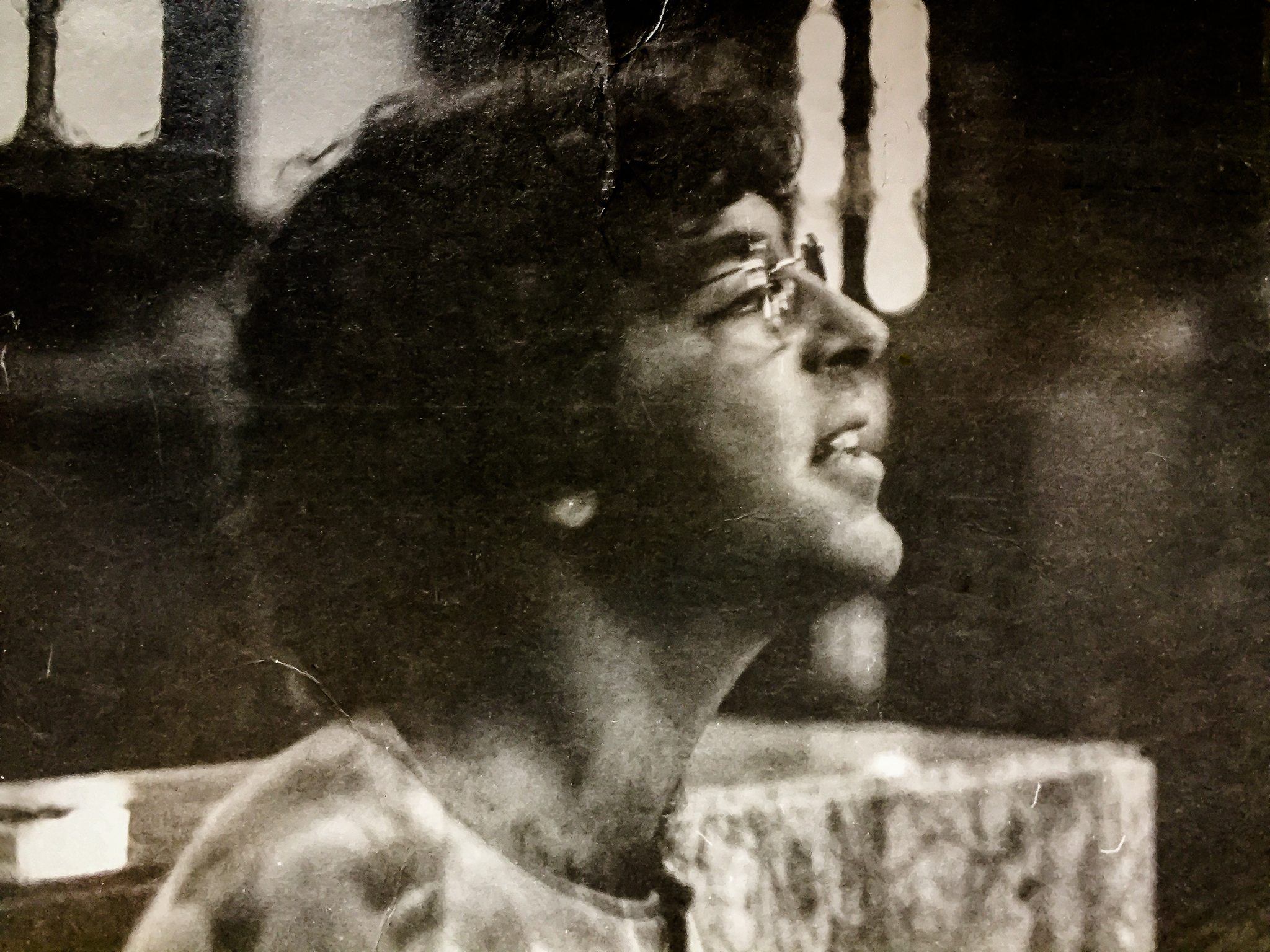
David Ackles singing at the author’s ordination, Sept. 17, 1970 (Photo by Marilyn Robertson)

I have no explanation as to why the David Ackles albums spoke to me so intensely, but it was with those records that I probably spent the most time when I was about sixteen, listening in a darkened room, trying to imagine how everything had come to exist.” 

— Elvis Costello, Unfaithful Music and Disappearing Ink

They suffer least who suffer what they choose.

— David Ackles, “American Gothic”


The Troubadour, an intimate club in West Hollywood, has seen some pretty special nights over the years. Joni Mitchell, Leonard Cohen, Randy Newman, Prince, Tom Petty, Pearl Jam and so many others have performed on its stage. Neil Young and James Taylor each made their solo debut there. The Byrds sang “Mr. Tambourine Man” for the first time in public. Tom Waits was discovered during amateur night. Springsteen, Dylan and Led Zeppelin dropped by after hours for legendary jams. Miles Davis and Van Morrison recorded there.[i]

When Elton John made his smashing American debut at the Troubadour on August 25, 1970, he was not yet widely known. He was originally booked as the opening act for David Ackles, a Los Angeles musical artist greatly admired by Elton John and his lyricist Bernie Taupin. But John’s record company pulled some strings to get the bill reversed. In conjunction with the release of his first album, John would become the headline act.

He would admit later to some embarrassment at being promoted above Ackles on the billing, since Ackles was one of his heroes, “one of the best that America has to offer.” Elvis Costello was also a fan, “It’s a mystery to me why his wonderful songs are not better known,” he has said.[ii] When Costello interviewed John on his Sundance cable series, Spectacle, they both voiced generous tributes to Ackles’ genius and influence, and closed the show with a duet of his great song of loss and longing, “Down River.” [iii]

Ackles put out four memorable albums between 1968 and 1973. His masterpiece, American Gothic (1972), generated critical raves. “The Sergeant Pepper of Folk,” gushed a noted British critic, astonished at its thematic brilliance, structural complexity and musical originality. Rolling Stone called it “moving” and “eloquent.” A retrospective appraisal in 2005 acclaimed it “a largely unrecognized work of genius, one of the most unfashionable and uncompromising American albums ever. . . Crafted layer upon layer, it reveals itself more as a dramatic work than a conventional rock or pop release, drawing on modern American classical composers such as Charles Ives and Aaron Copland as well as gospel, rock, blues, and soul. Imagine an art-folk album that bridges Woody Guthrie’s passionate storytelling and Kurt Weill’s orchestrations.” [iv]

Rolling Stone said at the time that American Gothic “deserves a wide audience,” but when sales proved weak, his recording company, Elektra, lost interest. Ackles made one more album on the Columbia label, but his music seemed too hard to categorize in an industry driven by identifiable genres. Was it folk, pop, classical, musical theater, or what? His originality didn’t fit the system. A ten-minute elegy to a lost past (“Montana Song”) was not going to get much radio time. And you couldn’t dance to it. But however neglected, the heartbreaking beauty of Ackles’ imagery still blooms like wildflowers on a deserted prairie:

The fallen barn, the broken plow,
the hoofprint-hardened clay;
where is the farmer, now,
who built his dream this way ?
Who felled the tree and cut the bough
and made the land obey,
who taught his sons as he knew how,
but could not make them stay. [v]

Disappointed by the lack of tangible support for his work, Ackles abandoned his recording career, but not his joie de vivre. “I’m not bitter about a thing that’s happened to me,” he told an interviewer in 1998. “I would hate for people to think I’m over here getting all twisted up about what happened 20 years ago. All that feels like another life, lived by someone else.” [vi]

Although he could write an achingly beautiful love song like “Love’s Enough,” he was at heart a storyteller, weaving poetic and sometimes tragic narratives of American dreamers and strivers, who “joined the circus, worked the fields,” but “never saved a dime.” And even when they had to “learn to dance to someone else’s song,” they managed to endure:

But I hold on to my dreams, anyway.
I never let them die.
They keep me going through the bad times,
while I dream
of the good times coming by. [vii]

Bernie Taupin, who produced American Gothic, summed up Ackles’ intensity and conviction in a 2008 remembrance: “Man! If you didn’t believe every word this guy was singing, you were dead inside.” [viii]

I first met David Ackles in early 1970, when I was working at Canterbury House in Ann Arbor, Michigan, an Episcopal campus ministry and coffeehouse known as one of the premiere folk music venues in the country. I was just out of seminary, working with two priests as an intern during the year of my “transitional diaconate,” the prelude to priestly ordination. While I was in residence, Canterbury House featured Neil Young, Doc Watson, Ramblin’ Jack Elliott, and David Ackles.

David was one of Canterbury’s most popular performers, loved not only for his music but also for his manifest warmth and wry humor. He was a lifelong Christian, deeply spiritual and theologically astute, an authentic and generous man. And though some of his songs revealed a profound empathy with the suffering of displaced souls, there was an essential core in him—a comedic faith in resurrection—which survived the harrowing descent of the artist into the nether regions of the human condition.

By summer of 1970, I was back home in Los Angeles, awaiting my ordination to the priesthood in September. When I saw that David was playing at the Troubadour, I knew I had to be there. Meanwhile, the radio was starting to preview a few unreleased songs by the other guy on the bill, and he sounded quite good as well. Word got around, excitement grew, and on August 25 the house was packed. We shared a table with Odetta, the “queen of American folk music.” [ix]

Before the show, I went backstage to ask David if he would consider singing at my ordination, and he graciously consented. While we were talking, Elton John entered the dressing room, wearing denim overalls with a cartoon duck patch on the front, to tell David how much he admired his work and how honored he was to share the stage with him.

And the concert? It’s been nearly fifty years now. Details grow hazy; I can’t recite the set lists anymore. But I can still feel the electricity of that Hollywood night, the passion of the performers, the visceral connection they made with their audience.

Stacy Sullivan, a jazz singer who once worked with David, is currently performing, in small New York clubs, “A Night at the Troubadour: Presenting Elton John and David Ackles.” While showing the brilliance of two stars aligning, her re-imagining of that night suggests the strangeness of fate: one singer became an international superstar, the other remained largely undiscovered.

The New York Times has called Sullivan’s tribute a “tour de force” which “interweaves more than a dozen Ackles songs with several of Mr. John’s hits, radically deconstructed, into a dual portrait in which their opposite sensibilities (Mr. John’s gregarious showmanship, and Mr. Ackles’ dignified introspection) eventually merge.” [x] Lucky Easterners can still see her at Manhattan’s Metropolitan Room on September 10 and October 8 [Note: this was in 2016]. I can only pray that she will do a West Coast reprise. I promise to come.

A few weeks after the Troubadour show, David sang two songs for my ordination at All Saints, Beverly Hills, where the opening hymn was “Let It Be” and large projected images filled the wall behind the altar. Those were the days! During communion, David sang “Be My Friend.” At the Dismissal, he led the congregation in “Family Band,” which he said was autobiographical, since he grew up in a musical family of church-going Presbyterians. I still play that song on my guitar every ordination anniversary:

I remember the songs we sang Sunday evening . . .
when my dad played the bass, mom played the drums,
I played the piano,
and Jesus sang the song.

David got lung cancer in the late nineties. When he went into remission, he and his wonderful wife Janice rented a Pasadena mansion, filled it with musicians, and threw a grand party for their friends, to celebrate the gifts of life and love. Then, in 1999, David departed this world, far too soon. He is dearly missed. But that gathering in Pasadena remains a joyous foretaste of the blessedness which awaits us all.

And I will cherish the faith in the songs we knew then,
till we all sing together, till we all sing together,
till we sing them together again.


[i] For a more extensive historical list: http://www.troubadour.com/history

[ii] Reuters obituary in March, 1999, cited in Kenny MacDonald interview: http://www.terrascope.co.uk/MyBackPages/David%20Ackles.htm

[iii] YouTube has a version of their duet: https://www.youtube.com/watch?v=sXvlCjrlHCQand their conversation about David is at https://www.youtube.com/watch?v=Qbt1Cee7Usw

[iv] George Durbalau, 1001 Albums You Must Hear Before You Die, 2005. Along with other review quotes, found at http://www.superseventies.com/spacklesdavid.html

[v] David Ackles, “Montana Song,” on American Gothic. Some of David’s songs can be heard on YouTube, and his albums can be found online as well.

[vi] Kenny MacDonald interview

[vii] “Another Friday Night,” American Gothic

[viii] Bernie Taupin’s blog, Dec. 3, 2008

[ix] Attributed to Martin Luther King, Jr.: http://entertainment.time.com/2011/10/24/the-all-time-100-songs/slide/take-this-hammer-odetta/

[x] New York Times, July 16, 2016: http://www.nytimes.com/2016/07/16/arts/music/stacy-sullivan-david-ackles-review.html?_r=1

 

What Would Samson Do? — Finding Trump in the Bible

Who can be serene in a country where both the rulers and the ruled are without principle? The remembrance of my country spoils my walk.

— Henry David Thoreau [i]

[T]his president and those in power—those who benefit from keeping things the way they are—they are counting on your cynicism … Do not let them take away your power. Don’t let them take away your democracy. 

— Barack Obama [ii]


When the previous American president called out the most dangerous man in America at the Democratic Convention, he broke the presidential norm of speaking softly about your successor. “Donald Trump hasn’t grown into the job because he can’t,” said Obama. “And the consequences of that failure are severe. 170,000 Americans dead. Millions of jobs gone while those at the top take in more than ever. Our worst impulses unleashed, our proud reputation around the world badly diminished, and our democratic institutions threatened like never before.” [iii]

Three years ago the press would have worried more about the broken norm than the words themselves. No longer. Democracy is on fire, and even some former White House officials are grabbing the nearest hose. In normal times, the Senate report detailing Trump’s extensive Russian collusion would bring an Administration’s swift collapse. But amid the ongoing maelstrom of misdeeds, it’s barely noticed. In normal times, a reporter would not be inviting a president to refute the conspiracy theory of his secret plan to save the world from a satanic cult of pedophiles and cannibals. And in normal times, the president would not respond by wondering “is that supposed to be a good thing or a bad thing?” [iv]

Coincidentally, in recent weeks the Episcopal Daily Office has been taking us through the Book of Judges, one of those disturbing texts that won’t let us mistake the Bible for a handbook on exemplary behavior. It’s a collection of ancient tales—legends with historical origins—from Israel’s history after the Exodus, when the refugees from Egyptian slavery were establishing themselves in a Promised Land. That land’s existing occupants were not so thrilled with the immigrants’ aspirations, and the narrative accounts are filled with appalling violence. It’s not a book I’d care to preach on.

When a later editor wove the stories into the Book of Judges, he sought to make a larger point about the Israelites losing their way as a people whose identity and survival was rooted in the divine Deliverer. Judges begins with stories of charismatic leaders who rise up as needed to guide their people through a formative time. But charisma proved an unreliable form of governance. Judges ends with several tales to demonstrate a need for a more stable political system, as the tribes devolve into civil war. The story of Samson is the turning point.

While Sunday school teachers have long cringed at the sex and violence of the Samson saga, children (and Hollywood producers) have been captivated by his superhero powers and comic-book adventures. Outnumbered by those Philistine bullies, he always gives them their comeuppance. BAM! POW! OOF! Not even a lion can beat him. And though tricked and weakened by a femme fatale, he still brings the house down on the bad guys in the end.

But to what purpose? He has no particular interest in the greater good of his people. All he cares about is himself. He is driven by impulse, not thought. Revenge and lust shape his choices. Although we are told “he led Israel … for twenty years,” he shows no leadership skills, and generates considerable hostility among his own people. However, he does excel at destruction—what Robert Alter calls his “anarchic impulse”—so cruelly exhibited when he ties torches to the tails of three hundred foxes to set Philistine fields and vineyards ablaze.

Finally captured and blinded by his enemies, he refuses to admit defeat. If he has to go down, he’s going to take everyone else down with him. In a famously spectacular finish, he pushes “powerfully” against the pillars of their temple, and the great structure collapses, killing three thousand men and women, including himself. The narrator ends with a chilling summation: “And the dead that he killed in his death were more than he had killed in his life” (Judges 16:30).

As Alter notes, the Book of Judges goes on to relate further episodes of “unbridled lust, implacable hostility, and mutual mayhem,” not to mention “dishonesty and deception … venality and the ruthless pursuit of personal and tribal self-interest.”[v] It’s a disheartening book, whose final sentence conveys the total disintegration of social bonds and the common good: “Every man did what was right in his own eyes” (Judges 21:25).

Sound familiar? Three years ago, few of us imagined how fragile and corruptible our own political institutions would prove to be. As Barack Obama warns us, we are on the verge of losing our democracy—and so much more. The current president’s small hands are pushing hard against the pillars of America. He’d rather kill us all than be the only “loser.”

It’s a stressful time to be an American, even without a pandemic. To paraphrase Thoreau, the “remembrance of my country” is spoiling my summer. Serenity is a rare commodity these days. And that is perhaps how it must be until we expel the demons from White House and Senate. Keep our eyes on the prize and hold on!

In Thoreau’s essay, “Slavery in Massachusetts,” his dark thoughts about America’s sins are succeeded by the memory of a walk when he chances upon a white waterlily. The flower becomes a redemptive epiphany:

“It bursts up so pure and fair to the eye, and so sweet to the scent, as if to show us what purity and sweetness reside in, and can be extracted from, the slime and muck of earth … What confirmation of our hopes is in the fragrance of this flower!”

So many moments in this week’s Democratic Convention have provided a confirmation of my own hopes: the determined voices of those who transform personal suffering and pain into commitment to the common good; the joyful spirits whose ideals still burn bright; the splendor of so many diverse and shining faces; a passionate yearning for beloved community; and the uplifting video segments which burst “so fair upon the eye.”


[i] H. D. Thoreau, “Slavery in Massachusetts,” Collected Essays and Poems (New York: The Library of America, 2001), 346.

[ii] The 44th President’s speech at the Democratic Convention (August 19, 2020).

[iii] Ibid.

[iv] https://www.independent.co.uk/news/world/americas/us-election/donald-trump-qanon-conspiracy-2020-election-a9678946.html

[v] Robert Alter, The Hebrew Bible: A Translation with Commentary, Volume 2: Prophets (New York: W. W. Norton & Company, 2019),

Walking on the Sea with Jesus: A Homily on Matthew 14:22-33

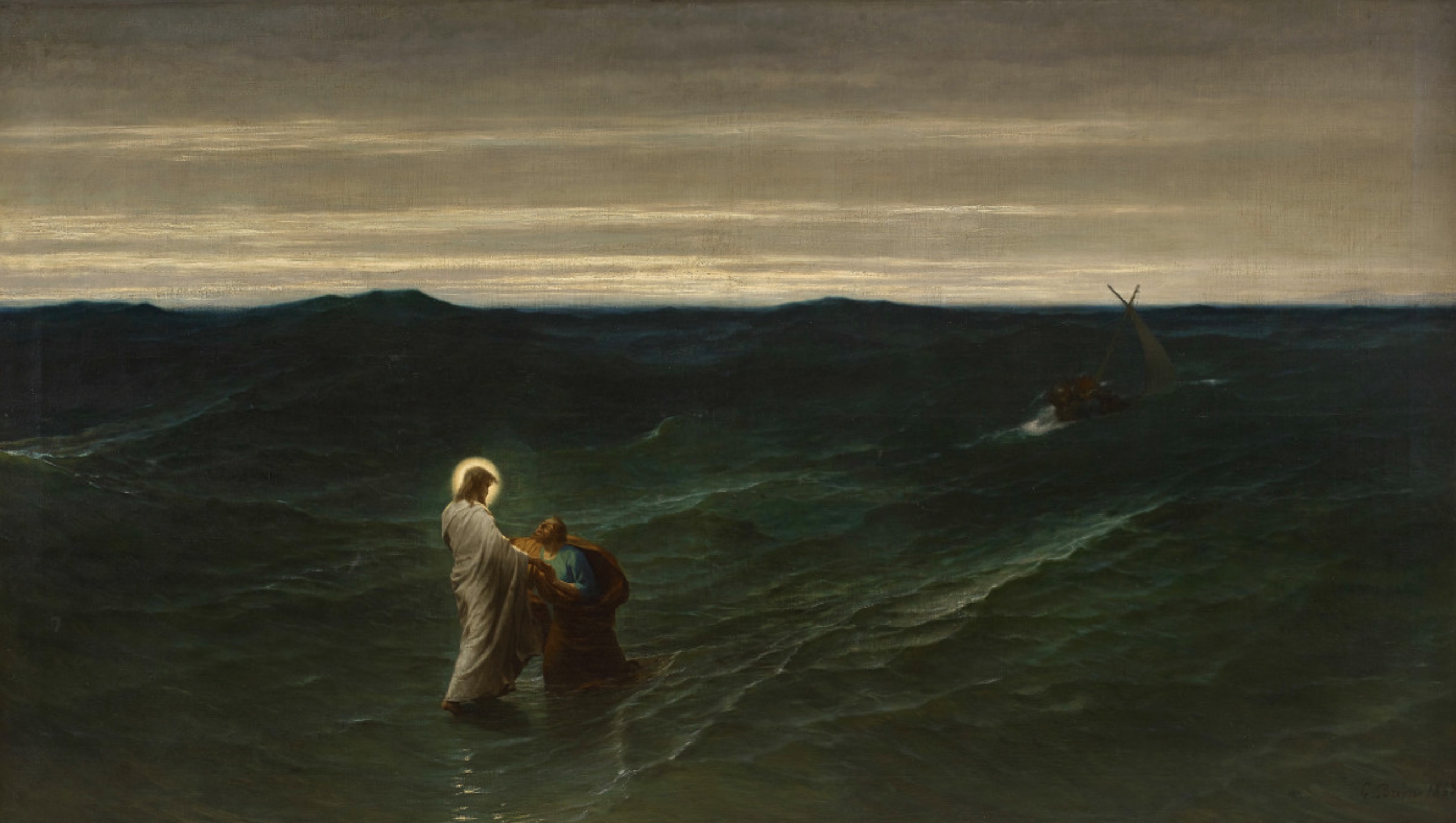
Gustave Brion, Jesus & Peter on the Water (1863).

This is the text of a homily preached from a kayak “on location” in Puget Sound, a stand-in for the Sea of Galilee where the gospel for this Sunday takes place. You can view the video below. 

“Get in the boat!” Jesus tells the disciples. “Get in the boat and go to the other side of the lake.” We don’t know the exact words Jesus used, or his tone of voice, but Matthew’s gospel is pretty clear about the forcefulness of his command. The original Greek words suggest that he had to force them or push them into the boat. They clearly were reluctant to go. But why?

They may have been hesitant to go anywhere without their trusted teacher. And certainly none of them would be eager to go to the other side. That’s where the Gentiles lived, those weird foreigners who were so disliked and feared. The other side, in the disciples’ eyes, was a bad neighborhood, infested by Roman rats.

But the scariest thing was the sea itself. Although the Sea of Galilee is only a large lake (about one-third the size of Lake Tahoe), its original Hebrew name, Yam, means “roar,” perhaps because of the tempestuous waves created by its infamous sudden storms. A few years ago, 80 swimmers in that lake had to be rescued when strong winds swept them out into deep waters.

I have only seen the Sea of Galilee in good weather. But almost without warning, it can become a wild and dangerous place. The fishermen disciples knew the risk of drifting too far from the shore, but here was Jesus making them cross its depths for five or six miles—that’s the distance between Bainbridge Island and Seattle. Would you want to do that in a small boat in a big storm?

For biblical people of the land, wild seas were not just physically dangerous. They conveyed a cosmic threat as well, manifesting the primal chaos which threatens to undo the harmonious stability of the world. Only the divine Creator can tame this chaos. As the Psalmist says,

You rule the raging of the sea.
When its waves roar, it is you who subdues them.
(Psalm 89:9)

Scriptures like that made the world seem safe, but when the winds kicked up and the waves began to wash over their little boat, Jesus’ disciples were probably thinking of another Psalm:

Save me, O God, for the waters have risen up to my neck.
I am sinking in deep mire,
and there is no firm ground for my feet.
I have come into deep waters,
and the torrent washes over me. (Psalm 69:1-3)

Matthew tells us that “the wind was against them.” No matter how hard they tried, they could make no headway. When the sun went down, the storm continued to batter them in the dark. They became exhausted, disheartened, and afraid. Would the long and terrible night ever end?

This was the archetypal night-sea journey, where everything familiar and safe is left behind in a perilous passage through a formless sea of unknowing and unmaking which threatens to swallow the voyager.

We know something about that, don’t we? We are all on a night-sea journey now, in this strange and anxious time. Having left behind the shore of “normal” life, battered by the fierce waves of multiple crises, we are trying desperately to stay afloat in the darkness. But like those first disciples, we find ourselves against the wind.

So how does the gospel story end? In the darkest hour just before dawn, Jesus “came walking toward them on the sea.” It’s an extraordinary moment in the gospel narrative, but a few centuries ago it became something of an embarrassment. Empiricists declared it to be the kind of thing that just doesn’t happen, and authors of books with titles like Christianity Not Mysterious (1696) began to purge the gospels of anything “inconsistent with the Light of Nature, and the eternal Reason of Things.” [i]

Christian rationalists sought plausible explanations for gospel miracles. Healings were deemed psychosomatic, for example, and walking on water, if not dismissed altogether, was explained as Jesus wading in the shallows along the shore, or standing on a raft which disciples couldn’t see in the dark.

This isn’t the time to address the complex questions about biblical miracles, but let me say in passing that we should be careful about applying modernity’s criteria for what is possible to anything dealing with the transcendent. The gospel stories come from a different thought-world, and sometimes they describe realities not yet fully realized in our fallen and unfinished world. Those of us who have grown familiar with biblical texts can forget just how strange the stories really are, and how strange Jesus is.

In both Jesus’ day and our own, the powers-that-be tend to affirm and enforce a “reality” of suffering, cruelty, and violence. “It is what it is,” they tell us. But then Jesus invades this so-called reality and calls it into question. He not only preaches the impossible, he proves it: the blind see, the lame walk, prisoners go free, mourners dance, and the poor inherit the earth.

Make no mistake: Jesus leads us into a very different world, and that world, in comparison to the present state of things, can appear miraculous to inexperienced eyes.

As for the story of Jesus walking on water, the question of its historical plausibility is not a critical question for me. It’s not the kind of thing I expect to happen, but I won’t rule out the possibility of something uncanny and transcendent lying behind this enigmatic narrative.

Jesus was in but not of this world, and the mysterious is an inseparable element of his story. How much does it matter what we are able to make of the story’s strangeness? What really matters is what the story makes of us.

And the story, like the disciples’ boat, is built to transport us out into the sea of unknowing, to find something we will miss if we remain on shore. So get on board, little children, get on board. Even if you are reluctant to embrace the miraculous, get on board. The story wants to take us all to the other side.

And so we soon find ourselves far from shore, awash in the sea’s brawling swells, helpless against the wind, hearts breaking in the endless night, when suddenly we see something—someone—walking toward us, walking on the sea like the Maker of heaven and earth who once “trampled the waves of chaos” (Job 9:8).

How can this be! It’s a ghost! A phantasm. A figment of our imagination. Our fear is making us crazy. But then we hear that voice we know so well:

“Take heart, it is I;
do not be afraid.”

It’s still hard to make out what we’re seeing in the darkness, but Peter calls out, “Lord? Oh Lord, if it is really you, call me, and bid me come to you.” The voice answers, “Come.” And that’s what Peter does. He climbs out of the boat, and begins to walk toward Jesus, striding impetuously across the water as if it were solid ground.

His eyes see nothing but the gaze of his Master. But just before he reaches Jesus, he remembers the storm, the wind, the waves. He remembers his fear. He takes his eyes off Jesus and looks at the raging water. Immediately he begins to sink, and the sea is swallowing him. “Lord, save me!” he cries. Jesus grabs his hand. “You of little faith, why did you doubt?” I like to think Jesus says this tenderly, with a smile.

And as soon as the two of them get into the boat, the wind ceases. The storm is over. The sea grows smooth and still. After so much turbulence and drama, this sudden calm may be the story’s greatest miracle, one we so desperately need today.

Buffeted on every side by so much danger, affliction, and loss, we have come to know the demons of anxiety and sadness. We’ve drifted too far from the shore, the wind is against us, and some of us are starting to sink. Who can even remember what it was like to be at peace in an uneventful time?

James Martin, a Jesuit author and teacher, wrote a book about Jesus based on his pilgrimage to the places where the gospels happened. At the Sea of Galilee, he recalls a time when he was deeply stressed by the relentless grind of nonstop speaking engagements. It felt like a ceaseless storm, and he was drowning. So he decided to pray about it with a visual meditation on Jesus and Peter on the sea.

“When I closed my eyes,” he says, “the first thing I saw in my mind’s eye was Jesus, clad in a light blue robe, standing silently on the sea, a glassy calm. He stretched out his hands as if to say, ‘Come.” But unlike Peter I didn’t feel the invitation to walk on the water, as if to prove something. Instead, he seemed to be saying, ‘Why not come into the calm?’ The wind whipped around his blue garments, with the sound of a flag in the wind, but both he and the sea remained calm.” [ii]

Why not come into the calm? What a precious and necessary gift this story wants to give us, inviting us into the calm. We all need that calm so very, very much. And I would be tempted to leave it at that, but I believe there is something else, equally important, we need to take from this story.

Last year, a minister in the United Church of Canada, Hilde J. Seal, was speaking with a parishioner at the door after worship. The woman thanked Seal for her sermon, and then she said, “I wish you would speak about racism.”

The preacher thought about that challenge for weeks, but she worried that the volatile subject might take her congregation, as she put it, into “troubled waters … Deep, murky, swirling, rushing, dashing water… exploding like a storm.” It’s not something a pastor does lightly.

But when it came time to preach on Matthew’s account of Jesus and Peter on the Sea of Galilee, she knew she had to go there, to address systemic racism in her country in the light of the gospel, because the middle of that storm, or any other, is exactly where the church needs to be if it wants to fulfill its vocation, trampling on the waves of sin and fear.

“Jesus calls us into the rough waters,” she said, “to meet the power of God’s presence within the storm. So let’s get out of the boat, to walk on the water toward Jesus. “But I warn you,” she added, “that once our toes are splashed by the swirling, rushing, dashing water… we might feel like we are about to drown.” [iii]

The wild sea, the storm-tossed boat,
the sinking disciple crying for help—
these are powerful and challenging images.
Most of us would rather remain on shore,
or at least inside the boat.
Who among us is prepared to step out into the deep?

That kind of courage doesn’t come naturally. British novelist Olaf Stapledon once described comfortable moderns as ill-suited for times of crisis.

“[A]ccustomed only to security and mildness,” he wrote, “[we] were fit only for a kindly world … We were adapted only to fair weather, for the practice of the friendly but not too difficult, not heroic virtues, in a society both secure and just. Instead, we found ourselves in an age of titanic conflict … when grave choices must be made in crisis after crisis, and no simple or familiar principles were adequate …” [iv]

Those words from 1937 could have been written yesterday. We are indeed better suited to fair weather and a kindly world. But that is not where we are right now, is it?

A 14th-century prayer, the Anima Christi, incorporates the powerful words that Peter shouted against the wind: O good Jesus, … call me and bid me come to you.

And faith knows how that prayer gets answered:
Come.
That’s what Jesus says to Peter,
and he says it to us as well:
Come.

Sometimes that will mean seeking the place of calm in a stormy world; and sometimes it will mean consenting to leave our comfort zone for the wild sea, where our only stay against drowning will be the touch of the Master’s hand.

Take heart, it is I; do not be afraid.

O good Jesus, call me, call your church,
and bid us come to you –
wherever you are,
even when you are
in the heart of the storm.


[i] John Toland wrote Christianity Not Mysterious. The quote is from from Matthew Tindal’s Christianity As Old As the Creation (1730).

[ii] James Martin, Jesus: A Pilgrimage (New York: Harper One, 2014), 237-238.

[iii] Hilde J. Seal is a minister at the United Churches of Langley, British Columbia. Her excellent homily, “With-in a Storm” (August 11, 2019), is online: https://www.unitedchurchesoflangley.ca/podcasts/sermons/2019-08-11-with-in-a-storm

[iv] Olaf Stapledon’s Star Maker (1937) is a science-fiction classic admired by H. G. Wells, Virginia Woolf, Jorge Luis Borges, Doris Lessing, and Arthur C. Clarke. This passage is cited in Gordon Mursell, English Spirituality: From 1700 to the Present Day (London: SPCK, 2008), 509.

“Seek ye first”—Scenes from the Camino de Santiago

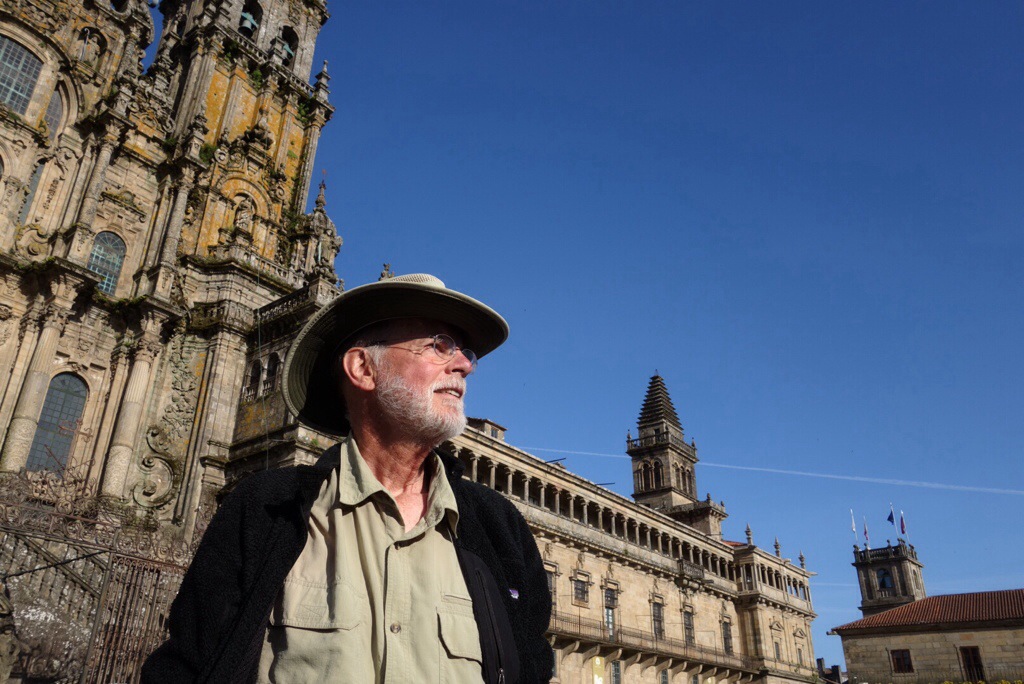
A 500 mile pilgrimage led me to the Cathedral of Santiago (May 11, 2014).

Today is the Feast of St. James, whose tomb in Galicia has drawn countless pilgrims to trek across Spain for 13 centuries. I walked the 500-mile Camino de Santiago in 2014, and this blog began with my dispatches along the way. It was, as every pilgrim will tell you, an indelible experience, and you can read about my own journey in the links below.

It took me 33 days, averaging 15 miles a day, but now you can do it in about 2 minutes.

For tomorrow’s segment of the virtual liturgy streaming on Sundays from our parish during lockdown, I combined images (in sequential order) from my Camino with a pre-COVID  recording of the parish choir singing “Seek Ye First.” It seemed a fitting way to honor the saint on his feast day.

The pilgrimage begins with a rainy day in the French Pyrenees, and ends inside the Santiago cathedral with the spectacular censing at the daily “Pilgrims’ Mass.”

Buen Camino!


Blog posts from the Camino de Santiago

The First Day (April 8)

Pamplona (April 10)

Cherish Every Step (April 11)

Palm Sunday (April 13)

Semana Santa (April 14)

Small Steps (April 15)

Jesus’ Bakery (April 17)

Christ is Risen! (April 20)

Hospital for the Soul (April 24)

By the Numbers (April 25)

Walking (April 29)

The Third Phase (May 1)

A Mountain Day (May 2)

The Movement of Hearts and Souls (May 7)

Surrender (May 9)

Songs to Sing and Tales to Tell (May 10)

Arrival (May 11)

The End of the World (May 15)


Words and Memories: Recollections on My Birthday

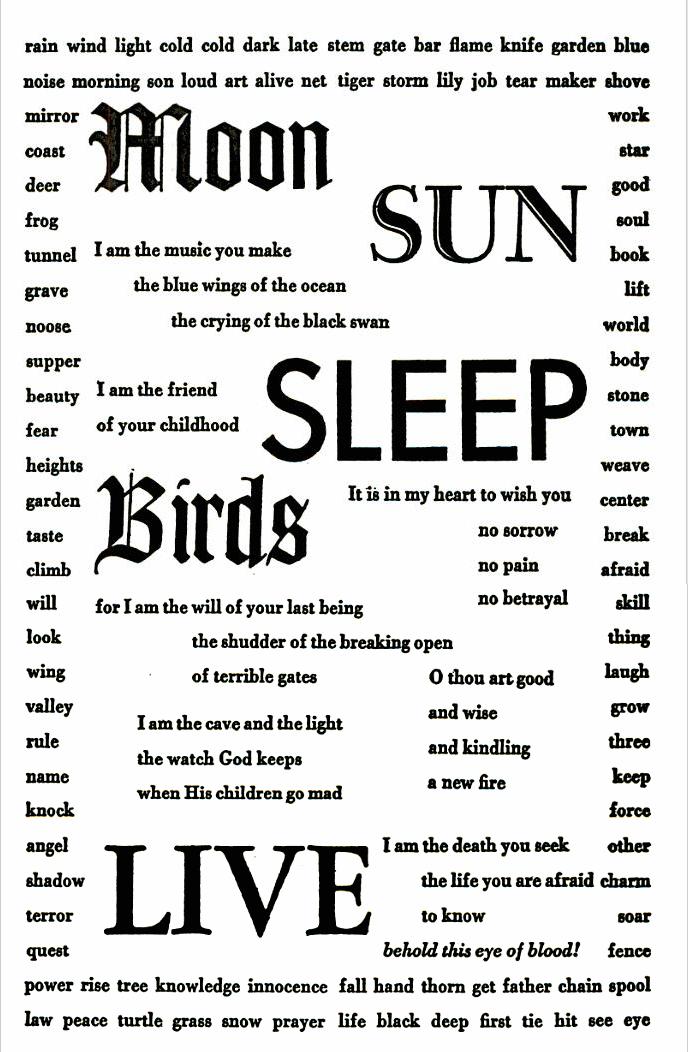
Kenneth Patchen, “Moon, Sun, Sleep, Birds, Live.”

Live long enough, and a single word can acquire a multitude of associations. Pick any word in Kenneth Patchen’s poem, for example. What images and narratives does it summon from your memory? What feelings does it unlock? I’ll get us started with the five large words.

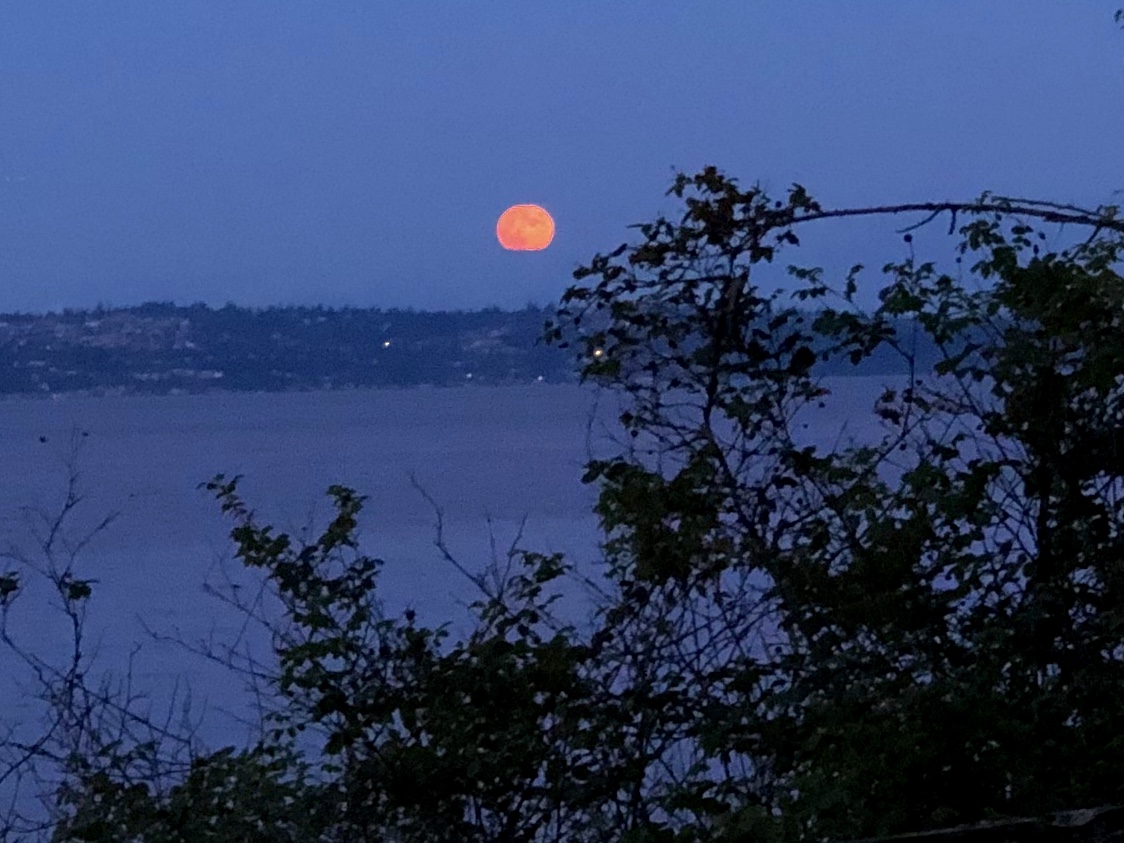
Full moon rising on the 50th anniversary of the Apollo 11 launch (July 16, 2019).

Moon:   Since the day of my birth, 912 full moons have risen into the evening sky. Whenever I am able and the sky is clear, I find an open view to the east and wait for its appearing. The moon’s predictability has never dulled the thrilling instant when its bright curved edge breaks the horizon. Over the four weeks of waning and waxing that follow, its slow dance of vanishing and renewal attunes us ever so gently to the temporal flow. The diurnal sequence of sunrise and sunset seems rushed in comparison.

I’ve had my eye on the moon since I was old enough to notice the sky. I remember specific moons the way one remembers luminous conversations: the Wyoming moon sparkling the fresh powder in a midnight ski run down Teton Pass; the Minnesota moon rising beyond the Mississippi River as we warm ourselves by a driftwood fire; the Florida moon shining down on the circus tent where 400 Episcopal collegians celebrate Epiphany all night till dawn; the Los Angeles moon traversing the sky behind a 7-hour performance of Indonesian shadow puppets; the glowing tip of a rising crescent climaxing a night of falling stars in the High Sierra; the lunar eclipse stunning three priests with wonder on a Northwest beach; the many moons lighting the way on mountain trails and desert dunes; and last year’s spectacular birthday moon, rising on the 50th anniversary of humanity’s first trip to the lunar surface.

The most recent full moon rises over Puget Sound on the Fourth of July.

When the full moon first appears, silence is best. It resembles the host of the Blessed Sacrament, a white disc lifted up before our contemplative eyes. The only words I can specifically recall from a moonrise were spoken by an American woman on the Scottish isle of Iona. “You know,” she said, “I’m 55 years old, and I’ve never seen the moonrise before.”

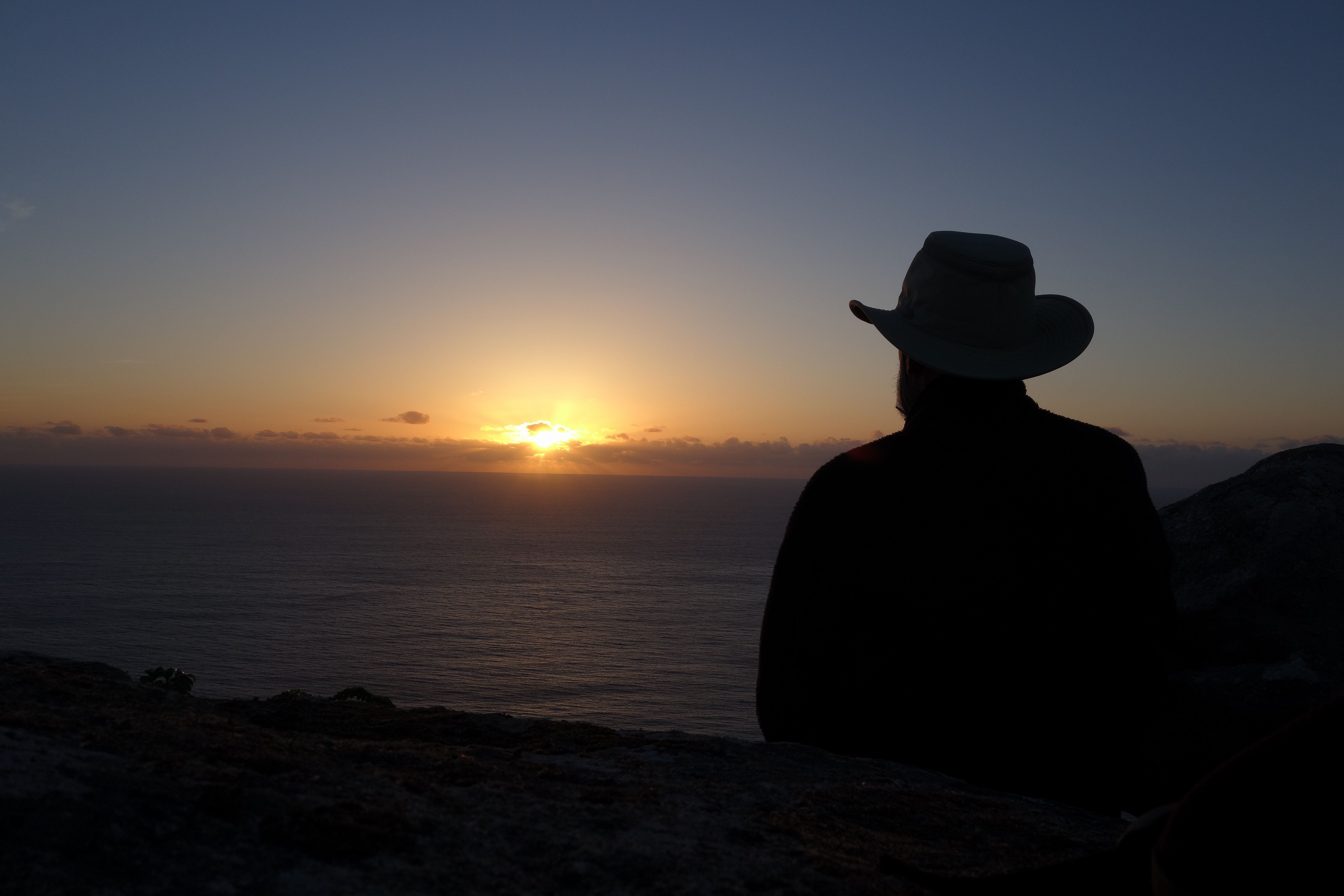
The sun sets over “the edge of the world” at Finisterre, the western terminus of the Camino de Santiago.

Sun:   The sun is a perennial symbol of life-giving energy and joyful radiance. And while climate change has certainly complicated both its literal and metaphorical meanings, we still welcome its warmth and light after a freezing night or a long winter, we still feel uplifted by its brilliance after a dreary stretch of sunless days. Even as we address the growing imbalance in our weather and our seasons, we remember to treasure in every moment the blessings we struggle to preserve.

A benevolent sun still has the power to cheer us, and the rhythms of night and day remain foundational for an embodied and temporal spirituality. Embrace each morning as the gift of creation’s new-made world, make each evening a vesper song of thanks. And in between, let us live as children of the light. Love whatever is good and beautiful and true, and work to transform whatever is not.

Sunlight, like our own breath, is easy to take for granted. Without it, life would be impossible. Even when night comes and goes, the transitions are gradual enough to ease the shock of the sun’s disappearance. We never experience the sun being abruptly switched off, except during a total eclipse. Watching the sun become a black disc, which can be viewed with the naked eye, is pure wonder, one of this world’s most unforgettable experiences. But the sudden disappearance of light from earth and sky is eerie and unsettling—so sudden, so absolute, like an apocalypse. Its return is equally swift, like the first moment of creation: Let there be light.

I shot this video clip of an Oregon landscape during the 2017 solar eclipse. I was gazing directly at the sun, of course, but the camera recorded what was happening on the earth. The shot is in real time. It only takes about 30 seconds for the darkness to vanish.


Sleep:  In 1979, after several days of sleep deprivation, I grabbed a red-eye flight from Los Angeles to New York to visit my brilliant friend Bob Sealy, a critical mentor to me in cinema, theater, the art of conversation, and all things New York. I arrived in Manhattan around 8 a.m., utterly exhausted. Bob was busy with revisions of his new play at Café La MaMa, and had arranged a place for me to nap while he worked––a windowless storage room in a seedy building reminiscent of Forties film noir. I stretched out on a dingy couch. When Bob closed the door I was left in total darkness, and soon fell into a dreamless sleep.

Ministry of Fear (Fritz Lang, 1944)

Hours later, the door swung open, awakening me from the depths of slumber into a confused state of mental fog. The room was still so dark. A faceless silhouette loomed in the doorway. For a moment, I didn’t know where I was, who he was, or what I was doing there. It was a nightmarish scene straight out of Fritz Lang. Then Bob switched on the light and my stupor began to fade. He led me out to the daylight world, the realism of city streets. But I had not entirely quit the darkness. The noirish image of that moment lingers to this day.

“Don’t watch the story,” Bob once told me about the movies. “Watch the image.” The story will go on its way toward a conclusion, but a vivid and suggestive image can detach itself from the plot to call up something deep and enduring in the psyche. Where is that dark room inside me? Who is at the door?

A goldfinch in our peach tree. They arrive at Easter and depart in the fall.

Birds:   As we shelter in place until the pandemic passes, our only regular visitors are the birds––robins, goldfinches, juncos, pine siskins, red-winged blackbirds, black-capped chickadees, spotted towhees, red-breasted nuthatches, golden-crowned kinglets, house and purple finches, varied thrushes, cedar waxwings, sparrows, wrens, ring-necked pheasants, and a pair of mallards. More rarely, a bald eagle may perch atop a Douglas-fir, or a blue heron land on the grass.

A blue heron drops in for a visit.

But the specific bird that came to mind when I first looked at Patchen’s poem was a mountain chickadee in the summer of 1973. While backpacking in California’s Desolation Valley near Lake Tahoe, I had paused to stretch out in a green meadow, leaning back on my elbows with my knees sticking up. I was in no hurry, and had settled into the stillness of reverie when the little bird landed on my right knee. It perched there calmly for some time. I like to think it was being sociable, signaling across the gulf between species the underlying kinship of all created beings. Perhaps it just mistook me for a log. But I have never forgotten our brief communion.

The author at the family plot in Red Wing, Minnesota (June 2006).

Live:    My great-grandfather, John Michael Friedrich, immigrated to Red Wing, Minnesota, in the 1860s. He died young, only 47, and for his male descendants, longevity has been in limited supply. John Michael had two sons, Charles Edward (died at 67) and John Harry (34). Charles Edward had four sons: John (72), Edward (20), my father James (62) and his twin brother Louis (8 months). John had two sons, Jack (50) and Brad (75). I am currently the oldest living male of the line, and today I become the first to reach 76. It is a humbling milestone, and I feel my ancestors cheering me on.

In these latter days, to borrow a line from Blade Runner, I want “the same answers as everybody else: Where did I come from? Where am I going? How long have I got?” But meanwhile, more moons! More suns! More birds! More sleeping and waking! As long as God gives me breath.

And then? For the pilgrim, the road goes ever on and on, in this life and the next.

The road goes ever on and on … (Camino de Santiago, Galicia, 2014)

Fourth of July 2020: Last Rites for a Dying America?

The burning of Washington, 1814.

“The country is on fire. It is in flames. We cannot stomp it out.
And the rest of the world is looking on in horror.”

— Chris Hayes [i]


I was born between D-Day and the liberation of Paris, and for the first time in my life, the Fourth of July will not be a celebration. Even when our country had gone astray in Vietnam or Iraq, even in the shameful eras of segregation or government-sanctioned torture, it still seemed possible to make ritual remembrance of America’s ideals and renew our collective hope in the better angels of our nature. Not this year.

For 1260 miserable days, we have endured a relentless assault on Constitutional principles and democratic norms by an authoritarian president, with a Congress and political structure either too paralyzed or too corrupt to resist. An unending stream of atrocities has made us so numb that even Trump’s despicable (and treasonous?) betrayal of American soldiers in Afghanistan is not sufficient to force his resignation. But as it turns out, the erosion (and potential demise) of our democracy will be of no concern for hundreds of thousands—perhaps millions—of U. S. citizens. By the next Fourth of July, they will be dead.

It’s not entirely Trump’s fault. Our healthcare delivery system is not well-suited to the conditions of pandemic. Neither is an economy which forces many workers into close proximity. And then there are those lockdown rebels, defiant to the end: “Give me liberty AND give me death.”

But there’s no denying the conclusion that Trump’s well-documented incompetence, unpreparedness, and criminal neglect have already caused, by some estimates, 60% of the U.S. deaths from COVID-19. As of today, we count 78,000 Americans whose lives were lost because the White House was incapable of a timely and well-managed response.[ii] And it is only getting worse. As we surpassed 50,000 new cases per day on July 1, Trump was still preaching magical thinking: Pretend there’s no problem and it will soon go away.

“How long can we live with this President?” is no longer a figure of speech. For the most vulnerable among us, it has become existential. Is it hyperbole to call Trump a mass murderer? Do the math. Sixteen 9/11s in a single day. According to Dr. Anthony Fauci, that could soon double. Thank you, Mr. President.

In a sobering Atlantic article, “The 3 Weeks That Changed Everything,” James Fallows compares the United States to an airplane being flown into a mountain. “At least in an airplane cockpit, the first officer can grab the controls from a captain who is steering the aircraft toward doom.” But our politics don’t work that way. A veteran intelligence official quoted in the article sums up the problem exactly: “Our system has a single point-of-failure: an irrational president.” [iii]

In his classic study, The American Adam [iv], R. W. B. Lewis examines fresh starts and new possibilities as the dominant tropes of American myth-making: a new Eden, the land of the free. This has required the repression of certain facts. North America was not an uninhabited space for the taking. “All men are created equal” was written by a slaveholder. The degree to which these tragic ironies have been balanced by substantial instances of liberation, justice and human flourishing continues to be contested.

But in any case, America identity—e pluribus unum—is a construction of fact and myth, (selective) memory and metaphor, aspiration and ideal. As one scholar puts it, “America has to be thought in order to be lived, but for both to happen, it had to be written.… America was invented, not discovered.”[v] We trace our nation’s birth to a rhetorical scripture, “for the truth of which,” as Thomas Jefferson put it, “we pledge a faith as yet unsullied by falsehood.” [vi]

Independence Day celebrates a radical break from the past, a casting off of the old order for the new. In “Earth’s Holocaust,” Nathaniel Hawthorne’s fable of revolution written in 1844, a great crowd gathers on a vast prairie to make a bonfire of everything humanity needs to renounce: the trappings and symbols of repressive institutions and economic inequality—all the “outworn trumpery” (!) of the world. The unprecedented scale and duration of the Black Lives Matter protests is a vivid enactment of this trope, evoking America’s most radical premise: We are not bound to our past; we can reinvent the social order.

Meanwhile, the COVID-19 pandemic is forcing institutions, communities, and individuals to reimagine how we live and move and have our being. When the pandemic passes, will we resume the old ways, or insist on something better? In another of his stories, Hawthorne proposed a state of perpetual renewal:

I doubt whether even our public edifices—our capitols, statehouses, courthouses, city-halls and churches—ought to be built of such permanent materials as stone or brick. It were better that they should crumble to ruin once every twenty years or thereabouts, as a hint to people to examine and reform the institutions which they symbolize.[vii]

Whether collective and personal transformation will come through purifying fire or the gentler urgings of wisdom and spirit, it will unmask our illusions and disturb our slumber. As David R. Williams reminds us, the sin of “profound unknowing” cannot endure:

We imagine we are awake and aware of what we are doing, but in fact we are walking in our sleep. We live in a constructed illusion of sounds we call words, and ideas we think we believe, and sights that at least seem to have reality. Most of the time, the illusion holds. But, as Puritan theologian Jonathan Edwards warned …, “we walk over the pit of hell as on a rotten covering, and there are places in that covering so rotten that they will not bear our weight, and these places are unseen.” [viii]

So no, not a normal Fourth of July this year. In the worst case scenario, it could be our last, if our democracy continues to implode. As a member of what Emerson called the Party of Hope [ix], I do not foresee that happening. But I do worry that my country is ill-prepared—emotionally or spiritually—for apocalypse of any kind. Even should the sun go out and the moon turn to blood, some will still be shouting, “Fake news!”

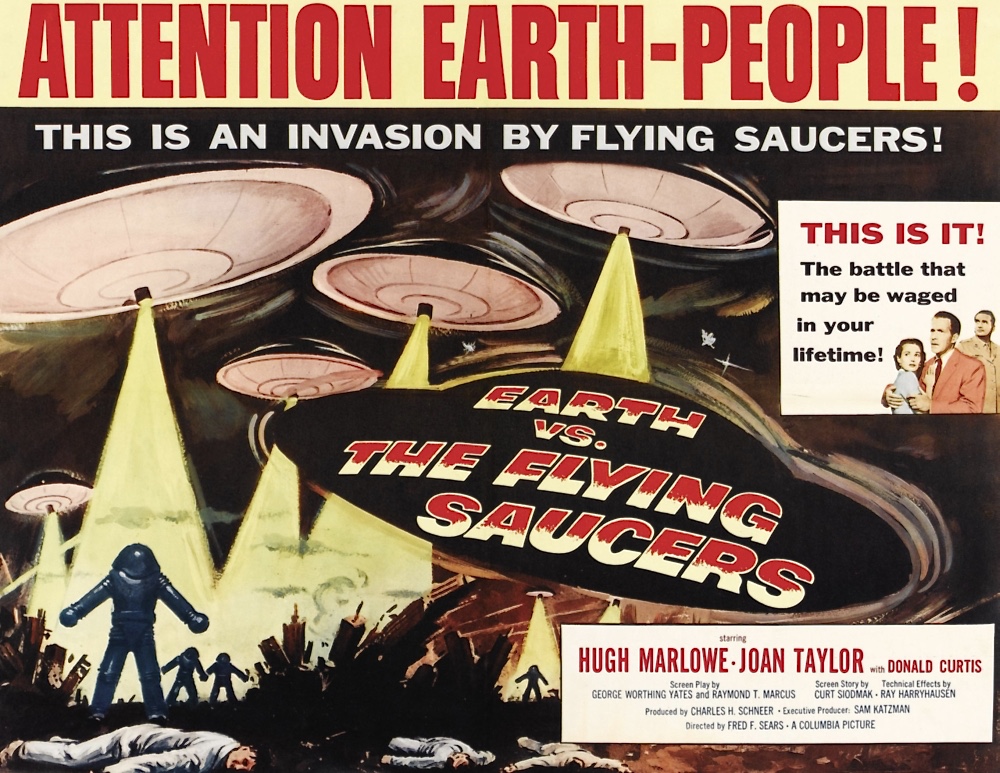
In 1957, a ten-year-old Stephen King was watching a movie matinee of Earth vs. the Flying Saucers, a sci-fi film about alien invaders from outer space.

“[J]ust when it was reaching the good part, with Washington in flames and the final, cataclysmic interstellar battle about to be joined—the screen suddenly went dead. Well, kids started to clap and hoot, thinking the projectionist made a mistake or the reel had broken, but then, all of a sudden, the theater lights went on at full strength … then the theater manager came striding down the center aisle, looking pale, and he mounted the stage and said, in a trembling voice, ‘I want to tell you that the Russians have put a space satellite into orbit around Earth. They call it Sputnik. … ’ There was a long hushed pause as this crowd of fifties kids in cuffed jeans, with crewcuts or ducktails or ponytails, struggled to absorb all that; and then, suddenly, one voice, near tears but also charged with terrible anger, shrilled through the stunned silence: ‘Oh, go show the movie, you liar!” [x]


Related posts:

Fourth of July

July 4th and the Pursuit of Happiness

“Your celebration is a sham” — Independence Day in an Age of Cruelty


[i] Chris Hayes, from his MSNBC program, All In with Chris Hayes, July 2, 2020.

[ii] https://trumpdeathclock.com

[iii] https://www.theatlantic.com/politics/archive/2020/06/how-white-house-coronavirus-response-went-wrong/613591/?fbclid=IwAR34gDXbfiSeHF-WEnBx5mR-g-sJBkkgskC29rSIY2NH_UdZBBuwgf9RYC0

[iv] R. W. B. Lewis, The American Adam: Innocence, Tragedy, and Tradition in the Nineteenth Century (Chicago: University of Chicago Press, 1955)

[v] Geoff Ward, The Writing of America: Literature and Cultural Identity from the Puritans to the Present (Cambridge, MA: Polity Press, 2002), 17.

[vi] This line from Jefferson’s original draft of the Declaration of Independence would be deleted by committee, but it expresses the document’s Edenic spirit (“as yet unsullied by falsehood”). Cited in Ward, 28.

[vii] Nathaniel Hawthorne, The House of the Seven Gables (1850), cited in Lewis, 19.

[viii] David R. Williams, Searching for God in the Sixties (Newark, DE: University of Delaware Press, 2010), 204.

[ix] Ralph Waldo Emerson described a duality in American culture as a schism between the Party of Memory (tradition, or reverence for a “sacred” past or origin) and the Party of Hope (dedicated to rebirth and new possibilities). These are not, of course, to be confused with specific political parties, and most of us belong to both (except, perhaps, for members of a third party, the Party of Irony). See the discussion in Lewis, 7.

[x] Tim Underwood and Chuck Miller (eds), Bare Bones: Conversations on Terror with Stephen King (New York: New English Library, 1990), p. 22, cited in Ward, 119.

Time to Welcome Summer (and refuse the darkness)

The author watches the Solstice sunset from Friedrich Point on Lake Pepin, Minnesota.

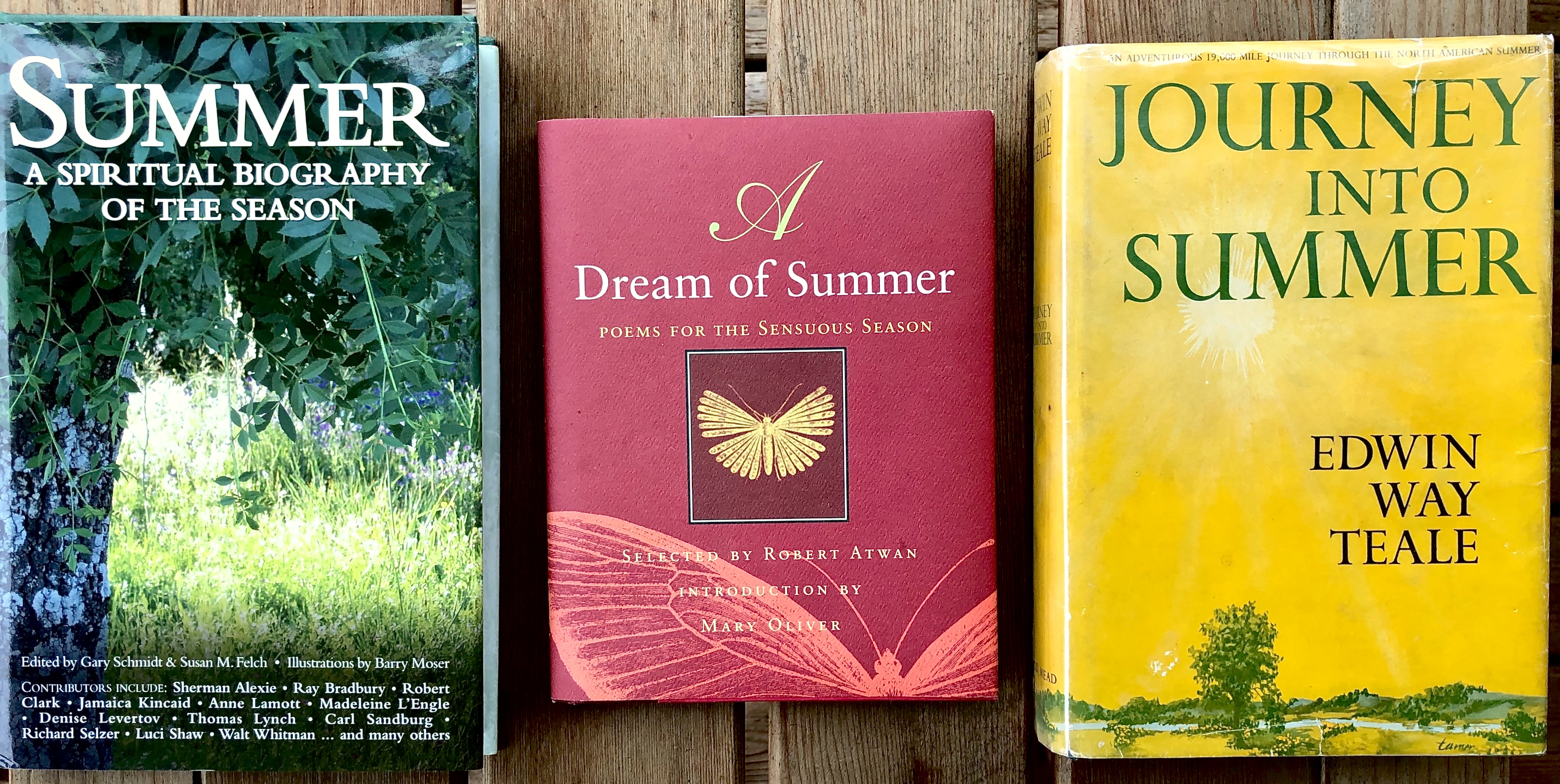
For 150 years, James Thomson’s The Seasons was one of the most widely read books in the English-speaking world. Its ornate classical style and lack of emotional inwardness fell out of favor in the Romantic era, but it still sits on my shelf along with other great ruminations on the circle of time, like Edwin Way Teale’s quartet of road trips through the American seasons, the “spiritual biographies” of Spring, Summer, Autumn and Winter compiled by Gary Schmidt and Susan Felch, and the four diminutive volumes of seasonal poetry selected by Robert Atwan.

Essential summer reading.

Thomson’s Summer begins:

From brightening fields of ether fair-disclosed,
Child of the Sun, refulgent Summer comes . . .
Hence let me haste into the mid-wood shade,
Where scarce a sunbeam wanders through the gloom,
And on the dark-green grass, beside the brink
Of haunted stream that by the roots of oak
Rolls o’er the rocky channel, lie at large
And sing the glories of the circling year.

But the poet’s encyclopedic survey of the world beneath the summer sun is not simply an inventory of its pleasures and beauties, for Nature is not uniformly benign. Storms, floods, drought and earthquakes are part of the mix. Et in Arcadia ego. Thomson’s description of a plague (“the great destroyer”) feels ripped from current headlines. Pandemic mutes “the voice of joy,” sickens human communities and empties public spaces. People shelter in place, hoping to escape the “awful rage” of pestilence, as “o’er the prostrate city black Despair / Extends her raven wing.”

The sullen door,
Yet uninfected, on its cautious hinge
Fearing to turn, abhors society:
Dependents, friends, relations, Love himself,
Savaged by woe, forget the tender tie,
The sweet engagement of the feeling heart.

Who among us is not “savaged by woe,” cut off as we are from tender ties and seasonal rituals? But the poet, trusting the Providence “of powers exceeding far his own,” does not leave us there. He envisions the evils of this world subdued within a larger harmony, and even in the time of trial faith knows, impossibly, that all shall be well. “Nature from the storm / Shines out afresh; and through the lightened air / A higher lustre and a clearer calm / Diffusive tremble;  while, as if in sign / Of danger past, a glittering robe of joy, / Set off abundant by the yellow ray, / Invests the fields, yet dropping from distress.”

Summer 2020 does not arrive robed in joy. Tonight’s dark and deadly Trumpist rally in Tulsa, a demonic parody of traditional Summer Solstice affirmations of light and life, seems to augur a summer of darkness. But we must not succumb to the pestilence without­­­­––or the pestilence within. We must live as children of the light, refusing the gloom and resisting the storm. Already, voices are rising across our tormented country, demanding “a higher lustre and a clearer calm.”  And each of us, in ways both great and small, must continue to welcome the light, and to remember our joy.

Enough for us to know that this dark state,
In wayward passions lost and vain pursuits,
This infancy of being, cannot prove
The final issue of the works of God,
By boundless love and perfect wisdom formed,
And ever rising with the rising mind.


Poetry excerpts are from James Thomson, Summer (1727), part of his quartet, The Seasons (1730).

Black Lives Matter Mural: More Than a Stunt?

When Washington D.C. mayor Muriel Bowser had BLACK LIVES MATTER painted in gigantic yellow letters on 16th Avenue near the White House, America’s racist-in-chief displayed his predictable rage. But the local chapter of the Black Lives Matter Global Network voiced their own objections to the street mural.

“This is a performative distraction from real policy changes,” they tweeted. “Bowser has consistently been on the wrong side of BLMDC history. This is to appease white liberals while ignoring our demands. Black Lives Matter means defund the police.”

I am not familiar with the relationship between the mayor and the activists, and as a white liberal I am hardly qualified to weigh in on the passion or the politics behind that tweet. I am aware that many D.C. residents, longing for concrete change, are calling the mural a meaningless stunt. But as a long-time liturgist, I would argue that symbolic “performance” need not be a substitute for or distraction from social change. Public art can produce transformative effects.

The problem with living within a particular “social imaginary” is that alternative ways of constructing our common life are not just utopian, they are literally inconceivable. Systemic racism, like so many other social ills, has long cast its spell of inevitability. But as events of the last week have shown, the spell can be broken. It may be only for a moment; America may yet resume its slumber. But an alternative future, by showing itself however briefly, can never again be unseen.

“Insurrectionary art” is not a distraction from prophetic vision, but a powerful means of making a new world visible. It does not inhibit concrete change; it anticipates it. The mass protests themselves are performance art, symbolically showing a new social order––where solidarity dances with diversity, and God’s new song breaks open the tombs of death and despair.

Four years ago, in the dark night of post-election depression, I wrote “Insurrectionary Imagination and the Art of Resistance,” citing many creative examples of prophetic art designed to awaken and empower. And I argued that symbolic or ritualized enactments of the “not-yet” are not only useful, but essential:

“In dark times, we can, we must, still live as children of the light—the custodians of hope—enacting rituals and images, as well as daily practices of kindness, solidarity and justice, to express and anticipate the emergent world of divine favor and human flourishing. As for the powers, God laughs them to scorn, and God’s friends, thankfully, are in on the joke.”

This is why I believe that those three words painted on 16th Street––words of revolutionary power pointing like an arrow at the heart of the beast––may now be counted as one of our capital’s greatest monuments––not to past glories and aspirations, but to a better future, cresting like a wave that wants to crash on the shore of the Now.

Words are not just descriptions; they are events. Language and action have been inextricably bound together ever since God spoke the world into being. By speaking, we make the unsaid suddenly conceivable. We begin to “make it so.”

e.e. cummings imagined the world’s creation this way:

when god decided to invent
everything he took one
breath bigger than a circustent
and everything began

The dying world wants to rob us of that breath. It wants us to believe that we can’t breathe something better into existence. But the divine Breath animating all existence cannot be choked. It blows, blasts, breaks forth in words that shatter, contradict, imagine, make new.

And the Word becomes actual, and dwells among us. 

Related posts

Temporary Resurrection Zones

Insurrectionary Imagination and the Art of Resistance

Beautiful Trouble: A How-To Book for Creative Resistance

Beyond Punch and Judy: The Art of Nonviolent Resistance

Come, Holy Spirit

Gerard David, Annunciation (detail), 1506

The heart itself is but a small vessel, yet dragons are there, and there are also lions; there are poisonous beasts and all the treasures of evil. But there too is God, the angels, the
life and the kingdom, the light and the apostles, the heavenly cities and the treasuries of grace—all things are there.

–– St. Macarius

Not, I’ll not, carrion comfort, Despair, not feast on thee;
Not untwist––slack they may be––these last strands of man
In me or, most weary, cry I can no more. I can;
Can something, hope, wish day come, not choose not to be.

––– Gerard Manley Hopkins


Even in the midst of immense and alarming crises, we remember to celebrate the Holy Spirit, who even now––especially now––broods over “the bent world. . . with warm breast and with ah! bright wings.” There is much more to be said, but for now, on this Whit Monday, let me simply share a video prayer I prepared for our parish Pentecost liturgy stream, combining the ancient supplication, Veni Sancte Spiritus (Come, Holy Spirit), with the biblical account (Acts 2:1-11) of a wondrous day when a power beyond all knowing dissolved the boundaries of separation and otherness, and a diverse crowd gathered in the streets experienced a oneness they had deemed impossible.

Easter Wings: An Ascension Homily

All the other Distance
He hath traversed first –
No new mile remaineth –
Far as Paradise –

 His sure foot preceding –
Tender Pioneer –
Base must be the Coward
Dare not venture – now –

 –– Emily Dickinson, “Life is what we make it”


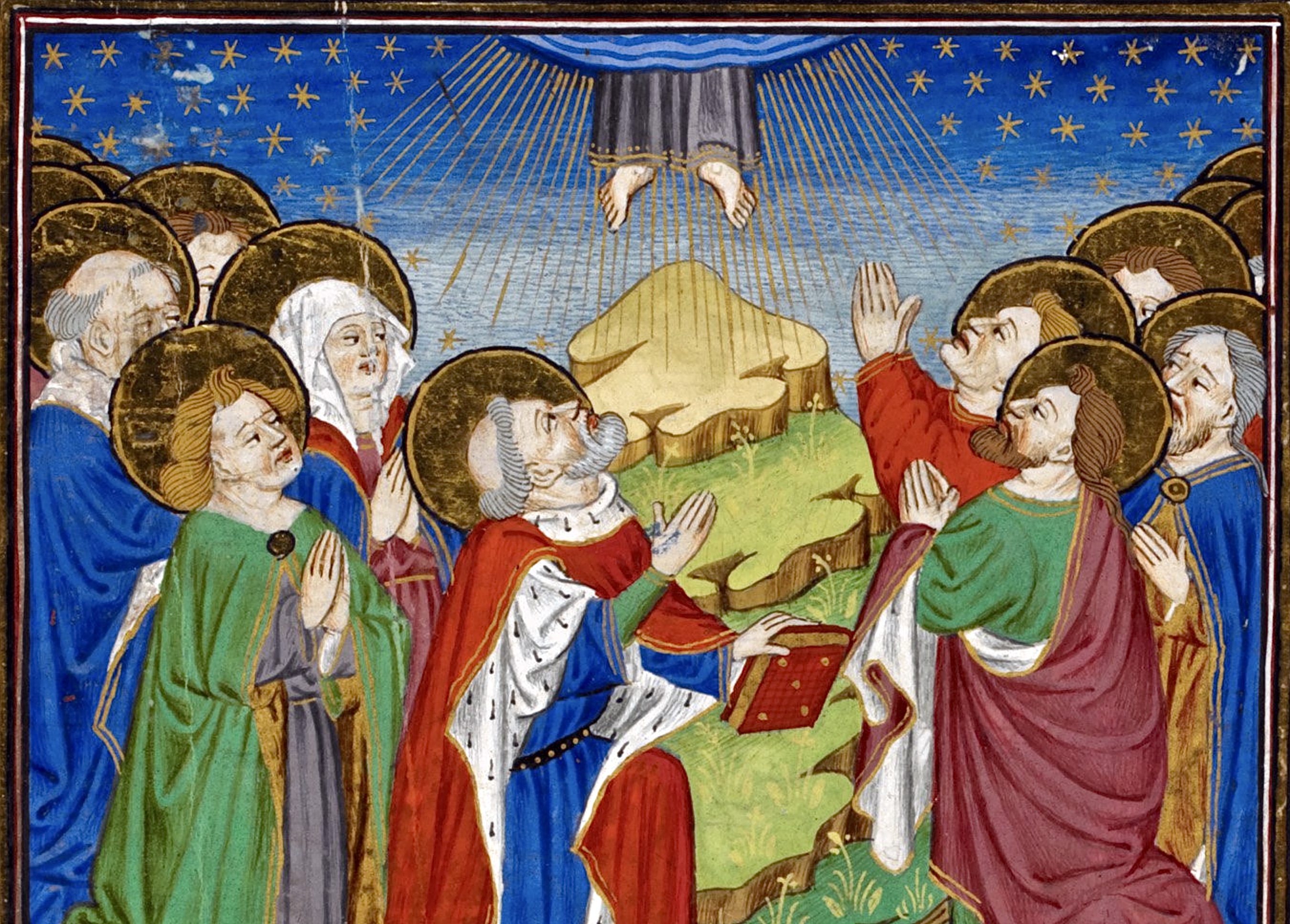
“He ascended into heaven. . .” We say this every time we recite the Creed. But what does it mean? Why do we say it, and what are we being asked to believe? Is it an embarrassing myth, a problematic metaphor, or an inexplicable fact? Many Christians would prefer to hurry past the doctrine of the Ascension, as if it were not something we should examine too closely. Nothing to see here, folks, just keep moving.

But maybe wondering what we do with the story isn’t the right question. What we really need to ask is: What is the story going to do with us?  Where does it want to take us? How might it change us?

John Calvin, the great Reformation theologian, called the Ascension “one of the chiefest points of our faith.”[i] Really? Compared to the birth, death and resurrection of Jesus Christ, the Savior’s disappearance into a cloud seems a relatively minor part of the story. How much does it matter for Christian faith and practice?

Let’s begin with three things that the Ascension is not. First of all, it is not the end of Jesus’ presence in the finite and temporal world, the world of human experience. In the sixth-century Ascension hymn by Romanos, the disciples express their anxiety about being abandoned:

Are you leaving us, O Compassionate?
Parting from those who love you?
You speak to us like someone going on a journey. . .
Do not take yourself far away from those who love you. [ii]

We know that feeling. In a secular age, sometimes is seems that all divinity has just up and left this world without a trace. But if the Ascension was the end of one kind of presence, it was the beginning of another. Jesus is still here, but in a different way.

Secondly, the Ascension is not the Incarnation in reverse, as though God was briefly one of us, and now he’s not. A human life is finite, vulnerable, dependent and particular. It’s radically different than being the infinite God of power and might. But when, as the Bible puts it, Jesus ascended to “the right hand of the Father,” he didn’t leave his humanity behind. He took it with him into the heart of God.

Finally, the Ascension is not just about Jesus.
It’s about us as well.
If we are in Christ, then wherever Jesus goes, we go too.

Let’s look at each of these themes more closely. First, the question of presence and absence. The unique particularity of Jesus of Nazareth, a first-century Jewish male who lived and died like one of us, could only be experienced the way every finite existence is experienced: in its own place and time. If it’s here, it can’t be there. If it’s then, it can’t be now. Once Jesus was laid in the tomb, he could no longer be one object alongside all the other objects in the world. That physical walking-around-the-neighborhood Jesus was gone for good.

When Jesus rose from the dead, his identity and presence were no longer bound by the rules of time and space. His risen body could be both here and there. And the reason the resurrection stories lack the chronological realism of the Passion narratives is because they occur outside historical time. Encounters with the risen Christ were not additional chapters in the life and times of the earthly Jesus. They took place outside of history, at the border between our spatiotemporal world and whatever lies beyond it.

If Easter is not a historical narrative following the rules of space and time, then Ascension was not the next thing that happened after the resurrection appearances, because things don’t happen in sequence outside of time. So instead of thinking of the Ascension as another event in time, think of it as another dimension of resurrection. In his Easter appearances, the risen Jesus assured his friends that he would be with them always. In the Ascension, however, he made it clear that his presence would now have to be experienced in new ways and different forms. First there is Jesus. Then there is no Jesus. Then there is.

Ever since the resurrection,
seeing Jesus has required an act of recognition,
a moment in which we ask, “Jesus, it that you?”

Discerning the myriad forms of Christ’s presence is a fundamental practice for God’s friends in these latter days. We find Christ in sacrament and community, prayer and Scripture. We find Christ through forgiveness and reconciliation, compassion and service, justicemaking and peacemaking. Christ meets us in our neighbor and in the stranger; in solitude and solidarity; in church and on the street. Christ hangs on every cross, and returns in every resurrection.

As Jesus said before he left,
“I am with you always, even to the end of time” (Matt. 28:20).

But if Christ now tends to appear incognito, quietly “as One unknown,”[iii] what do we make of the Ascension’s theology of exaltation, celebrating the Christ “whose glory fills the skies?”

Hail the day that sees him rise,
Glorious to his native skies;
Christ, awhile to mortals given,
Enters now the highest heaven. [iv]

Charles Wesley’s familiar hymn is one of many envisioning the enthronement of Christ as the governor of the world. And we all appreciate the theological irony: the humiliated and rejected one turns out to wear the crown. But such a dramatic reversal risks undoing the Incarnation, as though the finite and vulnerable humanity of Jesus were only a temporary thing, given back after Easter like a rented costume. But that’s not what happened. The Incarnate word came to stay.

Yes, divine and human are radically different. Infinite and finite are radically incommensurate. Creator and creature can never be confused. And yet, without God ceasing to be God or Jesus of Nazareth ceasing to be human, heaven and earth have been joined in holy union, never to be put asunder.

The understanding of Christ as the divine Word, the shaping power of love through whom all things are created and sustained in their being, is not a theological footnote. It is key to the story of redemption that our Savior not only has the whole universe at his back, but that his way, the sacrificial way of self-diffusive love, is the very truth of God, and therefore the truth of how things are meant to go in the world which God has made. To be in Christ is to conform to the most fundamental reality, and the Ascension imagery of divine enthronement celebrates this crucial fact. Christ is the way, the truth and the life. Self-diffusive love is the law of the universe.

However, too much of this and we risk highlighting the divine at the expense of the human in the story of Jesus, as if more of one means less of the other. If we fully embrace our humanity, is there less room for God? Or if we are to be more like God, must we diminish or abandon our humanity because it is essentially incapable of receiving and containing divinity?

Jesus answers these two questions with “no” and “no.” In the self-emptying act of becoming flesh, God lost nothing of the divine nature, for the essence of God is love: the ceaseless mutuality of giving and receiving that constitutes the Holy Trinity. As for human beings, whose very existence is dependent upon, and constituted by, the reception of God’s gifts of life and breath and Spirit, our creaturely nature was never more itself than when Jesus managed to receive divine fullness with an open heart.

In other words, God was never more like God than in the act of giving Godself away. And humanity was never more perfectly realized than when Jesus exercised his created capacity to receive that gift in a finite way. Communion with God does not obliterate our humanity. It fulfills it.

Irenaeus, one of the first great theologians, said in the second century that “the glory of God is a human being fully alive.”[v] And this fullness of creaturely life is attained, he said, not by “a casting away of the flesh, but by the imparting of the Spirit.”[vi] God loves us just the way God made us: finite, vulnerable, embedded in the absorbing and messy narratives  which comprise human be-ing. And what God desires is for us to live into our creaturely capacity to receive every gift, every blessing, and ascend into the divine communion which is our true and lasting home.

And this brings us to my final point. Ascension is not just about Jesus. It’s about us as well. As members of Christ’s body––with Christ and in Christ––we too are being drawn up to dwell in the vivifying presence of the Holy One––to enjoy God forever.

We call Jesus the Word made flesh because he showed, in the language of human flesh and earthly story, how the divine life could be translated into finite form as a life for others. From birth to death, Jesus was pro nobis: for us. And his Ascension was for us as well, to take us heavenward with him. Jesus did not abandon us. He went on ahead, as the “Tender Pioneer,”[vii] to prepare a place where we may join him.

John Calvin explained the Ascension’s shared, collective dimension in this way:

“Christ did not ascend to heaven in a private capacity, to dwell there alone, but rather that it might be the common inheritance of all the godly, and that in this He has also, by the power of the Holy Spirit, made it possible for us to share in the divine presence [viii]. . . . “Ascension follows resurrection: hence if we are members of Christ we must ascend into heaven.” [ix]

If we are members of Christ, we must ascend. This is the pattern of the Christian life: moving Godward. When I walked the Camino de Santiago, pilgrims encouraged one another with a wonderful word for this Godward movement: Ultreia!, which means Beyond! We are all pilgrims to the Beyond. Growth is our vocation. Transformation is our vocation.

But we can only advance with Christ and in Christ. No wings of our own can defy the gravity of our situation. The sins of the world weigh us down––all that heavy baggage that Thomas Merton called “the contagion of [our] own obsessions, aggressiveness, ego-centered ambitions and delusions.”[x] And in a time of pandemic, fear, illness and grief pile on their own crushing load.

Only the rising and ascending Christ can deliver us from so much gravity. Only Christ can give us what Anglican poet-priest George Herbert called “Easter Wings.” In his poem of that name, in which the words on the page are arranged in the shape of angels’ wings, he admits he can only fly “if I imp thy wing on mine.” He borrowed that peculiar term from falconry: to “imp” means “to engraft feathers in a wing to restore or improve its power of flight.”[xi] In other words, if we want to ascend, we need the help of Christ’s own feathers. If we’re going to fly, we need Easter wings.

As Herbert prays,

With thee
O let me rise
As larks, harmoniously,
And sing this day thy victories.

If you’ve ever heard an English lark, ascending high into the sky as it utters its ecstatic song, you will appreciate the charm of Herbert’s metaphor. A century after Herbert, hymnwriter Isaac Watts wrote my favorite Ascension lyric.

Thence he arose, ascended high,
to show our feet the way.
Up to the Lord our souls shall rise,
on the great rising day. [xii]

Of course, heaven is not susceptible to prepositions: “above,” “beyond,” or even “within” do not tell us where heaven is, since anything beyond space and time has no spatial dimension, and therefore no location. Neither heaven nor God are a place on any map. Still, by God’s grace we may discover their nearness even so, and breathe their atmosphere, in both this world and the next.

For physical and directional beings like ourselves, the imagery of ascending into the sky feels true enough. “Seek the things that are above,” St. Paul tells us (Col. 3:1). “Lift up your hearts,” says the priest at every mass. We don’t have to deny astronomy to know what these things mean. We feel the upward pull.

It’s not a matter of leaving creation behind, or shedding our bodies to become immaterial beings. “Behold, I make all things new,” says the Holy One. All things––not just our souls. The whole creation is being drawn higher and higher, further and further, deeper and deeper into God. Let everything that has breath shout “Glory!”


Related posts:

Ascension Day: Parting is Such Sweet Sorrow

Ascension Day “Charade”?––The Puzzling Exit of Jesus


[i] John Calvin, Commentary on Acts 1:9, cited in Julie Canlis, Calvin’s Ladder: A Spiritual Theology of Ascent and Ascension (Grand Rapids, MI: Eerdmans, 2010), K1249 (The Kindle edition has no page numbers, so I use the Kindle location numbers). Canlis’ rich and thoughtful book is a great read, and has increased my appreciation of Calvin immensely. My other invaluable sources for this essay were Christ the Heart of Creation (Rowan Williams, Bloomsbury 2018) and The Word Made Flesh: A Theology of Incarnation (Ian A. McFarland, WJK 2019).

[ii] Romanos, “Kontakion on the Ascension” in Kontakia: On the Life of Christ, trans. by Archimandrite Ephrem Lash (Harper Collins, 1962).

[iii] This phrase is from a famous passage by Albert Schweitzer: “He comes to us as One unknown, without a name, as of old, by the lakeside, He came to those men who knew him not. He speaks to us the same word: ‘Follow thou me!’ and sets us to the tasks which He has to fulfill for our time. He commands. And to those who obey Him, whether they be wise or simple, He will reveal Himself in the toils, the conflicts, the sufferings which they shall pass through in His fellowship, and, as an ineffable mystery, they shall learn in their own experience who He is.”

[iv] Charles Wesley, “Hail the Day That Sees Him Rise” (1739). The prolific 18th century writer composed over 6000 hymns, at least 10 of which are on the Ascension. However, his brother John, who gave some 40,000 sermons, never preached on the topic.

[v] Irenaeus (c. 130 – c. 202), Adversus Haereses IV.20.7, cited in Canlis, K2246.

[vi] Adversus Haereses V.8.1, in Canlis, K1960.

[vii] Emily Dickinson, “Life – is what we make it.” I quote the last 2 stanzas in the epigraph.

[viii] Calvin, Commentary on John 14:2, in Canlis K1218.

[ix] Calvin, Commentary on Colossians 3:1, in Canlis K991.

[x] Thomas Merton, Contemplation in a World of Action, p. 158, cited in Martin Laird, An Ocean of Light (Oxford/New York: Oxford University Press, 2019), 11.

[xi] Helen Wilcox, The English Poems of George Herbert (Cambridge, UK: Cambridge University Press, 2011), 148 n.19.

[xii] Isaac Watts, “Why do we mourn departing friends” (1707). Set to a shape note tune by Timothy Swan in 1801, it is #163b in The Sacred Harp (Bremen, GA: Sacred Harp Publishing Company, 1991). A powerful version from the 2nd Irish Shape Note Convention (2012) can be heard here: https://youtu.be/7mCFMKNJIAg