Ten questions to ask about your own picture of Jesus

"I was a teenage Jesus" - Jeffrey Hunter as Jesus in Nicholas Ray's King of Kings (1961)

“I was a teenage Jesus” – Jeffrey Hunter as Jesus in Nicholas Ray’s King of Kings (1961)

Are you the Expected One, or should we look for someone else? (Matthew 11:3)

Who do you say that I am? (Mark 8:29)

I’m teaching a course this month on “Jesus and the Movies” at the Graduate Theological Union in Berkeley, California. We are examining nineteen feature films on Jesus, made between 1912 and 2014, through the lenses of biblical criticism, Christology, film theory, and cultural contexts.

But we are also considering our own personal perspectives on the protagonist of “the greatest story ever told.” What influences have shaped our own image(s) of Jesus? How do we picture Jesus? What do we expect him to do? How do we expect him to be? How is our understanding of Jesus enlarged, challenged, confirmed, contradicted or disappointed by what we see on the screen?

Robert Powell, whose portrayal of Jesus in Franco Zefferelli’s Jesus of Nazareth (1977) was generally well received by the public, said some years later that “No one can play Jesus. Not really.” And many critics have agreed. The casting of boyish teen heartthrob Jeffrey Hunter (who was actually 33 when he played the part) elicited sneers of “I Was a Teenage Jesus.” Max von Sydow, praised by some for restoring virility to the role, was ripped by others for “an aphorism-spouting, Confucius-say edge to his speech, an overtone of pomposity.” Jesus Christ Superstar’s Ted Neely was dismissed as “a droopy little fellow with sad eyes and long hair, followed by nondescript young people without any particular place to go.” And Willem Dafoe’s troubled and uncertain Jesus caused NPR’s Tom Shales to say that “this Jesus wonders, wonders, wonders who — who wrote the book of love?”

My take on the subject is that no actor has to be the Jesus, and that no single film needs to be definitive. They only need to show us the “old, old story” in some fresh way, to reveal some dimension we might otherwise have missed. But any claim to have finally gotten it “right” would be idolatry. As Rowan Williams has noted:

If you think representation is copying or reproducing, quite clearly, there is no way you can do this as a religious believer. Not even if you think you are reproducing what Jesus looked like when he was on earth. If on the other hand you think ‘I need to find some kind of vehicle which will put me in touch with the action that underlies and sustains these events’, then of course you won’t necessarily look for a realistic picture… No, you don’t want to represent just the human facts, nor do you want to take refuge in abstract representations … you are put in touch with something, but you mustn’t think it’s a copy.[i]

So the actors and filmmakers are freed of the burden of factual replication. They merely have to put us in touch with that certain something contained in the Jesus story. And in provoking our own responses, both positive and negative, they make us reexamine the nature and history of our own images and ideas for Jesus.

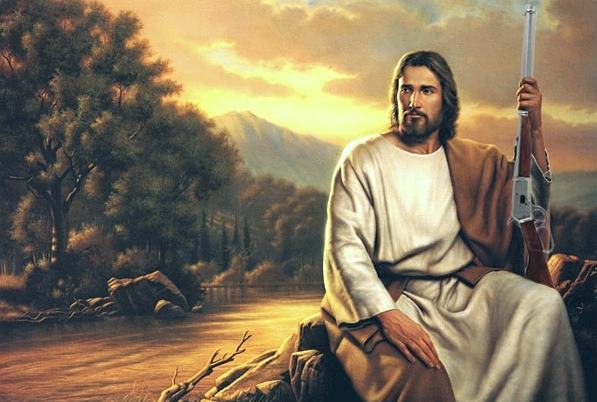
From the Internet, definitely a "not-Jesus".

From the Internet, definitely a “not-Jesus.”

That being said, here are ten preliminary questions to consider when Jesus asks the big one: “Who do you say that I am?”

  1. Where did your first images of Jesus come from? Have any of those become obsolete?
  2. What later images, experiences, and understandings caused those first images to grow, develop, change?
  3. What are your criteria for authenticity? Scripture, theological presuppositions, historical probability, psychological plausibility, inner experience, worship, moral resonance, etc.?
  4. Then vs. Now: Is Jesus only in the past, or can we encounter him in the present? Can faith communities receive information about Jesus that adds to the picture (as in the Fourth Gospel or the Book of Revelation)? Can individuals, such as Julian of Norwich in her visions of the Passion, be shown “new” things about the Jesus story? Can a painter, or a filmmaker, show us something new about Jesus? How can such new insights. assertions, or revelations be tested?
  5. Is historical investigation enough to reach the “real” Jesus? Is faith enough? Or do they shape and influence each other?
  6. What is the role of art, including film, in showing us Jesus? Can different images/actors/styles add to our understanding and experience of Jesus? What are the criteria that affect our receptivity?
  7. If a particular movie Jesus or scene doesn’t fit our own ideas. images, or understandings, do we reject it entirely, or do we engage with it, let its difference be a way to explore and test our presuppositions? Do we say, “That’s not Jesus,” and move on? Or do we wrestle till dawn with that stranger to see whether it might bless us?
  8. All language is difference: this is not that. Can even the not-Jesuses help define who Jesus is?
  9. Ontological Christology vs. functional Christology (being vs. doing): Do the identity of Jesus, and the authenticity of his representations, lie in who he is: a person in whom both human and divine are perfectly integrated (and then manifested in personality, charisma, appearance, and the way he feels to us)? Or does it lie in what he does, what he says, and how the story goes, regardless of our affective responses to his manner of being?
  10. If a particular representation of Jesus makes you uncomfortable, can that be a good thing?


Related Posts

The Ten Best Jesus Movies

My 10 Favorite Jesus Movie Moments


[i] “Faith and Image,” a conversation between Rowan Williams and Neil MacGregor, Art and Christianity 75 (Autumn 2013), 3

Feast of the Epiphany: The worst time of year for such a journey

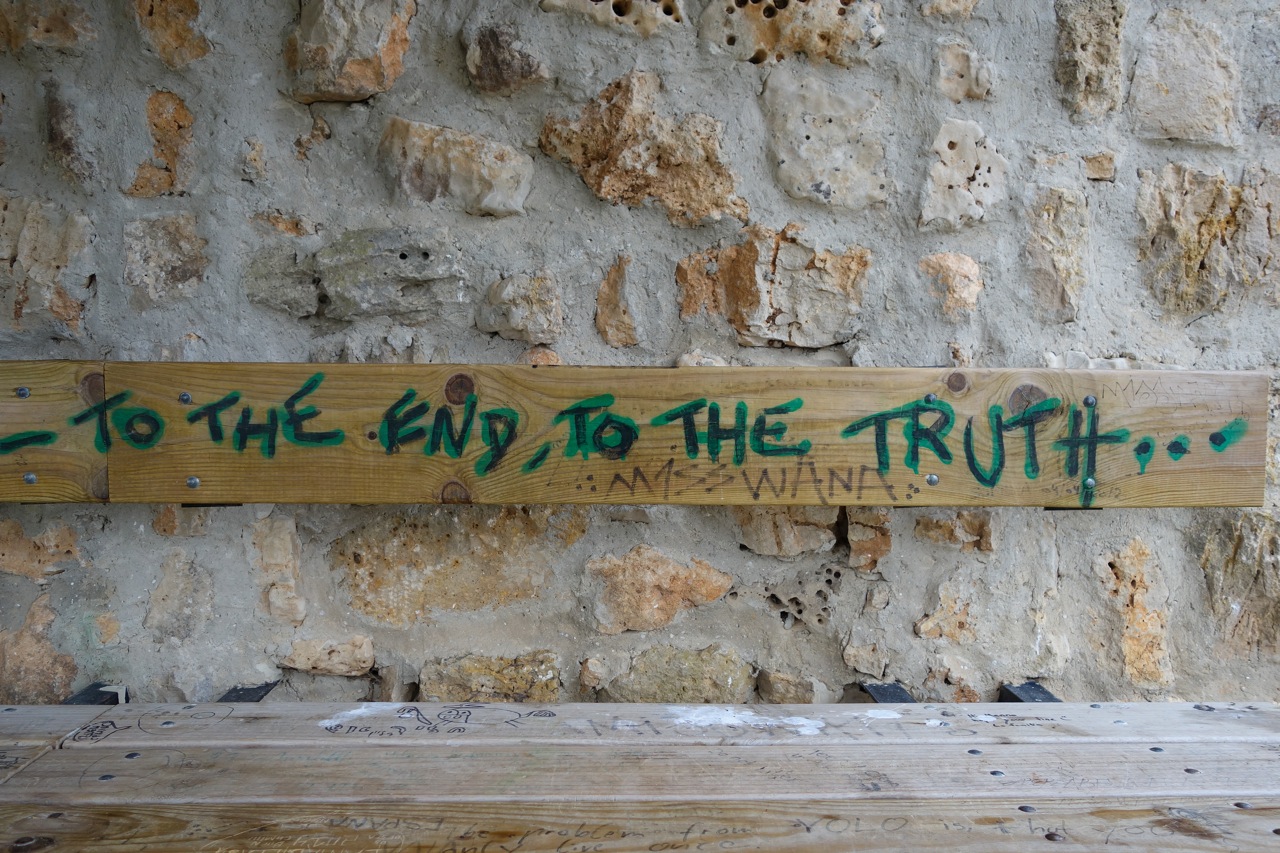
Along the Camino de Santiago, April 2014

Along the Camino de Santiago, April 2014

It is not commended to stand ‘gazing up into heaven’ too long; not on Christ himself ascending, much less on his star. For [the Magi] sat not still gazing on the star. Their vidimus begat venimus; their seeing made them come, come a great journey.

— Lancelot Andrewes, sermon for Christmas Day, 1622[i]

When T. S. Eliot wrote his great Epiphany poem, “Journey of the Magi,”[ii] he borrowed freely from a Nativity sermon preached in 1622 by the English bishop, Lancelot Andrewes:

A cold coming they had of it at this time of the year, just the worst time of the year to take a journey, and specially a long journey. The ways deep, the weather sharp, the days short, the sun farthest off, in solstitio brumali, ‘the very dead of winter.’

Andrewes, who oversaw the translation of the King James Bible, had a gift for elegantly expressive language, and Eliot altered the original only slightly to make the first lines of his poem:

‘A cold coming we had of it,
Just the worst time of the year
For a journey, and such a long journey:
The ways deep and the weather sharp,
The very dead of winter.’

The liturgical and theological focus of today’s Feast of the Epiphany is the universal reach of the Light of the World. The three Magi, coming from faraway places to do homage to the Christ Child, signify that whatever was revealed in Bethlehem was not confined to a single culture, language, or tradition. The babe in the manger would ultimately spark recognition in every longing heart.

But Eliot’s particular focus is on the psychology and spirituality of the Magi themselves, or at least the one whose voice speaks the poem. He recites the complaints common to pilgrims: bad roads, bad weather, bad food, unpleasant companions, inhospitable strangers, and the homesick yearning for one’s own bed. He wonders whether the journey might be ‘all folly.’

The bleak desert crossing resounds with haunting echoes of The Waste Land, heightening the relief we feel when the traveler finally comes to “a temperate valley … smelling of vegetation.” But instead of the sweet, unblemished beatitude of a Nativity scene, the Magus is baffled by a series of disparate sights whose meanings are still in the future: vine branches, empty wine-skins, pieces of silver, three trees on a hill, the pale horse of the Apocalypse.

As for the actual moment of arrival, of seeing the long-sought Epiphany, it is described with the utmost reticence, as though words must fail before such a mystery:

… it was (you may say) satisfactory.

Then what? The Magi go back home, to the world they knew,

But no longer at ease here, in the old dispensation,
With an alien people clutching their gods.

Whatever Bethlehem had shown them, nothing in their lives would ever, could ever, be the same. This holy Birth had also brought a kind of death: the ‘old dispensation,’ whatever the Magi had settled for up to now, could no longer stand. The world of the past – erring, broken, lost, in love with the wrong thing – was being swept away. Behold, I make all things new.

In Andrewes’ 1622 sermon, he played nicely upon the Latin verbs for having seen (vidimus) and having come (venimus). What the Magi saw made them come. ‘Their vidimus begat venimus.’ But in our own day, says the preacher, we are apt to hold ourselves back, and resist the journey of transformation:

And we, what should we have done? Sure these men of the East will rise in judgment against the men of the West, that is with us, and their faith against ours in this point. . . . Our fashion is to see and see again before we stir a foot, specially if it be to the worship of Christ. Come such a journey at such a time? No; but fairly have put it off to the spring of the year, till the days longer, and the ways fairer, and the weather warmer, till better travelling to Christ. Our Epiphany would sure have fallen in Easter week at the soonest.

I am well acquainted with such spiritual procrastination. It is a practice not so easy to shed. We do prefer our comfort zones. Or as Andrewes put it, ‘We love to make no great haste.’

And yet, despite our best evasions, there may come a time when we find ourselves on a strange and arduous journey into that Place where everything is changed. Whether we choose the journey, or the journey chooses us, doesn’t really matter. In either case, once we have encountered the Epiphany, we will be ‘no longer at ease here, in the old dispensation.’

And then what?

[i] Andrewes’ complete sermon may be found here.

[ii] “Journey of the Magi,” T. S. Eliot: Collected Poems 1909-1962 (London: Faber and Faber, Ltd., 1974), 99

“God isn’t fixing this”

Advent installation by Jim Friedrich at St. John's Episcopal Church, Los Angeles (1977)

Advent installation by Jim Friedrich at St. John’s Episcopal Church, Los Angeles (1977)

O come, O come Emmanuel,
and ransom captive Israel.

Once upon a time, worshippers entered their church on the Second Sunday of Advent to find a great wall between themselves and the sanctuary. The beautiful mosaics, the richly colored marble walls, and the magnificent carved Christ above the high altar were all hidden from view by this strange iconostasis, made from front pages of the Los Angeles Times. Instead of the images of holy men and women that adorn a traditional altar screen, there were banner headlines screaming catastrophe and mayhem.

When the assembly was seated, a mime came up the aisle to stand before the wall, searching for some way through it. His movements and gestures indicated perplexity, frustration, and finally discouragement. Then a voice from beyond the wall cried out,

Jerusalem, turn your eyes to the east,
see the joy that is coming to you from God. (Baruch 4:36).

Responding to the voice, the mime tore a small hole in the wall, and peeked through. He seemed entranced by what he saw.

The voice continued:

Take off the garment of your sorrow and affliction, O Jerusalem,
and put on forever the beauty of God’s glory. (Baruch 5:1)

The mime began to tear down the wall, encouraging others to join him. One by one, people rose from their pews to rip down the veil “of sorrow and affliction,” until the beauty of God’s sanctuary was finally revealed.

This simple but powerful ritual, the prelude to a eucharist I curated forty years ago at St. John’s Episcopal Church in Los Angeles, comes to mind whenever I hear that passage from Baruch in the December lectionary. It’s what we pray for each Advent from our place on this side of the wall: Good Lord, deliver us. Stir up your power. Tear down the wall between us. Show us your glory.

That wall of headlines reflected my ongoing interest in connecting Advent themes with the news of the world. The WTO protests in Seattle (1999) and the Occupy Movement (2011) both coincided nicely with Advent, mirroring its prophetic themes of judging the present order with the hope and vision of something better.[i] And just last week, the front page of the New York Daily News supplied a marvelous Advent provocation. By noon, it had 11 million Facebook views, and 74,000 shares.

New York Daily News, 12/3/15

New York Daily News, 12/3/15

The headline was a sharp rebuke to the shameless politicians who promise prayers for the victims of gun violence while refusing to do anything about the guns. Calling them “cowards who could truly end gun scourge” but instead “hide behind pious platitudes,” the newspaper offered a blunt theological assertion: “God isn’t fixing this.”[ii]

The daily office Old Testament readings for early Advent, calling the world to account for its evils, say much the same thing. To those who refuse to “renounce the dictates of our own wicked hearts,”[iii] the prophets imagine God declaring, “You made your own bed. Now lie in it.” (Thankfully, the prophets always redeem their rants in the end with comforting decrees of mercy and salvation).

However, the Lieutenant Governor of Texas was not comfortable with the Daily News’ riff on the old biblical idea that God sometimes gets fed up with human folly. His photoshopped revision was posted on Facebook and Twitter.

God hears our prayers

Of course this clueless retort (note the unfortunate juxtaposition of the headline with the red banner above it) did not actually answer the question of whether – or how – God acts in the world to “fix” things. It was just a clumsy attempt by a presumed gun lover to change the subject. Platitudes about prayer in the abstract are safe because they have no consequences, unlike real prayer, which always implicates the petitioner in a process of change and action. If we pray for an end to gun violence, we obligate ourselves to do all in our power to reduce it. Prayer is a call for action; it politicizes what we pray for. Prayer is not simply leaving things up to God. It is an act of volunteering to be part of God’s solution.

But is there such a thing as God’s solution? Does God – can God – fix things? It is not a question with a clear and simple answer. Human freedom has thrown a monkey wrench into the story of the world, while God has surrendered absolute control of the narrative. If we make a mess of things, God is not an indulgent parent rushing in to cover for us. We don’t get to multiply our weapons and then wonder why God allows so much violence.

So where does that leave us? In the Advent section of his Christmas Oratorio,[iv] W. H. Auden describes a closed-in, godless world where hope is absent.

Alone, alone about a dreadful wood
Of conscious evil runs a lost mankind …
The Pilgrim Way has led to the abyss.

But what if we are not alone? What if there is a God who can make the abyss into a way? What if an unexpected future is breaking through the walls of our self-made prison? The Advent message is to embrace this hope, as we take off the garments of sorrow and affliction to welcome the God of joy into our midst.

Whatever the “solution” (salvation) may be in the tangled histories of the world and the soul, it is a long-term, sometimes excruciating, process, requiring honest engagement with the consequences of human sin in acts of confession, repentance, reconciliation, justice, healing, sacrifice, and transformation. And I submit that these are not simply things we do with God, as though God were only a helper from the outside. They are things we do in God, or God does in us, as our own intentions and actions become the embodiment – the incarnation – of divine purpose.

So yes, I believe that God is fixing the world, but not in the short run. And not without us.


[i] I preached on both these events at the time, with mixed results. Some were not so ready to find traces of God in social movements which trouble the powers-that-be. One church subsequently banned me from its pulpit for being too “partisan.” Guilty as charged.

[ii] New York Daily News, December 3, 2015.

[iii] Baruch 2:8

[iv] W. H. Auden, For the Time Being: A Christmas Oratorio, in Collected Poems, ed. Edward Mendelson (New York: Random House, 1976), 273

We are the singers of life, not of death

A Choir of Angels (detail), Simon Marmion, 1459

A Choir of Angels (detail), Simon Marmion, 1459

“The great truth that is too often forgotten is that it is in the nature of people to do good to one another.”

– Marilynne Robinson[i]

Gonna rise up, burning black holes in dark memories,
Gonna rise up, turning mistakes into gold.

– Eddie Vedder[ii]

One of my favorite stories by the naturalist Loren Eiseley recalls a moment of awakening. He was napping in a forest glade when a sudden commotion of birds roused him from sleep. They were circling a raven which clutched their small nestling in its beak. It was not only the nestling’s parents crying in protest. Birds of half a dozen other species also began to join in. “No one dared attack the raven. But they cried there in some instinctive common misery, the bereaved and the unbereaved. The glade filled with their soft rustling and their cries.” The raven sat unperturbed on its perch, a perfect symbol of pitiless mortality – “the bird of death,” Eiseley called it.

It was then I saw the judgment. It was the judgment of life against death … For in the midst of protest, [the birds] forgot the violence. There, in that clearing, the crystal note of a song sparrow lifted hesitantly in the hush. And finally, after painful fluttering, another took the song, and then another, the song passing from one bird to another, doubtfully at first, as though some evil thing were being slowly forgotten. Till suddenly they took heart and sang from many throats joyously together as birds are known to sing. They sang because life is sweet and sunlight beautiful. They sang under the brooding shadow of the raven. In simple truth they had forgotten the raven, for they were the singers of life, and not of death.[iii]

On Sunday night I experienced a similar miracle of transcendent exultation in a new musical at the Seattle Repertory Theater, Come From Away. A musical about 9/11 might sound like a dubious idea, but it succeeds brilliantly in turning the darkness into a song of unconquerable life and resilient spirit.

Like the birds in the glade, Come From Away shifts its focus away from the familiar 9/11 narrative of horror and death to tell a powerful counter-story in which the bonds of community and kindness prove stronger than the forces that divide and destroy. Like the utopian “no-places” of Renaissance romance – say the forest of Arden or Prospero’s island – the small town of Gander in New-Found-Land is on “the edge of the world,” a liminal space where both individuals and social groups, free from conventional and habitual constraints, can explore alternative ways of being and being-together.

An island town of 9000 people, Gander had once been a key refueling station for transatlantic flights, and its remote airport is still relied on for emergency situations. When all North American airspace was closed on 9/11, 38 planes were rerouted there, bringing nearly 7000 people who needed to be housed and fed for six days. The logistical challenges were enormous, but the emotional ones were even greater – so many people from different cultures, stranded far from home in those surreal days of uncertainty, shock and anxiety. Their planes had found a place to land, but what about their hearts?

Over those six days, remarkable bonds formed among both Newfoundlanders and passengers. It was an experience of love and goodness which none of them would ever forget. Ten years later, many of the “plane people” returned to Gander for an anniversary reunion to re-collect that extraordinary experiment in community. Two Canadian playwrights, Irene Sankoff and David Hein, went there as well, spending a month listening to thousands of stories. In four-hour interviews with hundreds of people, Sankoff and Hein compiled a remarkable record of the human spirit.

The play’s title is a Newfoundland colloquialism for “immigrant.” In a time when many are bashing immigrants as “them,” such a powerful reminder that we have all “come from away” feels like a well-timed gift of grace. As the Bible puts it, we are all strangers and pilgrims on this earth[iv], and the essential human project is the overcoming of fear and division to make connections and create community.

Sankoff and Hein were fascinated to learn that Newfoundland is where all the continents crashed together eons ago. “So, geologically,” they said, “there are pieces of Africa, Europe and America all right there. It’s this wonderful metaphor for the world coming together.”[v] The theologians say that we are made in the image of a God whose essence is relationality, and that human nature is most fully realized in communion. What happened in Gander was a test of that thesis.

The stories collected in 2011 were gradually consolidated into a coherent musical drama, with 12 actors representing nearly a hundred characters. There are no flawless heroes, exempt from the fears, frailties and foolishness common to all of us. There are no villains either. They are just people making their way through an unknown land without a map, exhibiting an innate desire to do good to one another. Both recognizable and sympathetic, these characters stood in for all of us, and what we might become.

And how brilliant to make it a musical. The driving Celtic rock score by a nine-piece onstage band was irresistible, and the songs made you want to shout and dance, even as tears streamed down your face. Beautifully crafted by Sankoff and Hein, the infectious music made us all believe in our common vocation as the singers of life against all odds.

In her book on the musical genre, Jane Feuer observes that “musicals are unparalleled in presenting a vision of human liberation … Part of the reason some of us love musicals so passionately is that they give us a glimpse of what it would be like to be free.” But she cautions that the genre can also fall into the trap of being about nothing more than its own energy. “In its endless reflexivity the musical can offer only itself, only entertainment, as its picture of utopia.” In such a case, the musical remains self-enclosed fantasy, untranslatable into daily reality.[vi]

But Come From Away, grounded in remembered stories of real goodness, offers something more than a temporary escape into fantasy. It proposes the richness of human community as an authentic prospect, however imperfectly realized in actual practice. The merging of Christian, Jewish and Muslim prayers into a single song was but one of many scenes in which the characters discovered that their best selves were grounded in the interrelatedness of mutual belonging.

And to the extent that this play manifested an ideal by which our failures to love one another might be measured and found wanting, it was not unlike liturgy. Neither theater nor liturgy are “real” life, but they can still exert a transformative power. Through symbol and metaphor, song and story, they can suggest a hypothetical alternative to our tired old stories of decline and fall, luring us toward a higher vision of human becoming. When we rose to our feet at play’s end for a prolonged ovation, we were not just thanking the company for a good time. We were, at least for the moment, subscribing to its vision. Whatever it was they showed us, we wanted to be part of it. As Marilynne Robinson puts it, human community is “a work of the imagination”[vii] – a life-giving story we tell as we strive to make it real, in ourselves and in our world.

When the house lights come up, we all go our separate ways, and the vision weakens in the glare of ordinary time. The same thing happens after a liturgy. Yet something of the dream remains. The intuition of a better way of being lodges deep within us, and over time, if properly nourished, it may produce real outcomes.


Related posts


Remember

No Place like Home

After Paris and Beirut, what kind of story shall we tell?


[i] Marilynne Robinson, “Imagination and Community,” in When I Was a Child I Read Books (New York: Farrar, Straus and Giroux, 2012), 33

[ii] Eddie Vedder, “Rise”, from the film, Into the Wild (2007)

[iii] Loren Eiseley, The Immense Journey (New York: Random House, 1957), 174-5

[iv] I Peter 2:11

[v] Interview with Shirley Fishman, Come From Away program notes (Seattle: Encore Arts Programs, Seattle Repertory Theater, Nov. 2015), 15

[vi] Jane Feuer, The Hollywood Musical (Bloomington, IN: Indiana University Press, 1982), 84

[vii] Robinson, 29

After Paris and Beirut, what kind of story shall we tell?

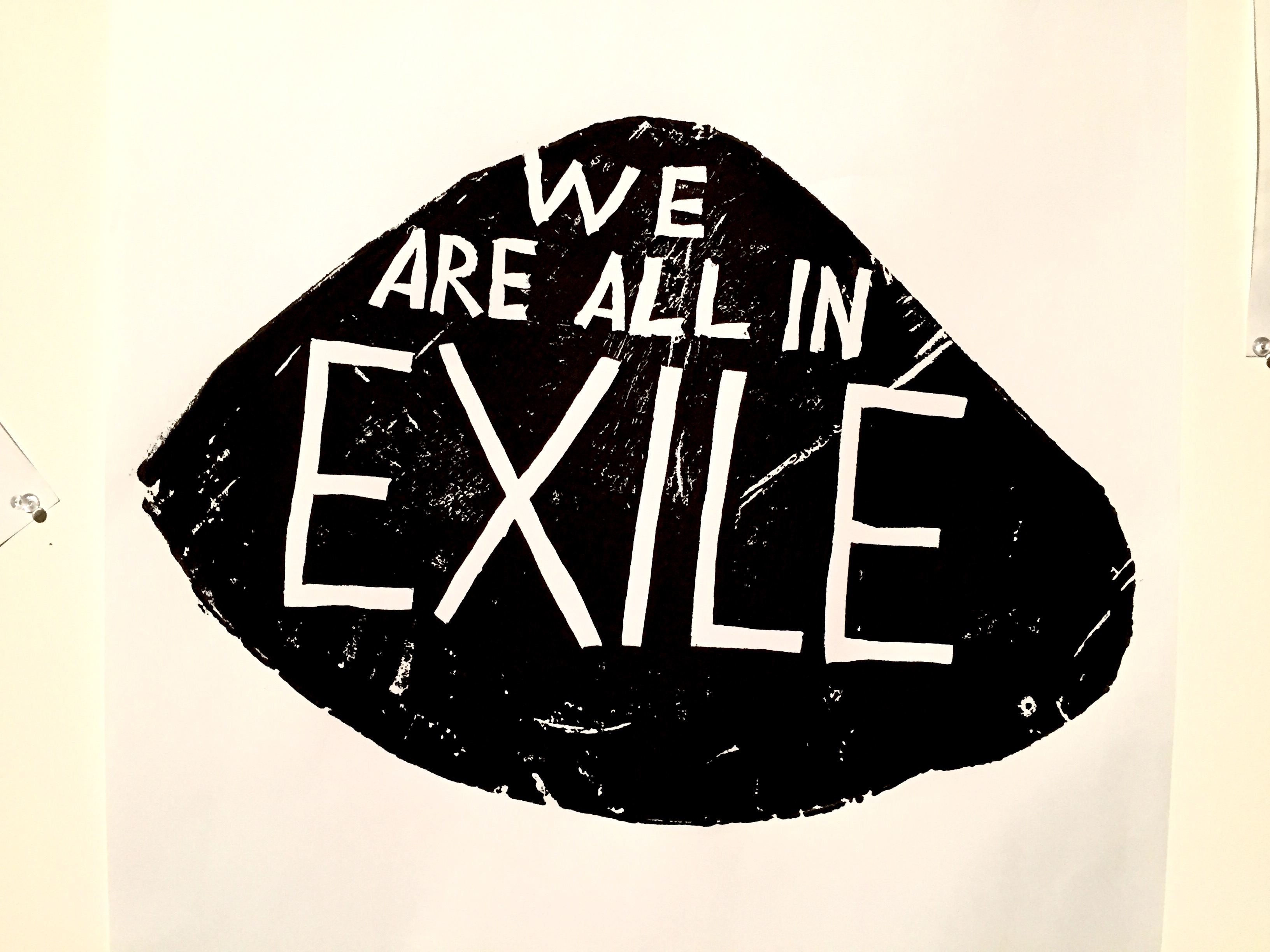
Barthelemy Toguo, wood stamp from tree trunk, Venice Biennale 2015

Barthelemy Toguo, wood stamp from tree trunk, Venice Biennale 2015

We played the pipes for you,
and you wouldn’t dance,
we sang dirges,
and you wouldn’t cry. (Luke 7:32)

This was, as Jesus observed, the perennial cry of the poor children in the marketplace, playing their instruments for the crowd, hoping for a handout. Every street performer could relate to this description of an unresponsive audience, but Jesus wasn’t using the image to address their plight. Instead, he was characterizing his critics as childish in their contradictory complaints about the prophets in their midst. They whined that John the Baptist was too austere and antisocial, but they didn’t like Jesus’ partying with sinners any better.

The failure of others to respond appropriately to the tunes we play for them could also describe the incredible discord among competing versions of reality in these days of terrorist violence. The actions of those living in alternative realities to our own seem inexplicable, and our often clueless responses to those actions fail to produce the intended results. We pipe, but they don’t dance. We bomb, but they don’t submit. We reason, but they won’t be persuaded.

In a long and unsettling article in The Atlantic last March, Graeme Wood diagnosed ISIS as a “dystopian alternate reality” grounded in an apocalyptic worldview. According to Wood, the western violent response to the Islamic State not only feeds their medieval narrative of Crusaders versus Muslims, it is the longed-for fulfillment of millenarian prophecy. In the Syrian farmland around the city of Dabiq, the armies of Islam will face down the armies of “Rome” (the West). This decisive battle will inaugurate the End of Days, resolving all the tribulations of history into a final triumph of God’s people.

In this narrative, the escalation of American military involvement would not be a deterrent, but an incentive. As Wood put it: “During fighting in Iraq in December [2014], after mujahideen (perhaps inaccurately) reported having seen American soldiers in battle, Islamic State Twitter accounts erupted in spasms of pleasure, like overenthusiastic hosts or hostesses upon the arrival of the first guests at a party.”[i]

If Wood is correct, then ISIS is operating from premises which we would dismiss as senseless and fantastic. But then what do we make of a recent poll on religion and politics, where1000 American adults were asked, “Do you think that the end of the world, as predicted in the Book of Revelation, will happen?”[ii] The results suggest that alternate realities are not exclusive to other cultures:

Yes, in my lifetime (13%)
Yes, but not in my lifetime (39%)
No (25%)
Not sure (22%)

I’m not sure what “not sure” means in this case, but I’m guessing some of those folks are at least conceding the possibility. In any case, more than half of those surveyed embraced the literal fulfillment of a highly metaphorical text with its problematic mixture of sacred violence and sublimely consoling imagery.

When they said “yes” to Revelation, did they mean verse 21:4? God will wipe every tear from their eyes. Death will be no more; mourning and crying will be no more. Or were they thinking of 11:18? The time has come to destroy those who are destroying the earth.

 Who knows? Polls on religious belief are misleading because they cannot measure ambiguity and nuance, nor do they distinguish between proposition and practice. Religion is not just what people say; it is what they do. And the correlation between the two is not always clear. If 52% of Americans believe that Revelation is predictive of human history, does that make us more or less likely to choose war as the means to “erase ISIS from the face of the earth?”[iii]

There is no consensus about the human story. The world is full of alternate realities. Sometimes we choose which story we want to live inside of. Sometimes the story chooses us. ISIS is living a story which seems crazy and evil, easily rejected by the majority of humanity who live outside it. But a consensus on competing narratives is harder to achieve when we consider our own national life.

The argument about Syrian immigrants is a perfect example. More than half of the state governors in America want to shut the door on them, while the President, speaking for many others, says that is not who we are as a people. Who is right? It depends on which story you are living inside of. Just in time for our national celebration of the Pilgrim immigrants, we get to choose between xenophobia and the Statue of Liberty. Of course my own framing of this debate tells you which story I live in.

My alternate reality, the story which I have chosen and which has chosen me, begins at the eucharistic table, where everyone is welcome, forgiveness is shared, no one goes hungry, and love is the costly gift. I may falter in my daily embodiment of that story, but I have no desire to belong to any other.

After 9/11, Americans had to choose what kind of story we wanted to live in. Many of our choices proved disastrous and toxic, but there were some who chose a better story, a better way. One of the finest articulations of that better way was a manifesto written by the Catholic Worker of Los Angeles in September, 2011. In the wake of Paris and Beirut, its eloquent faith still resonates:

Even after all this…

Our grief will not be short-circuited with cries of vengeance nor with acts of retribution. We will not cooperate with incitements to become that which we most oppose, namely perpetrators of violence.

We will honor the deeper levels of grief, acknowledging the woundedness inflicted upon us, and the woundedness that our nation has inflicted upon others…

We invite you to participate with us in all our wildest dreams and visions for peace. For now we sadly know that our affluence, our power, our possessions cannot serve as protection from harm. We invite you to clamber off the wheel of violence. It is the only worthy legacy we can offer to those who have died…

We are Catholic Workers and we still believe… the only solution is love.


[i] Graeme Wood, “What ISIS Really Wants,” The Atlantic (March 2015): http://www.theatlantic.com/magazine/archive/2015/03/what-isis-really-wants/384980/

[ii] YouGov/Huffington Post poll conducted Nov. 10-11, 2015. In the same poll, 42% said the earth was created in 6 days, but only 4% believed the pyramids were used for grain silos! https://today.yougov.com/news/2015/11/11/poll-results-bible-politics/

[iii] The quote is from a liberal politician I admire who is not an advocate for war. His use of the phrase suggests a rather apocalyptic consensus about the goal if not the means.


Do not fear: Reflections on the Venice Colloquium

image

The greatest thing a human soul ever does in this world is to see something, and tell what it saw in a plain way. Hundreds of people can talk for one who can think, but thousands can think for one who can see. To see clearly is poetry, prophecy, and religion – all in one.

– John Ruskin[i]

I can’t understand why people are frightened of new ideas.
I’m frightened of the old ones.

– John Cage[ii]

John Ruskin, the influential Victorian oracle on all things pertaining to the visual arts, had a particular passion for Venice. As a young man, he made repeated visits to analyze and record, in words, drawings and watercolors, the endangered architecture of the place he described as “a ghost upon the sands of the sea, so weak, so quiet, – so bereft of all but her loveliness, that we might well doubt, as we watched her faint reflection in the mirage of the lagoon, which was the City, and which was the Shadow.”[iii]

A city floating on the sea, a mirage of reflections and watery light, an endless play of surfaces and mazes, seems more imagined than built. Ruskin’s fevered description of San Marco celebrates this fantastic evanescence:

… as if in ecstasy, the crests of the arches break into a marble foam, and toss themselves far into the blue sky in flashes and wreaths of sculptured spray, as if the breakers on the Lido shore had been frost-bound before they fell, and the sea-nymphs had inlaid them with coral and amethyst.[iv]

Artists, writers, and dreamers have long made pilgrimage to Venice not just to admire its beautiful treasures, but to be immersed in its spectral fancies, a provocative analog for their own imaginative processes. When a small group of Christian creatives gathered there for the Venice Colloquium in late October, we arrived with that same longing for inspiration and discovery.

Our collective intention was to “dream the Church that wants to be.” It was born of a shared sense of urgency about the state of imagination in the common life of God’s friends. In my last post, I wrote that “the practice of holy imagination is like a sanctuary lamp in the life of the Church. If not duly attended to, it is in danger of going out.” In a week of group conversations and Venetian wanderings, we tended the flame as best we could.

We had little interest in being theological spin doctors, cranking out persuasive messages or illustrative answers. Art is not argument or propaganda. Its purpose is not to answer questions, make a point, or silence doubt. The artist should not know what is going to happen when she goes to work. One of our group, a painter, said, “I am not trying to get a message out with my work, but to evoke a deep experience. What right do I have to impose my meanings on the incredible lives of other people?”

“Church,” said another, “has become the place where you go if you know, rather than the place to find out. It has become the place of the answer instead of the question.” Could we possibly abandon the project of collecting the best answers and devote our attention to curating the best questions? Where would that lead? Would we just get lost in the maze of unknowability? Or as the Psalmist says, is there anywhere we can go where God is not?

Where can I escape from your Spirit?
Where can I flee from your presence?
If I climb up to heaven, you are there;
if I make my bed in the underworld, you are there.[v]

When we discussed the drag imposed on creativity by the institutional rage for order, the young leader of an “emergent” Christian community spoke up: “I want a wild church, where things are out of our control.” For Christians concerned about communal stability and institutional sustainability, that might sound like a recipe for chaos. But as our sacred stories remind us, chaos is prelude to creation. And if anyone thinks the Church is not in need of some serious re-creation, they aren’t paying attention.

The worship spaces of Venice, with their monumental forms of marble and mosaic, their exuberant decoration, their Bellinis, Titians, and Tintorettos, express a religious confidence that is nearly incomprehensible to our own time. More frequented by tourists than believers, they seem like gorgeous tombs for an expired past. Then what shall we say when the prophet asks: Can these bones live?

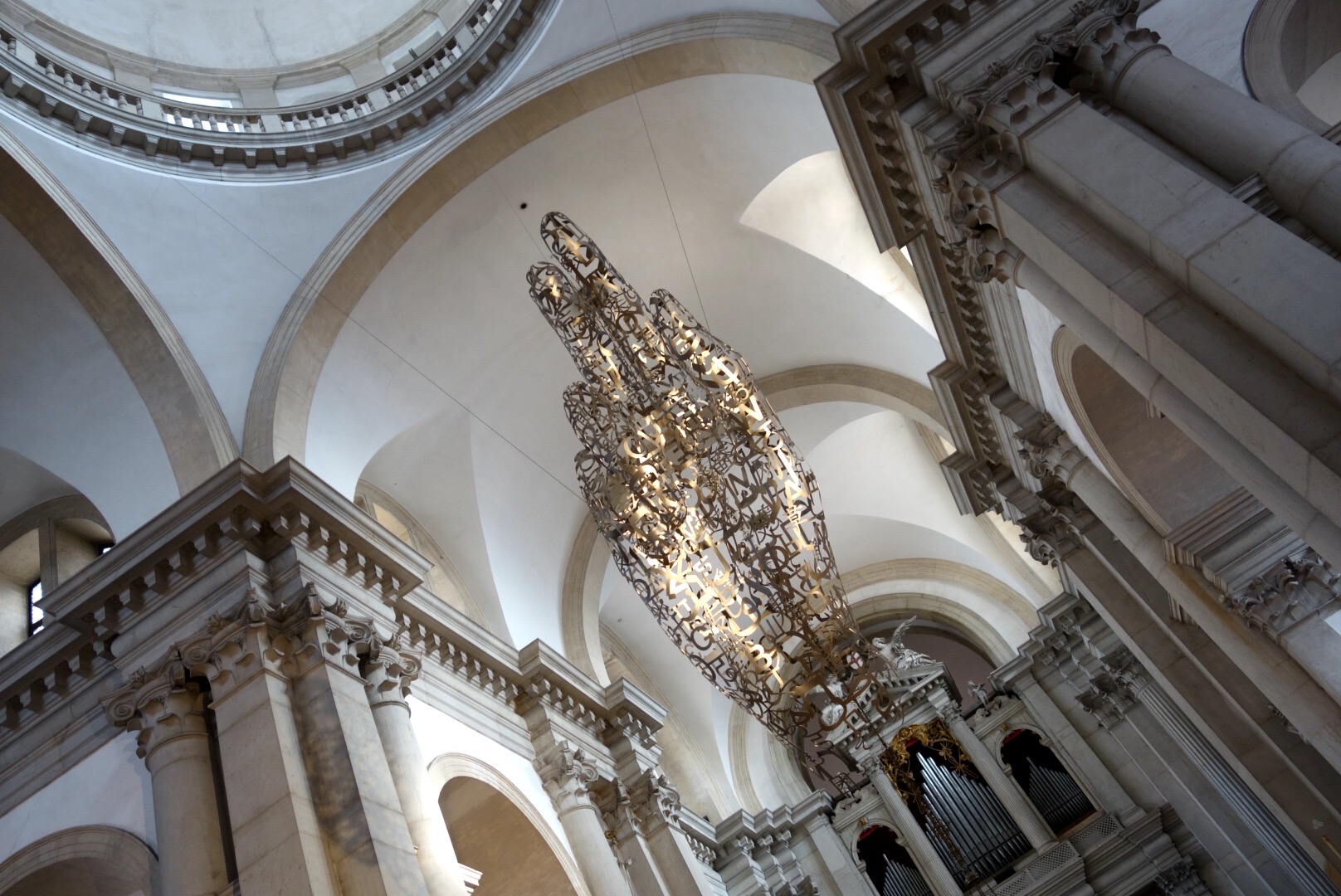
Jaume Plensa,

Jaume Plensa, “Together”

One Sunday morning I attended mass at San Giorgio Maggiore. There were less than forty people present in its vast interior. But as soon as the liturgy ended, many more people began to stream into the church. They had come not to worship, but to experience a contemporary art installation, part of the Biennale art exposition taking place throughout the city. A giant head, made of thick wire, faced the altar from the nave. Consisting of far more empty space than substance, it was a ghostly, immaterial presence, in but not of this world. A great golden hand, suspended over the crossing, bestowed upon that serene and mysterious face a perpetual blessing.

Jaume Plensa,

Jaume Plensa, “Together”

The contrast between the sparsely attended mass and the popular artwork could be interpreted as a simple duality of irreconcilable opposites: religion vs. art, old vs. new, moribund vs. vibrant, neglected vs. popular. But that would be too facile, ignoring the deep connections between the artwork and the worship space it inhabited.

It was not accidental that the head, modeled on a girl of Chinese and Spanish ancestry, faced the altar from the nave, like any common worshipper, or that the blessing hand mimicked the gesture of countless priests who had presided in that place for a thousand years. The work couldn’t be detached from Christian ritual without evacuating much of its meaning.

At the same time, there was something universal about a blessing hand and a receptive face. The extreme magnification of head and hand functioned like a cinematic close-up, focusing on the act of blessing in isolation from any specific ritual context or tradition. We didn’t see the vested body of a Catholic priest, or encounter the sociology of a local congregation. We only saw a hand that blesses and a face that receives. For me, the elemental humanity of this universal gesture reinforced rather than replaced the meaning of Christian blessing.

So instead of a rivalry between art and religion, there was a conversation, in which each informed and enriched the other. An explanatory text said that Jaume Plensa’s artwork, entitled Together, employed “a metaphorical language that will connect people of many faiths and of no faith.”

The conversation between art and religion, and among artists of many faiths and no faith, can only be tentative and experimental in an age of fragmentation and doubt. It will also be wild and unpredictable. If any of our small group came to Venice thinking we might collectively forge a vision of what the Christian artist is called to be in such a time, in such a Church, we were soon awakened from that fond dream. There will be no manifesto from the Venice Colloquium. We have returned to our homes with no answers, only more questions. And some lasting images.

Another Biennale work, Rashad Alakbarov’s The Union of Fire and Water, provided particular inspiration. As part of an installation evoking the turbulent political history of Azerbaijan, an array of swords and daggers was arranged in such a way that a message was created from their shadows: Do not fear. The instruments of violence and death had been transformed into an utterance of encouragement and hope. It was reminiscent of the Arma Christi, where the implements of Christ’s suffering become symbols of salvation.

Through the play of light and shadow, the handwriting on the wall was there for all to see. For artists out on the road of unknowing, with the voices of caution and order tugging us backward lest we lose our way, it seemed like a word from heaven. Do not fear.

Rashad Alakbarov,

Rashad Alakbarov, “The Union of Fire and Water”

[i] John Ruskin, Modern Painters III (IV: 333), abridged and edited by David Barrie (New York: Alfred A. Knopf, 1987), 404

[ii] q. in Kay Larson, Where the Heart Beats: John Cage, Zen Buddhism, and the Inner Life of Artists (New York: The Penguin Group, 2012), x

[iii] Ruskin, The Stones of Venice I, 9:17, quoted in Ruskin’s Venice: The Stones Revisited, ed. Sarah Quill (Farnham, Surrey: Lund Humphries, 2015), 41

[iv] The Stones of Venice (10:82-3), ibid., 55

[v] Psalm 139: 6-7


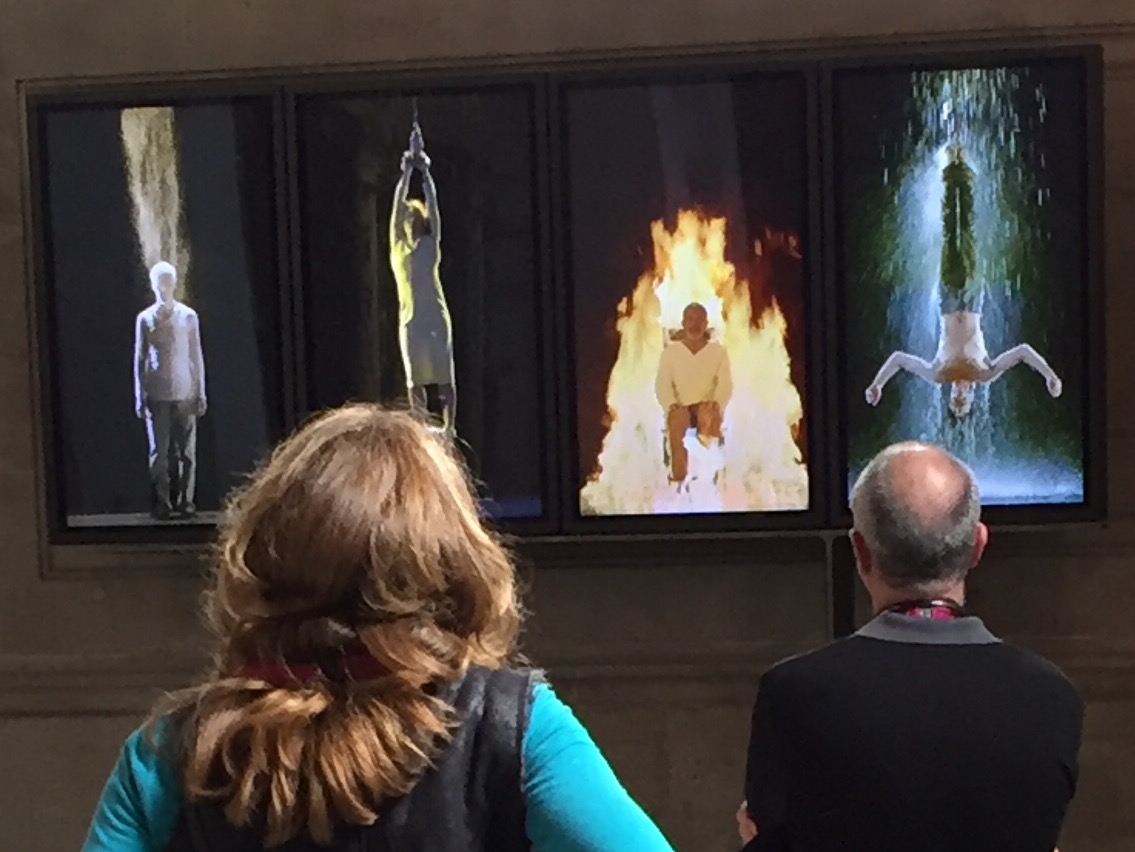
Bill Viola’s “Martyrs”

image

The souls of the righteous are in the hands of God, and no torment will ever touch them. In the eyes of the foolish they seemed to have died, and their departure was thought to be a disaster, and their going from us to be their destruction; but they are at peace.

– Wisdom of Solomon 3:1-9 (Lectionary reading for All Saints)

At the far end of the south choir aisle of St. Paul’s Cathedral in London, four “martyrs” perform a perpetual sacrifice in a slow-motion passage from suffering to glory. These martyrs are not the painted or sculptured figures of a traditional altarpiece, but two men and two women, recorded on high-definition video, and played back continuously on a polyptych of four adjacent vertical plasma panels, each 55” x 33.”

This stunning work is by Bill Viola, who has long been exploring the interplay of “technology and revelation.”[i] As David Morgan has written, “Viola’s work suggests that the human condition consists of the fact that we are embodied beings yearning, but ill-prepared, for communion with one another; that we suffer pain and loss, that we struggle to transcend our bodies and our suffering by connecting with a larger or inner aspect of reality; and that we die. Bodies, communion, suffering, transcendence, and death collectively constitute a condition, a worldview that the artist seeks to investigate in his work.”[ii]

Martyrs (Earth, Air, Fire, Water) was installed at St. Paul’s in 2014, and this week I had my first chance to see it. It is 7.5 minutes long, continuously repeated. Mesmerized and deeply moved, I watched it ten times, and each viewing provoked some new thought or feeling.

The figures begin in stasis, undergo an ordeal involving time and motion, and finally come to rest in a perfect stillness: not the anti-life of death or nonbeing, but something implicitly wondrous.

All the figures are facing in our direction. In the first panel, a kneeling man, head bowed to the floor, is almost completely buried beneath a triangular pile of dirt. We only see the top of his head, clutched by his two tense hands. The dirt begins to fly upward in a column, disappearing into whatever is above the frame. He rises to his feet, ever so slowly, as if it is a great struggle against gravity, or stasis. By the time he is upright, the last of the dirt has vanished into the “above,” and he is staring out at us impassively.

In the second panel, a woman in a white shift is suspended by a rope tied to her wrists. Her feet are anchored two feet above the ground by another rope securing her ankles. She is blown by a great wind coming from the left, buffeted back and forth within the constraint of her tethers, at the mercy of a relentless exterior force. After a while, the wind subsides, her suspended body grows still, and she gazes out with an unexpected measure of serenity.

A black man sits in a chair in the next panel, his head tilted to the side and downcast. Then bits of flame begin to drop from above, continuing to burn where they land. More and more flames fall, some leaving trails like shooting stars, until the whole floor, and the chair, are on fire. By this time the man has raised his head to look out at us, but he appears calm and still even as the flames envelop him. He remains in that position as the flames finally relent and die out.

In the last panel, a man is curled up in a fetal position with eyes closed. A rope tied to his angles is suspended from somewhere above the frame. The slack starts to be taken up, pulling his legs upward, and then his entire body, until he is completely upside down like the Hanged Man in the Tarot, or one of those skinned animals dangling in a Dutch genre painting as a secularized image of Christ’s Passion. When a stream of water begins to fall from above, his arms slowly stir, moving into a prayer position, bent 90 degrees at the elbow, then gradually sweeping backward, like a swimmer’s breaststroke, until they are near his side. Meanwhile, his inverted body begins to be pulled upward by the rope, toward the source of the falling water.

All of the figures have been handed over to forces or situations beyond their control. One buried, one bound and buffeted, one burned, and one left for dead. Yet none of them rages or resists. They accept their condition with a calm grounded in something greater than their own survival.

Each of the first three, after gazing out at us for a time, gradually shift their attention to whatever is above them, out of our sight, until their upturned faces glow with the light of eschatalogical radiance. Their faces never become expressive, or call attention to their own personalities; they remain still and quiet, in a condition of “absolute unmixed attention.”[iii]

The fourth figure, the “Hanged Man,” provides the dissonant harmony within this suite of images. He is the one who appeared already dead, his suffering behind him. His eyes, either closed or obscured by the water streaming down his face, are never quite visible. Although his arms eventually make hopeful gestures of prayer or embrace, the rest of his body stays limp, totally given over to the power at the other end of the rope, which pulls him up and out of the frame. The water continues to fall when he is gone.

Unlike the prayerful final images of the other panels, the fourth is fraught with absence. The other martyrs only gaze at the transcendent. The fourth has already ascended there, and we are left with only the water as a reminder of the one we can no longer see.

Noting that martyr means “witness,” an accompanying statement by Viola and his producer Kira Perov compares the active witness of martyrs to the passive witness of those who merely consume images of suffering through mass media, adding that these four figures “exemplify the human capacity to bear pain, hardship, and even death in order to remain faithful to their values, beliefs, and principles. This piece represents ideas of action, fortitude, perseverance, endurance, and sacrifice.”[iv]

But these evocative images can’t be reduced to a single meaning. The more I watched, the more meanings and associations were generated. The first figure suggested Adam formed from the mud, or Christ rising from his grave, shedding mortality clump by clump. It also seemed a kind of birth.

The strongly sidelit second figure, whose white shift and platinum hair glowed against the black background like a Zurburan crucifixion, mirrored both Jesus and Joan of Arc.

Like gold in the furnace God tried them, and like a sacrificial burnt offering God accepted them.[v] The fire in the third panel not only recalled the light of burning martyrs, but the positive biblical tropes of the refiner’s fire and tongues of flame.

The fetal position of the fourth martyr evoked both the womb and the grave. The falling water made me think of both baptism and waterboarding. Once he was gone, however, it spoke to me of both memory and promise: what had happened to him, and what might happen to us.

Just what – or who – is at the other end of that rope anyway?

[i] “Technology and Revelation” is the title of a lecture I heard Viola give at the University of California at Berkeley, September 28, 2009.

[ii] David Morgan, “Spirit and Medium: The Video Art of Bill Viola,” Image, No. 26 ((Spring 2000), 32

[iii] This was Simone Weil’s definition of prayer.

[iv] From the installation’s explanatory text.

[v] Wisdom of Solomon 3:6

Sweet miracle of our empty hands

Young priest in the Chapel of the Transfiguration, Grand Tetons National Park (1976)

Young priest in the Chapel of the Transfiguration, Grand Tetons National Park (1976)

When I preached at my wife Karen’s ordination on All Souls Day, 2010, I reflected on the peculiar vocation of priesthood. Since today, the Feast of Hildegard of Bingen, is the 45th anniversary of my own ordination, it seems fitting to publish it here.

In nineteenth-century Paris, there was a certain priest who was not quite right in the head, and one day he walked into a bakery, made the sign of the cross over the assorted breads, and said Hoc est corpus meum (This is my body) – the Words of Institution from the eucharistic prayer. When the Archbishop of Paris heard what had happened, he bought up every baguette and croissant in the shop, and reverently consumed them.

This story reflects an understanding of priesthood and sacrament which we do not share, but it does raise questions about the power that is conferred in ordination. What will happen to Karen tonight when the Holy Spirit is called down, and the hands of bishop and priests are laid on her head? How will she be different? What is the nature of the gift she will receive?

Priesthood has a certain aura. You wear special vestments, preside over worship in the name of the whole assembly, and stand at altar and pulpit to speak for God and Christ as though you were heaven’s ambassador. You are called and set apart by God and the Church to do holy things.

Eventually, the doers of holy things are sometimes regarded as possessors of an occupational holiness. The distinctiveness of what priests do becomes a distinctiveness in who priests are. The parson is seen as a kind of model person.

At its best, this understanding of a priest as a walking icon of the Christian life has produced some remarkable saints, clergy who have indeed exemplified a godly life, clergy whose words, actions, and faithfulness manage to bring God a little closer. At its worst, this attribution of holiness to the priest has let everyone else off the hook. We don’t have to be faithful or devout. The priest does that for us.

But in our own day, we have been rediscovering, to our joy, the ministry of all the baptized. All of us, clergy and laity, are empowered and called to be ministers of the gospel, to be doers of the Word in all the times and places of our lives.

Whatever is true, whatever is honorable, whatever is just, whatever is pure, whatever is pleasing, whatever is commendable [i] – that’s on every Christian’s agenda. When the saints go marching in, we are all “in that number.”

Our common vocation as ministers was beautifully summarized by Paul Moore, the late bishop of New York. When he retired, his last words to his people were these: “You are messengers clothed in the beauty of God. Take hope, be strong, be brave, be free, be open, be loving, and hold up the vision of the Heavenly City.”

You are all messengers clothed in the beauty of God, and you will be reminded of that again tonight, when you renew your baptismal vows and are sprinkled with water from the baptismal font, in the hope that Isaiah’s cry may ever be on your own lips: Here am I; send me.

But if we are all ministers, then what is so distinctive about the role of priest? If your understanding of priesthood is purely functional, based on what a priest does, the ministry of the baptized creates a crisis of definition as more and more of the priest’s jobs are outsourced to the laity.

Parish administration, pastoral counseling, preaching, teaching, evangelism, social witness and outreach, worship planning and a great deal of worship leading can all be done by laypeople. There are really only three things that a priest can do that a layperson cannot: preside at the eucharist, pronounce God’s forgiveness after confession, and give God’s blessing.

Just these three things. But perhaps they are not such little things.
Bread, forgiveness, blessing.
The things that priests give, in the name of God, in the name of Christ.
Bread, forgiveness, blessing.

It’s actually quite a lot, really, requiring no less than everything – and a lifetime of preparation. Why a lifetime of preparation? Can’t anyone do these things? Speak some words, perform a few actions? Simple, yes. Easy, not so much.

Ritual is like art, requiring natural gifts, extensive training, and a deep grasp of the cluster of conditions that constitute ritual practice: theology, history, the meaning of sign and symbol, the nuances of body language, gesture and gaze, and so forth.

Karen comes to this calling with her own particular identity, her own unique blend of gifts and qualities. Priesthood is always an embodied phenomenon, something only realized in the form of particular persons. In that respect, each priest is different.

But when the Church sets a person apart in ordination, she becomes more than her individual self. Whenever Karen puts on her priestly stole, she will become 2000 years old, a public representative of the cumulative tradition and collective wisdom of the Church.

As priest, she will be a keeper and guardian of our sacred stories, whose task it is to tend the flame of their saving grace. At the same time, she is given the privilege of being entrusted with the stories of her people, helping them to understand that their own lives are also sacred stories.

The priestly role is not for everyone. It requires a delicate balance between self-awareness and transparency to Spirit, the sensitivity to be attuned not only to one’s own self but also to all the other selves in the room, and to the Holy One in whose presence we gather.

At the eucharist, who the presider is, and how the presider is, both have an effect on the assembly’s understanding of what is really going on when we gather to worship.

The performance of ritual doesn’t happen by accident. It is the product of charism, call and holiness of life. It is a full-time, serious business, as Richard Baxter insisted in the seventeenth century when he said to worship leaders:

[A]bove all be much in secret prayer and meditation. There you must fetch the heavenly fire that must kindle your sacrifices. Remember that you cannot decline and neglect your duty to your own hurt alone; many will be losers by it as well as you. For your people’s sake, therefore, look to your hearts… If [your hearts] be then cold, how [are they] likely to warm the hearts of [your] hearers?[ii]

In its essence, priesthood is a concrete and visible expression of belief: belief in the presence of God, and belief in the meaning and destiny of the eucharistic assembly as the body of Christ.

Every time the priest stands at the altar and says the holy words, the whole assembly is alerted to the fact that we all stand on the border between earth and heaven, the visible and the invisible. The border is where worship is conducted: it is where God gives us the bread of life and we offer in return “our selves, our souls and bodies, to be a reasonable, holy and living sacrifice”[iii] unto God.

The priest’s ritual words and actions make clear to the assembly what is going on at the border. It’s not a place where we escape the world; it’s where we discover just how sacred the world is. Ordinary bread and wine become the food of heaven and the cup of salvation.

As Gordon Lathrop puts it, the eucharistic assembly is “a hole in the fabric of things, through which life-giving power flows into the world.”[iv]

But the priestly work of bread, forgiveness and blessing is something that belongs to the entire body of Christ – not just the priest, not just this particular assembly, but the whole Church of God’s people throughout the world and throughout all time.

You and I are all priests in a cosmic sacrament, standing in the place of Christ, seeing with the eyes of Christ, in order to make visible and tangible the eucharistic nature of all things. As priests, we look at our neighbor with the most sacred attention – and intention – and say, This is my body, that is to say, Christ’s body.

We look at the stranger and say, This is my body.
We look at our enemy and say, This is my body.
We even look at bread and wine,
ordinary matter, the stuff of the universe,
and say, This is my body.

And so, to return to that bakery in Paris, we may assume that the bread was already sacred before the priest ever got there, and that every crumb was already worthy of reverent consumption. But we would never know these things had not Jesus, and every priest since, taken bread, said the blessing, broken it, and passed it around.

When I was preparing to preach this sermon, I emailed some of my ordained friends around the country, asking if they had any words of counsel or encouragement for a priest at the beginning of her journey.

One priest repeated what a Methodist minister told him at his own ordination 30 years ago: “You can’t help anybody in their relationship with God unless you are completely human.”

Another said that “who you are is infinitely more important to God and the world than the words you speak, the lists you complete or the sermons you write.”

A priest ordained for 46 years offered this advice: “Try to see [God’s people] the way God sees them.”

A seminary classmate who went on to become parish priest, cathedral dean, and diocesan bishop said, “Never leave or forget your diaconal calling. Jesus came as one who serves. As a priest, you must first of all be a servant.”

And a priest I’ve known since elementary school simply said, “Give all to God.”

I also asked my friends if they could provide a few words that distilled for them the essence of priesthood. One of the best teachers I’ve ever had – an Old Testament professor, seminary dean, parish rector, and priest for 63 years – described it this way:

living with and for sisters and brothers
being the body of christ
celebrating with brothers and sisters
word and sacrament and pastoral act
christ recalling us reshaping us refreshing us
being christ’s body for the world

A priest and poet who has worked since the 1960’s in parishes, campus ministry, foreign missions, and the national church office, offered this succinct couplet:

Everything we share is broken;
and yet we remember the whole and make it present.

Another longtime priest wrote: “Yours is to walk with people to the Mystery and back.”

 And finally, the canon to the ordinary in a Midwest diocese, a woman ordained five years ago, quoted a 16th century Sufi mystic:

Go where you are sent
Wait until you are shown what to do
Do it with your whole self
Remain until you have done what you were sent to do
Walk away with empty hands

Empty hands. I have loved this image ever since I first encountered it, just before my own ordination, in Robert Bresson’s film of the Georges Bernanos novel, Diary of a Country Priest.

The story, a retrospective account narrated with passages from a young priest’s journal, turns on a dramatic and transformative pastoral encounter with a parishioner. In one of the great scenes of cinema, fraught with a severe and holy beauty, we witness “a supernatural storm.”[v] And somehow, by what the young and inexperienced priest says to this woman, but even more by who he is, the woman’s hardened heart is broken open, and she is filled with grace and peace.

That night, the priest learns the woman has suddenly died. He hurries to the vigil where her body lies. We see him kneel by her bed to make the sign of the cross over her. At the same time, we hear his voice describe the moment as he would later record it in his journal:

“Be at peace,” I told her.
And she had knelt to
receive this peace.
May she keep it forever.
It will be I that gave it to her.
Oh miracle –
thus to be able to give
what we ourselves do not possess,
sweet miracle of our empty hands.

Sweet miracle of our empty hands. Let us pray that Karen, like every priest before her, may go to the altar of God, the God of her joy, with empty hands:

Hands that offer, and hands that receive,
hands that feed, and hands that heal,
hands that welcome, and hands that bless.

[i] Philippians 4:8

[ii] Christopher Cocksworth and Rosalind Brown, Being a Priest Today: Exploring Priestly Identity (Norwich: Canterbury Press, 2006), 150

[iii] From Thomas Cranmer’s 16th century eucharistic prayer, retained in Rite I of The Book of Common Prayer (1979), 336

[iv] Gordon Lathrop, q. in Graham Hughes, Worship as Meaning: A Liturgical Theology for Late Modernity (Cambridge: Cambridge University Press, 2003), 150

[v] André Bazin, trans. Hugh Gray, What is Cinema? (Berkeley: University of California Press, 1967), 137
“Show me a coin” – A stewardship reflection

Roman coin with the head of the emperor Tiberius. The inscription may contain a claim of divinity.

Roman coin with the head of the emperor Tiberius. The inscription may contain a claim of divinity.

When the temple clergy in Jerusalem sent their stooges to ask Jesus a loaded question, they thought they had him cornered: Should we pay taxes to Caesar or not? If Jesus endorsed the Roman tax, he’d lose the crowd. If he encouraged nonpayment, he’d lose his freedom. His famous answer, of course, outsmarted his opponents and postponed his arrest for a few precious days.

“Show me a coin,” he said. One of them dug into his pockets and pulled out a coin, stamped with the image of the Roman emperor. “Whose picture is on it?” They all looked at the coin, straight men headed for a fall. “Caesar,” they said. Duh! “Well then,” Jesus said. “Give to Caesar the things that are Caesar’s, and to God the things that are God’s.”

We always smile at the Teacher’s wit. I like to think that Jesus pocketed the coin with a wink before walking away. But when the amusement fades, we are left with a puzzle. What does this saying mean for us? Is it a teaching, or even a commandment? What are we being asked to do with the money in our own pockets? The colorful Southern theologian Will Campbell, himself a country preacher, once said to me that if we give to God what belongs to God, there won’t be anything left for Caesar!

I loved what Will said – it had his characteristic prophetic edge – but it didn’t really solve the practicalities of being faithful to God while sharing in the costs and benefits of a complex economy. Most of us are not among the brave few who refuse participation by taxation in the military-industrial complex. We send in our check and accept our complicity in the mixed blessings of the system, which does provide for much common good along with its regrettably baneful effects (drones, for instance).

It’s like Monty Python’s Life of Brian, where a dissident complains, “The Romans took everything from us, and what have they ever given us in return?” His followers, to his chagrin, come up with a long list of benefits, including the aqueducts, sanitation, roads, irrigation, education, public baths, and even the absence of war in the Pax Romana.

While we live in this world, Jesus’ aphorism on taxes will never be an “answer” in the sense of an unambiguous guide for specific action. Instead, it persists as a question that interrogates every individual as well as every system. What does belong to God, exactly? And how then do we return to God what is God’s own?

Pooling our resources through taxation in order to educate our children, feed the hungry, protect the environment, provide universal health care and so on, might be regarded as one form of return, to which we subscribe as citizens with varying degrees of enthusiasm. Common good requires common action. Pooling our resources through church pledging to sustain a community of faith and grow God’s mission to the world is a less messy and more direct form of “giving to God what belongs to God.” Charitable giving is yet another kind of return.

This is how we live as citizens of heaven: we keep the gifts moving – in circulation – rather than hoard them for ourselves.

And did you notice that in this gospel story of the coin the notion of “belonging to” refers only to God or Caesar? We ourselves own nothing. We are but recipients and stewards. The only thing that really belongs to us, Jesus says, is the giving.

“Delightful! Wonderful! Incomparable!” – Thoughts about holy spaces

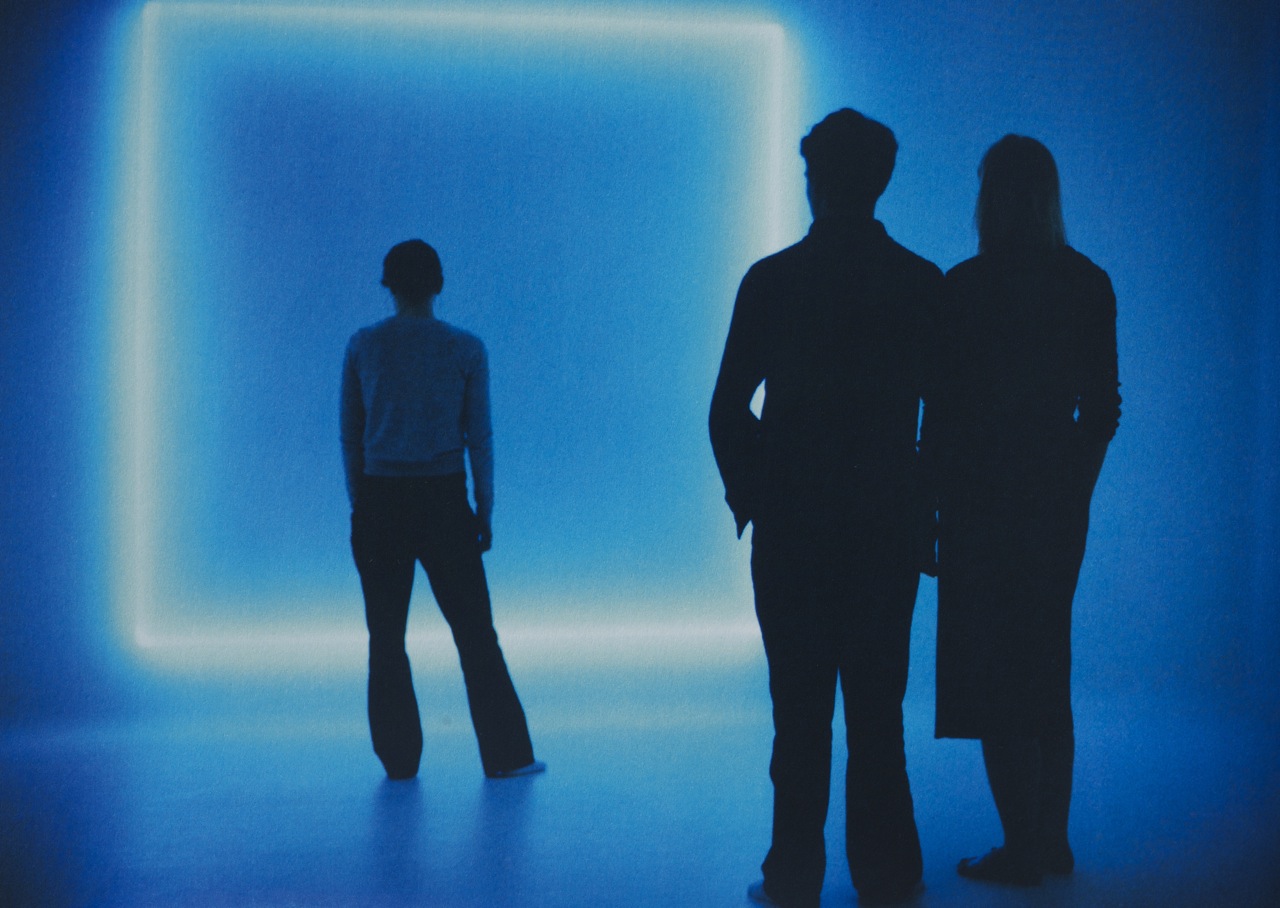
Doug Wheeler, RM 669 (1969)

Doug Wheeler, RM 669 (1969)

For the viewer/participant of Light and Space art, a significant outcome of this experimentation is that the works of art perceptually condition us, whether we are aware of it or not.[i]

– Dawna Schuld

In 1914 the German writer Paul Scheerbart published The Gray Cloth and the Ten Per Cent White, a novel about an architect who constructed buildings made of colored glass. For the opening of each new building, his wife always wore gray clothing containing 10 per cent white, in order to intensify by contrast the effect of all the colors. Anyone who entered these luminous environments felt enveloped by the sublime. “The splendor of the colored glass ornament was so enhanced by the sun that one was at a loss for words to praise this wonder of color. Many visitors shouted repeatedly, ‘Delightful! Wonderful! Incomparable!’”[ii]

As the architect’s fame grew, he became fond of tossing out pithy aphorisms: “Glass brings a new era.” … “Building in brick only does us harm.” … “Colored glass destroys hatred.” He would have loved Twitter. Scheerbart’s utopian dream of transforming human nature through salubrious environments would soon fade in the disillusioning violence of the Great War, but it would surface again in the idealism of Modernist architecture: Design can change the world. Better buildings will make better people.

Architectural idealism has a long history. Plato thought that measure, form and order in the built environment had significant shaping power for both the soul and the community. Eighteenth-century Anglicans applied an exacting symmetry to church buildings in the hope that regularity and order in places of worship would, over time, help produce constancy and balance in believers. Order and form would tame unruly passions.

Such ambitions are easily mocked. In his brilliant and entertaining documentary, Los Angeles Plays Itself, Thom Andersen observes that well-designed environments have become for the movies the equivalent of the bad guy’s black hat. “One of the glories of Los Angeles is its Modernist residential architecture, but Hollywood movies have almost systematically denigrated this heritage by casting many of these houses as the residences of movie villains.”

When L.A. Confidential (1997) placed the sleazy criminal Pierce Patchett in the Lovell House, Richard Neutra’s definitive manifesto for better living, the architecture critic for the Los Angeles Times wrote that the “house’s slick, meticulous form seemed the perfect frame for that kind of power. Neutra’s glass walls open up to expose the dark side of our lives. They suggest the erotic, the broken, the psychologically impure.”[iii] In fact, Andersen points out, the film’s director was a great admirer of Lovell House, whose actual history closely reflected its architect’s ideals. It produced no villains.

Of course there is no simple correlation between environment and ethics or spirituality. A beautiful space does not automatically produce beautiful people. But can more modest claims be made for the influential nature of designed environments?

In the mid-1960s, the Light and Space artists of southern California began to create works that were not objects to look at but environments to experience. “I’ve always been interested in how much I can take away,”[iv] said Bruce Nauman, who stripped a space of light and feeling to create Room with My Soul Left Out, Room That Does Not Care (1984). Its chilling title might be applied to many contemporary enclosures, from the black holes of prisons to many of the places where we shop and work. But most of the Light and Space artists, while also stripping away much of what the public expects from an artwork, preferred to create rooms that do care.

At New York’s Museum of Modern Art in 1970, Robert Irwin was offered a dingy room for whatever installation he wanted to use it for. “The room really was an unhappy space,” Irwin noted.[v] So he cleaned the skylight and installed on the ceiling alternating cool and warm fluorescents, veiled by a translucent scrim. There was nothing “in” the room except for what Irwin called a “subliminal rainbow” effect of the light. People would wander through, see nothing there, and continue on to the next room, full of Brancusi sculptures – something they actually could look at. While they didn’t notice anything in Irwin’s room and thought it empty or unfinished, they did tend to remark on how bad the lighting seemed in the Brancusi room. The pleasant glow of the first space made them critical of the less luminous space that followed. An intentional environment had changed the way they saw the world outside it. Such work has been called “an art of incremental resistances that seeks not to change the world but to sharpen our perception of it.”[vi] 21

Both art and religion – sometimes in collaboration, sometimes independently – have created physical environments designed not only to provide a refuge from the prevailing fixtures and forces of the culture, but to generate resistance to those forces by providing, through a sense of otherworldliness or unnameable presence, a critique of culture’s totalizing claim to be all there is. Such spaces pose questions about what we have settled for as reality, and about what else might lie beyond our cultural constructions.

Critic/historian/collector Melinda Wortz called the Light and Space artists “architects of nothingness,” seeing their work as transcending the purely material level. “By reducing the physical and visual incident in their art to almost nothing, or at least creating the illusion of nothingness, they challenge us to share in these perceptions. And they are important perceptions, which go beyond common sense experience of ineffable states of consciousness, giving us access to the unfamiliar, the unknown, or those levels of knowing that cannot be translated into words. These are precisely the states of being least addressed by our culture at large.”[vii]

A Zen garden has been described as a “locus of stillness, purity, and silence in the midst of ephemerality and sensation, a refuge that intentionally avoids (in the short run) any reference to the outside world.”[viii] Many of us have found such “holy” spaces not only in religious constructions, but in art and nature as well. And whether for refreshment, renewal, or revelation, we are drawn to visit them, to dwell for a time in their aura and remember what the culture has forgotten.

Orthodox icons have long striven to provide a window into a transcendent world. The Light and Space artists, while shunning any theological presumptions for their “disorienting metaphysical enigmas and wordlessly ecstatic experiences,”[ix] seem to take us right through that window to put us inside. As Eric Orr said of his Zero Mass (1972-3), “an uncanny feeling of merging with the space may occur when the viewer loses an absolute sense of the boundaries of the room and perhaps of their body.”[x] Using faint ambient light and coved corners to inhibit visual perception of edges or walls, he dematerialized the space, making it an apparently boundless void where “our selves are tenuously held together in some sort of rapprochement with the surrounding emptiness. If at first it appears that we are surrounded by nothing, to what are we responding and why?”[xi]

These artists all stress the materiality of their work. Their environments are not just metaphors for something else. They are actual physical events, even if not as solid and tangible as traditional art. Doug Wheeler, describing one work, said it “was a real space – not illusory – it was a cloud of light in constant flux. That molecular mist is the most important thing I do. It comes out of my way of seeing from living in Arizona – and the constant awareness of the landscape and the clouds.”[xii]

So is anything being intimated or shown besides the specific phenomena of these environments? Does a hidden reality or transcendent dimension lie behind the physical experience? Where does experience meet faith? And how important is it to put language to the experience? Does conscious reflection about such experience diminish or deepen its effect on us?

Whatever these artists believe, think or intend with their work, those of us who think theologically can’t help but find them revelatory, pointing beyond themselves. A sacramental view of things regards matter as the essential means of encountering Spirit. The givenness of the material world – light and water, bread and wine, flesh and blood – is how we begin to know anything, including the divine.

James Turrell, one of the best known of the Light and Space artists, has spoken of “the need and thought of spiritual sensibilities or dimensions beyond us,” though he avoids the “vocabulary of religion.”[xiii] His Quaker sensibilities prefer direct, unmediated experience. But when he speaks of the “thing-ness” of light which “becomes the revelation,” he blurs the opposition between material and spiritual, leaping across the either-or dualities as adeptly as the mystics.[xiv]

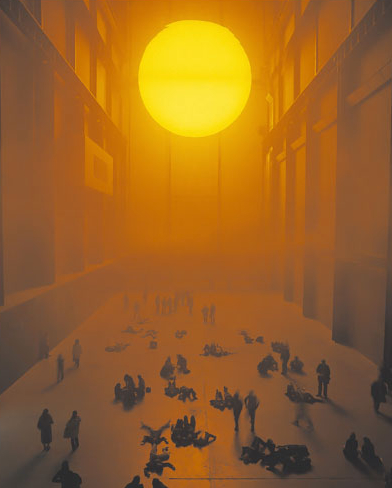
But whatever happens, whatever is encountered in these works, is it merely private experience, a matter solely of personal perception? Olafur Eliasson, an Icelandic artist, is insistent about the social dimension of his work, which is designed not only to produce wonder but also a collective “co-presence” in the sharing of the experiential space.

Olafur Eliason, The weather project (2003) at Tate Modern, London

Olafur Eliason, The weather project (2003) at Tate Modern, London

In The weather project (2003), he installed “a giant yellow orb like a dark winter sun” in the 500-foot long Turbine Hall at London’s Tate Modern. Sixteen nozzles sprayed mist into the atmosphere, filling the space with a light fog. Three hundred mirrored panels on the ceiling reflected the people below who glowed in the brownish-yellow haze of the sun’s two hundred sodium lamps.

During that winter season, two million people visited the museum to stand, sit or lie beneath the sun. It had the effect of Scheerbart’s fictional glass buildings: Delightful! Wonderful! Incomparable! Even if they arrived by themselves, people were immersed in provisional community. Sometimes they spontaneously arranged themselves into geometric patterns, symbols or even words. As Madeleine Grynsztejn observed, “This kind of participation calls us out of and beyond ourselves, an effect reinforced when witnessed and shared by others.”[xv]

The weather project, like many of the Light and Space artists’ “experiential processes,” bears resemblance to my ideal of church: a “holy” space, differentiated from the “ordinary” world, dedicated to the participatory experience of being called out of ourselves into an experience of wonder and praise. Not everyone shares this conception of Christian worship spaces. The stricter liturgical theologians argue that God is only present in the assembly and its liturgical actions, not in the physical space itself. Early Calvinists used to lock their churches during the week to discourage the idea that a space without a congregation at prayer retained any residue of holiness.

Peter Hammond, in his influential book, Liturgy and Architecture, argues that a church is not a place for a casual visitor to have a worship experience. It is not a shelter for an altar but for an assembly, and it has no meaning or symbolic power apart from its liturgical function. While I would agree that the primary function of a church is to shelter and enable the communal liturgy, I am sympathetic to Joseph Campbell’s view that one can be “reborn spiritually by entering and leaving a church.”[xvi]

The Light and Space artists would not make such large claims. But something unique and even significant can happen in their alternative spaces. Maybe colored glass can’t destroy hatred, but can certain kinds of experiences in certain kinds of places work on individuals and communities over time in positive, formative ways? In Dawna Schuld’s view, “we take the work with us: our heightened senses, now attuned to the subtleties of the conscious fringe, encounter a more vivid world than the one we left behind.”[xvii]

Eric Orr’s Sunrise (1976) was a nine by twelve foot room sheathed in lead, cutting off all sounds from the outer world. The space was quite dark. “I am engaged in using silence as a color,” Orr explained.[xviii] But the darkness was not total. A single bar of sunlight, guided into the space by a series of mirrors, moved slowly up the wall as time passed.

It reminded art critic Thomas McEvilley of the secret inner chamber of an Egyptian temple, and he reflected on the effect of being there: “Orr’s goal of producing spaces that will transform everyday experiences was mildly fulfilled here. Yet no one flew out the door like a bird. Rather, one walked out as one went in, but with a certain mental aura, as of secret ambiences and veiled promises of transcendence.”[xix]

Related posts

The Woven Light: Reflections on the Transfiguration

“Owl among the ruins” – What shall we do with empty churches?

[i] Dawna Schuld, “Practically Nothing: Light, Space, and the Pragmatics of Phenomenology,” in Robin Clark, ed., Phenomenal: California Light, Space, Surface (Berkeley: University of California Press, 2011), 111

[ii] Paul Scheerbart , The Gray Cloth, tr. John A. Stuart (Cambridge, MA: MIT Press), 3

[iii] Los Angeles Plays Itself (2003/2013), written and directed by Thom Andersen, Part 1, chapter 12: Modern Architecture

[iv] quoted in Michael Auping, “Stealth Architecture: The Rooms of Light and Space,” in Clark, p. 103

[v] Jan Butterfield, The Art of Light and Space (New York: Abbeville 1993), 24

[vi] Take Your Time: Olafur Eliasson, ed. Madeleine Grynsztejn (NY: Thames & Hudson, 2003), 22

[vii] Butterfield, 16

[viii] Lindsay Jones, The Hermeneutics of Sacred Architecture: Experience, Integration, Comparison, Vol. Two: Hermeneutical Calisthentics: A Morphology of Ritual-Architectural Priorities (Cambridge, MA: Harvard University Press, 2000), 280

[ix] Ross Weszsteon, referring to James Turrell, q. in Butterfield, 78

[x] Clark, 45

[xi] Schuld, 120

[xii] Butterfield, 121

[xiii] ibid., 82

[xiv] Michael Govan, “Inner Light: The Radical Reality of James Turrell,” in James Turrell: A Retrospective (Michael Govan & Christine Y. Kim, New York: DelMonico Books, 2014), 49

[xv] Take Your Time: Olafur Eliasson, ed. Madeleine Grynsztejn (NY: Thames & Hudson, 2003), 19

[xvi] I can’t find this citation, which has been in my church architecture notes for years, but it does sound like authentic Campbell!

[xvii] Schuld, 121

[xviii] Butterfield, 159

[xix] ibid., 160